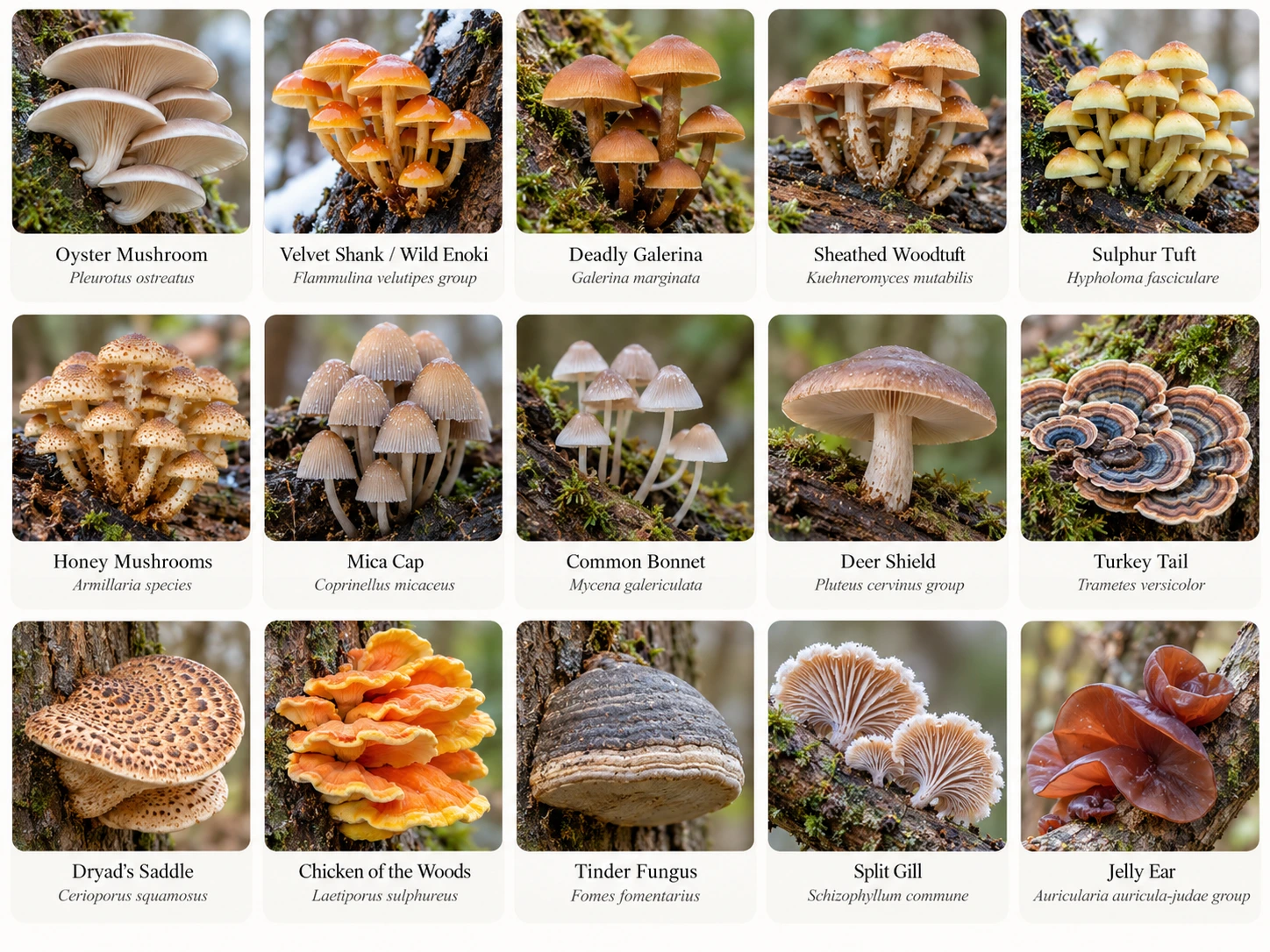
Dead wood is one of the richest mushroom habitats in forests. Fallen trunks, old stumps, buried roots, dead branches, and decaying logs support a huge range of fungi, from soft edible mushrooms to leathery brackets and deadly look-alikes.
A mushroom growing on dead wood is not automatically a wood-decay species, however. Some fungi fruit directly from visible timber, while others emerge from buried roots or wood hidden under soil and leaf litter. Identification should therefore combine substrate with gills, pores, teeth, stem structure, spore color, cap texture, and growth pattern.
⚠️ Important: This guide is for identification and education only. Never eat a wild mushroom based solely on where it grows, photographs, AI identification, or an online comparison.
Quick Guide to 15 Mushrooms Found on Dead Wood
| Species | Common name | Main clue | Safety |
|---|---|---|---|
| Pleurotus ostreatus | Oyster Mushroom | Pale fan-shaped caps, decurrent gills | Edible when correctly identified |
| Flammulina velutipes group | Velvet Shank / Wild Enoki | Honey cap, dark velvety stem base | Edible when correctly identified |
| Galerina marginata | Deadly Galerina | Brown cap, rusty spores, ring zone | Deadly poisonous |
| Kuehneromyces mutabilis | Sheathed Woodtuft | Two-toned hygrophanous cap, clustered growth | Edible only with expert ID |
| Hypholoma fasciculare | Sulphur Tuft | Yellow clusters, greenish-yellow gills | Poisonous |
| Armillaria species | Honey Mushrooms | Dense clusters, white spores, often ringed | Edibility varies |
| Coprinellus micaceus | Mica Cap | Honey-brown clustered caps with mica-like granules | Edible when young and correctly identified |
| Mycena galericulata | Common Bonnet | Gray-brown bonnet caps on logs | Inedible |
| Pluteus cervinus group | Deer Shield | Free pinking gills, no ring | Edibility varies |
| Trametes versicolor | Turkey Tail | Thin multicolored brackets, tiny pores | Inedible as food |
| Cerioporus squamosus | Dryad’s Saddle | Large scaly fan, coarse pores | Young specimens edible when correctly identified |
| Laetiporus sulphureus | Chicken of the Woods | Bright orange-yellow shelves | Edible when correctly identified |
| Fomes fomentarius | Tinder Fungus | Hard gray hoof-shaped conk | Inedible |
| Schizophyllum commune | Split Gill | Small fan-shaped caps with split gills | Not recommended as food |
| Auricularia auricula-judae group | Jelly Ear | Brown gelatinous ear-shaped fruit bodies | Edible when correctly identified |
Why Dead Wood Supports So Many Mushrooms
Dead wood is packed with cellulose, hemicellulose, and lignin. Fungi are among the few organisms capable of breaking these compounds down efficiently, making them essential decomposers in forests. Different species specialize in different stages of decay. Some colonize fresh dead branches, while others prefer old soft logs that have already been partly decomposed by earlier fungi.
White Rot and Brown Rot
Some fungi cause white rot by breaking down lignin and leaving the wood pale and fibrous. Others cause brown rot, removing cellulose and leaving darker, crumbly wood behind. This distinction is ecologically important, but it is rarely enough for field identification by itself. Growth form and underside structure are usually more practical.
1. Pleurotus ostreatus — Oyster Mushroom
Identification
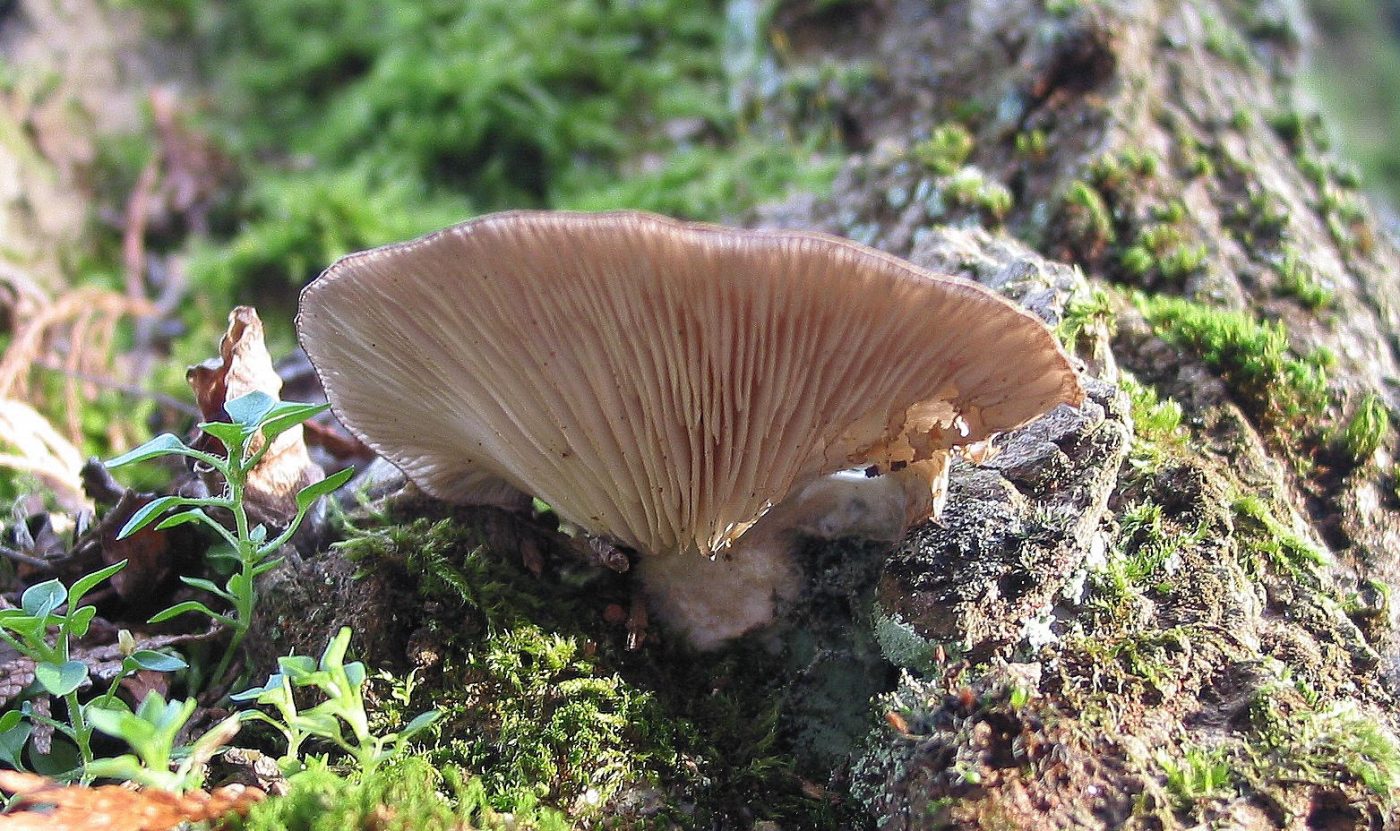
Oyster Mushroom forms overlapping fan-shaped or shell-like caps that are gray, beige, brownish, or nearly white. The gills run clearly down the short lateral stem.
Fruit bodies usually grow in dense shelves from dead hardwood. The flesh is white, soft when young, and relatively thick.
Habitat
Dead trunks, logs, and large branches of broadleaf trees are classic substrates. Beech, poplar, willow, and other hardwoods can all support it.
The mushroom can also fruit from weakened living trees. Cool weather often produces especially good flushes.
Safety
It is considered edible when correctly identified and properly cooked. The decurrent gills and clustered fan-shaped growth are key features.
2. Flammulina velutipes Group — Velvet Shank
Identification
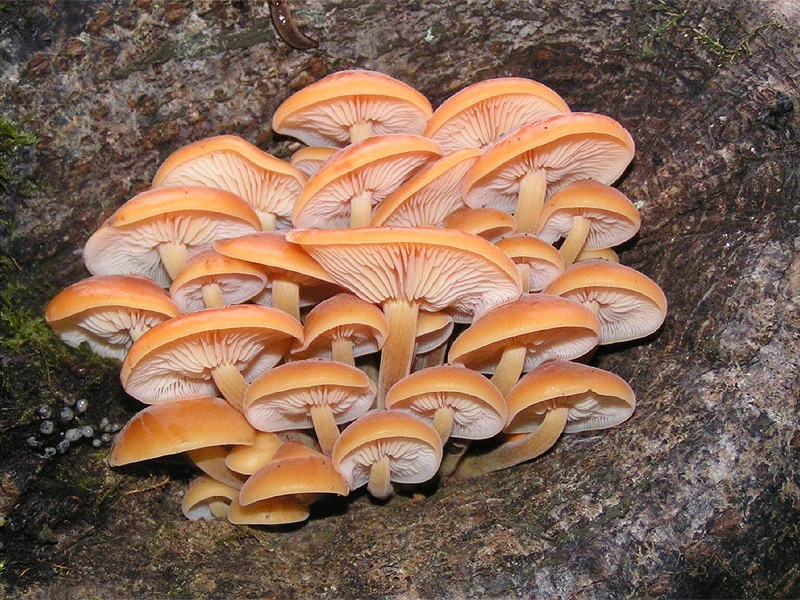
Wild Enoki has smooth yellow, honey-orange, or orange-brown caps and pale gills. The lower stem becomes dark brown to almost black and has a distinctive velvety surface.
It grows in clusters from hardwood. The spore print is white, and there is no persistent ring.
Habitat
Stumps, fallen trunks, and dead hardwood are common substrates. It is especially notable for fruiting in late autumn and winter.
Cold weather does not necessarily stop it. Mild winter periods can produce large fresh clusters.
Safety
It is edible when correctly identified and cooked, but confusion with Deadly Galerina is a serious risk. Spore color, ring structure, and lower stem texture are critical.
3. Galerina marginata — Deadly Galerina
Identification
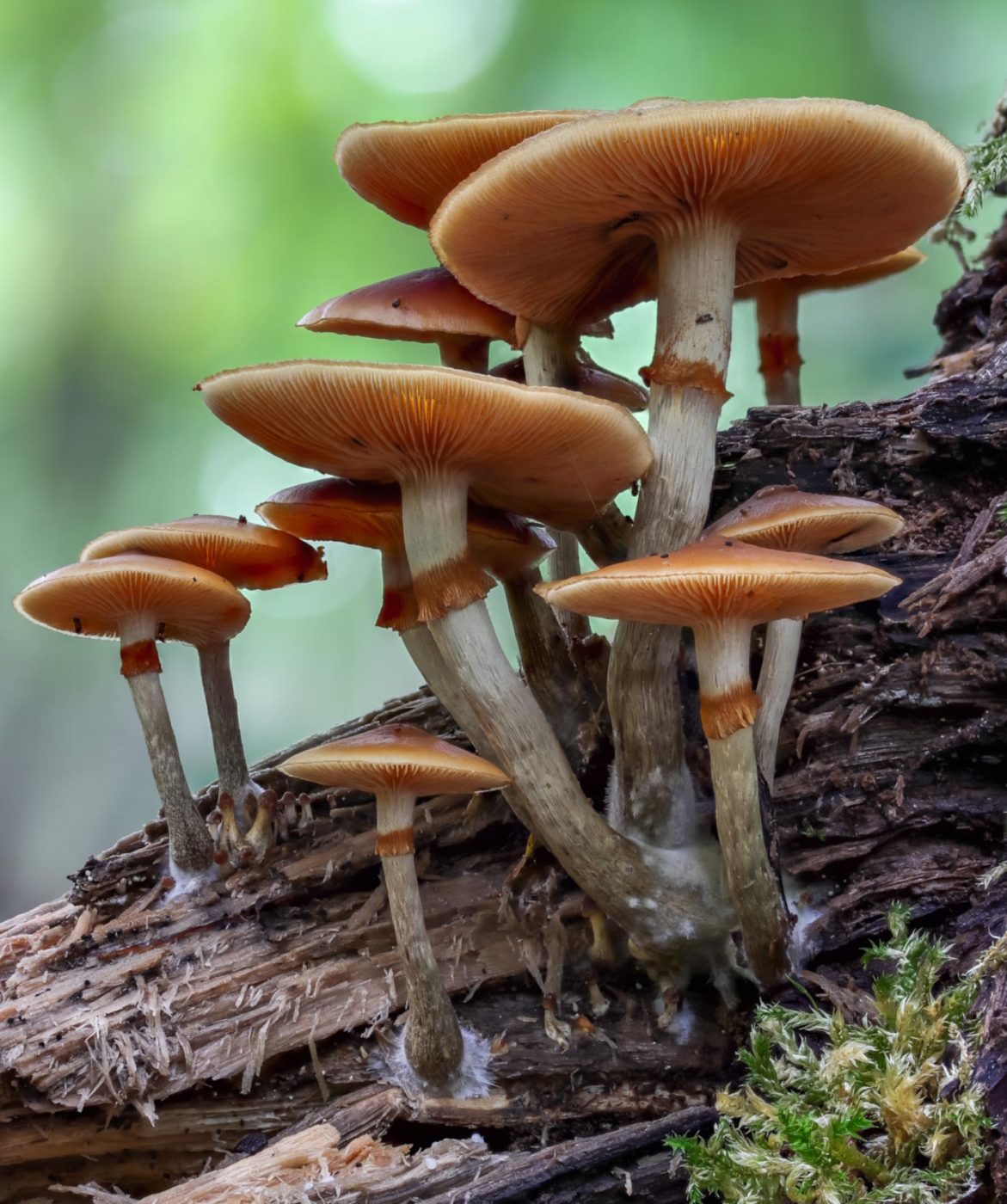
Deadly Galerina is a small to medium brown mushroom growing on decaying wood. The cap is yellow-brown to reddish-brown, and mature gills become rusty brown.
The stem often has a ring or ring zone. The spore print is rusty brown rather than white.
Habitat
It can grow on both conifer and hardwood debris. Fallen logs, buried wood, and heavily decayed stumps are common.
Fruit bodies may appear singly or in groups. Its plain brown appearance makes it easy to underestimate.
Safety
Galerina marginata is deadly poisonous and contains amatoxins. It is one of the most important wood-growing species to recognize.
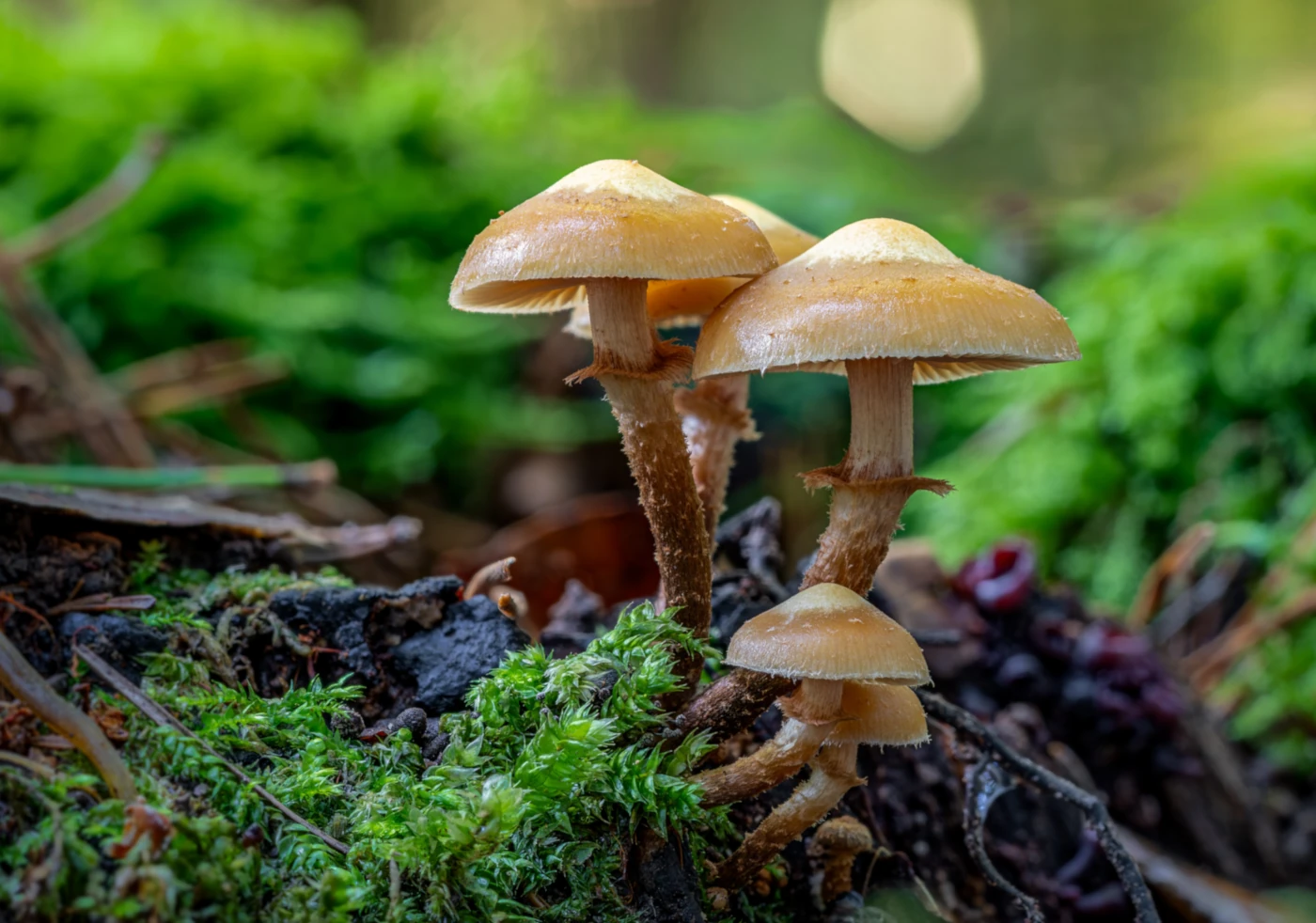
4. Kuehneromyces mutabilis — Sheathed Woodtuft
Identification
Sheathed Woodtuft grows in dense clusters and often has a strongly hygrophanous cap. The wet cap may be dark brown toward the edge, while drying creates a paler central or outer zone.
The stem commonly has a ring and darker scaly areas below it. Mature gills become brownish as spores develop.
Habitat
It grows on decaying hardwood, especially stumps and fallen trunks. Large clusters can return from the same wood repeatedly.
The clustered habit and changing cap color are striking. Unfortunately, this can overlap with dangerous Galerina.
Safety
Although traditionally considered edible in some regions, it is not a suitable beginner mushroom because of the risk of confusion with Galerina marginata. Expert-level identification is recommended.
5. Hypholoma fasciculare — Sulphur Tuft
Identification
Sulphur Tuft grows in dense clusters of bright yellow to sulfur-yellow mushrooms. The cap center is often darker orange-brown.
Young gills are yellowish and later become greenish or olive-gray. The stems are slender and usually lack a persistent ring.
Habitat
Old stumps, buried wood, logs, and dead roots are typical substrates. Both hardwood and conifer wood may be colonized.
Large clusters can emerge from apparently bare ground when buried wood is present. This can make the mushroom seem terrestrial.
Safety
Sulphur Tuft is poisonous and can cause gastrointestinal illness. Greenish mature gills are one of the most useful clues.
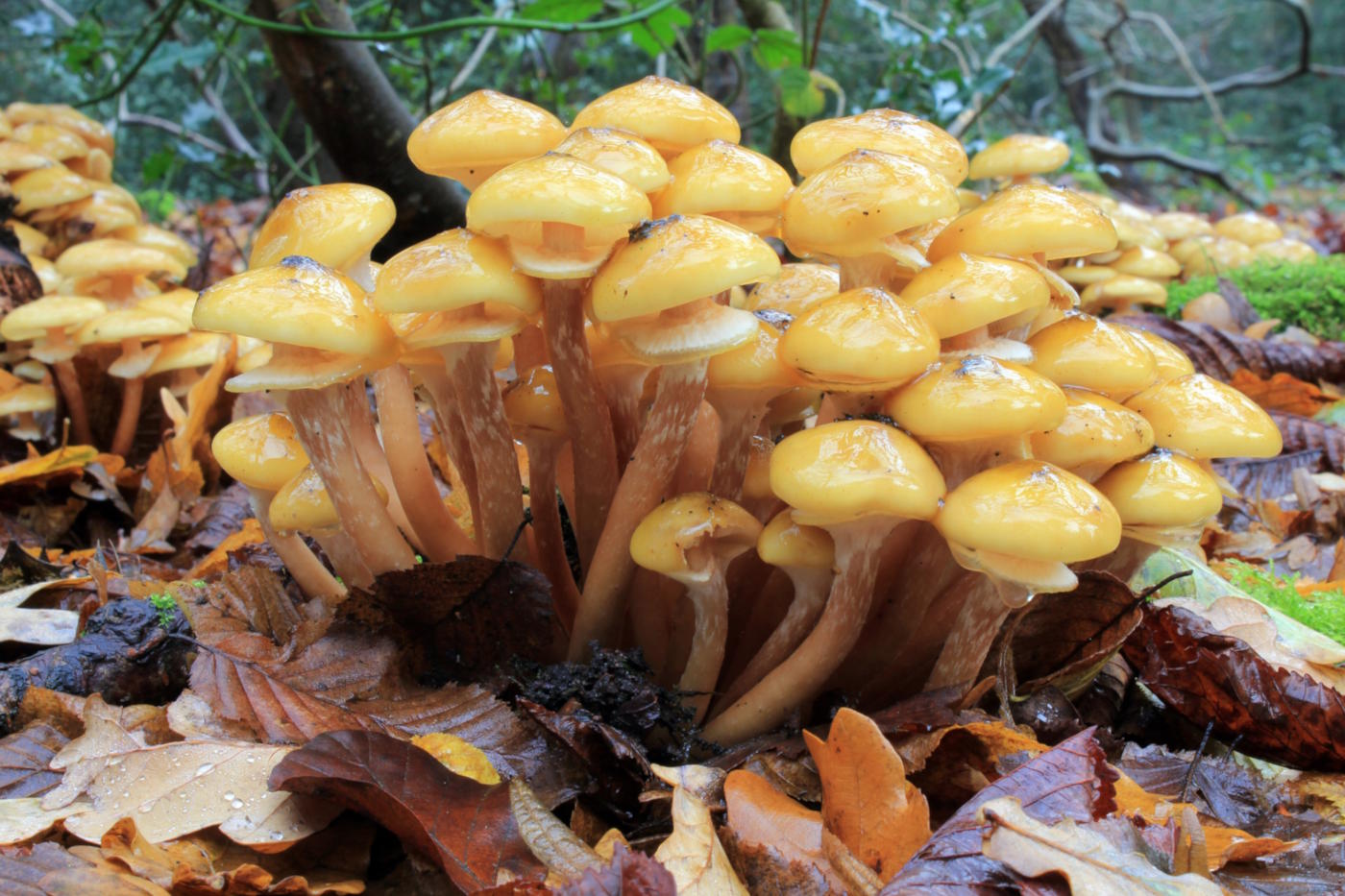
6. Armillaria Species — Honey Mushrooms
Identification
Honey Mushrooms usually grow in large clusters with honey-brown, yellow-brown, or tan caps. Many species have a ring on the stem, although ringless species also exist.
The gills are pale and the spore print is white. Caps may show fine scales, especially near the center.
Habitat
They grow from stumps, roots, buried wood, and living or dead trees. Dense clusters around tree bases are especially characteristic.
Rhizomorphs, dark shoe-lace-like fungal strands under bark or in soil, may also be present.
Safety
Edibility varies among species and regions, and gastrointestinal reactions are common enough that careful identification matters. Honey Mushrooms should never be confused with brown-spored wood-growing species such as Galerina.
7. Coprinellus micaceus — Mica Cap
Identification
Mica Caps form dense clusters of small honey-brown to amber caps. Fresh caps may carry sparkling veil granules that resemble tiny grains of mica.
The gills begin pale, darken, and eventually collapse into dark inky tissue. The stem is thin, pale, and fragile.
Habitat
They commonly grow around stumps, buried roots, and decaying hardwood. Sometimes they appear to grow from lawn soil because the actual wood is underground.
Warm wet weather can produce large clusters. The same site may fruit repeatedly.
Safety
Young specimens are generally considered edible when correctly identified, but they deteriorate quickly. Old blackening fruit bodies are not useful for identification or cooking.
8. Mycena galericulata — Common Bonnet
Identification
Common Bonnet has a gray-brown to brown bell-shaped cap with a translucent striate margin. The stem is slender and pale to brownish.
The gills are whitish to pale gray and attach to the stem. Clusters may contain many delicate fruit bodies.
Habitat
It grows on well-decayed hardwood logs, stumps, and buried woody debris. Large old trunks can host repeated flushes.
The species is common but visually plain. It is best recognized as part of the general Mycena group rather than by cap color alone.
Safety
It is not generally regarded as a food mushroom. Small bonnet mushrooms are not suitable beginner edibles because many species look similar.
9. Pluteus cervinus Group — Deer Shield
Identification
Deer Shield mushrooms have gray-brown to brown caps and free gills that do not attach directly to the stem. The gills begin pale and become pink as the spores mature.
There is no ring or volva. The stem is usually whitish and relatively firm.
Habitat
Decaying hardwood, buried logs, and old stumps are classic substrates. Fruit bodies may appear singly rather than in dense clusters.
Because buried wood can be invisible, the mushroom may look like it is growing directly from soil.
Safety
Edibility is treated differently across species and regions. Exact identification within the broader Pluteus cervinus group can be difficult.
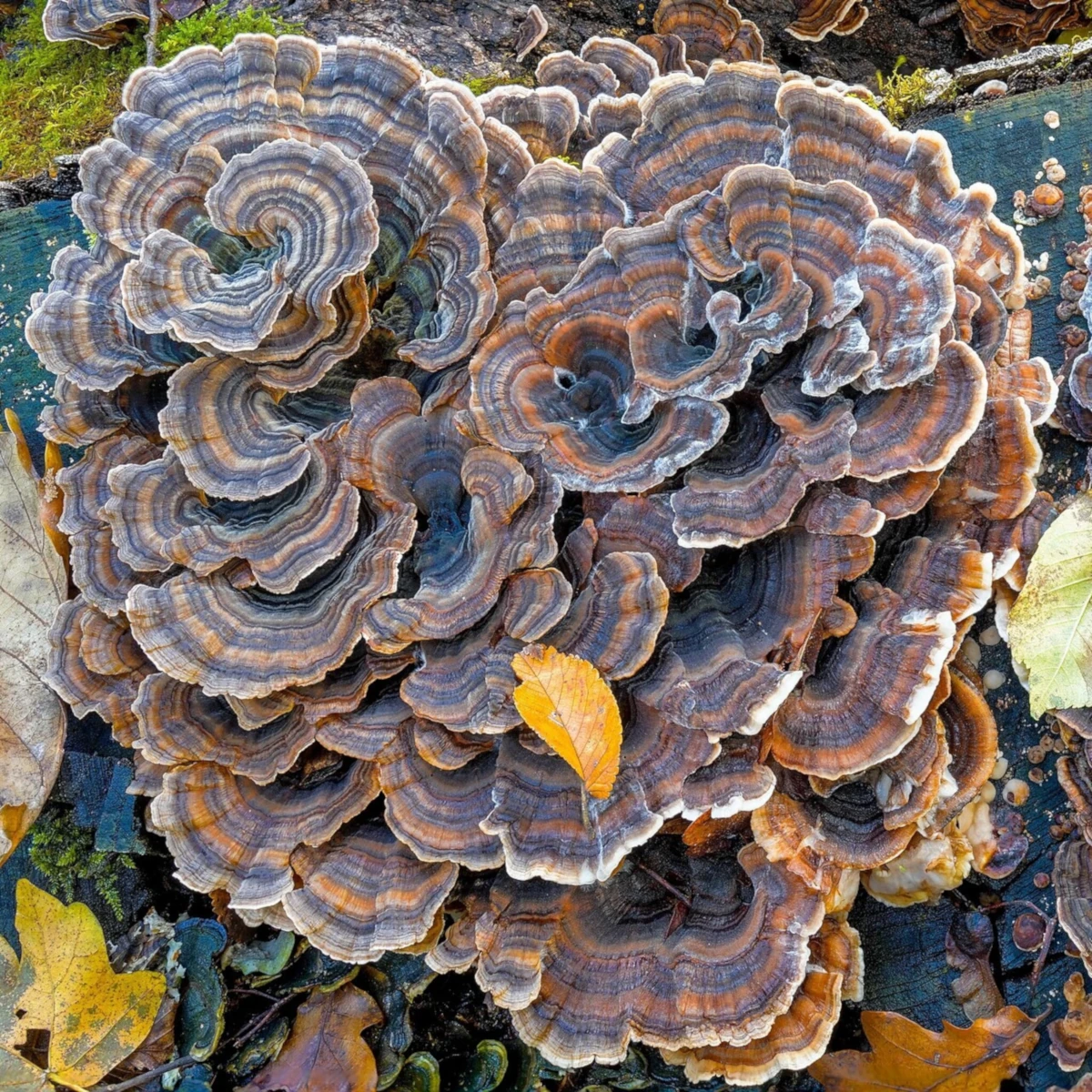
10. Trametes versicolor — Turkey Tail
Identification
Turkey Tail forms thin overlapping brackets with clear concentric zones of brown, cream, gray, blue-gray, and sometimes orange. The upper surface is finely velvety.
The underside is white to cream and covered with very small round pores. True pores are essential for identification.
Habitat
Dead hardwood logs, fallen branches, and old stumps are common. Large colonies can cover extensive areas of a single trunk.
It fruits over a long period and dried brackets may remain visible for months.
Safety
Turkey Tail is too tough and leathery to be treated as a normal edible mushroom. It is also frequently confused with smooth-undersided Stereum species.
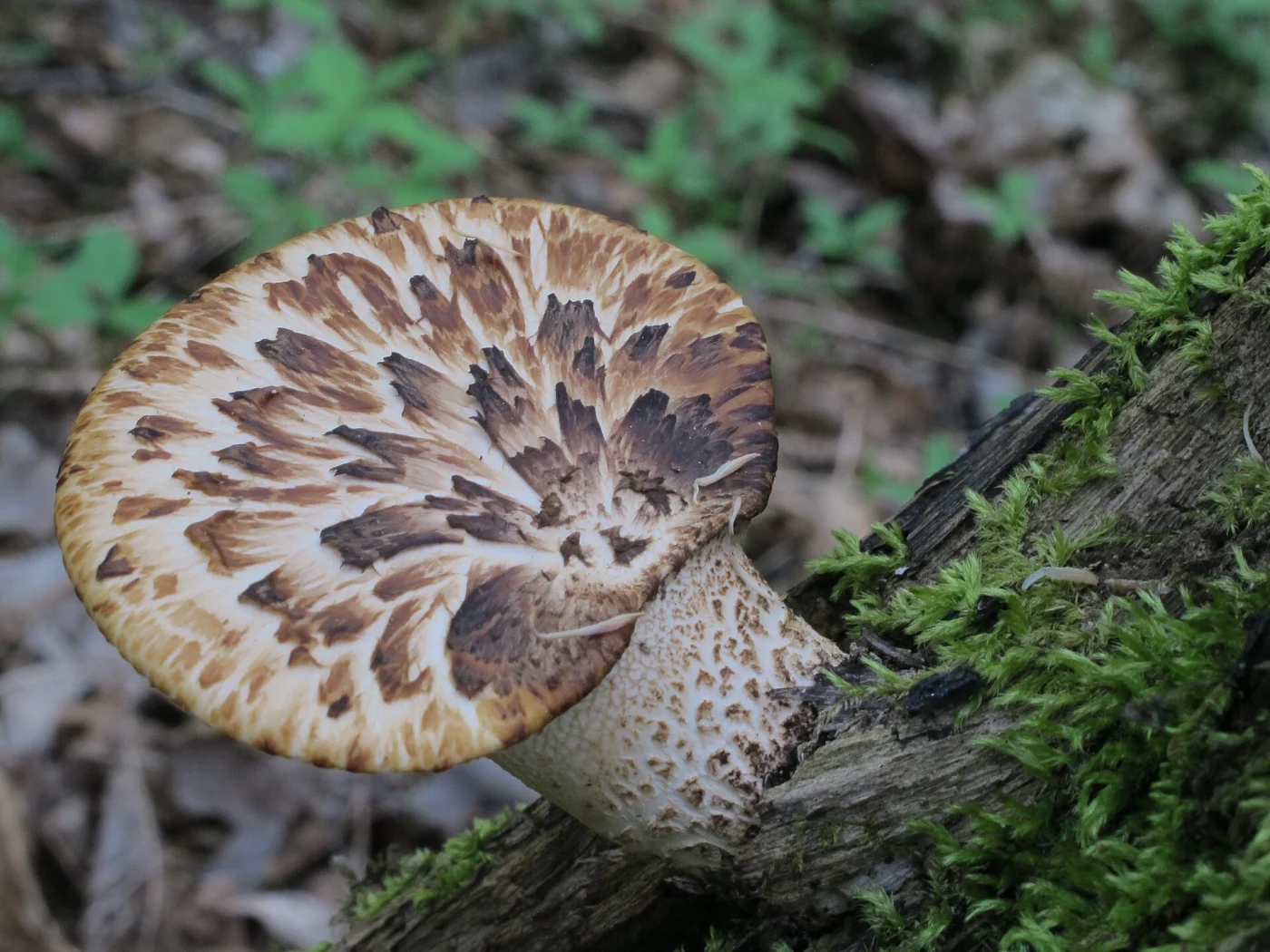
11. Cerioporus squamosus — Dryad’s Saddle
Identification
Dryad’s Saddle forms large fan-shaped caps with dark brown flattened scales on a pale tan background. The underside has large angular pores.
A short lateral stem is often present. Fresh fruit bodies may have a cucumber-like or watermelon-rind odor.
Habitat
It grows on hardwood stumps, fallen logs, and damaged living trees. Elm, maple, willow, poplar, and several other hosts are possible.
Spring and early summer are especially productive periods. Fruit bodies can become very large.
Safety
Young tender specimens are considered edible when correctly identified. Older caps become fibrous and tough.
12. Laetiporus sulphureus — Chicken of the Woods
Identification
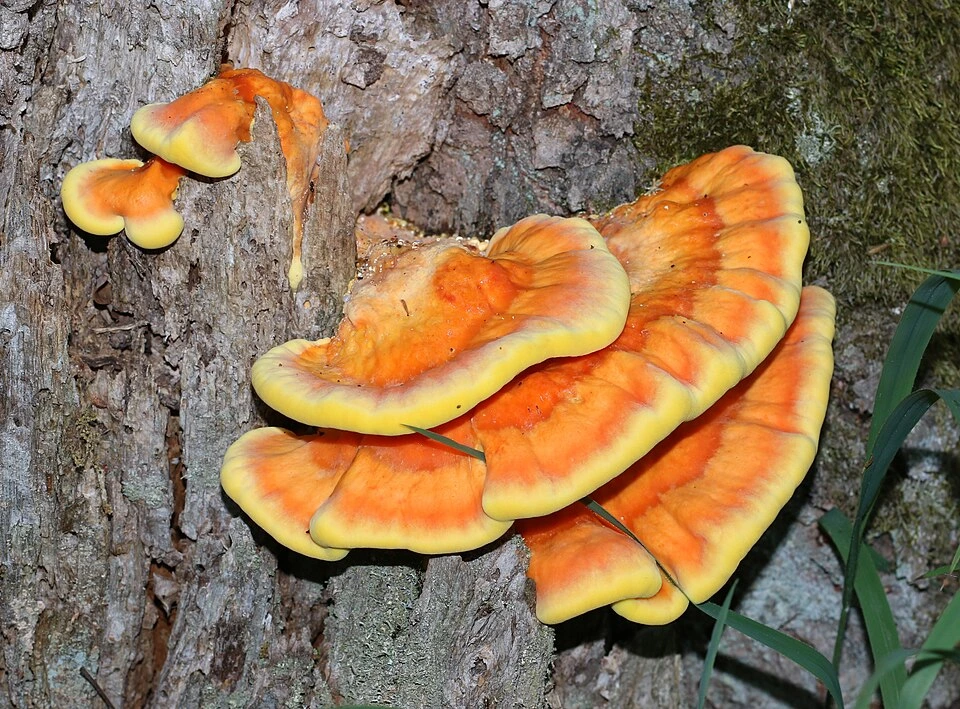
Chicken of the Woods produces bright orange and yellow shelves that grow in overlapping tiers. Young fruit bodies are thick, soft, and fleshy.
The underside has fine pores rather than gills. Colors fade as the fungus ages.
Habitat
It grows on dead or living wood depending on species and region. Oak and other hardwoods are especially common hosts for some taxa.
Old stumps and fallen trunks can produce large flushes. A single colony may weigh several kilograms.
Safety
It is widely eaten when correctly identified, young, and properly cooked. Regional species and host-tree differences still matter, so exact identification is important.
13. Fomes fomentarius — Tinder Fungus
Identification
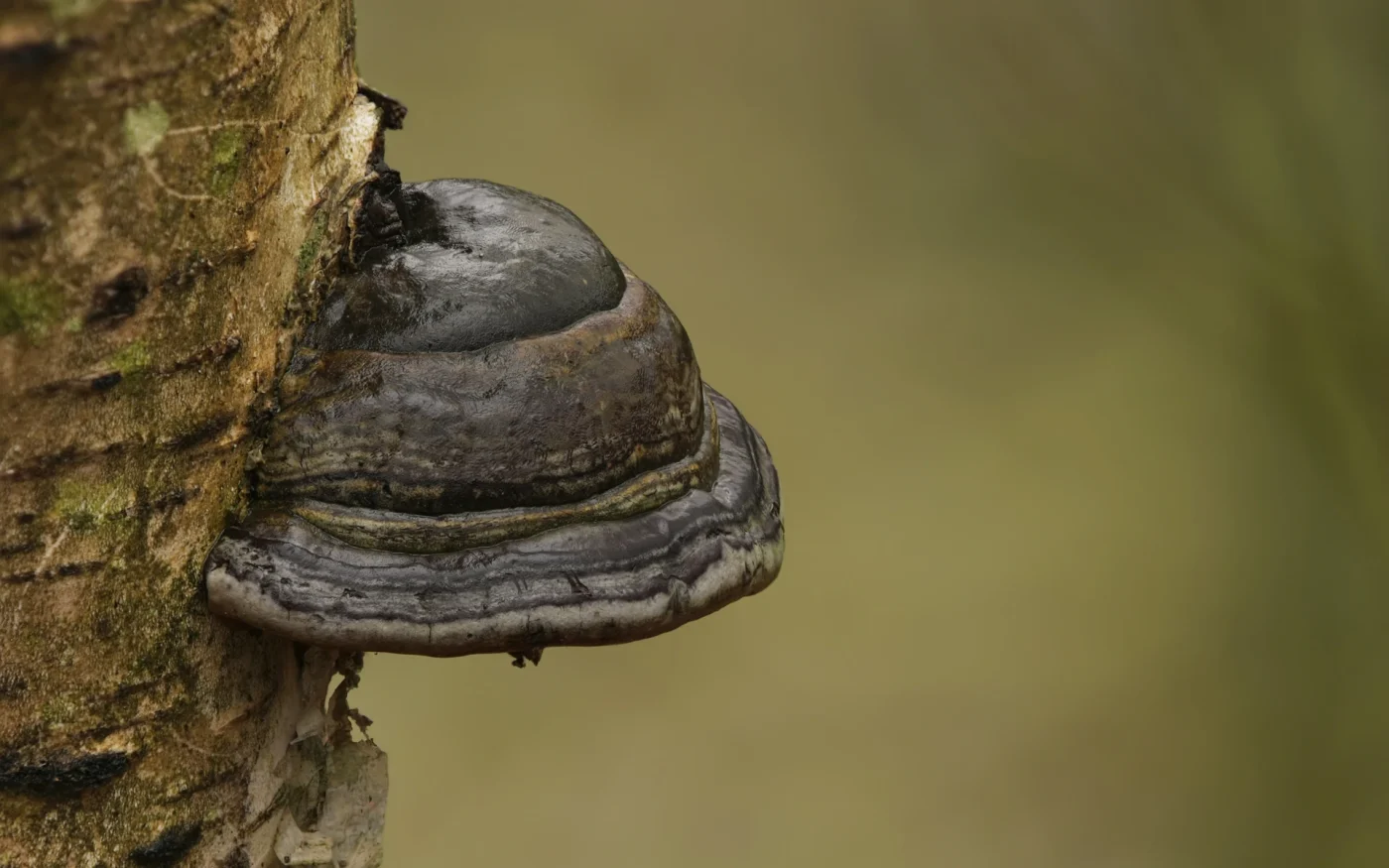
Tinder Fungus forms hard gray to brown hoof-shaped conks. The upper surface is concentrically zoned and can remain attached for many years.
The underside has fine pale pores. Internally, the tissue is brownish, tough, and cork-like.
Habitat
Birch and beech are important hosts, although other hardwoods may also be used. The fungus occurs on both living and dead trees.
Old conks can remain visible in every season. They may continue to persist long after active growth slows.
Safety
The fruit body is inedible because it is woody and extremely tough. Its historical importance comes from tinder and amadou rather than food use.
14. Schizophyllum commune — Split Gill
Identification
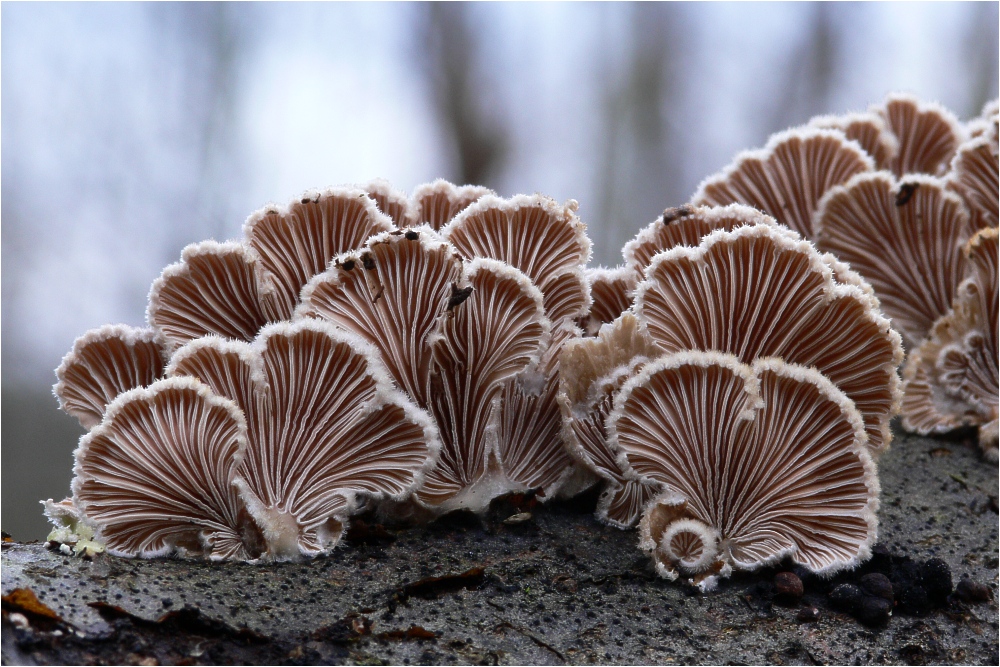
Split Gill forms small fan-shaped gray-white to tan fruit bodies on dead wood. The underside has distinctive gill-like folds that split lengthwise.
The caps are thin, dry, and often hairy or felted. They can shrink during dry weather and expand again when humidity rises.
Habitat
Dead branches, logs, and exposed wood are common substrates. The species is extremely widespread and tolerant of dry conditions.
It can occur in forests, orchards, parks, and urban environments. Small fruit bodies may cover large sections of dead branches.
Safety
It is not recommended as a food mushroom. Its main value for field identification is the unusual split-gill structure.
15. Auricularia auricula-judae Group — Jelly Ear
Identification
Jelly Ear produces brown to reddish-brown ear-shaped fruit bodies with a rubbery gelatinous texture. The upper surface may be slightly velvety, while the inner surface is smoother.
Fresh specimens are flexible and translucent around the edges. Dry specimens shrink dramatically but can rehydrate after rain.
Habitat
Dead hardwood branches and trunks are typical. Elder is especially well known as a host in Europe, though related species occur on many other hardwoods.
The fruit bodies often grow in groups. Mild wet weather can produce them outside the classic autumn season.
Safety
Several members of the broader group are considered edible when correctly identified. Regional taxonomy matters because similar jelly fungi occur on different continents.
Gilled Mushrooms on Dead Wood
Dead wood supports many gilled species, including Oyster Mushroom, Velvet Shank, Deadly Galerina, Honey Mushrooms, Mica Caps, and Sulphur Tuft. These fungi can look surprisingly similar when viewed only from above.
Gill color at maturity, spore print, ring presence, stem texture, and clustering pattern are therefore important. Brown caps on wood deserve particular caution because both edible and deadly species occur in this group.
White-Spored vs Brown-Spored Species
Oyster Mushroom, Velvet Shank, and Honey Mushrooms produce pale or white spores. Deadly Galerina and Woodtuft species produce brown to rusty spores. This difference is highly useful when morphology overlaps. A spore print can therefore be one of the strongest secondary tests for brown wood-growing mushrooms.
Bracket Fungi on Dead Wood
Brackets are among the most visible fungi on dead logs. Turkey Tail, Dryad’s Saddle, Chicken of the Woods, and Tinder Fungus all grow on woody substrates but differ dramatically in texture and pore structure.
Thin leathery fans point toward one group, while massive fleshy shelves or hard perennial conks point toward others. The underside should always be examined.
Jelly Fungi on Dead Wood
Jelly fungi thrive on damp dead wood and often appear after rain. Their gelatinous texture makes them easy to separate from gilled mushrooms and polypores.
Jelly Ear is one of the best-known examples. Several unrelated jelly fungi can share brown or black colors, so shape and substrate still matter.
Hardwood vs Conifer Wood
The tree species can strongly influence which fungi appear. Oyster Mushrooms, Dryad’s Saddle, and Jelly Ear are strongly associated with broadleaf wood, while other species can colonize conifers as well.
Deadly Galerina is less selective and can occur on both. This makes host wood useful but never sufficient for identification.
How to Identify Dead Wood
Bark is usually the easiest clue if it remains attached. Fallen leaves, cones, branch arrangement, and nearby living trees can also help.
Very old logs may become difficult to identify. In those cases, it is better to record the substrate as unknown hardwood or unknown conifer than to guess.
Mushrooms Growing From Buried Wood
One of the most confusing situations is a mushroom that appears to grow directly from soil but is actually attached to buried roots or timber. Honey Mushrooms, Mica Caps, Pluteus, and several other wood decomposers can do this.
Carefully tracing the base may reveal buried wood. This can completely change the likely identification.
How to Identify a Mushroom Growing on Dead Wood
Start by determining whether the fungus has gills, pores, teeth, a smooth surface, or gelatinous tissue. This immediately divides the possibilities into much smaller groups.
Then examine the cap, stem, spore color, growth pattern, and wood type. Finally, consider season and region.
Step 1: Check the Growth Pattern
A dense cluster suggests different species from a solitary mushroom. Overlapping shelves point toward yet another group.
Photograph the entire colony before removing anything. Growth architecture can be highly diagnostic.
Step 2: Look Underneath
Check whether you see gills, pores, split folds, or a smooth fertile surface. This is usually more useful than cap color.
For brackets, photograph pore size closely. For gilled mushrooms, note mature gill color.
Step 3: Examine the Stem
Check for a ring, dark velvety base, scales, or complete absence of a stem. These features can separate dangerous look-alikes.
With small brown mushrooms on wood, the stem deserves especially careful attention.
Step 4: Consider the Spore Print
White, pink, brown, rusty brown, and dark spores lead toward very different groups. Spore color is particularly helpful with clustered gilled mushrooms.
It should be combined with morphology rather than used as a standalone test.
Deadly Look-Alikes on Wood
The most important dangerous species in this habitat is Galerina marginata. Its brown cap and clustered wood-growing habit can overlap with several edible species.
The safest approach is not to identify a mushroom as edible from habitat alone. Rusty-brown spores, mature brown gills, and a ring zone should immediately raise concern for Galerina.
Wild Enoki vs Deadly Galerina
Wild Enoki has pale mature gills, white spores, no persistent ring, and a dark velvety lower stem. Deadly Galerina has rusty mature gills, rusty spores, and often a ring or ring zone.
Both can fruit from the same kind of wood. Season alone cannot guarantee a safe distinction.
How to Photograph Wood-Growing Mushrooms
Take a wide photograph showing the whole log, stump, or branch and the arrangement of fruit bodies. This preserves information about growth pattern.
Then photograph the underside and the complete stem. With small brown species, close-ups of the ring zone and stem surface are particularly useful.
A separate image of the wood and bark can also help. For bracket fungi, include a side profile and close-up of the pore surface.
Can AI Identify Mushrooms Growing on Dead Wood?
AI can often recognize distinctive species such as Oyster Mushroom, Turkey Tail, Chicken of the Woods, Dryad’s Saddle, and Jelly Ear. Their shapes and growth patterns are visually strong.
Small brown wood-growing mushrooms are much harder. Deadly Galerina, Velvet Shank, Woodtuft, and several other species can overlap strongly in photographs.
For better results, include mature gills, stem details, underside, substrate, and spore color when possible. A single cap-only image is especially risky in this habitat.
Common Identification Mistakes
One common mistake is assuming that every cluster on a stump is Honey Mushroom. Several unrelated and sometimes poisonous species grow in dense clusters on wood.
Another mistake is identifying every thin colorful bracket as Turkey Tail. The underside must have true tiny pores.
A third mistake is ignoring buried wood. A mushroom that seems to grow from soil may still be a wood decomposer and belong to a completely different ecological group.
Frequently Asked Questions
Why do mushrooms keep appearing from the same dead log for years?
The fungal mycelium can continue breaking down the wood long after the first fruiting. New mushrooms appear when moisture and temperature become suitable again.
Can one dead tree support several mushroom species at once?
Yes. Different fungi may colonize different parts of the wood or dominate at different stages of decay. One trunk can host brackets, gilled mushrooms, jelly fungi, and crusts simultaneously.
Why do some mushrooms appear only after bark falls off?
Exposed wood changes moisture, temperature, and accessibility for fungi. Some species fruit more readily once the bark loosens or internal decay reaches a suitable stage.
Can a fungus continue fruiting after the log is moved?
Sometimes. If enough colonized wood and moisture remain, the mycelium can continue producing fruit bodies even after the log changes position.
Why are mushrooms more abundant on the underside of fallen logs?
The shaded underside often stays wetter and experiences smaller temperature fluctuations. These conditions can favor both mycelial growth and fruiting.
Can firewood produce mushrooms after being stacked?
Yes. Wood that was already colonized before cutting may continue to fruit in a damp woodpile. Some species can also colonize stacked wood after storage begins.
Do mushrooms growing on treated lumber belong to the same species as forest fungi?
Some generalist decomposers can colonize processed wood if conditions allow, but preservatives and construction materials change the habitat considerably. Identification should be based on the fungus itself, not assumptions about the substrate.
Why do some dead logs have no visible mushrooms at all?
Fungal activity may still be occurring inside the wood without producing fruit bodies. Dryness, temperature, stage of decay, or competition with other organisms can suppress visible fruiting.
Final Identification Notes
Dead wood supports an enormous variety of fungi, including Oyster Mushrooms, Velvet Shank, Deadly Galerina, Honey Mushrooms, Turkey Tail, Dryad’s Saddle, Chicken of the Woods, Tinder Fungus, and Jelly Ear.
The best first question is not “what color is the cap?” but what kind of fertile surface does it have? Gills, pores, split folds, gelatinous tissue, and leathery brackets each lead toward different groups.
Most importantly, wood habitat does not imply edibility. Edible, inedible, poisonous, and deadly mushrooms can all grow from the same log, so each fruit body should be identified independently.
Upload a photo and get possible matches in seconds.