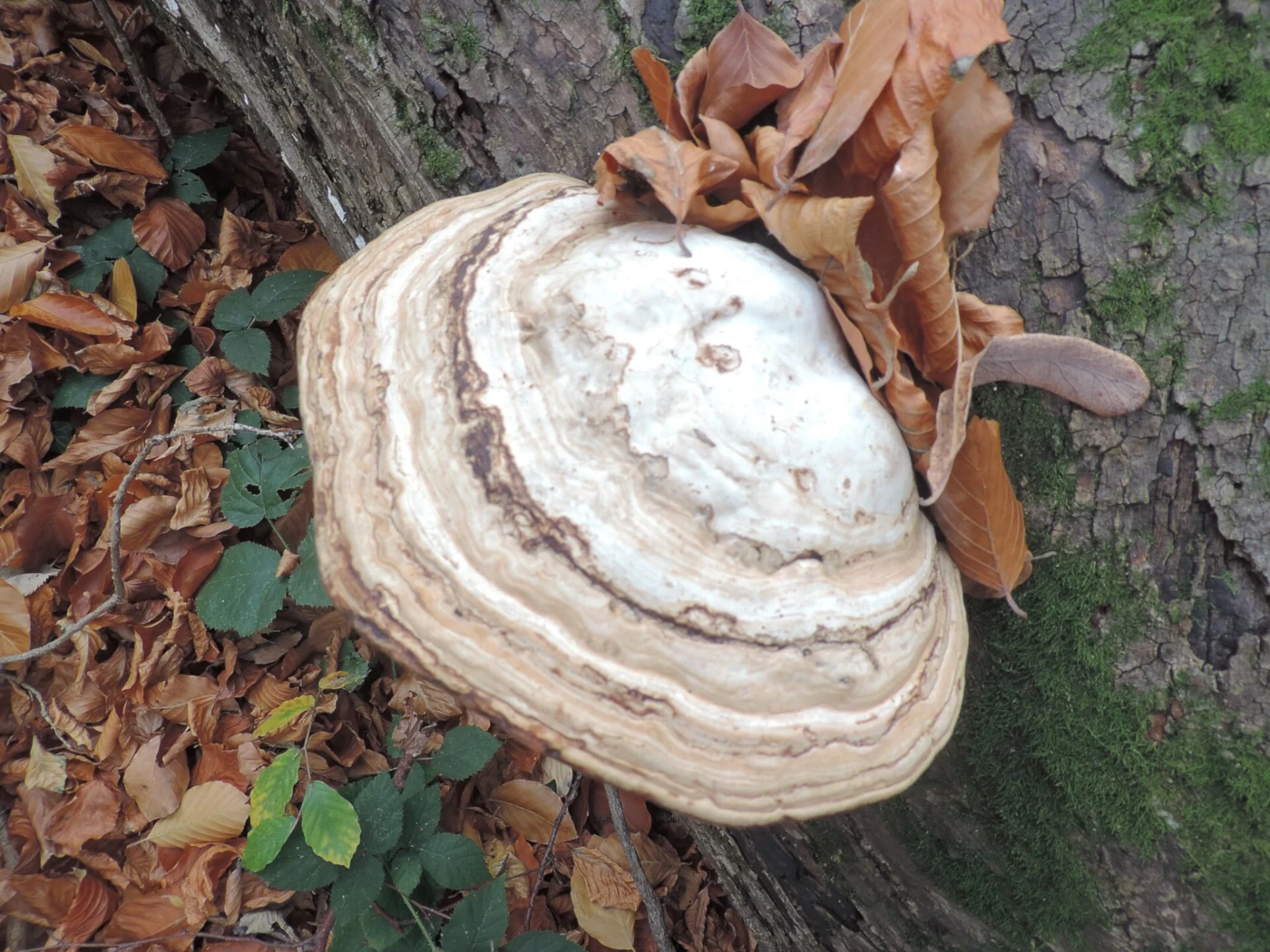
Fomes fomentarius, commonly known as Tinder Fungus, Tinder Conk, or Hoof Fungus, is a tough perennial bracket fungus that grows on broadleaf trees. Its gray to brown hoof-shaped fruit body can remain attached for years, adding new growth layers as the fungus continues to develop.
The species is especially associated with birch and beech, although it can occur on other hardwoods. Its hard woody texture, zoned upper surface, pale pore layer, and perennial growth make it very different from softer annual bracket fungi.
⚠️ Important: This guide is for identification and education only. Fomes fomentarius is not a conventional edible mushroom and should not be consumed based on photographs, AI identification, or online comparisons.
Quick Identification
| Feature | Fomes fomentarius |
|---|---|
| Scientific name | Fomes fomentarius |
| Common names | Tinder Fungus, Hoof Fungus, Tinder Conk |
| Family | Polyporaceae |
| Shape | Hoof-shaped to bracket-like |
| Cap color | Gray, brown, gray-brown, nearly black |
| Surface | Hard, zoned, often cracked with age |
| Underside | Pale pore surface |
| Pores | Very small and round |
| Stem | Absent |
| Flesh | Tough, fibrous, corky |
| Growth | Perennial |
| Substrate | Living or dead hardwood |
| Common hosts | Birch, beech, poplar and other broadleaf trees |
| Rot type | White rot |
| Spore print | Pale to white |
| Edibility | Inedible |
| Main look-alikes | Phellinus igniarius group, Ganoderma applanatum, other perennial polypores |
What Does Fomes fomentarius Look Like?
Tinder Fungus usually forms a thick hoof-shaped conk projecting from the side of a tree. Young fruit bodies may be more rounded, while older ones become broader, heavier, and distinctly layered.
The upper surface is gray, gray-brown, or dark brown and often shows visible concentric growth zones. Older specimens may become cracked or almost black in places, especially after years of exposure to rain, sun, and frost.
The underside is much paler and covered with tiny pores. Each year, a new layer of tubes can develop beneath the older tissue, making the fruit body gradually thicker.
Shape
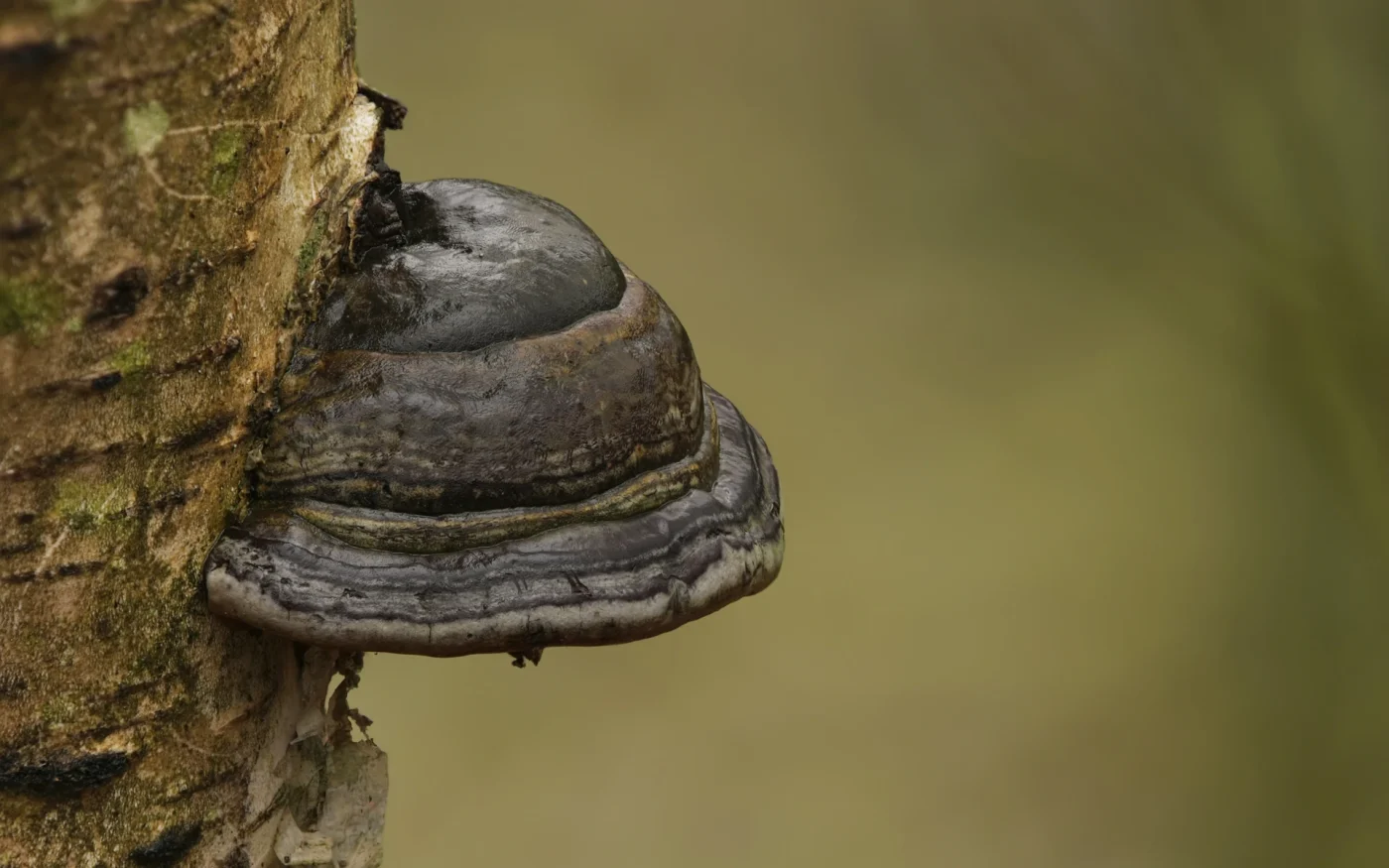
The classic shape resembles the hoof of a horse, with a rounded upper surface and a flatter underside. Some fruit bodies are more shelf-like, especially when they grow from sloping trunks or fallen wood.
Shape depends partly on the orientation of the host tree. A fungus growing on a vertical trunk develops differently from one on a horizontal log.
Growth Layers
Visible bands on the upper surface can reflect repeated growth over several seasons. These zones often become easier to see as the conk ages.
The fruit body may persist for many years. This perennial habit separates it from many bracket fungi that appear, release spores, and decay within a single season.
Upper Surface
The outer surface is hard and dry, with colors ranging from pale gray to dark gray-brown. Fresh growth near the margin can be lighter than older central areas.
Weathering may create cracks, moss, algae, or surface discoloration. Very old conks can become rough enough that the original zoning is less obvious.
Texture
The surface feels woody rather than leathery or fleshy. It cannot be bent easily like Turkey Tail or cut effortlessly like a young Oyster Mushroom.
This hardness is one of the fastest ways to recognize a mature perennial conk. Even relatively young fruit bodies are much tougher than ordinary mushrooms.
Underside
The underside is pale gray, cream, or light brown and covered with very fine pores. The pores are small enough that the surface may appear almost smooth from a distance.
Unlike gilled mushrooms, spores are released through these pores. The fertile surface usually faces downward regardless of the angle of the host.
Pore Surface
Fresh pore surfaces tend to be relatively pale. Older areas can become grayish, brownish, or stained.
The pores are much finer than those of Dryad’s Saddle. This difference helps separate Fomes fomentarius from large annual polypores with visibly coarse pore openings.
Flesh and Internal Structure
The internal tissue is tough, fibrous, and cork-like. It is usually brownish, cinnamon, or tan rather than white and fleshy.
The structure can be divided into hard outer crust, dense internal tissue, and repeated tube layers underneath. Cutting a large old conk requires much more force than cutting a soft seasonal mushroom.
Tinder Layer
Part of the internal tissue can be processed into a felt-like material known historically as amadou. This material has been used as tinder because it can catch and hold a spark when properly prepared.
The same fibrous tissue has also been used traditionally for other purposes. These historical uses are part of why Fomes fomentarius is one of the best-known bracket fungi in Europe.
Does Fomes fomentarius Have a Stem?
No. The fruit body attaches directly to the tree.
The attachment is broad and strong enough to support a heavy conk for years. There is no conventional central or lateral stem.
If a hoof-shaped bracket has a clear fleshy stem, another species should be considered.
Where Does Fomes fomentarius Grow?
Tinder Fungus grows on broadleaf trees, especially birch and beech. It can occur on both living trees and dead wood.
On living trees, it often enters through wounds or damaged tissue. Once established, the fungus causes internal wood decay that can persist for years.
Common Host Trees
Birch is one of the most familiar hosts, particularly in northern and eastern parts of Europe. Beech is also extremely important in many regions.
Poplar, maple, willow, and other hardwoods may also support the fungus. Exact host frequency varies with geography and forest type.
Living Trees
A fruit body on a living tree usually indicates significant internal colonization. The fungus causes white rot by breaking down lignin and other components of wood.
A tree can remain standing for years while carrying several conks. However, advanced decay may weaken the trunk structurally.
Dead Trees
The fungus can continue growing after the host tree dies. Standing dead trunks and fallen logs may carry old or still-active fruit bodies.
This persistence makes Tinder Fungus visible throughout the year. Winter is often an especially good time to spot it because foliage no longer hides trunks.
Distribution
Fomes fomentarius is widespread across Europe, Asia, and parts of North America. It is most common in temperate and boreal regions with abundant broadleaf forests. Its distribution is strongly tied to suitable host trees. Birch- and beech-rich forests are especially favorable.
When Can You Find Tinder Fungus?
Because the fruit bodies are perennial, they can be found in every season. Unlike soft gilled mushrooms, they do not disappear after a short fruiting period.
Fresh growth tends to occur during favorable moist conditions. Older layers remain attached through frost, snow, heat, and dry weather.
Why Winter Is a Good Time to Look
Leafless forests expose trunks and dead branches, making bracket fungi much easier to see. Large hoof-shaped conks can stand out from considerable distance. Winter also reduces competition from thousands of soft seasonal mushrooms. This makes perennial brackets easier to study carefully.
Is Fomes fomentarius Edible?
No. The fruit body is far too hard, woody, and fibrous to be eaten as a conventional mushroom. Historical uses involve processed internal tissue rather than normal culinary preparation. Those uses should not be confused with edibility. The species is much more important ecologically and historically than as food.
Fomes fomentarius Look-Alikes
Several perennial bracket fungi produce hard gray or brown conks on broadleaf trees. The most useful differences involve shape, pore surface, internal color, host tree, and reactions to scratching or bruising. Large old brackets can be difficult to identify from a single photograph. Underside and host information are especially helpful.
Phellinus igniarius Group — Willow Bracket and Related Species
Identification
Species in the Phellinus igniarius group form hard dark conks on living hardwoods. Mature fruit bodies can be blackish, cracked, and hoof-shaped.
The underside is brownish rather than clean pale cream, and the internal tissue is typically darker. Host tree can also provide valuable clues.
Main Difference
Tinder Fungus tends to have a paler pore surface and a more gray-toned zoned upper surface. Phellinus species often look darker and more heavily charred or blackened.
Older specimens can still overlap considerably. A cut section and host tree may be needed for better confidence.
Ganoderma applanatum — Artist’s Conk
Identification
Artist’s Conk forms broad flattened brackets rather than classic hoof-shaped fruit bodies. The upper surface is brown to gray-brown, while the underside is pale.
One famous feature is that the pore surface bruises brown when scratched. This allows lines or drawings to remain visible on the underside.
Main Difference
Artist’s Conk is usually flatter and broader. Fomes fomentarius is generally more hoof-shaped and vertically thick.
The strong scratch reaction of Ganoderma applanatum is another useful clue.
Fomitopsis betulina — Birch Polypore
Identification
Birch Polypore grows almost exclusively on birch and can occur beside Tinder Fungus on the same tree. It has a smoother, paler, more rounded fruit body with a softer texture when young.
The underside is white with small pores. Older specimens become tougher but usually remain less hoof-like than Fomes fomentarius.
Main Difference
Birch Polypore has a smoother pale cap and typically looks more like a thick rounded shelf. Tinder Fungus is harder, darker, and strongly zoned.
Both can occur on birch, so host tree alone does not separate them.
Fomes fomentarius vs Birch Polypore
| Feature | Fomes fomentarius | Birch Polypore |
|---|---|---|
| Shape | Hoof-shaped | Rounded shelf |
| Upper surface | Gray-brown, zoned | Pale brown to gray, smoother |
| Texture | Very hard and woody | Softer when young |
| Growth | Perennial | Usually annual |
| Main host | Birch, beech, others | Mainly birch |
| Pores | Fine | Fine |
| Edibility | Inedible | Not a conventional edible |
Growth habit and surface texture are particularly useful. A thick conk adding layers over multiple years strongly supports Fomes fomentarius.
Fomes fomentarius vs Artist’s Conk
| Feature | Fomes fomentarius | Ganoderma applanatum |
|---|---|---|
| Shape | Hoof-like | Broad and flattened |
| Surface | Gray and zoned | Brown-gray, flatter |
| Underside | Pale fine pores | Pale, bruises brown when scratched |
| Growth | Perennial | Perennial |
| Stem | None | None |
| Main clue | Hoof shape | Scratch-sensitive pore surface |
Both can become large and woody. Shape and underside reaction provide the fastest distinction.
How to Identify Fomes fomentarius Step by Step
Start with shape and texture. Look for a hard perennial hoof-shaped conk attached directly to broadleaf wood.
Then examine the upper surface for gray-brown concentric zones and the underside for very fine pale pores. Finally, identify the host tree and consider whether the fruit body shows multiple years of growth.
Step 1: Check the Shape
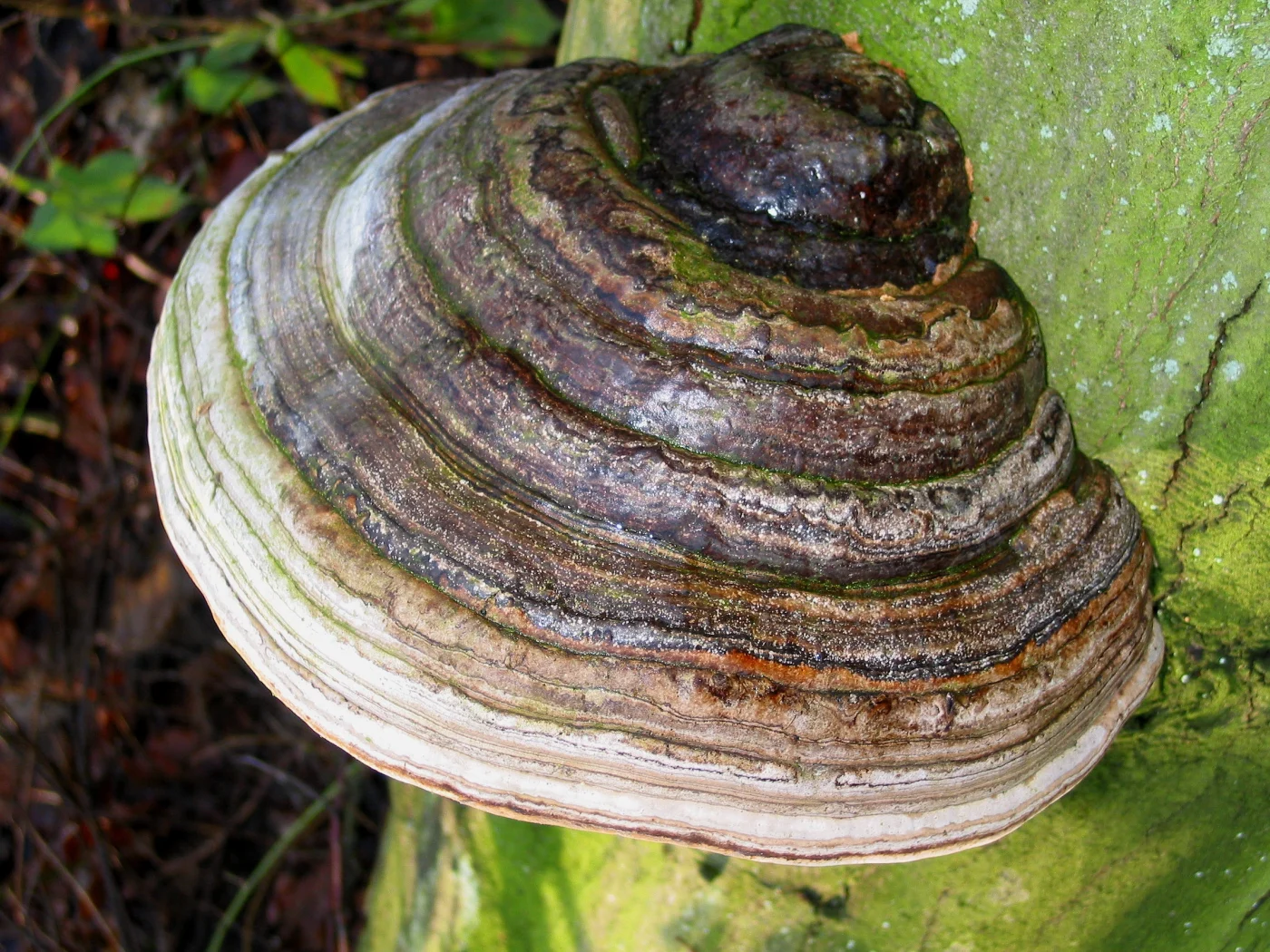
A classic fruit body is thick vertically and projects outward like a hoof. The upper surface is rounded while the lower fertile surface is flatter.
Very young specimens can be less distinctive. Older mature conks show the characteristic shape best.
Step 2: Check the Surface
Look for hard gray to brown zoning rather than a soft or brightly colored cap. Large cracks can appear with age.
A thin flexible bracket belongs to another group. Tinder Fungus should feel dense and woody.
Step 3: Look at the Pores
The underside should contain numerous tiny pale pores. They should not be large, maze-like, toothed, or gilled.
Fresh pore layers are usually paler than older tissue. Fine pores help separate the species from coarser annual polypores.
Step 4: Identify the Host
Birch and beech strongly support the identification. Other broadleaf trees are also possible.
If the fungus grows on a conifer, Fomes fomentarius becomes less likely. Host tree should always support morphology rather than override it.
White Rot and Tree Decay
Tinder Fungus is a white-rot fungus. It breaks down lignin and leaves the remaining wood pale, fibrous, and progressively weaker.
This decomposition is a normal and important part of forest nutrient cycling. Dead and weakened trees are gradually returned to the ecosystem.
What It Means for a Living Tree
Visible conks usually indicate that internal decay is already established. Removing the fruit body does not remove the fungus from inside the tree.
For large trees near buildings, roads, or frequently used areas, repeated conks may justify professional structural assessment. The concern is the condition of the tree, not the mushroom itself.
Historical Use as Tinder
The species has been associated with fire-making for thousands of years. Processed inner tissue can catch sparks and smolder slowly.
This material is commonly called amadou. Producing it requires preparation rather than simply breaking off a fresh conk and trying to burn it.
Other Traditional Uses
Amadou has also been made into soft felt-like material. Historically, it was used for various practical applications in parts of Europe.
These uses made Fomes fomentarius culturally significant long before modern mushroom identification guides existed.
How to Photograph Tinder Fungus for Identification
Take a side view showing the entire hoof-shaped profile and the way it attaches to the tree. This is more informative than a close-up of the upper surface alone.
Then photograph the underside so pore color and texture are visible. A third image should show the host tree, bark, and surrounding trunk.
If an old fallen conk can be examined without damaging living habitat, a cut surface can also reveal internal tissue and tube layers. Several angles make comparisons with other perennial polypores much easier.
Can AI Identify Fomes fomentarius?
AI can often recognize mature Tinder Fungus because the hoof-like shape and zoned gray surface are distinctive. Accuracy improves when the host tree and underside are visible.
The hardest cases are old dark conks that resemble Phellinus or other perennial polypores. A single side photo may not show enough detail for species-level confidence.
Host information is especially valuable. Birch or beech plus a classic hoof-shaped gray conk makes the identification much stronger.
Common Identification Mistakes
One common mistake is calling every hard hoof-shaped bracket Tinder Fungus. Several perennial polypores can develop similar forms.
Another mistake is relying only on birch habitat. Birch Polypore and other fungi can occupy the same tree.
A third mistake is ignoring the underside. Pore color and pore structure provide useful clues that the upper surface alone cannot supply.
Frequently Asked Questions
Can an old Tinder Fungus remain on a tree after the fungus is no longer active?
Yes. The hard fruit body can persist for a long time after active growth has slowed or stopped. An old conk therefore does not necessarily indicate that the visible surface is currently producing spores.
Why do some conks grow at strange angles on fallen trees?
The fruiting body tries to orient the pore surface downward so spores can fall effectively. If a tree falls while a conk is growing, later growth can change direction and create unusual shapes.
Can moss or algae grow on Tinder Fungus?
Yes. Old conks can remain exposed for years, providing enough time for algae, moss, and other organisms to colonize the surface. Heavy growth can hide the original gray zoning.
Can two different bracket fungi grow on the same tree?
Yes. One trunk can support several fungal species simultaneously or at different stages of decay. Each conk should therefore be identified independently rather than assuming all brackets belong to one species.
Why do some fruit bodies have very dark lower edges?
Age, weathering, frost, and previous growth layers can darken parts of the conk. The newest pore surface is usually more useful for identification than heavily weathered tissue.
Can removing the conk save an infected tree?
No. The visible fruit body is only the reproductive structure, while the main fungus already occupies wood inside the trunk. Removing the conk does not eliminate the internal mycelium.
Do woodpeckers or insects damage Tinder Fungus?
Yes. Hard conks can still be attacked by insects, and birds may damage them while searching for larvae. Old fruit bodies often contain holes or irregular broken areas.
Why can one tree have conks of several different sizes?
They may have started growing in different years or from separate infected areas within the trunk. Some remain small while others continue adding layers and become much larger.
Final Identification Notes
Fomes fomentarius is best recognized by the combination of a hard perennial hoof-shaped fruit body, gray to brown concentric zoning, tiny pale pores, no stem, fibrous internal tissue, and growth on broadleaf trees such as birch and beech.
Its closest look-alikes are usually other perennial polypores rather than soft seasonal mushrooms. Shape, pore surface, host tree, and internal structure are therefore more useful than color alone.
Because the fruit body may remain visible for years, Tinder Fungus is one of the easiest mushrooms to study outside the normal mushroom season. Winter forests in particular offer an excellent opportunity to see its classic hoof-shaped conks clearly on exposed trunks.
Upload a photo and get possible matches in seconds.