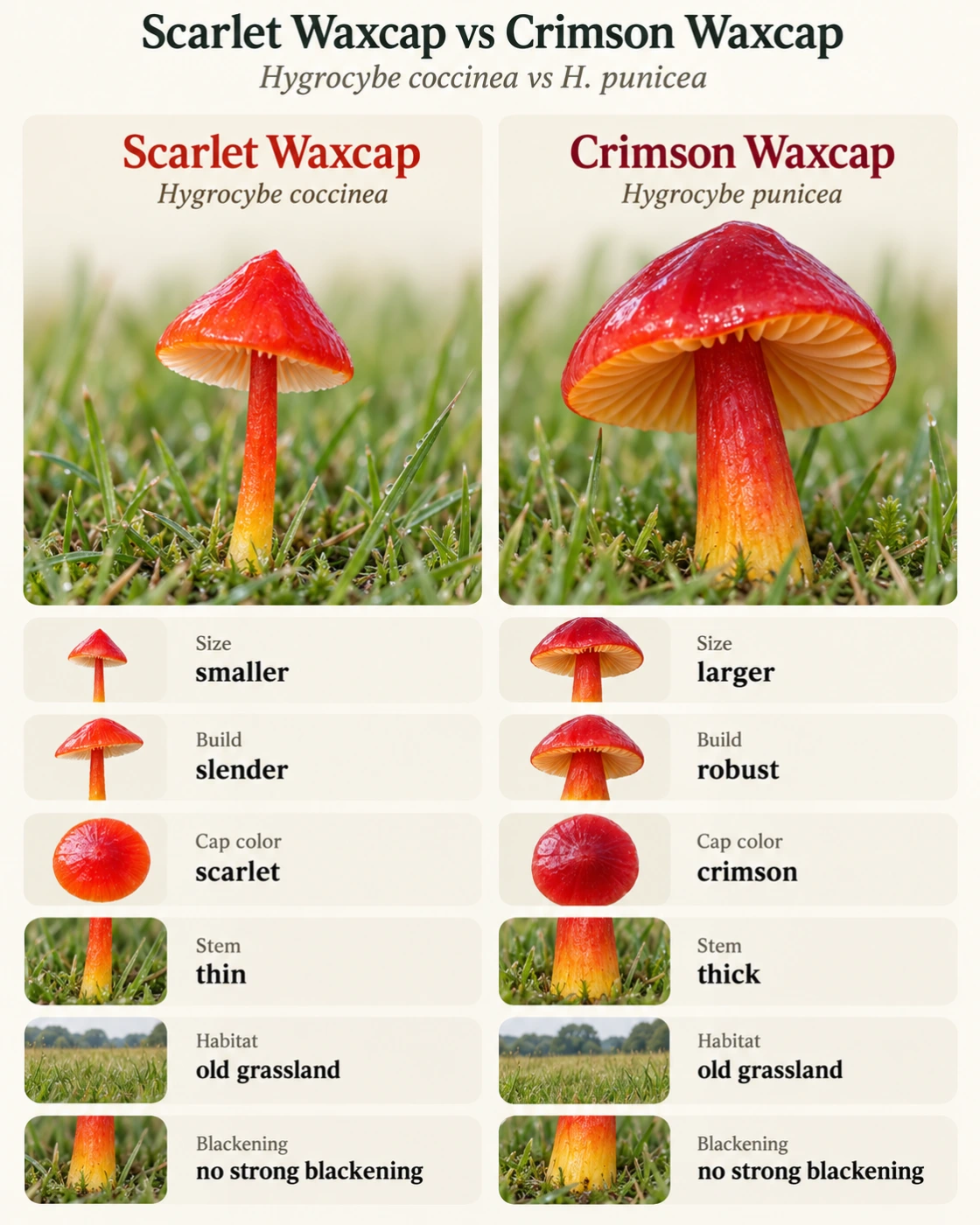
Scarlet Waxcap (Hygrocybe coccinea) and Crimson Waxcap (Hygrocybe punicea) are two of the most striking red mushrooms found in old grasslands. Both can have bright red caps, pale waxy gills, and red to orange stems, so they are easy to confuse at first glance.
The most useful difference is usually size and build. Hygrocybe coccinea is typically smaller and more delicate, while H. punicea is one of the largest and most robust red waxcaps.
⚠️ Important: Waxcaps can be difficult to identify from color alone. Cap texture, size, gill attachment, stem proportions, habitat, and aging changes should all be considered before assigning a species.
Quick Comparison
| Feature | Scarlet Waxcap | Crimson Waxcap |
|---|---|---|
| Scientific name | Hygrocybe coccinea | Hygrocybe punicea |
| Typical size | Small to medium | Medium to large |
| Build | Slender, delicate | Thick, robust |
| Cap color | Scarlet to bright red | Deep red to crimson |
| Cap surface | Smooth, often slightly moist | Smooth, often moist or greasy |
| Cap shape | Convex, later flatter | Broadly convex to expanded |
| Gills | Pale yellow, orange-yellow to reddish | Yellow-orange to reddish |
| Gill attachment | Adnate to slightly decurrent | Adnate to slightly decurrent |
| Stem | Slender, red-orange, often yellow at base | Thick, red-orange, usually yellow below |
| Blackening | No strong blackening | No strong blackening |
| Habitat | Old unimproved grassland | Old unimproved grassland |
| Season | Late summer to autumn | Late summer to autumn |
| Best clue | Smaller and more slender | Larger and more robust |
Scarlet Waxcap — Hygrocybe coccinea
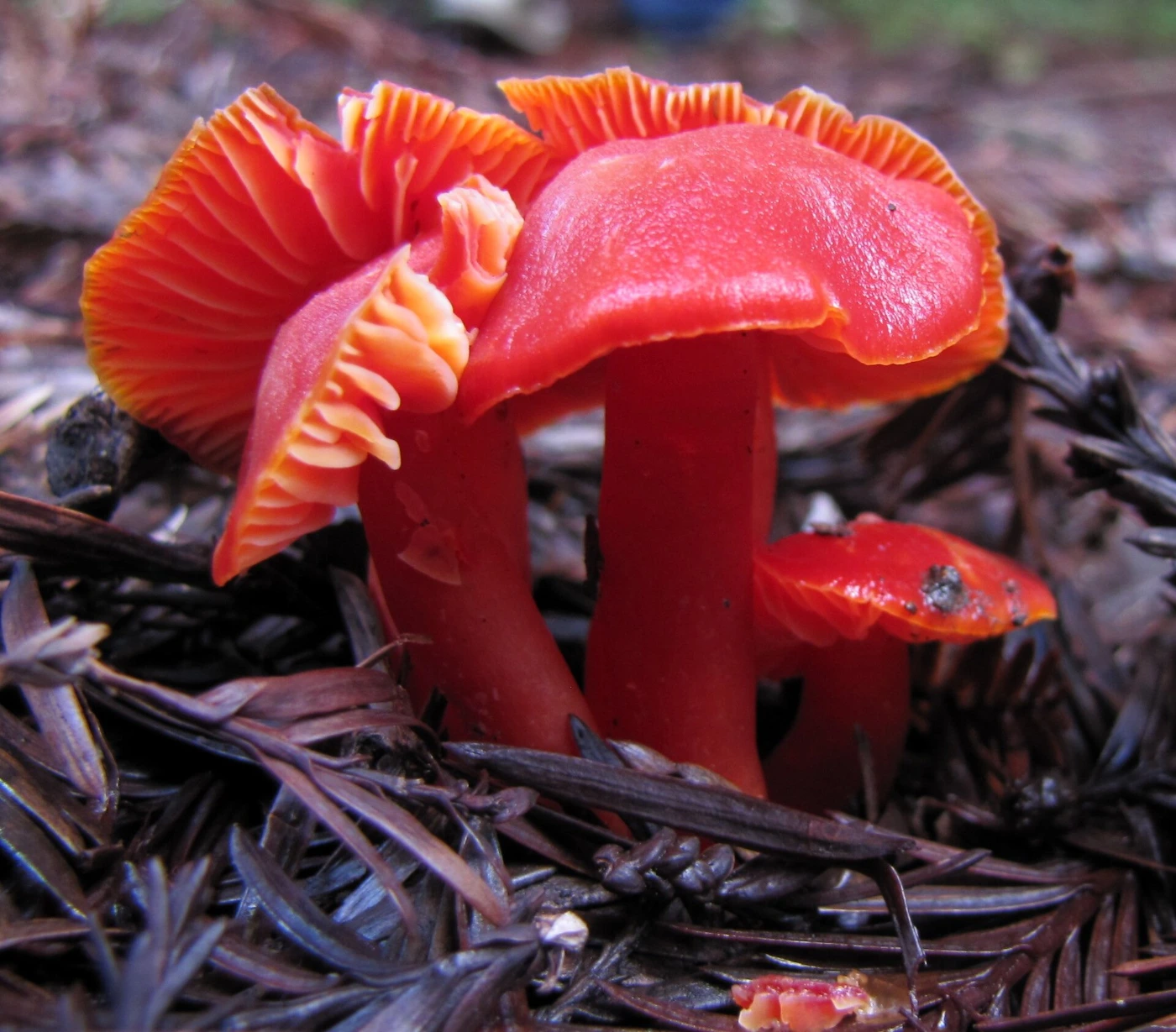
Hygrocybe coccinea is a small to medium-sized waxcap with a vivid scarlet or red cap. It often looks clean and brightly colored, especially when fresh.
The fruit body is generally slender compared with H. punicea. This lighter build is one of the most useful field characters.
Cap
The cap is usually bright scarlet, cherry-red, or orange-red. Young mushrooms are convex, while older specimens may become broadly convex or almost flat.
The surface is smooth and may be slightly moist, but it is not normally strongly slimy. Color can fade toward orange or yellowish tones with age.
Gills
The gills are thick and waxy, as expected in a waxcap. They are usually pale yellow to orange-yellow and may develop reddish tones near the cap margin.
Gill attachment can vary from broadly attached to slightly decurrent. The gills are usually fairly widely spaced.
Stem
The stem is slender and often similar in color to the cap, though it may become orange or yellow toward the base. It is generally smooth and hollow or soft inside with age.
Compared with H. punicea, the stem usually looks noticeably thinner in relation to the cap.
Crimson Waxcap — Hygrocybe punicea
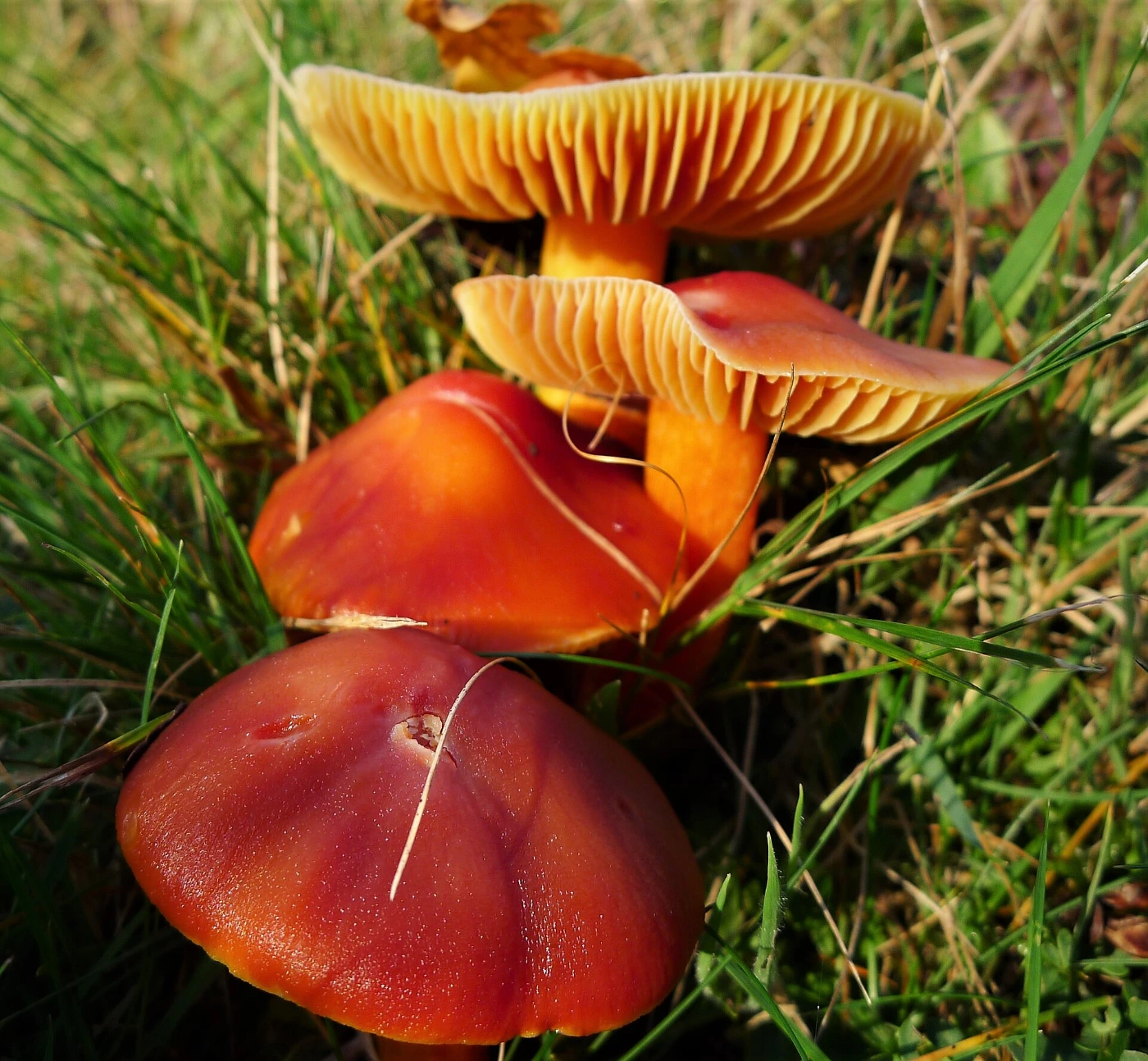
Hygrocybe punicea is one of the largest European waxcaps. Mature specimens can be much more substantial than H. coccinea, with a broad cap and thick stem.
Its color is often deeper and darker, ranging from rich red to crimson or blood-red. However, color overlaps enough that size and proportions are more reliable.
Cap
The cap is usually broad and fleshy, often deep red or crimson. Young fruit bodies can be strongly convex and later flatten considerably.
The surface is smooth and can feel moist or slightly greasy. Large mature caps can become irregular or slightly wavy around the margin.
Gills
The gills are thick, waxy, and relatively widely spaced. They are commonly yellow to orange-yellow, sometimes becoming more orange or reddish with age.
Like H. coccinea, they may be attached broadly or run very slightly down the stem. Gill attachment alone is therefore not a strong separator.
Stem
The stem is one of the best characters for H. punicea. It is usually thick, sturdy, and often somewhat flattened or irregular rather than perfectly cylindrical.
The upper stem may be red or orange-red, while the lower portion often becomes yellow. Its robust proportions are very different from the more delicate stem of H. coccinea.
Scarlet Waxcap vs Crimson Waxcap: The Main Differences
The easiest way to separate these species is to judge the whole mushroom rather than focusing on cap color. Scarlet Waxcap generally looks lighter and more delicate, while Crimson Waxcap looks heavier and more substantial.
A large, thick-stemmed red waxcap is much more likely to be H. punicea. A smaller, slender mushroom with a bright scarlet cap is more likely to be H. coccinea.
Size and Build
Hygrocybe coccinea is normally smaller, with a narrower cap and thinner stem. Even mature specimens usually maintain an elegant, relatively delicate appearance.
Hygrocybe punicea can become impressively large for a waxcap. Its cap and stem both have more mass, giving the mushroom a distinctly robust silhouette.
Cap Color
Scarlet Waxcap tends toward bright scarlet, cherry-red, or orange-red. Crimson Waxcap more often develops deeper crimson, dark red, or blood-red tones.
This distinction is useful but not absolute. Sun, rain, age, and moisture can strongly alter waxcap color.
Stem Thickness
Stem proportions are often more reliable than cap shade. H. coccinea normally has a relatively slender stem, while H. punicea has a much thicker and sturdier one.
If the stem looks disproportionately powerful compared with most waxcaps nearby, H. punicea becomes a stronger possibility.
Aging
Both species can fade as they age. Old caps may become orange, yellowish-orange, or patchy rather than remaining uniformly red.
Neither species should characteristically blacken strongly. A waxcap that quickly turns black after damage or aging belongs in a different comparison group.
Habitat
Both mushrooms are strongly associated with old, nutrient-poor grasslands. They are especially characteristic of unimproved meadows, old lawns, churchyards, pastures, and other sites that have not received heavy fertilizer.
Waxcap-rich grassland can support many species at once. Finding one red waxcap often means several other waxcap species may be nearby.
Season
Both Scarlet and Crimson Waxcaps usually fruit from late summer through autumn. The exact timing depends on rainfall, temperature, and local climate.
In mild wet years, fruiting can continue well into late autumn. Dry conditions may delay or greatly reduce the season.
Distribution
Both species are best known from Europe and other temperate regions. Their precise distribution varies, and red waxcaps reported from other continents may belong to related regional taxa.
Photographic identification should therefore take geography into account. A red waxcap outside the traditional European range should not automatically be assigned one of these names.
Are Scarlet and Crimson Waxcaps Edible?
Waxcaps are not generally good targets for beginner foraging. Many species are uncommon, difficult to distinguish, and associated with valuable old grassland habitats.
In several regions, waxcap grasslands are considered important conservation ecosystems. Even where a species is not known to be dangerously toxic, collecting rare waxcaps for food is usually unnecessary.
Look-Alikes
Several red and orange waxcaps can resemble either Hygrocybe coccinea or H. punicea. The most useful differences involve blackening, cap texture, stem proportions, and size.
Hygrocybe miniata — Vermilion Waxcap
Identification
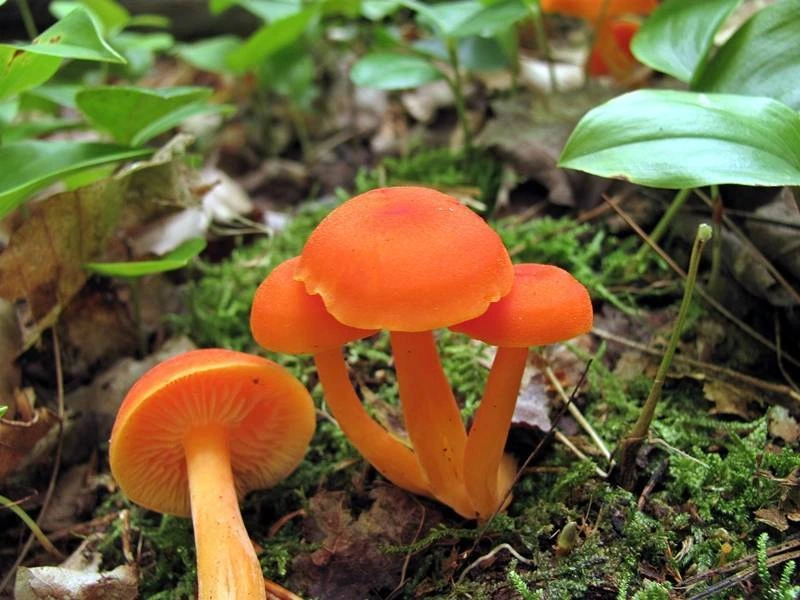
Vermilion Waxcap is usually small and has a red to orange-red cap. The surface often becomes finely scaly or granular, especially toward the center.
The fruit body is typically more delicate than either H. punicea or large specimens of H. coccinea.
Main Difference
The finely scaly cap is the strongest clue. Scarlet and Crimson Waxcaps generally have smoother caps.
Hygrocybe conica Group — Blackening Waxcaps
Identification
Blackening Waxcaps can begin red, orange, or yellow and may initially look similar to other brightly colored waxcaps. Their key character appears with age or damage.
The cap, stem, or entire mushroom gradually turns gray and then black.
Main Difference
Strong blackening separates this group from both H. coccinea and H. punicea. Neither of those species should develop such dramatic black staining.
Hygrocybe splendidissima — Splendid Waxcap
Identification
Splendid Waxcap is another large red waxcap found in high-quality grassland. It can have a vivid red cap and a sturdy appearance.
It may overlap considerably with H. punicea in size and color.
Main Difference
Exact separation can be difficult and may require a combination of cap texture, smell, stem characters, and expert experience. Large red waxcaps should therefore not automatically be called H. punicea.
Hygrocybe reidii — Honey Waxcap
Identification
Honey Waxcap is usually orange-red to red and often relatively small. Fresh or crushed specimens can develop a characteristic sweet smell.
The odor is often compared with honey.
Main Difference
A noticeable sweet honey-like smell strongly supports H. reidii. Scarlet and Crimson Waxcaps do not usually have this distinctive fragrance.
How to Identify Scarlet vs Crimson Waxcap Step by Step
Start with size and proportions before paying too much attention to color. This avoids one of the most common identification mistakes.
Then check the stem, cap surface, gills, and whether the mushroom blackens after damage.
Step 1: Judge the Overall Size
A small to medium, delicate red waxcap suggests H. coccinea. A large, heavy mushroom strongly favors H. punicea.
Use several specimens if possible because one individual may be unusually small or large.
Step 2: Examine the Stem
Look at thickness as well as color. A narrow, elegant stem fits Scarlet Waxcap, while a thick, sturdy stem fits Crimson Waxcap.
Both may show yellow near the base, so basal color alone is not enough.
Step 3: Check the Cap Surface
Both species usually have smooth caps. A clearly scaly surface suggests another species such as H. miniata.
Strong slime is also worth noting because cap texture can help narrow the waxcap group.
Step 4: Watch for Blackening
Handle the mushroom gently and look for natural aging or bruising. Strong gray-to-black discoloration points away from both species.
This is especially useful for excluding the H. conica group.
Step 5: Consider the Habitat
Old, low-nutrient grassland strongly supports both species. Heavily fertilized lawns or recently disturbed soil are less typical.
Habitat cannot separate H. coccinea from H. punicea, but it helps confirm that you are dealing with a true grassland waxcap.
How to Photograph Them for Identification
Photograph several mushrooms together if possible so their size and proportions are obvious. A single close-up can make a small Scarlet Waxcap look much larger than it really is.
Include the full stem, underside, and surrounding grassland. A side-by-side photograph with another waxcap or a familiar object for scale can be especially helpful.
Can AI Tell Scarlet Waxcap from Crimson Waxcap?
AI can often recognize a red waxcap, but separating these two species from a single cap photograph is difficult. Their colors overlap too much for color-based identification to be reliable.
The best images show the entire mushroom and provide a sense of scale. Multiple fruit bodies are even better because the difference in average build becomes much clearer.
Common Identification Mistakes
The most common mistake is using red shade alone. Scarlet, crimson, orange-red, and blood-red tones can overlap widely depending on weather and age.
Another mistake is ignoring size. H. punicea is notable precisely because it is such a large, robust waxcap.
A third mistake is overlooking blackening. Red waxcaps that later turn black belong to a different group and should not be forced into either species.
Interesting Facts
Waxcaps are strongly associated with old grasslands that have received little fertilizer. Their presence can therefore indicate long-term continuity and relatively undisturbed soil conditions.
A rich waxcap site may contain many species in a very small area. For this reason, waxcap grasslands are sometimes considered important indicators of biodiversity.
The intense red pigments of these mushrooms can fade rapidly with age and weather. This is one reason field guides often show a much narrower color range than people encounter in real grassland.
The unusually large size of Hygrocybe punicea makes it one of the most impressive members of the group. Mature specimens can look almost too substantial to be a typical waxcap.
Frequently Asked Questions
Can Scarlet Waxcap become orange?
Yes. Older or weathered specimens can fade from scarlet to orange or orange-yellow, especially near the margin.
Can Crimson Waxcap ever be small?
Yes. Young or poorly developed specimens can be much smaller than typical mature fruit bodies, which can make identification difficult.
Do both species grow in the same field?
Yes. High-quality waxcap grasslands can support several red waxcap species at the same time.
Does rain make the cap darker?
Often yes. Wet caps can look deeper red and more saturated, while dry specimens may appear paler.
Can one mushroom be identified from a cap-only photo?
Sometimes only to a general red waxcap group. Stem thickness, gills, scale, habitat, and aging reactions are important for separating similar species.
Why are waxcaps associated with old lawns and churchyards?
These sites can remain unfertilized and relatively undisturbed for many years. Such conditions favor the specialized fungal communities associated with waxcap grasslands.
Do Scarlet or Crimson Waxcaps blacken when damaged?
They should not show the strong progressive blackening typical of the Hygrocybe conica group. Minor darkening from age or decay is different from true blackening.
Final Identification Notes
The simplest distinction between these two mushrooms is build rather than color. Hygrocybe coccinea is generally the smaller, slimmer Scarlet Waxcap, while Hygrocybe punicea is the larger, thicker, more robust Crimson Waxcap.
Both share smooth red caps, waxy gills, reddish stems with yellowish lower portions, and old nutrient-poor grassland habitat. Neither should strongly blacken with age or damage.
The practical field rule is: small and slender = more likely Scarlet Waxcap; large and sturdy = more likely Crimson Waxcap.
Upload a photo and get possible matches in seconds.