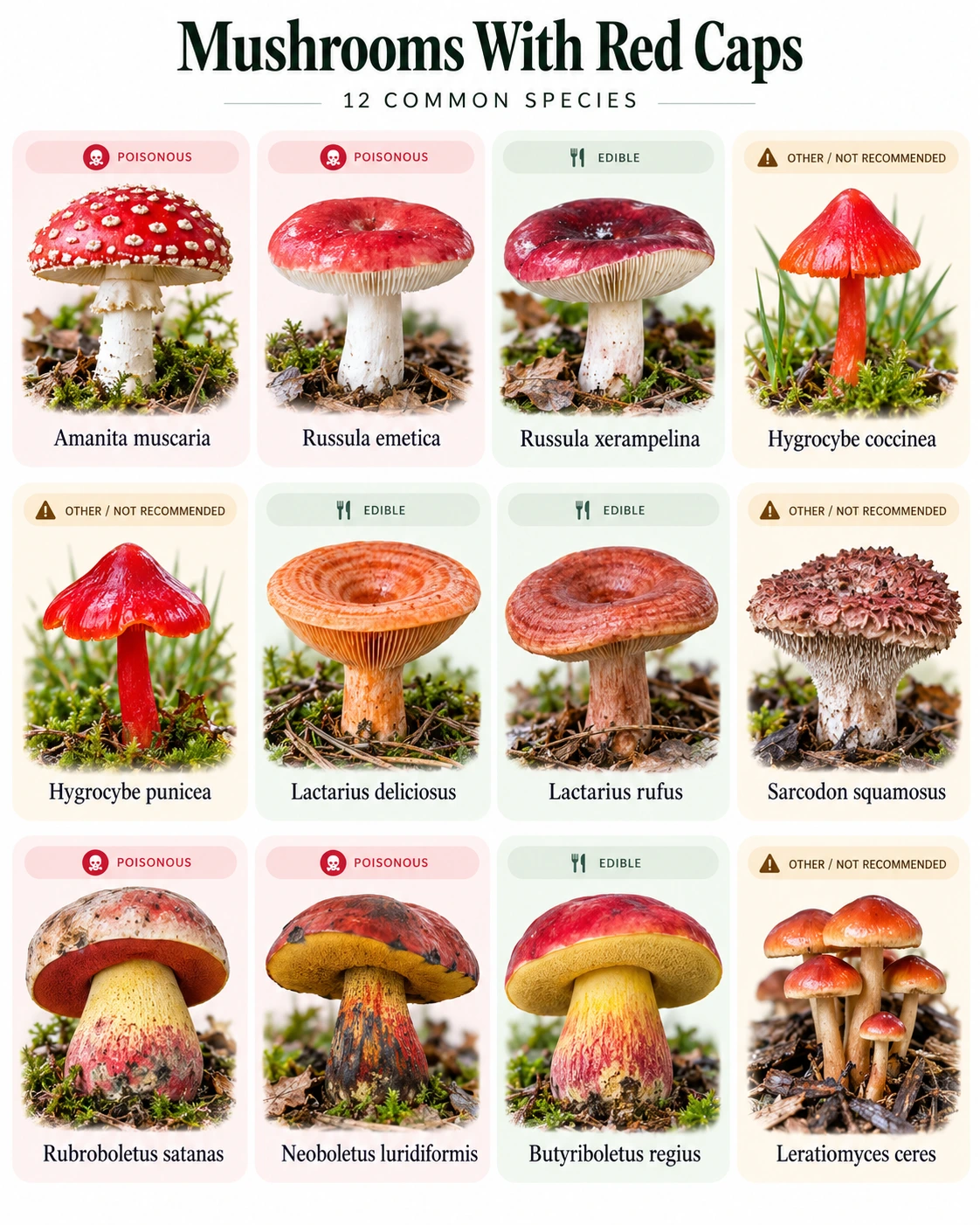
Red-capped mushrooms are some of the most eye-catching fungi in forests, parks, lawns, and woodland edges. Unfortunately, red is one of the least reliable identification features because edible, inedible, poisonous, and even deadly species can all have red or reddish caps.
The safest way to identify a red mushroom is to look beyond color and examine the underside, stem, stem base, bruising, latex, spore color, host trees, and habitat. A red cap can be useful as a starting clue, but it should never be used as evidence that a mushroom is safe to eat.
⚠️ Important: This guide is for identification and education only. Never eat a wild mushroom based solely on cap color, photographs, AI identification, or an online comparison.
Quick Guide to 12 Common Red-Capped Mushrooms
| Species | Common name | Main clue | Safety |
|---|---|---|---|
| Amanita muscaria | Fly Agaric | Red cap, white veil remnants | Poisonous |
| Russula emetica group | Sickener | Bright red cap, white brittle gills | Poisonous / irritating |
| Russula xerampelina group | Shrimp Russula | Red-purple cap, shrimp-like odor | Edible when correctly identified |
| Hygrocybe coccinea | Scarlet Waxcap | Bright scarlet cap, waxy gills | Not recommended for beginners |
| Hygrocybe punicea | Crimson Waxcap | Deep red cap, robust waxcap shape | Edibility uncertain / not recommended |
| Lactarius deliciosus | Saffron Milk Cap | Orange-red cap, orange latex, green staining | Edible when correctly identified |
| Lactarius rufus | Rufous Milkcap | Brick-red cap, white acrid latex | Inedible / irritating |
| Sarcodon squamosus group | Scaly Hedgehog | Brown-red scaly cap, teeth underneath | Edibility varies |
| Rubroboletus satanas | Satan’s Bolete | Pale cap, red pores, blue bruising | Poisonous |
| Neoboletus luridiformis | Scarletina Bolete | Dark cap, red pores, fast blueing | Edibility requires expert ID and preparation |
| Butyriboletus regius | Royal Bolete | Pink-red cap, yellow pores | Edible when correctly identified |
| Leratiomyces ceres | Chip Cherry / Redlead Roundhead | Red-orange cap on wood chips | Inedible / possibly toxic |
Why Red Caps Are Misleading
Red coloration appears in many unrelated mushroom groups. Amanitas, Russulas, waxcaps, milkcaps, boletes, and wood-chip fungi can all produce red caps for completely different evolutionary reasons.
This means that “red mushroom” is a visual category rather than a taxonomic one. Two red mushrooms growing side by side may be less closely related than a red mushroom and a brown one.
Color Changes With Age and Weather
A bright scarlet cap can fade to orange, pink, yellowish, or brown after sun exposure and rain. Some species become patchy or washed out enough that the original red color is hard to recognize.
Young mushrooms may also be much more intensely colored than old specimens. For this reason, exact shade should always be treated as supporting evidence rather than a decisive feature.
1. Amanita muscaria — Fly Agaric
Identification
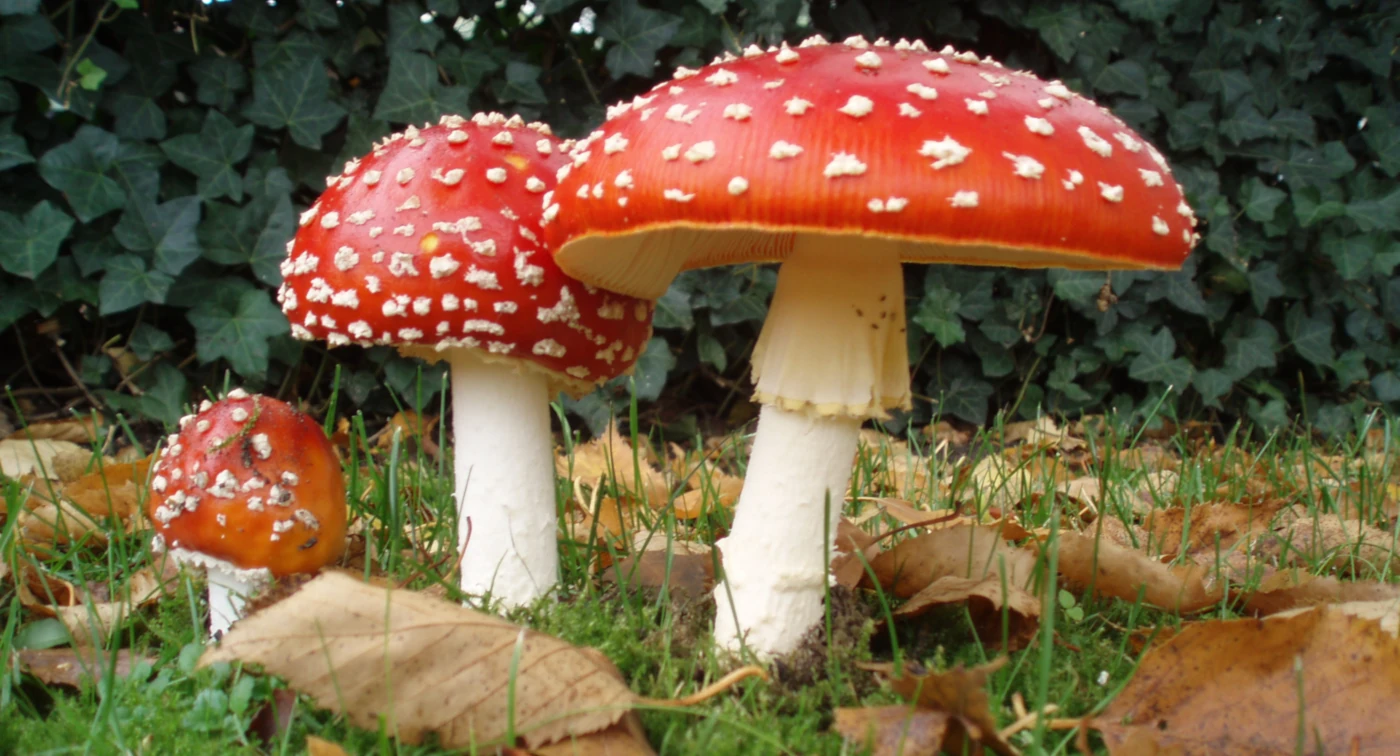
Fly Agaric is probably the world’s most famous red mushroom. It usually has a vivid red to orange-red cap covered with white veil remnants, along with white gills, a pale stem, a ring, and a bulbous base.
The white cap spots can be washed away by heavy rain. Older specimens may therefore look like smooth red or orange mushrooms rather than the classic storybook form.
Habitat
It grows in mycorrhizal association with birch, pine, spruce, and other trees. Forest edges, parks, and planted landscapes can all support it.
The species is especially common in temperate and boreal regions. Fruiting is usually strongest from late summer through autumn.
Safety
Fly Agaric is poisonous and contains ibotenic acid and muscimol. Poisoning can cause confusion, altered perception, poor coordination, nausea, and other neurological symptoms.
It does not contain the amatoxins associated with Death Caps. Its poisoning syndrome is different, although serious illness can still occur.
2. Russula emetica Group — The Sickener
Identification
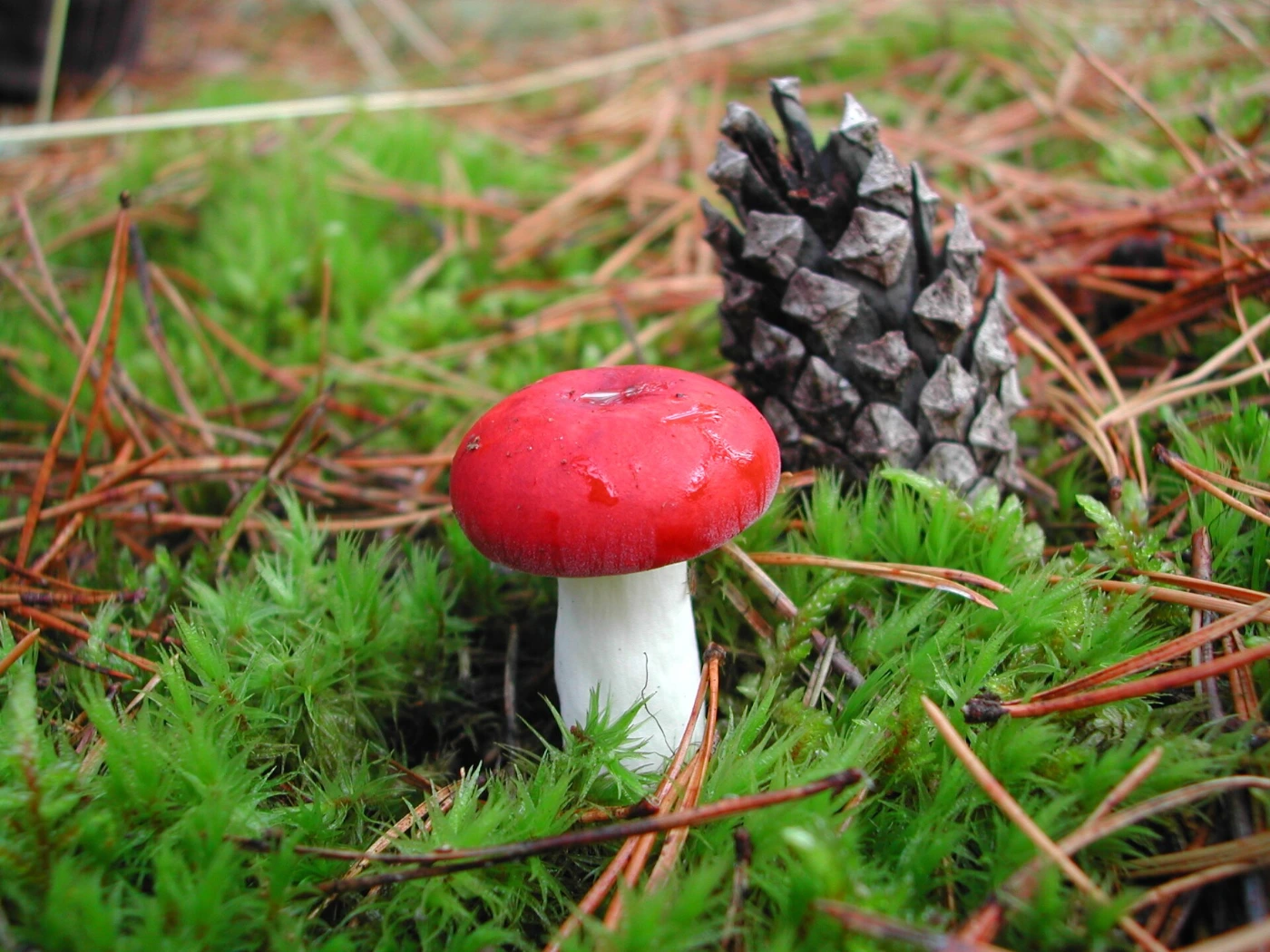
The Sickener group includes bright red Russulas with white to cream gills and very brittle flesh. The cap surface can be glossy when wet and may peel partly from the margin.
Like other Russulas, the stem breaks cleanly rather than bending fibrously. There is no ring or volva.
Habitat
These mushrooms are commonly associated with conifers and acidic soils. Damp spruce, pine, and mixed forests are typical habitats.
Exact species identification within the red Russula complex can be difficult. Several similar taxa have historically been grouped under familiar names.
Safety
The Sickener is considered poisonous or strongly irritating when eaten raw or improperly prepared. It can cause nausea, vomiting, and gastrointestinal distress.
Bright red Russulas should not be judged by color alone. Several edible species can look very similar.
3. Russula xerampelina Group — Shrimp Russulas
Identification
Shrimp Russulas often have red, wine-red, purple-red, or brownish-red caps. Their white to cream gills and brittle flesh place them clearly in the Russula group.
Mature specimens frequently develop a distinctive shrimp-like, seafood-like, or fishy odor. The stem may slowly stain brownish when handled.
Habitat
Different members of the group associate with conifers and broadleaf trees. Pine and spruce forests can be especially productive.
Modern taxonomy recognizes several closely related species rather than one universal mushroom. Geography and host tree can therefore matter.
Safety
Many members of the group are considered edible when correctly identified. Exact species confidence is still important because red Russulas can be difficult to separate visually.
4. Hygrocybe coccinea — Scarlet Waxcap
Identification
Scarlet Waxcap has a small to medium scarlet or orange-red cap with thick, waxy-looking gills. The cap is often smooth and slightly greasy rather than scaly.
The stem is slender and usually red, orange, or yellowish. The entire mushroom often looks unusually clean and bright.
Habitat
Waxcaps are famous for old grasslands, meadows, lawns, and other low-nutrient habitats. They are less strongly associated with trees than many woodland mushrooms.
Healthy waxcap communities can indicate long-established undisturbed grassland. Their ecology differs greatly from Amanitas and boletes.
Safety
Scarlet Waxcap is not generally treated as a beginner edible. Several waxcaps are poorly studied from a culinary perspective, and exact identification can be difficult.
5. Hygrocybe punicea — Crimson Waxcap
Identification
Crimson Waxcap is one of the largest red waxcaps. It has a deep red to crimson cap that may fade toward orange or yellowish tones with age.
The gills are thick and waxy, while the stem is comparatively robust. Older caps can split or become irregular.
Habitat
It is associated mainly with unimproved grasslands and similar habitats. It is especially notable in places where waxcap diversity is high.
Its presence can be ecologically interesting even when the mushroom itself is not collected. Grassland habitat is therefore a major clue.
Safety
Edibility is uncertain or inconsistently treated in field guides. It is better regarded as an identification species rather than a food mushroom.
6. Lactarius deliciosus — Saffron Milk Cap
Identification
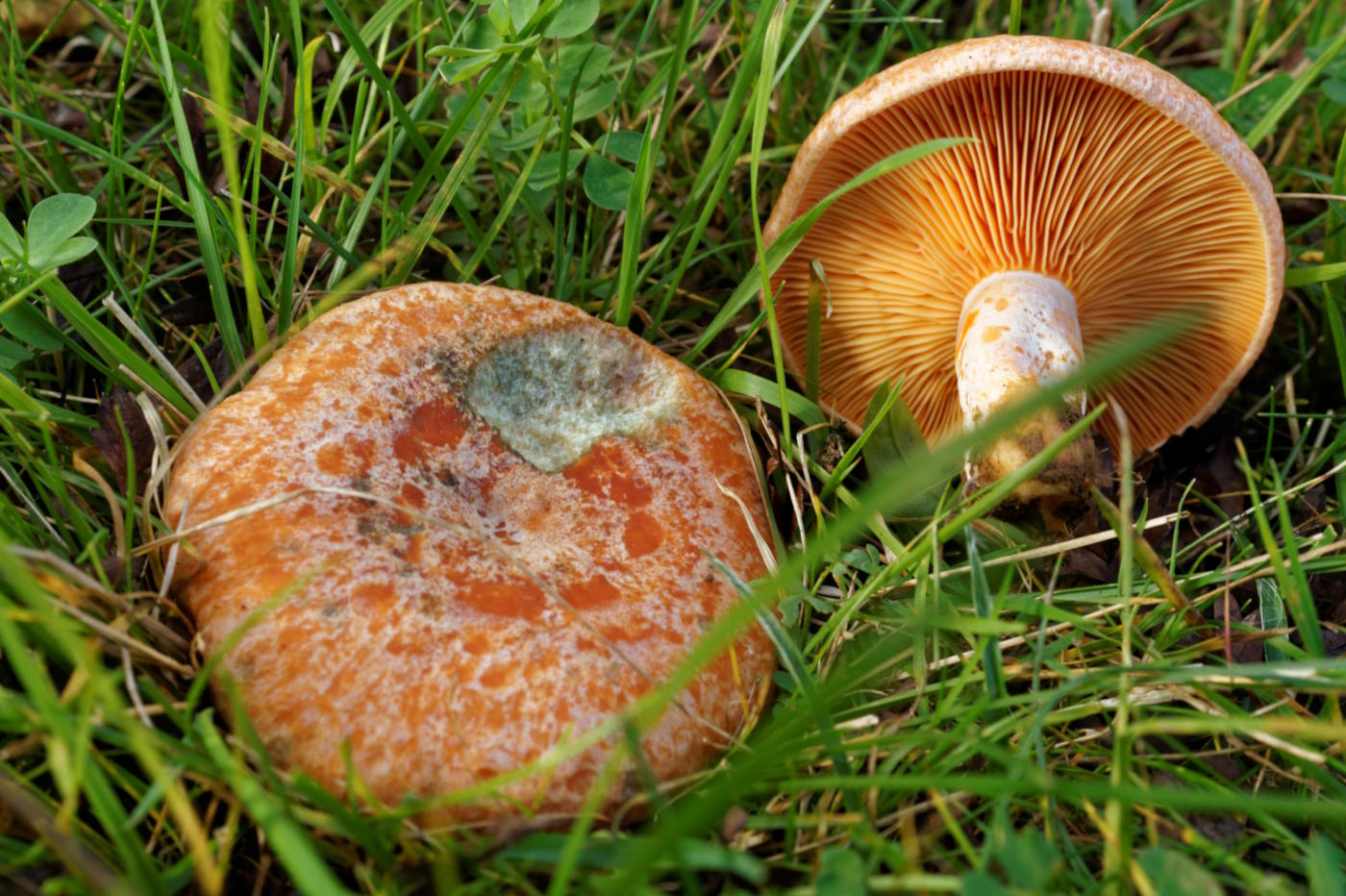
Saffron Milk Cap has an orange to reddish-orange cap, often with darker concentric zones. The gills are orange and release orange latex when damaged.
Green staining develops on bruised areas and old tissue. This orange-and-green combination is one of the most characteristic features of the group.
Habitat
The species is strongly associated with pine. It grows from soil in pine forests, plantations, and grassy areas influenced by pine roots.
Related orange milkcaps may associate with spruce or fir instead. Host tree is therefore useful for species-level identification.
Safety
It is edible when correctly identified. The orange latex, green staining, and pine association should all agree before assigning the name.
7. Lactarius rufus — Rufous Milkcap
Identification
Rufous Milkcap has a reddish-brown to brick-red cap, often with a small central bump. The gills are pale and release white latex when damaged.
The latex and flesh are strongly acrid. The mushroom usually has the brittle texture typical of milkcaps.
Habitat
It is common in acidic conifer forests and often grows beneath pine and spruce. Mossy forest floors can produce large numbers.
The relatively plain cap makes it easy to overlook. Latex is the fastest way to recognize it as a milkcap.
Safety
It is generally considered inedible or irritating without specialized traditional preparation. Beginners should not collect acrid milkcaps for food.
8. Sarcodon squamosus Group — Scaly Hedgehogs
Identification
Scaly Hedgehogs have broad brown to reddish-brown caps covered with coarse dark scales. The underside has downward-pointing teeth rather than gills or pores.
The fruit bodies are usually robust and can become large. The cap often looks rough, dry, and heavily patterned.
Habitat
Several species are associated with conifer forests, especially pine. Modern taxonomy has separated older broad species concepts into more regional taxa.
Host tree and geography are therefore useful for narrowing the exact species. Group-level identification is often more reliable from photographs.
Safety
Edibility varies within the group. Some species are bitter or tough, particularly when old.
9. Rubroboletus satanas — Satan’s Bolete
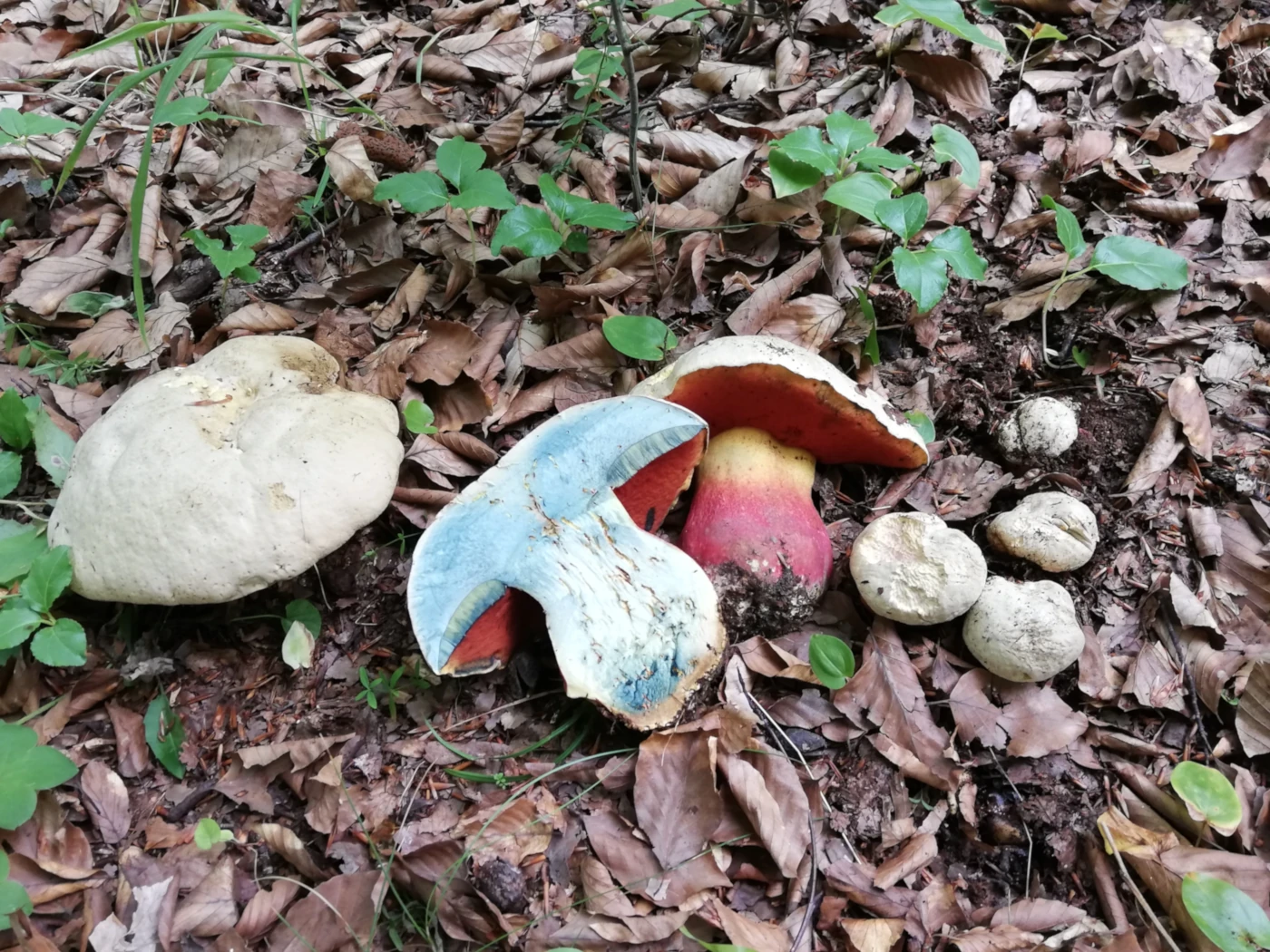
Identification
Satan’s Bolete is a large heavy bolete with a pale grayish cap, red pores, and a thick red-and-yellow stem. Although the cap itself is not always bright red, the mushroom belongs in red-themed identification because the pore surface and stem can be intensely crimson.
The yellow flesh can turn blue when cut. The combination of pale cap, red pores, and blue bruising is highly distinctive.
Habitat
It is associated mainly with warm broadleaf woodland, often on calcareous soil. Oak and beech are common host trees in Europe.
It is less typical of cold acidic conifer forests. Habitat can therefore help exclude it from similar boletes.
Safety
Satan’s Bolete is poisonous and can cause severe gastrointestinal illness. It should not be confused with edible red-pored boletes.
10. Neoboletus luridiformis — Scarletina Bolete
Identification
Scarletina Bolete has a dark brown to reddish-brown cap, red to orange-red pores, and a stem covered with red dots rather than strong reticulation. The flesh turns dark blue rapidly when damaged.
This intense blue reaction can occur within seconds. It is one of the most dramatic bruising reactions among European boletes.
Habitat
It grows with both conifers and broadleaf trees depending on region. Woodland soil is the typical setting.
The species often appears from summer through autumn. Acidic forests can be particularly productive.
Safety
The species has a history of culinary use after thorough cooking in some regions, but correct identification is essential. Red-pored boletes are not suitable beginner mushrooms because poisonous look-alikes exist.
11. Butyriboletus regius — Royal Bolete
Identification
Royal Bolete is an attractive species with a pink, rose-red, or reddish cap and bright yellow pores. The stem is yellow and may show fine reticulation.
The flesh is pale yellow and may show little or limited blue staining depending on the specimen. The overall color combination can be striking.
Habitat
It is associated mainly with broadleaf trees such as oak and beech. Warm woodland on suitable soils is typical.
The species is uncommon or locally rare in some regions. Habitat protection can therefore be more important than collecting it.
Safety
It is considered edible when correctly identified. Because of rarity and confusion with other red-capped boletes, collecting may be inappropriate in some areas.
12. Leratiomyces ceres — Chip Cherry
Identification
Leratiomyces ceres has a bright red, orange-red, or brick-red cap and grayish to darkening gills. The stem is pale and may retain fragments of veil tissue.
The mushroom often appears in groups. Its vivid caps stand out strongly against pale wood chips.
Habitat
Wood-chip beds, landscaped gardens, parks, and urban planting areas are typical habitats. It is especially common where fresh woody mulch is used.
This substrate is one of the strongest identification clues. A red mushroom growing from wood chips belongs in a very different identification path from a woodland Amanita.
Safety
It is generally regarded as inedible and may cause gastrointestinal illness. It should not be confused with edible woodland species simply because of cap color.
Red Caps With White Gills
A red cap combined with white gills occurs in several groups, especially Amanita and Russula. The stem structure is the fastest way to separate them.
Fly Agaric usually has a ring, veil remnants, and a bulbous stem base. Russulas lack both ring and volva and have brittle, chalk-like flesh.
Check the Stem Base
Never cut an unknown Amanita off at ground level. The base may contain important veil structures needed for identification.
Russulas do not have a volva. Their stems are generally clean, solid-looking, and brittle.
Red Caps With Pores
If the underside is spongy rather than gilled, you are likely dealing with a bolete or related fungus. Red-pored boletes deserve particular caution because edible and poisonous species can look similar.
Pore color, bruising, stem pattern, and cap color should all be checked. Rapid blue bruising by itself does not indicate whether the species is edible.
Red Caps With Latex
Milkcap mushrooms release latex when the gills or flesh are damaged. Latex color can be extremely useful.
Saffron Milk Cap has orange latex and often turns green after bruising. Rufous Milkcap releases white latex and has a much more acrid character.
Red Caps With Teeth
Toothed fungi have downward-pointing spines instead of gills or pores. Scaly Sarcodon species can have dark reddish-brown caps and are often associated with conifers.
The toothed underside instantly separates them from red Russulas, Amanitas, and boletes. Cap texture then helps narrow the group.
Edible Red-Capped Mushrooms
Several red or reddish mushrooms are edible when correctly identified, including Saffron Milk Cap, Shrimp Russulas, Royal Bolete, and some carefully identified boletes.
Their red coloration has no relationship to edibility. Each belongs to a different group and requires different identification features.
This is why general rules such as “bright colors mean poisonous” are unreliable. Many dangerous mushrooms are pale, while many edible species are vivid.
Poisonous Red-Capped Mushrooms
Fly Agaric, Sickener-type Russulas, Satan’s Bolete, and some other red or red-marked mushrooms can cause poisoning. The symptoms and toxins differ greatly between species.
There is no single “red mushroom toxin.” Some cause neurological effects, others gastrointestinal irritation, and completely different deadly mushrooms may not be red at all.
How to Identify a Red-Capped Mushroom Step by Step
Start with the underside. Decide whether the mushroom has gills, pores, teeth, ridges, or another structure. Then examine the stem for a ring, volva, reticulation, dots, or brittleness. Finally, check bruising, latex, habitat, nearby trees, and spore color if needed.
Step 1: Ignore the Red Color for a Moment
Pretend the cap is brown and ask what structural group the mushroom belongs to. This prevents the bright color from dominating the identification. A red bolete should first be recognized as a bolete. A red Russula should first be recognized as a brittle-gilled mushroom.
Step 2: Check the Underside
White gills, red pores, waxy gills, orange gills, and teeth all point toward different groups. This is usually the most useful first observation. Photograph the underside clearly. Cap-only photographs are especially weak for red mushroom identification.
Step 3: Examine the Stem and Base
Look for rings, volvas, reticulation, dots, color changes, and texture. The full stem base is essential when Amanita is possible. A missing stem base can turn an otherwise useful specimen into an incomplete identification.
Step 4: Test for Latex or Bruising
Milkcap gills can be lightly damaged to check for latex. Boletes can be pressed or cut to document bruising. Record how quickly colors change. Reaction speed can be as useful as the final color.
Step 5: Check Habitat
Wood chips, old grassland, pine forest, oak woodland, and mixed woodland support very different red mushrooms. Substrate and host trees can quickly narrow the possibilities. Habitat should confirm morphology rather than replace it. A mushroom with the wrong underside is not the right species simply because it grows in the expected place.
How to Photograph Red Mushrooms for Identification
Take the first image before touching the mushroom so the habitat and natural color remain visible. Include enough background to show whether it grows from soil, wood, grass, or mulch.
Then photograph the underside and complete stem. For Amanitas, carefully expose the entire stem base without cutting it off.
A final close-up should document special features such as latex, bruising, pores, scales, or veil remnants. Natural daylight gives more reliable red tones than strongly warm indoor lighting.
Can AI Identify Red-Capped Mushrooms?
AI can often narrow a red mushroom to the correct major group when the underside and stem are visible. It performs much worse when given only a bright red cap. The problem is that color creates superficial similarity between unrelated fungi. A Scarlet Waxcap, Fly Agaric, and red Russula can all appear “small red mushroom” in a poorly framed photograph. For better identification, provide several views and include habitat. The underside, stem base, and surrounding trees usually add more useful information than cap color.
Common Identification Mistakes
One common mistake is assuming red means poisonous. This fails because several edible mushrooms are red or orange-red.
Another mistake is assuming a familiar red mushroom must be Fly Agaric. Rain can remove Fly Agaric’s spots, but many unrelated smooth red mushrooms also exist.
A third mistake is ignoring the underside because the cap seems distinctive. In practice, the underside is often the fastest way to avoid major identification errors.
Frequently Asked Questions
Why do some red mushrooms turn orange after heavy rain?
Pigments can fade or wash out as the cap ages and becomes waterlogged. A scarlet cap may therefore become orange, pinkish, or yellowish without representing a different species.
Can sunlight bleach only one side of a red cap?
Yes. Mushrooms exposed unevenly to direct sunlight can fade asymmetrically. One side may remain dark red while the exposed side becomes orange or pale.
Why do red mushrooms sometimes stain nearby leaves or grass?
Wet pigments, spores, and damaged tissue can transfer color onto surrounding material. This staining is not necessarily a diagnostic feature of the species.
Can young red mushrooms look completely different from mature ones?
Yes. Young caps may be strongly rounded, more intensely colored, and partly covered by veil tissue. Mature mushrooms can flatten, fade, split, or lose surface decorations.
Are red mushrooms more common in autumn?
Many woodland species are, because autumn moisture and temperature favor fruiting. Waxcaps and some other groups can also peak later in the season depending on climate.
Can frost make a red cap appear darker?
Yes. Freezing and thawing can damage tissue and create darker, translucent, or brownish patches. Fresh unfrozen areas usually show the most reliable color.
Why do several unrelated red mushroom species grow in the same forest?
Color is not tied to one ecological strategy. Mycorrhizal Amanitas, Russulas, milkcaps, and boletes can all share the same woodland because they associate with the same trees in different ways.
Should I use a phone camera’s enhanced color mode for identification?
Prefer natural or neutral color settings. Heavy saturation and automatic enhancement can shift red toward orange or purple and make subtle identification features less reliable.
Final Identification Notes
A red cap is an excellent reason to look closer, but it is a poor reason to name a mushroom. Fly Agaric, red Russulas, milkcaps, waxcaps, boletes, and wood-chip fungi can all be red while differing completely in structure, ecology, and toxicity.
Start with the underside, then examine the stem and stem base. Latex, bruising, pore color, gill texture, host trees, and habitat are far more informative than the exact shade of red.
The most useful rule is simple: identify the mushroom first and the color second. Red can narrow the visual search, but the complete set of structural features determines what the mushroom actually is.
Upload a photo and get possible matches in seconds.