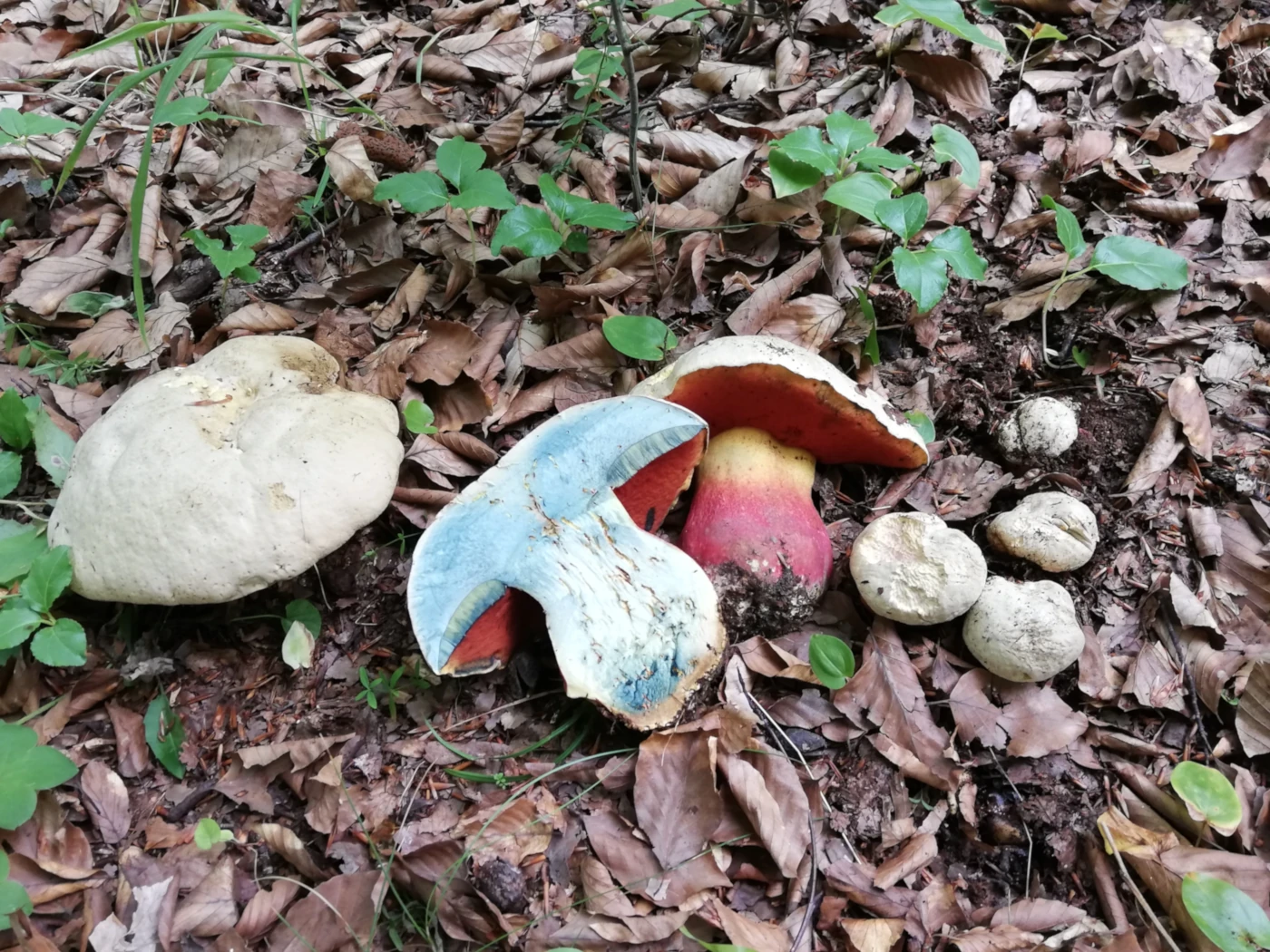
Rubroboletus satanas, commonly known as Satan’s Bolete, is a large and striking bolete found mainly in warm broadleaf woodland. It is recognized by its pale gray to whitish cap, red to orange-red pores, thick yellow-and-red stem, and flesh that often turns blue when cut or bruised.
Despite its dramatic appearance, Satan’s Bolete can still be confused with several other red-pored boletes. The safest identification comes from combining cap color, pore color, stem pattern, bruising reaction, habitat, and geography rather than relying on the red-and-blue color changes alone.
Important: This guide is for identification and education only. Rubroboletus satanas is poisonous. Never eat a wild mushroom based solely on photographs, AI identification, or an online comparison.
Quick Identification
| Feature | Rubroboletus satanas |
|---|---|
| Scientific name | Rubroboletus satanas |
| Common name | Satan’s Bolete |
| Family | Boletaceae |
| Cap color | White, pale gray, beige-gray |
| Underside | Pores, not gills |
| Young pores | Yellowish to orange |
| Mature pores | Orange-red to red |
| Stem | Very thick, bulbous |
| Stem color | Yellow with red to reddish zones |
| Stem pattern | Fine red reticulation may be present |
| Flesh | Pale yellow to whitish |
| Bruising | Blueing after cutting or pressure |
| Spore print | Olive-brown |
| Ecology | Mycorrhizal |
| Main hosts | Oak, beech and other broadleaf trees |
| Soil | Often calcareous |
| Season | Summer to early autumn |
| Toxicity | Poisonous |
| Main look-alikes | Rubroboletus legaliae, Rubroboletus rhodoxanthus, Suillellus luridus, Neoboletus luridiformis |
What Does Rubroboletus satanas Look Like?
Satan’s Bolete is usually a large, heavy mushroom with a very thick stem and a pale cap. Mature fruit bodies can become impressive in size and often look disproportionately stout.
The cap is normally much paler than the stem and pore surface. This contrast between a pale top and intense red underneath is one of the most useful visual clues.
The flesh can turn blue when damaged, sometimes quite strongly. However, the exact speed and intensity of this reaction can vary between specimens.
Cap
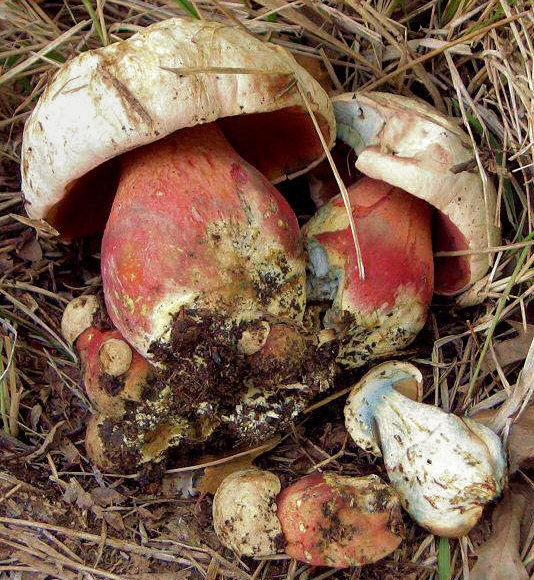
The cap begins rounded and later becomes broadly convex or nearly flat. It is usually pale gray, off-white, cream-gray, or beige-gray.
Young mushrooms may look almost chalky from above. Older caps can become more yellowish, brownish, or stained around the edge.
Cap Surface
The surface is generally dry to slightly velvety. It is not typically glossy or strongly sticky.
Cracks may develop in older specimens or during dry weather. Dirt and leaf litter can also change the apparent color considerably.
Pores
The underside has pores rather than gills. Young pores can begin yellowish or orange before becoming progressively more red.
Mature fruit bodies may have vivid orange-red to blood-red pore surfaces. This is one of the most striking features of the species.
Bruising of the Pores
Pressure often causes the pore surface to turn blue. The reaction may appear within seconds or develop more gradually.
Blue bruising is useful but not unique. Several edible and poisonous red-pored boletes show similar reactions.
Stem
The stem is usually very thick, swollen, and often bulbous. It can look almost barrel-shaped in young specimens.
Color is typically yellow toward the upper portion and red or reddish lower down. The combination can be very vivid.
Stem Reticulation
Fine reddish reticulation may be visible on the stem. The pattern can vary in intensity and may be more obvious on fresh specimens.
Reticulation helps separate some red-pored boletes, but it should not be used alone. Overall stem color and habitat are equally important.
Flesh
The flesh is pale yellow to whitish. When cut, it often develops blue discoloration.
The blueing can be strongest in some parts of the cap or stem and weaker in others. Older tissue may react less dramatically.
Smell
Young specimens may have a mild smell. Older mushrooms can develop a stronger and sometimes unpleasant odor.
Odor is not reliable enough for primary identification. Structural features are far more useful.
Spore Print
The spore print is olive-brown. This is typical for many boletes.
Spore color confirms the broader group but does not distinguish Satan’s Bolete from close relatives. Cap, pores, stem, and habitat are more practical in the field.
Where Does Rubroboletus satanas Grow?
The species is mycorrhizal and grows from soil in association with living broadleaf trees. Oak and beech are among the most common hosts.
Warm deciduous woodland, open oak forest, woodland edges, and park-like habitats can all support it. It often favors calcareous or base-rich soils.
Oak and Beech Association
Oak is one of the classic host trees. Beech can also be important in suitable regions.
This broadleaf association helps separate Satan’s Bolete from some red-pored species that are more common with conifers or on acidic soils.
When Does Satan’s Bolete Grow?
The main season is summer into early autumn. Warm conditions are generally more favorable than cool late-season weather.
In southern and central Europe, fruiting may begin during hot summer periods after rain. In cooler regions, it can be much less common.
Warm-Climate Preference
Satan’s Bolete is often associated with relatively warm habitats. This makes it more typical of lowland or thermophilous broadleaf woodland than cold mountain conifer forests.
Climate is therefore a useful supporting clue. It should still be combined with morphology.
Distribution
Rubroboletus satanas is primarily a European and western Eurasian species. It is especially associated with central, southern, and parts of western Europe.
Reports from other regions require care because similar red-pored boletes may belong to different species. Regional taxonomy matters.
Is Rubroboletus satanas Poisonous?
Yes. Satan’s Bolete is considered poisonous and can cause severe gastrointestinal illness.
Symptoms may include nausea, vomiting, abdominal pain, and diarrhea. The severity can vary depending on the amount consumed and individual sensitivity.
It should not be treated as an edible bolete after cooking. The safest approach is to regard it as a poisonous species and avoid consumption entirely.
Does Blue Bruising Mean It Is Poisonous?
No. This is a common misconception.
Some edible boletes turn blue, while some poisonous boletes also turn blue. The color reaction reflects chemistry rather than directly indicating toxicity.
Satan’s Bolete must therefore be identified from the full combination of features. Blue bruising alone proves very little.
Rubroboletus satanas Look-Alikes
The main look-alikes are other red-pored boletes. These species can overlap strongly in cap color, stem color, and bruising.
Several are difficult to separate without careful attention to reticulation, host trees, soil, and geographic region.
Rubroboletus legaliae — Ruby Bolete
Identification
Rubroboletus legaliae often has a pinkish, reddish, or gray-pink cap rather than a plain pale gray one. The pores are red and the stem is heavily colored with red tones.
The flesh also turns blue when cut. Mature specimens can look quite similar to Satan’s Bolete.
Main Difference
Cap color is one of the best initial clues. R. legaliae tends to show more obvious pink or reddish tones.
Satan’s Bolete usually has a paler grayish cap. Habitat and regional occurrence can also help.
Rubroboletus rhodoxanthus
Identification
Rubroboletus rhodoxanthus has a pale to pinkish cap, red pores, and a strongly reticulated red-yellow stem. The flesh can turn blue in the cap while remaining less reactive in parts of the stem.
This bruising pattern can be useful in expert identification. Overall appearance remains very similar to other red-pored boletes.
Main Difference
Bruising distribution and stem reticulation can help separate it from R. satanas. Exact identification may still require considerable experience.
Suillellus luridus — Lurid Bolete
Identification
Lurid Bolete typically has a brown to olive-brown cap rather than a pale gray one. The pores are orange-red to red, and the stem often shows clear reticulation.
The flesh turns blue quickly when cut. A reddish line may also be visible between the pore layer and cap flesh.
Main Difference
The darker brown cap separates it fairly well from Satan’s Bolete. R. satanas is usually much paler on top.
Both can grow in broadleaf woodland, so cap color and stem structure are especially useful.
Neoboletus luridiformis — Scarletina Bolete
Identification
Scarletina Bolete usually has a dark brown cap, red pores, and a stem covered with red dots rather than strong net-like reticulation. The flesh turns dark blue very rapidly.
It can be common in both conifer and broadleaf forests depending on region. The overall look is darker than Satan’s Bolete.
Main Difference
Stem ornamentation is especially useful. Scarletina Bolete usually has red dots, while Satan’s Bolete may show reticulation.
The cap is also much darker in N. luridiformis.
Rubroboletus satanas vs Neoboletus luridiformis
| Feature | Rubroboletus satanas | Neoboletus luridiformis |
|---|---|---|
| Cap | Pale gray to whitish | Dark brown |
| Pores | Red | Red |
| Stem | Thick, yellow-red, often reticulated | Red-dotted |
| Blue bruising | Present | Usually very rapid and strong |
| Habitat | Warm broadleaf woodland | Broadleaf or conifer woodland |
| Safety | Poisonous | Edibility requires expert ID and preparation |
Cap color and stem pattern are the fastest field differences.
Rubroboletus satanas vs Suillellus luridus
| Feature | Rubroboletus satanas | Suillellus luridus |
|---|---|---|
| Cap | Pale gray | Brown to olive |
| Pores | Red | Orange-red to red |
| Stem | Thick, yellow-red | Reticulated, usually less bulbous |
| Flesh | Pale yellow, blues | Yellow, strongly blues |
| Habitat | Warm calcareous broadleaf woodland | Broadleaf and mixed woodland |
| Safety | Poisonous | Edibility complex; not for beginners |
The pale cap of Satan’s Bolete is the most obvious difference.
How to Identify Rubroboletus satanas Step by Step
Start by confirming that the mushroom has pores rather than gills. Then look for a pale gray cap above a strongly colored red pore surface.
Next, examine the thick yellow-and-red stem for reticulation. Finally, cut the flesh to observe blue bruising and check for warm broadleaf habitat.
Step 1: Check the Cap
Look for a pale gray, cream-gray, or whitish cap. A dark brown cap points toward another red-pored bolete.
The cap should be relatively plain compared with the vivid underside.
Step 2: Check the Pores
Mature pores should be orange-red to red. Yellow pores without red development suggest another species.
Press a small area to document bruising. Blue discoloration supports the broader group.
Step 3: Examine the Stem
Look for a very thick, often bulbous stem with yellow and red coloration. Fine red netting may be visible.
A stem covered mainly in red dots rather than reticulation points more toward Neoboletus luridiformis.
Step 4: Cut the Flesh
The interior is pale yellow to whitish and often turns blue after cutting. Observe both the speed and location of the reaction.
Do not rely on the intensity alone. Several related boletes show equally dramatic blueing.
Step 5: Check Habitat
Warm oak or beech woodland on calcareous soil strongly supports the identification. Cool acidic conifer forest would be less typical.
Host and soil information are particularly helpful when comparing similar red-pored species.
Why Young Satan’s Boletes Can Be Misleading
Young fruit bodies may not yet show intense red pore coloration. The pores can begin more yellowish or orange.
The stem may also be less obviously patterned, and the pale cap can resemble other thick boletes. Mature specimens are often easier to identify.
This is why mixed-age groups are useful. Comparing young and mature mushrooms can reveal the normal progression of color.
How to Photograph Rubroboletus satanas for Identification
Take a side image showing the entire mushroom and its stout proportions. Include the full stem rather than cutting it off.
Then photograph the pore surface in natural light. A close-up of the stem can show whether reticulation is present.
A cut section is especially useful for documenting the blue reaction. Take one image immediately after cutting and another after a few minutes.
Finally, photograph the surrounding trees and habitat. Oak leaves, beech leaves, and calcareous woodland context can be valuable clues.
Can AI Identify Satan’s Bolete?
AI can often recognize a red-pored bolete group when the underside and stem are visible. Exact separation of Rubroboletus satanas from related species is much harder. A pale cap, massive stem, red pores, blue bruising, and warm broadleaf habitat together make the identification stronger. A single top-down cap photograph is not enough. For difficult red-pored boletes, AI should ideally return multiple possible species rather than one overly confident answer. Geography and host trees can materially improve accuracy.
Common Identification Mistakes
One common mistake is assuming all red-pored boletes are Satan’s Bolete. Several unrelated and closely related species share red pores.
Another mistake is using blue bruising as proof of toxicity. Blueing occurs in both edible and poisonous boletes.
A third mistake is ignoring habitat. A pale red-pored bolete in warm oak woodland is more consistent with R. satanas than a similar mushroom in cold conifer forest.
Frequently Asked Questions
Why do some Satan’s Boletes have only orange pores rather than deep red ones?
Pore color changes with age. Young fruit bodies can be yellow-orange before developing stronger red tones.
Can the cap become darker after rain?
Yes. Moisture can deepen the gray or beige tones and make the cap appear less pale than in dry weather. The contrast with the red pore surface usually remains useful.
Why does one specimen bruise much more strongly than another?
Age, moisture, temperature, and tissue condition all influence oxidation. Fresh hydrated specimens often show the clearest blue reaction.
Can insects damage the red pore surface enough to confuse identification?
Yes. Slugs and larvae can remove or discolor pores, especially in older mushrooms. Intact young areas are better for judging the original color.
Can Satan’s Bolete grow in parks?
Yes, if suitable broadleaf host trees and soil conditions are present. Mature oaks or beeches in landscaped areas can support mycorrhizal boletes.
Does an unpleasant smell prove the mushroom is old?
Not necessarily, but odor often becomes stronger with age. Smell should be treated as supporting evidence rather than a decisive feature.
Can several red-pored bolete species grow in the same woodland?
Yes. Warm broadleaf forests can support multiple related species, sometimes fruiting at the same time. Each specimen should therefore be checked individually.
Why can the stem look less red in young mushrooms?
Pigmentation develops as the fruit body matures. Young stems may initially appear more yellow before red tones become stronger.
Final Identification Notes
Rubroboletus satanas is best recognized by the combination of a pale gray to whitish cap, red pore surface, massive yellow-and-red stem, blue bruising, and growth in warm broadleaf woodland, often with oak or beech on calcareous soil.
The closest look-alikes are other red-pored boletes, especially Rubroboletus legaliae, Rubroboletus rhodoxanthus, Suillellus luridus, and Neoboletus luridiformis. Cap color, stem pattern, and habitat are more reliable than bruising alone.
Most importantly, Satan’s Bolete is poisonous. Red pores plus blue bruising should be treated as a signal to slow down and examine the mushroom carefully rather than as a shortcut to either edibility or toxicity.
Upload a photo and get possible matches in seconds.