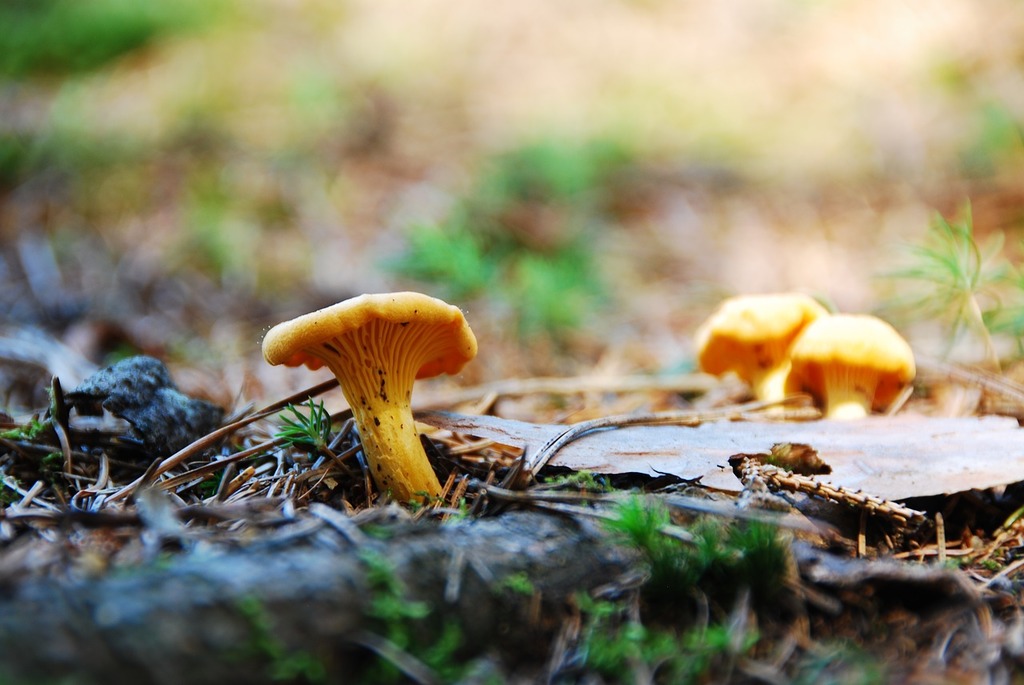
Orange mushrooms are among the most eye-catching fungi in forests, lawns and woodland edges, but color alone is a poor identification feature. Bright orange caps can belong to edible chanterelles, poisonous Jack-o’-Lantern mushrooms, toxic Amanitas, milkcaps, waxcaps, boletes and many other unrelated groups.
The safest way to identify an orange mushroom is to look beyond the cap. The underside, stem, bruising reactions, latex, habitat, substrate and growth pattern usually tell you far more than color does.
⚠️ Important: This guide is for identification and education only. Never eat a wild mushroom based solely on a photograph, AI result, or cap color.
Quick Orange Mushroom Identification Guide
| Species | Typical appearance | Habitat | Risk |
|---|---|---|---|
| Cantharellus cibarius group | Golden-orange, blunt ridges | Forest soil | Edible when correctly identified |
| Omphalotus species | Bright orange, true gills | Wood and buried roots | Poisonous |
| Amanita muscaria | Red-orange cap, white warts | Near trees | Poisonous |
| Lactarius deliciosus group | Orange cap, orange latex | Near pines | Edible when correctly identified |
| Hygrocybe species | Bright orange waxy caps | Grassland | Usually not food species |
| Laetiporus sulphureus | Orange-yellow shelves | Wood | Edible when young and correctly identified |
| Aleuria aurantia | Bright orange cup fungus | Bare soil | Generally not collected as food |
| Phyllotopsis nidulans | Orange shelf-like cap | Dead wood | Not recommended |
| Cortinarius species | Orange-brown cap, rusty spores | Woodland soil | Some dangerously poisonous |
| Orange boletes | Orange-red cap or pores | Near trees | Edibility varies by species |
First: Look Under the Cap
The underside immediately separates many orange mushrooms into different groups. If you see blunt folds or ridges rather than thin blade-like gills, a chanterelle becomes more likely. True gills suggest a different group, while pores indicate a bolete or polypore.
Some orange mushrooms have no classic underside at all. Shelf fungi such as Chicken of the Woods have pores, while cup fungi like Orange Peel Fungus form an open cup-shaped fruit body without a cap-and-stem structure.
Before trying to match color, determine the basic mushroom type.
1. Chanterelles — Cantharellus Species
- Scientific group: Cantharellus species
- Common name: Chanterelles
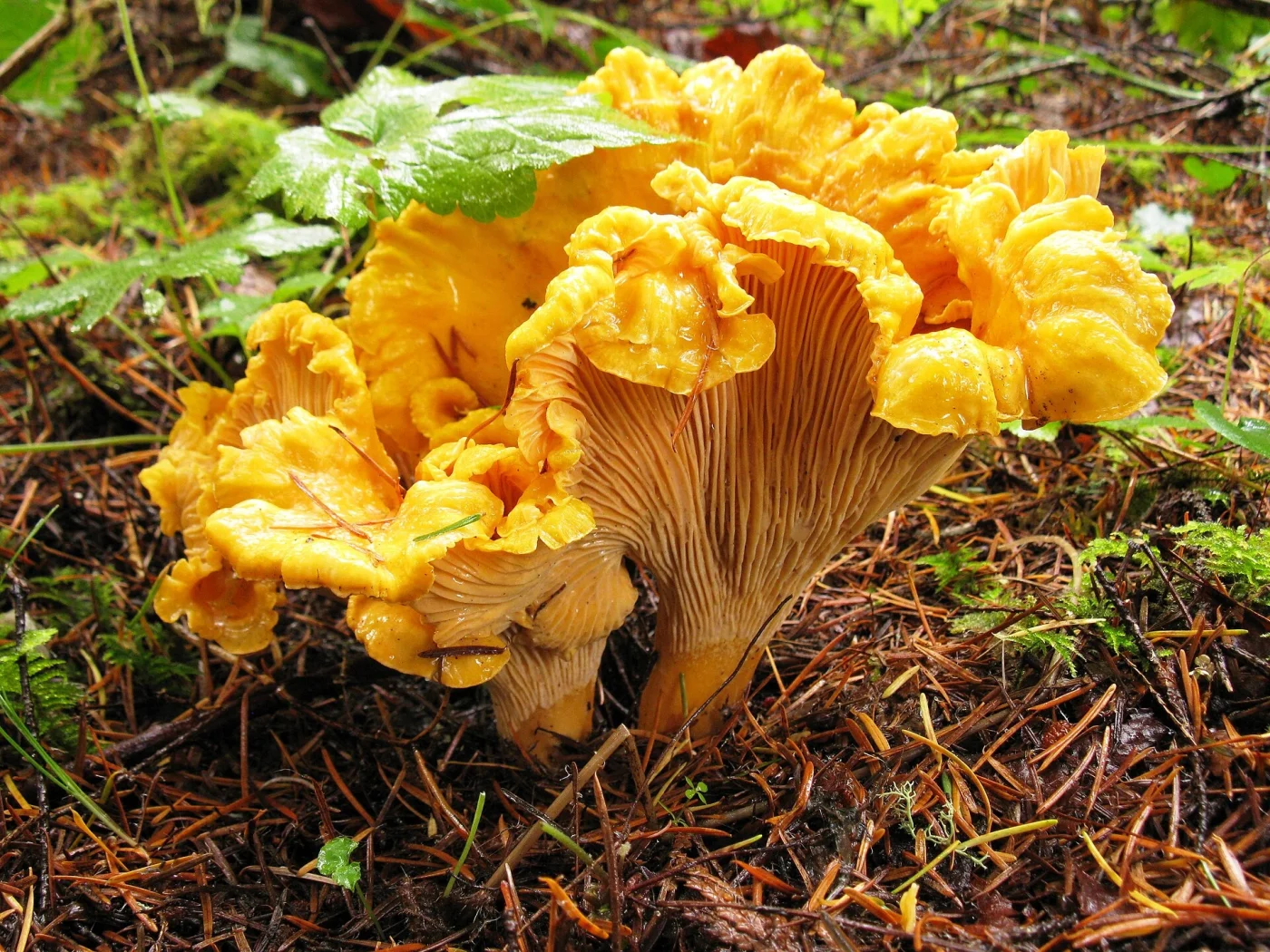
Chanterelles are among the best-known edible orange mushrooms. Their caps range from yellow to golden-orange and often become irregular or funnel-shaped with age.
The underside does not have true gills. Instead, chanterelles have blunt, forked ridges that run down the stem.
This structure is one of the most important identification clues.
Habitat
Chanterelles grow from soil in association with tree roots. They are typically found in forests and woodland edges rather than directly from stumps or logs.
Tree partners vary by region, but hardwoods and conifers can both support different chanterelle species.
Main Look-Alike: Jack-o’-Lantern
Jack-o’-Lantern mushrooms are brighter orange and have true thin gills. They also commonly grow from wood, stumps or buried roots and often form dense clusters.
The difference between ridges and true gills is far more useful than cap color.
2. Omphalotus Species — Jack-o’-Lantern Mushrooms
- Scientific group: Omphalotus species
- Common name: Jack-o’-Lantern Mushroom
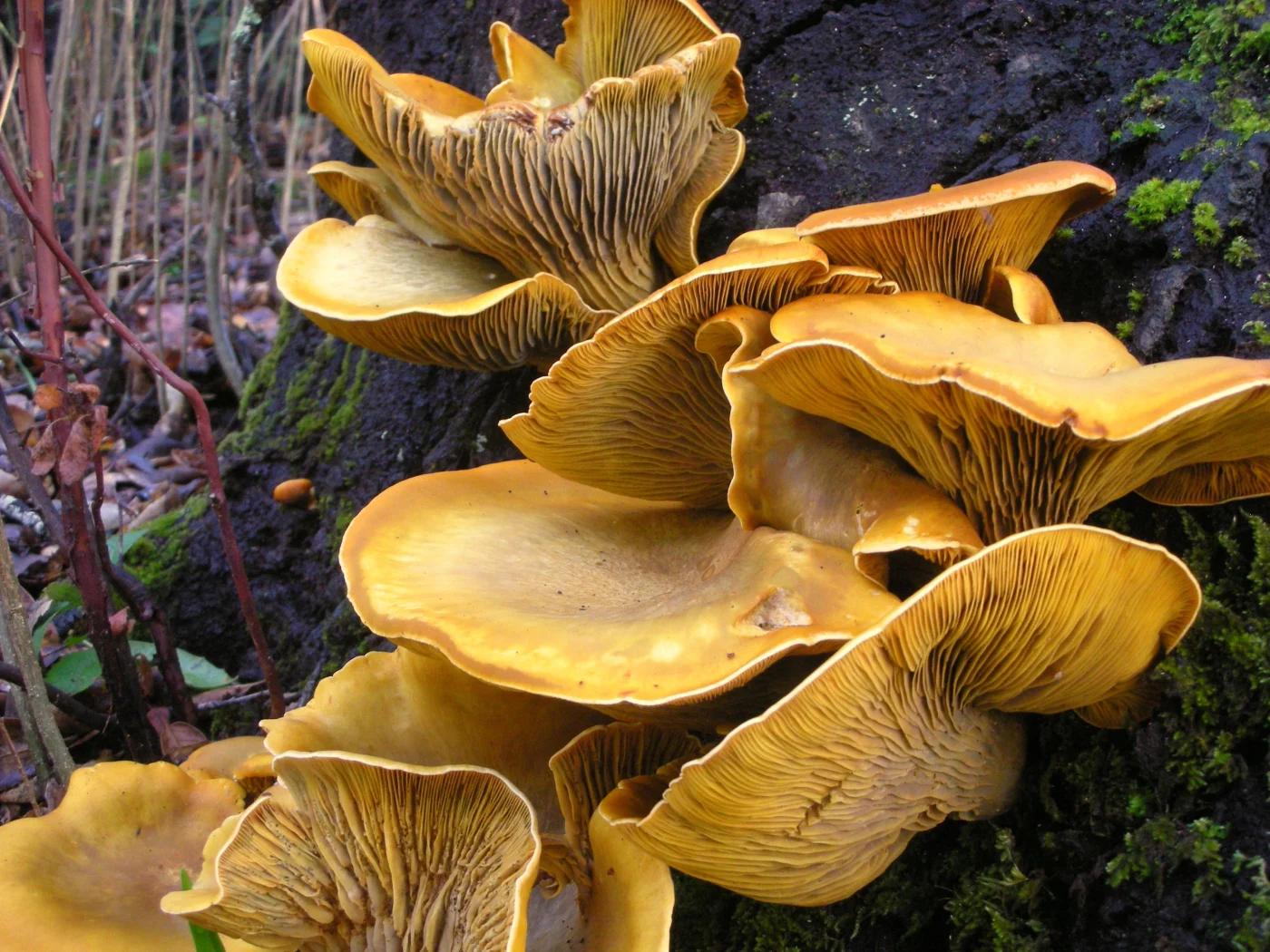
Jack-o’-Lantern mushrooms are among the most important poisonous orange mushrooms to recognize. They form orange to deep orange clusters and often grow on decaying wood or from buried roots.
The gills are true, thin, blade-like and run down the stem. The entire mushroom can be orange, including the stem and gills.
Why They Are Dangerous
Jack-o’-Lantern mushrooms can cause severe gastrointestinal poisoning. Symptoms may include vomiting, diarrhea and significant abdominal pain.
Their resemblance to chanterelles makes them especially important for beginners.
Main Difference From Chanterelles
Chanterelles usually grow from soil and have blunt folds. Jack-o’-Lantern mushrooms usually grow from wood or roots and have sharp true gills.
Growth pattern also helps. Chanterelles are often scattered or loosely grouped, while Jack-o’-Lantern mushrooms frequently appear in dense clusters.
3. Amanita muscaria — Fly Agaric
- Scientific name: Amanita muscaria
- Common name: Fly Agaric
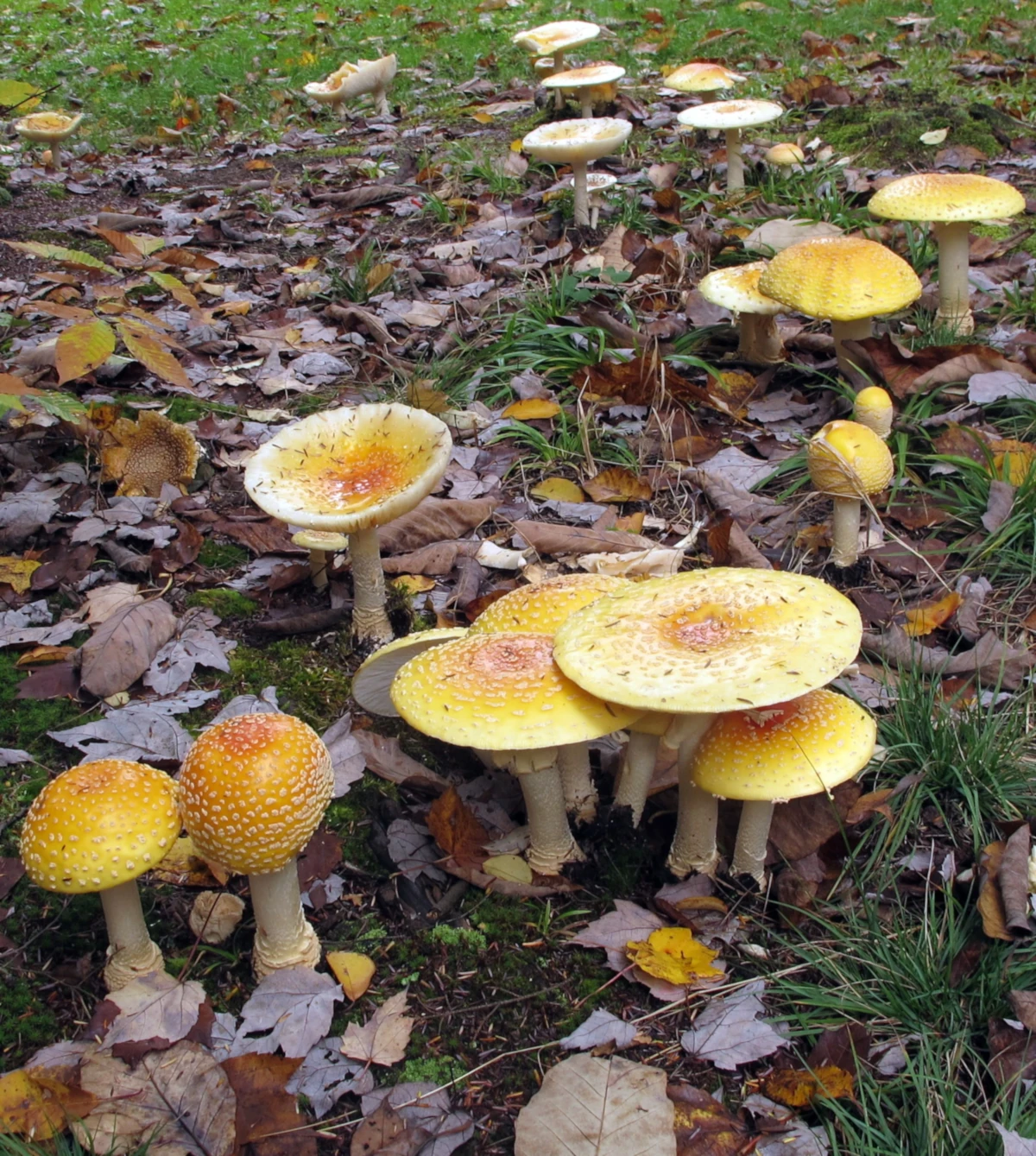
Fly Agaric is famous for its red cap with white spots, but many specimens are orange-red rather than deep red. Rain can also wash away the white veil remnants, leaving a smooth orange cap.
The gills are white, the stem is white and usually bears a ring, while the base is swollen with veil remnants.
Toxicity
Fly Agaric is poisonous and contains psychoactive compounds including muscimol and ibotenic acid. It can cause gastrointestinal and neurological symptoms.
The orange form is especially important because a faded or rain-washed specimen may no longer look like the classic fairy-tale mushroom.
Identification Clue
A bright orange cap with white gills, white stem and Amanita structures at the base should never be mistaken for a chanterelle or milkcap.
4. Lactarius deliciosus Group — Saffron Milk Caps
- Scientific group: Lactarius deliciosus and close relatives
- Common name: Saffron Milk Cap
Saffron Milk Caps are orange to carrot-colored mushrooms commonly associated with pine trees. Their caps often show concentric zones and may develop greenish stains with age or damage.
When the gills or flesh are cut, the mushroom releases colored latex. In the classic Lactarius deliciosus group, this latex is orange or carrot-colored and may later turn greenish.
Habitat
These mushrooms usually grow on soil near pines and other suitable conifers. They do not normally grow from wood.
Look-Alikes
Other milkcaps can be pink, orange or brownish and may have different latex colors. Some are inedible or irritating, so latex color, host tree and cap texture should be checked together.
5. Hygrocybe Species — Waxcaps
- Scientific name: Hygrocybe Species
- Common name: Waxcaps
Waxcaps are small to medium grassland mushrooms that often have striking yellow, orange or red caps. Many have a waxy or slippery surface and thick, widely spaced gills.
They are especially associated with old, nutrient-poor grasslands and can be good indicators of relatively undisturbed habitat.
Identification
Orange waxcaps often look very different from woodland mushrooms because they grow in open grass rather than under trees. Their caps may be conical, bell-shaped or broadly convex.
Species-level identification can be difficult because several Hygrocybe species have similar colors and shapes.
Edibility
Most waxcaps are not generally collected as food. Their ecological value and identification difficulty make them better appreciated in place.
6. Laetiporus sulphureus — Chicken of the Woods
- Scientific name: Laetiporus sulphureus
- Common name: Chicken of the Woods
Chicken of the Woods forms large bright orange and yellow shelves on living or dead wood. It has no true gills; instead, the underside is covered with small pores.
Young fruit bodies are soft and fleshy, while older brackets become dry, pale and tough.
Habitat
It grows directly from wood, especially hardwoods. Large clusters can cover a significant area of a trunk or stump.
Edibility
Young correctly identified specimens are widely regarded as edible. Older fruit bodies become much less desirable because of their fibrous texture.
The bright color and shelf-like form make this one of the easier orange fungi to recognize, but it should still be distinguished from other bracket fungi.
7. Aleuria aurantia — Orange Peel Fungus
- Scientific name: Aleuria aurantia
- Common name: Orange Peel Fungus
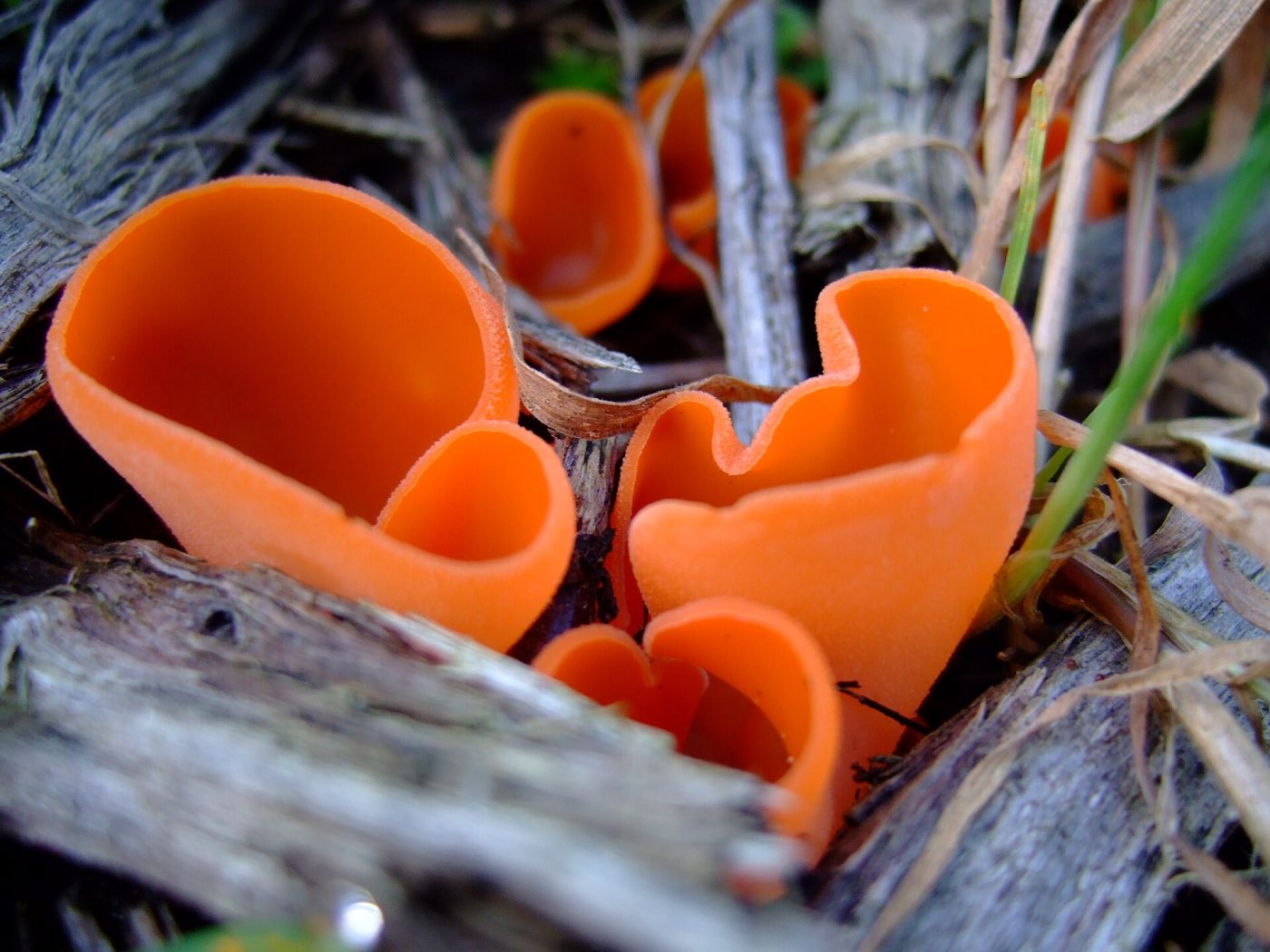
This unusual fungus looks more like a piece of orange peel than a conventional mushroom. It forms vivid orange cups or irregular discs on bare soil.
The inner surface is smooth and intensely orange, while the outside is usually paler.
Habitat
Orange Peel Fungus often appears on disturbed soil, paths, road banks and recently exposed ground. It can grow in groups and sometimes covers surprisingly large patches.
Identification
Its open cup shape separates it quickly from gilled orange mushrooms. There is no conventional stem-and-cap structure.
8. Phyllotopsis nidulans — Orange Oyster-Like Mushroom
- Scientific name: Phyllotopsis nidulans
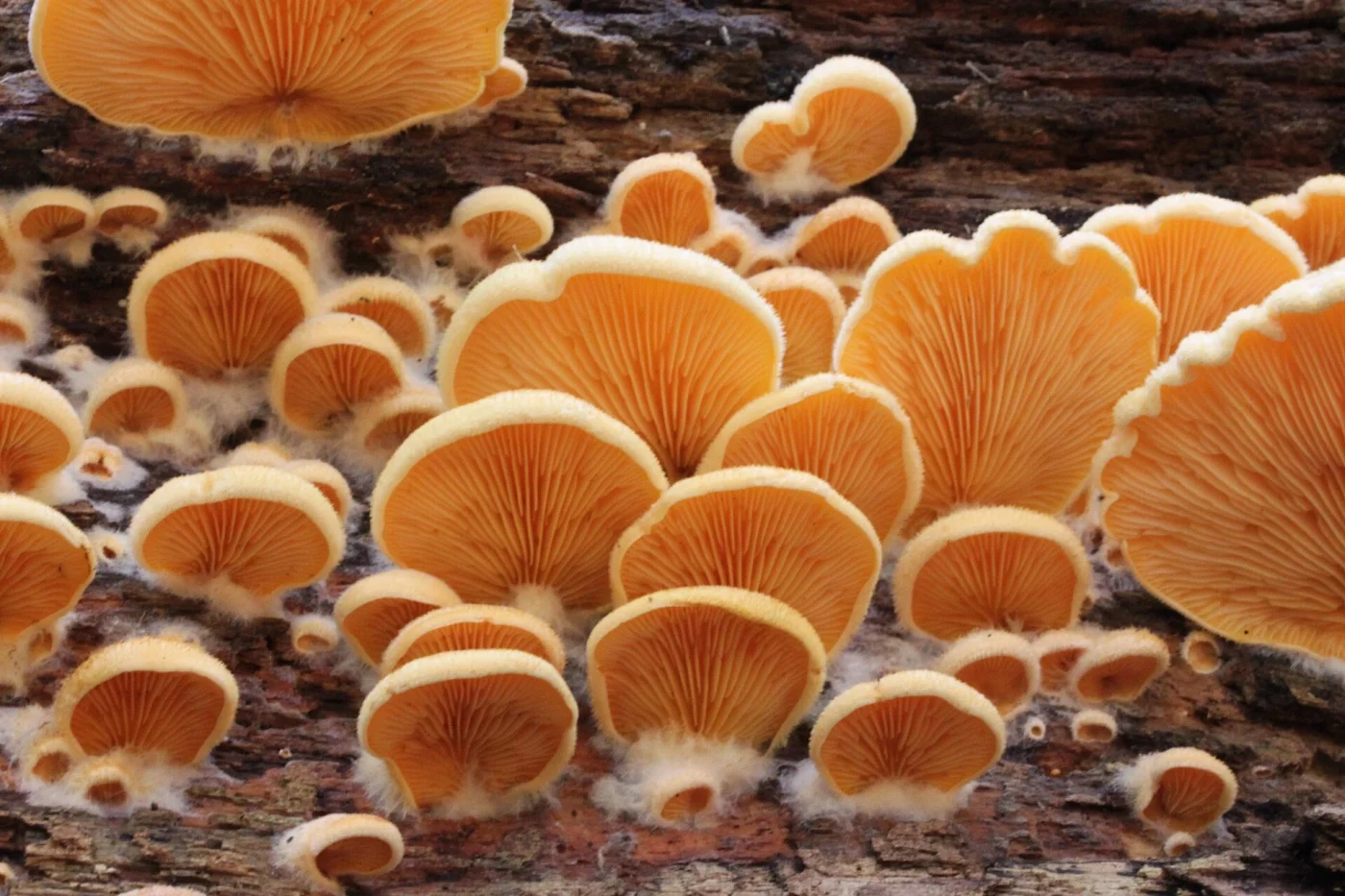
This orange wood-growing mushroom has a fan-shaped or shelf-like cap and can resemble a small Oyster Mushroom.
The cap surface is often fuzzy or hairy, while the gills are orange to yellow-orange. It grows directly from dead wood.
Why It Can Be Confusing
From a distance, it may resemble an orange Pleurotus or another shelf fungus. Closer examination reveals its stronger coloration and different texture.
It is generally not considered a desirable edible species.
9. Orange Cortinarius Species
- Genus: Cortinarius
The genus Cortinarius contains many orange, rust-colored and orange-brown woodland mushrooms. Young specimens may show a fine cobweb-like veil called a cortina between the cap and stem.
As spores mature, rusty-brown material often accumulates on the stem where the veil was attached.
Why They Matter
Some Cortinarius species contain orellanine and can cause severe kidney damage. Others are harmless or of uncertain edibility.
Because the genus is difficult to identify and includes dangerous species, orange Cortinarius-like mushrooms should not be collected for food casually.
Identification Clue
Rusty spores combined with a cortina or rusty veil remnants on the stem strongly suggest Cortinarius.
10. Orange Boletes
Several boletes can have orange, red-orange or orange-brown caps. Others may have pale caps but strongly orange or red pore surfaces.
Boletes have pores rather than gills, and many species show bruising reactions when cut or pressed.
Edibility Varies
Some orange-capped boletes are edible, while others can cause gastrointestinal illness. There is no reliable rule that says orange or red boletes are automatically poisonous or edible.
Identification should consider pore color, stem pattern, bruising, host trees and geography.
Orange Mushrooms Growing on Wood
Orange mushrooms on wood include Jack-o’-Lantern mushrooms, Chicken of the Woods, Phyllotopsis and several other shelf fungi.
The first question is whether the mushroom has true gills, pores or another surface underneath. This immediately separates many possible groups.
Jack-o’-Lantern mushrooms have true gills, Chicken of the Woods has pores, and Phyllotopsis has orange gills and a shelf-like growth habit.
Orange Mushrooms Growing on the Ground
Ground-growing orange mushrooms include chanterelles, Saffron Milk Caps, waxcaps, Fly Agaric and various Cortinarius species.
Nearby trees become especially important here. Chanterelles, Amanitas, milkcaps and Cortinarius are all mycorrhizal and can be strongly associated with particular hosts.
Grassland orange mushrooms point toward a different set of possibilities, especially waxcaps.
Orange Mushrooms With Gills
True gills occur in many unrelated orange mushrooms. Jack-o’-Lantern mushrooms, milkcaps, Fly Agaric and some Cortinarius all have gills, but the details differ.
Gill color, attachment and texture matter. Jack-o’-Lantern gills are orange and run down the stem, while Fly Agaric gills are white.
Milkcap gills release latex when damaged, and Cortinarius gills often mature toward rusty brown.
Orange Mushrooms Without Gills
Chanterelles have blunt ridges rather than true gills. Chicken of the Woods has pores, while Orange Peel Fungus lacks a conventional cap underside entirely.
This is why “orange mushroom” is far too broad to be useful on its own. The reproductive surface is often the fastest way to narrow the identification.
Chanterelle vs Jack-o’-Lantern
| Feature | Chanterelle | Jack-o’-Lantern |
|---|---|---|
| Underside | Blunt folds or ridges | True thin gills |
| Growth | Usually soil | Wood or buried roots |
| Pattern | Often scattered | Often dense clusters |
| Flesh | Pale and firm | Orange throughout |
| Edibility | Edible when correctly identified | Poisonous |
This is one of the most important orange mushroom comparisons because the two can share similar overall coloration.
Saffron Milk Cap vs Other Orange Milkcaps
| Feature | Saffron Milk Cap | Other orange/pink milkcaps |
|---|---|---|
| Latex | Orange, may turn green | May be white, cream or different colors |
| Cap | Orange, often zoned | Variable |
| Staining | Often greenish with age | Species-dependent |
| Habitat | Usually near pines | Depends on species |
| Edibility | Edible when correctly identified | Varies |
Latex color and host tree are often more useful than the cap alone.
How to Identify an Orange Mushroom Step by Step
Begin with the underside. Determine whether the mushroom has true gills, blunt ridges, pores, teeth or a smooth cup-like surface.
Next, check the substrate. Decide whether it is growing from soil, wood, grass or buried roots.
Then examine the stem and any special features such as a ring, volva, latex or bruising reaction. Finally, note nearby trees and growth pattern.
This sequence usually narrows the possibilities much more efficiently than trying to match an orange shade.
How to Photograph an Orange Mushroom for Identification
Take a clear image of the cap, but always include the underside. Gills, ridges and pores are often the most important structures.
Photograph the entire stem and its base, especially if the mushroom could be an Amanita. A wider image should show whether the mushroom is growing from soil, wood or grass.
If several specimens are present, photograph both young and mature examples because coloration and shape often change with age.
Can AI Identify an Orange Mushroom?
AI can often narrow down distinctive orange species such as Fly Agaric, Chicken of the Woods or chanterelles. The result becomes much more reliable when the underside and habitat are visible.
Problems arise when the photo shows only the cap. Several unrelated orange mushrooms can look almost identical from above.
AI should therefore be used as an identification aid rather than a final decision about edibility.
Are Orange Mushrooms Poisonous?
Some are poisonous and some are edible. Orange color has no reliable relationship with toxicity. Jack-o’-Lantern mushrooms and Fly Agaric are poisonous, while chanterelles, Saffron Milk Caps and young Chicken of the Woods include well-known edible species when correctly identified. The contrast between these groups is a good reminder that color should never be used as a safety rule.
Frequently Asked Questions
What is the most common orange mushroom?
There is no single answer because it depends on region and habitat. Chanterelles, Fly Agaric, Saffron Milk Caps and Jack-o’-Lantern mushrooms are all commonly encountered in suitable areas.
Are all orange mushrooms edible?
No. Some orange mushrooms are poisonous, including Jack-o’-Lantern mushrooms and Fly Agaric.
What orange mushroom looks like a chanterelle?
Jack-o’-Lantern mushrooms are one of the most important look-alikes. The key difference is that chanterelles have blunt ridges while Jack-o’-Lantern mushrooms have true gills.
What orange mushrooms grow on trees?
Chicken of the Woods, Jack-o’-Lantern mushrooms and Phyllotopsis are examples of orange fungi associated with wood.
What orange mushrooms grow under pine trees?
Saffron Milk Caps, Fly Agaric, some boletes and various Cortinarius can occur near pines, depending on region.
What orange mushroom has white spots?
An orange-red mushroom with white veil remnants may be Amanita muscaria, the Fly Agaric.
What orange mushroom releases orange milk?
Saffron Milk Caps in the Lactarius deliciosus group release orange latex when damaged.
What orange mushroom has no gills?
Chanterelles have blunt folds rather than true gills, while Chicken of the Woods has pores.
Can orange mushrooms be identified by color?
No. Orange appears in many unrelated mushroom groups and should only be treated as one clue.
Are orange lawn mushrooms poisonous?
Some may be harmless, while others can be difficult to identify. Grassland habitat plus cap color is not enough to determine edibility.
Final Identification Notes
Orange mushroom identification starts with structure, not color. A golden-orange mushroom with blunt ridges growing from forest soil points in a very different direction from a bright orange cluster with true gills growing from a stump.
The most useful questions are whether the mushroom has gills, ridges or pores, whether it grows from soil or wood, and whether it has special features such as latex, a ring, a volva or bruising reactions.
Some orange mushrooms are excellent edible species, while others can cause serious poisoning. If there is uncertainty, do not use color or a single photograph to decide whether the mushroom is safe to eat.