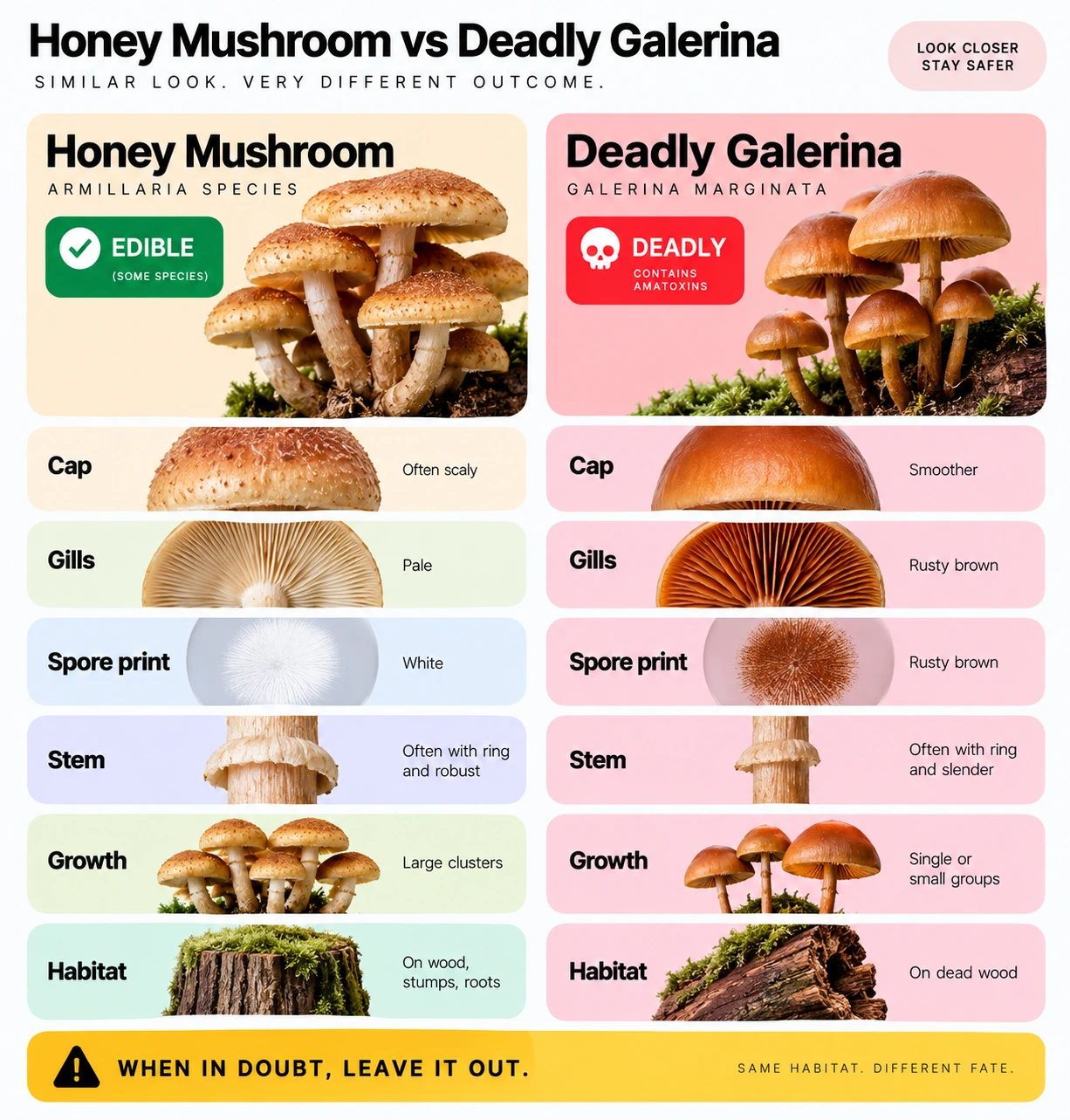
Honey mushrooms and Deadly Galerina can both grow on wood, form brownish caps, and appear in clusters, which makes them one of the more dangerous look-alike pairs for mushroom foragers. The risk is especially serious because Galerina marginata contains amatoxins, the same class of toxins associated with deadly Amanita poisoning.
The safest way to separate these mushrooms is not to rely on cap color or the presence of a ring. Spore print, gill color, stem structure, growth pattern, and the exact substrate are much more useful when considered together.
⚠️ Important: This guide is for identification and education only. Never eat a wild mushroom based solely on a photograph, AI result, or comparison with an online guide.
Quick Comparison
| Feature | Honey Mushroom | Deadly Galerina |
|---|---|---|
| Main group | Armillaria species | Galerina marginata |
| Cap | Honey-brown to tan, often scaly | Yellow-brown to reddish brown |
| Gills | Pale, usually cream to whitish | Pale when young, rusty brown with age |
| Spore print | White | Rusty brown |
| Stem | Usually robust | Usually slender |
| Ring | Often present in ringed species | May be present, often fragile |
| Growth | Often large dense clusters | Single, scattered, or small clusters |
| Habitat | Wood, roots, stumps, buried wood | Dead and decaying wood |
| Toxicity | Some species traditionally eaten after proper ID and preparation | Deadly poisonous |
| Main danger | Confusion with toxic wood-growing mushrooms | Amatoxins |
What Do Honey Mushrooms Look Like?
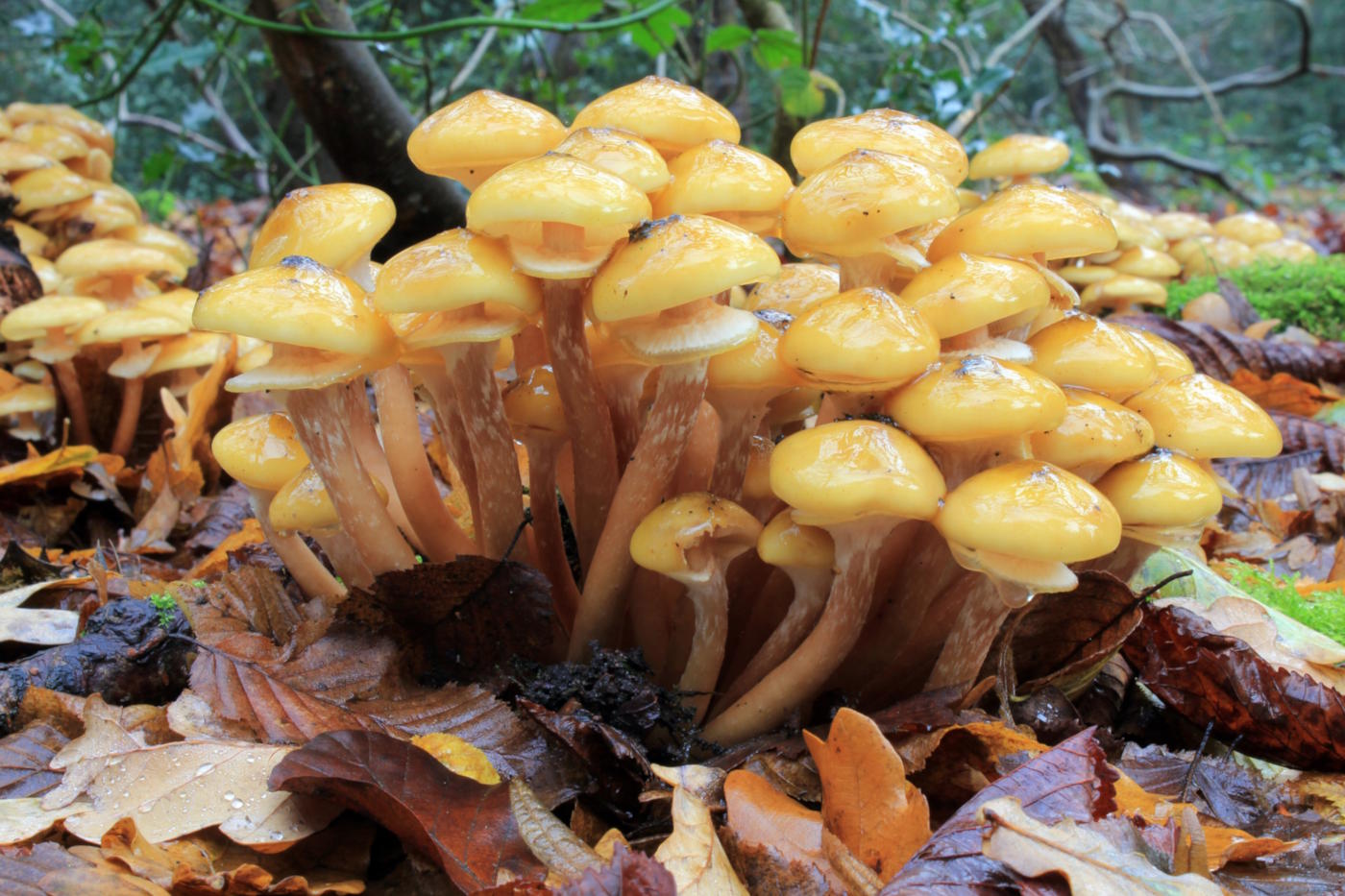
Honey mushrooms belong to the genus Armillaria, which includes several closely related species. Their caps are commonly honey-yellow, tan, brown, or reddish brown and may carry small darker scales, especially when young.
Many species grow in dense clusters around stumps, tree bases, buried roots, or weakened trees. Their stems are usually more substantial than those of Deadly Galerina and often appear pale above and darker toward the base.
Some Armillaria species have a distinct ring around the upper stem, while others do not. This is one reason the phrase “Honey Mushroom” refers to a group rather than one simple visual form.
What Does Deadly Galerina Look Like?
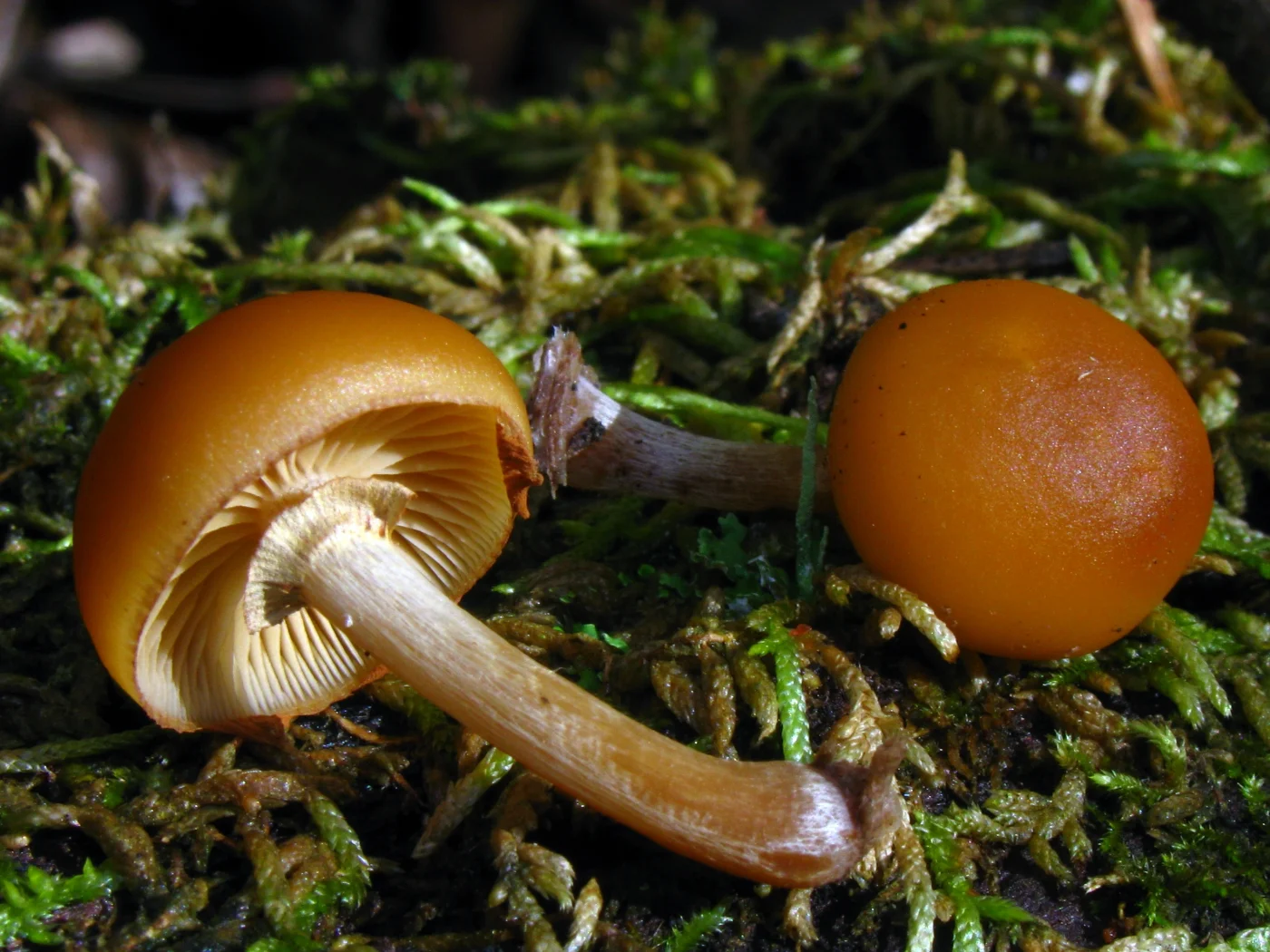
Galerina marginata is usually smaller and more delicate. The cap can range from honey-brown and yellow-brown to cinnamon or reddish brown, and it often changes color as it dries.
The gills may begin pale but become rusty brown as the spores mature. The stem is slender, fibrous, and may show a fragile ring or ring zone.
Because the ring can be damaged or disappear, its absence does not rule out Galerina. This is an important safety point.
Cap Differences
Cap color overlaps too much to be reliable on its own. Both Honey Mushrooms and Deadly Galerina can be brown, tan, or honey-colored.
Honey Mushroom caps are often broader and more robust and may show small scales. Deadly Galerina caps are usually smoother, thinner, and more hygrophanous, meaning the color can change noticeably as the cap loses moisture.
A wet Galerina cap may look darker and richer brown, then fade toward tan as it dries.
Gill Color
Gill color is much more useful than cap color.
Honey Mushroom gills are generally pale, cream, or whitish and usually remain relatively light. Deadly Galerina gills may start pale but gradually become rusty brown as the spores mature.
This change is especially important in older specimens. A small brown wood-growing mushroom with clearly rust-colored mature gills deserves immediate caution.
Spore Print
Spore print is one of the strongest practical differences between the two groups.
Honey Mushrooms typically produce a white spore print, while Galerina marginata produces a rusty-brown spore print.
This distinction can be very helpful when several other features overlap. However, spore print should still be treated as one part of the identification rather than as a complete safety test.
Stem Structure
Honey Mushroom stems are usually relatively thick and tough. In dense clusters, several stems may arise closely together from the same woody base.
Deadly Galerina stems are generally thinner, more fragile, and more fibrous. The lower stem may appear darker than the upper portion.
A robust clustered stem structure favors Armillaria, while a delicate slender structure fits Galerina better.
The Ring
The ring is a useful feature, but it is not enough by itself.
Many ringed Honey Mushrooms have a noticeable pale ring around the upper stem. Some species in the Honey Mushroom group, however, are ringless.
Deadly Galerina may also have a ring, but it is often thinner, more fragile, and less persistent. Older specimens may show only a ring zone rather than a clear skirt-like structure.
This is why the rule “ring means Honey Mushroom” is unsafe.
Growth Pattern
Honey Mushrooms often grow in large, dense clusters, sometimes with dozens of fruit bodies packed together around a stump or tree base.
Deadly Galerina can also grow in groups, but the clusters are often smaller and more scattered. It may also occur singly.
Growth pattern is useful as supporting evidence, but there is too much overlap to use it alone.
Where Do Honey Mushrooms Grow?
Honey Mushrooms are associated with wood, roots, and trees. They may grow around living trees, dead trees, stumps, buried roots, and decaying wood.
Some species act as pathogens on living trees, while others behave more as decomposers. Fruiting bodies often emerge at the tree base or from ground where buried roots are present.
This can make them appear to grow from soil even when the fungus is actually connected to woody material underground.
Where Does Deadly Galerina Grow?
Galerina marginata grows on dead and decaying wood. It is commonly found on logs, stumps, fallen branches, and buried woody debris.
It can occur on both conifer and hardwood substrates, depending on region and local conditions.
A brown mushroom growing from wood should never automatically be assumed to be a Honey Mushroom, even if nearby specimens look similar.
Can They Grow on the Same Log?
Yes. This is one of the most important safety points.
Different fungal species can fruit from the same stump, log, or root system. A correctly identified edible cluster in one part of the substrate does not guarantee that every nearby brown mushroom belongs to the same species.
Each group should be checked individually.
Why Deadly Galerina Is So Dangerous
Galerina marginata contains amatoxins capable of causing severe liver damage. Poisoning can be fatal.
One of the most dangerous features is the delayed onset of symptoms. A person may feel normal for many hours after eating the mushroom.
Severe vomiting, diarrhea, and abdominal pain may then appear, sometimes followed by a temporary period of improvement while liver injury continues.
Suspected Galerina ingestion is a medical emergency.
Honey Mushroom Edibility
Several Armillaria species have a long history of culinary use in some regions, but Honey Mushrooms require confident identification and proper preparation. Some people experience gastrointestinal upset even from correctly identified specimens.
The larger issue for beginners is the risk of confusion with poisonous wood-growing mushrooms. Because Deadly Galerina can occupy the same habitat, uncertain brown clusters should not be treated casually as food.
Regional species differences also matter, because the name “Honey Mushroom” covers multiple Armillaria species.
Honey Mushroom vs Deadly Galerina at a Glance
| Feature | Honey Mushroom | Deadly Galerina |
|---|---|---|
| Spore print | White | Rusty brown |
| Mature gills | Pale | Rusty brown |
| Stem | Robust | Slender |
| Ring | Often strong in ringed species | Often fragile or faint |
| Cluster size | Often large and dense | Often smaller or scattered |
| Cap | Often scaly | Often smoother |
| Substrate | Wood and roots | Dead wood |
| Risk | Edibility varies by species | Deadly poisonous |
The spore print and mature gill color are among the most useful differences, but safe identification should combine several features.
Honey Mushroom vs Kuehneromyces mutabilis
Kuehneromyces mutabilis, or Sheathed Woodtuft, is another edible brown mushroom that grows on wood and can resemble both Honey Mushrooms and Deadly Galerina.
It often has a two-toned hygrophanous cap and a more scaly lower stem beneath the ring. However, it also produces brown spores, so spore print alone does not separate it from Galerina.
This is a more advanced identification pair and demonstrates why small brown wood-growing mushrooms require caution.
Honey Mushroom vs Jack-o’-Lantern
Jack-o’-Lantern mushrooms can also grow in dense clusters around stumps and buried roots.
They are usually brighter orange and have strongly colored true gills. Honey Mushrooms are generally paler and less vividly orange.
Jack-o’-Lantern mushrooms are poisonous and can cause severe gastrointestinal symptoms, making clustered wood-growing mushrooms a group where careful identification is especially important.
How to Tell Them Apart Step by Step
Start with the gills and spore print. Pale gills with a white spore print strongly support Honey Mushroom, while rusty mature gills with a rusty-brown spore print strongly support Galerina.
Then examine the stem. A thick, robust stem and large dense cluster favor Armillaria, while a slender fibrous stem fits Galerina better.
Finally, check the cap texture, ring, substrate, and growth pattern. None of these should override the spore and gill evidence.
How to Make a Spore Print
Choose a mature cap and remove the stem. Place the cap gill-side down on a surface where both pale and dark spores will be visible, or use half white and half dark paper.
Cover the cap to reduce air movement and leave it long enough for spores to deposit. Honey Mushroom spores should appear white, while Deadly Galerina spores appear rusty brown.
A spore print is useful, but never use it as the only test.
How to Photograph Honey Mushrooms for Identification
Photograph the entire cluster, then take close-ups of the cap, gills, ring, and complete stem.
Include both young and mature specimens if possible, because gill color and ring appearance may change with age. A wider image showing the stump, log, or root system also provides important habitat information.
If you suspect Deadly Galerina, photograph individual specimens separately rather than assuming the whole cluster is one species.
Can AI Tell Honey Mushroom From Deadly Galerina?
AI can help narrow the possibilities, especially when several clear photos are available. It may recognize differences in cap texture, stem proportions, and clustering.
However, some of the most useful characteristics are difficult or impossible to judge from one photograph. Spore print, subtle gill color, microscopic features, and hidden substrate details may be missing.
AI should therefore be treated as an identification aid rather than a final safety decision.
Common Identification Mistakes
A common mistake is assuming that clustered brown mushrooms are automatically Honey Mushrooms. Deadly Galerina and several other genera can also grow in groups on wood.
Another mistake is relying too heavily on the ring. Both groups may show a ring, and rings can disappear with age.
A third mistake is ignoring the possibility of mixed species on the same stump. This is one of the most dangerous assumptions when collecting wood-growing mushrooms.
Frequently Asked Questions
What is the easiest way to tell Honey Mushroom from Deadly Galerina?
Spore print is one of the most useful differences. Honey Mushrooms usually have white spores, while Deadly Galerina has rusty-brown spores.
Does Deadly Galerina always have a ring?
No. The ring may be fragile, damaged, or almost absent in older specimens.
Are Honey Mushroom gills brown?
They are generally pale, cream, or whitish rather than rusty brown.
Can Deadly Galerina grow in clusters?
Yes. It may grow singly, scattered, or in groups, so clustering does not rule it out.
Can Honey Mushrooms and Galerina grow on the same stump?
Yes. Different fungal species can share the same woody substrate.
What color is the Deadly Galerina spore print?
Rusty brown.
What color is the Honey Mushroom spore print?
Typically white.
Are all Honey Mushrooms edible?
The group contains several species, and culinary use varies by region. Correct identification and preparation are essential, and some people experience gastrointestinal reactions.
Is Deadly Galerina really deadly?
Yes. It contains amatoxins capable of causing severe and potentially fatal liver poisoning.
Can you identify them from cap color alone?
No. Brown, tan, and honey-colored caps occur in both groups and in many unrelated mushrooms.
Final Identification Notes
Honey Mushrooms and Deadly Galerina can share the same general brown coloration, wood-growing habitat, and even a stem ring. These similarities make superficial identification unsafe.
The strongest field differences are usually white spores and pale gills in Honey Mushrooms versus rusty-brown spores and rusty mature gills in Deadly Galerina. Stem robustness, cluster size, and cap texture provide additional support.
Never assume that every brown mushroom on the same stump belongs to one species. If there is any uncertainty between Armillaria and Galerina marginata, do not eat the mushrooms.