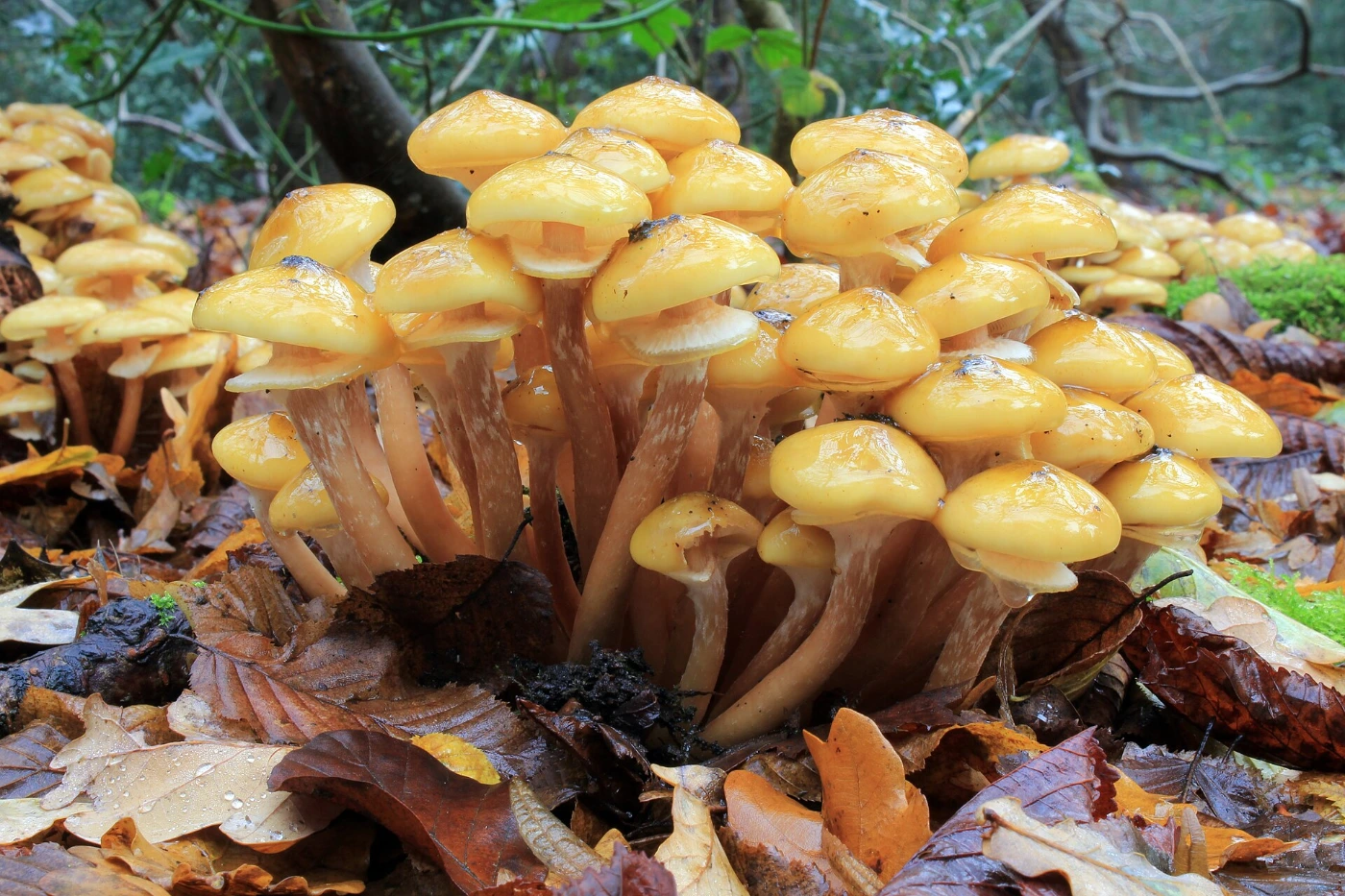
Armillaria mellea, commonly known as Honey Fungus or Honey Mushroom, is a yellow-brown to honey-colored mushroom that often grows in large clusters around trees, stumps, and buried roots. It is both a wood-decaying fungus and an important tree pathogen capable of spreading through root systems.
Typical specimens have honey-yellow caps, pale gills, a persistent stem ring, and a white spore print. The most useful field pattern is clustered growth around hardwoods + honey-colored caps + pale gills + persistent ring + white spores.
⚠️ Important: Several Armillaria species look similar, and not every cluster called “Honey Mushroom” is Armillaria mellea. Edibility also requires caution because Honey Mushrooms can cause gastrointestinal reactions and should never be eaten raw or undercooked.
Quick Identification
| Feature | Armillaria mellea |
|---|---|
| Common name | Honey Fungus / Honey Mushroom |
| Cap color | Honey-yellow, yellow-brown, reddish-brown |
| Cap surface | Fine scales, especially when young |
| Cap center | Often darker |
| Gills | Pale cream, later yellowish or spotted |
| Stem | Pale above, yellow-brown below |
| Ring | Usually persistent and membranous |
| Volva | Absent |
| Spore print | White to very pale cream |
| Growth | Usually dense clusters |
| Substrate | Roots, stumps, buried wood, weakened trees |
| Ecology | Parasitic and saprotrophic |
| Main hosts | Especially broadleaf trees |
| Season | Late summer to autumn |
| Edibility | Edible in some traditions when correctly identified and thoroughly cooked, but reactions occur |
| Main look-alikes | Other Armillaria, Pholiota, Hypholoma, Galerina |
What Does Armillaria mellea Look Like?
Honey Fungus usually appears as a group rather than as a single isolated mushroom. Dozens of fruit bodies may emerge from the base of a tree, around an old stump, or seemingly from soil where infected roots or buried wood are hidden below.
Young caps are convex and usually yellow to honey-brown. As they mature, they flatten and can develop irregular or wavy margins.
Cap
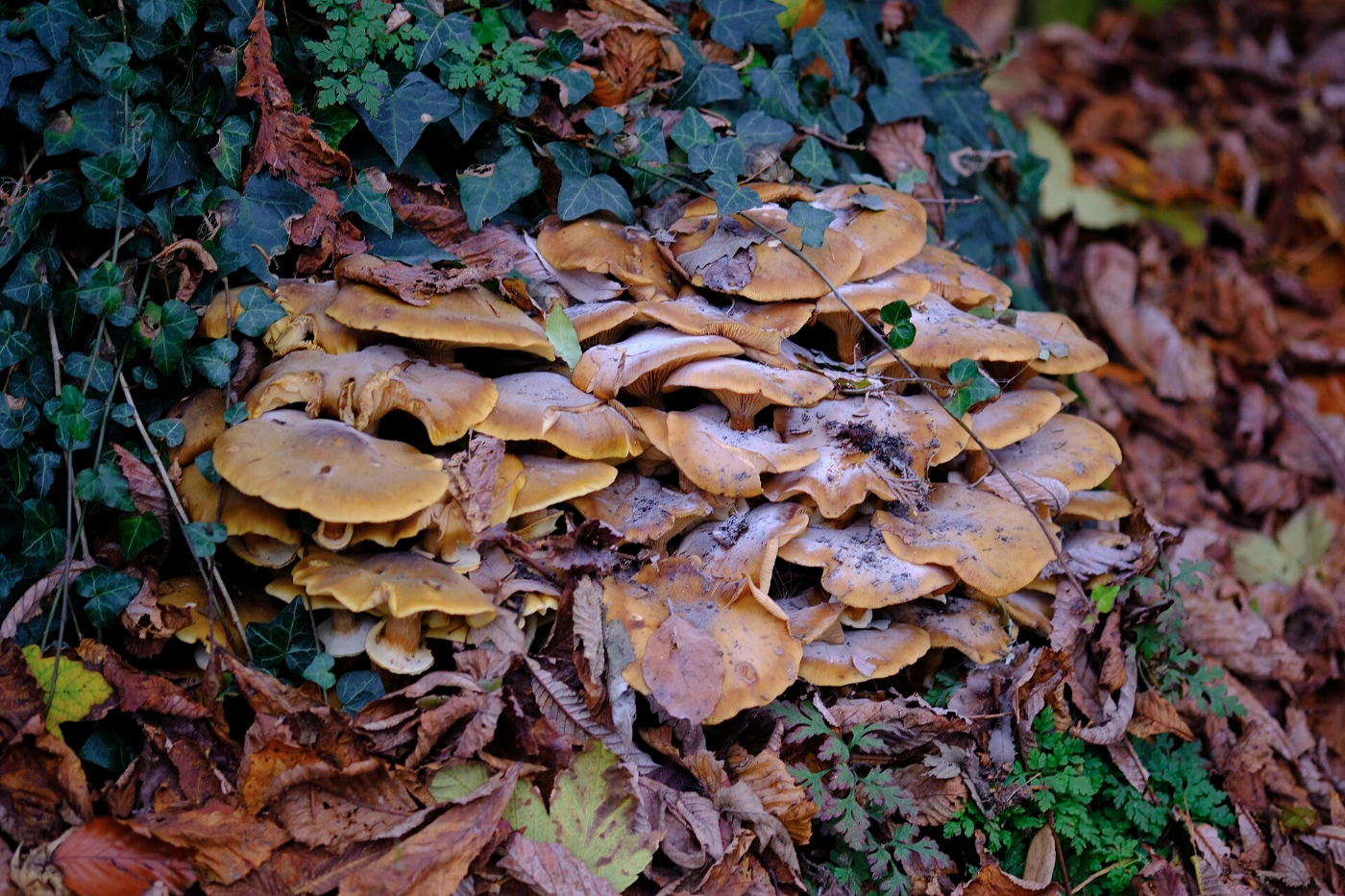
The cap commonly ranges from honey-yellow and ochre to yellow-brown or reddish-brown. The center is often darker than the outer portion.
Young specimens usually carry numerous fine scales, particularly toward the middle. These scales can become much less obvious as the cap expands or after heavy rain.
Cap Color
The name Honey Fungus comes from the characteristic warm yellow-brown coloration. However, color varies considerably between collections and should not be used alone.
Older caps may become dull brown or washed-out yellow. Mushrooms growing in different weather conditions can therefore look surprisingly different even when they belong to the same species.
Gills
The gills are initially pale cream to whitish and are attached to the stem or run slightly downward. They can become yellowish and may develop reddish or rusty-looking spots with age.
Despite these darker stains, the spores themselves are white. This distinction is particularly important when comparing Honey Fungus with brown-spored wood-growing mushrooms.
Stem
The stem is relatively long and fibrous, often pale near the top and becoming yellowish or brownish toward the base. Several stems can emerge close together from the same woody substrate.
The flesh is tougher than in many soft woodland mushrooms. Older stems can become particularly fibrous and less suitable for culinary use.
Ring
A persistent membranous ring is one of the useful features of Armillaria mellea. It usually occurs high on the stem and may be whitish to yellowish.
Ring structure is especially useful when separating A. mellea from ringless Honey Mushroom relatives. It is not enough by itself, because unrelated wood-growing mushrooms can also have stem rings.
Flesh
The flesh is white to pale cream and relatively firm. It does not normally show dramatic blue or red staining when damaged.
Older specimens can become fibrous and waterlogged. Fresh young caps are much more useful for both identification and culinary consideration.
Spore Print
The spore print is white to very pale cream. This is one of the most useful characters for separating Honey Fungus from several brown-spored look-alikes.
A dense cluster can sometimes leave visible white spore deposits on the caps of mushrooms growing below it. These pale deposits can be noticeable even before a deliberate spore print is made.
Where Does Armillaria mellea Grow?
Armillaria mellea is closely associated with woody plants. It can parasitize living trees and later continue growing as a decomposer after the host or part of its root system dies.
Fruit bodies commonly appear around tree bases, stumps, buried roots, and other woody material. A cluster that seems to grow directly from soil may actually be connected to wood below the surface.
Broadleaf Trees
True Armillaria mellea is particularly associated with broadleaf trees. It can occur around oak, beech, fruit trees, and many other woody hosts.
Orchards and gardens can therefore support substantial colonies as well as natural woodland. Fruit bodies around an apparently healthy tree can sometimes indicate infection in the root system.
Stumps and Buried Roots
Old stumps are classic places to find Honey Fungus. Dense clusters may emerge from the sides of the stump or from the ground immediately around it.
Buried roots can create the impression that the mushrooms are terrestrial. Looking around the base often reveals woody material or a nearby tree that explains the colony.
Season
Honey Fungus is primarily an autumn mushroom. Fruiting often begins after wet weather and can continue late into the season in mild climates.
Large flushes may appear quite suddenly. Because many mushrooms develop from the same root system, an entire area around a tree can become covered in clusters within a short period.
Distribution
Armillaria mellea occurs in Europe and has also been reported widely in other temperate regions. However, the name has historically been used too broadly for many Honey Mushroom collections.
North America contains several distinct Armillaria species that can look extremely similar. For an international guide, it is safer to identify many collections initially as Armillaria species until regional characters support a more precise name.
Black Rhizomorphs
One of the most interesting features of Honey Fungus is its production of dark cord-like structures called rhizomorphs. These structures can spread through soil and beneath bark.
Rhizomorphs are often described as resembling black bootlaces. They allow the fungus to move between suitable woody substrates and are an important sign of Armillaria infection.
White Mycelial Fans
Under loose bark, Armillaria may produce white sheets or fan-shaped growths of mycelium. These can occur between the bark and wood of infected trees.
This feature is more useful when investigating an infected tree than when identifying a mushroom collected away from its substrate. Together with rhizomorphs, it demonstrates that the visible mushrooms are only a small part of a much larger organism.
Is Armillaria mellea Edible?
Honey Fungus has traditionally been eaten in many regions when correctly identified and thoroughly cooked. Young caps are generally preferred because mature stems become tough and fibrous.
However, gastrointestinal reactions are well documented, and some people tolerate Honey Mushrooms poorly. The mushroom should never be treated as universally safe simply because it has a history of culinary use.
Does Cooking Matter?
Honey Mushrooms should not be eaten raw or undercooked. Traditional preparation generally involves thorough cooking, and some regional practices include boiling before further preparation.
Proper cooking does not solve an identification mistake. Similar clustered mushrooms include species that are unsuitable or dangerous, so identification must be completed first.
Look-Alikes
The most important comparisons include other Honey Mushrooms and unrelated clustered fungi growing on wood. Spore color, ring structure, cap scales, substrate, and regional ecology are especially useful.
Armillaria ostoyae — Dark Honey Fungus
Identification
Dark Honey Fungus is generally darker and more heavily scaled than A. mellea. Its cap can be brown to dark brown with conspicuous dark scales.
A persistent ring is present, and dark scales may occur on its underside. It is particularly important in conifer forests and is a major root pathogen.
Main Difference
Dark cap scales and stronger association with conifers favor A. ostoyae. A. mellea is usually paler and is particularly characteristic around broadleaf hosts.
Armillaria gallica — Bulbous Honey Fungus
Identification
Armillaria gallica often has a more bulbous stem base and a relatively weak or fleeting ring. Caps are yellow-brown to brown and can carry fine scales.
It frequently behaves as a decomposer or weak parasite on buried wood and stumps. The overall appearance can overlap substantially with other Honey Mushrooms.
Main Difference
A swollen stem base and less substantial ring support A. gallica. A stronger persistent membranous ring is more typical of A. mellea.
Desarmillaria Species — Ringless Honey Mushrooms
Identification
Ringless Honey Mushrooms resemble Armillaria in cap color, clustered growth, and white spores. The most obvious difference is the absence of a true stem ring.
They commonly grow in dense clusters around hardwood trees, stumps, and roots. In North America, ringless species are particularly relevant.
Main Difference
Check several mature stems. A complete absence of a ring points toward Desarmillaria rather than typical Armillaria mellea.
Pholiota squarrosa — Shaggy Scalycap
Identification
Shaggy Scalycap forms clusters around trees and stumps and can look remarkably similar to Honey Fungus from a distance. Its cap and stem are covered with conspicuous pointed brown scales.
The mature gills become rusty-brown because the species produces brown spores. The mushroom also tends to retain a much more heavily scaly appearance than A. mellea.
Main Difference
A rusty-brown spore print and strongly shaggy cap and stem favor Pholiota squarrosa. Honey Fungus produces white spores.
Hypholoma fasciculare — Sulphur Tuft
Identification
Sulphur Tuft grows in dense clusters from dead wood and buried roots. Its caps are bright sulphur-yellow, usually with darker orange-brown centers.
Young gills have a greenish-yellow or olive tone and later become darker. There is no large persistent ring.
Main Difference
Bright sulphur coloration and greenish young gills strongly favor Hypholoma fasciculare. The species is poisonous and should not be confused with Honey Mushrooms.
Galerina marginata — Deadly Galerina
Identification
Galerina marginata is a dangerously poisonous wood-growing mushroom containing amatoxins. It has brown to honey-brown caps and may grow in groups or clusters on logs and other dead wood.
Mature gills and spores become rusty-brown rather than remaining pale. The mushrooms are generally smaller and less robust than typical Armillaria clusters.
Main Difference
The spore print provides one of the strongest distinctions. Armillaria produces white spores, while Galerina marginata produces rusty-brown spores.
Armillaria mellea vs Pholiota squarrosa
| Feature | Armillaria mellea | Pholiota squarrosa |
|---|---|---|
| Cap | Honey-yellow to brown | Yellow-brown with heavy scales |
| Cap scales | Fine, may fade | Large and persistent |
| Gills | Pale, later spotted | Become rusty-brown |
| Spore print | White | Rusty-brown |
| Ring | Present | Present |
| Growth | Clustered | Clustered |
| Best clue | White spores | Brown spores + heavy scales |
These species can grow around the same kinds of trees and stumps. A spore print is much more useful than general cap color when the collection is ambiguous.
Armillaria mellea vs Sulphur Tuft
| Feature | Armillaria mellea | Hypholoma fasciculare |
|---|---|---|
| Cap | Honey-yellow to brown | Bright sulphur-yellow |
| Gills when young | Cream | Yellow-green |
| Ring | Usually present | Absent |
| Spore print | White | Dark purplish-brown |
| Substrate | Trees, roots, stumps | Dead wood |
| Toxicity | Reactions possible | Poisonous |
| Best clue | Ring + white spores | Greenish gills + no ring |
Large clusters make these mushrooms superficially similar from a distance. Close examination of the gills and stem quickly reveals major differences.
Armillaria mellea vs Deadly Galerina
| Feature | Armillaria mellea | Galerina marginata |
|---|---|---|
| Typical size | Medium to large | Small to medium |
| Growth | Often large clusters | Solitary to clustered |
| Gills | Pale | Brownish with age |
| Spore print | White | Rusty-brown |
| Ring | Usually substantial | Often smaller |
| Toxins | GI reactions possible | Deadly amatoxins |
| Best clue | White spores | Rusty spores |
This comparison matters most when collections are atypical or only small fruit bodies are available. Never assume that every honey-brown mushroom growing on wood is a Honey Mushroom.
How to Identify Armillaria mellea
Start with the growth pattern and substrate. Dense clusters around broadleaf trees, stumps, or buried roots are characteristic.
Then examine the ring, gills, and spores. A persistent ring together with pale gills and a white spore print strongly supports Armillaria.
Finally, consider the regional species. Exact identification as A. mellea requires more than simply recognizing the Honey Mushroom group.
Young vs Mature Honey Fungus
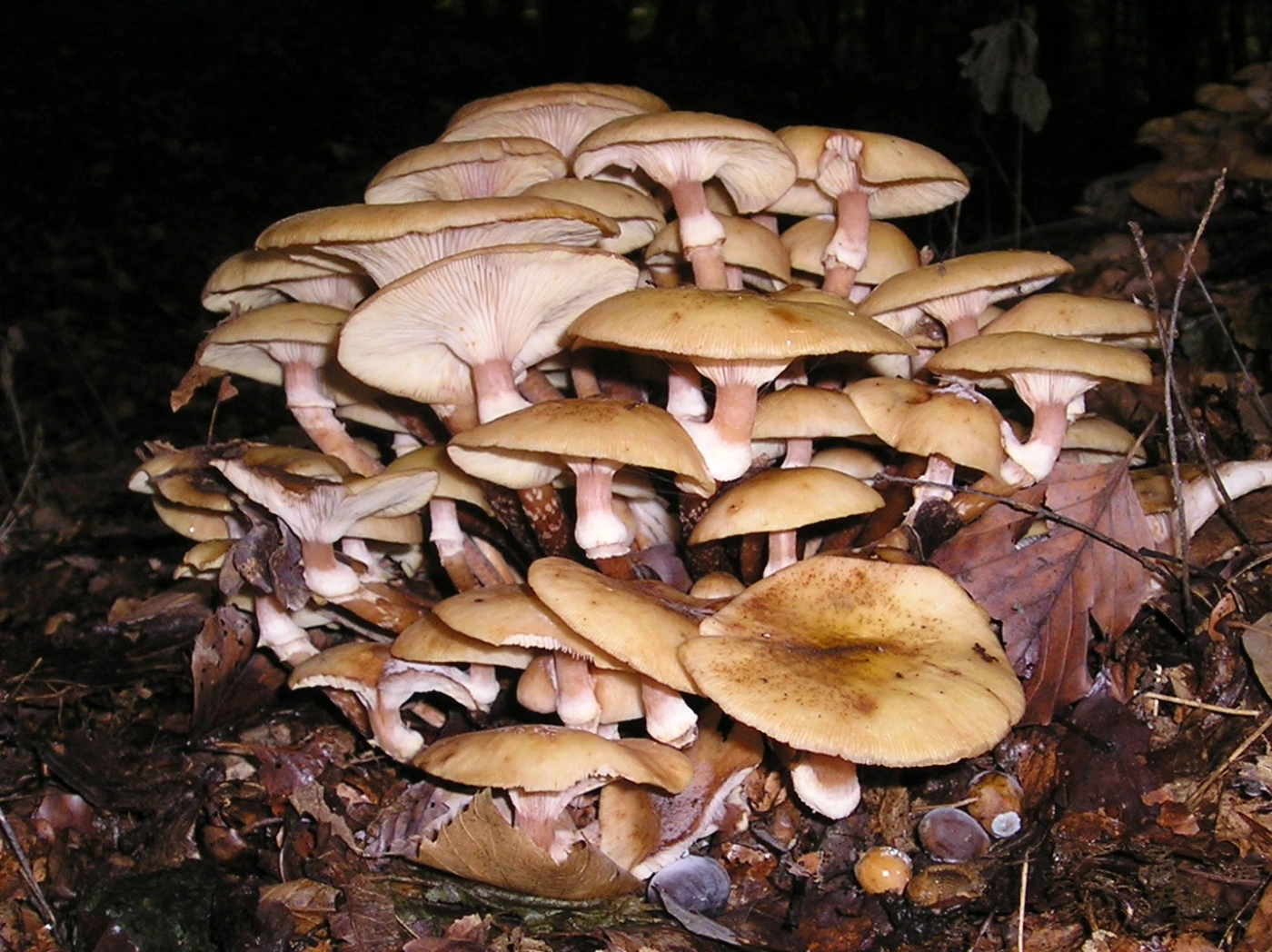
Young mushrooms usually show the clearest cap scales and strongest honey-yellow coloration. Their caps are rounded and their veil structures are easier to examine.
Mature caps flatten and may lose many scales. Gills can develop darker spots, while stems become more fibrous and less useful for cooking.
Common Identification Mistakes
One common mistake is using “Honey Mushroom” and Armillaria mellea as exact synonyms. Several Armillaria and Desarmillaria species can produce very similar clustered fruit bodies.
Another mistake is identifying by cap color alone. Honey-yellow and brown caps occur in many wood-growing genera, including dangerous Galerina species.
A third mistake is assuming that mushrooms emerging from soil are not wood-associated. Honey Fungus frequently fruits from buried roots that are invisible from the surface.
How to Photograph Armillaria mellea
Photograph the entire cluster before removing mushrooms because growth pattern is useful information. Include the tree, stump, or surrounding ground so the substrate relationship is visible.
Take separate close-ups of the cap scales, gills, ring, and full stem. If possible, make a spore print because white spores are especially helpful when separating Honey Fungus from brown-spored look-alikes.
Can AI Identify Armillaria mellea?
AI can often recognize the broader Honey Mushroom group from clustered growth, honey-colored caps, pale gills, and ringed stems. Distinguishing A. mellea from closely related Armillaria species is considerably more difficult.
Regional information, host tree, ring structure, cap scales, and spore print improve identification. A photograph of only one cap from a large colony removes many of the most useful clues.
Armillaria as a Tree Pathogen
Honey Fungus is more than a mushroom identification subject because it can cause serious root disease in trees and shrubs. The fungus colonizes roots and can spread through woody tissue and soil.
Affected trees may decline gradually, although the presence of fruit bodies alone does not reveal the exact extent of damage. Black rhizomorphs and white mycelial fans beneath bark are additional signs associated with Armillaria infection.
Interesting Facts
Honey Fungus produces some of the best-known rhizomorphs in the fungal world. These dark cords can travel through soil and have the appearance of thin black bootlaces.
Species in the genus Armillaria are also famous for producing some extraordinarily large fungal individuals. A colony can spread through extensive underground root systems while producing mushrooms only intermittently above ground.
The mushrooms themselves are therefore temporary structures. The main organism may occupy roots and buried wood over an area far larger than the visible cluster suggests.
Honey Fungus can also switch ecological roles. It may behave as a parasite on living trees and later continue decomposing the same woody material after the host has died.
Frequently Asked Questions
Does Armillaria mellea always grow in clusters?
Clusters are very common, especially around tree bases and stumps. Smaller groups or more scattered fruit bodies can also occur when the woody substrate is spread underground.
Does Honey Fungus always have a ring?
Typical Armillaria mellea has a persistent membranous ring. Some related Honey Mushroom species have weaker rings, while Desarmillaria species lack them.
What color is the spore print?
The spore print is white to very pale cream. This is one of the most useful distinctions from Pholiota and Galerina, which produce brownish spores.
Can Honey Fungus grow from apparently bare soil?
Yes. Buried roots and woody debris may be hidden beneath the surface, making a wood-associated fungus appear terrestrial.
Does Armillaria mellea grow on conifers?
It can occur with a variety of hosts, but true A. mellea is especially associated with broadleaf trees. Dark Honey Fungus and other Armillaria species become important comparisons in conifer forests.
Are Honey Mushrooms edible?
Some Armillaria species have a history of culinary use after thorough cooking, but gastrointestinal reactions occur and species identification can be difficult. They should not be treated as beginner edible mushrooms.
What are the black cords under the bark or soil?
They are rhizomorphs, bundles of fungal hyphae that help Armillaria spread between woody substrates. Their bootlace-like appearance is characteristic of the group.
Can Armillaria kill trees?
Yes. Some Armillaria species are important root pathogens and can weaken or kill susceptible trees and shrubs, especially when plants are already stressed.
Final Identification Notes
Armillaria mellea is best recognized by the combination of honey-yellow to brown caps, fine young cap scales, pale gills, a persistent stem ring, white spores, and clustered growth around broadleaf trees, stumps, or buried roots.
The most important practical distinction is between true Armillaria and other clustered wood mushrooms. Pholiota has brown spores and heavier scales, Sulphur Tuft has greenish young gills and no ring, while deadly Galerina marginata produces rusty-brown spores.
The practical field pattern is: large honey-colored cluster + pale gills + persistent ring + white spore print + woody roots or stump = strong Armillaria candidate. Exact identification as A. mellea should also take regional species and host trees into account.
Upload a photo and get possible matches in seconds.