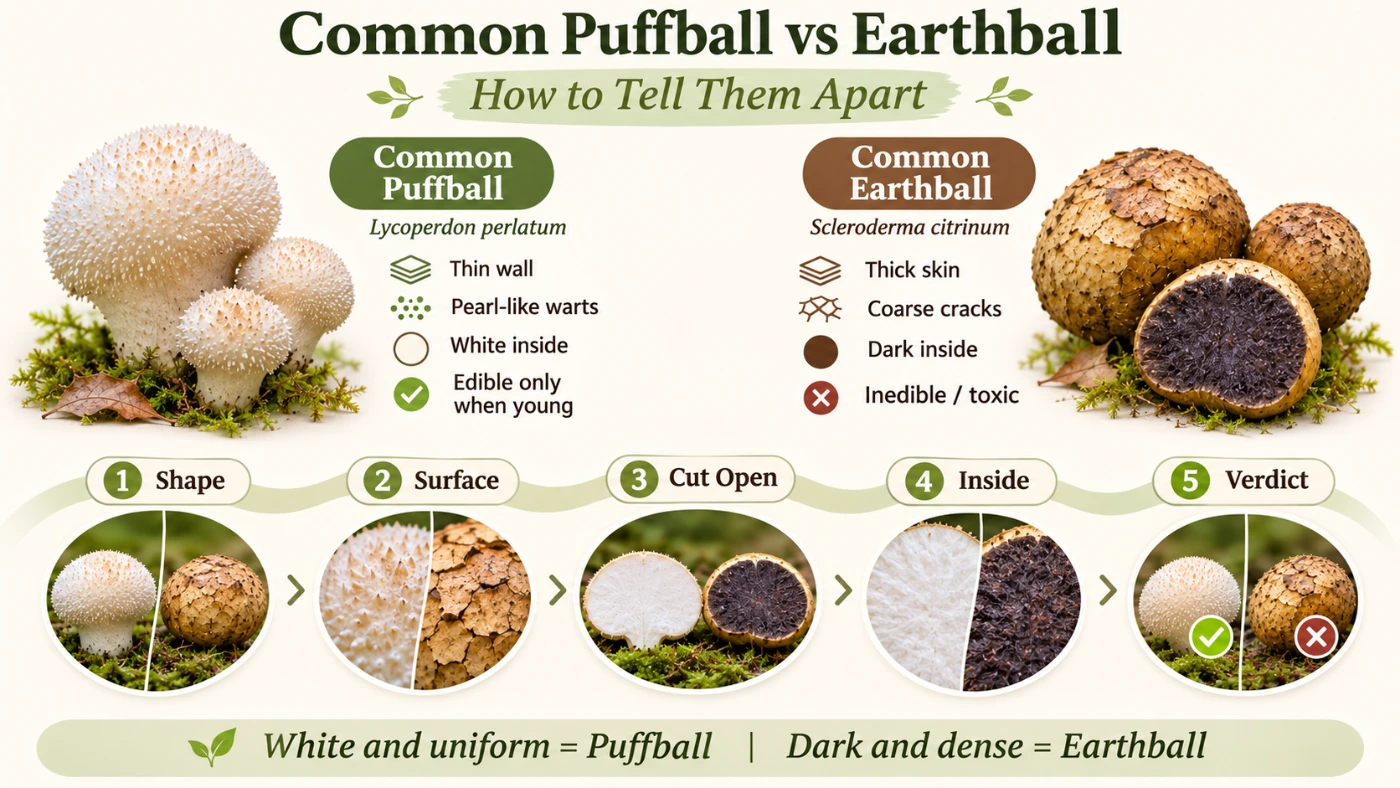
Common Puffball (Lycoperdon perlatum) and Common Earthball (Scleroderma citrinum) can both appear as rounded mushrooms growing on the ground, but they are very different fungi. A young puffball has a relatively thin outer wall and completely white homogeneous flesh inside, while an earthball has a much thicker, tougher skin and quickly develops a dark interior.
The easiest practical distinction is to cut the fruit body vertically from top to bottom. A young Common Puffball should be solid white throughout, while an Earthball usually has dense gray, purple-brown, or blackish tissue inside as it develops.
⚠️ Important: Do not identify a rounded mushroom as edible from its outer appearance alone. Young Amanitas can also resemble puffballs from the outside, so every young puffball considered for food should be cut open and checked for internal cap, gill, or stem structures.
Quick Comparison
| Feature | Common Puffball | Common Earthball |
|---|---|---|
| Scientific name | Lycoperdon perlatum | Scleroderma citrinum |
| Shape | Pear-shaped to rounded | Round to irregularly potato-shaped |
| Surface | Small pointed warts or “pearls” | Thick, coarse scales or cracked patches |
| Outer wall | Relatively thin | Thick and tough |
| Young interior | Pure white and homogeneous | White only very young, then rapidly darkens |
| Mature interior | Olive-brown powdery spores | Dark purple-brown to nearly black |
| Stem-like base | Usually present | Usually absent or very reduced |
| Spore release | Opening at the top | Outer wall splits irregularly |
| Habitat | Woodland floor, paths, grass | Woodland, heaths, acidic soils |
| Edibility | Edible only when young and correctly identified | Inedible / toxic |
| Best clue | Thin wall + white interior | Thick skin + dark interior |
Common Puffball — Lycoperdon perlatum
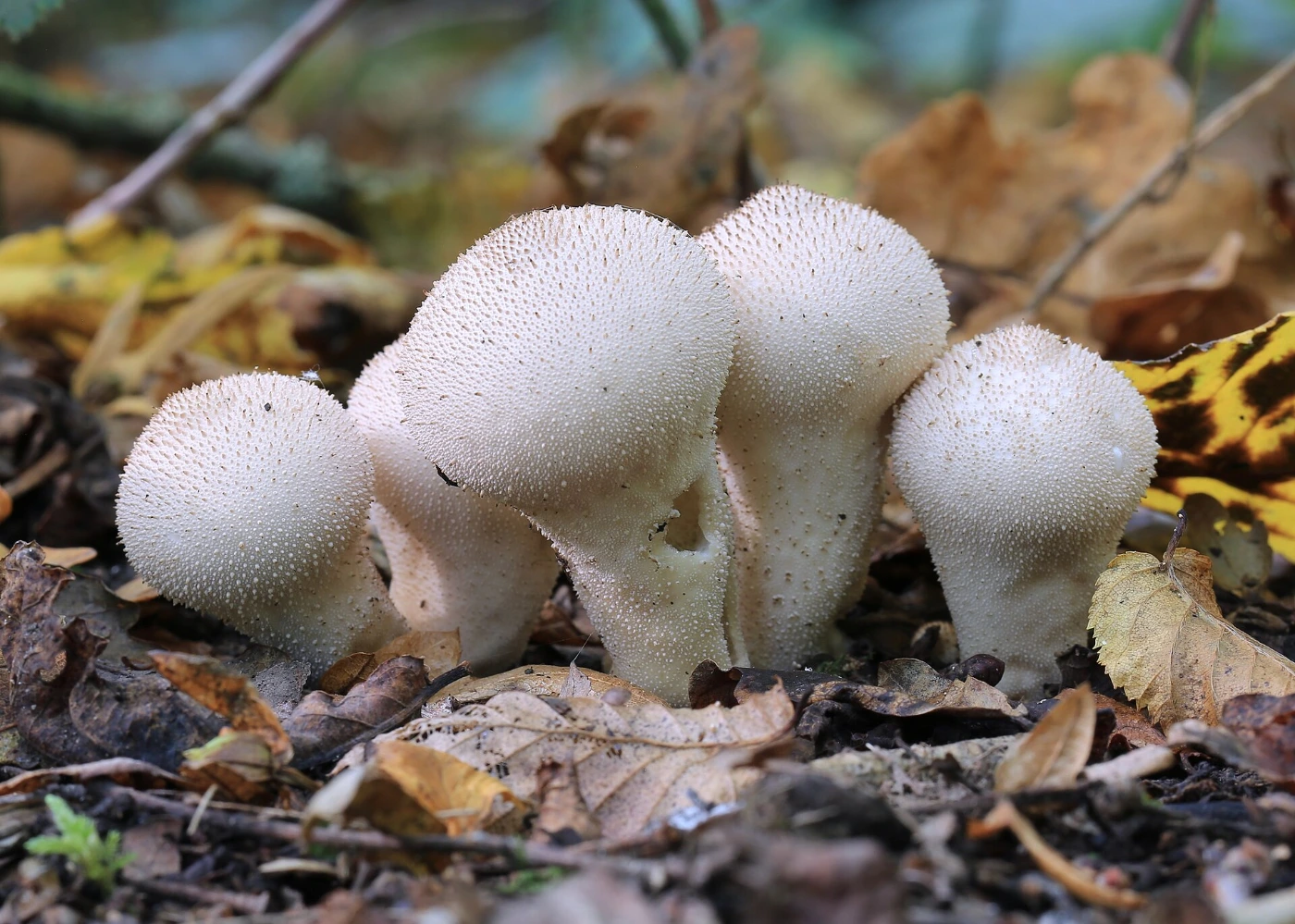
Common Puffball is a small to medium-sized puffball with a pear-like shape and a short sterile base. Young specimens are white to cream and covered with many small pointed warts.
As the mushroom ages, these warts fall away and leave a fine net-like pattern on the surface. The inside gradually changes from white flesh into an olive-brown mass of mature spores.
Earthball — Scleroderma citrinum
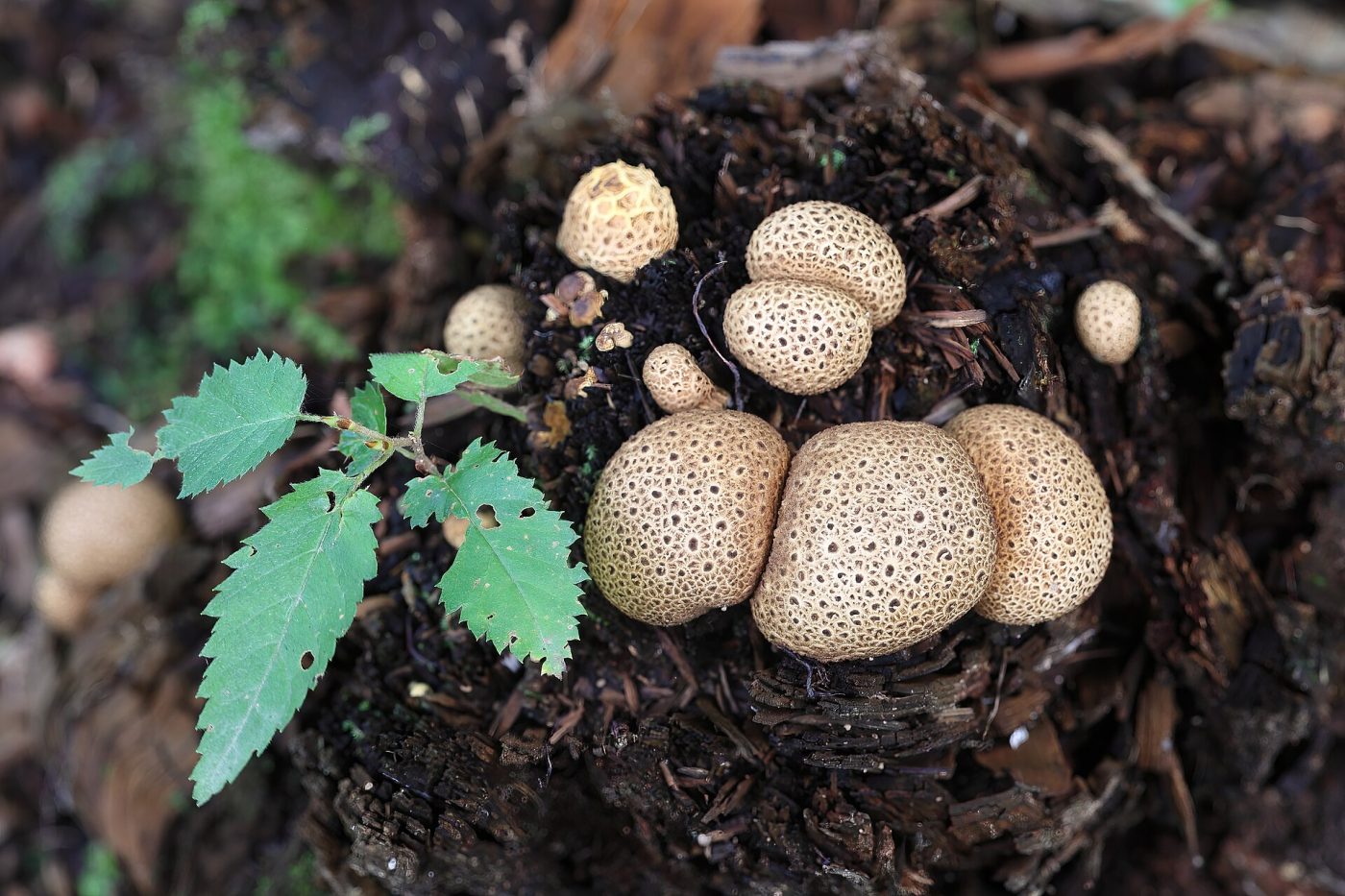
Common Earthball is usually more rounded, heavier, and tougher than a puffball. Its outer skin is thick, yellow-brown to ochre, and often broken into coarse irregular scales or cracks.
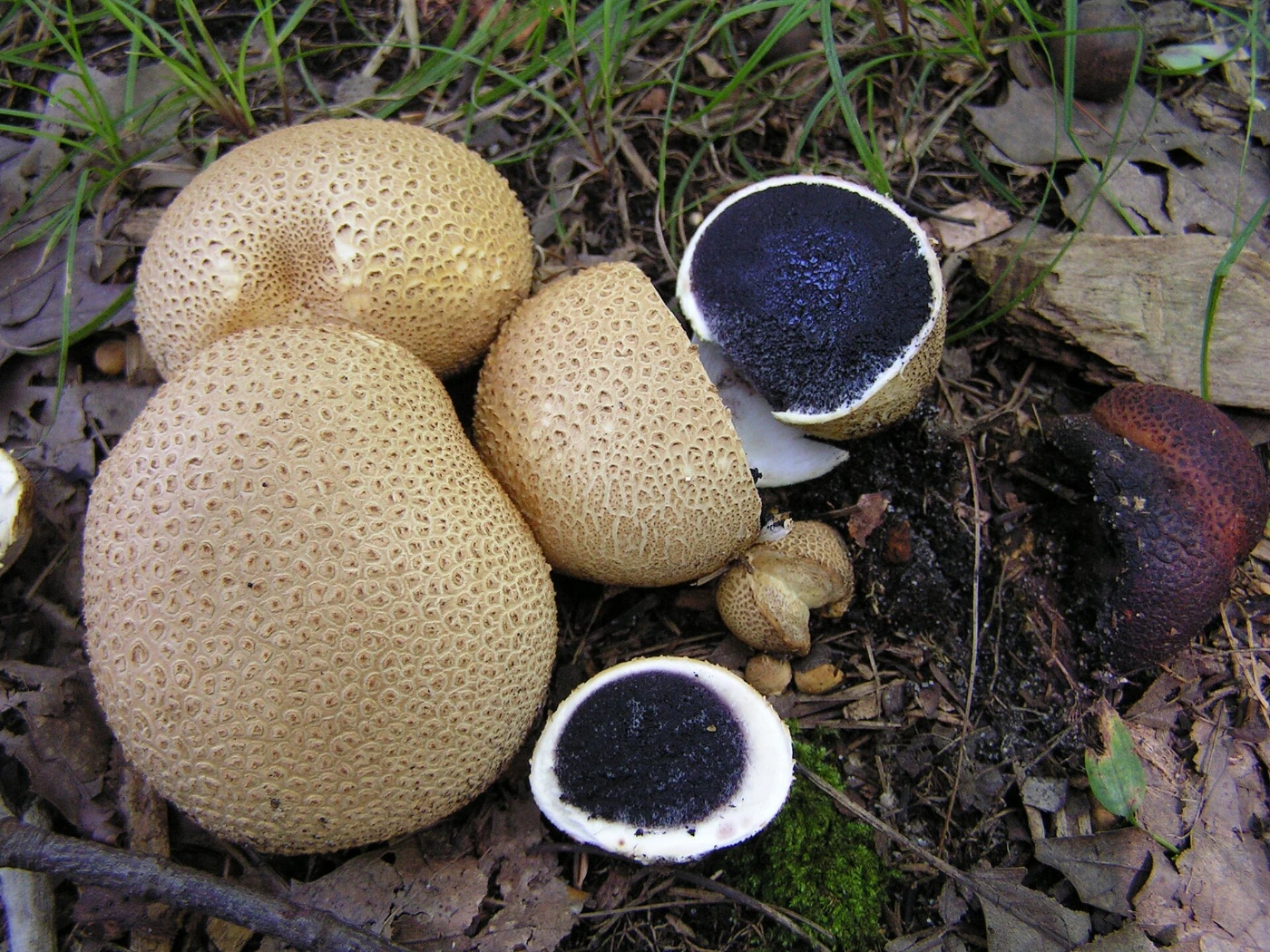
The interior becomes dark very early in development. Mature Earthballs contain dense purple-brown to black spores rather than the softer olive-brown powder typical of mature Common Puffballs.
The Fastest Way to Tell Them Apart
Cut the mushroom vertically through the center. This is much more reliable than judging color or shape from the outside.
A young Common Puffball should show uniform white flesh with no separate internal structures. An Earthball usually has a much denser interior and often shows gray, purple, or black tones even while the outside is still relatively pale.
Outer Skin
The outer wall of a Common Puffball is relatively thin and soft compared with an Earthball. It is decorated with small warts that can often be rubbed away.
An Earthball has a noticeably thicker and tougher outer skin. It can feel almost leathery and may require more pressure to cut.
Surface Texture
Common Puffball has small pointed warts, often with larger central points surrounded by smaller ones. When these warts fall away, they leave a delicate reticulated pattern.
Earthball has much coarser surface ornamentation. The skin often breaks into broad polygonal scales or cracked patches rather than small pearl-like warts.
Shape
Common Puffball often has a rounded upper portion and a narrower base, giving it a pear-like outline. The lower sterile section may look like a short stem.
Earthball is usually more globose or potato-shaped. It often sits directly on or partly in the soil without a distinct stem-like base.
Interior of a Young Common Puffball
The inside should be completely white, firm, and homogeneous. There should be no difference between a cap, stem, or central structure because a true puffball does not develop those parts internally.
This uniform white interior is the key feature for determining whether a young puffball is still at the edible stage. Once yellow, olive, or brown tones appear, the mushroom has begun maturing and should not be eaten.
Interior of an Earthball
Earthballs darken much earlier than true puffballs. The inner tissue often becomes gray, purple-brown, or almost black while the fruit body is still firm.
The contrast between pale outer skin and dark dense interior is one of the easiest identification clues. Mature Earthballs can look almost charcoal-black inside.
Mature Common Puffball
As Common Puffball matures, the white internal tissue converts into millions of dry spores. The inside becomes olive-brown and powdery.
A small opening develops at the top of the fruit body. Raindrops, animals, or a light press can force a cloud of spores through this opening.
Mature Earthball
Earthball also becomes filled with spores, but the structure is different. The outer wall remains thick and often cracks or ruptures irregularly.
Instead of producing spores through a neat top pore, the skin usually breaks open in larger sections. The spore mass is much darker than in Common Puffball.
Habitat
Common Puffball is widespread in deciduous, coniferous, and mixed woodland. It may also occur along paths, woodland edges, and grassy areas with enough organic matter.
Earthball is strongly associated with woodland and heathland, often on acidic or sandy soil. It can occur near birch, pine, oak, and other trees.
Season
Both species are most common from summer into autumn. In mild climates they may remain visible into late autumn.
Old fruit bodies can persist long after active growth has ended. A brown puffball or cracked Earthball found in late autumn may have matured weeks earlier.
Is Common Puffball Edible?
Common Puffball is generally regarded as edible when young, correctly identified, and completely white inside. The texture becomes unsuitable once the interior begins turning yellow or olive.
Correct identification matters more than culinary quality. A rounded white fruit body should never be eaten without cutting it open first.
Is Earthball Edible?
No. Earthballs are considered inedible and can cause gastrointestinal poisoning.
Their tough texture and dark developing interior are also very different from a young culinary-stage puffball. They should not be collected as substitutes for true puffballs.
Look-Alikes
Several rounded fungi can resemble either Common Puffball or Earthball. The most important safety comparison is with young Amanita species, while other true puffballs can create more ordinary identification confusion.
Young Amanita Species
Identification
Young Amanitas can begin as enclosed white or pale “eggs” before the cap and stem emerge. From the outside, they may look like smooth puffballs.
When cut vertically, however, a developing mushroom is visible inside. The outline of the cap, gills, and stem can often be seen clearly.
Main Difference
A true puffball has a completely homogeneous interior. Any organized internal mushroom structure immediately rules out Lycoperdon perlatum.
Lycoperdon echinatum — Spiny Puffball
Identification
Spiny Puffball has longer, darker, more conspicuous spines than Common Puffball. The fruit body can also become brown earlier.
The overall pear-shaped form is similar. Surface texture is the easiest distinction.
Main Difference
Long clustered spines favor Lycoperdon echinatum. Short pearl-like warts with a fine mesh pattern favor L. perlatum.
Apioperdon pyriforme — Stump Puffball
Identification
Stump Puffball grows in dense groups on decaying wood, buried roots, and stumps. Its surface is generally smoother and less prominently warted.
Large colonies are common and can make the species very conspicuous. The wood substrate is usually the strongest clue.
Main Difference
Direct growth from wood strongly favors Stump Puffball. Common Puffball is usually terrestrial in woodland litter.
Other Scleroderma Species
Identification
Several Earthball species share thick skins and dark interiors. Surface color and cracking patterns can vary between species.
Exact identification within Scleroderma can require closer examination. For practical purposes, the thick wall and dark interior are more important than the exact Earthball species.
Main Difference
Any rounded fungus with a very tough skin and dark developing interior should be treated as an Earthball-type mushroom rather than a true edible puffball.
Common Puffball vs Earthball Side by Side
The outer surface provides useful clues, but the cross-section is much more decisive. Common Puffball should have thin skin and homogeneous white flesh when young.
Earthball combines a thick, leathery wall with a dense interior that soon becomes dark. This difference remains useful even when both mushrooms are dirty, weathered, or similar in color.
Common Puffball vs Amanita Egg
| Feature | Common Puffball | Young Amanita |
|---|---|---|
| Exterior | White, warted | White or pale, often smooth |
| Interior | Uniform white | Internal mushroom visible |
| Developing gills | No | Yes |
| Developing stem | No | Yes |
| Developing cap | No | Yes |
| Main clue | Homogeneous flesh | Organized anatomy |
This is the most important safety comparison when collecting young puffballs. Always cut the entire fruit body through the center rather than making only a shallow cut.
Why Earthballs Can Be Confusing
Very young Earthballs may begin pale inside before the spores develop. At this stage, the thick outer wall and coarse surface texture become especially important.
The interior usually darkens quickly as the fungus matures. Comparing several fruit bodies of different ages from the same group can make the identification much easier.
How to Identify Common Puffball
Look for a small pear-shaped mushroom with pale pointed warts and a short sterile base. The warts often leave a fine net-like pattern as they fall away.
Cut a young specimen vertically and confirm that the inside is pure white and completely uniform. This combination strongly supports Lycoperdon perlatum.
How to Identify an Earthball
Look for a round or potato-shaped fungus with a thick yellow-brown outer skin. Coarse cracking or broad scales are common.
Then cut it open and inspect the interior. Dense dark purple-brown or blackish tissue strongly supports Scleroderma.
Common Identification Mistakes
One common mistake is assuming that every rounded white mushroom is a puffball. Young Amanitas, Earthballs, stinkhorn eggs, and other fungi can all begin as enclosed structures.
Another mistake is using only the outside color. Both Puffballs and Earthballs change dramatically with age, so internal structure is much more useful.
A third mistake is assuming that all mature puffballs are still edible. Once the inside stops being pure white, the edible stage has ended.
How to Photograph Puffballs and Earthballs
Take one photograph of the intact fruit body and another showing the surface texture close up. A side view helps document whether a narrow sterile base is present.
The most useful image is a clean vertical cross-section. It immediately shows wall thickness, interior color, and whether any internal cap or stem structures are present.
Can AI Tell Puffballs From Earthballs?
Typical mature specimens are often relatively easy to distinguish from photographs because their surface texture and internal color differ strongly. Very young fruit bodies can be more difficult.
A cross-section dramatically improves image-based identification. A photograph showing only the outside of a small white ball cannot safely rule out a young Amanita.
Interesting Facts
Common Puffballs release spores through a specialized opening at the top. A single raindrop can compress the mature fruit body and send a visible puff of spores into the air.
Earthballs use a different strategy. Their thick outer wall eventually ruptures and exposes the dark spore mass inside.
Both groups evolved enclosed fruit bodies, but they are not simply different stages of the same type of mushroom. Common Puffballs and Earthballs belong to different fungal lineages.
The dark interior of a mature Earthball can look almost artificial when cut open. This dramatic contrast with the thick yellow-brown exterior is one reason the group is relatively easy to recognize once mature.
Frequently Asked Questions
Are Earthballs poisonous?
Yes, Earthballs are considered inedible and can cause gastrointestinal symptoms. They should not be collected as edible puffballs.
Can a young Earthball be white inside?
Very young specimens can begin relatively pale. The thick outer wall and coarse surface are therefore useful when the interior has not yet darkened strongly.
Is every puffball with white flesh edible?
No. Correct species identification is still necessary, and a young Amanita can also look white when viewed only from outside. The interior must be homogeneous with no developing mushroom structures.
Why does Common Puffball have little spikes?
The small warts are part of the outer surface structure. As they fall away, they leave a characteristic fine network of scars.
Why is an Earthball so hard to cut?
Its outer wall is much thicker and tougher than that of most true puffballs. This leathery skin is one of the best practical identification clues.
Do Common Puffballs and Earthballs grow in the same habitat?
Yes, their habitats can overlap in woodland. Soil type and tree association may differ, but habitat alone is not enough to separate them.
What color should a young Common Puffball be inside?
It should be completely white from top to bottom. Yellow, olive, brown, or powdery areas indicate maturation.
What is the safest way to check a puffball?
Cut it vertically through the center. You should see uniform white flesh with no cap, gills, stem, or other internal anatomy.
Final Identification Notes
Common Puffball and Earthball are easiest to separate by combining surface texture, wall thickness, and internal color. Lycoperdon perlatum has small pearl-like warts, a relatively thin wall, and homogeneous white flesh when young, while Scleroderma citrinum has a thick coarse skin and an interior that becomes dark purple-brown to black.
The vertical cross-section is the most useful practical test because it also helps rule out young Amanitas. A true young puffball should contain no organized mushroom structures whatsoever.
The simplest field rule is: thin wall + pearl-like warts + pure white homogeneous interior = Common Puffball; thick tough skin + coarse cracking + dark interior = Earthball.
Upload a photo and get possible matches in seconds.