Oak trees support some of the richest mushroom communities in temperate forests. Their roots form partnerships with many mycorrhizal fungi, while fallen leaves, buried roots, dead branches, and old wood create habitat for decomposers.
A mushroom growing under an oak is not automatically associated with that oak, however. In mixed woodland, nearby beech, birch, pine, or other trees may also influence the fungal community, so identification should combine habitat with cap, underside, stem, bruising, latex, spore color, and growth pattern.
⚠️ Important: This guide is for identification and education only. Never eat a wild mushroom based solely on habitat, photographs, AI identification, or an online comparison.
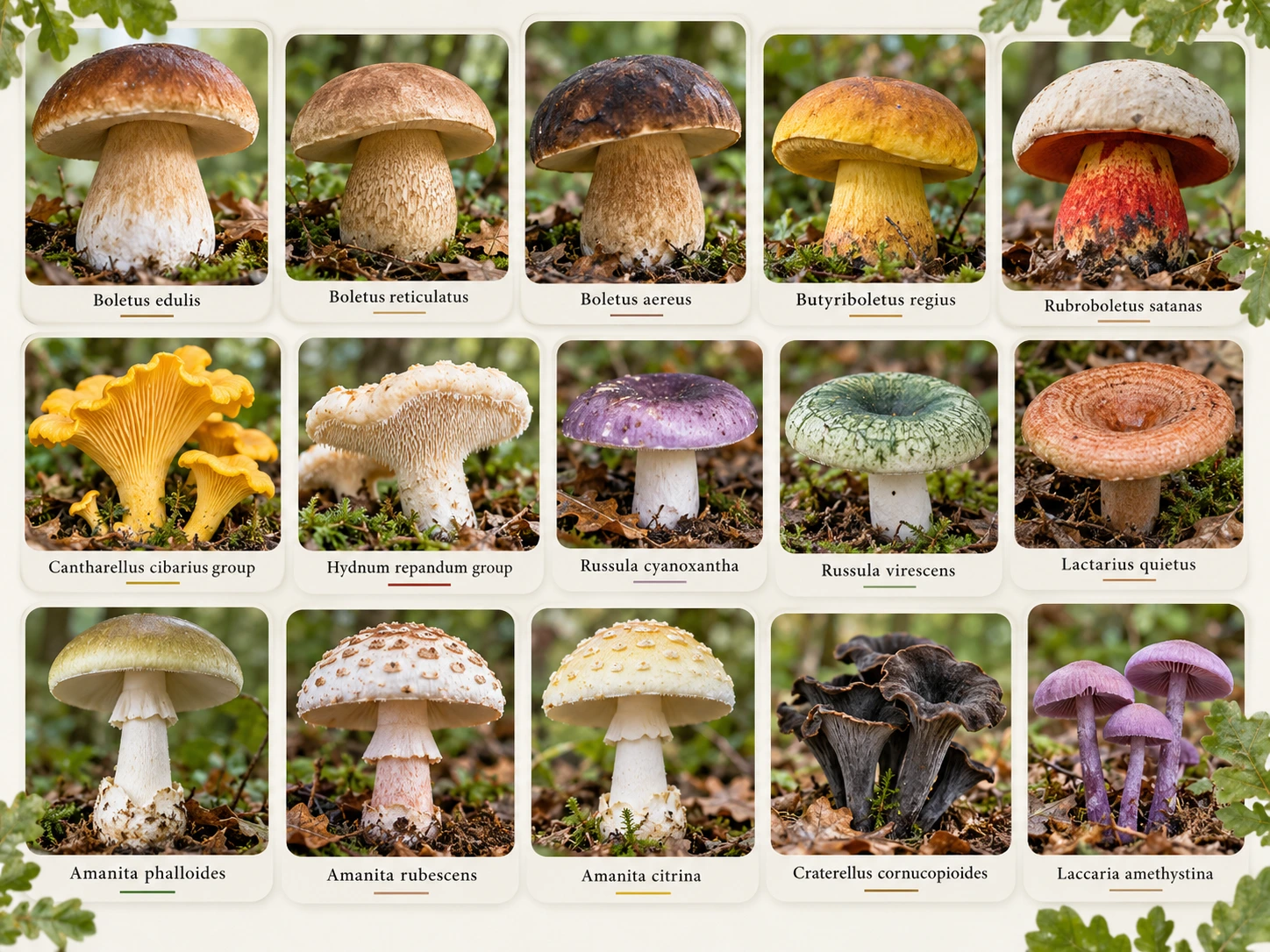
Quick Guide to 15 Mushrooms Found Under Oak Trees
| Species | Common name | Main clue | Safety |
|---|---|---|---|
| Boletus edulis | Porcini / Cep | Brown cap, white-to-olive pores, pale reticulated stem | Edible when correctly identified |
| Boletus reticulatus | Summer Cep | Dry brown cap, strong stem reticulation | Edible when correctly identified |
| Boletus aereus | Bronze Bolete | Very dark cap, robust stem | Edible when correctly identified |
| Butyriboletus regius | Royal Bolete | Pink-red cap, yellow pores | Edible when correctly identified |
| Rubroboletus satanas | Satan’s Bolete | Pale cap, red pores, blue bruising | Poisonous |
| Cantharellus cibarius group | Golden Chanterelles | Yellow cap, false gills, fruity odor | Edible when correctly identified |
| Hydnum repandum group | Wood Hedgehog | Pale cap, teeth underneath | Edible when correctly identified |
| Russula cyanoxantha | Charcoal Burner | Variable purple-green cap, flexible gills | Edible when correctly identified |
| Russula virescens | Green-Cracking Russula | Green cracked cap | Edible when correctly identified |
| Lactarius quietus | Oak Milkcap | Brown zoned cap, white latex | Inedible / low culinary value |
| Amanita phalloides | Death Cap | Olive cap, white gills, ring, volva | Deadly poisonous |
| Amanita rubescens | Blusher | Brown cap, reddish bruising | Edibility requires expert identification |
| Amanita citrina | False Death Cap | Pale yellow cap, bulbous base | Inedible / not recommended |
| Craterellus cornucopioides | Horn of Plenty | Dark trumpet shape | Edible when correctly identified |
| Laccaria amethystina | Amethyst Deceiver | Purple cap and gills | Edible when correctly identified, but not ideal for beginners |
Why Oak Trees Support So Many Mushrooms
Oak roots form mycorrhizal relationships with many fungi. These fungi help the tree absorb water and nutrients, while the tree supplies them with sugars produced through photosynthesis.
This relationship is especially important for boletes, Amanitas, Russulas, milkcaps, chanterelles, and Hedgehog Mushrooms. Oak woodland can therefore produce a very diverse mushroom community in a relatively small area.
Oak Leaf Litter Creates a Stable Forest Floor
Oak leaves decompose slowly and form a thick organic layer. This helps retain moisture and creates a stable habitat for fungi and other forest organisms.
The soil beneath mature oaks can support both mycorrhizal species and decomposers. The exact mix depends on soil chemistry, moisture, climate, and surrounding trees.
1. Boletus edulis — Porcini
Identification
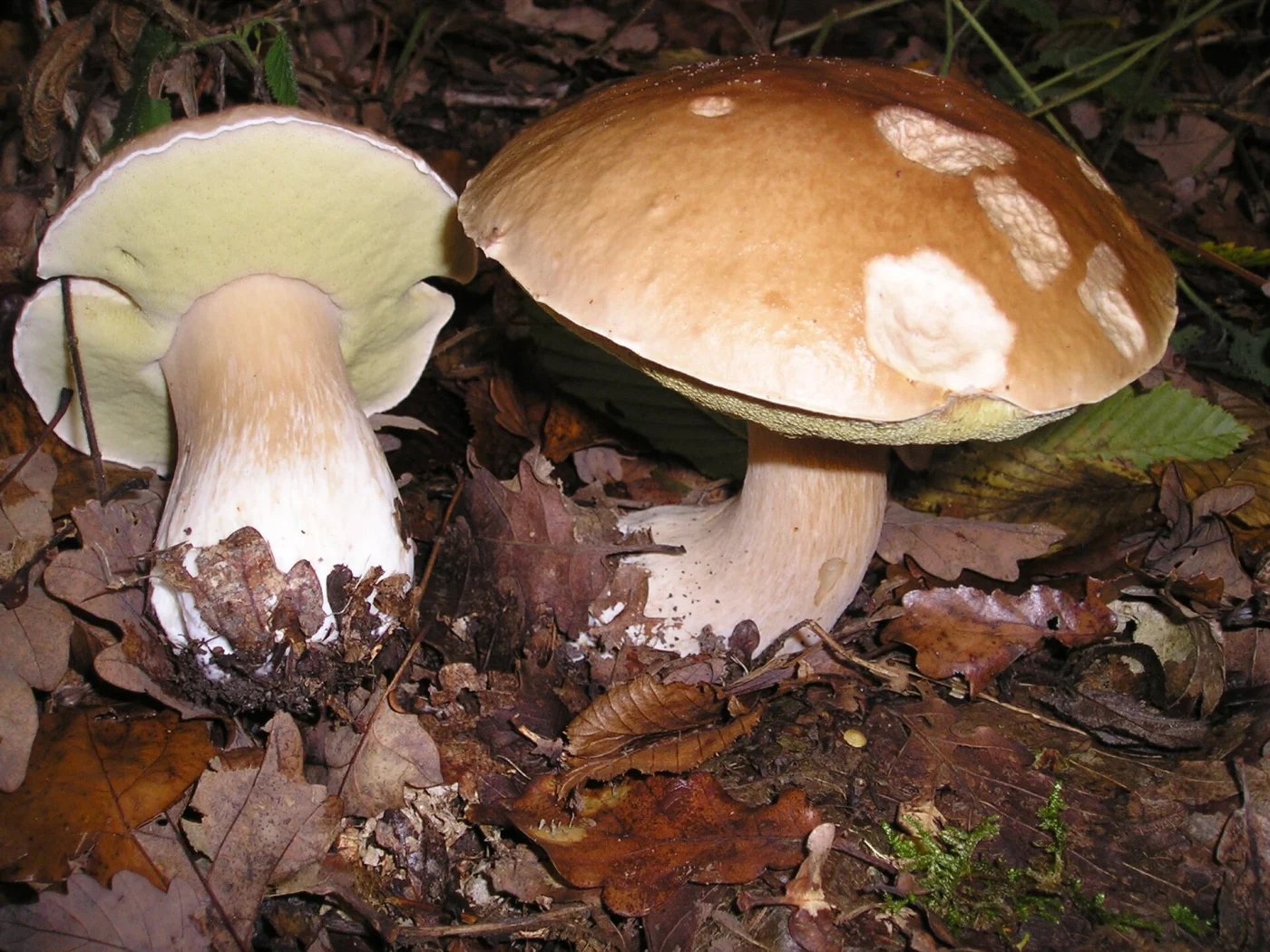
Porcini has a brown to chestnut cap, a thick pale stem, and a sponge-like underside with pores instead of gills. The young pore surface is white and gradually becomes yellow to olive.
The upper stem often shows pale reticulation. The flesh is white and usually does not turn blue when cut.
Oak Association
Boletus edulis can associate with both broadleaf and coniferous trees. Oak is one of several important hosts.
In mixed woodland, the exact host may not always be obvious. Nearby beech, birch, spruce, or pine can also support the species.
Safety
It is highly valued as an edible mushroom when correctly identified. Bitter Bolete and other similar boletes should be excluded carefully.
2. Boletus reticulatus — Summer Cep
Identification
Summer Cep usually has a warm brown, tan, or ochre-brown cap and a thick pale stem with a prominent net-like pattern. The cap surface is often dry and may crack in hot weather.
The pores begin white and mature toward yellow-green. The flesh remains pale and generally does not bruise blue.
Oak Association
This species is strongly associated with warm broadleaf woodland, especially oak and beech. It often appears earlier in the season than classic autumn Porcini.
Dry summer conditions followed by rain can trigger fruiting. Mature oak woodland is a classic habitat.
Safety
It is edible when correctly identified. Strong stem reticulation and broadleaf habitat are useful clues.
3. Boletus aereus — Bronze Bolete
Identification
Bronze Bolete has a very dark brown to nearly blackish cap and a thick pale to brownish stem. The pore surface is white when young and later becomes yellow to olive.
The flesh is dense, white, and usually non-blueing. The cap often has a dry, slightly velvety appearance.
Oak Association
It favors warm broadleaf forests and is especially associated with oak. Mediterranean and southern European regions are particularly suitable.
It often grows in well-drained soil during warm weather. Host tree and climate are important supporting clues.
Safety
It is considered an excellent edible mushroom when correctly identified. Its dark cap can make it distinctive, but exact identification should still rely on the whole set of features.
4. Butyriboletus regius — Royal Bolete
Identification
Royal Bolete is striking, with a pink to reddish cap, yellow pores, and a yellow stem that may show fine reticulation. The overall color contrast can be vivid.
The flesh is pale yellow and may show little or mild blueing. Strong dark blue bruising is less typical than in many red-pored boletes.
Oak Association
The species is associated mainly with broadleaf trees, especially oak and beech. Warm woodland and calcareous soil are common settings.
It is uncommon in some regions and may be protected or locally rare. Habitat conservation can therefore be more important than collecting.
Safety
It is generally considered edible when correctly identified. Because of rarity and similarity to other boletes, it is not a good beginner collection species.
5. Rubroboletus satanas — Satan’s Bolete
Identification
Satan’s Bolete is a large heavy mushroom with a pale grayish cap, red pores, and a thick red-and-yellow stem. The yellow flesh often turns blue when cut.
Young specimens may have less intense red pore coloration. Mature fruit bodies are usually much more dramatic.
Oak Association
It favors warm broadleaf woodland, often with oak and beech. Calcareous soils are especially typical.
The species is more characteristic of warmer regions than cool acidic forests. Ecology helps distinguish it from other red-pored boletes.
Safety
It is poisonous and can cause severe gastrointestinal illness. Blue bruising does not make a bolete edible or poisonous by itself.
6. Cantharellus cibarius Group — Golden Chanterelles
Identification
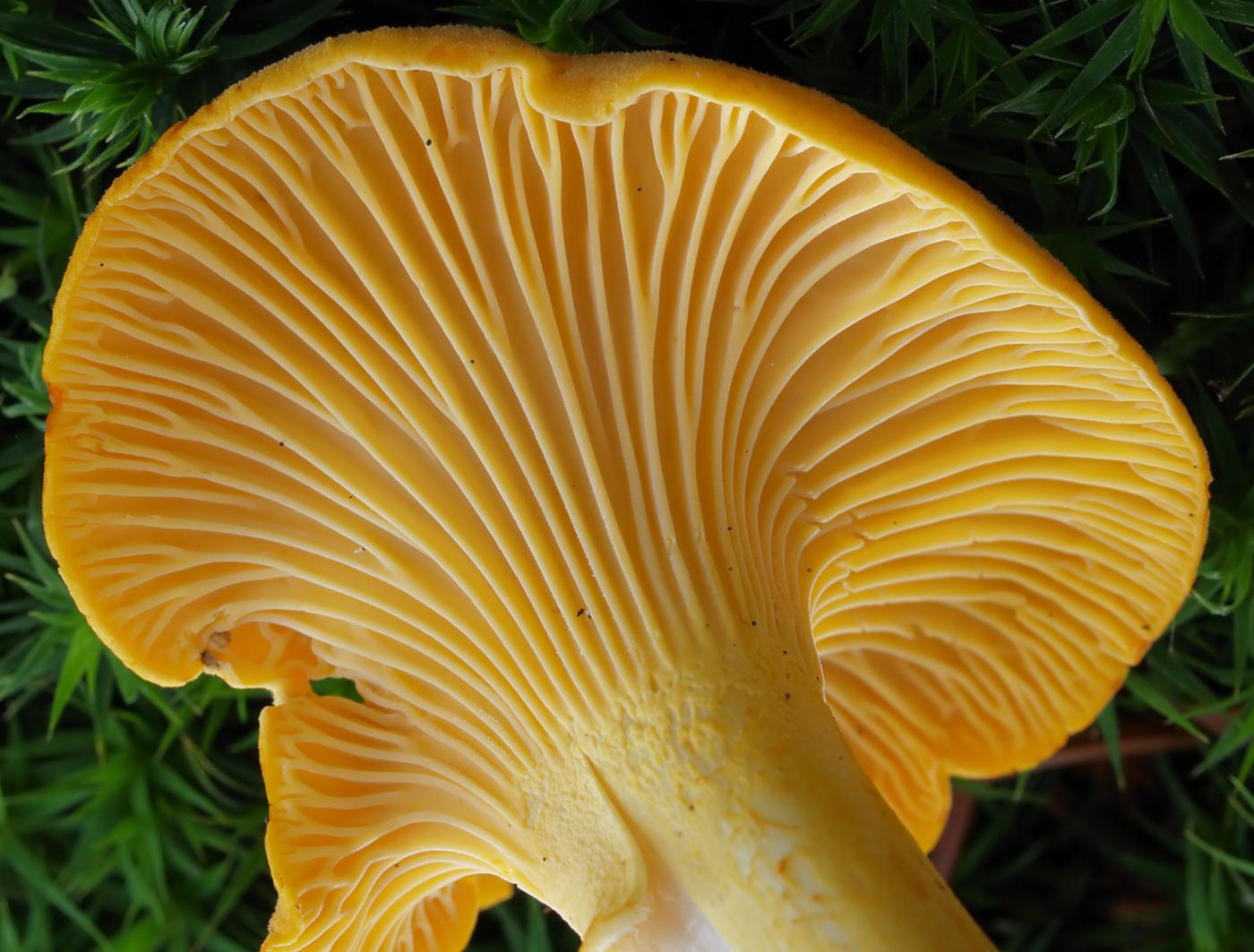
Golden Chanterelles have yellow to golden-orange caps and blunt forked ridges rather than true gills. The flesh is firm and pale inside.
Many have a fruity smell often compared with apricot. Caps become wavy and irregular with age.
Oak Association
Chanterelles are mycorrhizal and can occur with oak, beech, birch, conifers, and other trees depending on species and region. Oak woodland is a classic habitat in many parts of Europe.
They often grow scattered rather than from one dense central cluster. Moist mossy ground can be especially productive.
Safety
They are edible when correctly identified. False Chanterelle and Jack-o’-Lantern mushrooms must be excluded.
7. Hydnum repandum Group — Wood Hedgehog
Identification
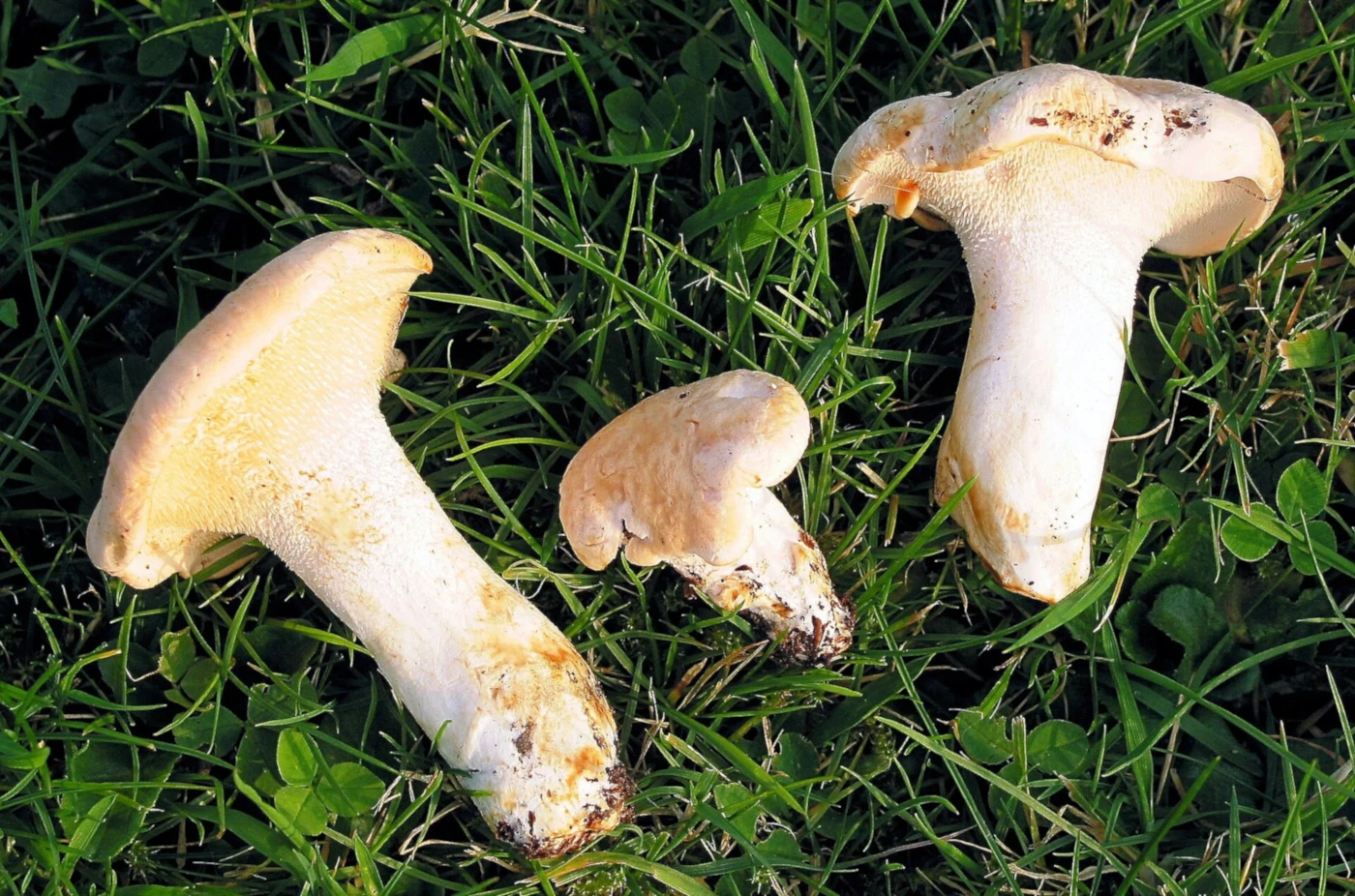
Wood Hedgehog has a pale cream to apricot cap and soft downward-pointing teeth underneath. It has no gills or pores.
The cap often becomes irregular and lobed with age. The flesh is firm and pale.
Oak Association
Hydnum species are mycorrhizal and commonly occur in both broadleaf and coniferous woodland. Oak can be an important host.
Modern taxonomy recognizes several similar species, so exact naming may depend on geography. Group-level identification is often more reliable.
Safety
Many common Hedgehog Mushrooms are edible when correctly identified. The toothed underside makes the group relatively distinctive.
8. Russula cyanoxantha — Charcoal Burner
Identification
Charcoal Burner has a variable cap that may combine purple, green, gray, blue, or olive tones. Its gills are pale and unusually flexible for a Russula.
Most Russulas have brittle gills that break easily, while R. cyanoxantha gills bend more than expected. This is one of its best field clues.
Oak Association
It grows in deciduous and mixed woodland and is commonly associated with oak and beech. It may occur singly or in scattered groups.
Summer and autumn are the main seasons. Moist mature woodland is ideal.
Safety
It is considered edible when correctly identified. Russula identification can be difficult, so species-level confidence matters.
9. Russula virescens — Green-Cracking Russula
Identification
Green-Cracking Russula has a pale green to gray-green cap with a distinctive cracked or mosaic-like surface. The gills and stem are pale.
The flesh is brittle like other Russulas. Mature caps often develop a very characteristic patchwork pattern.
Oak Association
It commonly grows in warm deciduous woodland, especially with oak and beech. It is more frequent in some regions than others.
The green cracked cap makes it one of the more recognizable Russulas. Habitat helps support the identification.
Safety
It is considered edible when correctly identified. Greenish Amanitas and other pale mushrooms should still be distinguished carefully.
10. Lactarius quietus — Oak Milkcap
Identification
Oak Milkcap usually has a brown to reddish-brown cap with darker concentric zones. The gills are pale to tan and release white latex when damaged.
The cap often has a dull, dry appearance. The odor can be distinctive but varies in how people perceive it.
Oak Association
As the common name suggests, it is strongly associated with oak. It is one of the more characteristic milkcaps of oak woodland.
Finding a brown milkcap directly beneath oak is therefore useful ecological evidence. Latex color and cap pattern should still be checked.
Safety
It is generally considered inedible or of little culinary value. Its main interest is as a characteristic oak-associated species.
11. Amanita phalloides — Death Cap
Identification
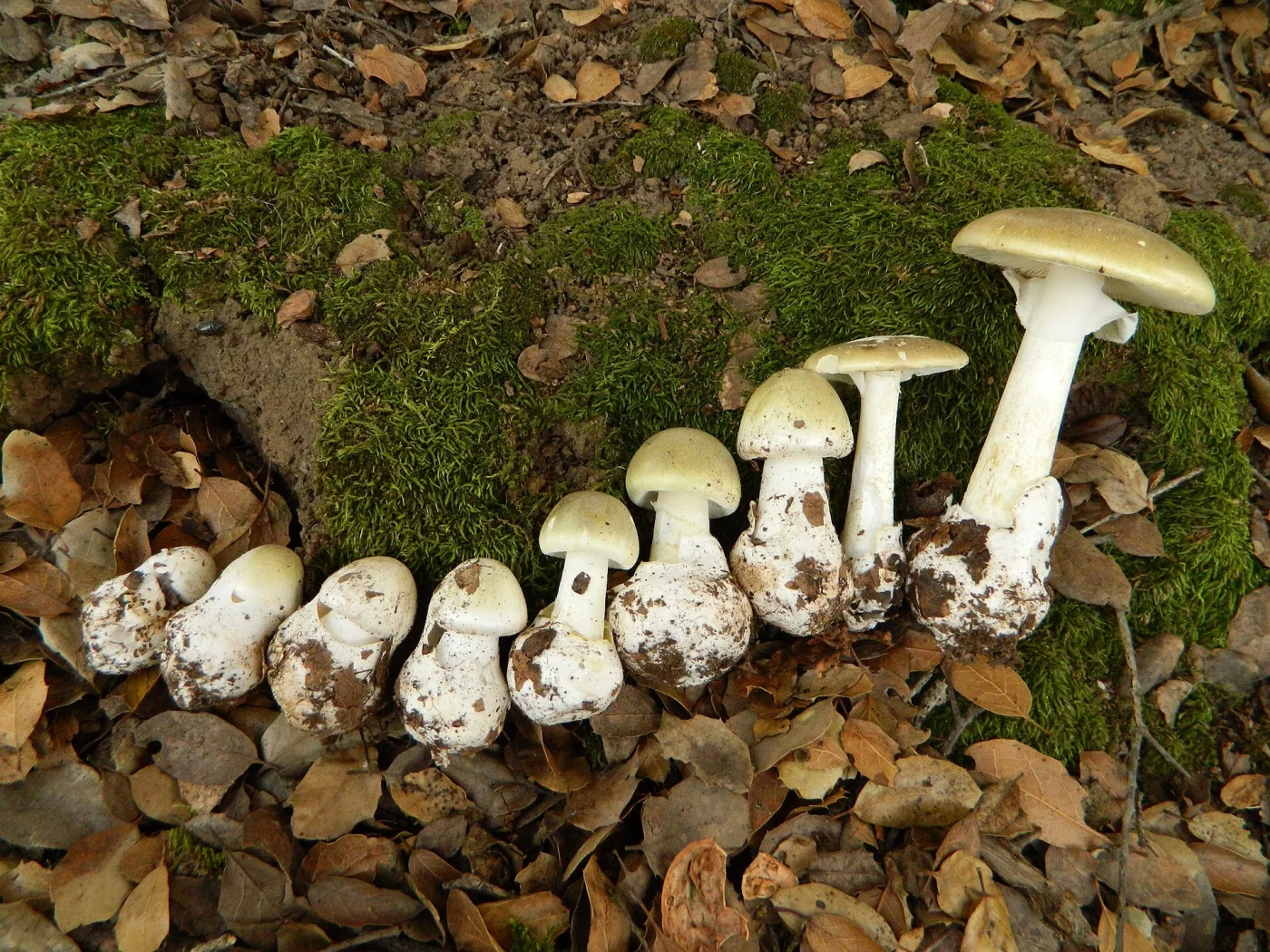
Death Cap typically has an olive-green, yellow-green, brownish, or occasionally very pale cap. The gills are white and remain white with age.
The stem has a ring and a sack-like volva at the base. The volva can be buried in soil, making the complete stem base essential for identification.
Oak Association
Death Cap forms mycorrhizal relationships with oak and several other broadleaf trees. Oak woodland is one of its classic habitats in Europe.
It has also spread to other regions with planted host trees. Urban parks and landscaped areas can therefore support it.
Safety
Death Cap is deadly poisonous and contains amatoxins. Poisoning can cause delayed severe liver failure.
12. Amanita rubescens — Blusher
Identification
The Blusher has a brown to reddish-brown cap with pale veil patches. The flesh, stem, and damaged areas often develop reddish or wine-colored staining.
The stem has a ring and an enlarged base. Unlike some dangerous Amanitas, it lacks a free sack-like volva.
Oak Association
It occurs in both broadleaf and coniferous forests and can be common under oak. Summer through autumn is the main season.
Its reddish bruising is an important clue. However, bruising can be weak in young or dry specimens.
Safety
It is eaten in some regions after correct identification and thorough cooking, but it has dangerous Amanita look-alikes. It is not a beginner edible.
13. Amanita citrina — False Death Cap
Identification
False Death Cap has a pale yellow, yellow-green, or cream cap and white gills. The stem has a ring and a bulbous base with distinct veil remnants.
The mushroom may have a raw potato-like odor. Color can overlap with pale forms of Death Cap, which makes the stem base important.
Oak Association
It occurs in deciduous and mixed woodland and can be associated with oak. Acidic soils are common habitats.
It may fruit near other Amanitas at the same time. Each specimen should therefore be examined individually.
Safety
It is generally considered inedible or not recommended for consumption. Confusion with deadly Amanitas makes it especially unsuitable as a food mushroom.
14. Craterellus cornucopioides — Horn of Plenty
Identification
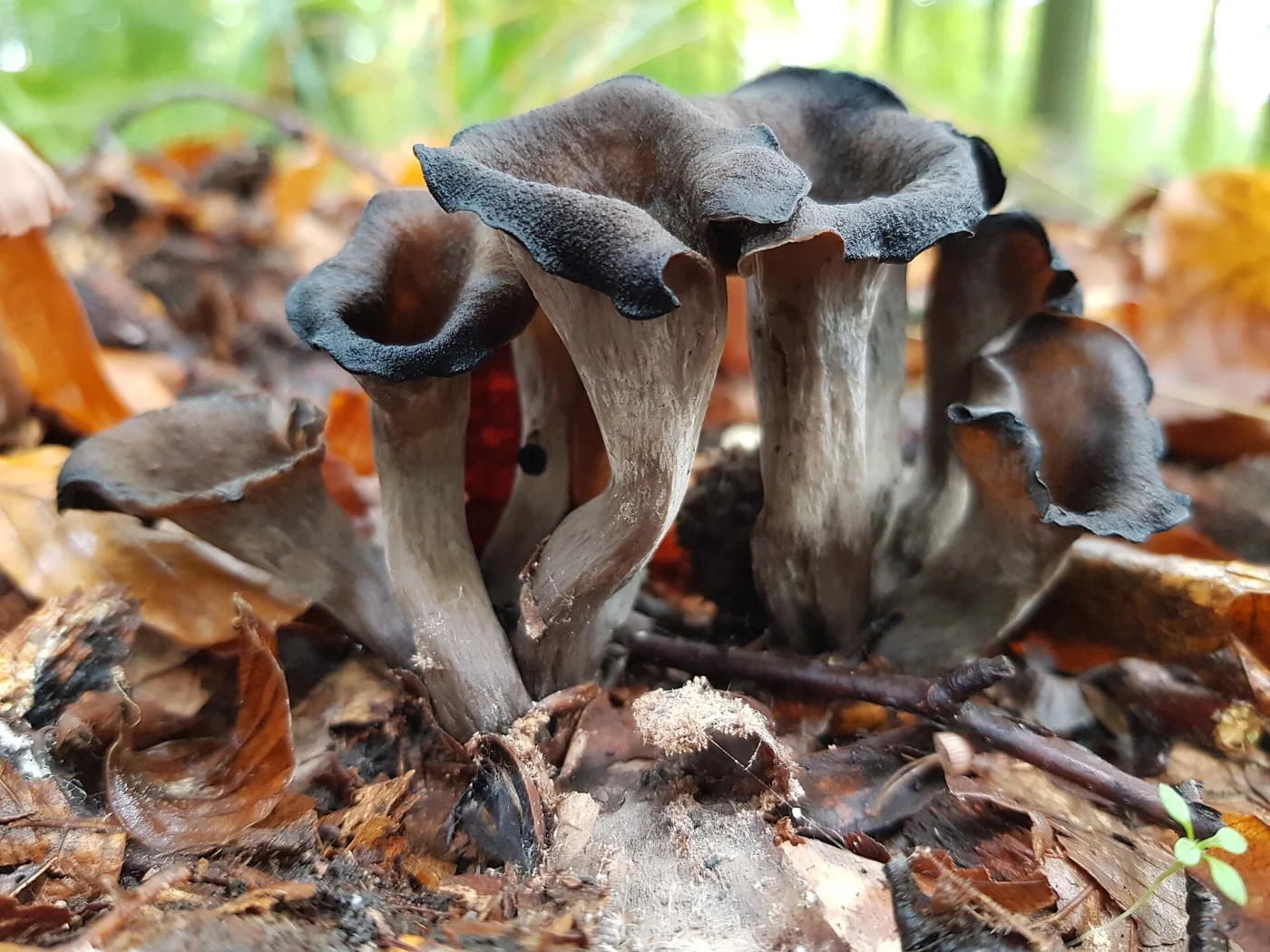
Horn of Plenty forms dark gray to nearly black trumpet-shaped fruit bodies. There are no true gills underneath.
The outer surface is gray and smooth to slightly wrinkled. The thin hollow trumpet shape is highly distinctive.
Oak Association
It often grows in deciduous woodland with oak and beech. Leaf litter can hide the dark fruit bodies surprisingly well.
Large patches may appear after sustained wet weather. They can be difficult to notice until one specimen is spotted.
Safety
It is edible when correctly identified. Its structure is unusual enough that dangerous confusion is limited, though exact habitat and morphology should still match.
15. Laccaria amethystina — Amethyst Deceiver
Identification
Amethyst Deceiver is a small purple mushroom with purple gills and a slender fibrous stem. Fresh young specimens can be intensely violet.
The color fades strongly with age and dry weather. Old mushrooms may become pale lilac or almost brownish.
Oak Association
It grows in deciduous and mixed woodland and can associate with oak, beech, and other trees. Mossy shaded ground is a common habitat.
Several purple mushrooms can occur in the same forests. Gills, stem texture, and spore characteristics help confirm the genus.
Safety
It is considered edible when correctly identified, but small purple mushrooms are not ideal beginner food species. Some can accumulate environmental contaminants depending on site.
Boletes Under Oak Trees
Oak woodland is especially rich in boletes. Porcini, Summer Cep, Bronze Bolete, Royal Bolete, and several red-pored species can all occur in similar habitats.
Pore color is one of the fastest ways to separate them. White-to-olive pores suggest the king bolete group, while red pores lead toward a very different set of species.
White Pores vs Red Pores
King boletes usually begin with white pores that mature toward yellow or olive. Their flesh generally does not show dramatic blue bruising.
Red-pored boletes often show stronger blue reactions and require much more careful identification. Some are edible, while others are poisonous.
Russulas Under Oak Trees
Oak woodland supports many Russula species. Their brittle flesh and pale gills make the genus relatively easy to recognize, but exact species identification can be much harder.
Cap color is highly variable and should never be used alone. Gill behavior, taste, spore color, bruising, and habitat may all matter.
Amanitas Under Oak Trees
Oak is an important host for many Amanitas, including both edible and deadly species. This makes oak woodland especially important for careful stem-base examination.
Any unknown Amanita should be removed with the full base intact for identification. Cutting it at ground level can remove the volva or bulb features needed to distinguish species.
Milkcap Mushrooms Under Oak
Milkcaps are another major oak-associated group. Damaging the gills releases latex, and the latex color can be highly useful.
Oak Milkcap is one classic example, but many regional species occur. Host tree, cap zoning, latex color, and taste all help narrow the group.
How to Identify a Mushroom Growing Under Oak
Start by confirming that the nearby tree is actually oak. Fallen acorns, lobed leaves, and bark are often easier to inspect than the canopy.
Then check the underside of the mushroom. Determine whether it has gills, pores, teeth, ridges, or another fertile surface.
Next, examine the stem, base, bruising, ring, volva, latex, and spore color. Only then should oak association be used to narrow the likely species.
Step 1: Identify the Oak
Oak leaves vary by species, but many have characteristic lobes. Acorns are even more distinctive when present.
In mixed forest, check whether beech, birch, hornbeam, or conifers are also nearby. The closest trunk is not always the true fungal host.
Step 2: Check the Underside
Pores suggest boletes. Teeth suggest Hydnum, while blunt ridges suggest chanterelles.
White gills plus a ring and volva should immediately raise concern for Amanita. Underside structure is usually more useful than cap color.
Step 3: Examine the Stem Base
The stem base matters most when Amanita is possible. Carefully expose the whole base rather than cutting it off.
Look for a bulb, sack-like volva, collar-like veil remnants, or reddish bruising. These details can completely change the identification.
Step 4: Note Bruising and Latex
Blue bruising is especially useful in boletes. Red staining can matter in Amanitas.
White, orange, or differently colored latex points toward milkcaps. Record the reaction quickly because some color changes develop over time.
Why Mushrooms Can Grow Far From the Oak Trunk
Oak roots can spread well beyond the canopy. Mycorrhizal fungi connected to these roots may therefore fruit several meters from the visible trunk.
In mature forest, several root systems can overlap. A mushroom appearing under one tree can actually be associated with another nearby host.
This is why host identification is ecological evidence rather than proof. Morphology always comes first.
Best Time to Find Mushrooms Under Oak Trees
Summer through autumn is the most productive period in much of temperate Europe. Warm rain followed by mild weather can trigger strong fruiting.
Some boletes appear early in summer, while Amanitas, Russulas, chanterelles, and Hedgehog Mushrooms may continue well into autumn. Season varies with region and altitude.
Weather matters more than calendar date. Sustained moisture is usually more important than one short rainstorm.
How to Photograph Oak-Forest Mushrooms for Identification
Take a wide photo showing the complete mushroom and surrounding ground. Include oak leaves, acorns, or the tree trunk if possible.
Then photograph the underside and full stem. Amanitas should always be documented with the entire base visible.
A close-up can record bruising, latex, reticulation, teeth, or false gills. Multiple angles make identification much stronger than a single cap photo.
Can AI Identify Mushrooms Growing Under Oak?
AI can use oak habitat as useful context, especially for characteristic boletes, chanterelles, Russulas, Amanitas, and milkcaps. It performs best when the tree association is supported by clear structural photos.
The main limitation is biodiversity. Oak forests can support dozens of similar species, and some require microscopic or regional information.
For better results, include the underside, stem base, surrounding leaves, and host tree. Habitat should support the identification rather than determine it automatically.
Common Identification Mistakes
One common mistake is assuming every robust brown bolete under oak is Porcini. Summer Cep, Bronze Bolete, Bitter Bolete, and other species may occur in the same habitat.
Another mistake is ignoring the stem base of Amanitas. This can hide the most important feature separating deadly and non-deadly species.
A third mistake is assuming that all yellow woodland mushrooms are chanterelles. True chanterelles have blunt ridges rather than thin blade-like gills.
Frequently Asked Questions
Why do the same oak trees produce different mushrooms in different years?
Rainfall, temperature, soil moisture, and competition between fungi change from year to year. The underground fungal community may stay similar even when the visible fruit bodies are completely different.
Can a young oak support mycorrhizal mushrooms?
Yes. Some fungi colonize oak roots relatively early, although mature woodland usually supports greater diversity and larger established mycelial networks.
Do acorns influence where mushrooms appear?
Not directly in most cases. Acorns indicate oak presence, but mycorrhizal fungi are connected to roots rather than fallen acorns.
Can one oak tree support several bolete species at once?
Yes. A single mature oak can associate with multiple fungal species, and several boletes may fruit around the same root zone during one season.
Why do mushrooms sometimes appear more heavily on one side of an oak?
Moisture, shade, soil depth, root density, and slope can create better fruiting conditions on one side of the tree. The fungal mycelium may also be distributed unevenly.
Can oak woodland mushrooms survive drought years?
Yes. The underground mycelium can persist even when no fruit bodies appear. Fruiting may return strongly once favorable moisture conditions return.
Does removing mushrooms harm the oak tree?
Removing fruit bodies usually does not remove the underground mycelium. The main fungal relationship with the tree remains in the soil and around the roots.
Can mushrooms under oak appear after the leaves have fallen?
Yes. Many autumn species continue fruiting after leaf fall, especially during mild wet weather. Fallen leaves can actually make mushrooms harder to spot.
Final Identification Notes
Oak woodland supports an exceptionally diverse mushroom community, including Porcini, Summer Cep, Bronze Bolete, chanterelles, Hedgehog Mushrooms, Russulas, milkcaps, Amanitas, and Horn of Plenty.
The host tree is useful, but the underside and stem structure are more important. Pores, teeth, false gills, brittle flesh, latex, rings, and volvas lead toward very different identification groups.
Most importantly, oak habitat contains both excellent edible mushrooms and deadly poisonous species. Each mushroom should therefore be identified from its full set of features rather than from tree association alone.
Upload a photo and get possible matches in seconds.