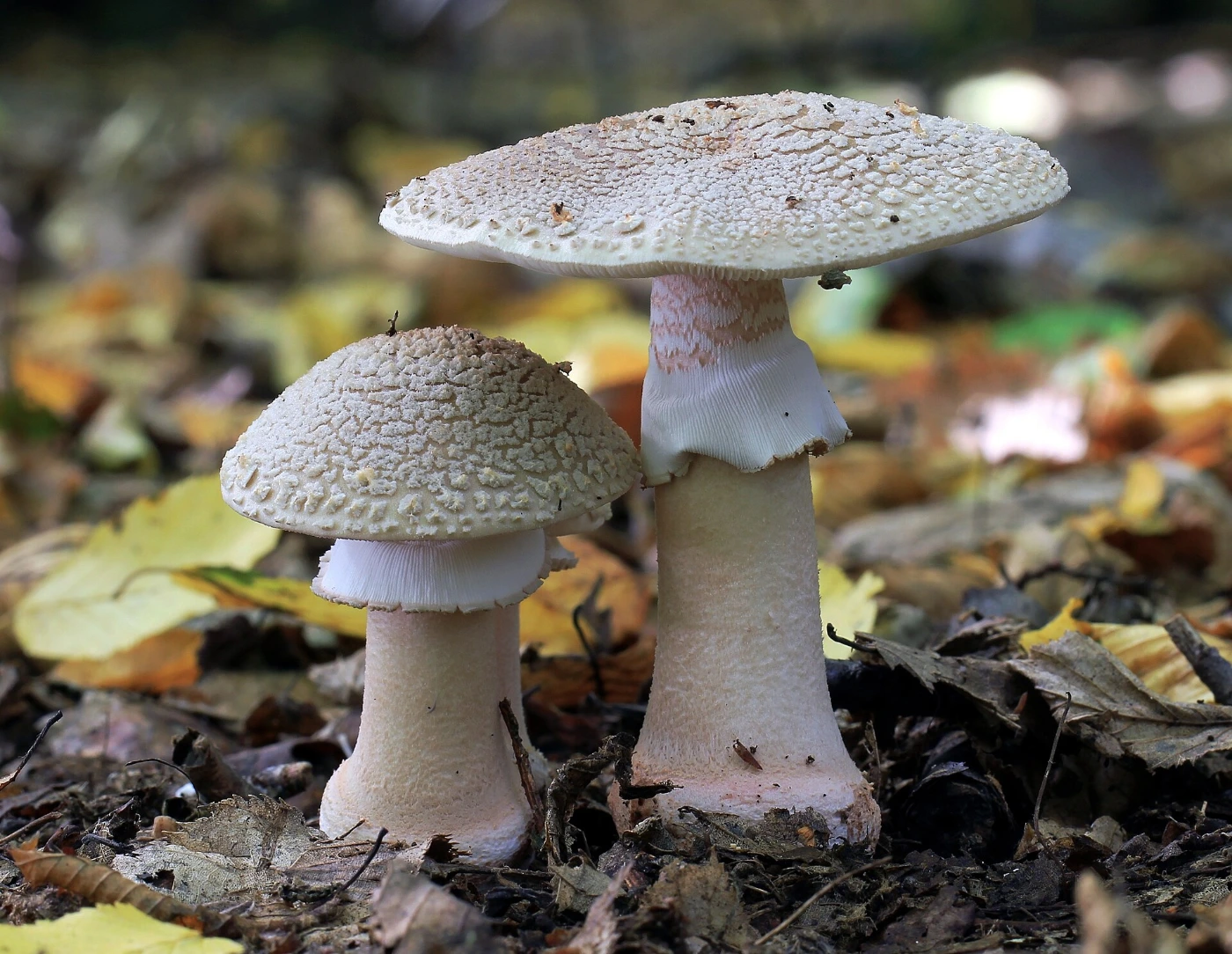
Amanita rubescens, commonly known as the Blusher, is a widespread European Amanita recognized by its brownish cap with pale veil patches, ringed stem, bulbous base, and a characteristic tendency to develop pink, reddish, or wine-colored stains when damaged.
The blushing reaction is one of its most useful field characters, but it should never be used alone. Several Amanitas can look similar from above, and the safest identification combines bruising, cap remnants, ring structure, stem base, gills, habitat, and geography.
⚠️ Important: Amanita rubescens is considered edible only after correct identification and thorough cooking. Raw or insufficiently cooked specimens are unsafe, and confusion with toxic Amanitas such as Amanita pantherina can be dangerous.
Quick Identification
| Feature | Amanita rubescens |
|---|---|
| Scientific name | Amanita rubescens |
| Common name | Blusher |
| Family | Amanitaceae |
| Cap color | Pinkish brown, reddish brown, gray-brown |
| Cap remnants | Pale gray, cream, or pinkish veil patches |
| Gills | White to cream |
| Stem | Pale, often developing reddish stains |
| Ring | Present, usually hanging and striate above |
| Stem base | Bulbous, without a deep sac-like volva |
| Volval remains | Usually fragmented rather than a free sac |
| Flesh | White, then pink to wine-red when damaged |
| Spore print | White |
| Ecology | Mycorrhizal |
| Habitat | Broadleaf, mixed, and conifer woodland |
| Season | Summer to autumn |
| Distribution | Mainly Europe and western Eurasia |
| Edibility | Edible only when correctly identified and thoroughly cooked |
| Main look-alikes | Amanita pantherina, A. excelsa, A. franchetii, A. muscaria |
What Does Amanita rubescens Look Like?
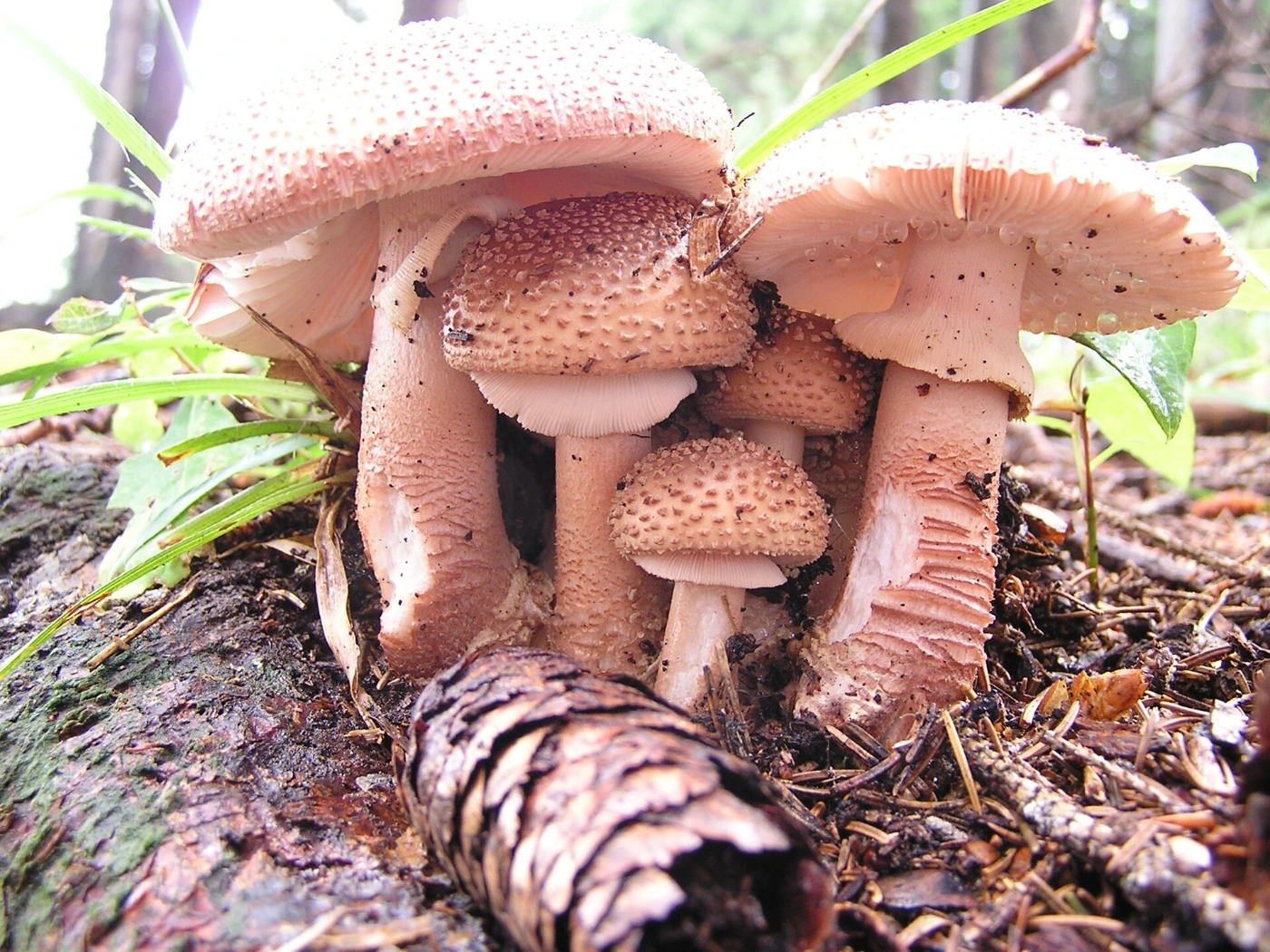
The Blusher is a medium to large Amanita with considerable variation in color. Some specimens are distinctly reddish brown, while others are gray-brown, pale brown, or muted pinkish beige.
What makes the species more distinctive is not one fixed cap color but the combination of veil remnants, ring, bulbous stem base, and reddish staining. Fresh insect damage or cuts often reveal the blushing reaction particularly well.
Cap
The cap is initially rounded to hemispherical and later becomes broadly convex or flatter. Typical colors include pinkish brown, reddish brown, gray-brown, tan, and occasionally paler buff tones.
The surface is usually decorated with remnants of the universal veil. These patches are commonly dirty white, grayish, cream, or slightly pinkish rather than brilliant pure white.
Cap Veil Patches
The veil remnants may appear as small scattered warts or larger irregular patches. Rain can wash some of them away, so old specimens may have a much cleaner cap than young mushrooms.
Their color is useful when comparing the Blusher with Panther Cap. Amanita pantherina more often has sharply contrasting white veil patches on a darker brown background.
Gills
The gills are white to cream, free or nearly free from the stem, and relatively crowded. With age or damage, they can develop pinkish or reddish marks.
This staining is especially useful when insect feeding or handling has damaged the gill edges. Completely white undamaged gills do not exclude the species.
Stem
The stem is pale, usually white to cream, and may become pinkish or reddish in bruised areas. It can be fairly robust and usually ends in a swollen or bulbous base.
The surface below the ring may show fine scales or fibrous texture. Damage around the lower stem often develops stronger reddish-brown tones than the untouched surface.
Ring
Amanita rubescens usually has a substantial membranous ring on the upper stem. It is often hanging or skirt-like and commonly shows fine radial grooves on its upper surface.
These grooves result from contact with the gills before the veil separated. A clearly striate upper ring surface can be a useful supporting feature.
Stem Base
The stem base is one of the most important areas to inspect. The Blusher usually has a bulbous base but lacks the distinct free sac or strongly rimmed volva seen in some other Amanitas.
Universal veil remnants may survive as weak patches or zones on the bulb. The base should always be removed intact because cutting the mushroom above ground can hide critical differences from look-alikes.
The Blushing Reaction
The characteristic reddish staining gives the species its common name. White flesh may gradually become pale pink, reddish, or wine-colored after cutting, bruising, insect damage, or handling.
The reaction is often strongest in damaged flesh, around larval tunnels, and near the stem base. It may develop progressively rather than appearing instantly.
What Color Does It Turn?
Fresh damage can first look pinkish, then deepen toward reddish brown or wine-red. Older damaged areas may become dull brown-red.
Lighting and age affect how obvious the reaction appears. A fresh cut through firm tissue is usually easier to interpret than an old weathered wound.
Flesh
The flesh is white when freshly exposed and relatively firm in young mushrooms. It develops the characteristic reddish tones where damaged.
This is very different from strong blue bruising seen in some boletes. The color change is slower and usually pink-to-wine rather than vivid or dramatic.
Smell
The smell is generally mild and mushroom-like. It is not usually distinctive enough to identify the species.
Odor is therefore much less useful than bruising, ring structure, and stem-base morphology. An unusual smell should encourage consideration of another species.
Spore Print
The spore print is white. This is typical of many Amanitas and therefore confirms the broader group rather than the exact species.
Spore color is most useful when excluding mushrooms from unrelated dark-spored genera.
Where Does Amanita rubescens Grow?
The Blusher is mycorrhizal and grows from soil in association with living trees. It occurs in broadleaf, mixed, and coniferous woodland.
It can be found with oak, beech, birch, spruce, pine, and other trees depending on region. Because the species is not restricted to one host, habitat supports but rarely proves the identification.
When Does the Blusher Grow?
The main fruiting season is summer through autumn. In suitable climates, mushrooms may appear from early summer after rain and continue into cooler autumn weather.
Fruiting varies strongly between years. Warm conditions followed by sustained moisture can produce large numbers.
Distribution
Amanita rubescens in the strict modern sense is primarily a European and western Eurasian species. It is widespread across much of Europe and can be common in suitable forests.
North American mushrooms historically called Amanita rubescens may represent related but different taxa. For that reason, photographs from North America should not automatically be assigned the European species name.
Is Amanita rubescens Edible?
The Blusher is traditionally regarded as edible after correct identification and thorough cooking. Raw or inadequately cooked specimens contain heat-sensitive compounds and should not be eaten.
The greater practical problem is identification risk. The species can resemble toxic Amanita pantherina and other Amanitas, making it unsuitable as a beginner mushroom for the table.
Amanita rubescens Look-Alikes
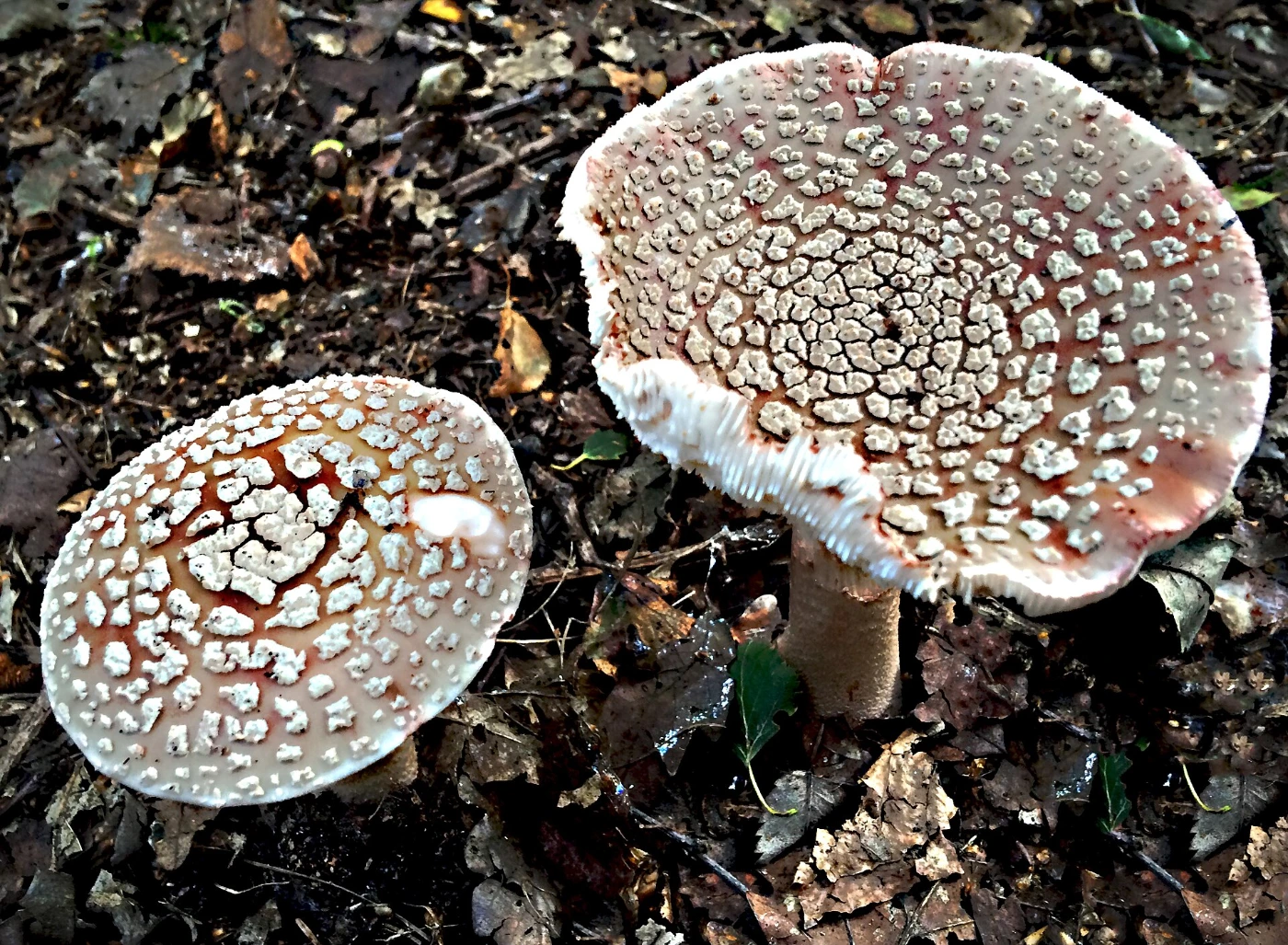
Several brown or gray Amanitas have white gills, cap warts, a ring, and a bulbous base. The most important distinction is not cap color alone but the combination of bruising reaction, ring surface, veil remnants, and basal structure.
Among these, Panther Cap deserves the most attention because it is toxic and can appear deceptively similar.
Amanita pantherina — Panther Cap
Identification
Panther Cap usually has a brown to gray-brown cap with sharply contrasting white veil warts. The gills and flesh remain white and do not characteristically develop the reddish bruising typical of the Blusher.
The stem base often has a distinct rim or collar and concentric volval zones. This structured basal morphology is one of the most valuable differences.
Main Difference
The strongest practical combination is reddish bruising + less sharply defined basal volva for the Blusher versus no reddish bruising + distinct rimmed or zoned base for Panther Cap.
Panther Cap is toxic and contains ibotenic acid and muscimol. It causes neurological poisoning and should not be confused with amatoxin-containing Death Caps.
Blusher vs Panther Cap
| Feature | Blusher | Panther Cap |
|---|---|---|
| Scientific name | Amanita rubescens | Amanita pantherina |
| Cap | Brown to reddish brown | Brown to gray-brown |
| Cap warts | Cream, grayish, sometimes pinkish | Usually bright white |
| Bruising | Pink to wine-red | No typical red staining |
| Ring | Often striate above | Usually smoother above |
| Stem base | Bulbous, weak fragmented veil remains | Distinct rim and concentric zones |
| Flesh | Reddens when damaged | Remains mostly white |
| Toxicity | Edible only after proper cooking and secure ID | Toxic |
| Best clue | Blushing reaction | Structured volval base |
The table is useful as a first comparison, but the entire stem base should still be examined carefully.
Amanita excelsa — Grey Spotted Amanita
Identification
Amanita excelsa can have a gray-brown cap with grayish veil patches and a ringed pale stem. It may occur in similar European woodland habitats.
Its flesh does not normally show the clear reddish bruising expected in Amanita rubescens. The overall coloration can nevertheless be very similar.
Main Difference
Fresh damage is especially useful. A strong pink-to-wine staining reaction supports the Blusher, while persistently pale flesh suggests Amanita excelsa or another species.
The ring and stem base should still be inspected because weathered specimens can be ambiguous.
Amanita franchetii
Identification
Amanita franchetii can have a brownish cap with yellowish to cream veil remnants. Yellow tones may also be visible around the bulb and veil material.
It grows in woodland and can share the overall ringed Amanita structure of the Blusher.
Main Difference
Yellowish veil remnants are an important clue. The Blusher is more notable for reddish staining rather than yellow universal-veil tissue.
Regional distribution should also be taken into account because the species is less uniformly common than A. rubescens.
Amanita muscaria — Fly Agaric
Identification
Typical Fly Agaric has a red to orange-red cap with pale warts, white gills, a hanging ring, and a bulbous base with veil remnants.
Faded orange or brownish specimens can occasionally look less obvious than the classic red-and-white form.
Main Difference
Fly Agaric does not normally show the characteristic wine-red bruising of the Blusher. Its cap coloration and basal universal-veil remnants usually provide additional separation.
Why the Stem Base Is So Important
Many Amanitas retain highly diagnostic universal-veil structures at the very bottom of the stem. These can form sacs, rims, rings, bands, or irregular patches.
The Blusher generally has a swollen base with relatively indistinct fragmented veil material. A sharply rimmed basal bulb should make you reconsider Panther Cap or another Amanita.
Does Every Blusher Turn Red?
Typical specimens eventually develop reddish staining when damaged, but the strength and speed vary. Very fresh, very dry, or lightly handled mushrooms may initially show little change.
Older insect-damaged specimens often display the reaction clearly. Reddish tunnels through the flesh can be particularly noticeable when the mushroom is cut lengthwise.
Why Cap Color Is Not Reliable Enough
Amanita rubescens is highly variable in color. A dark gray-brown specimen can look surprisingly close to Panther Cap, while another Blusher may be distinctly pinkish or reddish.
Rain, sunlight, age, and genetics all affect cap appearance. Structural characters therefore matter much more than choosing between two shades of brown.
How to Identify Amanita rubescens Step by Step
Start with the entire fruit body rather than the cap. Confirm that you have a ringed Amanita with white gills, then examine damage, ring structure, and the complete stem base.
A single red mark should not be treated as proof. Several features should agree before the identification becomes strong.
Step 1: Look for Blushing
Cut or gently bruise fresh flesh and watch for pink to reddish or wine-colored staining. Existing insect holes may already show the reaction.
Give the tissue time to change because the color may become stronger gradually.
Step 2: Examine the Ring
Look for a substantial hanging ring and inspect its upper surface. Fine striations support the Blusher.
A smooth-looking ring does not automatically exclude it if the specimen is damaged, but it reduces the strength of the match.
Step 3: Expose the Entire Stem Base
Carefully remove soil around the bulb and keep the base intact. Look for a bulbous base without a deep free sac or the strongly rimmed concentric zones typical of Panther Cap.
This step is essential for Amanita identification.
Step 4: Check the Cap Remnants
Look at the color and shape of veil patches. Cream, grayish, or slightly pinkish remnants fit the Blusher better than very crisp white warts.
Rain can remove them, so their absence is not decisive.
Step 5: Consider Geography and Habitat
European woodland is appropriate for Amanita rubescens. Outside its established range, similar blushing Amanitas may represent related regional species.
Geography should therefore be part of any species-level identification.
How to Photograph the Blusher for Identification
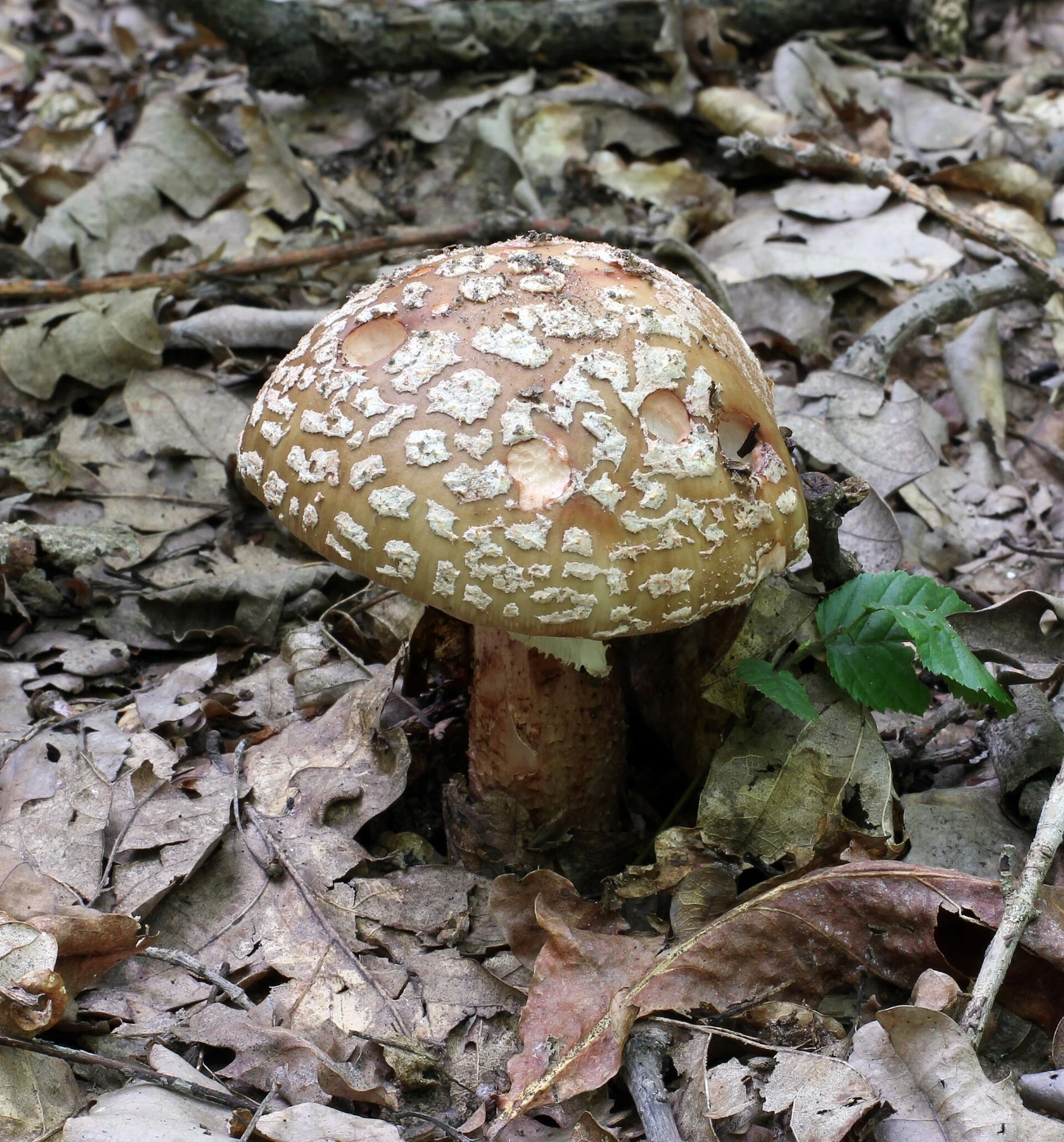
Begin with a photograph showing the entire mushroom and surrounding woodland. Then expose and photograph the complete stem base without cutting it off.
Take close-ups of the cap warts, ring, gills, and any reddish damaged areas. A fresh cut through the stem or cap can provide an especially useful image of the blushing reaction.
Photograph the Color Change
A before-and-after pair can be more informative than one photograph. Take one image immediately after cutting and another after the tissue has had time to react.
This is particularly useful for AI-assisted identification because the staining itself is a diagnostic feature.
Can AI Identify Amanita rubescens?
AI can often recognize typical Blushers when reddish staining, cap remnants, ring, and bulbous base are all visible. A top-only photograph of a brown warted cap is much less reliable.
The main challenge is confusion with other brown Amanitas, especially Panther Cap. A responsible identification should remain uncertain when the stem base or bruising reaction is missing.
For edibility decisions, AI identification should never substitute for independent expert confirmation.
Common Identification Mistakes
One common mistake is identifying every brown Amanita that develops a reddish patch as Amanita rubescens. Old damage, contamination, and weathering can create misleading colors.
Another is relying on the cap warts while ignoring the stem base. The structure around the basal bulb can be more important than the appearance of the cap.
A particularly risky mistake is assuming that the presence of a ring plus reddish-brown cap makes the species edible. Similar Amanitas must be excluded first, especially Amanita pantherina.
Interesting Facts About Amanita rubescens
The name “Blusher” refers directly to the characteristic reddish staining of damaged tissue. The scientific name rubescens has the same idea behind it, referring to becoming reddish.
The staining is particularly easy to observe where insects have eaten through the fruit body. Larval tunnels can become surrounded by wine-red discoloration, making internal damage surprisingly useful for identification.
The species is also a good example of how much information can be hidden below ground level. Cap photographs receive most of the attention, but the ring and stem base often provide stronger evidence.
Amanita rubescens also illustrates a broader taxonomic problem in mushroom identification. Similar blushing Amanitas occur outside Europe, but older field guides and online records sometimes applied the European name too broadly.
Frequently Asked Questions
Can a Blusher have almost no red color on the cap?
Yes. Some specimens are predominantly gray-brown or tan and show little obvious reddish coloration before they are damaged. The blushing flesh is more informative than the original cap color.
How quickly should the flesh turn red?
The reaction can begin relatively soon after damage but may strengthen over several minutes. Temperature, moisture, and age can influence the speed.
Can the gills develop red spots?
Yes. Damaged gills can become pinkish or reddish, particularly around insect feeding or pressure points. Undamaged areas usually remain white to cream.
Why do some specimens have very few cap warts?
Rain can wash veil remnants away, and older mushrooms naturally lose them through weathering. A nearly smooth cap therefore does not automatically exclude the species.
Can the ring tear or disappear?
Yes. The ring can become damaged by age, insects, weather, or handling. Remaining fragments and the stem surface may still provide clues.
Can several Amanita species grow together?
Yes. A woodland may support multiple Amanitas at the same time and even within a small area. Each fruit body should therefore be checked individually.
Does reddish staining mean an Amanita is safe?
No. A color reaction is an identification character, not a general edibility test. The whole species must be identified confidently before edibility is even considered.
Can the Blusher grow with both conifers and broadleaf trees?
Yes. It occurs in several woodland types and can associate with different tree genera. This broad ecology makes structural features more important than host tree alone.
Final Identification Notes
Amanita rubescens is best recognized by the combination of white gills, a hanging usually striate ring, a bulbous base without a deep sac-like volva, pale cap veil remnants, and flesh that develops pink to wine-red staining after damage.
The most important dangerous look-alike is Amanita pantherina. Panther Cap usually lacks the reddish bruising response and has a more distinctly rimmed or concentrically zoned stem base, often combined with bright white cap warts.
The simplest field pattern is: brown warted Amanita + reddish bruising + striate ring + bulbous but non-rimmed base = strong Blusher candidate. Because mistakes within Amanita can have serious consequences, this pattern should still be independently confirmed before any consideration of eating the mushroom.
Upload a photo and get possible matches in seconds.