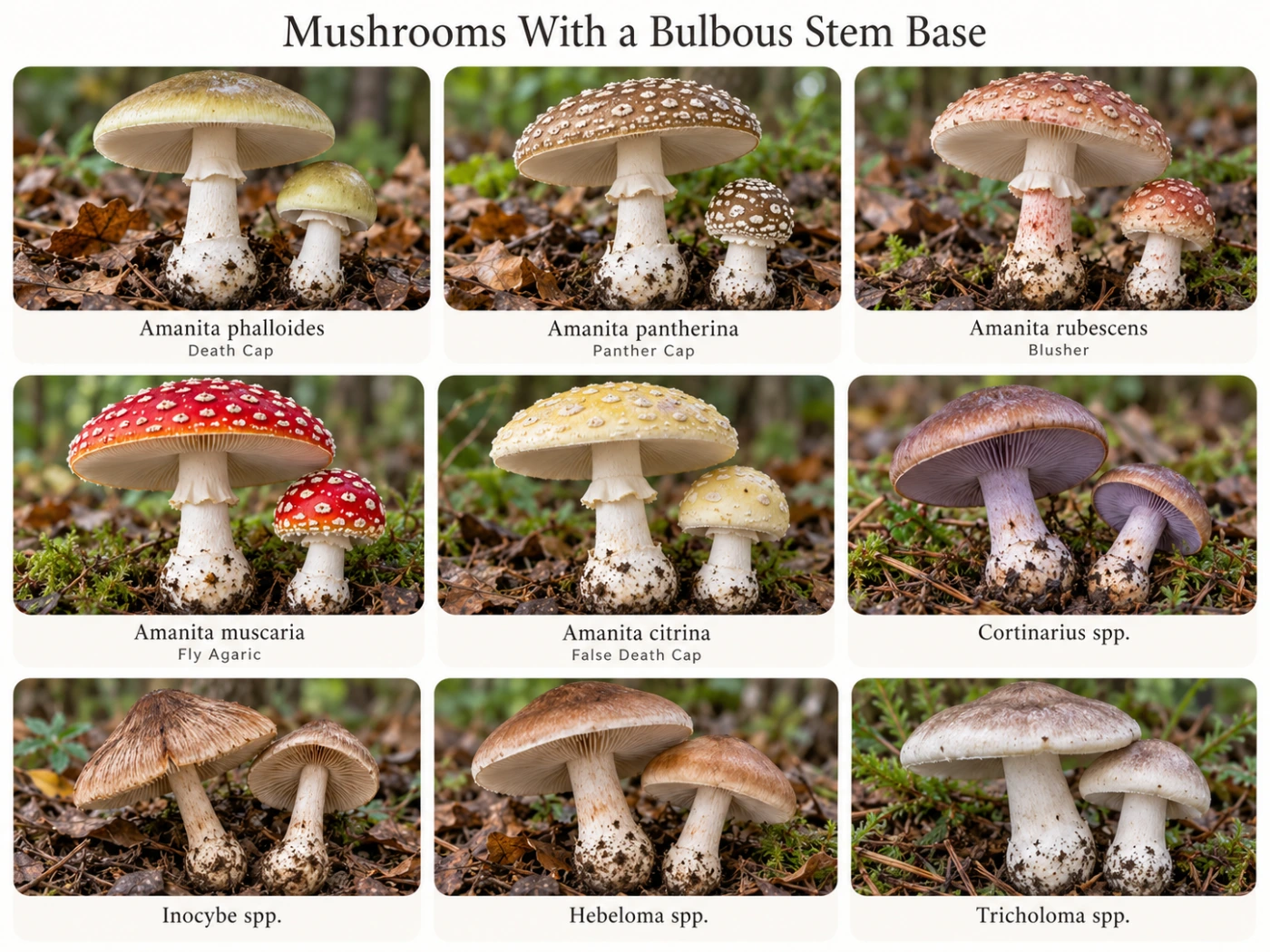
A bulbous stem base is an important identification feature in many gilled mushrooms. Instead of ending in a straight or evenly tapered stem, the lower part becomes swollen, club-shaped, rounded, or distinctly bulb-like.
This feature can be very useful, but it does not point to one single genus or toxicity level. Some deadly Amanitas have bulbous bases, while many harmless or unrelated mushrooms can also develop enlarged stem bases, so the exact shape and surrounding structures matter.
⚠️ Important: A swollen stem base should always be examined together with the presence or absence of a volva, ring, gill color, cap features, habitat, and bruising reactions. Never use a bulbous base alone to decide whether a mushroom is edible.
Quick Identification
| Feature | What to Check |
|---|---|
| Location | Very bottom of the stem |
| Possible shapes | Rounded bulb, club-shaped base, marginate bulb, rooting base |
| Volva present? | Sometimes |
| Ring present? | Sometimes |
| Most important genus | Amanita |
| Other groups | Cortinarius, Hebeloma, Inocybe, Tricholoma and others |
| Best comparison | Bulb vs volva vs rooting stem |
| Safety importance | High |
| Main mistake | Assuming every bulb is an Amanita volva |
| Best practice | Remove the complete stem base intact |
What Is a Bulbous Stem Base?
A bulbous base is simply a swelling at the bottom of the stem. It can be subtle and gradual, or sharply defined and much wider than the rest of the stem.
The swelling may be part of the stem itself or associated with veil remnants around the base. This distinction is especially important in Amanita identification.
Why the Stem Base Matters
The lower stem can contain some of the most diagnostic features on the entire mushroom. A cap may fade or lose surface remnants, but the structure of the base can remain highly informative.
This is especially useful when comparing similar brown or white mushrooms. A bulb, volva, rim, concentric bands, or rooting extension can immediately change the identification.
Bulbous Base vs Volva
A bulb and a volva are not the same thing. A bulb is a shape of the stem, while a volva is actual veil tissue left from the universal veil.
Some Amanitas have both. The stem may be swollen into a bulb while a sac, rim, or band of veil material surrounds it.
What Does a Bulbous Base Look Like?
Bulbous bases vary widely in form. Some are smoothly rounded, while others have a sharply defined rim or flattened edge.
The exact shape can be more useful than simply noting that the stem is “thick at the bottom.”
Rounded Bulb
A rounded bulb gradually expands at the base without a sharp edge. It can look like a small onion attached to the bottom of the stem.
This type occurs in several genera and is not diagnostic by itself.
Marginate Bulb
A marginate bulb has a clear rim or edge around the top of the swelling. The transition from normal stem to bulb is therefore more abrupt.
This can be an important feature in some Amanitas and Cortinarius species.
Club-Shaped Base
Some mushrooms have stems that simply widen gradually toward the bottom. This is better described as clavate or club-shaped rather than truly bulbous.
The difference is useful because a gradual club shape is generally less diagnostic than a sharply defined bulb.
Rooting or Tapered Base
A stem that narrows into a long underground extension is not a bulb. Some mushrooms appear swollen above the soil but then continue downward as a rooting structure.
The full base must therefore be excavated before deciding what kind of structure is present.
Amanita and Bulbous Stem Bases
Amanita is the most important genus to consider when a gilled mushroom has a swollen base. Several toxic and deadly species have very distinctive basal structures.
The exact combination of bulb, volva, ring, and cap remnants is often more useful than cap color.
Amanita phalloides — Death Cap
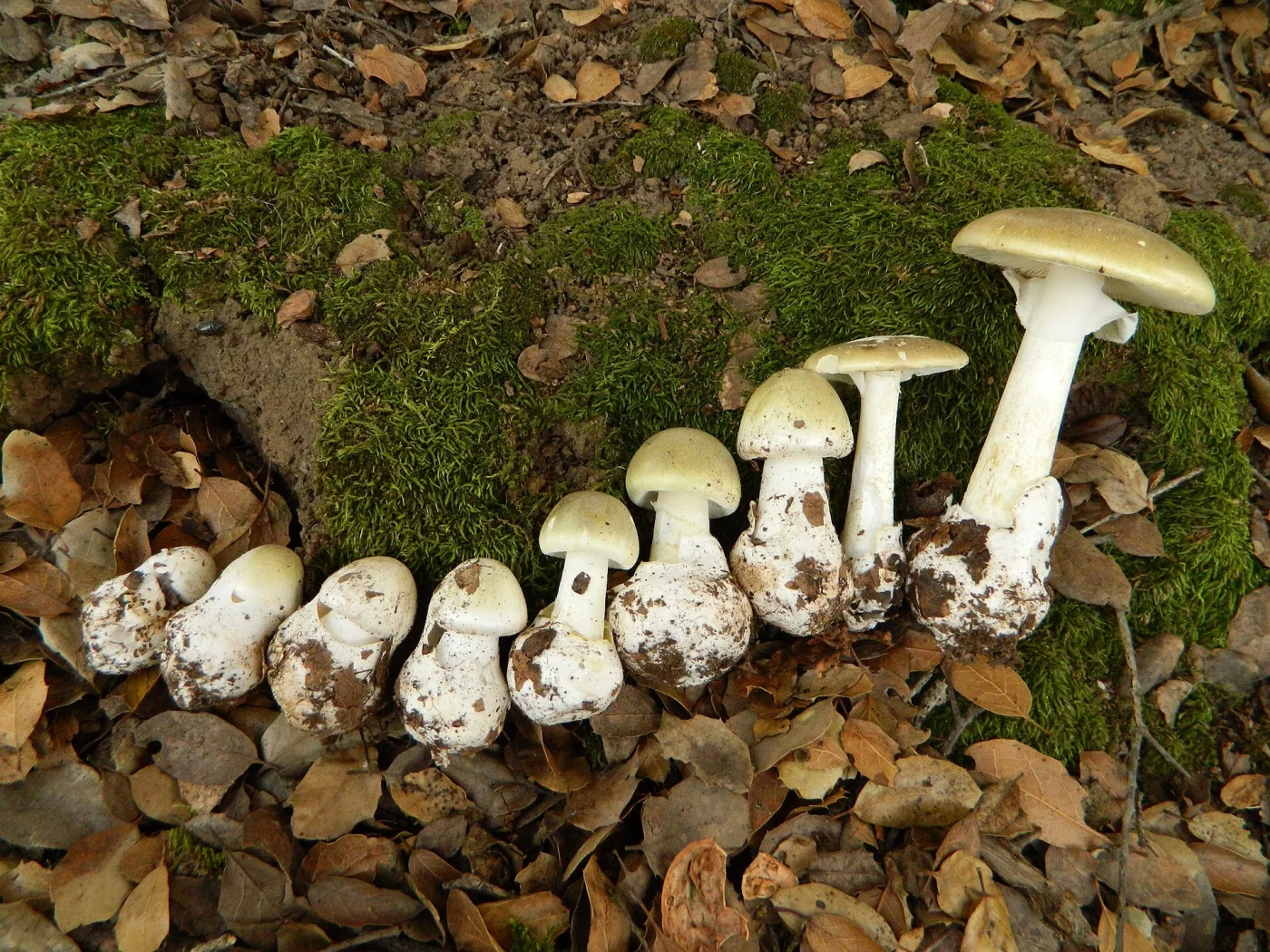
Identification
Death Cap usually has a swollen stem base enclosed in a loose sac-like volva. The gills are white, and a ring is usually present on the upper stem.
The cap may be olive, greenish, yellowish, brownish, or pale. Because cap color is variable, the stem base becomes especially important.
Main Difference
A bulb inside a free white sac is a major warning sign. The volva matters more than the simple fact that the stem is swollen.
Amanita pantherina — Panther Cap
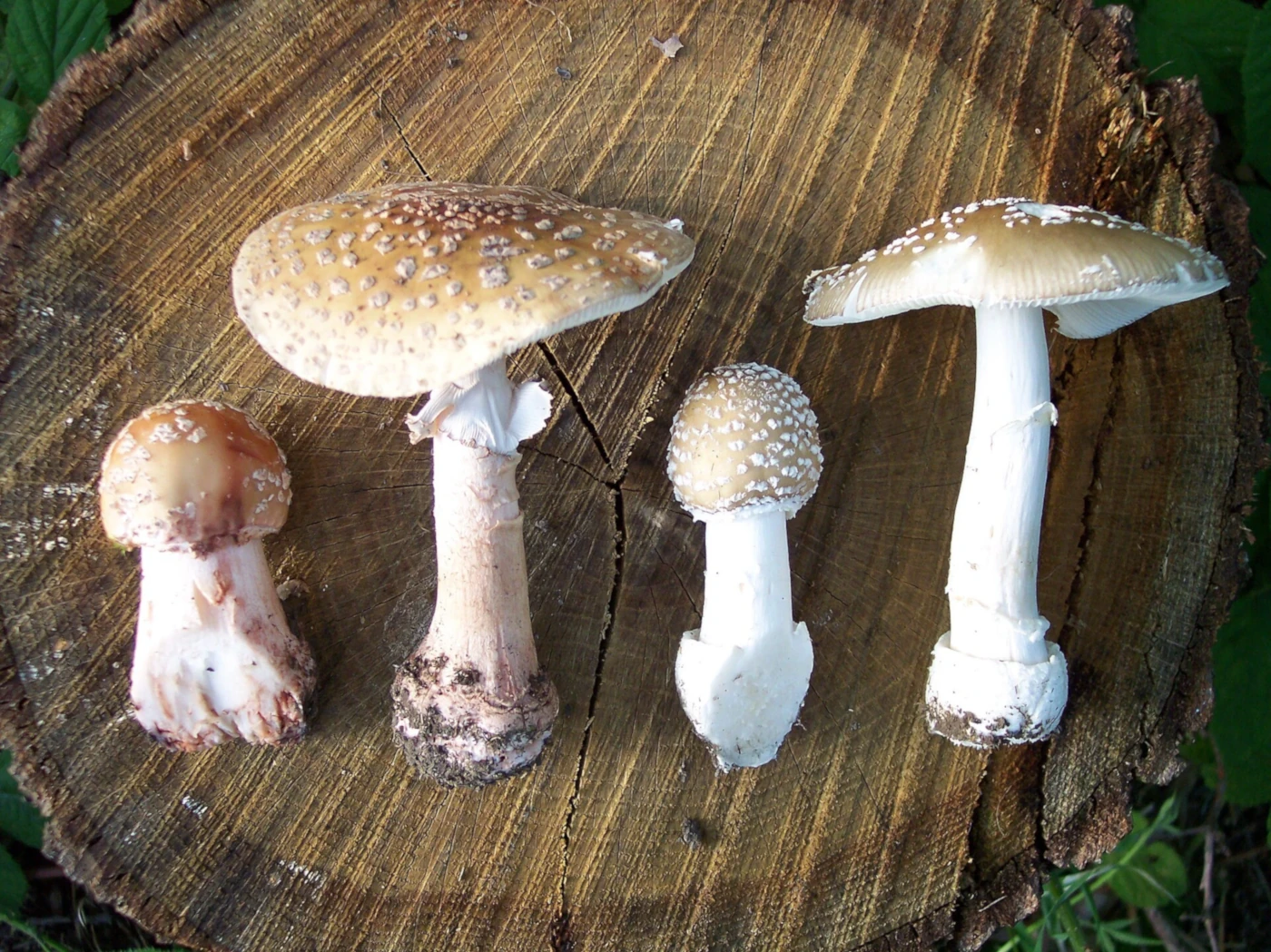
Identification
Panther Cap typically has a bulbous base with a distinct rim or collar and often concentric volval zones. The cap is brown to gray-brown with white veil patches.
The flesh does not characteristically redden when damaged. This helps separate it from the Blusher.
Main Difference
The basal structure is usually more sharply organized than in Amanita rubescens. A clear rim and concentric zones strongly support Panther Cap.
Amanita rubescens — Blusher
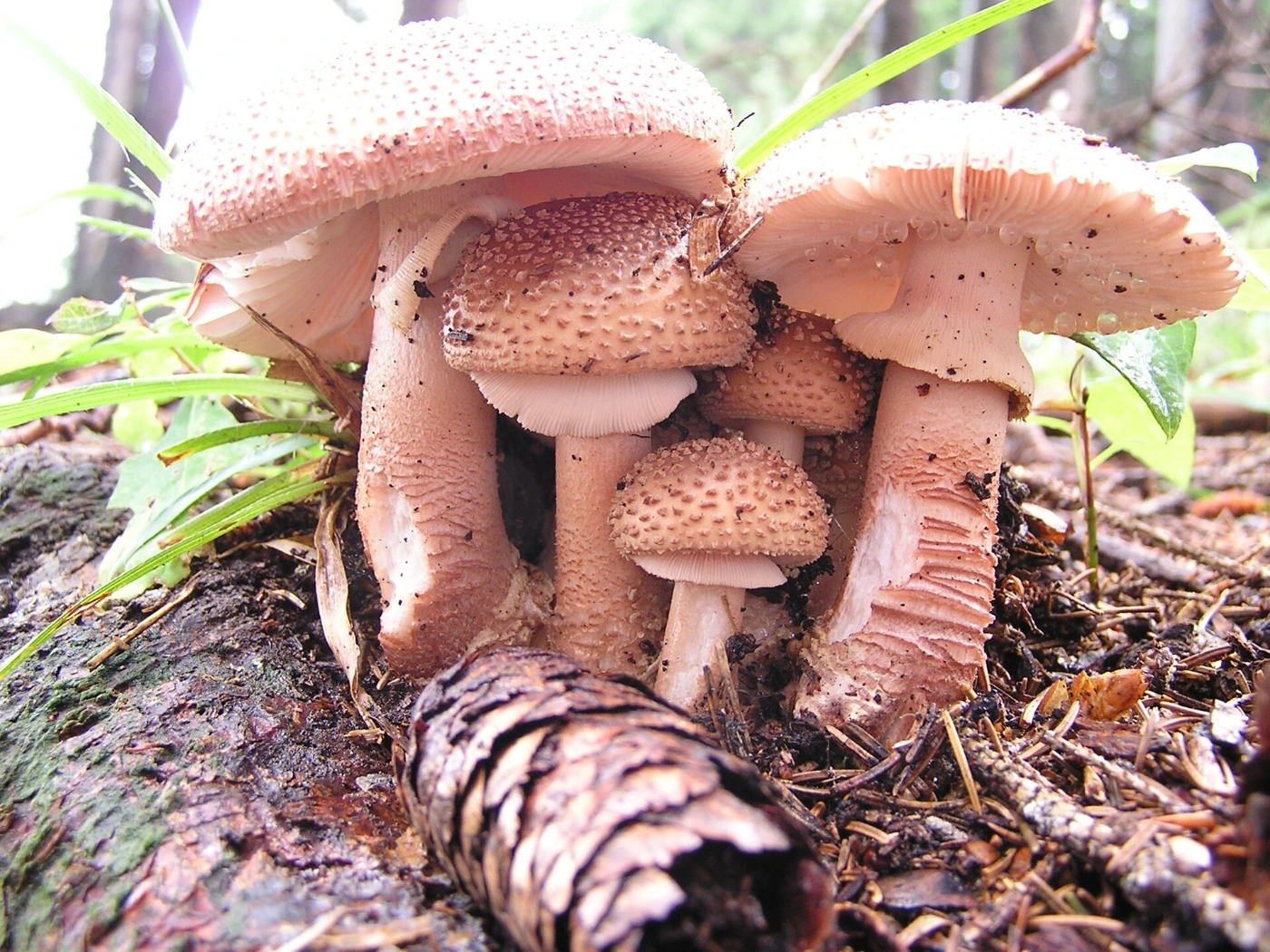
Identification
The Blusher has a bulbous stem base, but the basal veil remnants are usually fragmented rather than forming a neat free sac. The flesh develops pink to wine-red staining when damaged.
A hanging ring and pale cap remnants are also typical. The combination of blushing and a less sharply rimmed base is useful.
Main Difference
Reddish bruising is the strongest practical clue. A brown Amanita with a bulbous base but no red staining deserves more careful comparison with Panther Cap or related species.
Amanita muscaria — Fly Agaric
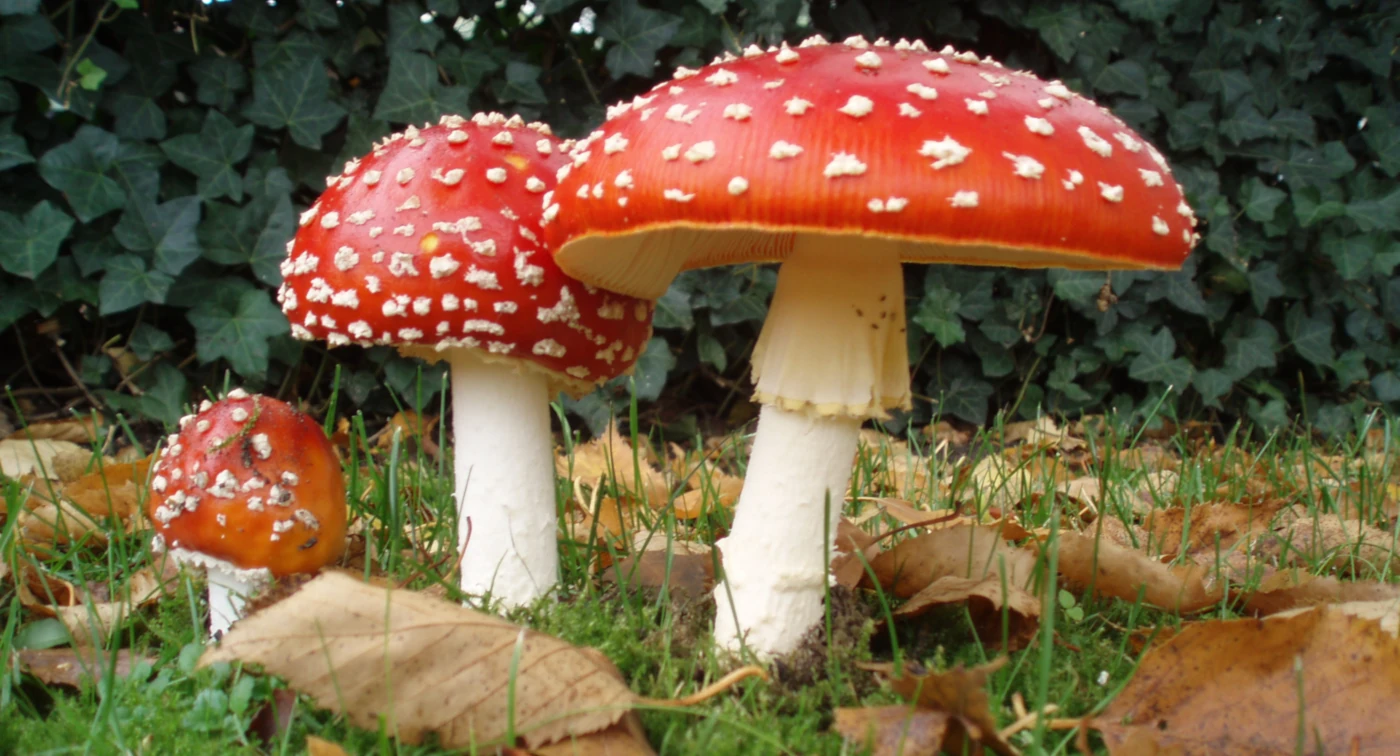
Identification
Fly Agaric has a swollen basal bulb covered with irregular rings, scales, or patches of universal veil tissue. It usually lacks a deep loose sac.
The red to orange-red cap with pale warts is distinctive in typical specimens. Faded examples can be less obvious.
Main Difference
The volval remnants appear as fragmented bands or patches rather than one continuous bag-like volva.
Amanita citrina — False Death Cap
Identification
Amanita citrina often has a pale yellowish or cream cap, white gills, a ring, and a distinctly bulbous base. The bulb may have a sharp upper margin.
It can superficially resemble paler dangerous Amanitas. Stem-base structure and other features must therefore be checked carefully.
Main Difference
The combination of a marginate bulb and different overall cap characters can help separate it from the Death Cap group. Exact identification should still be cautious.
Bulbous Bases Outside Amanita
A swollen stem base is not unique to Amanitas. Several other genera contain species with bulbs, enlarged bases, or club-shaped stems.
This is why the base must always be interpreted together with gill color, spore color, habitat, and veil structures.
Cortinarius Species
Many Cortinarius species have bulbous or marginate stem bases. Young specimens may also have a cortina, a cobweb-like veil between cap and stem.
Their gills usually become rusty brown as spores mature. This spore color separates them clearly from white-spored Amanitas.
Inocybe Species
Some Inocybe species have swollen or bulbous stem bases. They are often smaller, with fibrous caps and brownish mature gills.
Many species in the genus are toxic, so a small fibrous mushroom with a bulbous base should not be dismissed as harmless.
Hebeloma Species
Several Hebeloma species have thickened stem bases and grow in mycorrhizal association with trees. Their caps are usually brownish, and their gills become clay-brown as spores mature.
The combination of brown spores and lack of a true Amanita-style volva helps separate them from white-spored Amanitas.
Tricholoma Species
Some Tricholoma species develop strongly thickened or club-shaped stems. These mushrooms usually lack a universal veil and therefore do not form a true volva.
White spores and mycorrhizal growth can make them superficially similar to Amanita in poor photographs, so the base and ring structures still matter.
Bulb vs Volva vs Ring
| Feature | Bulb | Volva | Ring |
|---|---|---|---|
| What it is | Swollen stem shape | Universal veil remnant | Partial veil remnant |
| Location | Stem base | Around stem base | Upper or middle stem |
| Can occur alone | Yes | Yes | Yes |
| Common in Amanita | Yes | Yes | Often |
| Best use | Shape clue | Major structural clue | Additional veil clue |
These three structures should be recorded separately rather than treated as one feature.
Why Cutting the Stem Can Cause Problems
If a mushroom is cut off above soil level, the most important part of the stem base may remain hidden underground. A sac-like volva, marginate bulb, or concentric bands can disappear from the specimen completely.
For identification, it is usually better to loosen the soil and remove the whole fruit body carefully.
How to Expose the Stem Base
Work around the stem with fingers, a small stick, or the tip of a knife. Avoid pulling straight upward because fragile basal tissue can tear off and remain buried.
Once exposed, photograph the entire base before cleaning it too aggressively. Soil position itself can sometimes show how deep the bulb or volva was buried.
Bulbous Base and White Gills
A mushroom with white gills and a bulbous base deserves careful attention. Amanita becomes an important possibility, especially if a ring or universal veil remnants are also present.
This does not mean the mushroom is automatically dangerous, but it raises the safety significance of the identification.
Bulbous Base and Brown Gills
Brown or rusty mature gills usually point away from Amanita. Genera such as Cortinarius, Hebeloma, and Inocybe become more likely.
The stem shape can still be useful, but spore color may be more informative at that stage.
Bulbous Base Without a Ring
The absence of a ring does not automatically exclude Amanita. Some ringless Amanitas still have swollen bases or volval structures.
Other genera can also have bulbous ringless stems. The complete combination of structures must therefore be considered.
Bulbous Base With a Ring
A ring plus bulbous base is an important combination but still not diagnostic. Amanita, some Tricholoma, and other groups can share this appearance.
The next step should be checking the volva, gills, cap remnants, and spore color.
How to Identify a Mushroom With a Bulbous Base Step by Step
Start by removing the entire stem base intact. Then decide whether the swelling is simply part of the stem or surrounded by veil tissue.
After that, check gills, ring, cap remnants, and habitat.
Step 1: Determine the Shape
Decide whether the base is rounded, club-shaped, marginate, or rooting. A sharply rimmed bulb is more informative than a gradual widening.
Take a side photograph before cutting the specimen.
Step 2: Look for a Volva
Check for a sac, rim, collar, rings, or loose patches around the bulb. These structures may indicate universal veil remnants.
A free sac should immediately raise strong suspicion for Amanita.
Step 3: Check the Gills
White gills, rusty gills, pink gills, and brown gills lead toward very different groups. Mature gill color is often one of the fastest ways to narrow the possibilities.
Do not rely on young pale gills alone because many species darken as spores mature.
Step 4: Look for a Ring
Inspect the stem for a ring or ring zone. Note whether it is thick, membranous, fragile, or absent.
Ring structure is especially useful when combined with the base.
Step 5: Check Bruising and Flesh
Cut the mushroom and observe any color change. Reddening, yellowing, blueing, or no reaction can all provide additional information.
For example, reddish bruising strongly supports Amanita rubescens among brown Amanitas.
How to Photograph a Bulbous Stem Base
Take one photograph before removing the mushroom so the natural depth in the soil is visible. Then carefully expose the entire base and photograph it from the side.
A close-up should show whether there is a rim, sac, band, or simple swelling. Include the ring and gills in separate photographs so the basal feature can be interpreted in context.
Can AI Identify a Bulbous Stem Base?
AI can often recognize a clearly exposed bulb, but it cannot reliably infer structures that remain underground. A cropped photograph of the cap and upper stem removes exactly the information needed for many Amanita comparisons.
For potentially dangerous mushrooms, the absence of a visible stem base should reduce confidence substantially. A cautious system should ask for or recommend a complete basal photograph rather than guessing.
Common Identification Mistakes
One common mistake is calling every swollen base a volva. A volva is veil tissue, while a bulb is simply a shape of the stem.
Another mistake is assuming a bulb automatically means Amanita. Several unrelated genera can produce very similar stem shapes.
The most serious mistake is cutting the base off before photographing it. This can remove the decisive difference between two otherwise similar mushrooms.
Interesting Facts About Bulbous Stem Bases
Bulb shape is often connected with the developmental anatomy of the fruit body. Some species naturally build a swollen basal structure before the cap fully expands.
In Amanita, the bulb interacts with remnants of the universal veil, producing a wide variety of shapes. One species may have a loose sack, another a rim, and another only fragmented rings.
A bulbous base can also be partly hidden by soil, moss, or leaf litter. This means that the visible stem shape above ground can be misleading until the mushroom is fully excavated.
The feature is a good example of why mushroom identification is three-dimensional. Looking only at the cap from above can completely miss one of the most important characters on the specimen.
Frequently Asked Questions
Can a bulbous base be completely underground?
Yes. In many mushrooms the swelling is partly or entirely buried, so the stem may look normal until the soil is removed.
Can a mushroom have both a bulb and a volva?
Yes. This is common in several Amanitas, where the stem itself is swollen and universal veil remnants surround the swelling.
Can rain damage basal veil remnants?
Yes. Fragile tissue can weather or tear, especially in older specimens. The overall bulb shape may remain even when the veil becomes less obvious.
Does a larger bulb mean a more dangerous mushroom?
No. Bulb size has no direct relationship with toxicity. Toxicity depends on species, not on how swollen the stem appears.
Can insects change the appearance of the stem base?
Yes. Larvae and physical damage can distort tissue, especially in older fruit bodies. Fresh young specimens usually show the structure more clearly.
Can the bulb become elongated with age?
Yes. As the mushroom matures, a rounded young base can look less dramatic compared with the lengthening stem.
Can two mushrooms of the same species have different-looking bulbs?
Yes. Soil pressure, age, moisture, and individual variation can all affect the apparent shape.
Is a bulbous base useful without knowing the gill color?
Only to a limited extent. It narrows the possibilities, but gill and spore color are usually necessary for meaningful identification.
Final Identification Notes
A bulbous stem base is an important structural feature, but it should never be treated as a species name by itself. The key is to determine what kind of bulb is present and whether veil tissue surrounds it.
In Amanita, the combination of bulb shape, volva, ring, gills, and bruising can be critical for separating dangerous and non-dangerous species. In other genera, spore color and cap structure often become more important.
The simplest field rule is: expose the whole base first, then decide whether you are seeing a simple bulb, a true volva, or both.
Upload a photo and get possible matches in seconds.