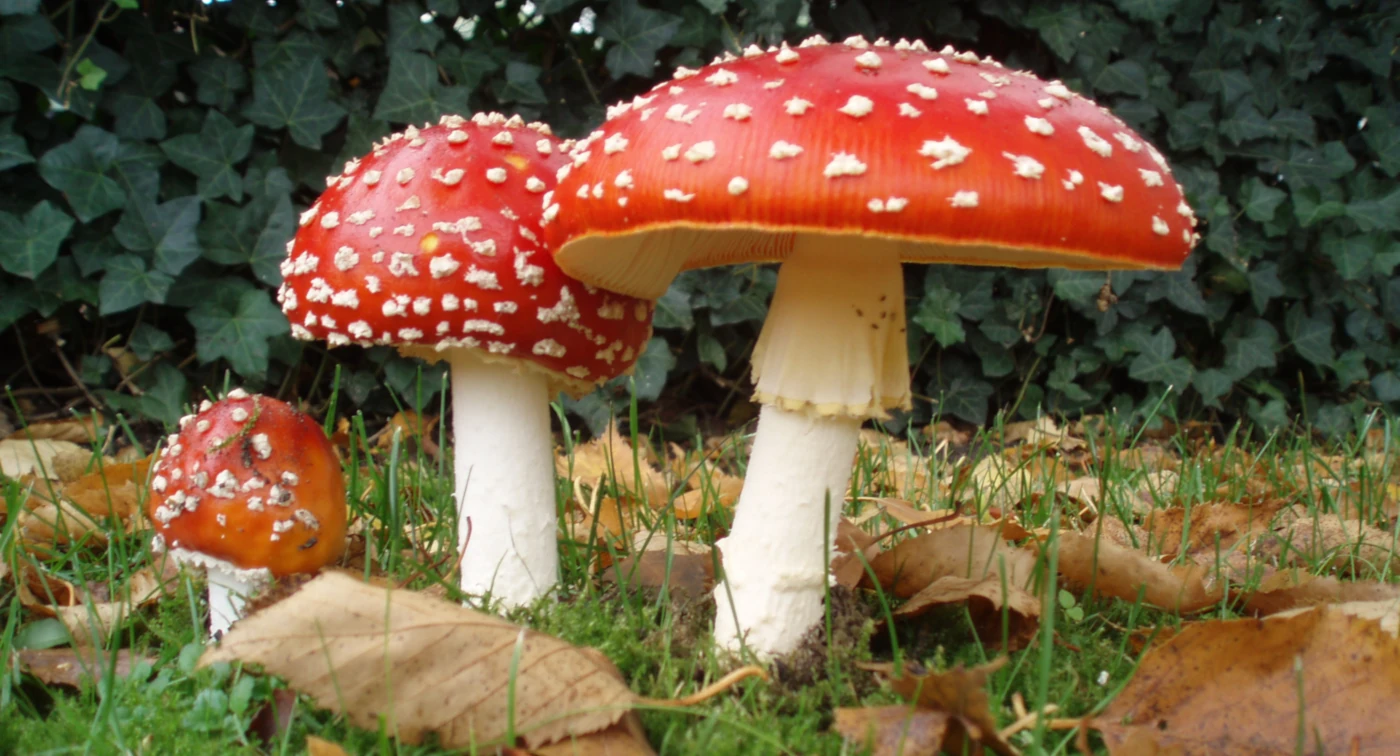
Amanita muscaria, commonly known as the Fly Agaric, is one of the most recognizable mushrooms in the world. Its bright red cap with white spots appears in fairy tales, games, illustrations and popular culture, but real specimens are much more variable than the classic image suggests. Rain can wash away the white veil remnants, cap color can fade from deep red to orange, and young mushrooms may look almost completely different from mature ones.
Fly Agaric is a poisonous and psychoactive mushroom. It contains compounds such as ibotenic acid and muscimol, which affect the central nervous system and can cause nausea, confusion, loss of coordination, agitation and altered perception. Although poisoning from Fly Agaric is different from the deadly amatoxin syndrome associated with species such as Amanita phalloides, the mushroom should still be treated as unsafe to eat.
⚠️ Important: Mushroom appearance can vary considerably. Never decide whether a wild mushroom is safe to eat from a photograph, AI identification or a single visible feature.
Quick Identification
| Feature | Amanita muscaria |
|---|---|
| Scientific name | Amanita muscaria |
| Common name | Fly Agaric |
| Family | Amanitaceae |
| Cap | Usually red to orange-red with white veil remnants |
| Gills | White, crowded and free from the stem |
| Stem | White with a hanging ring |
| Stem base | Swollen, with veil remnants |
| Spore print | White |
| Habitat | Woodland and areas near host trees |
| Ecology | Ectomycorrhizal |
| Common tree partners | Birch, pine, spruce and other trees |
| Main season | Usually late summer through autumn |
| Toxicity | Poisonous and psychoactive |
| Main toxins | Ibotenic acid and muscimol |
What Does Amanita muscaria Look Like?
The classic Fly Agaric has a red or orange-red cap scattered with white warts. These white patches are remnants of the universal veil that enclosed the young mushroom before it emerged. As the mushroom matures, the cap expands from a rounded shape to convex and eventually almost flat, sometimes becoming slightly depressed in the center.
Mature caps are often around 10–20 cm across, although size varies depending on growing conditions. Color can range from bright scarlet to orange-red, and in some forms it may become noticeably paler. The cap surface can also look quite different after rain, because the white veil remnants may be partly or completely washed away.
Can Fly Agaric Lose Its White Spots?
Yes. The white spots are not permanent structures, so rain, age and physical contact can remove them. A mature Fly Agaric may therefore have a nearly smooth orange or red cap, which makes identification more difficult if the observer relies only on the familiar fairy-tale appearance.
For this reason, the mushroom should always be examined as a whole. The gills, stem, ring and stem base are just as important as the cap color and surface pattern.
Gills
The gills of Amanita muscaria are typically white to pale cream, crowded and free from the stem. “Free” means that the gills stop before reaching the stem rather than attaching directly to it.
As the mushroom ages, the gills may become slightly cream-colored, but they remain pale. They do not develop the pink-to-brown progression seen in many Agaricus species, which can be an important distinction when comparing white-gilled mushrooms.
Stem
The stem is usually white, fairly tall and often 10–25 cm long. One of its most noticeable features is the broad hanging ring around the upper part of the stem, which is a remnant of the partial veil that protected the gills while the mushroom was developing.
The ring is usually easy to see on fresh mature specimens, but it may become torn, damaged or partly disappear with age. This is another reason why absence of a perfect ring should not be used to rule out the species.
Stem Base and Volva
The stem base is one of the most important parts of any Amanita identification. In Amanita muscaria, the base is usually swollen or bulbous and surrounded by white remnants of the universal veil, often forming irregular rings, scales or patches.
Unlike some other Amanita species, Fly Agaric does not usually have a large loose sack-like volva. Nevertheless, veil remnants around the bulb are a major identification feature, so the entire stem base should be exposed and photographed rather than cut off at soil level.
Spore Print
The spore print of Amanita muscaria is white. This can help confirm that the mushroom belongs to a white-spored group, but it is not enough to identify the species on its own because many Amanitas also produce white spores.
Spore-print color should therefore be treated as supporting evidence together with the cap, gills, stem, veil remnants and habitat.
Young Amanita muscaria
Very young Fly Agarics can look surprisingly unlike mature specimens. The developing mushroom begins inside a white universal veil and may appear as a rounded or egg-like structure emerging from the soil.
As it expands, the veil breaks apart and remains as white warts on the cap and as material around the swollen stem base. Before the red cap becomes visible, a young specimen can resemble a puffball, which is why suspected puffballs should be cut completely in half before any consideration of edibility. A true young puffball should be uniformly white inside, while a young Amanita may reveal the developing cap, gills and stem.
Where Does Amanita muscaria Grow?
Fly Agaric is an ectomycorrhizal mushroom, which means it lives in a mutually beneficial association with tree roots. The fungus helps the tree obtain water and minerals, while the tree supplies sugars produced through photosynthesis.
Because of this relationship, Fly Agaric usually appears in forests, at woodland edges, in parks and along tree-lined paths where suitable host trees are present. Birch, pine and spruce are among its most common partners, although it can associate with other hardwood and conifer species as well.
Distribution
Amanita muscaria is widespread across much of the Northern Hemisphere and occurs throughout large parts of Europe, Asia and North America. It has also been introduced to parts of the Southern Hemisphere, including Australia, Tasmania and New Zealand.
Its appearance can vary between regions, and the broader Amanita muscaria complex includes geographically variable forms. This is one reason why local mushroom guides remain useful even for such a famous and recognizable species.
When Does Fly Agaric Grow?
In temperate climates, Fly Agaric is mainly a late-summer and autumn mushroom. Fruiting often begins after periods of rain when soil moisture rises and temperatures start to fall.
The exact season depends on climate, altitude and location, but in much of Europe the mushroom is commonly seen from August into November. Because the underground mycelium remains in place, fruit bodies can return to the same locations year after year.
Is Amanita muscaria Poisonous?
Yes. Amanita muscaria should be regarded as a poisonous mushroom because it contains psychoactive compounds, mainly ibotenic acid and muscimol. These chemicals affect the nervous system and can produce both gastrointestinal and neurological symptoms.
The concentration of active compounds varies from mushroom to mushroom, which makes the effects difficult to predict. This variability is one of the main reasons why deliberate consumption is unsafe.
What Happens if Amanita muscaria Is Eaten?
Symptoms may include nausea, vomiting, abdominal discomfort, dizziness, confusion, drowsiness, agitation, poor coordination and altered perception. In stronger poisonings, a person may become severely disoriented or experience delirium.
Fly Agaric poisoning is not the same as Death Cap poisoning. It does not usually produce the classic delayed liver-failure syndrome associated with amatoxins, but that distinction does not make it safe. Anyone who has eaten an unidentified wild mushroom and develops neurological or gastrointestinal symptoms should seek medical help promptly.
Is Fly Agaric Deadly?
Fatal poisoning from Amanita muscaria appears to be uncommon compared with poisoning caused by deadly amatoxin-containing Amanitas. However, uncommon does not mean harmless, and significant poisoning can still occur.
Severity depends on the amount consumed, individual sensitivity and toxin concentration in the mushroom. Because none of these factors can be predicted reliably in advance, Fly Agaric should not be treated as a safe wild food.
Why Is It Called Fly Agaric?
The common name “Fly Agaric” is linked to an old practice of using pieces of the mushroom as a fly poison. The mushroom was sometimes placed in milk or water to attract insects, which were then affected by its compounds.
The scientific name also reflects this association. The Latin word musca means “fly,” which is the origin of the species name muscaria.
Amanita muscaria Look-Alikes
Although the classic red-and-white form is distinctive, faded, rain-washed or unusually colored specimens can resemble several other mushrooms. The most important comparisons are with other Amanitas and with a few red-capped species from unrelated genera.
Amanita caesarea — Caesar’s Mushroom
Amanita caesarea is an edible species found mainly in warmer parts of Europe and the Mediterranean region. Both species can have orange to red-orange caps, especially when Fly Agaric has lost its white warts.
Caesar’s Mushroom typically has yellow gills, a yellow stem and a yellow ring, while Fly Agaric usually has white gills, a white stem and a white ring. Caesar’s Mushroom also has a more obvious white sack-like volva at the stem base, whereas Fly Agaric usually has a swollen base with rings or patches of veil material.
Amanita rubescens — Blusher
The Blusher can have a reddish, brownish-red or orange-brown cap with pale veil remnants. Its most useful characteristic is the tendency of the flesh to develop pinkish or wine-red staining when damaged.
Fly Agaric does not show the same typical reddening reaction. However, cap color alone is too variable to safely separate the two species.
Amanita regalis — Royal Fly Agaric
Amanita regalis looks somewhat like a brown version of Fly Agaric. Its cap is usually brown to dark yellow-brown and covered with pale veil remnants.
In northern Europe, where the two species can occur in similar habitats, dark or unusual specimens may cause confusion. The entire structure of the mushroom should be examined rather than relying on cap color.
Amanita pantherina — Panther Cap
The Panther Cap has a brown cap with white veil remnants, white gills, a white stem and a ring. Structurally, it can resemble Fly Agaric quite closely.
It is also poisonous and contains related psychoactive compounds. The main visual difference is usually the brown cap rather than the red or orange coloration typical of Fly Agaric.
Red Russula Species
Several Russula species have red caps and white gills, and a rain-washed Fly Agaric may superficially resemble them. Russulas, however, lack a ring, volva and universal-veil remnants.
Their flesh is also characteristically brittle and snaps rather than tearing into fibrous strands. This texture difference can be useful when comparing mature specimens.
Fly Agaric vs Caesar’s Mushroom
| Feature | Amanita muscaria | Amanita caesarea |
|---|---|---|
| Common name | Fly Agaric | Caesar’s Mushroom |
| Cap | Red or orange, often with white warts | Orange-red, usually smooth |
| Gills | White | Yellow |
| Stem | White | Yellow |
| Ring | White | Yellow |
| Stem base | Bulbous with veil remnants | Large sack-like white volva |
| Toxicity | Poisonous | Edible when correctly identified |
This comparison is useful, but no wild Amanita should be identified for food using a table alone. The genus contains several dangerously poisonous species, so complete identification is essential.
Fly Agaric vs Panther Cap
| Feature | Amanita muscaria | Amanita pantherina |
|---|---|---|
| Cap color | Usually red to orange-red | Usually brown |
| Veil remnants | White warts | White warts |
| Gills | White | White |
| Stem | White | White |
| Spore print | White | White |
| Toxicity | Poisonous | Poisonous |
These two species show clearly why white spots are not unique to Fly Agaric. Structural details and cap color together are more useful than any single feature.
How to Photograph Amanita muscaria for Identification
A useful identification photo should show the cap from above, the gills beneath it, the entire stem, the ring and the complete stem base. It is also helpful to photograph several specimens at different ages because young and mature mushrooms can look very different.
The surrounding habitat matters as well. Including nearby trees and showing whether the mushroom is growing directly from soil can provide useful ecological information.
Can Amanita muscaria Be Identified From a Photo?
A typical mature specimen can often be recognized visually with relatively high confidence because the combination of a red cap, white veil remnants, white gills, a ring and a swollen stem base is distinctive. Problems arise when rain removes the cap warts, the mushroom is unusually pale, or the base of the stem is hidden.
Photo-identification tools can therefore be useful for suggesting Amanita muscaria, but they should not be treated as final proof. Any decision involving consumption requires independent confirmation from an experienced local mushroom expert.
Interesting Facts About Amanita muscaria
Fly Agaric is the type species of the genus Amanita, which makes it important from a taxonomic perspective as well as a cultural one. Its red cap and white spots have become one of the most widely recognized symbols of mushrooms in the world.
The species also has a long history of folklore and traditional use in parts of northern Eurasia. Its distinctive appearance has made it far more famous than most other poisonous mushrooms, even though some less colorful Amanitas are considerably more dangerous.
Frequently Asked Questions
Is Amanita muscaria poisonous?
Yes. Fly Agaric contains psychoactive compounds including ibotenic acid and muscimol, and it should be treated as a poisonous mushroom.
Is Amanita muscaria deadly?
Fatal poisoning is uncommon compared with Death Cap poisoning, but serious illness can still occur. The mushroom should not be considered safe to eat.
Where does Fly Agaric grow?
It usually grows on soil near host trees, especially birch, pine and spruce. It is mycorrhizal rather than a wood-decaying species.
Can Fly Agaric lose its white spots?
Yes. Rain, age and physical contact can remove the white veil remnants and leave the cap almost smooth.
What color are Fly Agaric gills?
The gills are usually white to pale cream and remain pale as the mushroom matures.
What color is the Fly Agaric spore print?
The spore print is white.
When does Fly Agaric appear?
In temperate regions it is mainly a late-summer and autumn mushroom, often appearing from August into November.
What mushrooms look like Amanita muscaria?
Possible look-alikes include Amanita caesarea, Amanita rubescens, Amanita regalis, Amanita pantherina and several red-capped Russula species.
Final Identification Notes
The typical Fly Agaric combines a red or orange-red cap, white veil remnants, white free gills, a white stem with a ring, a swollen stem base with veil remnants and a white spore print. It also usually grows on soil near suitable host trees rather than on dead wood.
No single feature is enough for a safe identification because the cap can fade, the white warts can disappear and young mushrooms can look very different from mature ones. The most reliable approach is to examine the whole fruit body together with its habitat and to treat any uncertain Amanita with particular caution.
Found a red or orange mushroom? Photo identification can help narrow down the possibilities, but any decision involving consumption should be independently confirmed by an experienced local mushroom expert.