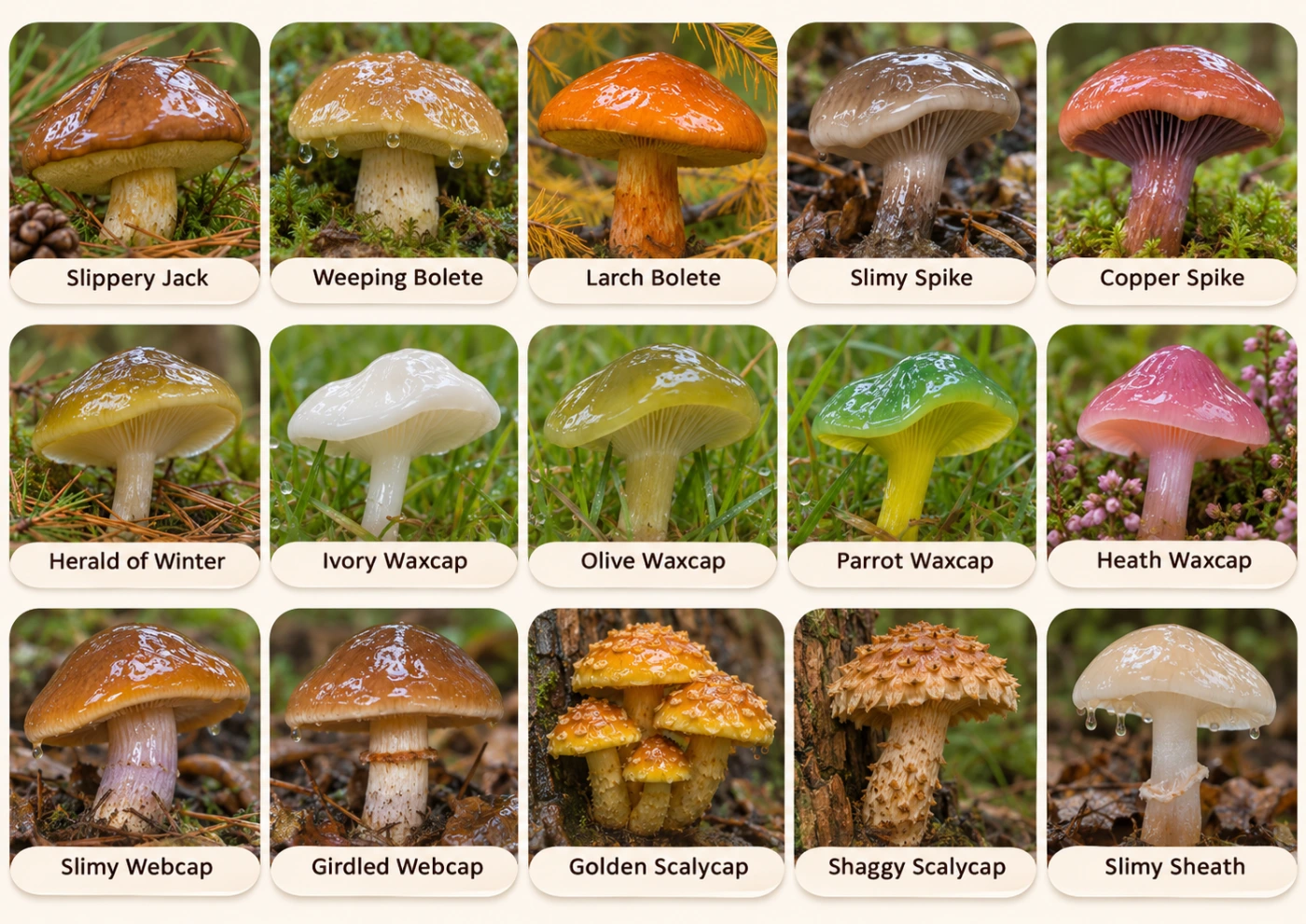
Some mushrooms develop caps that feel sticky, greasy, slimy, or almost gelatinous, especially after rain. This surface is usually described as viscid, glutinous, or slimy, and it can be one of the most useful clues for narrowing a mushroom identification.
Sticky caps occur in several unrelated groups, including boletes, waxcaps, wood-growing mushrooms, and mycorrhizal woodland species. The texture alone does not identify a mushroom, but combining it with pores or gills, stem features, habitat, host trees, and spore color can quickly reduce the possibilities.
⚠️ Important: A slimy or sticky cap is not an edibility test. Some sticky-capped mushrooms are edible, while others are inedible, poorly known, or belong to difficult genera that should not be identified for food from appearance alone.
What Does “Sticky Cap” Mean?
Mushroom guides often use words such as viscid, glutinous, slimy, or greasy to describe cap surfaces. These terms overlap but usually refer to different degrees of moisture and stickiness.
A viscid cap feels tacky or slippery when wet, while a glutinous cap has a thicker gelatinous layer. Some species feel almost dry in warm weather but become obviously sticky within minutes of rain.
Why Do Some Mushrooms Have Sticky Caps?
The cap surface of many mushrooms contains gelatinized hyphae that absorb or retain water. This creates a slippery layer that can protect the fruit body from drying too quickly.
The effect is especially common in fungi that fruit during cool, wet conditions. In some species, the slimy layer is persistent, while in others it disappears quickly during dry weather.
Sticky When Wet, Dry When Old
Weather can completely change the appearance of a sticky-capped mushroom. A cap that looks glossy and slimy after rain may become matte and almost dry a few hours later.
This is why field notes are useful. If a mushroom is suspected to belong to a viscid species, checking several fruit bodies in shaded or moist places can reveal the original surface texture.
15 Mushrooms With Sticky or Slimy Caps
1. Slippery Jack — Suillus luteus
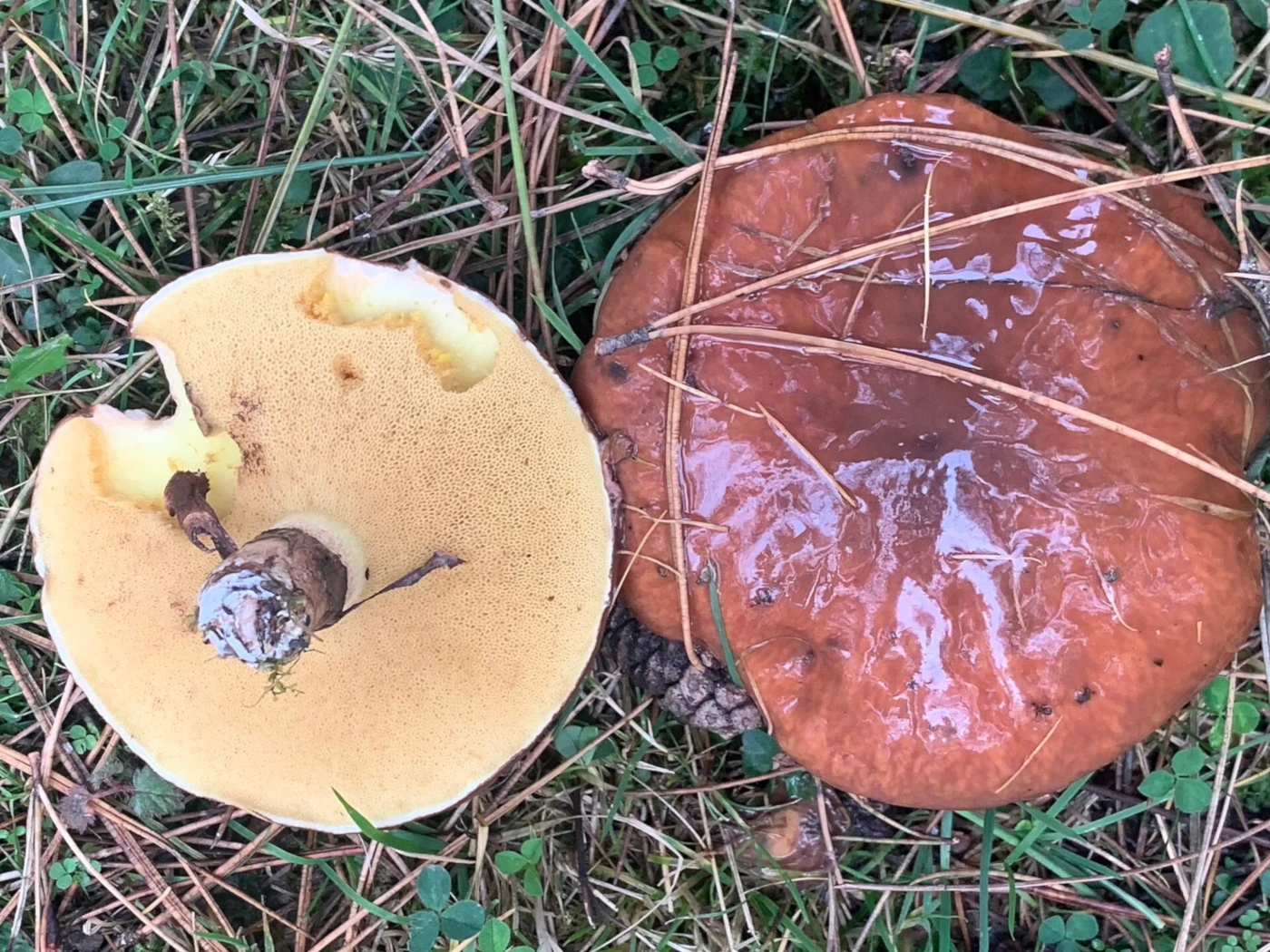
Suillus luteus is one of the classic sticky-capped mushrooms. Its brown cap becomes extremely slimy in wet weather and can feel as if it has been coated with oil.
The underside has yellow pores rather than gills, and the stem carries a conspicuous ring. It grows mainly with pine and is common in Europe and other regions where pines and the fungus have been introduced.
Identification
Look for a dark brown viscid cap, yellow pore surface, pale stem, and persistent ring. The cap skin can often be peeled relatively easily.
Main Difference
The ring separates Suillus luteus from many similar Suillus species. Suillus granulatus, for example, lacks a stem ring.
2. Weeping Bolete — Suillus granulatus
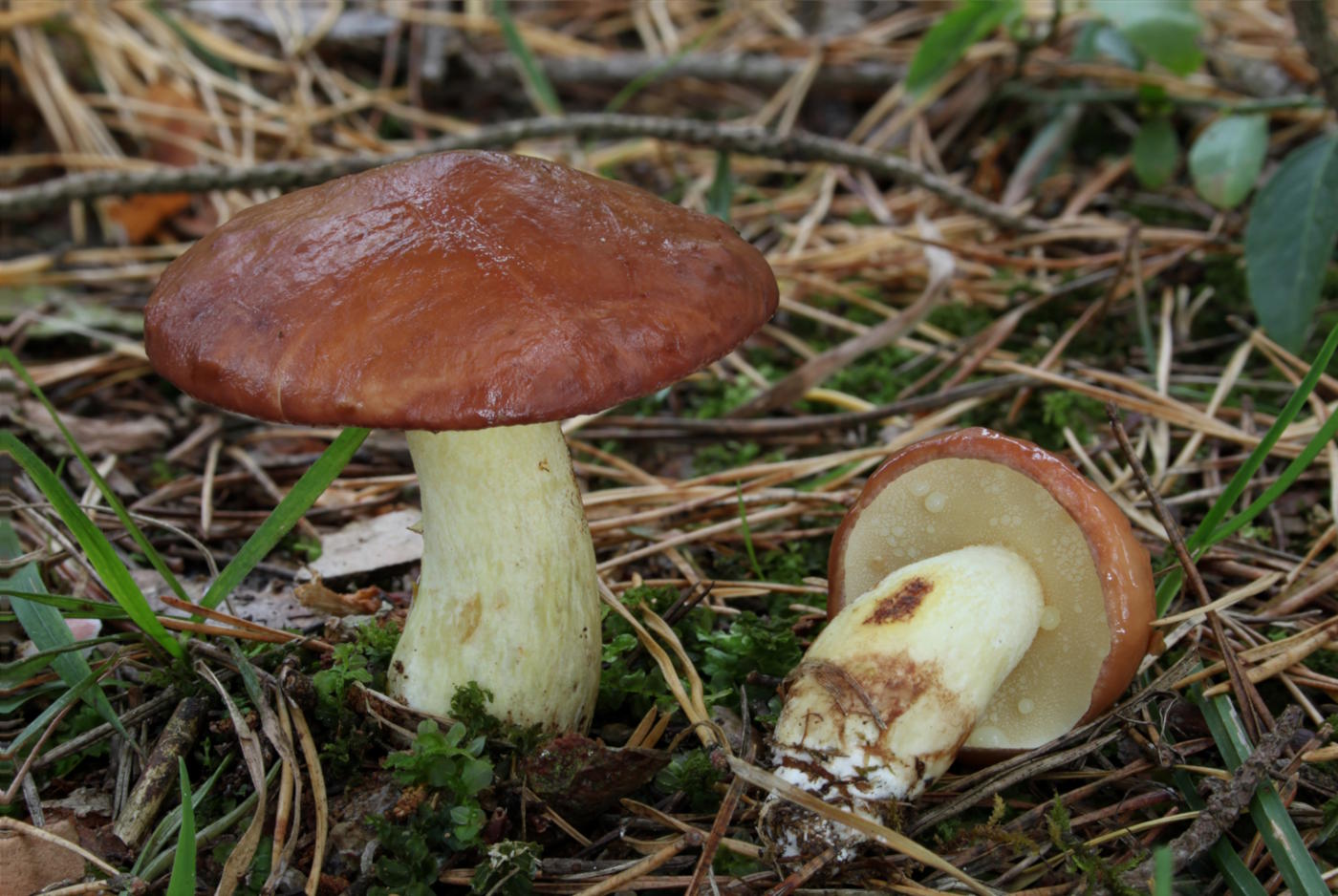
Suillus granulatus has a pale yellow-brown to orange-brown cap that becomes sticky after rain. Young pores often produce small milky or amber droplets.
The stem lacks a ring and commonly has fine glandular dots near the top. Like many Suillus, it is strongly associated with pine.
Identification
The combination of a sticky cap, yellow pores, no ring, and droplets from young pores is characteristic. Older mushrooms may lose the droplets but usually retain visible glandular dots.
Main Difference
No ring separates it from Slippery Jack. The droplets and dotted upper stem are also useful field clues.
3. Larch Bolete — Suillus grevillei
Suillus grevillei is a bright yellow to orange Suillus with a strongly viscid cap. Fresh mushrooms can look polished or almost lacquered after rain.
It is closely associated with larch rather than pine. The stem usually has a ring, and the pores are yellow.
Identification
Look for an orange-yellow sticky cap, yellow pores, ringed stem, and larch nearby. Host tree is one of the strongest identification clues.
Main Difference
The combination of larch habitat and bright orange-yellow coloration distinguishes it from many other ringed Suillus species.
4. Slimy Spike — Gomphidius glutinosus
Gomphidius glutinosus has a gray-brown to purplish-gray cap covered by a conspicuous layer of slime. The mushroom can feel much more gelatinous than a typical sticky bolete.
Its gills are thick, widely spaced, and run down the stem. Mature gills become dark gray to blackish from the spores.
Identification
A strongly slimy gray cap plus thick decurrent gills is a distinctive combination. The stem is often pale above and yellow toward the base.
Main Difference
Unlike Suillus, Slimy Spike has gills rather than pores. It also produces a dark spore print.
5. Copper Spike — Chroogomphus rutilus
Chroogomphus rutilus has a copper-brown to reddish cap that may be sticky when moist. It grows in association with conifers, particularly pine.
The gills are thick and decurrent and gradually darken as the spores mature. The fruit body often develops warm orange, copper, or wine-colored tones.
Identification
Look for thick descending gills, reddish-brown coloration, and pine habitat. The cap may become noticeably tacky in damp weather.
Main Difference
Its warm copper coloration separates it from the grayer Gomphidius glutinosus. Both groups have unusually thick decurrent gills.
6. Herald of Winter — Hygrophorus hypothejus
Hygrophorus hypothejus is a late-season waxcap relative with an olive-brown to yellow-brown sticky cap. It often appears in cool weather under pine.
The gills are pale yellowish, thick, and widely spaced. The stem can also feel slightly viscid.
Identification
The best combination is a slimy olive-brown cap, pale thick gills, yellowish tones, and pine woodland habitat. Fruiting late in autumn or early winter is also typical.
Main Difference
Unlike Suillus, it has waxy gills rather than pores. The thick widely spaced gills point toward Hygrophorus.
7. Ivory Waxcap — Hygrophorus eburneus
Hygrophorus eburneus is an almost entirely white mushroom with a strongly viscid cap and stem. Fresh fruit bodies can feel remarkably slippery.
The gills are white, thick, and slightly decurrent. It is a woodland species associated mainly with broadleaf trees, especially beech.
Identification
Look for an ivory-white mushroom with a sticky cap, sticky stem, and thick waxy gills. The uniform pale coloration is distinctive.
Main Difference
Its combination of white color and strongly viscid surface helps separate it from many dry-capped white woodland mushrooms.
8. Olive Waxcap — Hygrophorus olivaceoalbus
Hygrophorus olivaceoalbus has an olive-gray to dark brown cap covered with a viscid layer. The center is often darker than the margin.
The stem commonly shows dark fibrillose markings beneath a slimy veil. It is particularly associated with spruce.
Identification
A dark olive slimy cap, pale waxy gills, patterned stem, and spruce habitat strongly support this species. Young mushrooms often show the surface features most clearly.
Main Difference
The dark olive coloration and spruce association make it more distinctive than many paler Hygrophorus species.
9. Parrot Waxcap — Gliophorus psittacinus
Parrot Waxcap is one of the most colorful sticky mushrooms. Young fruit bodies can be bright green, yellow-green, or olive, often with a strongly slimy cap and stem.
As the mushroom ages, the green pigment may fade and yellow or orange tones become stronger. It usually grows in unimproved grassland rather than woodland.
Identification
Look for a small slimy waxcap with green tones and a translucent appearance. Both the cap and stem may feel slippery.
Main Difference
Green coloration is the strongest clue in fresh specimens. Older mushrooms can become much harder to identify after the green fades.
10. Heath Waxcap — Gliophorus laetus
Gliophorus laetus is a small waxcap with an orange, brownish-orange, or gray-orange cap that becomes strongly slimy in damp conditions. It often grows in nutrient-poor grasslands.
The gills can be pale and somewhat decurrent. The entire mushroom may have a wet, translucent appearance.
Identification
A small orange-brown slimy mushroom in old grassland deserves comparison with Gliophorus. The cap surface and waxy gills are more important than exact color.
Main Difference
Habitat helps separate it from sticky woodland fungi. It grows from grassland soil rather than with forest trees.
11. Slimy Webcap — Cortinarius mucosus
Cortinarius mucosus has an orange-brown to chestnut cap coated in a thick layer of slime. It is usually found with pine.
Young specimens have a cortina, the cobweb-like veil characteristic of Cortinarius. As spores mature, the gills and veil remnants become rusty-brown.
Identification
Look for an orange-brown glutinous cap, rusty mature gills, cortina remnants, and pine habitat. The stem itself is usually less slimy than in some related species.
Main Difference
Rusty-brown spores immediately separate Cortinarius from pale-spored waxcaps and dark-spored Gomphidius. Cortinarius is a difficult genus and should not be treated casually for edibility.
12. Girdled Webcap — Cortinarius collinitus
Cortinarius collinitus is unusual because both its cap and stem can be extremely slimy. The cap ranges from yellow-brown to orange-brown, while the stem may show distinctive bluish or violet tones.
The stem can develop bands or zones beneath the gelatinous veil. Mature spores turn the gills rusty-brown.
Identification
The combination of a glutinous cap, very slimy stem, rusty spores, and possible violet stem coloration is useful. It grows in woodland with trees through mycorrhizal associations.
Main Difference
A stem that is almost as slimy as the cap is an important clue. The rusty spore color confirms the Cortinarius connection.
13. Golden Scalycap — Pholiota aurivella Group
Golden Scalycaps grow in clusters on trunks, stumps, and dead wood. Their yellow to golden caps are covered with darker scales and become sticky or slimy in wet weather.
The gills start pale and mature toward rusty-brown as spores develop. A stem ring or veil remnants may be visible.
Identification
Look for a sticky golden cap with brown scales growing directly from wood. Clustered growth and brown spores strongly suggest Pholiota.
Main Difference
Growth from wood distinguishes Golden Scalycaps from most mycorrhizal sticky-capped species. Their cap combines both slime and obvious scales.
14. Shaggy Scalycap — Pholiota squarrosa
Pholiota squarrosa grows in dense clusters around the bases of trees, stumps, and buried wood. It has a yellow-brown cap covered with prominent pointed brown scales.
The cap can become somewhat tacky when moist, although it is usually less strongly slimy than Golden Scalycap. Mature gills become rusty-brown.
Identification
The mushroom is recognized by dense clusters, coarse scales on both cap and stem, and growth from woody material. Brown spores confirm the broader Pholiota pattern.
Main Difference
The heavy shaggy scales are much more conspicuous than in most sticky-capped mushrooms. It can resemble Honey Fungus from a distance but produces brown rather than white spores.
15. Slimy Sheath — Limacella illinita
Limacella illinita is a pale mushroom with a strikingly glutinous cap and stem. Fresh fruit bodies can be covered with so much slime that they are difficult to handle.
The gills are pale, and the mushroom may resemble an Amanita at first glance. However, it lacks the typical sac-like volva of the destroying-angel group.
Identification
Look for an extremely slimy whitish mushroom with pale gills and a sticky stem. Woodland habitat is typical.
Main Difference
The intense gelatinous coating is the most distinctive feature. Because pale mushrooms with rings or veil remnants can be difficult to identify safely, uncertain specimens should be treated cautiously.
Quick Comparison
| Species | Cap | Underside | Main Habitat | Key Clue |
|---|---|---|---|---|
| Suillus luteus | Brown, very slimy | Yellow pores | Pine | Ring |
| Suillus granulatus | Yellow-brown, sticky | Yellow pores | Pine | No ring + droplets |
| Suillus grevillei | Orange-yellow, slimy | Yellow pores | Larch | Larch association |
| Gomphidius glutinosus | Gray, very slimy | Thick gills | Conifers | Gray slime + dark spores |
| Chroogomphus rutilus | Copper-brown | Thick gills | Pine | Copper coloration |
| Hygrophorus hypothejus | Olive-brown | Waxy gills | Pine | Late season |
| Hygrophorus eburneus | White | Waxy gills | Beech woodland | White + slimy stem |
| H. olivaceoalbus | Olive-gray | Waxy gills | Spruce | Dark cap + patterned stem |
| Gliophorus psittacinus | Green-yellow | Waxy gills | Grassland | Green color |
| Gliophorus laetus | Orange-brown | Waxy gills | Grassland | Small + strongly slimy |
| Cortinarius mucosus | Orange-brown | Rusty gills | Pine | Cortina |
| Cortinarius collinitus | Yellow-brown | Rusty gills | Woodland | Slimy cap and stem |
| Pholiota aurivella group | Golden, scaly | Brown gills | Wood | Sticky scales |
| Pholiota squarrosa | Yellow-brown, shaggy | Brown gills | Wood | Coarse scales |
| Limacella illinita | White, very slimy | Pale gills | Woodland | Gelatinous cap and stem |
Sticky-Capped Boletes
Sticky caps are especially common in the genus Suillus. These mushrooms have pores rather than gills and usually grow with conifers.
Host tree can be extremely useful. Pine, larch, and other conifers support different Suillus species, so the nearby tree should always be recorded.
Sticky-Capped Waxcaps
Several species in Hygrophorus and Gliophorus have viscid or strongly glutinous caps. Their gills are usually thick and waxy rather than thin and brittle.
Habitat separates the groups surprisingly well. Many Hygrophorus grow in woodland with trees, while Gliophorus species often occur in old grassland.
Sticky-Capped Cortinarius
Some Cortinarius species develop remarkably slimy surfaces. The cap may look similar to a Suillus from above, but the underside has gills rather than pores.
Young specimens often have a cobweb-like cortina. As the mushroom matures, rusty-brown spores become one of the strongest clues to the genus.
Sticky Mushrooms Growing on Wood
Wood-growing sticky mushrooms often belong to groups such as Pholiota. Their caps can combine a gelatinous surface with conspicuous scales.
The growth substrate becomes an immediate clue. A mushroom directly attached to a stump or trunk belongs to a very different ecological group from a Suillus growing from soil under pine.
How to Identify a Sticky-Capped Mushroom
Start by turning the mushroom over. Deciding whether it has pores, thin gills, thick waxy gills, or unusually broad decurrent gills immediately eliminates many possibilities.
Next check the substrate and surrounding trees. Pine, larch, spruce, grassland, and dead wood each suggest different groups.
Finally, examine the stem for a ring, cortina, slime, glandular dots, or distinctive colors. These features are often much more diagnostic than cap stickiness alone.
Is the Cap Really Sticky?
A wet mushroom is not necessarily a naturally viscid species. Rainwater can make almost any smooth cap feel slippery.
Natural slime usually feels gelatinous or tacky and often remains obvious beneath sheltered portions of the cap. Comparing several specimens can help distinguish true viscid texture from simple rainwater.
Can You Test the Cap Surface?
Gently touching the surface is usually enough. In some Suillus species, the cap skin can also peel away easily.
Do not use stickiness as a single diagnostic test. Always check the underside and stem before narrowing the identification.
Why Dirt Sticks to Slimy Caps
A viscid surface acts almost like glue. Pine needles, soil particles, leaves, and insects can become attached to the cap.
This can make older specimens look very different from clean young mushrooms. The original cap color may only be visible after debris is gently removed.
Do Sticky Caps Become Less Slimy With Age?
Yes. The gelatinous layer can dry out, become thinner, or collect so much debris that its original texture becomes difficult to recognize.
Old mushrooms are therefore often harder to identify. Young fruit bodies collected during damp weather show the surface character more clearly.
Are Sticky-Capped Mushrooms Edible?
Some are well-known edible mushrooms, including several Suillus species. Others belong to groups where edibility is poor, uncertain, or difficult to evaluate safely.
Cortinarius deserves particular caution because the genus includes seriously poisonous species. A sticky cap should never be treated as evidence that a mushroom is safe.
Should You Peel a Sticky Mushroom Cap?
The slimy cap skin of some Suillus species is traditionally removed before cooking. This can improve texture and reduce the amount of forest debris on the mushroom.
Peeling is a culinary practice rather than an identification or safety method. It does not make an uncertain mushroom edible.
Sticky Caps vs Slimy Stems
Some mushrooms have only a viscid cap, while others have both cap and stem covered with slime. This difference can be diagnostically useful.
Cortinarius collinitus and Hygrophorus eburneus, for example, may have very slippery stems. Other species have dry stems beneath an obviously glutinous cap.
How Rain Changes Identification
Rain often makes naturally sticky mushrooms easiest to recognize. Their caps become glossy, reflective, and sometimes visibly coated with mucus.
However, heavy rain can also wash away veil remnants or scales. The best identification usually combines observations made on several specimens at different stages.
How to Photograph Sticky-Capped Mushrooms
Take photographs before wiping or cleaning the cap. Reflections from the surface can help show whether the mushroom is genuinely viscid.
Also photograph the underside, complete stem, surrounding trees, and substrate. These images are usually more important for species identification than the shiny cap itself.
Can AI Identify a Mushroom From a Sticky Cap?
AI can recognize groups such as Suillus or Hygrophorus when several characters are visible together. A glossy cap alone is too common across unrelated genera.
For better results, include photographs of the pores or gills, full stem, and habitat. Host tree information is particularly useful for Suillus and Hygrophorus.
Common Identification Mistakes
One common mistake is assuming every slimy bolete is a Slippery Jack. Several Suillus species have similarly sticky caps, and the ring and host tree must be checked.
Another mistake is treating every yellow-brown slimy mushroom as a bolete. Cortinarius and Hygrophorus can look surprisingly similar from above but have gills underneath.
A third mistake is judging a mushroom after it has dried. Species with naturally viscid caps can appear completely ordinary once the slime disappears.
Interesting Facts
A sticky cap surface has evolved independently in several mushroom groups. Suillus, Hygrophorus, Cortinarius, and Pholiota are not simply variations of the same type of fungus.
The gelatinous surface can dramatically change the visual appearance of a mushroom. Wet specimens may look darker, more saturated, and shinier than the same species during dry weather.
Sticky caps also preserve evidence of their surroundings. Needles and leaf fragments often become attached to the surface and can sometimes provide clues about nearby host trees.
Some mushrooms take the adaptation even further and develop slime on both cap and stem. These species can be among the most tactile and visually distinctive mushrooms in wet forests.
Frequently Asked Questions
Why is my mushroom cap sticky?
Some species naturally contain a gelatinized surface layer that becomes viscid when moist. Rain can make this characteristic much more obvious.
Does a sticky cap mean the mushroom is a Suillus?
No. Suillus frequently have slimy caps, but Hygrophorus, Cortinarius, Pholiota, Gomphidius, and several other genera can also be sticky.
What is the difference between viscid and glutinous?
Viscid generally means sticky or tacky, while glutinous usually describes a thicker and more strongly gelatinous coating. The terms are sometimes used somewhat loosely in field guides.
Do sticky mushrooms always grow after rain?
Rain makes the slime visible, but the fungus can fruit under a range of moist conditions. Cool humidity and wet soil also help preserve the sticky surface.
Are all sticky boletes edible?
No. Even within superficially similar bolete groups, identification should be completed before considering edibility.
Why do Slippery Jacks have such slimy caps?
Their cap surface contains gelatinized tissue that retains water and becomes strongly viscid when wet. This is particularly obvious after rain.
Can a sticky mushroom become completely dry?
Yes. Warm, windy, or dry conditions can remove almost all visible slime and make a naturally viscid species appear matte.
Is a sticky cap useful for mushroom identification?
Yes, but mainly as one character among several. Underside structure, stem features, habitat, host trees, and spore color are usually needed for a confident identification.
Final Notes
Sticky caps occur across many unrelated mushroom groups, from Suillus boletes and waxy Hygrophorus to Cortinarius, Gomphidius, Pholiota, and Gliophorus. The slimy surface is useful for narrowing possibilities but cannot identify a mushroom by itself.
The fastest approach is to check the underside first. Pores strongly suggest a bolete group such as Suillus, thick waxy gills suggest Hygrophorus or Gliophorus, rusty gills point toward Cortinarius, and clustered growth on wood can suggest Pholiota.
The practical identification pattern is: check whether the cap is naturally sticky → examine pores or gills → inspect the stem → identify the substrate and nearby trees → combine all features before naming the species.
URL: /mushrooms-with-sticky-caps/
SEO Title: Mushrooms With Sticky Caps: 15 Slimy Species to Identify
Meta Description: Identify 15 mushrooms with sticky or slimy caps, including Suillus, Hygrophorus, Cortinarius and Pholiota, with key features, habitats and look-alikes.
Upload a photo and get possible matches in seconds.