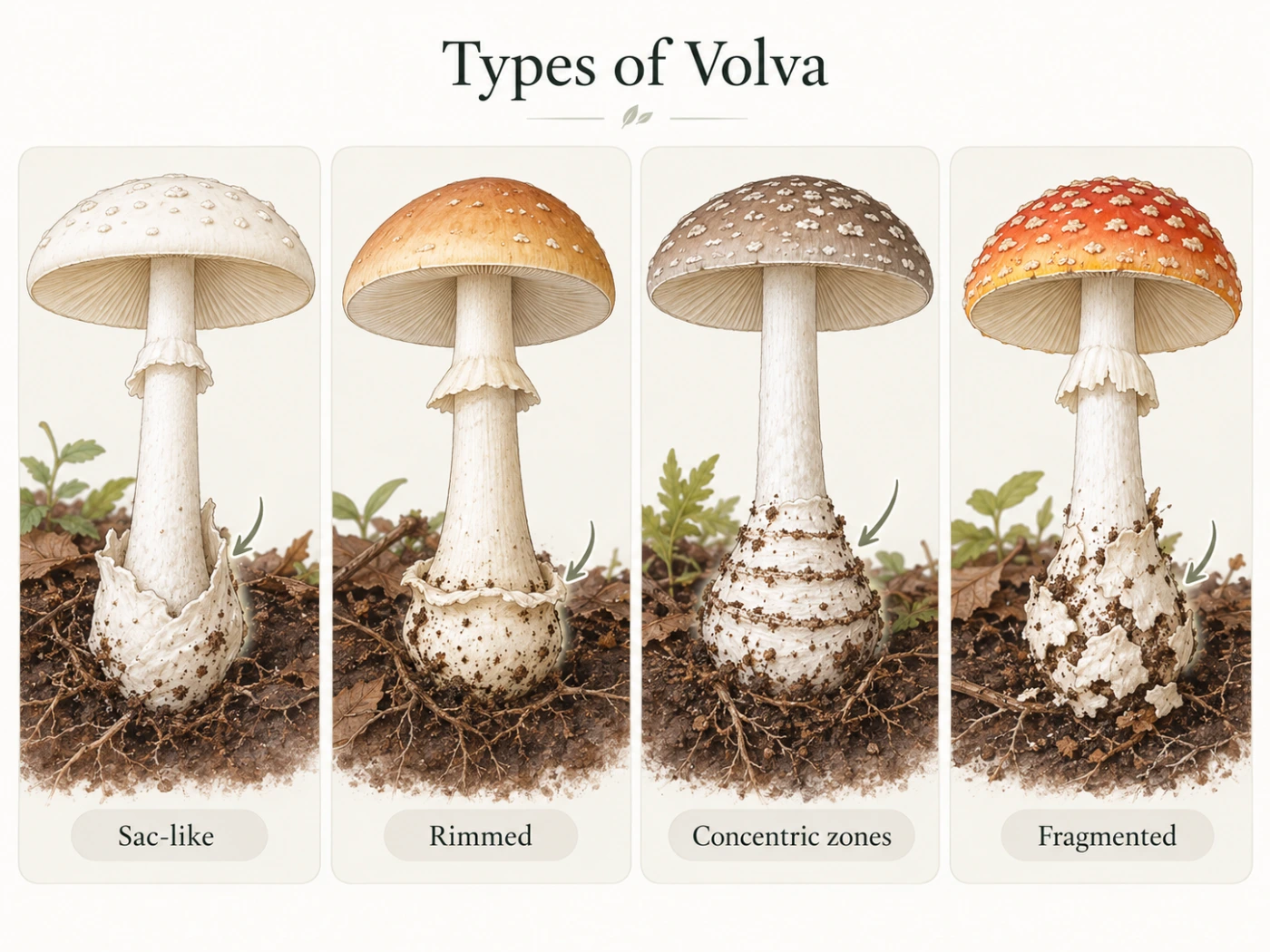
A volva is one of the most important structures in mushroom identification. It is a cup, sac, rim, or series of loose patches at the very base of the stem, formed from tissue that enclosed the young mushroom before it expanded.
The presence of a volva can immediately narrow an identification to a smaller set of groups, and in some cases it is a critical safety feature. Several highly toxic Amanita species have a volva, so cutting the stem above ground and leaving the base buried can remove one of the most important clues.
⚠️ Important: Never identify a mushroom for eating from cap color alone. If a volva may be present, the entire stem base should be exposed and examined before any edibility decision is considered.
Quick Identification
| Feature | What to Look For |
|---|---|
| Volva location | At the very base of the stem |
| Appearance | Cup, sac, collar, rim, loose patches, concentric zones |
| Origin | Remnant of the universal veil |
| Most important group | Amanita |
| Other genera | Volvopluteus, Volvariella and others |
| Ring present? | Sometimes, but not always |
| Gills | Often white in Amanita, pink in Volvopluteus/Volvariella |
| Safety importance | Very high |
| Main mistake | Cutting the mushroom off above the soil |
| Best practice | Remove the whole base intact |
What Is a Volva?
A volva is a remnant of the universal veil, a protective tissue that surrounds the very young fruit body. As the mushroom expands, this veil breaks apart and may remain around the stem base, on the cap, or in both places.
The exact shape varies dramatically between species. Some volvas form a deep bag-like sac, while others appear as a low rim, several rings of tissue, or irregular patches around a bulbous base.
Why the Stem Base Matters So Much
The stem base often carries identification features that do not appear anywhere else on the mushroom. A cap may fade, lose veil remnants in rain, or vary greatly in color, but the structure at the base can remain much more diagnostic.
This is especially important in Amanita. Several dangerous species can look superficially similar to edible mushrooms when the base is missing from the specimen.
The Universal Veil
The universal veil surrounds the entire young mushroom during early development. When the fruit body grows, that tissue tears apart in species-specific ways.
Part may remain as a volva around the stem base, while other fragments can stay on the cap as warts or patches. This is why cap decorations and basal structures are often related.
Volva vs Ring
A volva and a ring are not the same structure. The volva comes from the universal veil, while the ring usually comes from a partial veil that originally protected the developing gills.
A mushroom may have both structures, only one, or neither. In Amanita phalloides, for example, a ring and a sac-like volva can both be present.
What Does a Volva Look Like?
There is no single universal shape. Some are obvious and bag-like, while others are subtle enough to be missed unless the soil is carefully removed. The main forms include sacs, cups, collars, rims, concentric bands, and fragmented patches.
Sac-Like Volva
A sac-like volva forms a distinct loose cup around the stem base. It can look as though the mushroom is growing from a white bag. This form is especially important in dangerous Amanita species such as the Death Cap group and Destroying Angel groups.
Rimmed or Collar-Like Volva
Some species have a lower, tighter structure around the bulbous base rather than a deep sac. This may appear as a sharp rim or collar. Such forms are easy to damage during collection. If the mushroom is pulled roughly from compact soil, the rim may remain underground.
Concentric Volval Zones
Some Amanitas show several rings or belts of veil material around the bulbous stem base. These zones can be very useful for separating otherwise similar species. The Panther Cap is a classic example where the basal structure can be more informative than cap color alone.
Fragmented Volva
In other species, the universal veil breaks into irregular patches rather than a clean cup. These remnants may cling to the base or appear as loose scales. Because the fragments are less dramatic, they are easier for beginners to overlook.
Mushrooms Commonly Associated With a Volva
The most important genus is Amanita, but a volva is not exclusive to Amanitas. Several other gilled mushrooms also develop a volva-like structure from a universal veil.
The context of gill color, ring presence, spore print, habitat, and overall structure is therefore still essential.
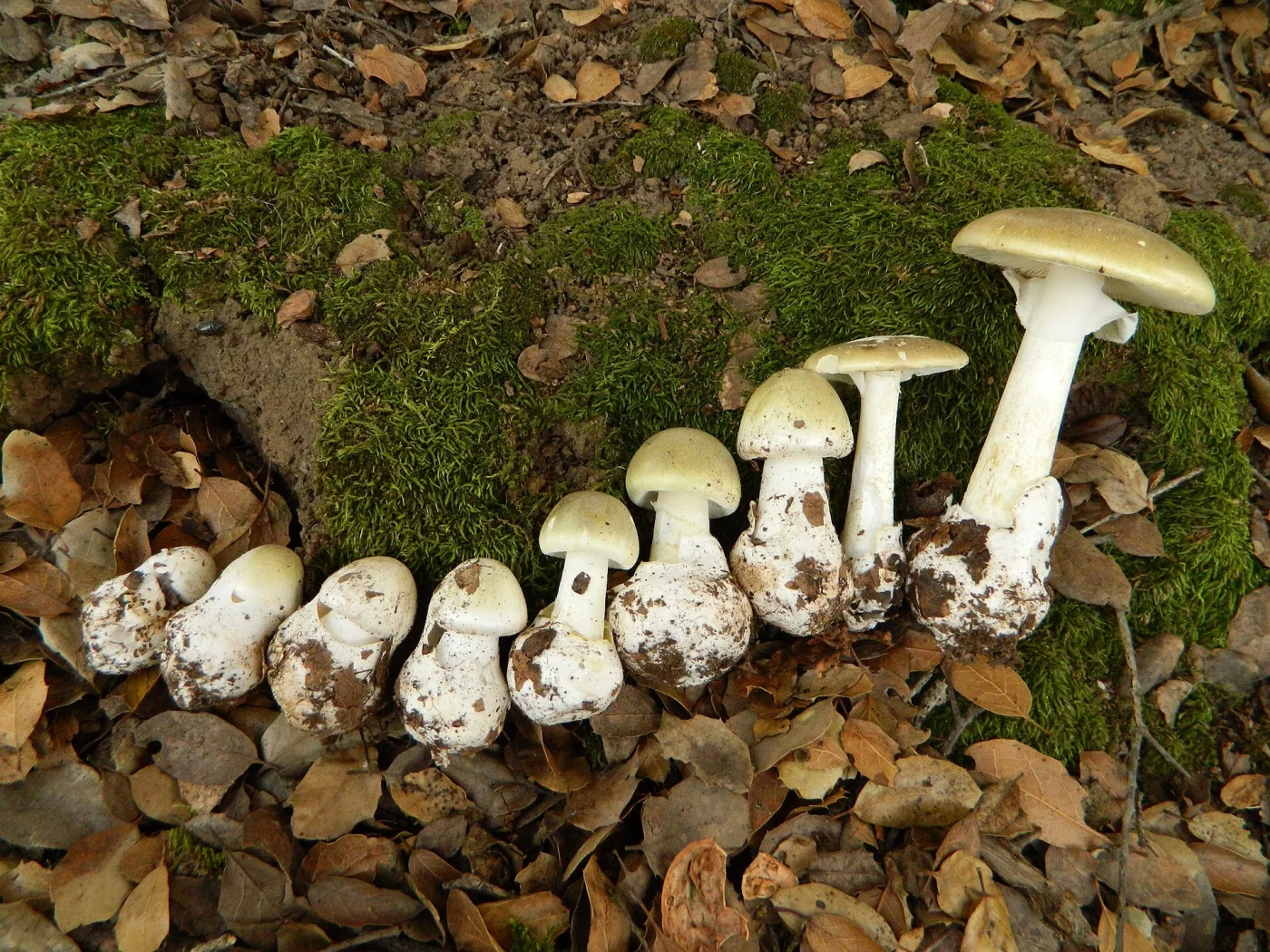
Amanita phalloides — Death Cap
Identification
The Death Cap usually has a greenish, olive, yellowish, or brownish cap, white gills, a pale stem, a ring, and a distinct sac-like volva at the base.
Cap color is highly variable, which makes the stem base especially important.
Why the Volva Matters
A specimen with the base cut off can resemble several edible mushrooms. The white sac-like volva is one of the strongest clues pointing toward a deadly Amanita.
Death Cap contains amatoxins and can cause severe liver failure after a delayed symptom-free period.
Amanita virosa and Related Destroying Angels
Identification
Destroying Angel species are usually white overall, with white gills, a white stem, a ring, and a sac-like volva.
Their clean white appearance can seem harmless, which is one reason they are dangerous.
Why the Volva Matters
White gilled mushrooms occur in many genera. A white sac at the base is a critical sign that the mushroom may belong to a deadly Amanita group.
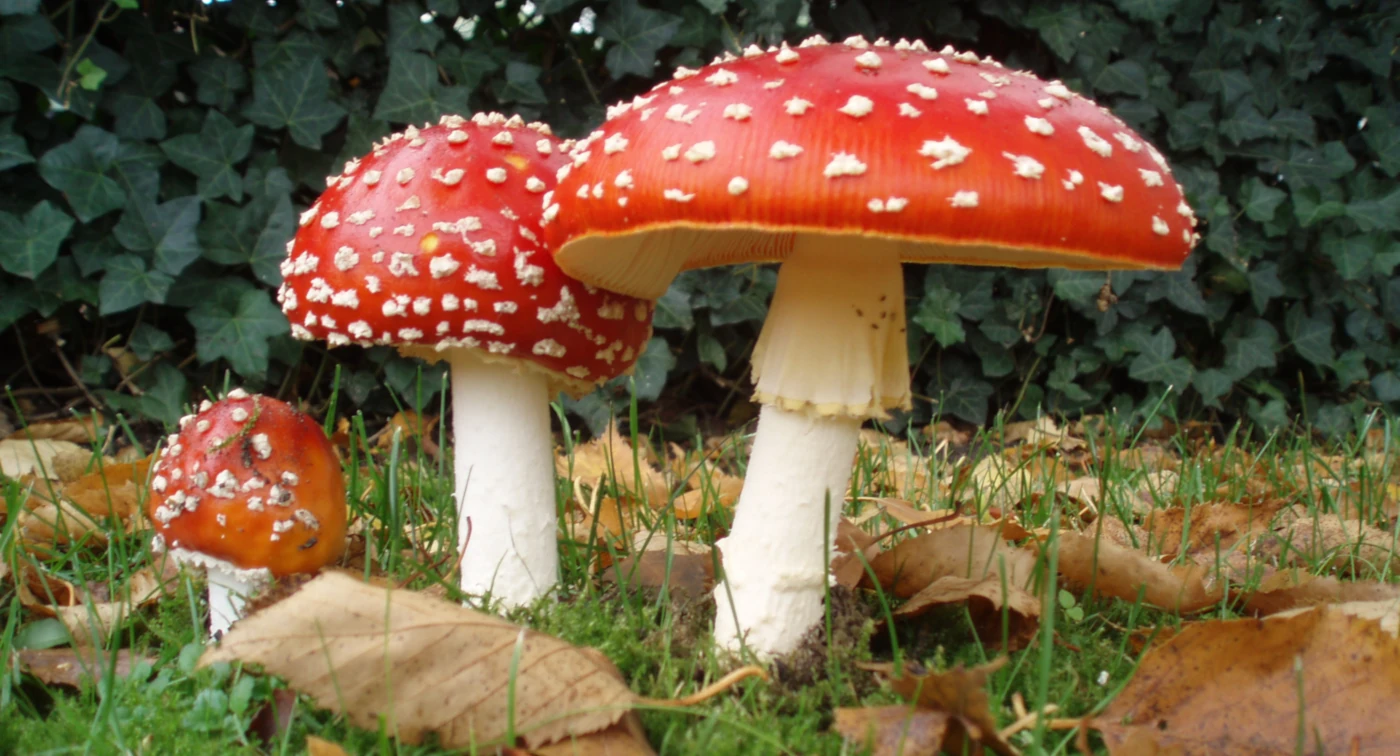
Amanita muscaria — Fly Agaric
Identification
Fly Agaric is famous for its red to orange-red cap with pale warts, white gills, a ring, and a bulbous stem base.
The volva is not usually a deep loose sac. Instead, it often appears as irregular rings, scales, or bands around the basal bulb.
Why the Volva Matters
The basal remnants help distinguish Fly Agaric from other red-capped mushrooms. They also show how variable a volva can look between different Amanita sections.
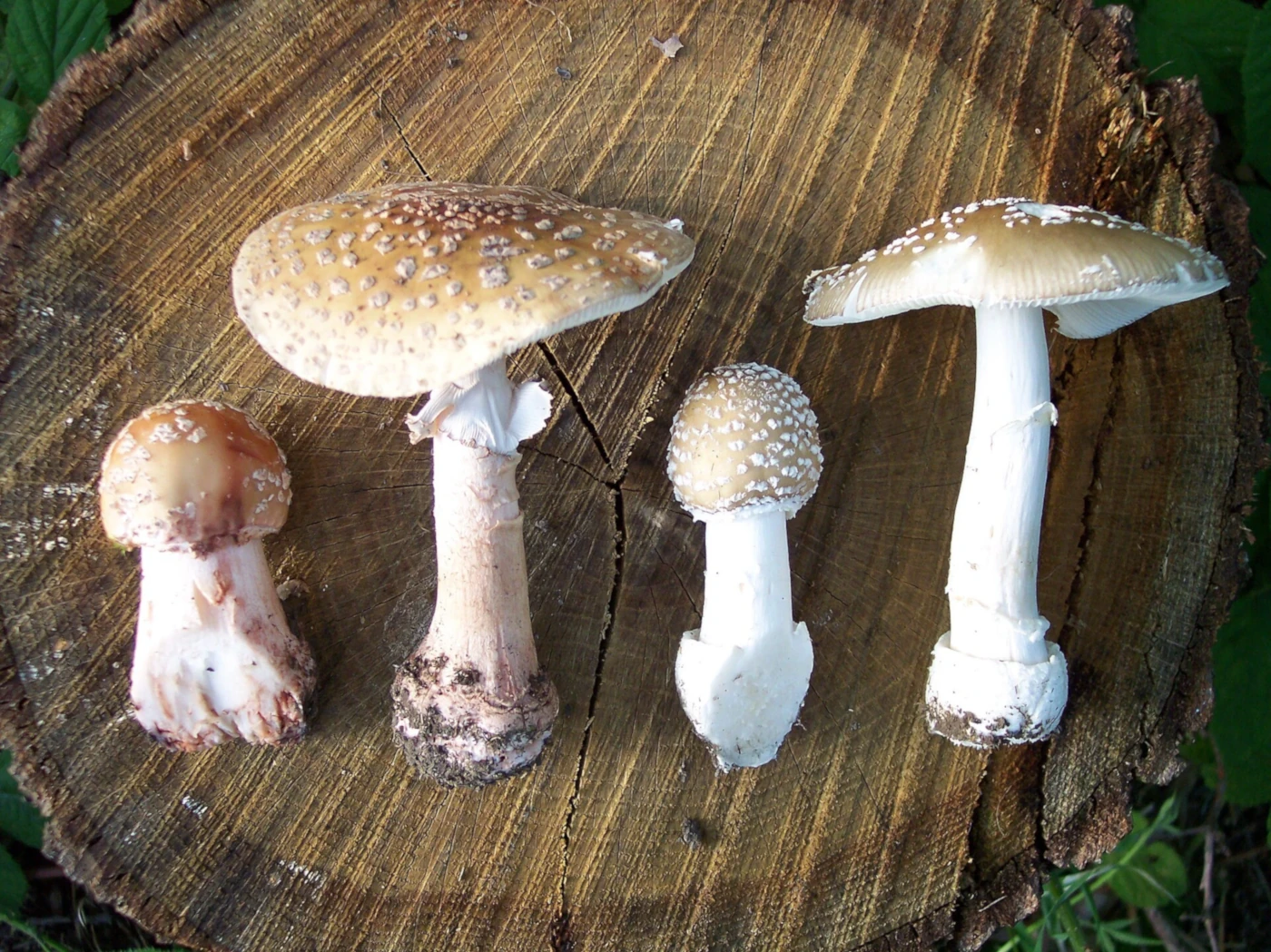
Amanita pantherina — Panther Cap
Identification
Panther Cap typically has a brown to gray-brown cap with white veil patches, white gills, a ring, and a bulbous base.
The base often shows a distinct rim and concentric volval zones.
Why the Volva Matters
The basal structure is one of the most useful features separating Panther Cap from similar brown Amanitas. Cap color and white warts alone are not reliable enough.
Amanita fulva — Tawny Grisette
Identification
Amanita fulva has a tawny brown to orange-brown cap, strongly striate margin, white gills, and a prominent sac-like volva.
Unlike many familiar Amanitas, it normally lacks a persistent ring.
Why the Volva Matters
This is a good reminder that volva does not always mean ring. Amanitas in the grisette group can have a very obvious volva while lacking a ring completely.
Volvopluteus gloiocephalus — Stubble Rosegill
Identification
This species has a pale grayish to whitish cap, free gills that become pink as spores mature, and a volva around the stem base.
Unlike typical Amanitas, the mature gills are pink rather than white.
Main Difference
Pink mature gills and a pink spore print point away from Amanita. The volva remains important, but it must be interpreted together with spore color.
Volvariella Species
Identification
Members of Volvariella also have a volva and free gills that become pink with maturity.
They can occur on wood, plant debris, compost, or other organic substrates depending on species.
Main Difference
Again, pink spores separate them from the white-spored Amanitas. A volva alone therefore identifies a structural group, not a species.
Volva vs Bulbous Stem
A swollen stem base is not automatically a volva. Many mushrooms have bulbs without any universal veil.
The key question is whether there is actual veil tissue forming a sac, rim, collar, patches, or zones around the swelling.
Volva vs Mycelium
White mycelial threads around the base can also be mistaken for a volva. Mycelium usually looks fibrous or cottony rather than forming a defined membrane or cup.
A true volva has a more organized structure. Careful cleaning of the stem base helps reveal the difference.
Volva vs Soil Sticking to the Base
Wet soil and leaf litter often adhere to the bottom of a mushroom and can hide or mimic structures. This is why the base should be gently cleaned rather than aggressively scraped.
Photographing the base before cleaning can also preserve useful context.
Why Cutting Mushrooms at Ground Level Can Be a Problem
Cutting a mushroom across the stem may leave the entire volva underground. This can remove exactly the feature needed to distinguish a dangerous Amanita from another gilled mushroom.
For identification purposes, it is usually better to carefully loosen the soil and extract the complete stem base intact.
How to Remove the Whole Stem Base
Use a finger, knife tip, or small stick to loosen the soil around the stem rather than pulling straight upward. Work around the mushroom until the basal bulb or sac becomes visible.
The goal is not to damage the underground mycelium unnecessarily, but to recover the complete fruit body needed for identification.
White Gills Plus a Volva
White gills combined with a volva deserve special caution. This feature combination is strongly associated with Amanita, including some of the most dangerous mushrooms in the world.
A ring may or may not be present. The absence of a ring does not automatically make the mushroom safe.
Pink Gills Plus a Volva
Pink mature gills point toward groups such as Volvopluteus or Volvariella rather than classic Amanita.
Young specimens can still have pale gills before the spores mature, so age should always be considered.
Volva and Cap Warts
Cap warts can represent additional remnants of the universal veil. In species such as Fly Agaric, part of the veil stays around the base while other fragments remain scattered across the cap.
Rain can wash cap warts away, which makes the volva and basal bulb even more important.
Volva and Habitat
Habitat can help refine identification once a volva has been found. Some species are mycorrhizal and occur in woodland, while others are decomposers growing in compost, straw, wood debris, or disturbed ground.
Substrate should therefore be recorded along with cap, gills, stem, and base.
Mushrooms With a Volva vs Mushrooms With a Ring
| Feature | Volva | Ring |
|---|---|---|
| Position | Stem base | Upper or middle stem |
| Origin | Universal veil | Partial veil |
| Common in Amanita | Yes | Often |
| Can occur alone | Yes | Yes |
| Safety importance | Very high | High |
| Main risk | Often left underground | May disappear with age |
The two structures should always be checked independently.
How to Identify a Mushroom With a Volva Step by Step
Start by exposing the entire base before focusing on cap color. Once a volva is confirmed, the next steps are gill color, ring presence, cap surface, spore color, and habitat.
This sequence is much safer than starting with superficial resemblance.
Step 1: Expose the Base
Carefully remove the mushroom with the entire stem base attached. Do not cut the stem at soil level if identification is the goal.
Look for a sac, cup, rim, bands, or loose veil fragments.
Step 2: Check the Gills
Determine whether the gills are white, cream, pink, brown, or another color.
White free gills plus a volva strongly suggest Amanita, while pink mature gills point toward other genera.
Step 3: Look for a Ring
Check the upper and middle stem for a ring or ring zone. A ring can be large and hanging, fragile and disappearing, or absent from the beginning.
Its presence helps narrow the group, but absence does not exclude Amanita.
Step 4: Examine the Cap
Look for veil patches, warts, striations, color, and surface texture. These features can help distinguish Amanita sections and other volva-bearing genera.
Do not depend on color alone because several dangerous species vary substantially.
Step 5: Consider Habitat and Geography
Record nearby trees, substrate, region, and season. Closely related species can have different host preferences and geographic distributions.
Regional taxonomy is especially important with Amanita.
How to Photograph a Volva for Identification
Take a side photograph of the entire mushroom before disturbing it. Then carefully expose the stem base and photograph it from several angles.
A close-up should show whether the structure is a loose sac, a sharp rim, concentric belts, or fragmented veil tissue.
The Most Important Photo
For a suspected Amanita, the stem base may be more important than a second cap photograph. Make sure the base is fully visible and in focus.
A mushroom photographed with the bottom of the stem cut off may remain impossible to identify safely.
Can AI Recognize a Volva?
AI can often detect an obvious sac or bulb when it is clearly visible. The main limitation is that users frequently photograph only the cap and upper stem.
If the base is buried, cropped out, or cut off, the model cannot recover the missing information. A cautious identification should therefore remain uncertain when a potentially important volva is not visible.
Common Identification Mistakes
One common mistake is assuming that all volvas look like large white bags. In reality, some are reduced to rims, bands, or patches.
Another mistake is confusing a bulbous stem with a true volva. A bulb is a stem shape, while a volva is veil tissue around or attached to the base.
A third mistake is trusting cap color too strongly. Death Caps can be green, olive, yellowish, brownish, or quite pale, so the stem base often carries more stable information.
Interesting Facts About Volvas
The volva is essentially a visible record of how the mushroom developed. Its form reflects the way the universal veil tore apart as the fruit body expanded.
Different Amanita groups break their universal veils in different ways, which is why one species may have a bag-like sac while another has concentric rings around a bulb.
The universal veil can also leave remnants on the cap. This explains why structures that seem unrelated — a cup at the base and white patches on the cap — can come from the same original tissue.
Volvas also show why mushroom identification sometimes depends on collecting technique. A perfectly photographed cap can still be less useful than an intact, carefully excavated stem base.
Frequently Asked Questions
Can a volva be completely buried underground?
Yes. In some mushrooms, most of the volva remains below the soil or leaf litter, especially when the fruit body grows deeply.
Can rain destroy a volva?
Heavy weather can damage delicate veil tissue, but basal remnants often persist better than cap patches. Very old specimens can still become difficult to interpret.
Can a mushroom have a volva but no ring?
Yes. Grisettes and some other Amanitas commonly have a volva without a persistent ring.
Can a mushroom have a ring but no volva?
Yes. Many gilled mushrooms produce rings from a partial veil without having any universal veil or volva.
Can young pink-spored mushrooms have white-looking gills?
Yes. Before spores mature, the gills may remain pale, which can make young Volvariella or Volvopluteus more confusing.
Why does the volva sometimes stay in the ground when the mushroom is pulled?
The membrane may be fragile or tightly embedded in soil. Pulling vertically can tear the stem free while leaving the sac behind.
Can a volva disappear completely with age?
It can become damaged or less obvious, but some remnants often remain. Identification becomes harder when the base is old, broken, or poorly collected.
Should every mushroom with a volva be considered poisonous?
No. A volva is not itself a toxicity marker, and several non-Amanita genera have one. It is important because some extremely dangerous species also possess this structure.
Final Identification Notes
A volva is one of the most valuable structural clues in mushroom identification. It forms from the universal veil and may appear as a sac, cup, rim, collar, concentric bands, or fragmented patches around the stem base.
Its safety importance is particularly high in Amanita. White gills, a ring, and a volva should always trigger careful consideration of dangerous Amanita species, while a volva combined with mature pink gills points toward different genera.
The simplest field rule is: never discard the stem base before identification. A mushroom that looks ordinary from above can become immediately recognizable once the complete base is exposed.
Upload a photo and get possible matches in seconds.