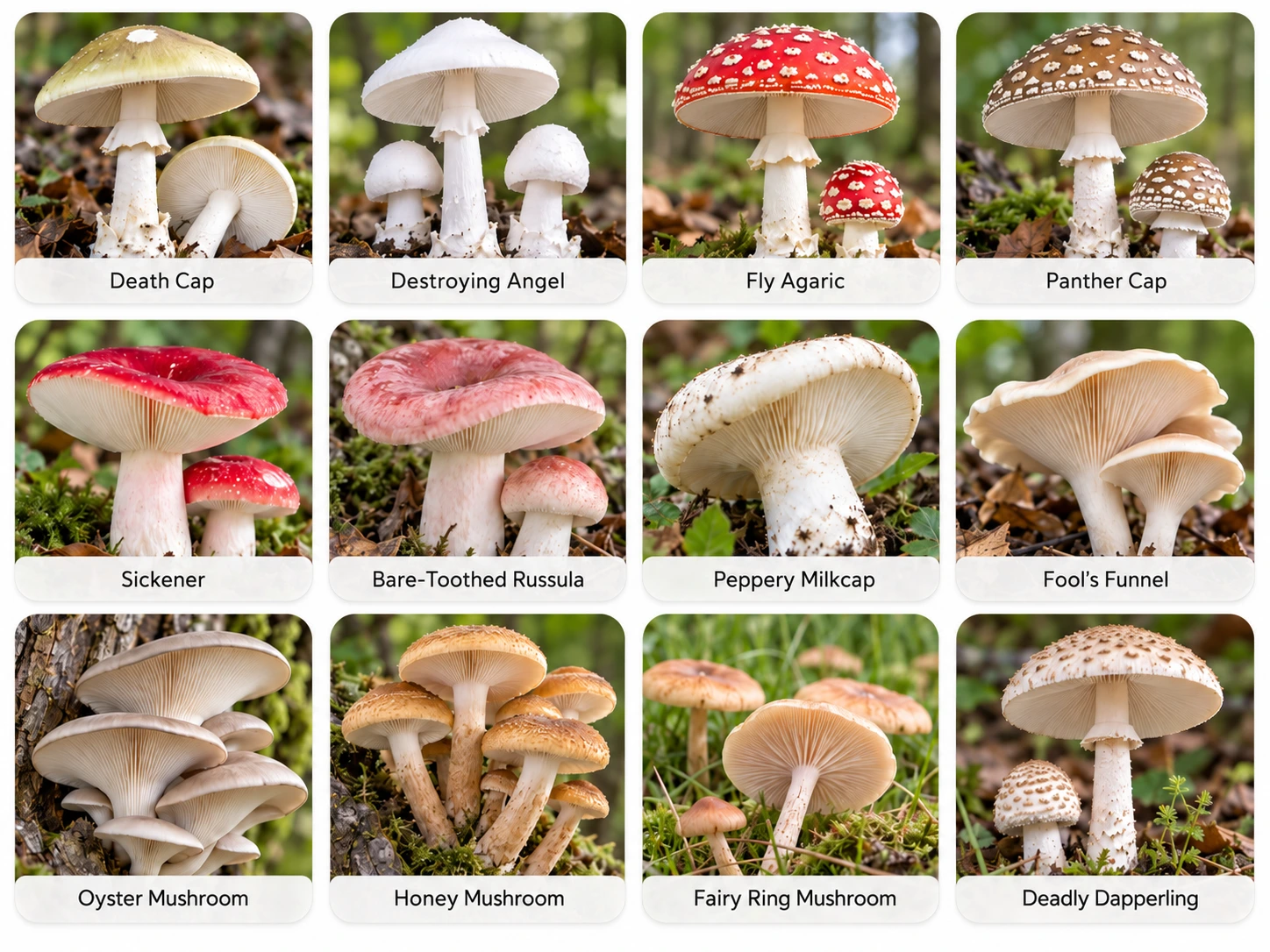
White gills are common in many completely unrelated mushroom groups, which makes them useful as a starting clue but dangerous as a final identification feature. A mushroom with white gills could be an edible Oyster Mushroom, a brittle Russula, a clustered Honey Mushroom, or a deadly Amanita.
The most useful next step is to look beyond gill color. Stem rings, volvas, latex, growth on wood, cap texture, spore color, habitat, and changes with age can quickly separate mushrooms that initially look very similar.
⚠️ Important: White gills do not indicate whether a mushroom is edible or poisonous. Several of the world’s most dangerous mushrooms have white gills, so identification should always use the complete fruit body.
Quick Guide to 12 Mushrooms With White Gills
| Species or group | Common name | Typical habitat | Important clue | Safety |
|---|---|---|---|---|
| Amanita phalloides | Death Cap | Soil near broadleaf trees | Volva + ring | Deadly poisonous |
| Amanita virosa group | Destroying Angel | Woodland soil | Entirely pale, sack-like volva | Deadly poisonous |
| Amanita muscaria | Fly Agaric | Woodland near trees | Red/orange cap, veil spots | Poisonous |
| Amanita pantherina | Panther Cap | Woodland | Brown cap, white veil patches | Poisonous |
| Russula emetica group | Sickener | Woodland soil | Red cap, brittle flesh | Poisonous / causes GI illness |
| Russula vesca | Bare-Toothed Russula | Woodland soil | Brittle stem and pale gills | Edible when correctly identified |
| Lactarius piperatus | Peppery Milkcap | Broadleaf woodland | White latex | Generally not considered a choice edible |
| Clitocybe rivulosa | Fool’s Funnel | Lawns and grassland | Small pale funnel | Poisonous |
| Pleurotus ostreatus | Oyster Mushroom | Dead hardwood | Decurrent gills, lateral growth | Edible when correctly identified |
| Armillaria species | Honey Mushrooms | Wood, roots and stumps | Clustered growth, white spores | Edibility varies |
| Marasmius oreades | Fairy Ring Mushroom | Lawns and grassland | Widely spaced pale gills | Edible when correctly identified |
| Lepiota brunneoincarnata | Deadly Dapperling | Grass, gardens, disturbed ground | Small scaly cap, ring | Deadly poisonous |
What Does “White Gills” Actually Mean?
Gills described as white are not always pure bright white. Depending on age, moisture, lighting, and species, they may appear ivory, cream, pale beige, or slightly yellowish.
The important question is whether they remain broadly pale as the mushroom matures. In some genera, young gills start pale but become pink, brown, rusty, or black as spores develop.
Gill Color Can Change With Age
This is particularly important with genera such as Agaricus. Young Agaricus gills can initially look pale, but they soon become pink and eventually chocolate brown.
Amanita gills, by contrast, usually remain white or pale throughout development. Observing mature specimens can therefore prevent a common identification mistake.
1. Amanita phalloides — Death Cap
Identification
The Death Cap usually has a smooth cap that ranges from olive-green and yellow-green to brownish, grayish, or very pale. The gills are white and remain white as the mushroom matures.
The stem normally has a ring, while the base sits inside a sack-like volva. That basal structure may be hidden beneath soil or leaf litter, so the entire mushroom should be carefully exposed during identification.
Habitat
Death Caps grow from soil in association with living trees. Oaks, beeches, chestnuts, and several other broadleaf species can act as hosts depending on region.
They can occur in forests, parks, roadside plantings, and gardens with mature trees. Their appearance in landscaped areas sometimes surprises people who associate dangerous mushrooms only with wild forest.
Safety
Amanita phalloides contains amatoxins capable of causing severe liver failure and death. Symptoms are often delayed for many hours, which makes suspected ingestion a medical emergency even if the person initially feels well.
The combination of white gills, a ring, and a volva should always make an Amanita identification a serious possibility.
2. Amanita virosa Group — Destroying Angels
Identification
Destroying Angels are among the classic white mushrooms with white gills. The cap, stem, and gills are usually predominantly white, giving the entire fruit body a deceptively clean appearance.
A ring is commonly present on the stem, and a sack-like volva surrounds the base. Some related North American species, such as members of the Amanita bisporigera group, can look very similar.
Habitat
These mushrooms grow from soil near living trees in woodland. They are mycorrhizal rather than decomposers, so they do not normally grow directly from dead logs.
Forest type varies by species and region. Broadleaf and mixed woods are common habitats.
Safety
Destroying Angels contain amatoxins and can cause fatal poisoning. Their plain white appearance makes them particularly important to recognize because they do not look obviously threatening.
Any unknown white-gilled mushroom with a volva should be treated with extreme caution.
3. Amanita muscaria — Fly Agaric
Identification
Fly Agaric usually has a red or orange-red cap covered with white universal veil remnants. The gills are white, and the pale stem typically carries a ring.
The base is enlarged and often has additional veil remnants. Rain can wash many of the white cap spots away, making old specimens less immediately recognizable.
Habitat
Amanita muscaria grows from soil near trees such as birch, pine, spruce, and other suitable hosts. It is common in forests but can also appear in parks and lawns near mature trees.
Autumn is one of its main seasons in temperate regions. Large groups may appear after prolonged rain.
Safety
Fly Agaric is poisonous and contains ibotenic acid and muscimol. The poisoning syndrome is mainly neurological rather than the delayed liver failure associated with Death Caps.
White gills therefore occur in Amanita species with very different toxins, reinforcing why gill color alone is insufficient.
4. Amanita pantherina — Panther Cap
Identification
Panther Cap has a brown to gray-brown cap decorated with white veil patches. Its gills are white, and the stem is pale with a ring.
The stem base is bulbous and carries characteristic veil remnants. The flesh generally does not develop the strong reddish staining typical of the Blusher.
Habitat
The mushroom grows from soil in deciduous, coniferous, and mixed woodland. Like other Amanitas, it forms relationships with living tree roots.
Autumn is a major fruiting period. Heavy rain can remove cap patches, so the stem base becomes especially important for identification.
Safety
Panther Cap contains ibotenic acid and muscimol and can cause serious neurological poisoning. It should not be confused with amatoxin-containing Amanitas, although both groups require caution.
5. Russula emetica Group — Sickener
Identification
Sickener-type Russulas usually have bright red caps, white to cream gills, and white brittle stems. The entire fruit body has the characteristic brittle texture of Russula, often breaking almost like chalk.
The cap skin may peel from the margin to some degree. Gill color remains pale rather than becoming brown or rusty.
Habitat
These mushrooms grow from soil in association with trees. Depending on the exact species, coniferous, mixed, and wet woodland can all provide habitat.
Modern taxonomy has shown that several red-capped Russulas can resemble one another closely. Species-level identification from appearance alone may therefore be difficult.
Safety
Some red Russulas cause strong gastrointestinal irritation and have an intensely acrid taste. They should not be treated as edible simply because other members of the genus are eaten.
6. Russula vesca — Bare-Toothed Russula
Identification
Russula vesca usually has a pinkish, reddish brown, or flesh-colored cap with white to cream gills. The cap skin often fails to reach the outer margin completely, exposing a narrow pale edge that gives rise to the “bare-toothed” common name.
The stem is pale and brittle. Like other Russulas, it lacks a ring and volva.
Habitat
It grows from soil in woodland and forms mycorrhizal relationships with living trees. Broadleaf and mixed forests can both provide suitable habitat.
Fruiting usually occurs from summer into autumn. It may appear singly or in scattered groups.
Safety
The species is regarded as edible when correctly identified. However, beginners should be cautious with Russulas because many species look similar and some cause gastrointestinal illness.
7. Lactarius piperatus — Peppery Milkcap
Identification
Peppery Milkcap is a large white to cream mushroom with crowded pale gills. When the gills or flesh are damaged, they release white latex or “milk.”
The cap becomes funnel-shaped with age, and the stem is relatively short and sturdy. The combination of crowded white gills and white latex is far more diagnostic than the cap color alone.
Habitat
It grows from soil in broadleaf and mixed woodland, often near beech, oak, and other suitable trees. Fruit bodies may appear singly or in groups.
Summer and autumn are the main fruiting periods. The pale color can make the mushrooms difficult to see among dry leaves.
Safety
The flesh and latex have a very strong peppery or acrid taste. Its culinary use varies by region and preparation tradition, but it should not be treated as a straightforward edible mushroom for beginners.
8. Clitocybe rivulosa — Fool’s Funnel
Identification
Fool’s Funnel is a small white to cream mushroom with pale gills that run slightly down the stem. Mature caps often become shallowly depressed or funnel-shaped.
The overall appearance is plain, and individual mushrooms can be easy to overlook in grass. They may occur in arcs, rings, or scattered groups.
Habitat
Lawns, parks, meadows, grassy roadsides, and other open habitats are typical. Autumn rain often triggers large fruitings.
The species can grow in places where children or pets have easy access, making recognition especially useful around homes and parks.
Safety
Clitocybe rivulosa contains muscarine and is poisonous. Symptoms can include heavy sweating, salivation, nausea, abdominal symptoms, and cardiovascular effects.
Its unremarkable pale appearance demonstrates why white lawn mushrooms should never be assumed harmless.
9. Pleurotus ostreatus — Oyster Mushroom
Identification
Oyster Mushrooms have broad fan-shaped caps with white to cream gills running down toward a short lateral stem or attachment point. The caps often grow in overlapping shelves.
Color varies from nearly white to gray or brown depending on conditions. The gills generally remain pale and contrast with darker caps.
Habitat
Pleurotus ostreatus grows directly from dead or weakened hardwood. Fallen logs, standing dead trees, trunks, and large branches are common substrates.
Cool autumn and winter weather can produce excellent fruiting. Several clusters may appear along the same tree.
Safety
Oyster Mushrooms are considered edible when correctly identified and cooked. Pale gills combined with shelf-like growth directly from wood are useful clues, but other oyster-shaped fungi should still be ruled out.
10. Armillaria Species — Honey Mushrooms
Identification
Honey Mushrooms usually have honey-yellow, tan, or brown caps with white to cream gills. Many species have a ring on the stem, although some members of the group are ringless.
They often grow in dense clusters from tree bases, roots, stumps, and buried wood. Their spore print is white, and heavy spore deposits may sometimes coat nearby caps.
Habitat
Armillaria species can act as parasites, decomposers, or both depending on circumstances. They are strongly associated with woody material even when fruit bodies appear to emerge from soil.
Autumn is a major season for large Honey Mushroom flushes. A single stump may produce dozens of mushrooms.
Safety
Edibility varies by species and preparation, and gastrointestinal reactions can occur. The more important safety issue is confusion with brown wood-growing species such as Deadly Galerina, which produces rusty-brown spores rather than white.
11. Marasmius oreades — Fairy Ring Mushroom
Identification
Fairy Ring Mushrooms have tan to buff caps and pale cream to whitish gills. The gills are relatively widely spaced compared with many other small lawn mushrooms.
The stem is thin but surprisingly tough and flexible. Caps often become flatter or develop a small central bump as they mature.
Habitat
They grow in lawns, meadows, parks, and other grassy areas. Fruiting frequently forms arcs or complete rings that may expand gradually over many years.
Rain after dry weather can trigger sudden flushes. Several generations may appear during the growing season.
Safety
Marasmius oreades is considered edible when correctly identified. Small pale lawn mushrooms are difficult for beginners, however, and poisonous species can occur in similar habitats.
12. Lepiota brunneoincarnata — Deadly Dapperling
Identification
Deadly Dapperling is a relatively small mushroom with a pale cap covered in brown to reddish-brown scales. The gills are white and remain pale, while the slender stem usually carries a ring or ring zone.
Its modest size can make it look less threatening than large Amanitas. Unfortunately, size has little relationship to toxicity.
Habitat
The species can occur in gardens, parks, grassy areas, paths, and disturbed ground. It is not restricted to remote woodland and may appear relatively close to human habitation.
Warm temperate regions can support fruiting during summer and autumn. Its inconspicuous appearance makes careful identification important.
Safety
Lepiota brunneoincarnata contains amatoxins and can cause fatal liver poisoning. Small white-gilled mushrooms in the Lepiota group should therefore never be assumed edible.
White-Gilled Mushrooms With a Ring
A ring on the stem immediately narrows the possibilities, but it does not indicate safety. Death Cap, Destroying Angels, Fly Agaric, Panther Cap, many Honey Mushrooms, and Deadly Dapperling can all have rings. The stem base then becomes particularly important. A ring combined with a sack-like volva or other universal veil remnants strongly suggests an Amanita and deserves immediate caution.
Ring Plus Volva
The combination of a stem ring and a volva is one of the classic Amanita patterns. The volva may be a loose sack, a rim around a bulb, or fragmented material depending on species. Because much of the structure can remain underground, simply cutting a mushroom at soil level destroys valuable evidence. The entire stem base should be exposed whenever an Amanita is possible.
White-Gilled Mushrooms Without a Ring
Many white-gilled mushrooms lack a ring entirely. Russulas, Peppery Milkcap, Fool’s Funnel, Fairy Ring Mushroom, and Oyster Mushroom are among the examples in this guide. Absence of a ring eliminates some possibilities but does not establish edibility. Small pale funnel-shaped mushrooms without rings can still be poisonous.
White-Gilled Mushrooms Growing on Wood
Oyster Mushrooms and Honey Mushrooms are common white- or pale-gilled fungi associated with wood. Their growth patterns are very different, with oysters forming shelf-like clusters and Honey Mushrooms producing more conventional cap-and-stem fruit bodies. Substrate is useful but can be misleading when roots or logs are buried. A mushroom that appears to grow from soil may actually be attached to hidden wood.
White-Gilled Mushrooms Growing in Lawns
Fool’s Funnel and Fairy Ring Mushroom are two important examples of pale-gilled lawn fungi. One is poisonous, while the other is considered edible when correctly identified. This is a good example of why habitat and gill color cannot determine safety. Cap structure, gill spacing, stem texture, spore characteristics, and overall morphology must also agree.
White-Gilled Mushrooms in Forests
Woodland contains an enormous variety of mushrooms with pale gills. Amanitas, Russulas, milkcaps, Honey Mushrooms, and numerous smaller genera may all occur within a relatively small area. Nearby tree species can provide useful clues because many forest mushrooms are mycorrhizal. Oak, pine, birch, spruce, beech, and other trees support different fungal communities.
How to Identify a Mushroom With White Gills
Start by checking whether the mushroom actually has true gills. Chanterelles have false gills, while boletes have pores and Hedgehog Mushrooms have teeth. If the mushroom has true white gills, inspect the complete stem next. Look for a ring, volva, bulbous base, latex, brittle texture, lateral attachment, or clustered growth.
Step 1: Check the Stem Base
This is especially important for white-gilled Amanitas. A volva may remain hidden below the surface even when the rest of the mushroom looks ordinary.
Carefully expose the complete base instead of cutting the stem. A buried structure may completely change the identification.
Step 2: Look for a Ring
A ring can help separate broad groups. Its size, texture, position, and persistence may all provide useful information.
A missing ring should not be treated as definitive because fragile rings can disappear. Check several specimens if they are available.
Step 3: Check the Substrate
Determine whether the mushroom grows from soil, grass, dead wood, or buried roots. Oyster Mushrooms and Honey Mushrooms are strongly associated with wood, while Amanitas and Russulas normally grow from soil near living trees.
Substrate should support the physical identification rather than override it. Buried wood can make a wood-growing fungus appear terrestrial.
Step 4: Look at Gill Attachment
Gills may be free from the stem, directly attached, notched, or decurrent down the stem. This is useful for separating mushrooms that otherwise share similar colors.
Oyster Mushroom gills run down the attachment point, while Amanita gills are typically free or nearly free. Learning these basic attachment patterns makes pale-gilled mushrooms easier to sort into groups.
White Gills vs White Spore Print
Gill color and spore color are not the same thing. A mushroom with white gills may produce white, cream, pink, brown, or other colored spores depending on species and maturity.
This distinction becomes particularly useful with young mushrooms. Gill color may initially be pale even when the eventual spore print is dark.
A spore print should therefore be treated as an additional identification feature rather than simply inferred from the gills.
Are White Gills a Sign of a Poisonous Mushroom?
No. White gills occur in edible, inedible, and deadly poisonous mushrooms. Oyster Mushrooms and some Russulas have pale gills, while Death Caps and Destroying Angels also have white gills. Toxicity has to be determined from species identification rather than gill color. The association between white gills and danger exists mainly because several important Amanitas have this feature. It is a useful reason for caution, not a universal rule.
Dangerous White-Gilled Mushrooms to Learn First
Beginners should become familiar with Death Cap and Destroying Angels before collecting pale-gilled mushrooms for food. Their combination of white gills, pale stems, rings, and volvas is particularly important. Small amatoxin-containing Lepiotas are also worth learning because they demonstrate that deadly mushrooms are not always large or dramatic. Fool’s Funnel adds another useful pattern: a small ordinary-looking pale lawn mushroom can also be poisonous. Recognizing dangerous groups is often more useful than trying to memorize dozens of edible species immediately.
White Gills vs Pale Gills
Field guides often use terms such as white, cream, ivory, buff, or pale yellow. The boundary between these colors can be subjective, especially under warm artificial light or in photographs.
It is often better to think in broader categories. A mushroom with consistently pale gills belongs in a very different identification pathway from one whose mature gills become chocolate brown, rusty, purple-black, or black.
Why Mature Mushrooms Are Useful
Young mushrooms may hide important features. Veils can cover the gills, cap shape may be undeveloped, and mature spore color may not yet be visible.
Older specimens reveal how the gills change, whether a ring persists, and what the fully expanded cap looks like. A group containing both young and mature mushrooms is often much easier to identify than a single perfect-looking specimen.
How to Photograph White Gills for Identification
Take a clear underside photograph in neutral natural light. Avoid strong yellow indoor lighting because it can make genuinely white gills look cream or brown.
Photograph the complete stem and base in a separate image. For mushrooms growing on wood, include the exact attachment point so the substrate is unambiguous.
A side view can also show whether the gills are free, attached, or decurrent. This often provides more useful information than another photograph of the cap.
Can AI Identify White-Gilled Mushrooms?
AI can help narrow possibilities when photographs include the underside, stem, stem base, and habitat. Distinctive mushrooms such as Oyster Mushroom or Fly Agaric may be relatively easy to recognize from good images.
White Amanitas and small pale mushrooms are much more challenging because critical features can be subtle or hidden underground. An image showing only a white cap and white gills may fit many unrelated species.
For white-gilled mushrooms, complete photographic documentation is especially important. AI should never be used to decide whether an uncertain wild mushroom is safe to eat.
Common Identification Mistakes
One common mistake is assuming that every white-gilled mushroom is an Amanita. White gills occur across many fungal families, so the stem base, substrate, texture, and other features must also be considered.
The opposite mistake is more dangerous: assuming that an ordinary-looking white mushroom cannot be poisonous. Destroying Angels and Deadly Dapperlings show why appearance alone is unreliable.
Another frequent error is ignoring mushroom age. Gills that look pale in a young specimen may become dark later, completely changing the likely identification.
Frequently Asked Questions
What mushrooms have white gills?
Many groups have white or pale gills, including Amanitas, Russulas, milkcaps, Oyster Mushrooms, Honey Mushrooms, Fairy Ring Mushrooms, and numerous smaller genera. White gills should therefore be treated as a broad identification clue rather than a species-level feature.
Are mushrooms with white gills poisonous?
Some are, but many are not. Death Caps and Destroying Angels are deadly poisonous, while correctly identified Oyster Mushrooms and several other white-gilled species are edible.
What deadly mushrooms have white gills?
Death Cap, Destroying Angels, and some small Lepiota species are important examples. These mushrooms can contain amatoxins capable of causing severe liver failure.
Do Amanitas always have white gills?
Many well-known Amanita species have white or pale gills, including Death Cap, Fly Agaric, Panther Cap, and Destroying Angels. The genus is diverse, however, so identification should also use the stem base, veil structures, cap, and habitat.
Do Oyster Mushrooms have white gills?
Yes. Oyster Mushrooms usually have white to cream gills that run down toward their short lateral stem or attachment point, and they grow directly from wood.
Do Honey Mushrooms have white gills?
Honey Mushrooms generally have pale or whitish gills, although they may develop cream or slightly darker tones with age. Their white spore print and clustered growth on wood are additional useful clues.
Can a white-gilled mushroom have a dark spore print?
Yes. Gill color and spore-print color are separate characteristics, and young gills may not show mature spore coloration. This is why checking both features can improve identification.
What should I check after noticing white gills?
Check the complete stem base, ring or absence of a ring, substrate, cap texture, gill attachment, spore color, and nearby trees. These features usually narrow the possibilities much more effectively than gill color alone.
Are white mushrooms with white gills dangerous?
Some are extremely dangerous, particularly Destroying Angels. A completely white mushroom with white gills, a ring, and a volva should be treated as a possible deadly Amanita until confidently identified otherwise.
Can I identify a mushroom from gill color alone?
No. Many unrelated species share the same gill color, and some mushrooms change dramatically as they mature. Reliable identification requires several independent features to agree.
Final Identification Notes
White gills are a useful first observation, but they open a large identification category rather than provide an answer. The same pale underside occurs in deadly Amanitas, poisonous lawn mushrooms, edible Oyster Mushrooms, brittle Russulas, milkcaps, Honey Mushrooms, and many other groups.
The next features to check are the complete stem base, ring, substrate, gill attachment, flesh texture, latex, spore color, and habitat. A white-gilled mushroom with a volva leads toward a very different identification than a white-gilled shelf growing from a dead tree.
Most importantly, never interpret white gills as evidence of edibility. Several of the most dangerous mushrooms to learn first are white-gilled species, which makes careful structural identification especially important.
Upload a photo and get possible matches in seconds.