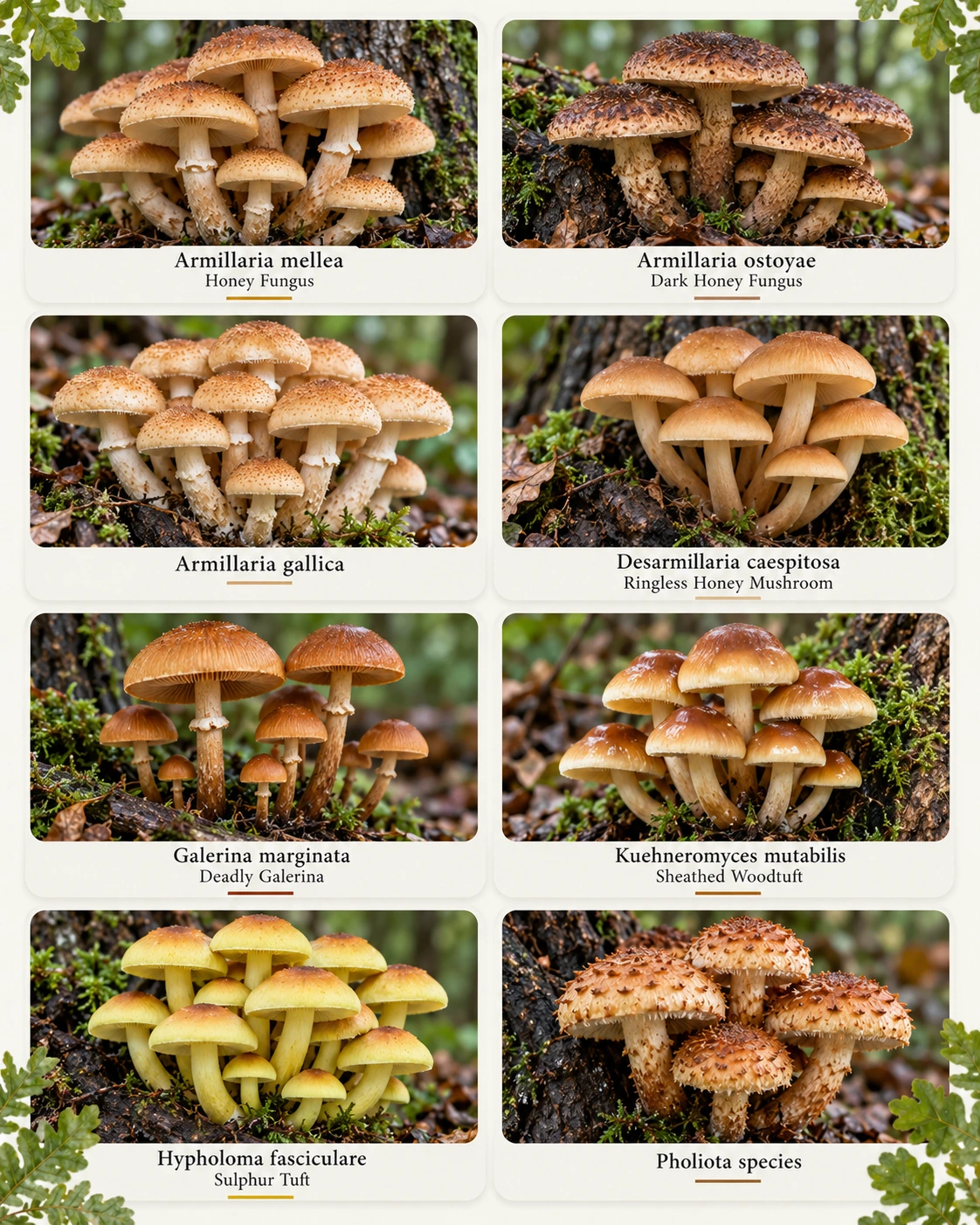
Armillaria species, commonly known as Honey Mushrooms, are a group of wood-associated fungi that often grow in dense clusters around stumps, tree bases, buried roots, and decaying wood. Their caps are usually honey-brown to yellow-brown, their gills are pale, and many species have a ring on the stem.
Honey Mushrooms are common across Europe, North America, and other temperate regions, but they are not a single species. Several Armillaria species look very similar, and some important look-alikes can be poisonous or even deadly, so identification should rely on the complete combination of cap, gills, stem, ring, spore print, growth pattern, and substrate.
⚠️ Important: This guide is for identification and education only. Never eat wild Honey Mushrooms based solely on photographs, AI identification, or an online comparison.
Quick Identification
| Feature | Armillaria species |
|---|---|
| Common name | Honey Mushrooms |
| Genus | Armillaria |
| Cap color | Honey-yellow, tan, brown, olive-brown |
| Cap surface | Often with small scales |
| Gills | Pale cream to whitish |
| Stem | Fibrous, pale to brownish |
| Ring | Present in many species, absent in some |
| Spore print | White |
| Growth | Dense clusters or scattered groups |
| Substrate | Stumps, roots, trunks, buried wood |
| Ecology | Parasitic and saprobic |
| Season | Mainly late summer through autumn |
| Edibility | Varies by species and region |
| Main danger | Confusion with Galerina marginata and other brown wood-growing mushrooms |
What Do Honey Mushrooms Look Like?
Honey Mushrooms usually form clusters of medium-sized mushrooms growing from wood or from soil above buried roots. Caps are commonly yellow-brown, honey-colored, tan, or darker brown.
The cap may carry small darker scales, especially around the center. The gills begin pale and usually remain cream to whitish rather than becoming rusty brown.
Many species have a ring on the upper stem. However, ringless Honey Mushrooms also exist, so the absence of a ring does not automatically exclude Armillaria.
Cap
The cap is usually convex when young and becomes flatter with age. Mature caps may develop a low central bump or become slightly irregular.
Color varies considerably. Yellow, honey, caramel, olive-brown, and reddish-brown tones can all occur depending on species, age, weather, and moisture.
Cap Scales
Many Armillaria species have small darker scales concentrated toward the center of the cap. These can be especially noticeable in young fruit bodies.
Rain can wash scales away, while old specimens may become smoother. A completely smooth cap does not automatically rule out the genus.
Gills
The gills are pale cream to whitish and attach to the stem. In some species they may become slightly pinkish, yellowish, or spotted with age.
They do not mature to rusty brown like those of Galerina marginata. This difference becomes especially important in older specimens.
Gill Attachment
The gills may be attached broadly to the stem or run slightly down it. Exact attachment varies among species. Gill color and spore print are generally more useful than the precise attachment pattern for separating Honey Mushrooms from dangerous look-alikes.
Stem
The stem is fibrous and often tougher than the cap. It may be pale near the top and darker toward the base.
Clusters often contain stems fused or crowded together at their bases. This dense growth pattern is typical of many Armillaria fruitings.
Ring
Many Honey Mushroom species have a distinct ring left by the partial veil. The ring can be thick, membranous, and relatively persistent.
Other species, especially those traditionally called ringless Honey Mushrooms, lack a substantial ring. This is one reason why the genus cannot be identified using the ring alone.
Spore Print
The spore print is white. This is one of the most useful features for separating Honey Mushrooms from several brown-spored wood-growing mushrooms.
A rusty-brown or cinnamon-brown spore print points away from Armillaria. This distinction is especially important when Galerina is a possibility.
Flesh
The flesh is pale and relatively firm in young specimens. The stem is often more fibrous and tough than the cap.
Older mushrooms become increasingly stringy and less pleasant in texture. Insect damage may also become common.
Smell
The smell is usually mild and mushroom-like. Some specimens may have a slightly sweet, earthy, or musty odor.
Odor is not distinctive enough for reliable identification. Growth habit, spore color, stem structure, and substrate are much stronger clues.
Where Do Armillaria Species Grow?
Honey Mushrooms grow in association with wood, especially roots, trunks, and stumps. They may fruit directly from visible wood or emerge from soil where buried roots are hidden.
This can make them appear to be ordinary ground-growing mushrooms. Following the stem base or examining the surrounding area may reveal the buried woody substrate.
Living Trees
Many Armillaria species are important tree pathogens. They can infect weakened or stressed trees and cause root and lower-trunk decay.
Clusters often appear around the base of affected trees. Fruiting bodies are only the visible reproductive structures, while the main fungus extends through roots and wood.
Dead Wood
After a tree dies, Armillaria can continue decomposing the wood. Stumps and dead roots may produce mushrooms for years.
This dual parasitic and decomposer lifestyle explains why Honey Mushrooms occur around both living and dead trees.
Rhizomorphs
Armillaria can produce dark cord-like structures called rhizomorphs. These often resemble black or dark brown shoelaces. They can grow beneath bark, through soil, and along roots. Rhizomorphs are useful supporting evidence but are not always visible.
Why Rhizomorphs Matter
These structures help the fungus spread from one woody food source to another. Large Armillaria colonies can therefore extend over substantial underground areas. Finding rhizomorphs under loose bark can strongly support the identification. They should still be combined with mushroom features.
When Do Honey Mushrooms Grow?
Late summer through autumn is the main fruiting period in many temperate regions. Large flushes often appear after sustained rainfall. Some species fruit earlier or later depending on climate. Mild autumn weather can extend the season considerably.
Why Clusters Can Appear Suddenly
The underground fungus may remain active for years without producing obvious mushrooms. Suitable temperature and moisture can trigger a large fruiting almost simultaneously. A stump that looked inactive one week can suddenly be surrounded by dozens of fruit bodies.
Armillaria mellea — Honey Fungus
Identification
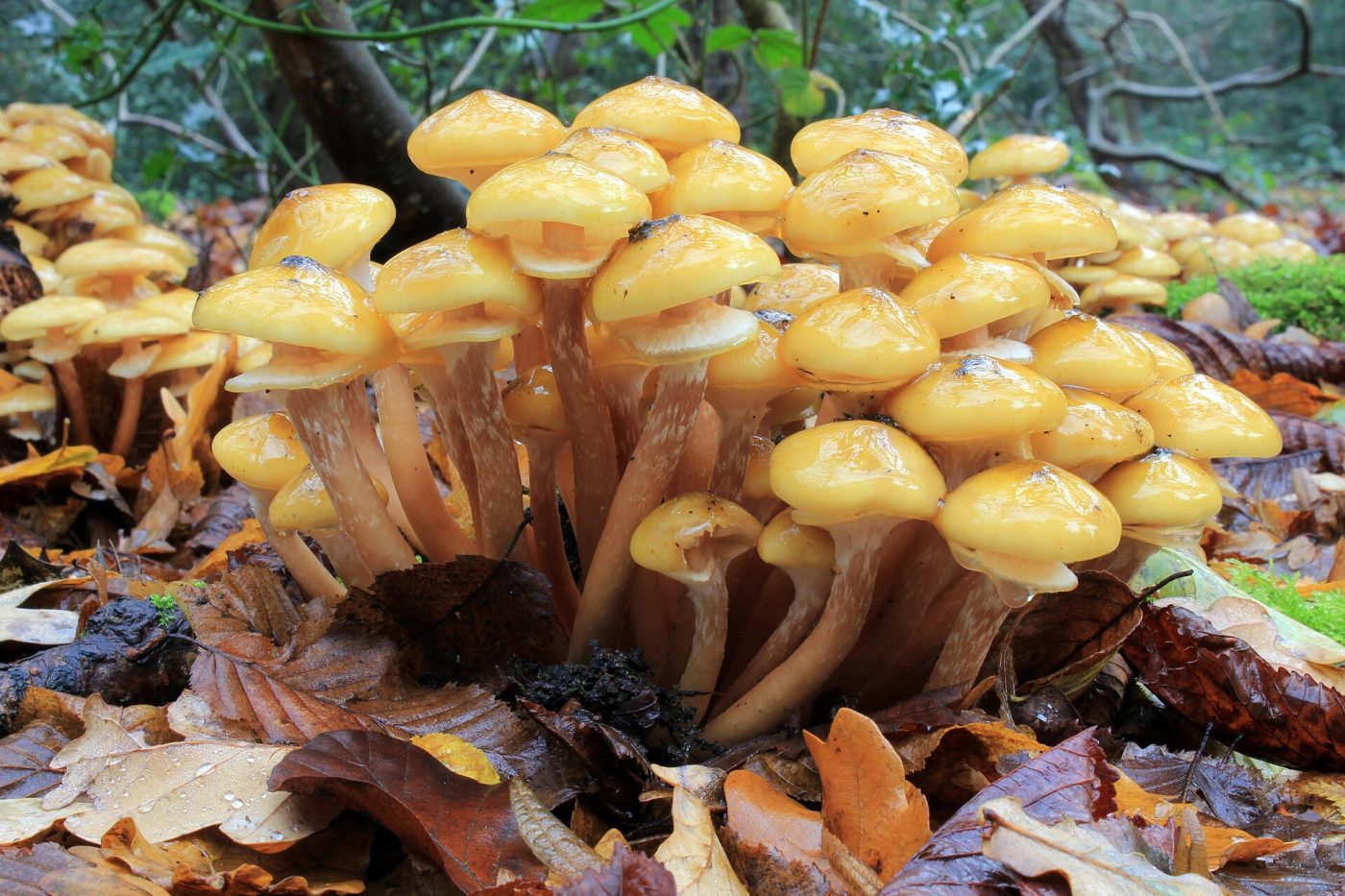
Armillaria mellea typically has honey-yellow to brown caps with small darker scales and a distinct pale ring on the stem. The gills remain pale.
It often grows in large clusters around hardwood roots and stumps. The stems can become darker toward the base.
Habitat
Broadleaf trees are important hosts. Gardens, parks, orchards, and woodland can all support the species.
Its ability to attack living trees makes it particularly important from a horticultural perspective.
Armillaria ostoyae — Dark Honey Fungus
Identification
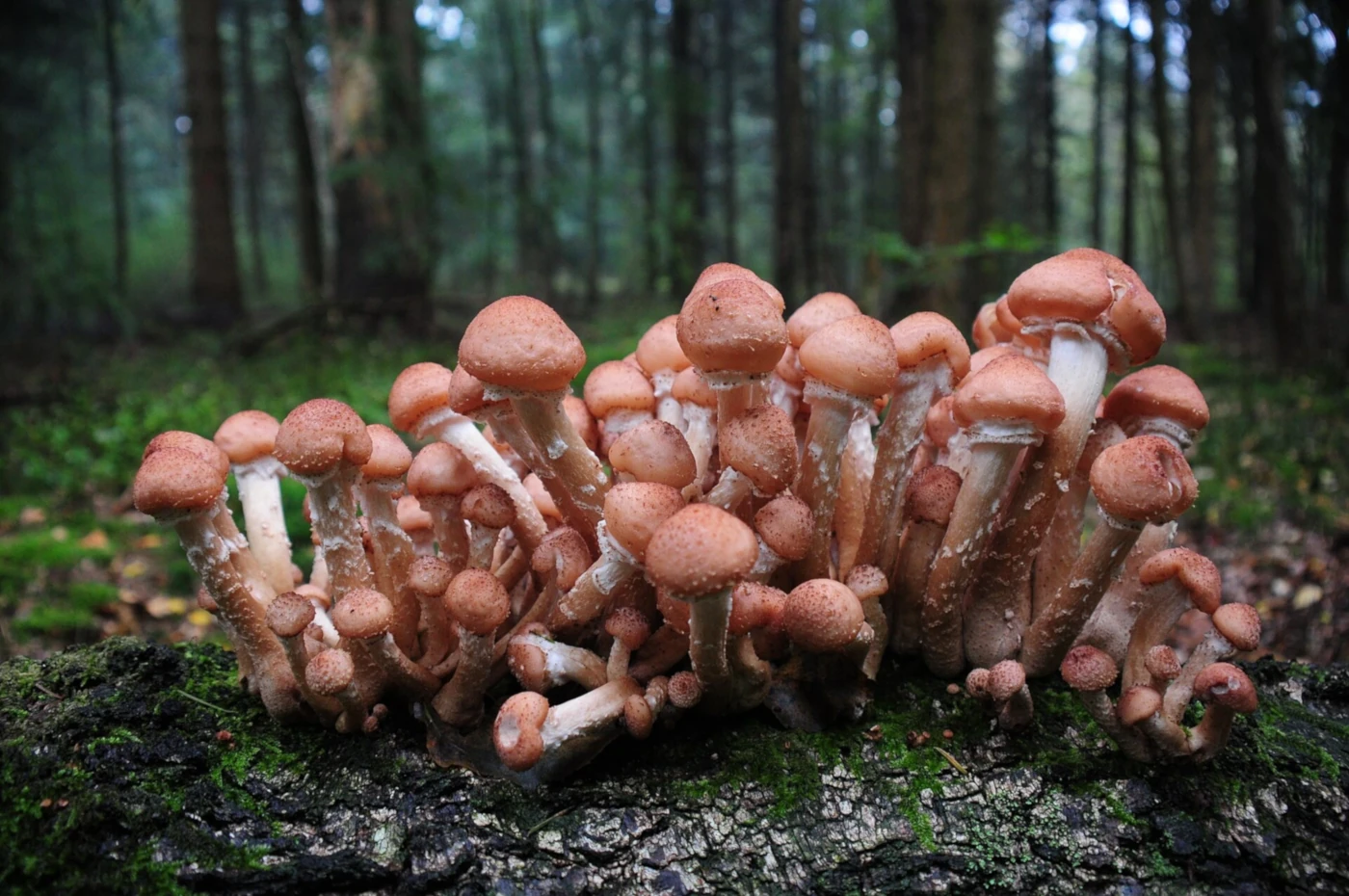
Armillaria ostoyae usually has darker brown caps with more obvious dark scales. The ring is often prominent and edged or marked with darker coloration.
It is especially associated with conifers. Large clusters may develop around infected roots and stumps.
Habitat
Pine, spruce, fir, and other conifers are common hosts. It can cause significant root disease in forests.
The darker cap and conifer association help separate it from some other members of the genus.
Armillaria gallica
Identification
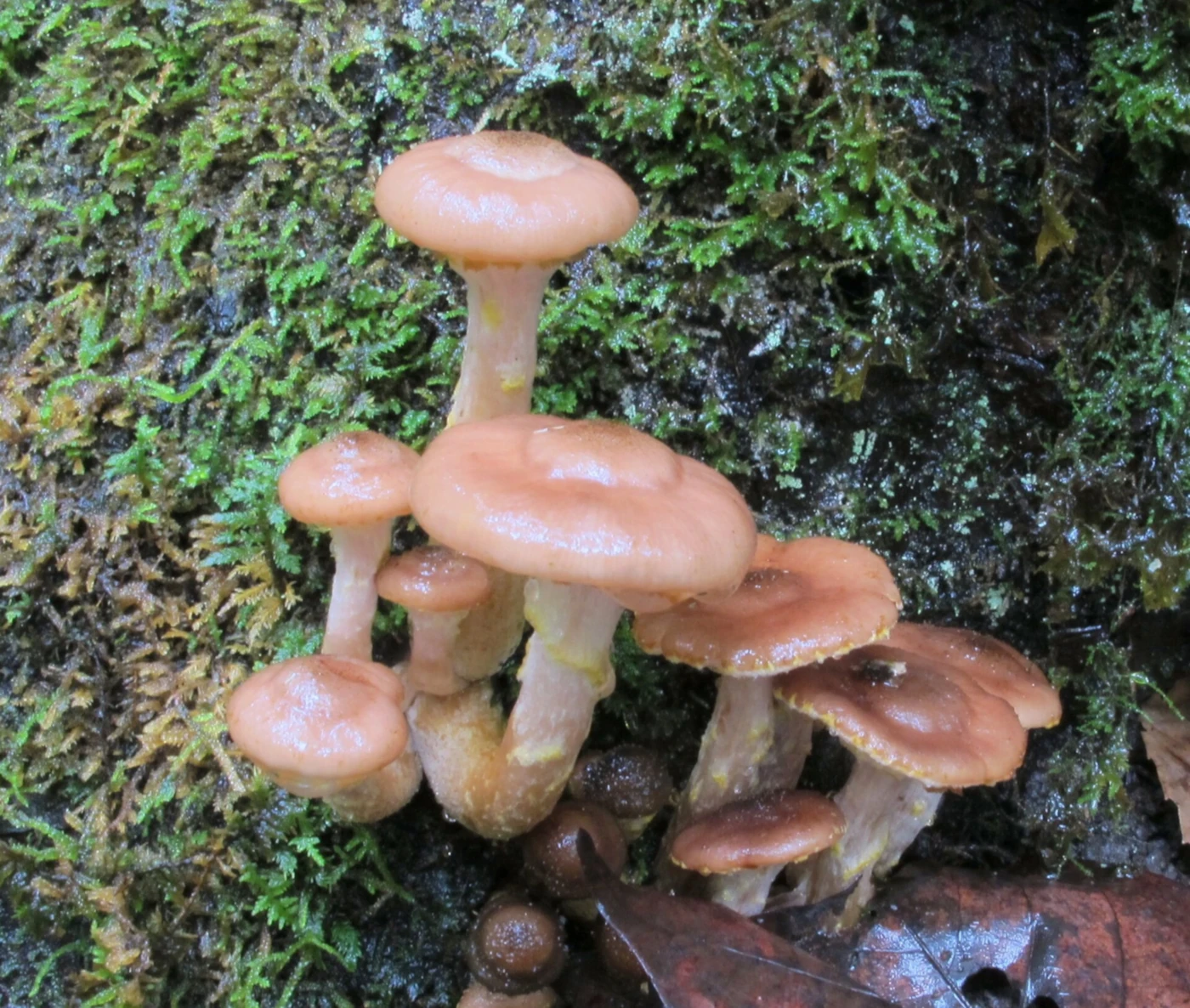
Armillaria gallica often has yellow-brown to brown caps with scales and a comparatively thinner ring. The base of the stem can become swollen or bulbous.
Clusters may be less tightly packed than in some other Honey Mushrooms. Exact appearance varies considerably.
Habitat
It occurs with broadleaf trees and mixed woodland. It can behave as both a weak parasite and decomposer.
Desarmillaria caespitosa and Ringless Honey Mushrooms
Some mushrooms traditionally grouped with Armillaria lack a ring and are now placed in related genera such as Desarmillaria. In North America, ringless Honey Mushrooms are especially well known.
They still share many Honey Mushroom features, including clustered growth, pale gills, and white spores. The absence of a ring makes them easier to confuse with unrelated wood-growing mushrooms.
Why Taxonomy Matters
Older field guides may use Armillaria broadly for species now assigned elsewhere. Modern identification should therefore be cautious about applying older genus names automatically.
For practical field recognition, “Honey Mushroom group” may sometimes be more useful than forcing an exact species name.
Honey Mushroom Look-Alikes
The most important look-alikes are other clustered brown mushrooms growing on wood. Some are harmless or inedible, but others are dangerous.
The combination of white spores, pale gills, and growth structure is especially useful for separating Armillaria from brown-spored species.
Galerina marginata — Deadly Galerina
Identification
Deadly Galerina is a brown wood-growing mushroom that may appear singly or in groups. Its mature gills become rusty brown, and the spore print is rusty to cinnamon-brown.
A ring or ring zone is often present. This can make it superficially resemble ringed Honey Mushrooms.
Main Difference
Honey Mushrooms have white spores and pale mature gills. Deadly Galerina develops rusty-brown spores and gills.
This is one of the most important differences in mushroom identification because Galerina marginata contains deadly amatoxins.
Armillaria vs Galerina marginata
| Feature | Honey Mushrooms | Deadly Galerina |
|---|---|---|
| Spore print | White | Rusty brown |
| Mature gills | Pale cream | Rusty brown |
| Growth | Often dense clusters | Single, scattered, or clustered |
| Ring | Often present | Often present or ring zone |
| Cap | Honey to brown, often scaled | Brown, often smooth |
| Stem | Fibrous, often robust | More slender |
| Toxicity | Varies by species | Deadly poisonous |
Spore color is one of the strongest distinctions. A brown wood-growing mushroom should never be called Honey Mushroom if the spores are rusty brown.
Kuehneromyces mutabilis — Sheathed Woodtuft
Identification
Sheathed Woodtuft grows in dense clusters on hardwood and often has a two-toned hygrophanous cap. The stem typically has a ring with darker scales below it.
The gills darken as brown spores mature. This separates it from white-spored Honey Mushrooms.
Main Difference
Spore print and mature gill color are again decisive. Kuehneromyces produces brown spores, while Armillaria produces white spores.
Hypholoma fasciculare — Sulphur Tuft
Identification
Sulphur Tuft grows in dense clusters and can occur around the same stumps as Honey Mushrooms. Its caps are bright sulfur-yellow to yellow-orange.
The gills develop greenish or olive-gray tones. There is no substantial persistent ring.
Main Difference
Yellow-green mature gills and brighter sulfur colors strongly favor Hypholoma. Honey Mushroom gills remain much paler.
Sulphur Tuft is poisonous and can cause gastrointestinal illness.
Pholiota Species
Identification
Several Pholiota species grow in clusters on wood and have scaly brown or yellow caps. Some also have rings.
Their mature gills become brown, and their spore prints are brown rather than white. Caps may also be noticeably sticky or heavily scaled.
Main Difference
Brown spores immediately separate typical Pholiota from Armillaria. The cap scales can be misleading without checking the gills.
Armillaria vs Sulphur Tuft
| Feature | Armillaria | Sulphur Tuft |
|---|---|---|
| Cap | Honey-brown | Sulfur-yellow |
| Gills | Pale | Greenish-yellow to olive |
| Spore print | White | Purple-brown |
| Ring | Often present | Usually absent |
| Growth | Dense clusters | Dense clusters |
| Substrate | Roots, stumps, wood | Dead wood |
| Safety | Species-dependent | Poisonous |
Clustered growth alone is not enough. The underside often gives the answer much faster.
Are Honey Mushrooms Edible?
Some Armillaria species have a long history of culinary use when correctly identified and thoroughly cooked. However, edibility varies by species, region, and individual tolerance.
Gastrointestinal reactions are reported often enough that Honey Mushrooms should not be treated as universally safe. Raw or undercooked specimens are particularly unsuitable.
The greatest practical danger is misidentification with other wood-growing mushrooms. For beginners, clustered brown mushrooms are not a good group for casual culinary decisions.
How to Identify Honey Mushrooms Step by Step
Start with the growth pattern. Look for mushrooms growing in clusters from stumps, roots, tree bases, or buried wood.
Then inspect the cap, gills, stem, ring, and complete base. Finally, confirm a white spore print and compare the mushroom with dangerous brown-spored look-alikes.
Step 1: Check the Substrate
Look for direct attachment to wood or evidence of buried roots. Dense clusters around a stump or tree base strongly support a wood-associated fungus.
Do not assume apparent soil growth means the mushroom is terrestrial. Buried roots can extend several meters.
Step 2: Check the Gills
The gills should remain pale cream or whitish rather than becoming rusty brown. Mature specimens are especially useful for judging this feature.
Rust-colored gills point toward another genus. This should immediately stop an Armillaria identification.
Step 3: Examine the Ring
Check for a substantial ring on the upper stem. If present, note its thickness, color, and persistence.
If no ring is present, consider ringless Honey Mushroom relatives as well as unrelated look-alikes. The spore print becomes especially important.
Step 4: Look at the Cap
Check for honey-brown coloration and small scales, particularly toward the center. Several mushrooms in one cluster may show different amounts of scaling.
Do not reject the identification simply because an old cap has become smooth. Rain and age can remove surface decoration.
Step 5: Make a Spore Print
A white spore print strongly supports Honey Mushroom identification. Rusty, brown, or purple-brown spores point elsewhere.
For difficult brown wood-growing mushrooms, this step is especially valuable. It can separate superficially similar species with very different toxicity.
Why Honey Mushrooms Can Look So Different
The genus contains multiple species, and individual mushrooms change significantly as they age. Young caps may be dark and heavily scaled, while old ones become pale and relatively smooth.
Moisture also affects color. Wet caps can look much darker and glossier than dry specimens.
This variation is why single cap photographs are weak evidence. Clusters containing several ages are much more informative.
Honey Mushrooms and Tree Health
Armillaria is not just a group of mushrooms but an important tree pathogen. Some species can colonize roots and lower trunks, causing progressive root rot.
Visible mushrooms may indicate that the fungus has been present in the tree or root system for some time. Removing fruit bodies does not remove the underlying infection.
Signs Around Trees
Clusters around the base, white fungal sheets beneath bark, dark rhizomorphs, and root decay can all occur with Armillaria infection. Individual signs vary by host and species.
For large trees near buildings or paths, fungal fruiting at the base may justify professional inspection. The concern is structural decay rather than the mushrooms themselves.
How to Photograph Honey Mushrooms for Identification
Take a wide image showing the entire cluster and exactly where it emerges from the tree, stump, or soil. Growth pattern is important.
Then photograph the cap surface, mature gills, and complete stems. Include the ring if one is present.
A close-up of the lower stem and substrate can reveal fused bases or buried wood. If possible, document the spore print separately.
Can AI Identify Armillaria Species?
AI can often recognize a Honey Mushroom group from dense clustered growth, honey-brown caps, pale gills, and ringed stems. Exact species-level identification is much harder.
The biggest safety problem is confusion with other brown wood-growing fungi. AI should therefore consider spore color, mature gills, substrate, region, and ring structure.
A cautious identification may be “Armillaria species” rather than a specific species. This is often more accurate when microscopic or regional features are missing.
Common Identification Mistakes
One common mistake is assuming every brown cluster on a stump is Honey Mushroom. Deadly Galerina, Woodtufts, Pholiota, and other fungi can grow in similar places.
Another mistake is relying entirely on a ring. Both Honey Mushrooms and dangerous look-alikes may have rings or ring zones.
A third mistake is ignoring the spore print. White versus rusty-brown spores can completely change the identification.
Frequently Asked Questions
Why do Honey Mushroom clusters sometimes appear several meters from a tree?
They may be fruiting from buried roots extending away from the trunk. The underground root system can spread much farther than the visible base of the tree.
Can the same stump produce Honey Mushrooms for several years?
Yes. The fungus can remain active in colonized wood and fruit repeatedly when temperature and moisture are suitable.
Why are some clusters huge while others contain only a few mushrooms?
The amount and condition of colonized wood influence fruiting. Moisture, temperature, and the size of the underground fungal colony also affect how many mushrooms appear.
Can Honey Mushrooms grow after a tree has been removed?
Yes. Remaining roots and stump material can continue supporting the fungus long after the visible tree is gone.
Can white spores be visible directly on mushrooms in a cluster?
Yes. In dense clusters, spores from upper caps may fall onto mushrooms below and create a pale powdery coating. This can sometimes provide a useful field clue.
Why do old Honey Mushroom stems become so tough?
The stem contains fibrous tissue that becomes increasingly firm as the mushroom matures. Older stems are often much tougher than the caps.
Can two different wood-growing species occur on the same stump?
Yes. A single stump can host multiple fungi simultaneously or in different seasons. Never assume every mushroom in one location belongs to the same species.
Can frost change the appearance of Honey Mushrooms?
Yes. Freezing can darken caps, damage gills, and make the mushrooms more watery after thawing. Fresh unfrozen specimens are better for identification.
Final Identification Notes
Armillaria species are best recognized by the combination of clustered growth from roots or wood, honey-brown often scaled caps, pale gills, fibrous stems, white spores, and—in many species—a prominent ring.
The most important dangerous comparison is Galerina marginata. Pale mature gills and a white spore print strongly support Honey Mushroom, while rusty-brown gills and spores point toward Deadly Galerina.
Because Armillaria includes several closely related species and ringless relatives, exact species naming can be difficult from photographs alone. In many cases, a confident identification as the Honey Mushroom group is more accurate than forcing a species name.
Upload a photo and get possible matches in seconds.