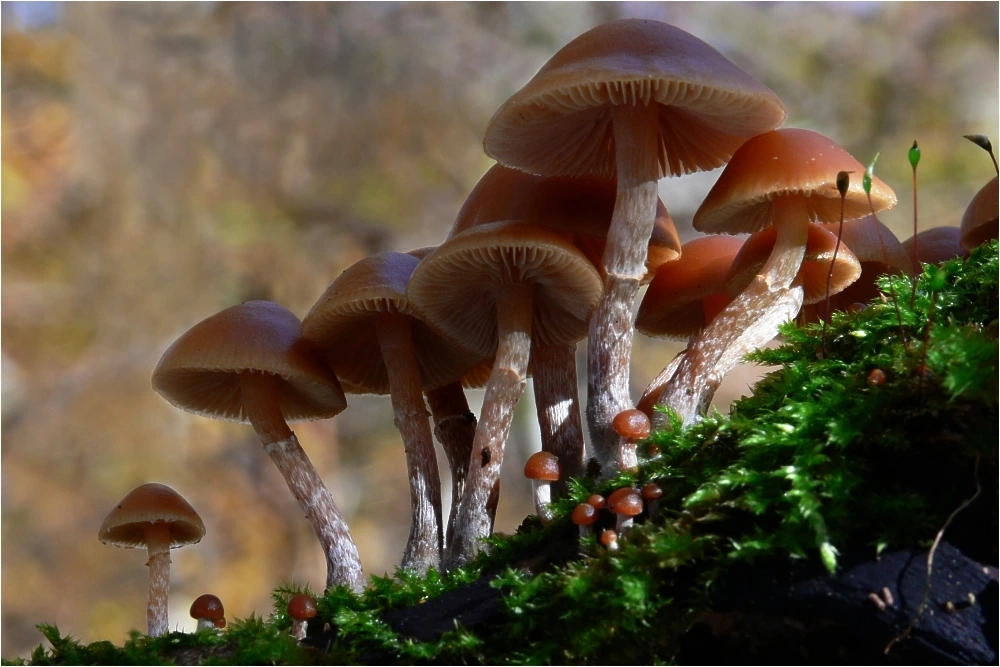
Galerina marginata, commonly known as the Deadly Galerina, Funeral Bell, or Deadly Skullcap, is a small brown mushroom that deserves special attention because it contains amatoxins — the same group of toxins responsible for many severe and fatal Amanita poisonings. The North American Mycological Association lists Galerina marginata among amatoxin-containing mushrooms and classifies this poisoning syndrome as extremely serious.
The danger is increased by its ordinary appearance. Galerina marginata is a relatively small brown mushroom growing on dead wood, exactly the sort of habitat where several edible species may also occur.
For this reason, any small brown mushroom growing on wood should be identified very carefully before it is even considered for consumption.
Important: Never use this guide, a photograph, or an AI identification alone to decide whether a wild mushroom is safe to eat.
Quick Identification
| Feature | Galerina marginata |
|---|---|
| Common names | Deadly Galerina, Funeral Bell |
| Scientific name | Galerina marginata |
| Toxicity | Deadly poisonous |
| Cap | Yellow-brown to reddish-brown, often darker when wet |
| Cap size | Usually about 1–7 cm |
| Gills | Pale at first, becoming rusty or brownish |
| Stem | Slender, fibrous, often with a fragile ring or ring zone |
| Spore print | Rusty to brown |
| Habitat | Dead and decaying wood |
| Typical substrate | Logs, stumps, fallen branches |
| Season | Mainly summer through autumn, varying by region |
| Main danger | Can be confused with edible wood-growing mushrooms |
What Does Galerina marginata Look Like?
The Deadly Galerina belongs to the difficult group often informally called LBMs — “little brown mushrooms.” Many unrelated species share the same basic appearance, which means color and cap shape alone are not reliable identification features.
Cap
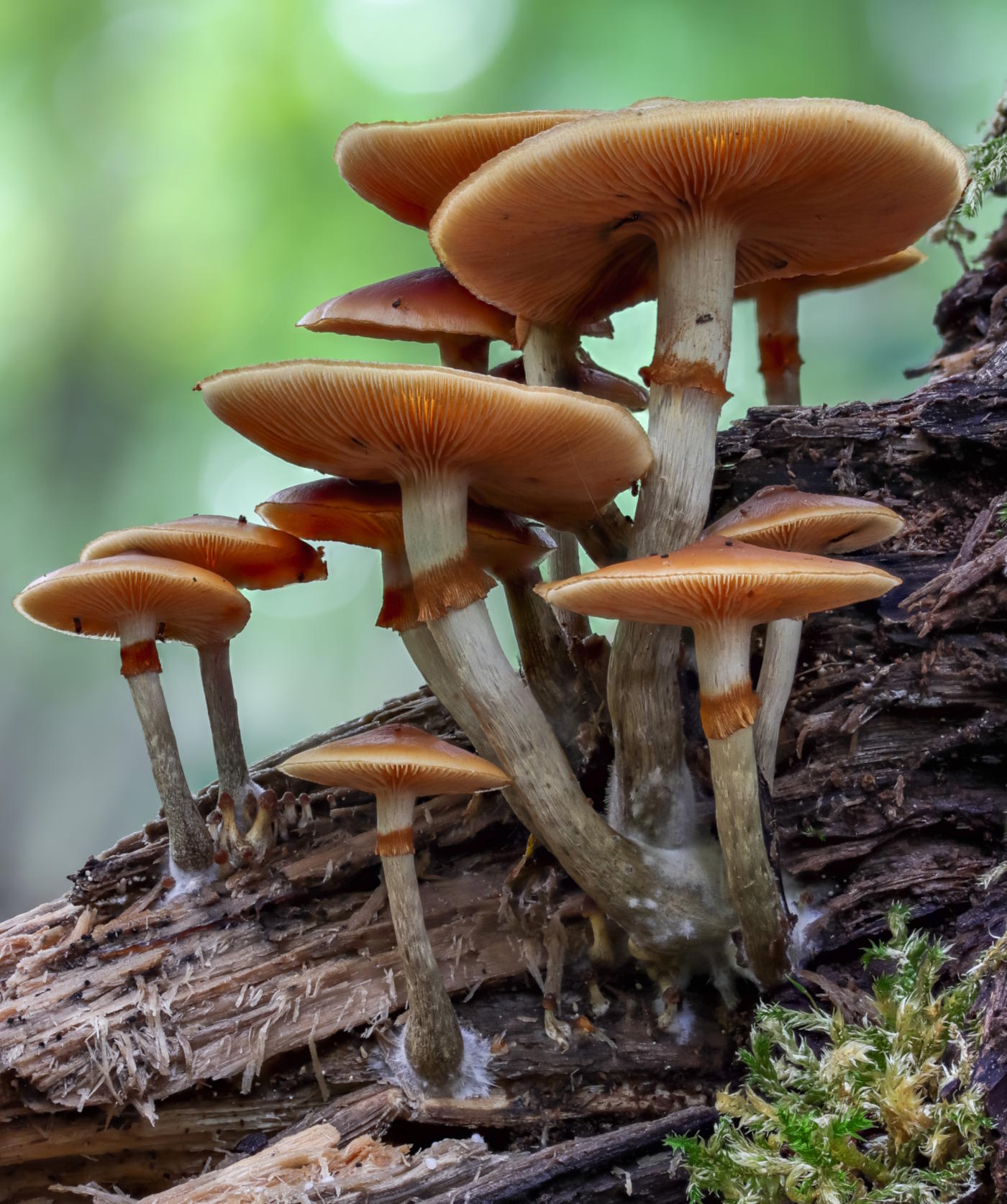
The cap generally begins rounded or bell-shaped and becomes broadly convex or nearly flat with age.
Typical colors include:
- honey brown;
- yellow-brown;
- cinnamon brown;
- reddish brown.
The cap is hygrophanous, meaning its appearance changes as it loses moisture. Wet mushrooms are commonly darker, while drying caps become paler, especially toward the edges.
Mature caps are generally small, often around 1–7 cm across.
This color variation is one reason the species can resemble several harmless or edible brown mushrooms.
Gills
The gills are attached to the stem and are relatively close together.
They may initially appear pale cream, yellowish, or light brown and become increasingly rusty brown as the spores mature.
Rust-colored mature gills are useful evidence but should never be used as the only identification feature.
Stem
The stem is usually slender and fragile compared with many robust edible wood-growing mushrooms.
It may be:
- pale near the top;
- darker brown toward the base;
- covered with fine longitudinal fibers.
A pale ring can sometimes be visible around the upper portion of the stem. However, this ring may be weak, damaged, or disappear as the mushroom ages.
That is particularly important because beginners sometimes assume that the absence of an obvious ring rules out Galerina. It does not.
Spore Print
The spore print is brown to rusty brown.
Spore-print color can be particularly helpful when separating Galerina marginata from superficially similar mushrooms producing white spores.
However, it is one feature among many and should not be treated as a standalone safety test.
Where Does Galerina marginata Grow?
Galerina marginata is a saprobic fungus, meaning it obtains nutrients by decomposing dead organic material.
It primarily grows on:
- dead logs;
- fallen branches;
- decaying tree trunks;
- old stumps;
- buried woody material.
It is frequently associated with conifer wood but can also occur on hardwoods.
Individual mushrooms may appear alone, scattered, or in groups.
The fact that it grows directly from wood is one of the most important things to record when photographing an unknown brown mushroom.
A log may sometimes be almost completely buried beneath moss or soil, making the mushrooms appear to be growing from the ground. Always inspect the substrate carefully.
Distribution
Galerina marginata has a broad distribution. It has been recorded across:
- Europe;
- North America;
- parts of Asia.
In Europe it occurs across many central and northern regions and is also recorded in Britain and Ireland.
Because closely related Galerina species also occur across wide geographic areas, identification should always take local fungal diversity into account.
When Does Galerina marginata Grow?
Fruit bodies are most frequently reported during summer and autumn, although exact timing depends strongly on geography, rainfall, temperature, and local climate. In milder climates, fruiting can continue later into the year whenever conditions remain cool and moist. Dead wood retains moisture well, so mushrooms can appear after sustained rainfall even when surrounding ground begins to dry.
Is Galerina marginata Poisonous?
☠️ Yes. Galerina marginata is potentially deadly.
It contains amatoxins, including compounds in the same toxin group associated with Death Cap and Destroying Angel poisoning. NAMA specifically includes Galerina marginata among mushrooms responsible for amatoxin syndrome.
Documented poisoning reports have included severe human illness and fatalities attributed to Galerina. A NAMA toxicology report for 2011 recorded three poisoning cases involving Galerina, including one death.
Why Amatoxin Poisoning Is Particularly Dangerous
One of the most dangerous characteristics is the delay before symptoms appear.
According to NAMA, symptoms of amatoxin poisoning may not begin until approximately 6–24 hours after ingestion. By that stage, significant toxin absorption has already occurred.
Early symptoms can include:
- severe vomiting;
- diarrhea;
- abdominal pain;
- dehydration.
A patient may then appear to improve temporarily even while liver damage continues.
Severe poisoning can progress to:
- liver failure;
- kidney injury;
- multi-organ failure;
- death.
Suspected ingestion of Galerina marginata is therefore a medical emergency.
What Should You Do After Suspected Galerina Ingestion?
Do not wait for symptoms. Contact your local poison center or emergency medical service immediately and tell them that an amatoxin-containing mushroom may have been consumed.
Whenever possible, preserve:
- uncooked mushrooms;
- remaining cooked mushrooms;
- photographs from the collecting site;
- scraps and stem bases;
- information about when the mushrooms were eaten.
These materials can help professional mushroom identifiers and medical teams determine the likely species.
Galerina marginata Look-Alikes
The greatest practical danger is that Galerina marginata can resemble several other small brown mushrooms growing on wood.
1. Honey Mushrooms — Armillaria species
Honey mushrooms are collected as food in many regions, but brown specimens growing around dead or dying trees can superficially resemble Galerina.
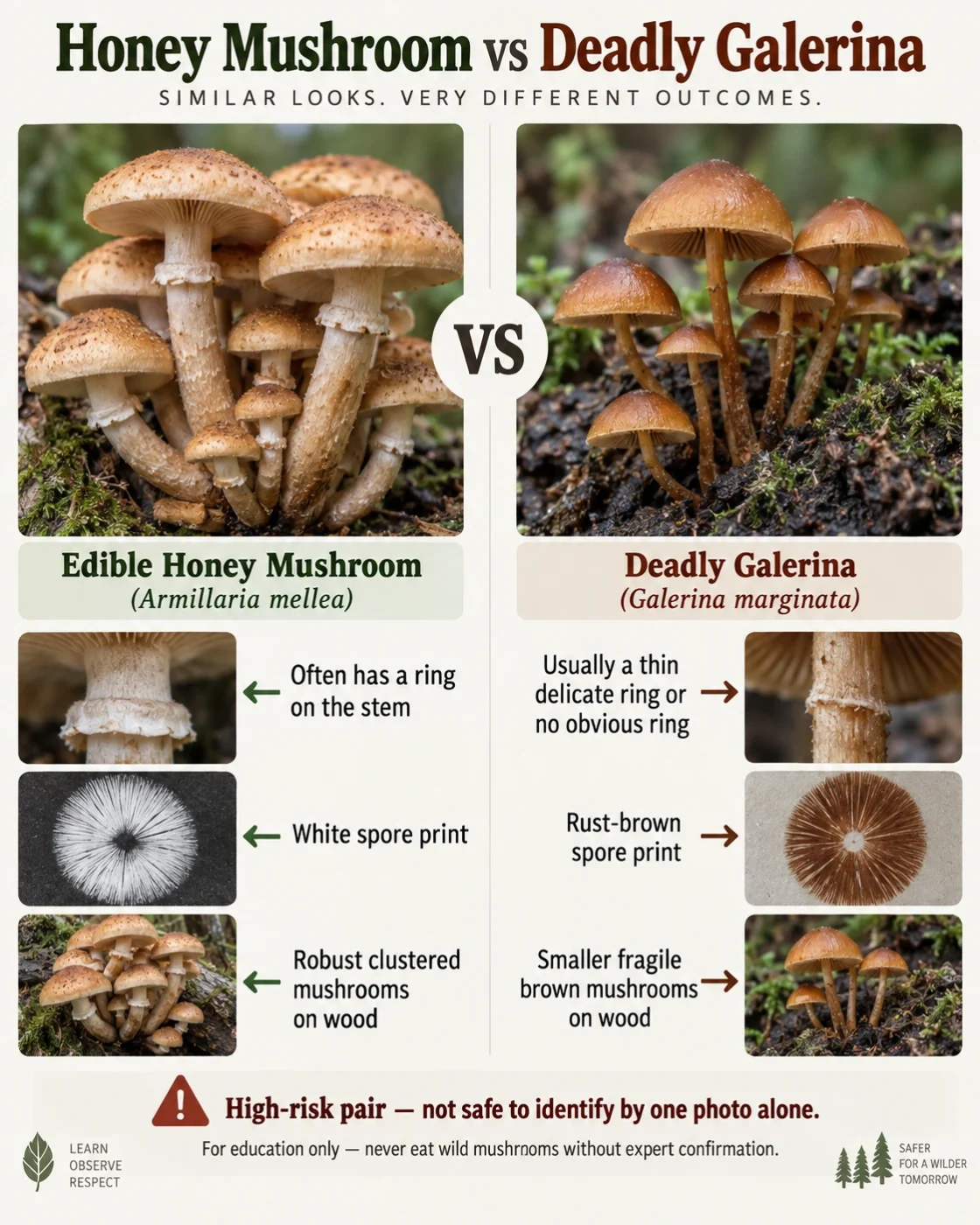
Honey mushrooms are generally more robust and frequently grow in substantial clusters. Many have pale spores rather than the rusty-brown spore print characteristic of Galerina marginata.
However, growth in clusters and the presence of a stem ring are not enough to make an identification.
A single log or stump can also support more than one mushroom species, so mushrooms collected from the same location should not automatically be assumed to be identical.
2. Kuehneromyces mutabilis
Kuehneromyces mutabilis is an edible wood-growing mushroom and one of the more concerning look-alikes.
It forms clusters on dead wood and may have similarly colored brown caps and a ring on the stem.
First Nature specifically lists Kuehneromyces mutabilis as a similar edible species and notes the close resemblance between it and the poisonous Funeral Bell.
Because of this similarity, beginners should not collect Kuehneromyces for food without expert confirmation.
3. Flammulina velutipes — Velvet Shank
Wild enoki or velvet shank can also occur on dead wood.
A useful feature of mature Flammulina velutipes is the dark, velvety lower stem. It also produces a white spore print, in contrast with the rusty-brown spores of Galerina.
Nevertheless, old, wet, or damaged specimens may lose their textbook appearance.
4. Hypholoma Species
Several Hypholoma species grow in dense clusters on stumps and dead wood.
They often differ in gill color, cap coloration, and spore-print characteristics, but inexperienced collectors can easily group all small brown or yellow-brown wood-growing mushrooms together.
Some Hypholoma species are themselves toxic.
5. Gymnopilus Species
Species of Gymnopilus may also grow on wood and produce rusty-colored spores.
They can sometimes share yellow-orange or brown coloration with Galerina, and small specimens may be difficult to separate without considering multiple features.
This highlights why spore color alone does not provide a definitive identification.
Galerina marginata vs Honey Mushroom
Because this is one of the more important comparisons, it is worth examining separately.
| Feature | Galerina marginata | Honey Mushroom |
|---|---|---|
| Toxicity | Deadly poisonous | Some species traditionally eaten after proper identification/preparation |
| Size | Usually small | Often larger and more robust |
| Spore print | Rusty brown | Usually white |
| Growth | Single, scattered or grouped | Often dense clusters |
| Stem | Slender, fibrous | Usually more substantial |
| Ring | Can be fragile or disappear | Often more obvious in ringed species |
| Habitat | Dead wood | Wood, roots, stumps and infected trees |
The spore-print difference is useful, but never rely on this table alone before eating a mushroom.
Galerina marginata vs Kuehneromyces mutabilis
This is a particularly risky pair because both species can grow in groups on wood and share similar brown coloration.
Kuehneromyces mutabilis often has a distinctly two-toned hygrophanous cap, with color changing as the surface dries, and a more conspicuously scaly lower stem below the ring.
But these characteristics vary depending on weather and mushroom age.
If there is any uncertainty between Kuehneromyces and Galerina, the mushrooms should not be eaten.
Can Galerina marginata Grow With Edible Mushrooms?
Yes. This is one of the most useful safety lessons involving wood-growing fungi. Different mushroom species can fruit on the same stump, log, or patch of woody debris.
Finding several correctly identified edible mushrooms does not mean every mushroom in the cluster or nearby is the same species. Each specimen should be checked individually.
This is particularly important when gathering small brown mushrooms.
How to Photograph Galerina for Identification
When photographing an unknown Galerina-like mushroom, take several images rather than only photographing the cap.
Include:
- the cap from above;
- the underside and gills;
- the entire stem;
- any ring or ring zone;
- the stem base;
- several mushrooms at different ages;
- the wood or substrate they are growing from;
- the surrounding habitat.
If practical, a spore print can provide additional identification information.
Avoid changing colors with strong filters or artificial image enhancement.
Can Galerina marginata Be Identified From a Photo?
Sometimes a photograph can strongly suggest Galerina, but a photo should not be used to confirm edibility or rule out an amatoxin-containing mushroom. Small brown mushrooms are one of the more difficult groups to identify visually because many unrelated species share similar:
- cap colors;
- sizes;
- gill arrangements;
- rings;
- habitats.
Professional identification may require microscopic examination of spores and other structures.
Photo-identification tools are best used to generate possible species for further investigation rather than as permission to eat a mushroom.
Interesting Facts About Galerina marginata
The ominous common name Funeral Bell reflects the mushroom’s serious toxicity.
Several names once treated as separate species — including Galerina autumnalis — have historically been associated with the broader Galerina marginata complex. NAMA lists G. autumnalis and G. venenata as synonyms associated with Galerina marginata in its amatoxin guidance.
Unlike dramatic poisonous mushrooms such as Amanita muscaria, the Deadly Galerina has no spectacular warning coloration. Its appearance is ordinary, which makes it a particularly useful example of why the visual idea that “dangerous mushrooms look dangerous” is false.
Frequently Asked Questions
Is Galerina marginata deadly?
Yes. It contains amatoxins and has been associated with fatal mushroom poisoning.
Where does Galerina marginata grow?
It grows primarily on decaying wood such as stumps, fallen trunks, logs and branches, particularly conifer wood but also hardwood.
What color is Galerina marginata?
It is generally yellow-brown, honey-brown, cinnamon, or reddish-brown. Wet caps tend to be darker and become paler as they dry.
What color is its spore print?
The spore print is brown to rusty brown.
Can Galerina marginata grow in clusters?
Yes. It can occur singly, scattered, or in groups on dead wood.
Does Galerina marginata always have a ring?
No. A fragile ring may be present, but it can become inconspicuous or disappear as the mushroom matures.
What edible mushroom looks like Galerina marginata?
Several wood-growing mushrooms may resemble it, particularly Kuehneromyces mutabilis. This similarity is one reason small brown mushrooms growing on wood require especially careful identification.
Final Identification Notes
Galerina marginata is one of the most important poisonous mushrooms for foragers to recognize, not because it looks unusual, but because it looks so ordinary.
Remember the general combination: small brown mushroom + rusty-brown spores + decaying wood + possible fragile ring.
But never treat this combination as a complete identification key.
Numerous small brown mushrooms share overlapping characteristics, and the consequences of a mistake with Galerina marginata can be extremely serious.
If a wood-growing mushroom could potentially belong to Galerina, do not eat it unless its identity has been independently confirmed by an experienced mushroom expert.
Found an unknown mushroom? A photo-identification tool can help narrow down possible species, but always verify the result independently before making any decision about edibility.