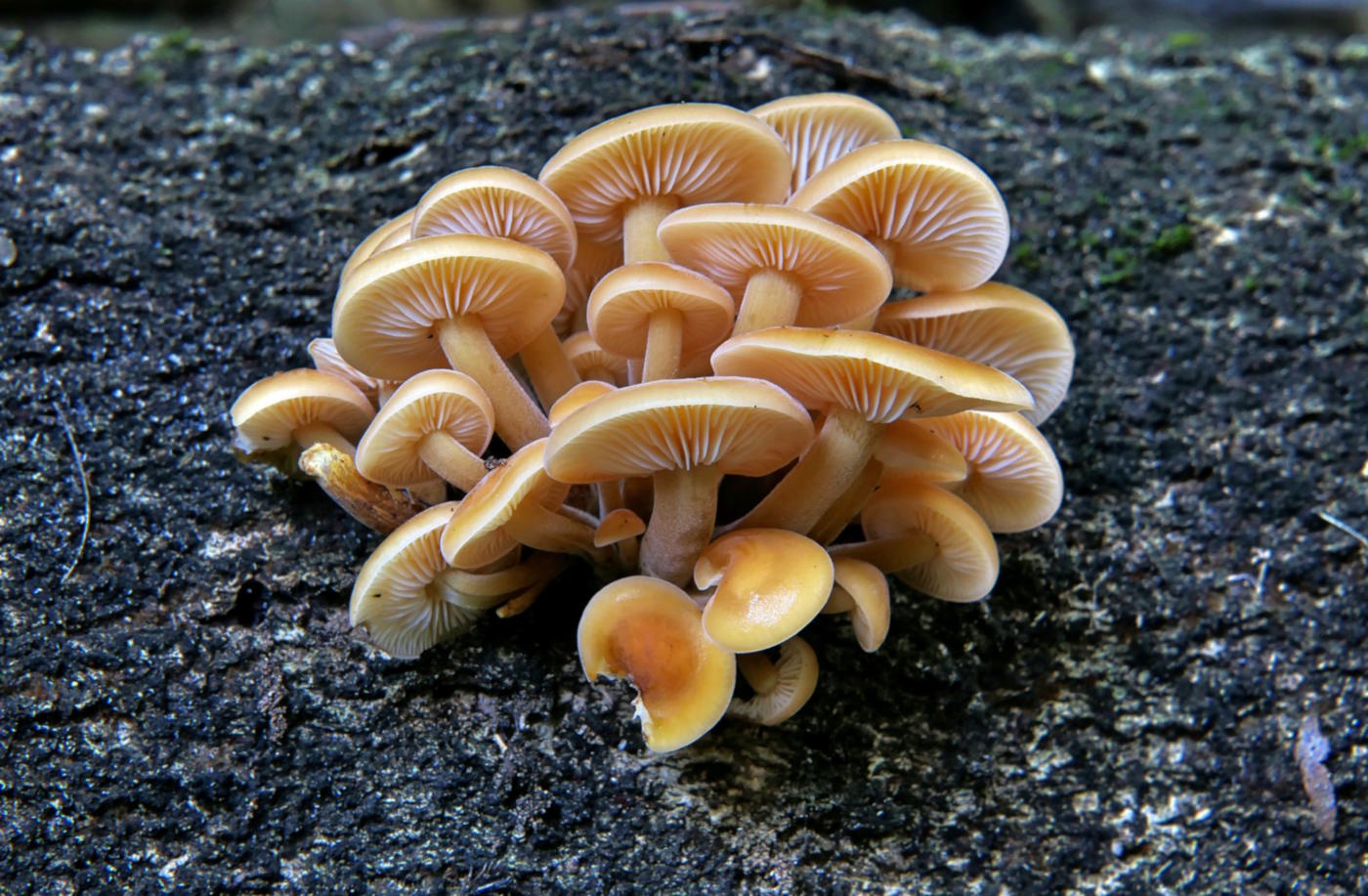
Flammulina velutipes, commonly known as Velvet Shank, is a cold-tolerant wood-growing mushroom that often appears when many other autumn species have already disappeared. Its orange-brown caps, pale gills, clustered growth, and dark velvety lower stem make it one of the more distinctive mushrooms of late autumn and winter.
Despite that distinctive appearance, Velvet Shank should be identified carefully because several small brown or orange mushrooms grow on the same kinds of wood. The most important dangerous comparison is Galerina marginata, the Deadly Galerina, which can share the same habitat and contains amatoxins.
⚠️ Important: This guide is for identification and education only. Never eat a wild mushroom based solely on photographs, AI identification, or an online comparison.
Quick Identification
| Feature | Flammulina velutipes |
|---|---|
| Scientific name | Flammulina velutipes |
| Common name | Velvet Shank |
| Family | Physalacriaceae |
| Cap color | Honey-yellow to orange-brown |
| Cap surface | Smooth, often sticky when wet |
| Gills | White to pale cream |
| Stem | Dark brown to blackish and velvety toward the base |
| Ring | Absent |
| Flesh | Pale and relatively thin |
| Spore print | White |
| Growth | Usually in clusters |
| Substrate | Dead or weakened hardwood |
| Ecology | Saprobic, sometimes associated with weakened trees |
| Season | Late autumn through winter |
| Edibility | Edible when correctly identified and cooked |
| Main look-alikes | Deadly Galerina, Sheathed Woodtuft, Funeral Bell relatives, other small wood-growing mushrooms |
What Does Velvet Shank Look Like?
Velvet Shank usually forms clusters of small to medium-sized mushrooms with smooth yellow, orange, or orange-brown caps. Fresh caps can look glossy or sticky, especially in wet weather, while older or drier specimens may become more matte.
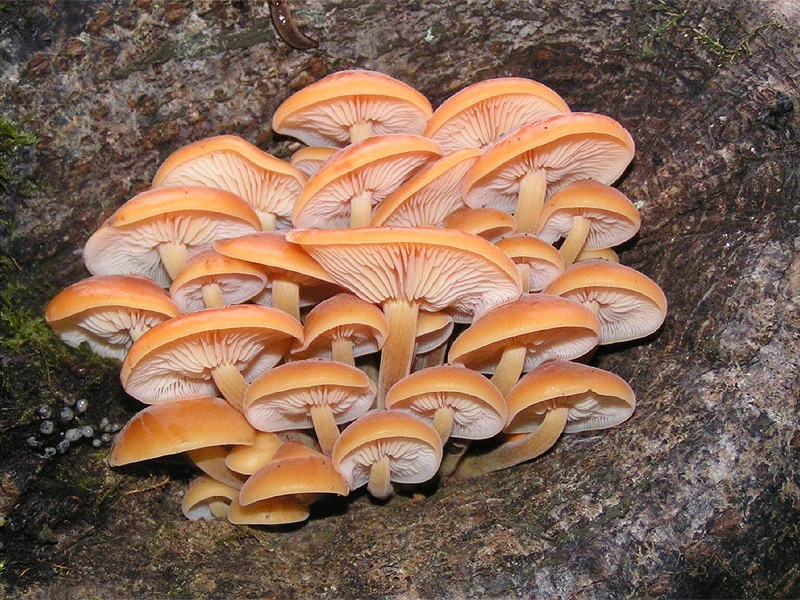
The pale gills contrast strongly with the darker cap and stem. The lower stem becomes progressively darker and develops a distinctive velvety texture, which gives the mushroom its common name.
This combination of a bright cap, pale gills, and a dark fuzzy stem is one of the best visual clues. However, each feature should still be checked because dangerous brown wood-growing mushrooms can overlap in color and size.
Cap
The cap is usually convex when young and gradually becomes flatter with age. Mature caps may develop a slightly depressed center, although they generally remain smoother and less irregular than many woodland mushrooms.
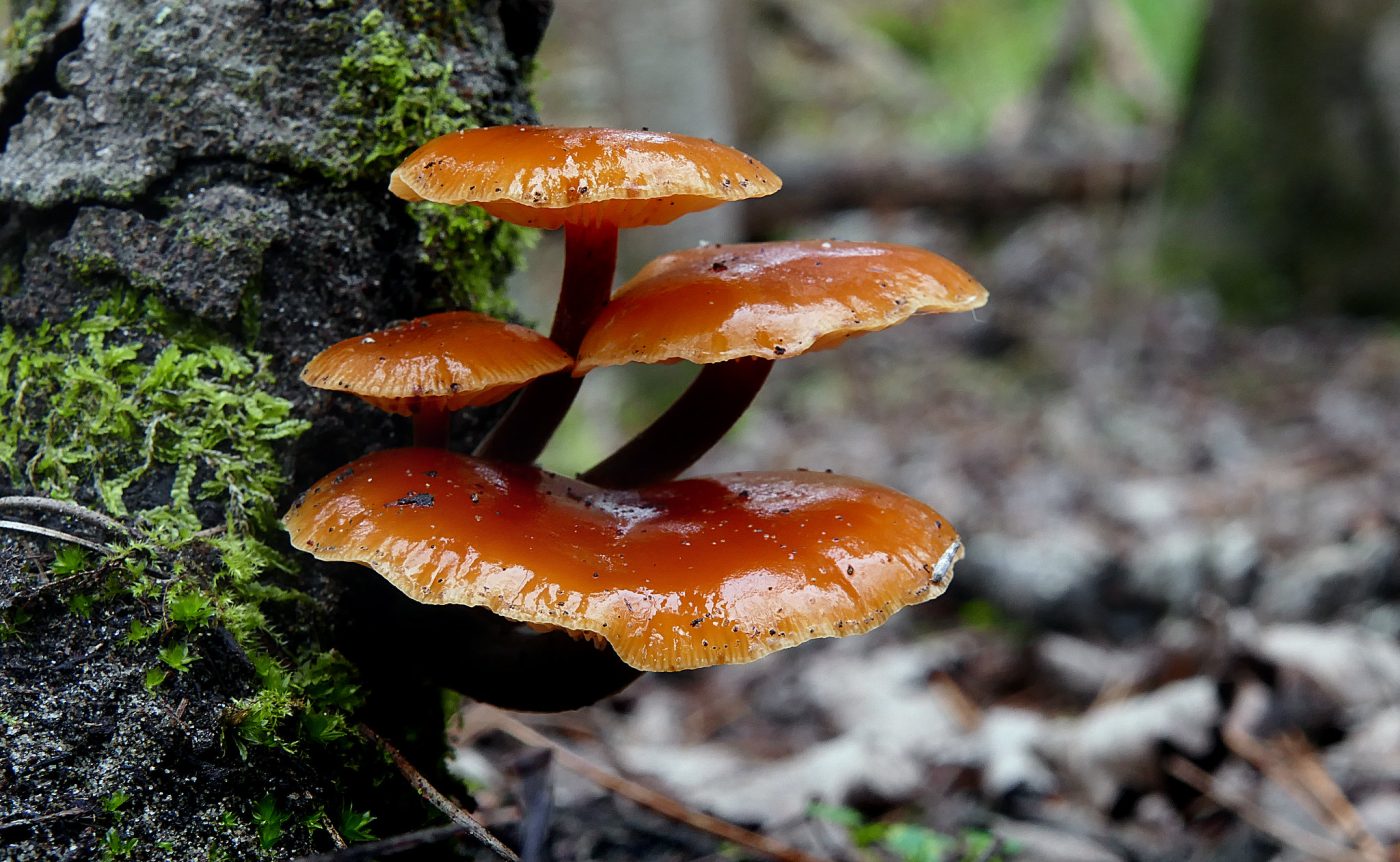
Color ranges from golden yellow to honey-orange or reddish brown. The center is often darker than the margin, especially in older specimens.
Cap Surface
Fresh caps often feel sticky or slightly slimy. This is particularly noticeable after rain or during humid winter weather.
The surface is smooth and lacks scales or obvious warts. A dry specimen may lose much of the sticky texture, so cap feel should not be used as the only identification feature.
Gills
The gills are white to cream and remain relatively pale as the mushroom matures. They are attached to the stem and may be slightly notched or broadly attached depending on the specimen.
The pale gills are important because Deadly Galerina develops rusty-brown gills as its spores mature. This contrast becomes especially useful when comparing mature specimens.
Gill Color With Age
Velvet Shank does not develop the strongly rusty gill coloration typical of many brown-spored wood-growing mushrooms. Older gills may become cream or slightly yellowish but should remain broadly pale.
A mushroom with strongly rusty, cinnamon, or brown mature gills should therefore raise suspicion for another genus.
Stem
The stem is one of the most diagnostic features of Flammulina velutipes. The upper stem may begin pale or yellowish, but the lower portion becomes dark brown to blackish and develops a dense velvety coating.
This texture is most obvious near the base. Mature specimens can look as though the lower half of the stem has been covered in dark brown felt.
Does Velvet Shank Have a Ring?
No. Flammulina velutipes does not have a persistent ring.
This is important because several look-alikes, including Deadly Galerina and Sheathed Woodtuft, may show a ring or ring zone on the stem. The absence of a ring supports Velvet Shank, although a missing ring alone cannot prove the identification.
Flesh
The flesh is pale and relatively thin, especially in the cap. It is softer than the tough stem base and does not usually show dramatic color changes when cut.
The lower stem becomes progressively more fibrous and tough. This contrast between softer cap flesh and darker, tougher stem tissue is typical.
Smell
Velvet Shank usually has a mild mushroom-like smell. It does not have the strong fruity scent associated with chanterelles or the intense spicy odor of some Tricholoma species.
Smell is not a major identification feature for this species. It is better used as supporting information after the cap, gills, stem, and substrate have already been checked.
Spore Print
The spore print is white. This is one of the most useful confirmation features when separating Velvet Shank from Deadly Galerina.
Galerina marginata produces a rusty-brown spore print. The contrast between white and rusty brown is far more useful than subtle differences in cap color.
Where Does Velvet Shank Grow?
Velvet Shank grows from dead or weakened wood. Stumps, fallen branches, buried roots, and standing dead hardwood can all support fruiting. It is particularly associated with deciduous trees. Willows, elms, poplars, maples, and other hardwoods can all provide suitable substrate depending on region. The mushroom may appear to grow from soil when it is actually attached to buried wood. This is why checking the base of the cluster is important.
Does Velvet Shank Grow on Living Trees?
It can appear on weakened or damaged living trees, especially where dead tissue is already present. In many cases, however, the fungus is primarily exploiting dead wood. A cluster emerging from a damaged trunk or dead branch is therefore consistent with the species. Healthy intact wood without obvious dead tissue would be less typical.
When Does Velvet Shank Grow?
Velvet Shank is famous for fruiting in cold weather. Late autumn, winter, and mild periods between frosts are especially productive. It can continue growing when many other mushrooms have disappeared. This makes it one of the classic fungi of the transition from autumn into winter.
Can Velvet Shank Survive Frost?
Yes. The fruit bodies tolerate cold temperatures surprisingly well and may resume growth after freezing periods. Repeated severe frost eventually damages older fruit bodies, but new growth can appear during milder weather. This cold tolerance is one of the species’ most recognizable ecological traits.
Distribution
Flammulina velutipes and closely related species occur widely across temperate parts of Europe, Asia, and North America. Modern taxonomy has shown that some populations once grouped under the same name represent distinct but closely related species.
For practical field identification, the Velvet Shank group remains recognizable by its pale gills, white spores, clustered wood growth, and dark velvety stem base. Exact species-level identification can sometimes require more detailed examination.
Velvet Shank Look-Alikes
Several brown or orange mushrooms grow on wood in autumn and winter. The most important dangerous look-alike is Galerina marginata, but other species can also create confusion. The best identification strategy is to combine gill color, spore print, ring presence, stem texture, and substrate. No single feature should be trusted in isolation.
Galerina marginata — Deadly Galerina
Identification
Deadly Galerina is a small brown mushroom that grows on decaying wood. The cap can be honey-brown, yellow-brown, or reddish brown and may appear shiny when wet.
Its mature gills become rusty brown, and the stem often carries a fragile ring or ring zone. The spore print is rusty brown rather than white.
Main Difference
Velvet Shank has pale gills, no ring, a white spore print, and a dark velvety stem base. Deadly Galerina has rusty spores and often shows a ring or ring zone.
This is the most important safety comparison because Galerina marginata contains amatoxins and can cause fatal liver failure.
Velvet Shank vs Deadly Galerina
| Feature | Velvet Shank | Deadly Galerina |
|---|---|---|
| Gills | White to cream | Becoming rusty brown |
| Spore print | White | Rusty brown |
| Ring | Absent | Often present or visible as ring zone |
| Stem base | Dark and velvety | Fibrous, not strongly velvet-black |
| Growth | Clusters on wood | Clusters or groups on wood |
| Season | Late autumn and winter | Summer through autumn, sometimes later |
| Safety | Edible when correctly identified | Deadly poisonous |
The spore print and mature gill color are especially useful. If uncertainty remains, the mushroom should not be considered suitable for consumption.
Kuehneromyces mutabilis — Sheathed Woodtuft
Identification
Sheathed Woodtuft is another clustered brown mushroom that grows on dead wood. Its cap is often hygrophanous, meaning the color changes noticeably as it dries. The stem usually has a ring, with a paler area above and darker scaly tissue below. The gills become brownish as spores mature.
Main Difference
Velvet Shank lacks a ring and has a dark velvety stem base rather than a scaly lower stem. Its spore print is also white instead of brown. Both can occur in clusters on stumps, so the stem and spore color deserve careful attention.
Velvet Shank vs Sheathed Woodtuft
| Feature | Velvet Shank | Sheathed Woodtuft |
|---|---|---|
| Ring | None | Usually present |
| Spore print | White | Brown |
| Stem base | Dark and velvety | Darker and scaly |
| Gills | Pale | Brownish with age |
| Cap | Smooth, often sticky | Hygrophanous, often two-toned |
| Season | Cold season | Mainly spring through autumn |
The ring is often the fastest field clue, but it should not be used alone. Old or damaged mushrooms can lose fragile veil structures.
Armillaria Species — Honey Mushrooms
Identification
Honey Mushrooms form clusters on trunks, stumps, and buried roots. Their caps are usually tan to brown and may show small scales. Many Armillaria species have a ring, pale gills, and a white spore print. This combination can create some overlap with Velvet Shank.
Main Difference
Honey Mushrooms usually have more robust stems and thicker caps. The dark velvety lower stem characteristic of Velvet Shank is absent. Their fruiting season also tends to peak earlier in autumn, although seasonal overlap can occur.
Other Small Brown Wood-Growing Mushrooms
Many unrelated small mushrooms grow from dead wood. Species in Psathyrella, Hypholoma, Mycena, and other genera may share similar size or clustered growth. This is why Velvet Shank should never be identified simply as “a small orange mushroom on a stump.” The dark velvety stem base and white spore print are much more useful.
How to Identify Velvet Shank Step by Step
Start with the substrate. Confirm that the mushrooms are growing from wood, buried roots, or a damaged woody base rather than ordinary forest soil. Then inspect the gills and stem. Pale gills combined with a dark velvety lower stem strongly support Velvet Shank. Finally, check for a ring and, when needed, make a spore print. No ring plus white spores is a strong combination when dangerous brown-spored look-alikes are being ruled out.
Step 1: Check the Stem Base
The lower stem should become dark brown to nearly black and feel distinctly velvety. This feature is much more useful than cap color because many wood-growing mushrooms share similar orange-brown caps.
If the stem is uniformly pale or strongly scaly, another species should be considered. A ring or ring zone should also prompt additional caution.
Step 2: Check the Gills
Look at mature specimens rather than only very young mushrooms. Velvet Shank gills remain pale, while Deadly Galerina develops rusty-brown tones.
This difference is often visible even before a spore print is made. Several specimens at different ages can make the comparison much easier.
Step 3: Make a Spore Print
A white spore print strongly supports Velvet Shank. A rusty-brown print points away from Flammulina and toward dangerous possibilities such as Galerina.
Spore printing is particularly valuable when fruit bodies are old or weathered. It provides evidence that cap color alone cannot.
Why Winter Habitat Helps With Identification
Season can provide useful supporting evidence because Velvet Shank is unusually cold tolerant. A fresh cluster appearing during a mild spell in late November, December, or even later is more consistent with Flammulina than with many warm-season wood mushrooms.
Season is not proof, however. Deadly or inedible look-alikes can persist later than expected, especially during mild weather.
Cold-season fruiting should therefore be treated as one clue among several.
Wild Velvet Shank and Enoki
Velvet Shank is closely related to the cultivated mushroom commonly sold as enoki. Commercial enoki looks dramatically different because it is grown under controlled conditions with low light and high carbon dioxide levels. Cultivated enoki develops long thin white stems and tiny pale caps. Wild Velvet Shank is shorter, sturdier, orange-brown, and has a dark velvety lower stem.
Why Do They Look So Different?
Light and growing conditions strongly influence morphology. Wild mushrooms develop normal pigmentation and broader caps, while cultivated enoki is intentionally grown in conditions that produce elongated pale fruit bodies. This difference is a good reminder that appearance can change dramatically depending on environment. The cultivated supermarket form should not be used as the visual model for identifying wild specimens.
Is Velvet Shank Edible?
Velvet Shank is considered edible when correctly identified and properly cooked. The tough lower stem is usually less desirable than the cap and upper stem. The major safety issue is not the species itself but confusion with toxic wood-growing mushrooms. Deadly Galerina is dangerous enough that uncertain specimens should never be used as food.
Correct identification should therefore include the stem base, gills, ring status, and spore color.
Can AI Identify Velvet Shank?
AI can often recognize a Velvet Shank-like mushroom when clear photographs show the cap, pale gills, and dark stem base. Multiple views are much more useful than a single image from above.
The challenge is that dangerous look-alikes can share cap color and clustered growth. AI cannot reliably replace a spore print or reveal a missing ring when the stem is hidden.
For this species, underside and stem photographs are essential. A cap-only image is not sufficient for safe identification.
How to Photograph Velvet Shank for Identification
Start with a photograph of the entire cluster and the wood it is growing from. This shows growth pattern, substrate, and whether the mushrooms emerge directly from a stump, branch, or buried root.
Next, photograph the underside so the gill color is clearly visible. A third close-up should focus on the lower stem and show the dark velvety texture.
If a ring-like structure is visible, photograph it carefully. This can be extremely important when separating Velvet Shank from Deadly Galerina or Sheathed Woodtuft.
Common Identification Mistakes
One common mistake is identifying Velvet Shank by its orange cap alone. Many small wood-growing mushrooms share the same basic color palette.
Another mistake is ignoring mature gill color. Young Deadly Galerina can look less obviously rusty than older specimens, so checking mushrooms of several ages is useful.
A third mistake is assuming that winter automatically makes a mushroom safe. Season narrows possibilities, but morphology and spore color remain more important.
Frequently Asked Questions
What does Velvet Shank look like?
Velvet Shank has smooth yellow to orange-brown caps, pale gills, and a stem that becomes dark brown to blackish and velvety toward the base. It usually grows in clusters from dead or weakened hardwood.
Why is it called Velvet Shank?
The name refers to the dark velvety texture on the lower part of the stem. This feature becomes especially obvious in mature specimens and is one of the best identification clues.
Does Velvet Shank have a ring?
No. A typical Flammulina velutipes does not have a persistent ring on the stem. A clear ring or ring zone should prompt comparison with other wood-growing mushrooms.
What color is the Velvet Shank spore print?
The spore print is white. This is particularly useful for separating it from Deadly Galerina, which produces rusty-brown spores.
Where does Velvet Shank grow?
It grows on dead or weakened hardwood, including stumps, logs, trunks, and buried roots. A cluster may sometimes appear to grow from soil when wood is hidden below the surface.
When does Velvet Shank grow?
The species is most characteristic of late autumn and winter. It can fruit during mild periods after frost and may continue when many other mushrooms have stopped appearing.
Is Velvet Shank the same as enoki?
Wild Velvet Shank is closely related to the cultivated enoki sold in supermarkets. The cultivated form is pale and elongated because of artificial growing conditions, while wild mushrooms are shorter, orange-brown, and dark-stemmed.
What is the most dangerous Velvet Shank look-alike?
Deadly Galerina is the most important dangerous comparison. It grows on wood, can have a similar brown cap, and contains amatoxins capable of causing fatal liver failure.
How can I tell Velvet Shank from Deadly Galerina?
Velvet Shank has pale gills, a white spore print, no ring, and a dark velvety lower stem. Deadly Galerina develops rusty-brown gills and spores and often has a ring or ring zone.
Can Velvet Shank grow after frost?
Yes. It is unusually tolerant of cold weather and may continue fruiting during mild winter periods. This cold tolerance is one of the species’ characteristic ecological traits.
Final Identification Notes
Flammulina velutipes is best recognized by a combination of smooth orange-brown caps, pale gills, clustered growth on hardwood, absence of a ring, a white spore print, and a dark velvety lower stem.
The dark stem base is the fastest field clue, but the spore print is one of the most important safety checks. Deadly Galerina can grow on the same type of wood and may look similar from above, yet it produces rusty-brown spores and often shows a ring or ring zone.
Season provides useful supporting evidence because Velvet Shank is strongly associated with late autumn and winter. Even so, cold weather should never replace a full identification based on morphology, substrate, stem structure, and spore color.
Upload a photo and get possible matches in seconds.