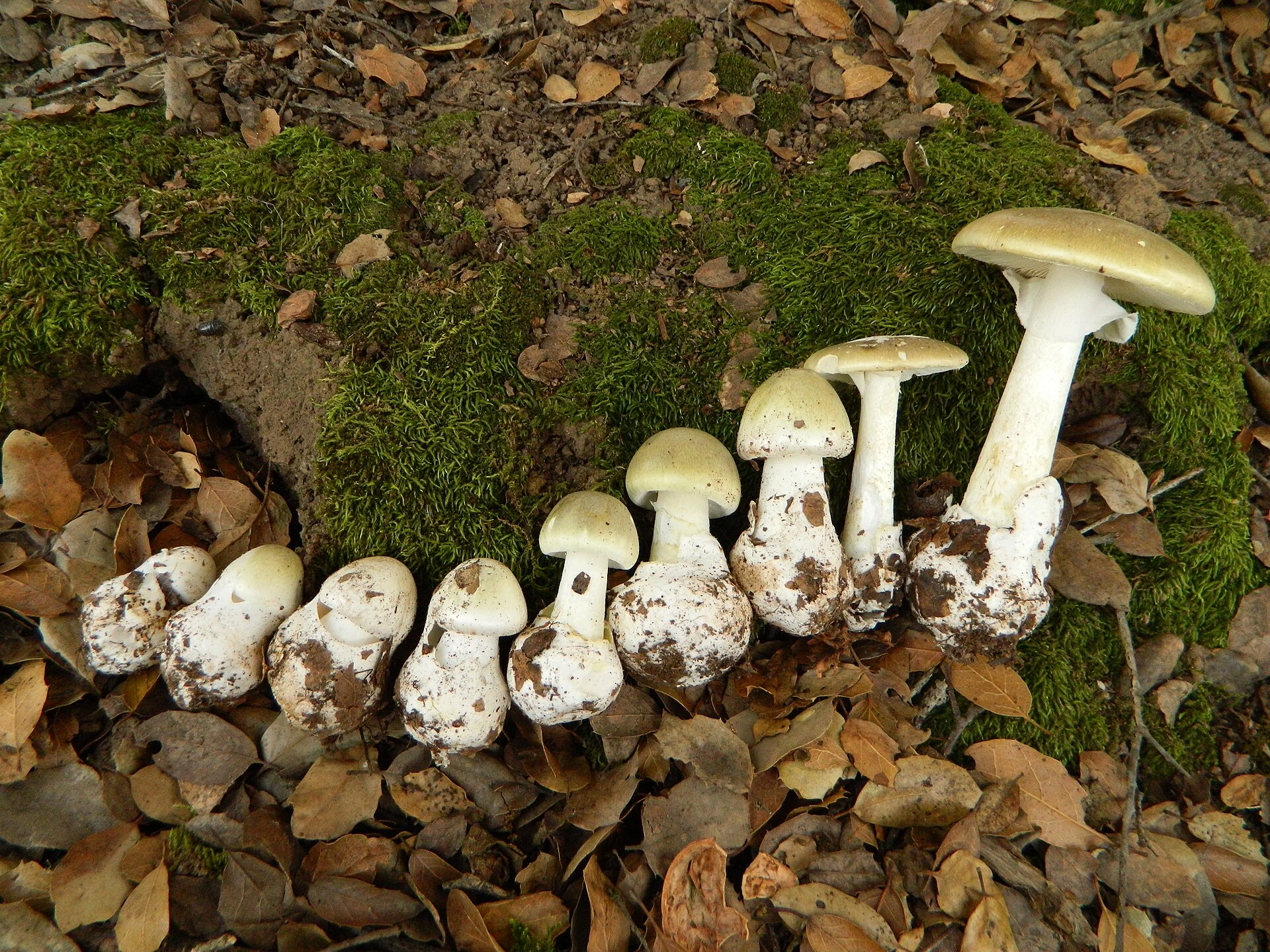
Amanita phalloides, commonly known as the Death Cap, is one of the most dangerous poisonous mushrooms in the world. It contains amatoxins that can cause severe liver failure, and poisoning may initially appear deceptively mild because symptoms are often delayed for many hours.
The species is especially dangerous because it does not look dramatic or obviously toxic. Its cap can be olive green, yellow-green, pale brown, grayish, or almost white, and inexperienced collectors may confuse it with edible mushrooms such as Agaricus, some Russula, or young puffball-like fungi.
⚠️ Important: This guide is for identification and education only. Never eat a wild mushroom based solely on a photograph, AI result, or comparison with an online guide.
Quick Identification
| Feature | Amanita phalloides |
|---|---|
| Scientific name | Amanita phalloides |
| Common name | Death Cap |
| Family | Amanitaceae |
| Cap | Olive green, yellow-green, brownish, grayish, or pale |
| Gills | White, crowded, free from the stem |
| Stem | Pale, often with a ring |
| Stem base | Distinct sack-like volva |
| Spore print | White |
| Habitat | Woodland, parks, areas near host trees |
| Ecology | Ectomycorrhizal |
| Common hosts | Oak, beech, chestnut, hazel and other broadleaf trees |
| Main season | Usually late summer through autumn |
| Toxicity | Deadly poisonous |
| Main toxins | Amatoxins |
What Does Amanita phalloides Look Like?
The Death Cap has the classic Amanita structure: a smooth cap, pale gills, a central stem, a ring, and a volva surrounding the stem base. The overall appearance is elegant and often quite ordinary, which is one reason the species is so dangerous.
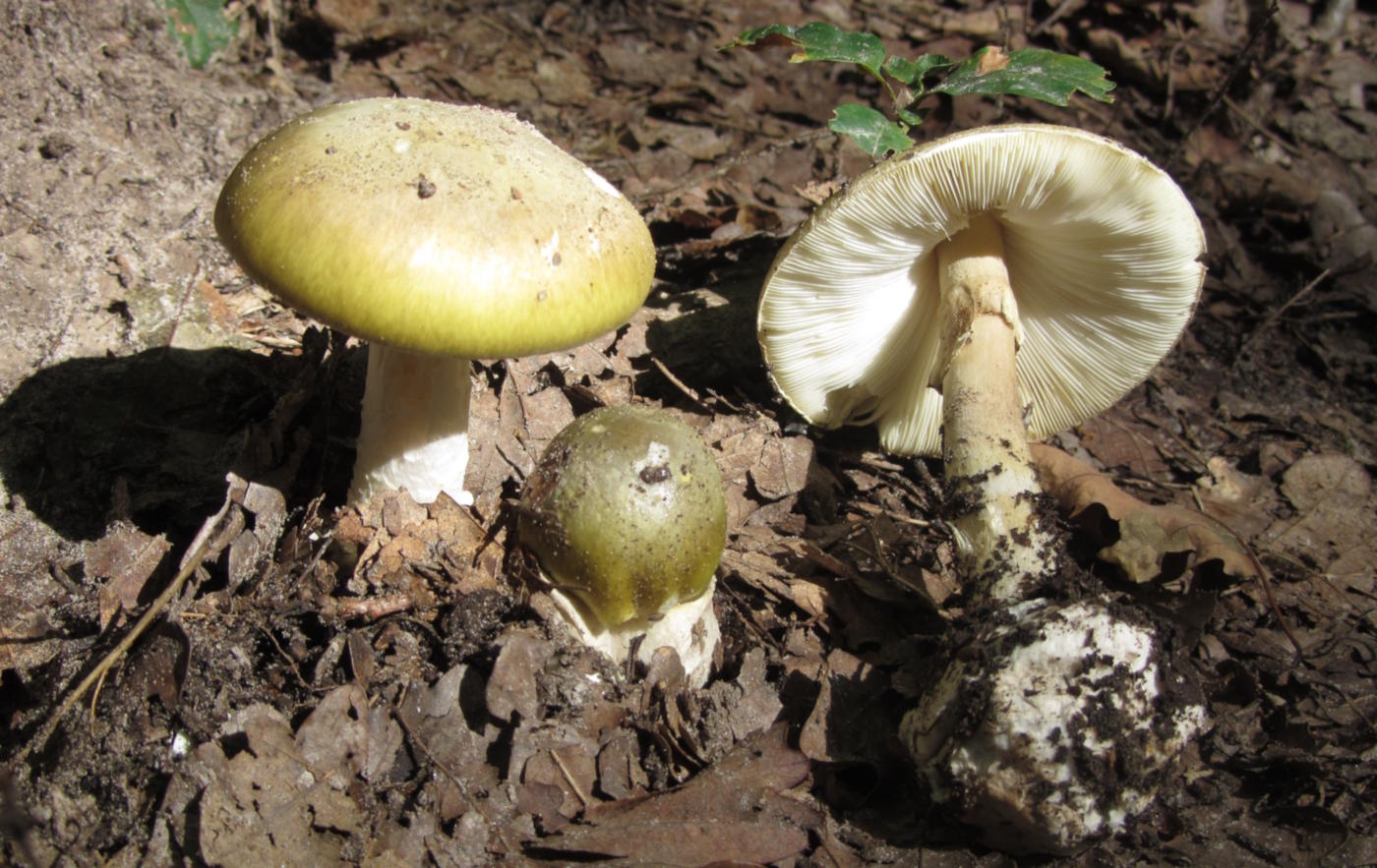
Cap color is highly variable. Many specimens are olive green or yellow-green, but some can be pale brown, grayish, cream, or nearly white. This means that the absence of a green cap does not rule out Amanita phalloides.
Cap
The cap begins rounded or hemispherical and gradually becomes convex, then almost flat as the mushroom matures. Mature caps are often around 5–15 cm across.
The surface is usually smooth and may become slightly sticky when wet. White veil remnants are generally absent or sparse, unlike the prominent white warts commonly seen on Amanita muscaria.
The margin is usually smooth rather than strongly striated. Color can be darker toward the center and paler toward the edge, but this pattern varies considerably.
Gills
The gills remain white to cream throughout development. They are crowded and usually free from the stem, meaning they stop just before reaching it.
This persistent white gill color is an important distinction from many Agaricus species, whose gills typically begin pink and become brown with age.
Young specimens can still be difficult to interpret, so gill color should always be combined with the stem base and other Amanita features.
Stem
The stem is pale, usually white to cream, and may show faint greenish or grayish tones. A ring is normally present around the upper portion of the stem, though it can become damaged or disappear in older specimens.
The stem may have a slightly fibrous or patterned surface rather than being completely smooth. Its base widens into a bulb enclosed by the volva.
The ring alone is not enough for identification because many edible and poisonous mushrooms also have rings.
The Volva
The volva is one of the most important features of the Death Cap. It forms a white, sack-like cup around the swollen base of the stem.
This structure can be partly or completely buried in soil or leaf litter. If the mushroom is cut off at ground level, the volva may be left behind and one of the strongest warning signs can be missed.
For this reason, unknown pale mushrooms should be removed intact when identification is necessary. The whole stem base should be visible before an Amanita can be evaluated properly.
Spore Print
The spore print of Amanita phalloides is white. This supports identification as an Amanita but is not enough to separate it from other white-spored species.
Spore color is most useful when combined with white gills, a ring, a volva, and the overall structure of the mushroom.
Flesh
The flesh is white and does not usually show dramatic bruising reactions. It may have a mild or slightly sweet odor when young, becoming more unpleasant in older specimens.
Smell is too subjective to use as a primary identification feature. Different people may describe the same mushroom differently, and age can change the odor.
The lack of vivid staining can make the mushroom seem less suspicious, but toxicity has no reliable relationship with visible color changes.
Where Does the Death Cap Grow?
Amanita phalloides is ectomycorrhizal, meaning it forms a symbiotic relationship with tree roots. It typically grows from soil near suitable broadleaf trees rather than directly from dead wood.
Common host trees include oak, beech, chestnut, hazel, and other deciduous species. In some regions, the mushroom can also occur with introduced trees in parks, urban plantings, and residential areas.
This ability to grow in landscaped environments is important because Death Caps are not restricted to remote forests.
Distribution
The Death Cap is native to Europe and is widespread across many temperate regions there. It has also been introduced to other parts of the world, including North America, Australia, and other regions where suitable host trees were planted.
In introduced areas, the species can spread with host trees and establish new populations. This is why local identification knowledge matters even outside Europe.
The mushroom may be common in one region and absent or rare in another.
When Does Amanita phalloides Grow?
The main fruiting season is usually late summer through autumn, especially after periods of rain. Exact timing depends on climate, rainfall, altitude, and geographic region.
In mild climates, fruiting can continue later into the year. The same site may produce Death Caps repeatedly across multiple seasons if the underground mycelium remains active.
Season is useful as supporting information, but it should never override structural identification.
Why Is Amanita phalloides So Dangerous?
The Death Cap contains amatoxins, which inhibit essential cellular processes and can cause catastrophic liver damage. The kidneys and other organs may also be affected.
One of the most dangerous features of amatoxin poisoning is the delay before symptoms appear. A person may feel normal for many hours after eating the mushroom.
When symptoms begin, they often include severe vomiting, diarrhea, abdominal pain, and dehydration. This can be followed by a temporary period of apparent improvement even while liver injury continues.
Severe cases may progress to liver failure, multi-organ failure, and death.
What Happens After Death Cap Poisoning?
The poisoning pattern often develops in stages. The first stage may be symptom-free, followed by severe gastrointestinal illness several hours later.
After this, the patient may seem to recover temporarily. This apparent improvement is dangerous because internal organ damage can continue during the quiet phase.
Later, signs of liver failure can appear, including jaundice, bleeding problems, confusion, and severe metabolic disturbances.
Suspected Death Cap ingestion is a medical emergency, even if the person feels well.
Amanita phalloides Look-Alikes
The Death Cap can resemble several edible or harmless mushrooms, especially when the cap is unusually pale. The most dangerous errors usually involve young or incomplete specimens.
The best identification approach is to compare the complete mushroom, including the stem base.
Agaricus Species
Young Agaricus mushrooms can have pale caps and rings and may appear superficially similar from above. The important difference is in the gills.
Agaricus gills typically begin pink and become dark brown as spores mature. Death Cap gills remain white.
Another major difference is the volva. Agaricus species do not have the sack-like volva found at the base of Amanita phalloides.
Russula Species
Some pale or greenish Russula species can resemble a Death Cap when only the cap is visible. However, Russulas typically lack both a ring and a volva.
Their flesh is also brittle and snaps rather than tearing into fibrous strands. This texture can be useful once the specimen is handled.
From above alone, though, confusion is possible.
Amanita caesarea and Related Edible Amanitas
Edible Amanitas can also create identification problems, particularly in regions where collectors seek Caesar’s Mushroom or related species.
Because the genus contains both edible and deadly species, identification within Amanita requires particular caution. Cap color alone is never enough.
The gills, stem color, ring, volva, and regional species all need to be considered together.
Young Puffballs
Very young Amanitas are enclosed in a universal veil and can appear like white eggs or rounded balls before the cap expands.
This can lead to confusion with edible puffballs. The safest check is to cut the specimen vertically through the center.
A true young puffball should be uniformly white inside. A young Amanita may reveal a developing cap, gills, and stem within the outer tissue.
Death Cap vs Field Mushroom
| Feature | Amanita phalloides | Agaricus campestris |
|---|---|---|
| Cap | Olive, pale, brownish, or nearly white | White to cream |
| Young gills | White | Pink |
| Mature gills | White | Dark brown |
| Spore print | White | Dark brown |
| Ring | Usually present | Usually present |
| Volva | Present | Absent |
| Habitat | Near trees | Lawns and grassland |
| Toxicity | Deadly poisonous | Edible when correctly identified |
The gill-color progression and presence of a volva are among the most useful differences. Neither should be used completely alone.
Death Cap vs Russula
| Feature | Amanita phalloides | Russula species |
|---|---|---|
| Cap | Olive, pale, greenish, or brownish | Variable |
| Gills | White | Usually white to cream |
| Ring | Usually present | Absent |
| Volva | Present | Absent |
| Flesh | More fibrous | Brittle, chalk-like |
| Toxicity | Deadly poisonous | Varies by species |
This comparison shows why viewing only the cap and gills can still be misleading. The stem base and ring provide important additional information.
How to Identify a Death Cap Step by Step
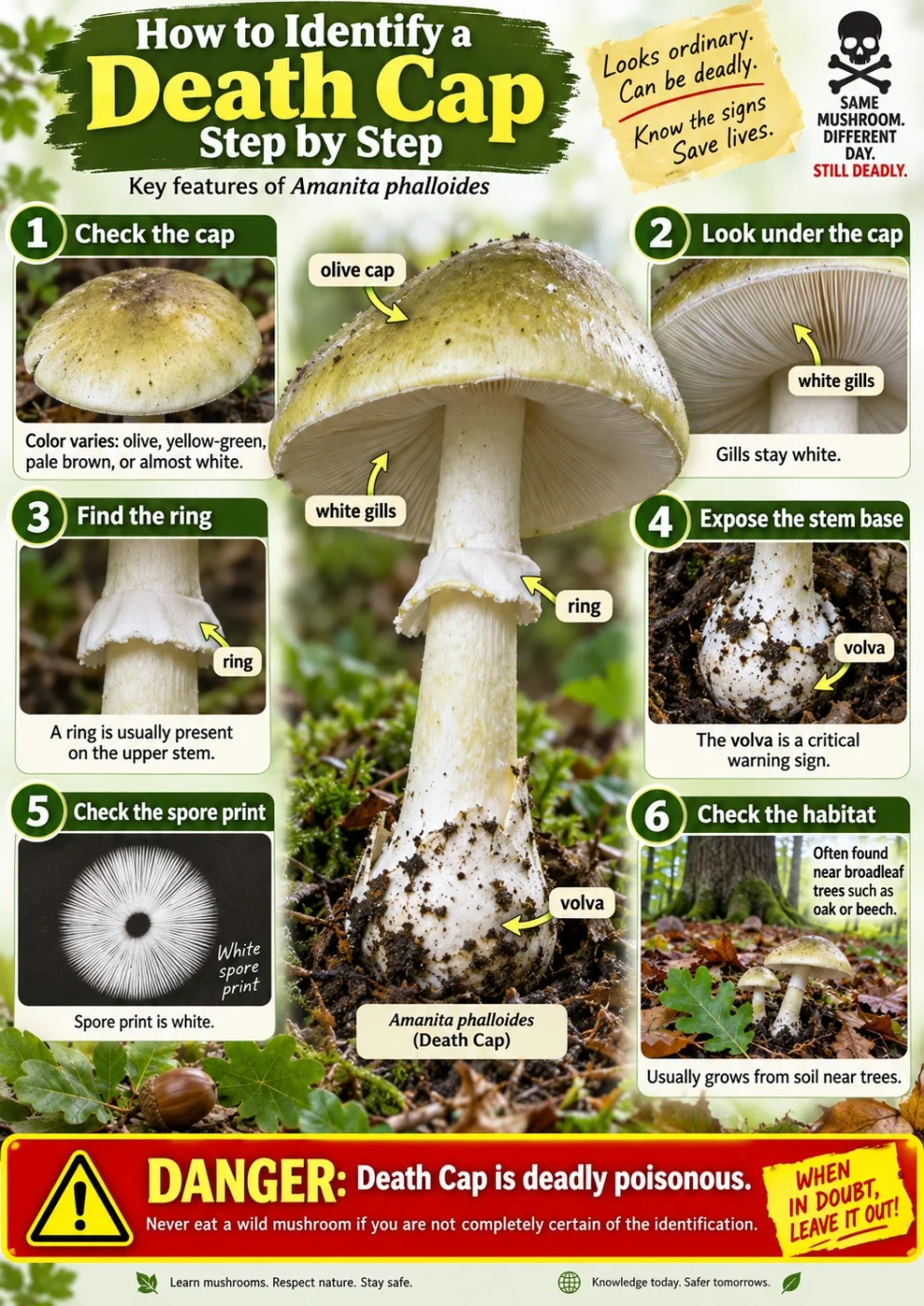
Start with the overall structure. A suspected Death Cap should have pale free gills, a stem with a ring, and a sack-like volva at the base.
Then consider cap color, habitat, and nearby trees. Olive or greenish tones are common, but pale specimens are possible.
Finally, check the spore print and whether the mushroom fits the expected Amanita structure. If the volva is missing because the stem base was cut away, the identification becomes less reliable.
How to Photograph Amanita phalloides for Identification
A useful photo set should show the cap, underside, complete stem, ring, and entire stem base. The volva should be clearly visible if present.
A wider image should include nearby trees and the exact place where the mushroom is growing. This helps determine whether the habitat fits a mycorrhizal Amanita.
If several specimens are present, photograph both young and mature mushrooms because the cap shape and ring can change significantly with age.
Can a Death Cap Be Identified From a Photo?
A mature Death Cap can often be strongly suspected from good photographs, especially when the volva, ring, white gills, and cap are all visible.
However, a single cap photo is not enough. Pale specimens can resemble edible mushrooms, while missing stem-base details can hide the most important Amanita feature.
AI identification can help narrow the possibilities, but it should never be used as a final safety decision.
Are Death Caps Always Green?
No. Olive green is a classic color, but real specimens can be yellow-green, gray-green, pale brown, cream, or almost white.
This variation is one of the main reasons cap color should never be used as the deciding feature.
The Amanita structure is more important than the exact shade of the cap.
Can Death Caps Grow in Parks and Gardens?
Yes. Because the fungus grows in association with tree roots, it can appear wherever suitable host trees are present.
Parks, residential streets, landscaped gardens, and university campuses can all provide suitable habitat. A manicured setting does not make a wild mushroom safe.
Urban Death Caps are especially important because they may appear in places where children and pets have easy access.
Can Animals Eat Death Caps?
Wildlife feeding behavior is not a reliable guide to mushroom safety. Some animals can tolerate compounds that are highly toxic to humans.
The presence of insect damage, slug bites, or animal feeding does not make a mushroom edible.
This is another common folklore rule that should be ignored.
Interesting Facts About Amanita phalloides
The name “Death Cap” reflects the severe toxicity of the species, but the mushroom itself often looks surprisingly ordinary. Its understated appearance contrasts with the bright warning colors people often imagine when they think of poisonous fungi.
The species has also become a notable invasive fungus in some parts of the world. Where suitable host trees were introduced, Amanita phalloides was able to establish outside its native European range.
Its success as both a symbiotic fungus and an invasive species makes it important from ecological as well as medical perspectives.
Frequently Asked Questions
Is Amanita phalloides deadly?
Yes. It contains amatoxins and can cause fatal liver failure.
What does a Death Cap look like?
It typically has a smooth olive to pale cap, white gills, a pale stem with a ring, and a sack-like volva at the base.
Are all Death Caps green?
No. Some specimens are pale brown, grayish, cream, or nearly white.
What color are Death Cap gills?
The gills remain white to cream throughout development.
What color is the spore print?
The spore print is white.
Where do Death Caps grow?
They grow from soil near host trees, especially broadleaf trees such as oak, beech, chestnut, and hazel.
When do Death Caps appear?
They are most common from late summer through autumn, especially after rain.
Can Death Caps grow in lawns?
Yes, if suitable host tree roots extend beneath the grass.
What edible mushrooms look like Death Caps?
Possible look-alikes include Agaricus, some Russula, and edible Amanitas. Young specimens can also be confused with puffballs.
What should I do if someone ate a suspected Death Cap?
Seek emergency medical or poison-control help immediately. Do not wait for symptoms, because amatoxin poisoning may have a long delay.
Final Identification Notes
A typical Amanita phalloides combines a smooth olive to pale cap, white free gills, a pale stem with a ring, and a sack-like volva around the base. The cap color is variable, so the Amanita structure is far more important than the exact shade.
The most critical practical rule is to never discard the stem base before identification. A buried volva can be the feature that separates a deadly Amanita from an edible look-alike.
When a mushroom has white gills, a ring, and a volva, it should be treated with extreme caution. If there is any uncertainty, do not eat it and seek expert identification.