North America has an enormous diversity of wild mushrooms, ranging from prized edible species to fungi capable of causing severe organ damage or death. Some poisonous mushrooms are distinctive, but others closely resemble edible species collected by foragers, which makes careful identification essential.
The greatest danger is often not an obviously unusual mushroom, but a familiar-looking white, brown, or orange species that is mistaken for something edible. Cap color alone is never enough. Reliable identification usually requires the gills or pores, complete stem base, spore color, substrate, nearby trees, growth pattern, and sometimes microscopic characters.
⚠️ Important: This guide is for identification and education only. Never eat a wild mushroom based solely on a photograph, AI result, or comparison with an online guide.
Quick Guide to 10 Poisonous North American Mushrooms
| Species | Common name | Main danger |
|---|---|---|
| Amanita phalloides | Death Cap | Amatoxins, severe liver failure |
| Amanita ocreata | Western Destroying Angel | Amatoxins, potentially fatal |
| Amanita bisporigera group | Eastern Destroying Angel | Amatoxins, potentially fatal |
| Galerina marginata | Deadly Galerina | Amatoxins, potentially fatal |
| Cortinarius rubellus and related species | Deadly Webcap group | Orellanine, kidney failure |
| Gyromitra species | False Morels | Gyromitrin poisoning in some species |
| Chlorophyllum molybdites | Green-Spored Parasol | Severe gastrointestinal poisoning |
| Omphalotus species | Jack-o’-Lantern Mushrooms | Gastrointestinal poisoning |
| Amanita smithiana | Smith’s Amanita | Delayed kidney injury |
| Muscarine-containing Inocybe species | Fibrecaps | Muscarine poisoning |
1. Amanita phalloides — Death Cap
- Scientific name: Amanita phalloides
- Common name: Death Cap
The Death Cap is one of the most dangerous mushrooms found in North America. It is particularly well established on the West Coast, where it grows in association with several broadleaf trees and can occur in parks, residential areas, and woodland.
The cap is often olive green, yellow-green, pale brown, or grayish, although some specimens can be much paler. The gills remain white, the stem normally carries a ring, and a sack-like volva surrounds the base.
The volva is one of the most important features, but it may remain buried beneath soil or leaf litter. Cutting an unknown mushroom at ground level can therefore remove critical evidence needed for identification.
Why Death Caps Are So Dangerous
Amanita phalloides contains amatoxins that can cause severe liver damage. Symptoms are often delayed for many hours, so a person may initially feel completely normal after eating the mushroom.
Severe vomiting and diarrhea may eventually begin, followed by a temporary period when the patient appears to improve. Liver damage can continue during this apparent recovery, and severe cases may progress to liver failure.
Main Look-Alikes
Death Caps can be confused with edible puffballs when extremely young, pale Agaricus, some Russula species, and mushrooms familiar to people who collected different edible species in other parts of the world.
The combination of white gills, a stem ring, and a volva should always be treated with extreme caution.
2. Amanita ocreata — Western Destroying Angel
- Scientific name: Amanita ocreata
- Common name: Western Destroying Angel
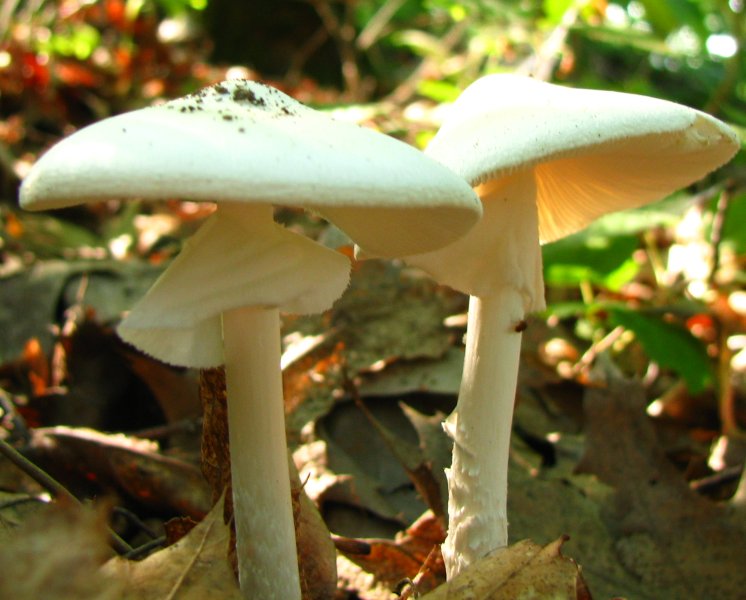
The Western Destroying Angel is an important deadly Amanita of western North America, particularly California and nearby regions. It is often almost entirely white or cream, although older caps may develop tan or yellowish tones.
The gills are white, and the pale stem usually has a ring. A prominent membranous volva surrounds the stem base and may be partly hidden underground.
Its simple white appearance can make the mushroom seem harmless, especially when young.
Why It Is Dangerous
Like the Death Cap, Amanita ocreata contains amatoxins capable of causing fatal liver failure. The delayed onset of symptoms makes accidental poisoning particularly dangerous.
The mushroom should never be identified using only the white cap. The entire stem base, gills, ring, habitat, and other Amanita features must be examined.
Main Look-Alikes
Young destroying angels may resemble edible Agaricus or other pale mushrooms. One useful distinction is that mature Agaricus gills become pink and eventually brown, while Destroying Angel gills remain white.
3. Amanita bisporigera Group — Eastern Destroying Angels
- Scientific name: Amanita bisporigera and closely related species
- Common name: Eastern Destroying Angel
White destroying angels occur across eastern North America, where several closely related species may be involved. Amanita bisporigera is one of the best-known names associated with this group.
These mushrooms typically have white caps, white gills, pale stems, rings, and volvas at the base. They often occur in woodland in association with tree roots.
From above, a young specimen can look remarkably ordinary.
Why It Is Dangerous
Eastern destroying angels contain amatoxins and can produce the same severe poisoning syndrome as the Death Cap. Liver injury may develop after an initial delay, and untreated poisoning can be fatal.
This is why wild white mushrooms with white gills deserve particular caution in eastern North America.
Main Look-Alikes
Possible confusion includes edible Agaricus, white puffballs, and other pale woodland mushrooms. Examination of the complete stem base is essential because the volva may otherwise remain hidden.
4. Galerina marginata — Deadly Galerina
- Scientific name: Galerina marginata
- Common names: Deadly Galerina, Funeral Bell
The Deadly Galerina is a small brown mushroom that grows on decaying wood across much of North America. Its ordinary appearance makes it one of the most important poisonous wood-growing mushrooms to know.
The cap is usually honey-brown, yellow-brown, or reddish brown and may become paler as it dries. The gills mature toward rusty brown, while the slender stem may show a fragile ring or ring zone.
It can grow alone, scattered, or in groups on logs, stumps, and buried woody material.
Why It Is Dangerous
Galerina marginata contains amatoxins, despite being much smaller than a Death Cap or Destroying Angel. Ingestion can therefore cause severe liver poisoning.
The danger is increased by its resemblance to edible wood-growing species.
Main Look-Alikes
It can be confused with Honey Mushrooms, Kuehneromyces, wild enoki, and other small brown mushrooms growing on wood.
Any small brown mushroom collected from a log or stump should be identified with particular care.
5. Cortinarius rubellus and Related Species — Deadly Webcaps
- Scientific name: Cortinarius rubellus and related orellanine-containing species
- Common name: Deadly Webcap group
Some North American Cortinarius species contain orellanine, a toxin capable of causing severe kidney damage. Cortinarius rubellus has been documented in North America, while other related toxic species also occur on the continent.
These mushrooms are generally orange-brown, reddish brown, or rusty colored. Young fruit bodies may show a fine cobweb-like veil known as a cortina between the cap and stem.
As spores mature, rusty material can accumulate on the stem where the cortina was previously attached.
Why They Are Dangerous
Orellanine poisoning is especially concerning because symptoms may be delayed for days and, in some cases, considerably longer. By the time severe thirst, nausea, weakness, or changes in urination become noticeable, kidney damage may already be significant.
This delayed pattern makes it difficult for people to connect illness with a mushroom meal eaten many days earlier.
Main Look-Alikes
The genus Cortinarius contains many similar brown and orange mushrooms. Species-level identification can be difficult even for experienced mushroom enthusiasts.
Unknown rusty-spored woodland mushrooms should not be collected as food casually.
6. Gyromitra Species — False Morels
- Common name: False Morels
- Important genera: primarily Gyromitra
False morels occur in several parts of North America and often fruit during spring, around the same time as highly prized true morels.
Their caps are usually irregularly lobed, folded, saddle-shaped, or brain-like rather than covered in the deep regular pits of true Morchella. Internally, false morels are often chambered instead of being completely hollow from top to bottom.
Several different Gyromitra species occur in North America, and their chemistry is not identical.
Why They Are Dangerous
Some false morels contain gyromitrin or related compounds capable of causing serious poisoning. Symptoms can include vomiting, abdominal pain, neurological effects, seizures, and liver injury.
Historical consumption of some false morels does not make unidentified Gyromitra safe. Toxin concentration can vary among species and individual specimens.
Main Look-Alike: True Morels
True morels have clearly defined pits and ridges creating a honeycomb-like surface. When sliced lengthwise, a true morel is hollow through the cap and stem.
False morels typically have folded caps and chambered interiors. Cutting the mushroom vertically is therefore one of the most useful identification checks.
7. Chlorophyllum molybdites — Green-Spored Parasol
- Scientific name: Chlorophyllum molybdites
- Common names: Green-Spored Parasol, False Parasol
The Green-Spored Parasol is one of the most important poisonous lawn mushrooms in North America. It is especially common in warm regions and well-watered lawns, where it may form large rings containing many fruit bodies.
The mushroom can become large, with a pale cap covered in brownish scales and a substantial stem with a ring. Young gills are pale, which can make early specimens look deceptively similar to edible parasol mushrooms.
As the spores mature, the gills often develop a gray-green color, and the spore print is characteristically green.
Why It Is Dangerous
The Green-Spored Parasol causes severe gastrointestinal poisoning. Intense vomiting, diarrhea, abdominal cramps, and dehydration can follow ingestion.
Although this is different from the organ failure associated with amatoxins, the poisoning can still be severe enough to require hospital treatment.
Main Look-Alike
The edible Parasol Mushroom and related species can have similarly large, scaly caps. The green mature spores of Chlorophyllum molybdites are one of the most important warning characteristics.
8. Omphalotus Species — Jack-o’-Lantern Mushrooms
- Important North American species: Omphalotus illudens, Omphalotus olivascens and relatives
- Common names: Jack-o’-Lantern Mushrooms
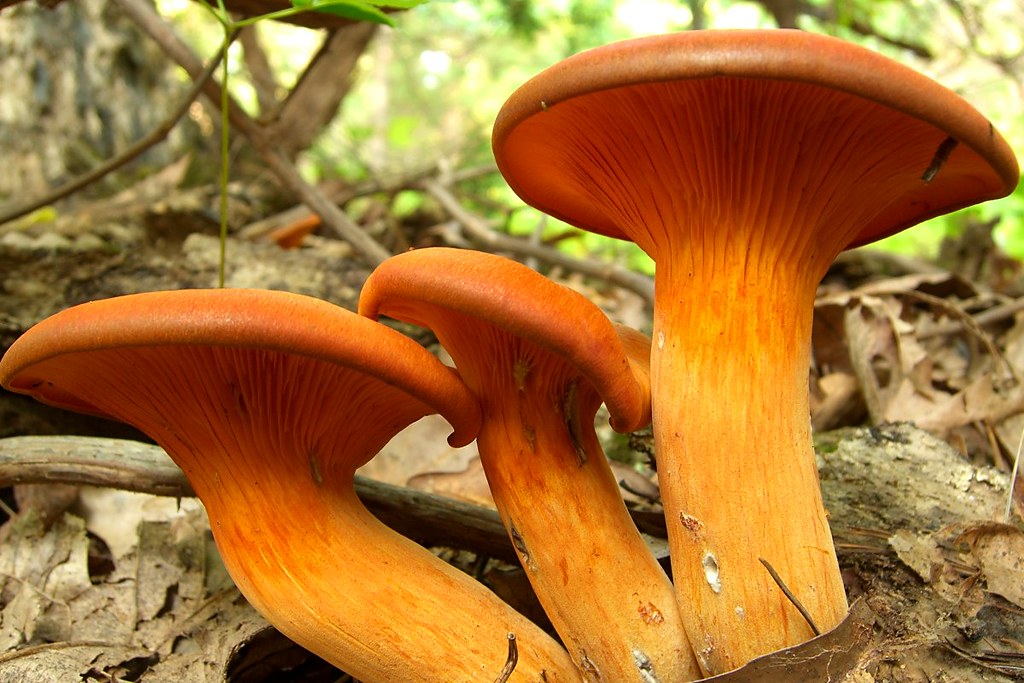
Jack-o’-Lantern mushrooms form striking yellow-orange to deep orange clusters from wood, buried roots, or tree bases. Different species occur in different parts of North America.
Their caps may become funnel-shaped, and the underside has genuine thin gills that run down toward the stem. Large clusters can be visually impressive and may be mistaken for edible orange mushrooms.
Why They Are Dangerous
Jack-o’-Lantern mushrooms contain compounds that cause substantial gastrointestinal poisoning. Symptoms can include vomiting, diarrhea, and severe abdominal discomfort.
The poisoning is generally not associated with the delayed liver failure characteristic of deadly Amanitas, but ingestion can still produce significant illness.
Main Look-Alike: Chanterelles
Chanterelles generally grow from soil and have blunt ridges or folds rather than thin blade-like true gills. Jack-o’-Lantern mushrooms usually grow from wood or buried roots and possess clearly defined true gills.
Checking both the underside and substrate is therefore essential.
9. Amanita smithiana — Smith’s Amanita
- Scientific name: Amanita smithiana
- Common name: Smith’s Amanita
Amanita smithiana is particularly important in western North America, especially the Pacific Northwest. It is a pale mushroom that can occur in conifer forests and may resemble certain edible white mushrooms collected in the same region.
The cap is white to cream and can carry veil remnants. The stem is also pale, and the base may be enlarged with remnants of the universal veil.
This species is especially important because it has been mistaken for matsutake or pine mushrooms.
Why It Is Dangerous
Poisoning can cause serious delayed kidney injury. Gastrointestinal symptoms may occur first, followed later by evidence of renal damage.
Because matsutake are highly valued edible mushrooms, this comparison is particularly important for foragers in western North America.
Main Look-Alike: Matsutake
Matsutake identification involves more than a pale cap. Odor, stem structure, gill attachment, habitat, and the complete stem base should all be examined.
Any uncertainty between matsutake and a pale Amanita should be treated seriously.
10. Muscarine-Containing Inocybe — Fibrecaps
- Genus: Inocybe
- Common name: Fibrecaps
North America contains many species of Inocybe, and several produce significant amounts of muscarine. These mushrooms are generally small to medium-sized and often have conical or bell-shaped caps with a fibrous or silky surface.
Colors range from white and cream to tan, brown, or reddish brown. The gills become darker as spores mature, and the mushrooms commonly occur on soil near trees.
Accurate species-level identification can be difficult without microscopy.
Why They Are Dangerous
Muscarine affects the parasympathetic nervous system. Poisoning may produce heavy sweating, salivation, tearing, abdominal cramps, vomiting, diarrhea, and cardiovascular changes.
Symptoms often develop much more quickly than those caused by amatoxins or orellanine.
Main Look-Alikes
Small fibrous woodland mushrooms can resemble many harmless species. Because Inocybe is such a difficult genus and some members contain substantial amounts of muscarine, unknown fibrecaps should not be collected for food.
The Most Dangerous Mushroom Toxins in North America
The mushrooms in this guide do not all cause the same type of poisoning. Understanding the major syndromes helps explain why timing and symptoms vary so dramatically.
Amatoxins
Death Caps, destroying angels, and Deadly Galerina are among the North American mushrooms containing amatoxins. These toxins primarily threaten the liver and can produce life-threatening poisoning.
One of the defining features is the delayed onset of gastrointestinal symptoms, frequently many hours after ingestion. A temporary period of apparent improvement may occur before severe organ injury becomes obvious.
Orellanine
Certain Cortinarius species contain orellanine, which primarily damages the kidneys. Symptoms can be delayed for days or even longer, making these poisonings particularly difficult to recognize early.
A long symptom-free period after eating an unknown Cortinarius should never be interpreted as evidence that the mushroom was safe.
Gyromitrin
Some false morels contain gyromitrin-related toxins. Effects can involve the gastrointestinal tract, liver, and nervous system.
Severe cases may include seizures and significant systemic illness. Chemistry varies within the false morel group, which is one reason broad assumptions about their safety are unreliable.
Muscarine
Several Inocybe and related mushrooms contain muscarine. Symptoms often include sweating, excessive salivation, tearing, gastrointestinal distress, and cardiovascular effects.
The relatively rapid appearance of symptoms distinguishes this syndrome from delayed amatoxin and orellanine poisoning.
Poisonous White Mushrooms in North America
White wild mushrooms deserve particular attention because North America contains several deadly white Amanitas.
Western Destroying Angels and Eastern Destroying Angels both combine pale caps, white gills, stem rings, and volvas. The complete stem base is therefore one of the first structures to examine when an unknown white mushroom is found.
Edible Agaricus species usually develop pink and eventually dark brown gills. This difference is useful, but young mushrooms can be difficult to evaluate and should never be identified from a single characteristic.
Poisonous Brown Mushrooms in North America
Brown color provides almost no information about mushroom safety. Deadly Galerina, toxic Cortinarius, and numerous other poisonous fungi can all look like ordinary brown woodland mushrooms.
The problem becomes especially difficult with small brown mushrooms, sometimes informally called “LBMs” or Little Brown Mushrooms. Many unrelated species share similar cap shapes and colors and may require spore prints or microscopy for reliable identification.
A small brown mushroom growing from wood should always raise the possibility of Galerina marginata.
Poisonous Mushrooms Growing in Lawns
Lawns are not safe mushroom habitats simply because they are far from a forest. The Green-Spored Parasol is one of the most frequently encountered poisonous lawn mushrooms in North America.
Mycorrhizal mushrooms can also appear in lawns when suitable tree roots extend beneath the grass. This means potentially dangerous Amanitas may fruit in parks, landscaped areas, or residential properties.
The exact substrate, nearby trees, gill color, and stem base should therefore be examined even when the mushroom appears in an ordinary yard.
Poisonous Mushrooms Growing on Wood
Deadly Galerina and Jack-o’-Lantern mushrooms are two important examples of poisonous fungi associated with wood.
A log or stump can support several different mushroom species at the same time. This creates a dangerous situation for people collecting edible clustered mushrooms, because a poisonous species can occur only a short distance away.
Never assume that every mushroom on the same stump belongs to the same species.
Regional Differences Across North America
North America is too large for one mushroom guide to represent every region equally. The fungi of coastal California differ from those of the Pacific Northwest, eastern hardwood forests, the Gulf Coast, northern Canada, and the Rocky Mountains.
Death Caps and Western Destroying Angels are especially important in parts of western North America, while Eastern Destroying Angel species are major concerns farther east. Warm and humid regions frequently produce Green-Spored Parasols, while northern and montane habitats contain their own toxic Cortinarius and Amanita species.
Local identification knowledge is therefore particularly valuable. A mushroom common in Oregon may be absent or represented by a related species in Florida or Quebec.
What to Do if an Unknown Mushroom Was Eaten
Suspected wild mushroom poisoning should be taken seriously even if no symptoms have appeared. Some of the most dangerous toxins have delayed effects, so waiting for illness can waste valuable time.
Contact an appropriate poison center or medical service promptly. Keep uncooked specimens, leftovers, and photographs if they are available, because accurate identification can help guide treatment.
If possible, record where the mushroom was collected, what time it was eaten, how it was prepared, and approximately how much was consumed.
How to Photograph a Poisonous Mushroom for Identification
Photograph the cap from above and the gills or pores from below, but also include the entire stem and stem base. Amanita identification in particular can depend heavily on structures hidden beneath the soil.
A wider photograph should show the substrate and surrounding habitat. Trees, logs, lawns, buried wood, and growth pattern can all help distinguish visually similar species.
If several mushrooms are present, photograph both young and mature specimens because rings, gill colors, cap shapes, and veil remnants change as fruit bodies develop.
Can AI Identify Poisonous Mushrooms?
AI can be useful for recognizing dangerous possibilities and narrowing a large list of species. It works best when provided with multiple photographs showing the cap, underside, stem base, substrate, and habitat.
However, important identification characteristics may be invisible in photographs. Smell, staining reactions, microscopic spores, hidden volvas, and subtle structural differences can separate an edible species from a toxic one.
AI should therefore be used as an identification aid rather than a safety decision. An uncertain result should always be treated conservatively when consumption is involved.
Frequently Asked Questions
What is the deadliest mushroom in North America?
Death Caps and destroying angels are among the most dangerous mushrooms because they contain amatoxins capable of causing fatal liver failure. Several Amanita species are involved, and the most important species varies by region.
Are Death Caps native to North America?
The Death Cap is generally considered introduced in North America but is now well established in parts of the continent, particularly along the West Coast.
What deadly white mushrooms occur in North America?
Important examples include Amanita ocreata in western North America and the Amanita bisporigera group in eastern regions.
What poisonous mushrooms grow in lawns?
Chlorophyllum molybdites, the Green-Spored Parasol, is one of the most important poisonous lawn mushrooms. Other toxic species can also occur in grassy habitats.
What poisonous mushrooms grow on wood?
Deadly Galerina and Jack-o’-Lantern mushrooms are important examples. Both can grow from woody substrates and resemble edible mushrooms.
What poisonous mushroom looks like a morel?
Several Gyromitra species are known as false morels. Their caps are usually folded or brain-like, while true morels have deep pits and are hollow inside.
What mushroom can damage the kidneys?
Orellanine-containing Cortinarius species can cause delayed kidney failure. Amanita smithiana is another North American mushroom associated with serious renal injury.
Can poisonous mushrooms grow next to edible mushrooms?
Yes. Different species can grow on the same log, lawn, or patch of forest floor, so nearby mushrooms should never automatically be assumed to be identical.
Does cooking destroy mushroom toxins?
Not reliably. Many dangerous toxins survive ordinary cooking, and cooking cannot make an unidentified poisonous mushroom safe.
What should I do after eating an unknown wild mushroom?
Seek professional poison-control or medical advice promptly rather than waiting for symptoms. Preserve mushroom samples and photographs when possible.
Final Identification Notes
North America contains several distinct groups of dangerous mushrooms rather than one recognizable “poisonous mushroom type.” Deadly Amanitas may be pale and elegant, Galerina marginata can look like an ordinary small brown mushroom, and Green-Spored Parasols can appear in perfectly maintained suburban lawns.
The most important species to recognize include Death Caps, western and eastern Destroying Angels, Deadly Galerina, orellanine-containing Cortinarius, toxic false morels, Green-Spored Parasols, Jack-o’-Lantern mushrooms, Amanita smithiana, and muscarine-containing fibrecaps.
Always examine the complete fruit body and combine morphology with substrate, nearby trees, season, and geographic region. When identification remains uncertain, leaving the mushroom uneaten is far safer than trying to decide from cap color or a single photograph.