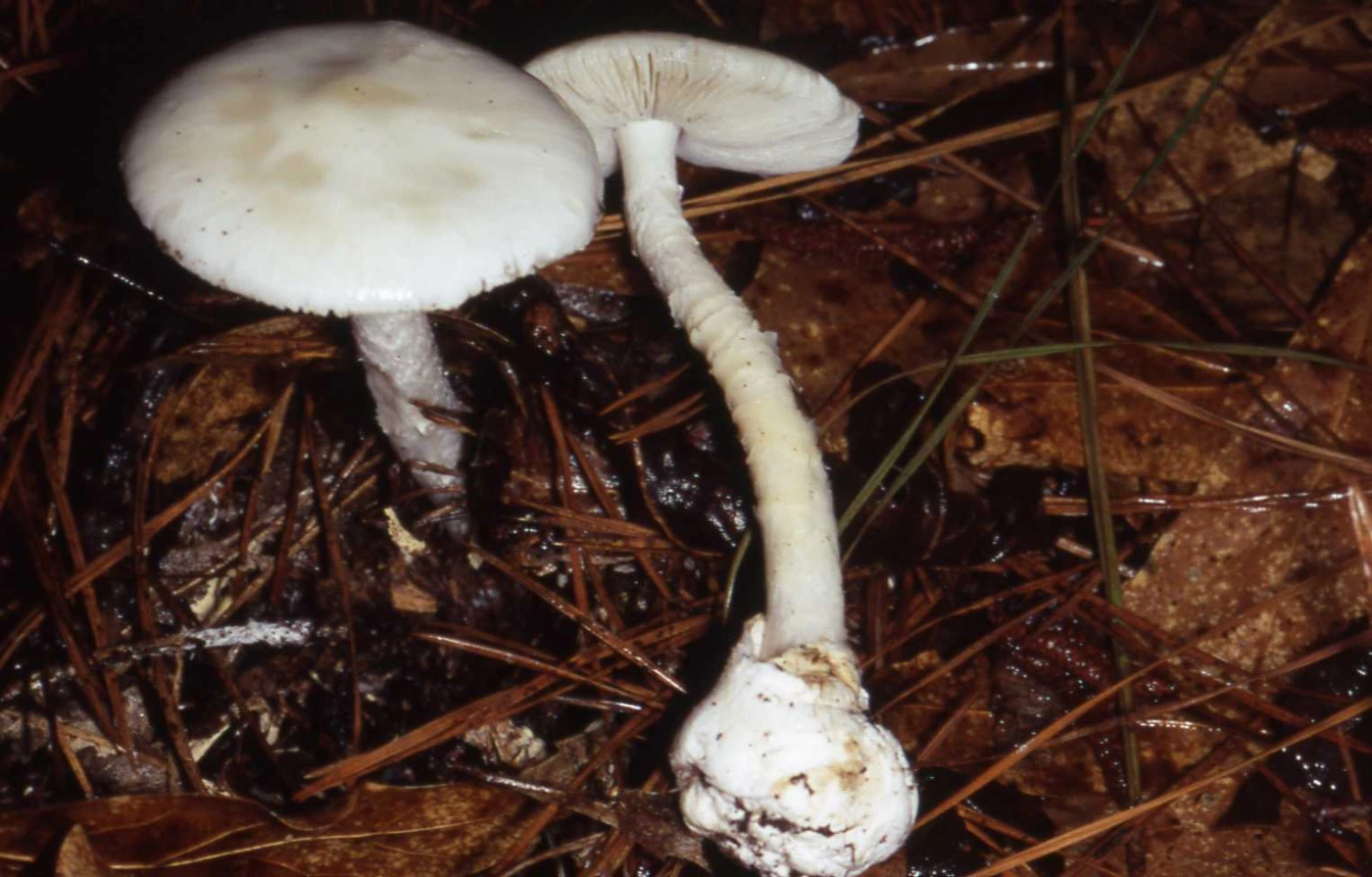
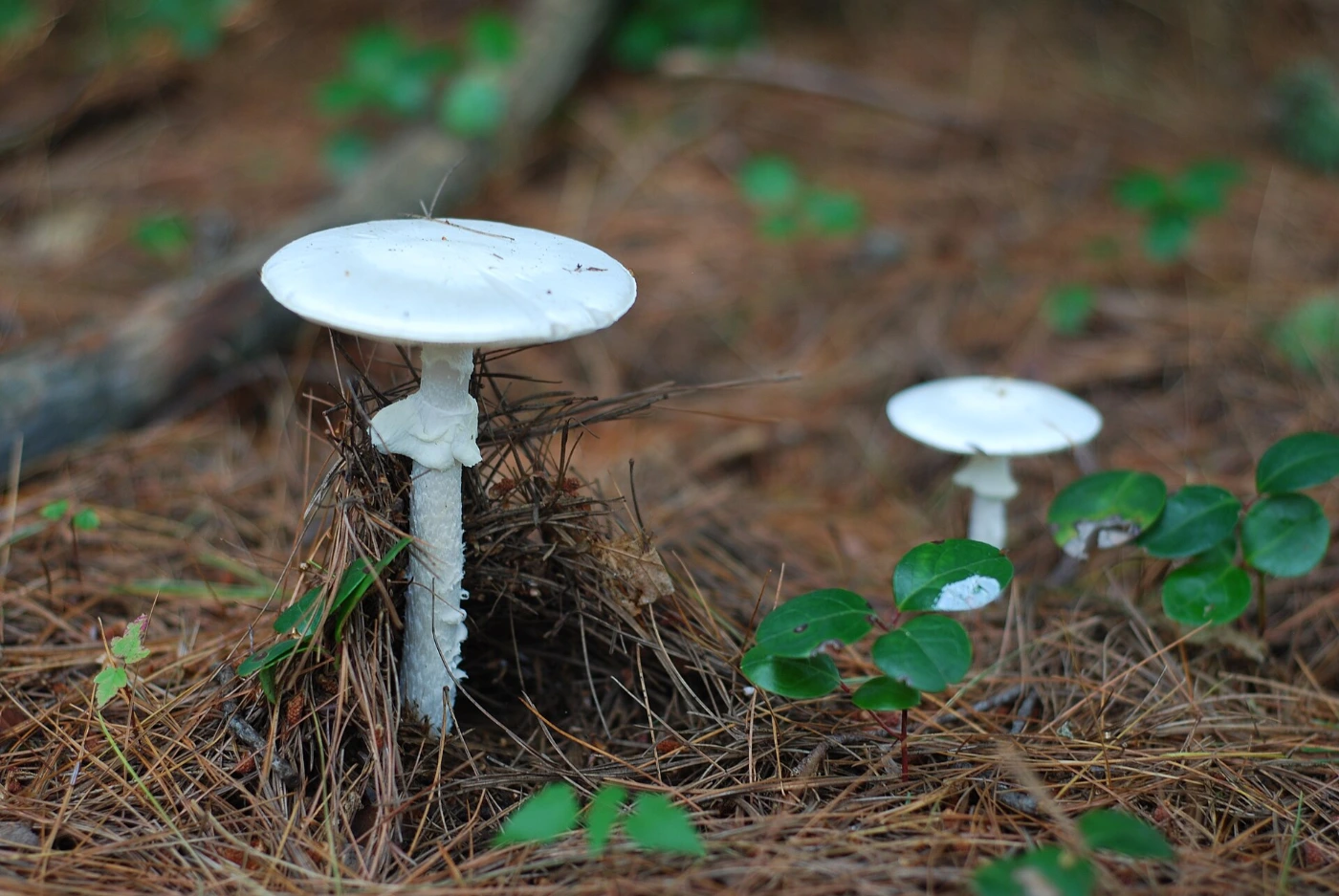
Amanita bisporigera, commonly known as the Eastern Destroying Angel, is a deadly poisonous white Amanita found in eastern North America. It has a smooth white cap, crowded white gills, a white stem with a skirt-like ring, and a sac-like volva surrounding the enlarged stem base.
The most useful field pattern is all-white mushroom + free white gills + ring on the stem + sac-like volva at the base + woodland habitat. Because several harmless white mushrooms can look similar from above, the complete stem base is essential for identification.
⚠️ Important: Amanita bisporigera contains amatoxins capable of causing severe liver failure and death. Never eat a white Amanita or any unidentified white gilled mushroom based on photographs, apps, or superficial resemblance to an edible species.
Quick Identification
| Feature | Amanita bisporigera |
|---|---|
| Common name | Eastern Destroying Angel |
| Cap color | White to ivory |
| Cap surface | Smooth, usually without warts |
| Cap margin | Usually not striate |
| Gills | White, crowded, free or nearly free |
| Stem | White, slender to moderately robust |
| Ring | White, skirt-like, usually persistent |
| Stem base | Enlarged |
| Volva | White, sac-like |
| Spore print | White |
| Flesh | White |
| Ecology | Mycorrhizal |
| Main habitat | Deciduous and mixed woodland |
| Common associates | Especially oak and other hardwoods |
| Season | Summer to autumn |
| Distribution | Eastern North America |
| Toxicity | Deadly poisonous |
| Main look-alikes | White Agaricus, Leucoagaricus, Volvopluteus, other destroying angels |
What Does Amanita bisporigera Look Like?
Typical fruit bodies are almost entirely white from cap to stem. Young mushrooms may initially emerge as rounded buttons before the cap expands into a convex and eventually broadly convex or nearly flat shape.
The clean white appearance can make the mushroom look harmless. That simplicity is one reason destroying angels are particularly dangerous to inexperienced foragers.
Cap
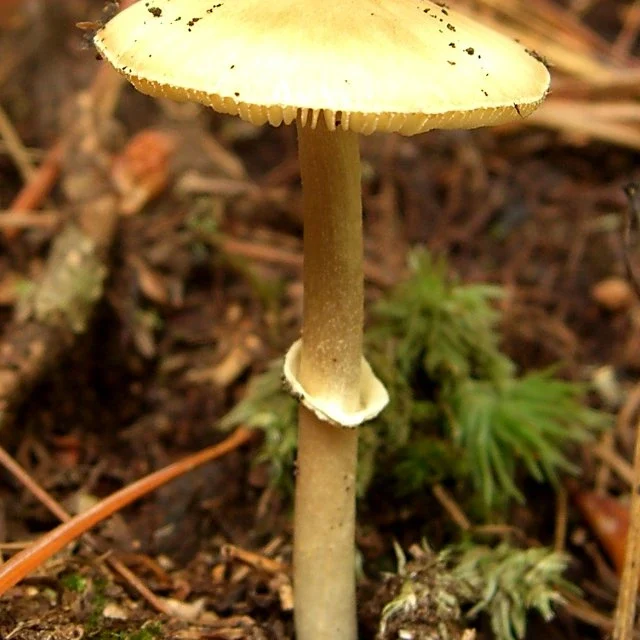
The cap usually begins oval or convex and becomes broader with maturity. Mature caps are generally smooth and lack the obvious white patches or warts seen on many other Amanitas.
Fresh caps are white to ivory and can become faintly cream, yellowish, or pinkish with age. Exact coloration is less useful than the combination of white gills, ring, and volva.
Cap Surface
The surface is normally smooth and relatively plain. It may feel dry or slightly sticky depending on moisture.
A persistent covering of large wart-like veil remnants would suggest comparison with other Amanita species. Typical A. bisporigera usually has a much cleaner cap.
Gills
The gills are white and remain white as the mushroom matures. They are crowded and free or nearly free from the stem.
This is an important distinction from white Agaricus species. Agaricus gills become pink and eventually dark chocolate-brown as their spores mature.
Stem
The stem is white and usually somewhat slender, although proportions vary. It may taper upward and become enlarged toward the base.
The surface can be nearly smooth or slightly fibrous. A white ring is usually present high on the stem.
Ring
The ring is thin, membranous, and skirt-like. In fresh mature specimens it can hang clearly from the upper stem.
Weather and age can damage veil structures, so the ring may occasionally be less obvious. Its absence in a damaged specimen does not automatically rule out a deadly Amanita.
Volva
The volva is one of the most important features. A white sac surrounds the enlarged base of the stem and may remain partly buried beneath soil or leaf litter.
This is why destroying angels should never be pulled or photographed with the stem base left underground. Cutting the mushroom off at soil level can remove the strongest identification clue.
Flesh
The flesh is white throughout and does not normally show dramatic staining after cutting. It is relatively firm when young.
Color change is therefore not a particularly useful feature for identification. Structural characters matter much more.
Spore Print
The spore print is white. This helps confirm Amanita but does not distinguish A. bisporigera from many other white-spored mushrooms.
Spore color becomes more useful when comparing it with Agaricus or Volvopluteus. Those groups produce brown or pinkish spores instead.
Why Is It Called bisporigera?
The scientific name refers to the microscopic spore-producing structures. Amanita bisporigera was traditionally characterized by basidia that often produce two spores rather than the four more typical of many mushrooms.
This feature cannot be seen in an ordinary field photograph. Microscopy and other characters may be needed to separate closely related white destroying angels with confidence.
Where Does Amanita bisporigera Grow?
The Eastern Destroying Angel is a mycorrhizal mushroom associated with living trees. It grows from soil rather than directly from dead wood.
Oak is an important host, and the species can occur in deciduous or mixed woodland with other hardwoods. Fruiting bodies may appear singly, scattered, or in small groups.
Oak Woodland
Oak-dominated woodland is classic habitat. White caps may emerge through leaf litter after warm wet weather.
Because the mushroom is pale, it can be surprisingly conspicuous against dark forest soil. Young buttons may be much harder to distinguish from other rounded fungi.
Season
Fruiting occurs mainly during summer and autumn. Warm conditions combined with adequate moisture can produce flushes during the main eastern North American mushroom season.
Exact timing varies by latitude and weather. Seasonal timing should never be used as more than supporting evidence.
Distribution
Amanita bisporigera is characteristic of eastern North America and is widely reported from the eastern United States and Canada. It is commonly treated as one of the principal destroying angels of the region.
Western North America has different important white deadly Amanitas, especially Amanita ocreata. European names such as Amanita virosa and Amanita verna have historically been applied too broadly to North American collections and should not automatically be used for eastern North American specimens.
Is Amanita bisporigera Poisonous?
Yes. Amanita bisporigera is deadly poisonous and contains amatoxins, including α-amanitin. These toxins interfere with RNA polymerase II and can cause catastrophic liver injury.
Cooking, drying, freezing, or ordinary food preparation does not reliably destroy amatoxins. The species should never be considered edible under any preparation method.
What Happens After Amatoxin Poisoning?
Symptoms may be delayed for many hours after eating the mushroom. Severe vomiting, diarrhea, and abdominal pain can then occur, sometimes followed by an apparent period of improvement.
The dangerous phase may continue afterward as liver injury develops. Because delayed symptoms are characteristic of amatoxin poisoning, suspected ingestion requires urgent medical evaluation rather than waiting to see whether the person feels better.
Look-Alikes
Several white mushrooms can resemble Eastern Destroying Angel, especially when the stem base is hidden. The most useful distinctions involve gill color, spore print, ring, volva, habitat, and changes with maturity.
Amanita ocreata — Western Destroying Angel
Identification
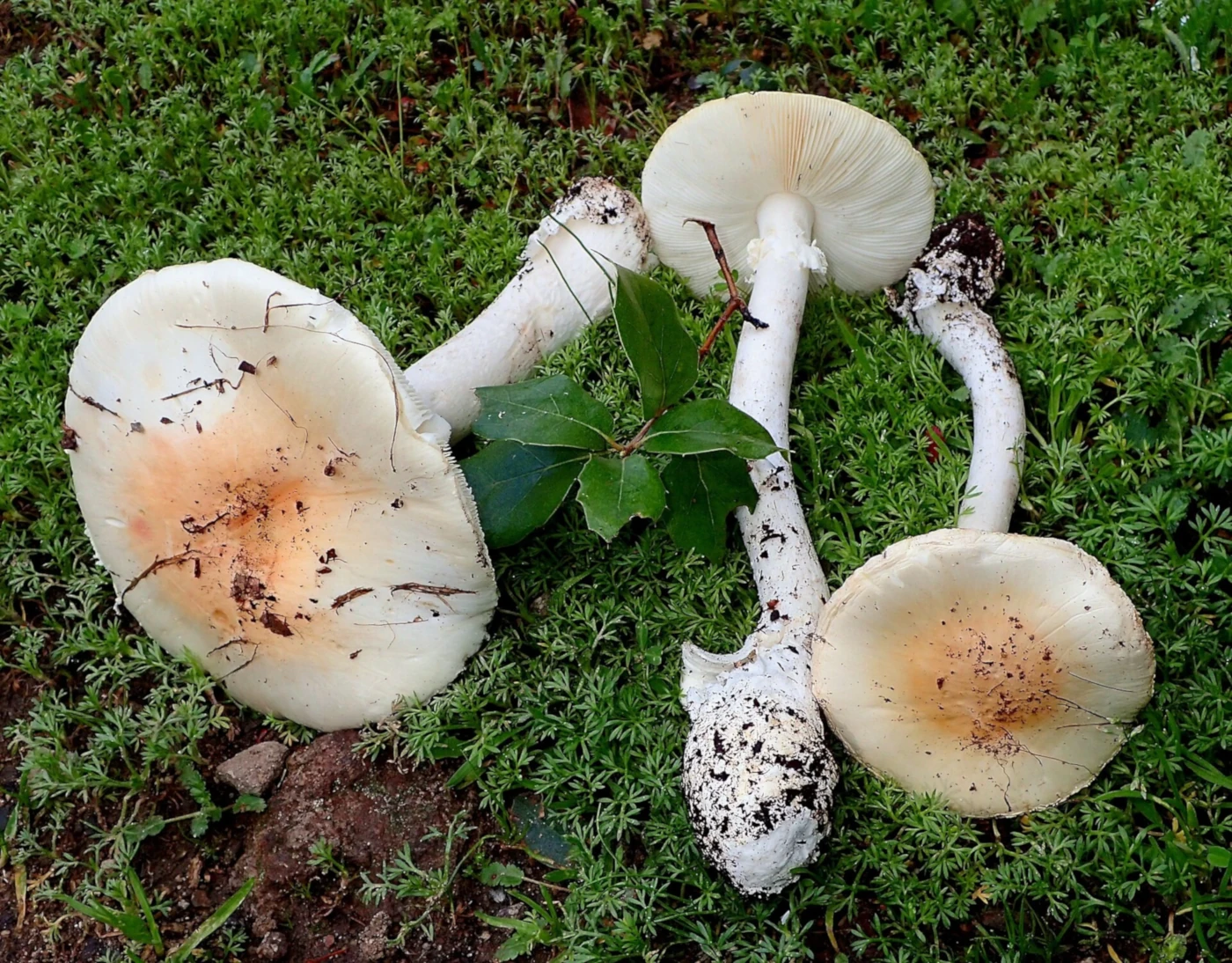
Amanita ocreata is another deadly white Amanita with a ring, white gills, and sac-like volva. It is primarily a western North American species and is especially important in California and nearby regions.
Its general appearance can overlap strongly with A. bisporigera. Geographic range is therefore one of the most useful distinctions.
Main Difference
Eastern North America strongly favors A. bisporigera, while western coastal North America favors A. ocreata. Both should be treated as equally dangerous.
Other Eastern Destroying Angels
Identification
Eastern North America contains additional white members of Amanita section Phalloideae that can resemble A. bisporigera. Some have different microscopic spores, KOH reactions, odors, or veil characteristics.
Exact species-level identification can therefore be difficult in the field. For safety purposes, recognizing the deadly destroying-angel group matters more than forcing an uncertain species name.
Main Difference
A white Amanita with ring and volva should be treated as a potentially deadly destroying angel regardless of whether the exact species can be established. Microscopic or chemical characters may be needed for precise separation.
Agaricus Species
Identification
White Agaricus species can have smooth pale caps and stem rings. Young mushrooms may look superficially similar from above.
The gills provide a major difference. Agaricus gills typically begin pinkish and become dark brown, and there is no sac-like volva at the base.
Main Difference
Pink-to-brown gills + brown spore print + no volva = Agaricus. White gills + white spores + sac-like volva = dangerous Amanita pattern.
Leucoagaricus leucothites — White Dapperling
Identification
White Dapperling is a pale lawn and grassland mushroom with white gills and a stem ring. Its clean white appearance can resemble a destroying angel, particularly when the stem base is not visible.
It lacks a true sac-like volva. Habitat also tends to be more open and grassy rather than woodland.
Main Difference
The absence of a volva is important, but white dapperlings should not be treated casually as edible look-alikes. Any uncertain white ringed mushroom deserves extreme caution.
Volvopluteus gloiocephalus — Stubble Rosegill
Identification
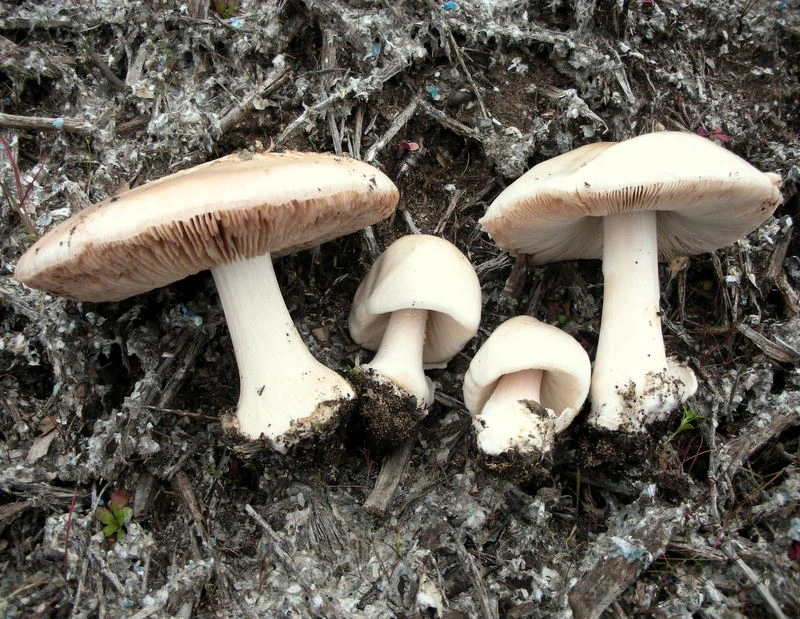
Volvopluteus gloiocephalus has a sac-like volva and can initially resemble Amanita. Young gills are pale, which increases confusion.
As the mushroom matures, the gills become distinctly pink from its pink spores. It also lacks the prominent persistent stem ring typical of destroying angels and usually occurs in disturbed soil, gardens, fields, compost-rich ground, or similar habitats.
Main Difference
Pink mature gills + pink spore print + no substantial ring favor Volvopluteus. White mature gills + white spores + ring favor Amanita bisporigera.
Young Puffballs
Identification
Very young Amanitas may remain enclosed in universal veil tissue and look like white balls before the cap and stem fully emerge. From the outside they can resemble young puffballs.
Cutting the fruit body vertically exposes the difference. An Amanita button contains a developing cap, gills, and stem inside, while a true young puffball is homogeneous throughout.
Main Difference
Any internal mushroom anatomy immediately rules out a puffball. A true young puffball should contain uniform white tissue with no hidden gills or stem.
Eastern Destroying Angel vs White Agaricus
| Feature | Amanita bisporigera | White Agaricus |
|---|---|---|
| Young gills | White | Pale pink to pink |
| Mature gills | White | Dark brown |
| Spore print | White | Brown |
| Ring | Present | Usually present |
| Volva | Present | Absent |
| Habitat | Woodland near trees | Lawns, fields, woodland depending on species |
| Toxicity | Deadly | Varies by species |
| Best clue | White gills + volva | Gills become brown |
This comparison shows why the entire mushroom must be examined. A cap and ring alone do not provide enough information.
Eastern Destroying Angel vs Volvopluteus
| Feature | Amanita bisporigera | Volvopluteus gloiocephalus |
|---|---|---|
| Cap | White to ivory | White, grayish, pale brown |
| Young gills | White | White to pale |
| Mature gills | White | Pink |
| Spore print | White | Pink |
| Ring | Present | Absent |
| Volva | Present | Present |
| Ecology | Mycorrhizal near trees | Saprotrophic disturbed soil |
| Best clue | Ring + white spores | Pink spores + no ring |
Young specimens are harder because the pink gills of Volvopluteus have not yet developed. Mature mushrooms provide much stronger evidence.
How to Identify Amanita bisporigera
Start by keeping the entire stem base intact. A white mushroom with a sac-like volva should immediately place deadly Amanita species high on the list.
Then inspect the gills and ring. White mature gills, a white spore print, a high skirt-like ring, and a smooth white cap create the classic destroying-angel combination.
Geography then helps refine the species. In eastern North America, Amanita bisporigera is one of the most important candidates.
Why the Stem Base Matters So Much
The volva is often partly or completely buried. A mushroom casually cut at ground level may therefore appear to have an ordinary straight stem.
Dig around the base and remove the entire fruit body carefully when identifying Amanitas. This is one of the most important habits for avoiding dangerous mistakes.
Young vs Mature Eastern Destroying Angels
Young specimens may have a rounded cap and a compact overall appearance. Very young mushrooms can remain partly enclosed in universal veil tissue.
Mature caps become broad and open while the ring and volva become easier to interpret. Old specimens may develop damaged or collapsed veil structures, so several ages from the same collection can be informative.
Chemical KOH Reaction
Amanita bisporigera is known for producing a bright yellow reaction when potassium hydroxide is applied to the cap surface. This can help separate it from some similar eastern destroying angels.
This is an advanced identification character rather than a beginner safety test. A negative or uncertain home chemical reaction should never be used to declare a white Amanita harmless.
Common Identification Mistakes
One common mistake is assuming that an all-white mushroom is automatically an edible parasol or Agaricus. Several of the most dangerous Amanitas are nearly pure white.
Another mistake is leaving the stem base behind. Doing so can remove the volva and make a deadly Amanita appear much less distinctive.
A third mistake is applying European names such as Amanita virosa to every North American destroying angel. Regional taxonomy matters, and eastern North America has its own important species.
How to Photograph Amanita bisporigera
Photograph the mushroom before removing it so the woodland habitat and nearby trees are visible. Then carefully expose the entire stem base and include the volva in a side photograph.
Take additional images of the gills, ring, and cap surface. A single overhead photograph of a white cap is insufficient for a meaningful Amanita identification.
Can AI Identify Eastern Destroying Angel?
AI can recognize the general destroying-angel pattern when the white cap, gills, ring, and complete volva are visible. It is much less reliable when the stem base is missing or when the mushroom is still very young.
Exact separation among white Amanita species can require geography, microscopy, and chemical reactions. AI or photo identification should never be used to decide that a white wild mushroom is safe to eat.
Interesting Facts
The scientific name bisporigera refers to the species’ unusual microscopic basidia, which were classically described as often producing two spores. This microscopic feature helped separate it from similar destroying angels.
The almost completely white fruit body is deceptive because there are few visual warning colors. Its toxicity comes from amatoxins rather than anything obvious about the mushroom’s appearance.
Amanita bisporigera is also a useful example of regional mushroom taxonomy. European destroying-angel names were historically applied to North American fungi, but eastern and western North America have distinct native species.
Like other mycorrhizal Amanitas, the fungus lives in partnership with trees. The deadly mushroom above ground is only the temporary reproductive structure of a larger underground fungal network.
Frequently Asked Questions
Is Amanita bisporigera deadly?
Yes. It contains amatoxins capable of causing severe and potentially fatal liver failure. No ordinary cooking method makes it safe.
Where does Eastern Destroying Angel grow?
It occurs in eastern North America, mainly in woodland associated with living trees. Oak and other hardwood forests are particularly important habitats.
Are the gills always white?
Yes, they remain white through maturity. This helps separate destroying angels from Agaricus species, whose gills become pink and then brown.
Does it always have a ring?
Typical specimens have a thin skirt-like ring, but rings can be damaged or lost with age. The absence of a visible ring should not be used to declare a suspicious white Amanita safe.
Does it always have a volva?
A volva is characteristic, but it can remain buried, tear apart, or be left behind when the mushroom is picked incorrectly. Always inspect the complete stem base.
Is Amanita bisporigera found in western North America?
It is principally an eastern North American species. Western destroying angels include other species, especially Amanita ocreata.
Can it look like a puffball when young?
Yes. Very young Amanitas can appear egg-shaped, but cutting them vertically reveals the developing cap, gills, and stem inside.
Can I identify it by white color alone?
No. Many harmless and dangerous mushrooms are white. Ring, volva, gills, spore color, habitat, geography, and overall structure are all important.
Final Identification Notes
Amanita bisporigera is best recognized by the combination of an all-white smooth cap, white crowded gills, white stem with a skirt-like ring, sac-like volva around the enlarged stem base, white spore print, and eastern North American woodland habitat.
The most important safety comparisons include white Agaricus, Leucoagaricus, Volvopluteus, young puffballs, and other destroying angels. The complete stem base and mature gill color are especially valuable for avoiding dangerous confusion.
The practical warning pattern is simple: white gills + ring + volva = treat as a potentially deadly Amanita. Never rely on a photograph or AI identification to decide that such a mushroom is safe to eat.
Upload a photo and get possible matches in seconds.