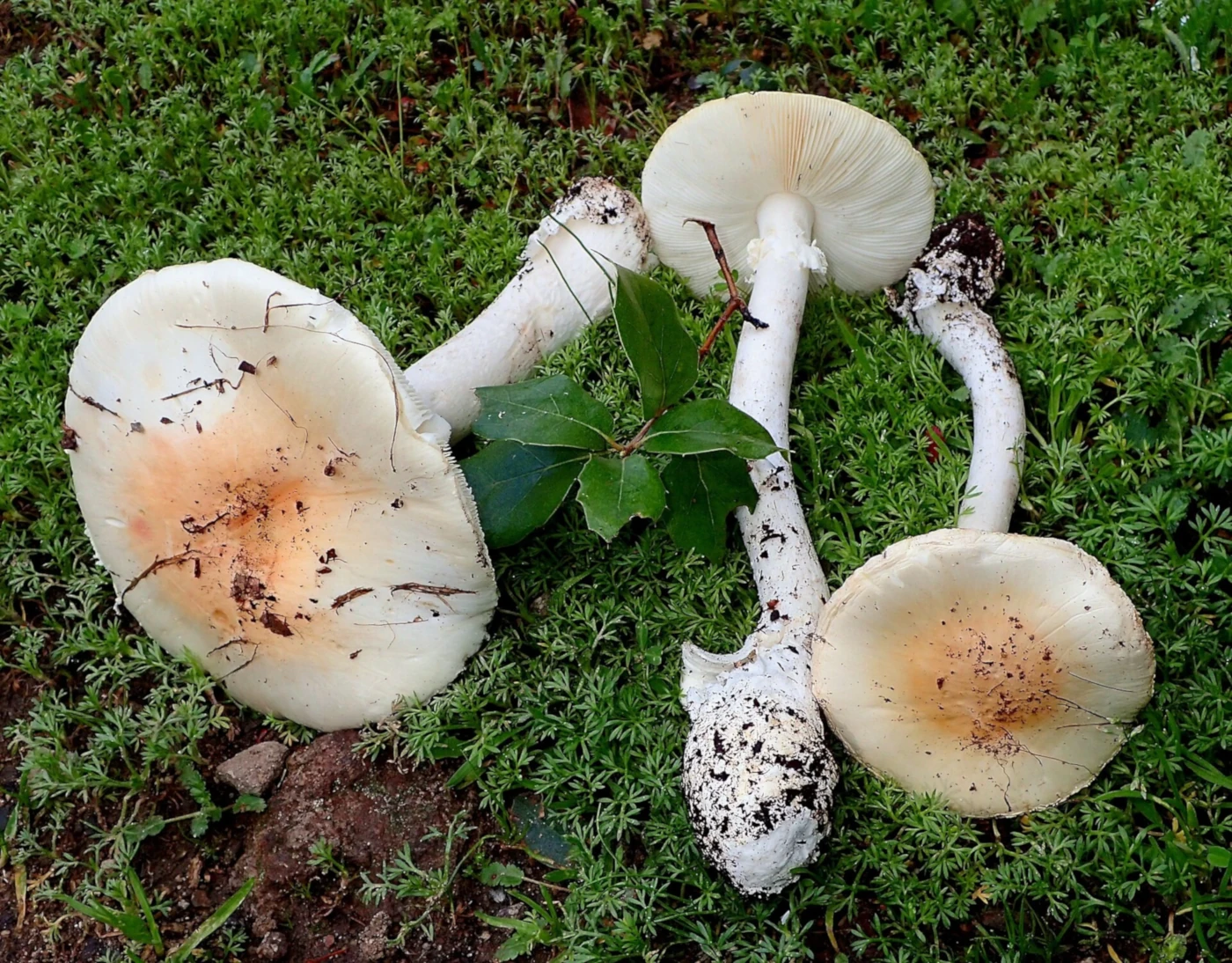
Amanita ocreata, commonly known as the Western Destroying Angel, is one of the most dangerous mushrooms in western North America. It is a pale to white Amanita with white gills, a ring on the stem, and a sack-like volva at the base, and it contains amatoxins capable of causing severe liver failure.
Its appearance can seem deceptively simple, especially when the cap is nearly white. The most reliable identification comes from checking the complete stem base, persistent pale gills, ring, habitat, and overall Amanita structure rather than relying on cap color alone.
⚠️ Important: This guide is for identification and education only. Never eat a wild mushroom based solely on photographs, AI identification, or an online comparison.
Quick Identification
| Feature | Amanita ocreata |
|---|---|
| Scientific name | Amanita ocreata |
| Common name | Western Destroying Angel |
| Family | Amanitaceae |
| Cap color | White to cream, tan, or pale ochre |
| Cap shape | Convex to broadly expanded |
| Gills | White, free or nearly free |
| Stem | White to pale |
| Ring | Usually present |
| Volva | Large, sack-like, at stem base |
| Flesh | White |
| Spore print | White |
| Ecology | Mycorrhizal |
| Main region | Western North America |
| Typical habitat | Oak woodland, mixed woodland, parks |
| Season | Mainly winter through spring in Mediterranean-climate regions |
| Toxicity | Deadly poisonous |
| Main look-alikes | White Agaricus, Volvopluteus, other pale Amanitas |
What Does Amanita ocreata Look Like?
The Western Destroying Angel is typically pale, elegant, and relatively large. Young specimens may be almost entirely white, while older caps can develop cream, tan, or pale ochre tones.
The mushroom has the classic Amanita structure: white gills, a pale stem, a ring, and a volva at the base. The complete stem base is therefore essential for identification.
Unlike some Amanitas, the cap usually lacks obvious persistent warts or large patches. This smooth appearance can make mature specimens look less obviously like a dangerous Amanita.
Cap
The cap begins rounded or convex and gradually expands with age. Mature caps can become broadly convex to nearly flat.
Color ranges from white to cream, pale tan, or ochre. Weather and age can create more noticeable brownish or yellowish tones.
Cap Surface
The surface is generally smooth and may become slightly sticky when wet. Obvious universal veil patches are usually absent or much less prominent than on species such as Fly Agaric or Panther Cap.
The margin may become slightly lined in older specimens, but this is not the main identification feature. The stem base and gills are far more important.
Gills
The gills are white and remain pale as the mushroom matures. They are crowded and typically free or nearly free from the stem.
This persistent white color is a major clue when comparing A. ocreata with Agaricus species. Agaricus gills become pink and later chocolate brown.
Why Mature Gill Color Matters
Young mushrooms can be misleading because several unrelated genera begin with pale gills. Mature specimens reveal whether the gills stay white or darken with spore development.
A large mature mushroom with persistent white gills, a ring, and a volva should immediately suggest Amanita. This combination deserves serious caution.
Stem
The stem is white to pale cream and usually fairly tall and slender. It may widen toward the base.
A ring is commonly present on the upper stem. This ring can be membranous but may become damaged or less obvious with age.
Ring
The partial veil leaves a ring beneath the cap. Young mushrooms may show the structure especially clearly.
Weathering can tear or collapse the ring. Its absence in an old mushroom does not rule out Amanita ocreata.
The Volva: The Most Important Feature
The base of the stem sits in a prominent sack-like volva. This is one of the strongest features for identifying Amanita ocreata and separating it from many pale gilled mushrooms.
The volva may be partly or completely buried. A mushroom cut off at ground level can therefore lose the very feature needed for safe identification.
How to Check the Stem Base
Carefully remove the mushroom with the entire base intact. Do not simply slice through the stem above the soil.
Look for a loose cup or sack surrounding the bulbous or widened base. If the base is missing, the identification should remain incomplete.
Flesh
The flesh is white and does not show dramatic bruising when cut. It is relatively firm in fresh specimens.
Color change is not a key feature for this species. The Amanita structures around the stem and gills are much more informative.
Smell
Odor can be mild in young specimens and become more noticeable with age. Older fruit bodies may develop a stronger or unpleasant smell.
Smell is too subjective to function as a primary identification feature. It should never outweigh the structural clues.
Spore Print
The spore print is white. This supports identification as an Amanita-type mushroom but is not unique to Amanita ocreata.
Many pale Amanitas also have white spores. Geography, volva shape, cap appearance, and habitat remain necessary for species-level identification.
Where Does Amanita ocreata Grow?
Amanita ocreata is a mycorrhizal fungus that grows from soil near living trees. It does not grow directly from dead wood.
It is especially associated with western North American oak habitats and other compatible hardwoods. Woodland edges, parks, and landscaped areas with mature trees can also support it.
Distribution
The species is characteristic of western North America, especially regions with Mediterranean-type climates. California is particularly well known for it.
Its range and ecology differ from the classic European Destroying Angels. This is why geography is essential when identifying pale Amanitas.
Why Regional Names Matter
“Destroying Angel” is a common name used for several deadly white Amanitas. In eastern North America, other species are more typical, while Amanita ocreata is especially important in the West.
A white deadly Amanita in California is therefore a different identification problem from a similar mushroom in Europe or eastern North America.
When Does Amanita ocreata Grow?
In much of its range, Amanita ocreata fruits during the cool wet season. Winter through spring is especially important in Mediterranean-climate areas.
Rainfall strongly influences fruiting. A wet winter can produce many mushrooms around suitable host trees.
Why Its Season Can Surprise Mushroom Hunters
Many people associate dangerous Amanitas mainly with autumn. In California and nearby regions, A. ocreata can be especially relevant in winter and spring.
This seasonal difference is important because it means serious Amanita risk continues long after the classic autumn mushroom season ends.
How Toxic Is Amanita ocreata?
Amanita ocreata contains amatoxins and is considered deadly poisonous. These toxins primarily damage the liver and can also affect other organs.
The poisoning pattern is especially dangerous because symptoms may not begin for many hours after ingestion. By the time severe illness becomes obvious, significant internal damage may already have occurred.
Amanita ocreata Poisoning
The first phase often involves severe gastrointestinal symptoms. Nausea, vomiting, abdominal pain, and diarrhea may appear after a long symptom-free delay.
A temporary improvement can follow, creating the false impression that the danger has passed. Liver injury can then become severe during the following phase.
Why Delayed Symptoms Matter
Fast symptom onset is not required for a mushroom to be dangerous. Amatoxin poisoning is famous precisely because of its delayed beginning.
Any suspected ingestion of Amanita ocreata or another deadly Amanita requires urgent medical evaluation. Waiting for symptoms can be dangerous.
Amanita ocreata Look-Alikes
The most concerning look-alikes are other white or pale mushrooms growing from soil. Young Agaricus species, Volvopluteus, and other Amanitas can all create confusion.
The safest distinction comes from checking gill color, ring presence, volva, spore print, and habitat together. White cap color alone is almost useless.
White Agaricus Species
Identification
Some young Agaricus mushrooms can be white and have a ring, creating a superficial resemblance. Their gills, however, do not remain white.
Young gills typically become pink and then dark chocolate brown as the spores mature. Agaricus also lacks the sack-like volva of Amanita ocreata.
Main Difference
Persistent white gills plus a volva strongly favor Amanita. Pink to brown mature gills without a volva favor Agaricus.
This distinction becomes much easier when mature specimens are available.
Amanita ocreata vs Agaricus
| Feature | Amanita ocreata | Agaricus species |
|---|---|---|
| Mature gills | White | Pink to chocolate brown |
| Spore print | White | Brown |
| Ring | Usually present | Usually present |
| Volva | Present | Absent |
| Stem base | Enclosed in sack-like volva | No volva |
| Safety | Deadly poisonous | Varies by species |
The volva is the most important structural clue. Mature gill color provides another strong distinction.
Volvopluteus Species
Identification
Volvopluteus species can have a pale cap and a prominent volva at the stem base. This makes them one of the more convincing structural look-alikes.
The key difference is in the gills and spores. Mature Volvopluteus develops pink gills and a pinkish spore print.
Main Difference
A volva does not automatically mean Amanita. Mature gill and spore colors are therefore critical when comparing these groups.
White gills and white spores point toward Amanita, while pink maturation points toward Volvopluteus.
Other Pale Amanitas
Several other Amanita species can look similar to A. ocreata. Some may also be deadly, while others differ in ecology, cap color, volva shape, or microscopic features.
This is why exact species identification can be difficult from photographs alone. Recognizing a mushroom as a dangerous pale Amanita is often more important than forcing an uncertain species name.
Amanita ocreata vs Amanita phalloides
Both species can contain amatoxins and share white gills, a ring, and a volva. Amanita phalloides usually has a more olive, greenish, or brownish cap, although pale forms exist.
Amanita ocreata is generally paler and is particularly associated with western North America. Geography and season are therefore useful supporting clues.
Quick Comparison
| Feature | Amanita ocreata | Amanita phalloides |
|---|---|---|
| Typical cap | White to cream or ochre | Olive, greenish, brownish, sometimes pale |
| Gills | White | White |
| Ring | Usually present | Usually present |
| Volva | Sack-like | Sack-like |
| Main region | Western North America | Europe; introduced in other regions |
| Toxicity | Deadly | Deadly |
Both should be treated as medical emergencies if ingested. Separating them exactly is less important than recognizing the deadly Amanita pattern.
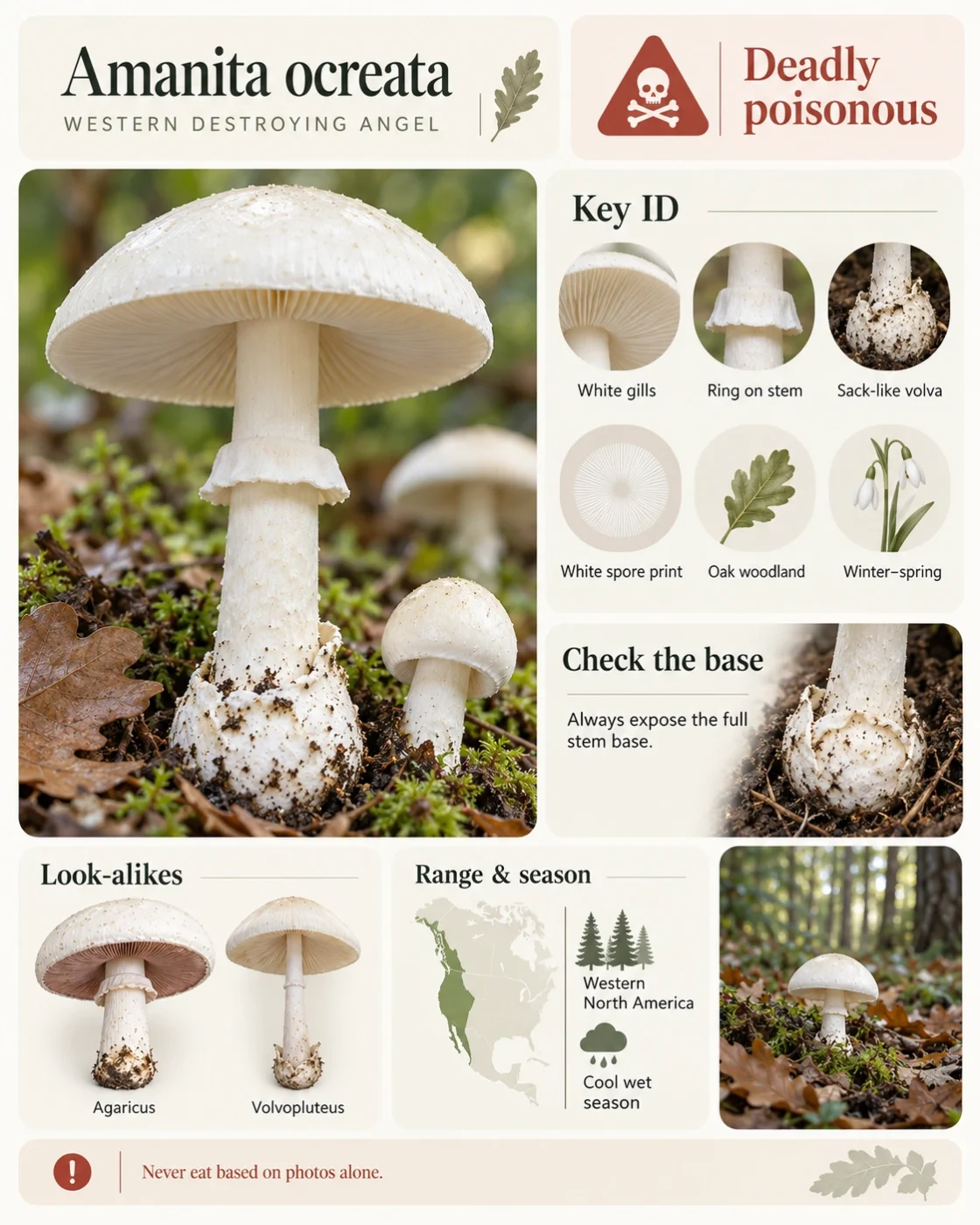
How to Identify Amanita ocreata Step by Step
Begin with the complete mushroom rather than the cap. Confirm persistent white gills, a pale stem, and the presence of a ring.
Then expose the entire base and look for a sack-like volva. Finally, consider western North American geography, host trees, and cool-season fruiting.
Step 1: Check Mature Gill Color
Look for a mature specimen and confirm that the gills remain white. Pink or brown gills point away from Amanita ocreata.
Young mushrooms alone can be misleading. Mixed-age groups are much easier to evaluate.
Step 2: Find the Volva
Expose the base carefully and look for the loose sack around the stem. Missing this structure is one of the most dangerous identification errors.
Do not assume the volva is absent simply because it is not visible above ground. It may be completely buried.
Step 3: Check for a Ring
Look beneath the cap for a membranous ring or remnants of one. The ring supports Amanita identification but may be damaged.
A ring without a volva is not enough. Both structures should be considered together.
Step 4: Consider Region and Season
A pale deadly Amanita appearing in western North America during winter or spring is consistent with Amanita ocreata. The same-looking mushroom in another region may belong to a different Amanita species.
Geography narrows the possibilities but should never override morphology. The complete structure still matters most.
How to Photograph Amanita ocreata for Identification
Take the first photo before disturbing the mushroom so the habitat and growth pattern remain visible. Include nearby trees whenever possible.
Then photograph the underside, complete stem, ring, and especially the full stem base. A close-up of the volva is one of the most valuable images.
A vertical cut can document the white flesh, but the stem base should be photographed intact first. Cutting before documenting the volva can destroy useful evidence.
Can AI Identify Amanita ocreata?
AI can often recognize a pale Amanita-like mushroom when the ring, gills, and volva are clearly visible. Species-level identification becomes more difficult because several deadly white Amanitas share nearly identical structures.
Geography and season can improve the result significantly. A photograph from California in winter carries different context from an identical-looking specimen found in Europe in autumn.
AI should therefore help flag a possible deadly Amanita rather than provide reassurance about edibility. Any uncertain pale Amanita should be treated conservatively.
Common Identification Mistakes
One common mistake is photographing only the cap. A smooth white or cream cap contains very little diagnostic information by itself.
Another mistake is leaving the volva underground. This removes one of the most important structural clues before identification even begins.
A third mistake is assuming that “Destroying Angel” refers to one universal species. Several deadly white Amanitas share that common name in different regions.
Frequently Asked Questions
Can Amanita ocreata appear darker than expected after dry weather?
Yes. Older or weathered caps can develop cream, tan, or ochre coloration, so not every specimen looks pure white. The structural Amanita features remain more reliable than exact cap color.
Can heavy rain damage the ring or volva?
Yes. Veil structures can tear, collapse, or become less obvious after rain and physical damage. This is why several specimens at different ages are especially useful when available.
Why are young button-stage Amanitas particularly risky?
Young Amanitas may still be enclosed in veil tissue and can look like small white balls or other immature mushrooms. Cutting one vertically can reveal a developing cap, gills, and stem inside rather than the uniform interior of a true puffball.
Can Amanita ocreata fruit in landscaped urban areas?
Yes. Mycorrhizal fungi can follow the roots of planted trees into parks, gardens, and roadside landscapes. A suburban setting does not make a pale Amanita harmless.
Can animals eat Amanita ocreata without becoming ill?
Animal feeding does not establish human safety. Different species tolerate toxins differently, and visible bite marks should never be treated as evidence of edibility.
Why can one patch produce mushrooms again in later years?
The underground mycelium can persist in association with the same host-tree roots for many years. Fruiting depends on suitable rainfall, temperature, and tree health rather than the fungus being newly introduced each season.
What if the volva was accidentally left in the ground?
The mushroom should be treated as incompletely documented. If the identification matters, return to the exact spot if possible and inspect the remaining stem base or nearby intact specimens.
Can a nearly white Death Cap be mistaken for Amanita ocreata?
Yes, especially in areas where both taxa or introduced populations may be relevant. If the mushroom clearly fits the deadly Amanita pattern, exact species naming is less important than recognizing the poisoning risk.
Final Identification Notes
Amanita ocreata is best recognized by the combination of persistent white gills, a pale cap and stem, a ring, a large sack-like volva, white spores, and growth near living trees in western North America.
The volva is the most important feature to preserve during collection for identification. A pale mushroom cut off above ground can become much harder to distinguish from Agaricus and other look-alikes.
Most importantly, the Western Destroying Angel should be recognized as part of the deadly Amanita pattern. When white gills, a ring, and a volva occur together, the mushroom should be treated with extreme caution regardless of how plain or harmless it appears.
Upload a photo and get possible matches in seconds.