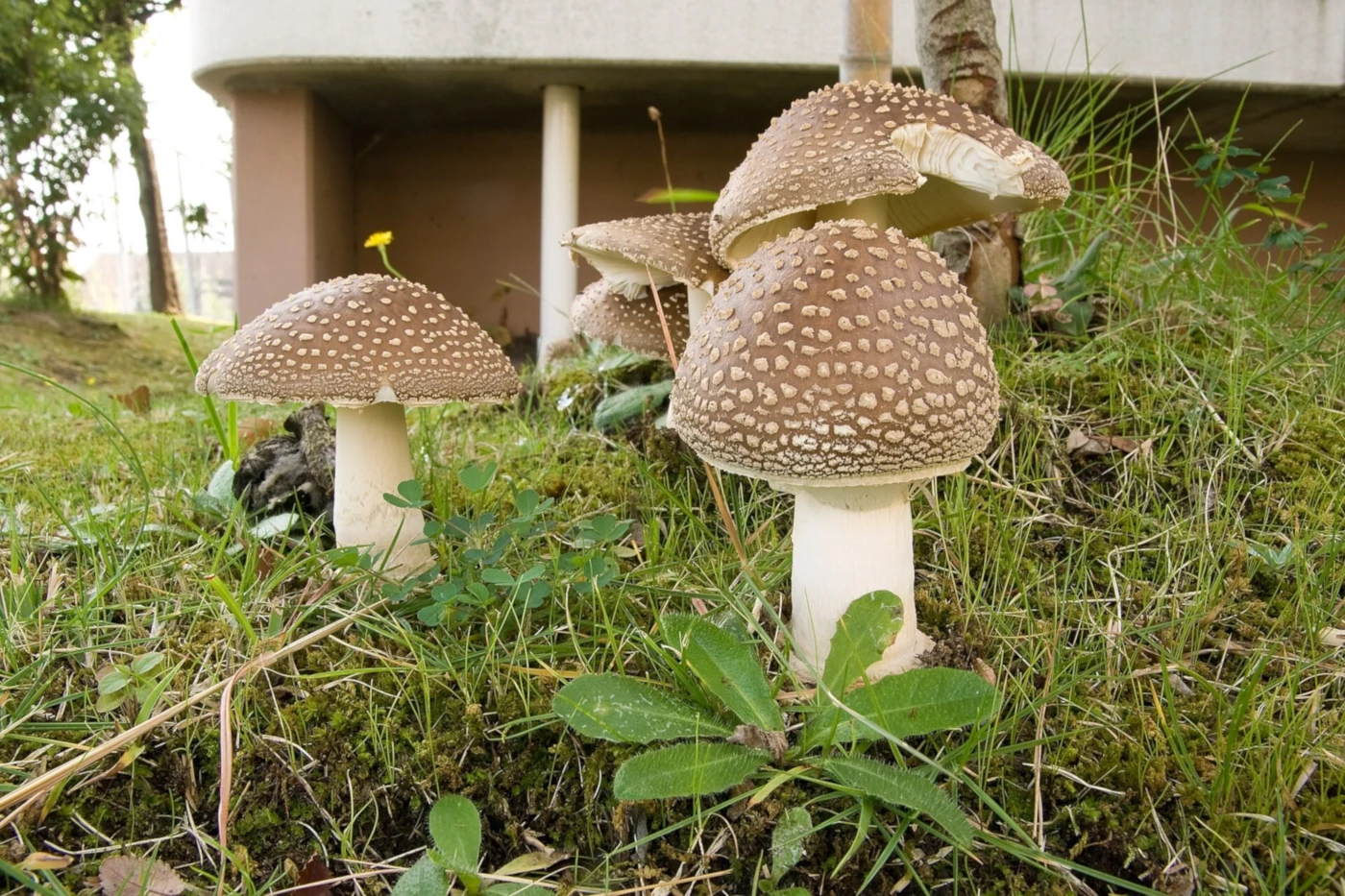
Amanita pantherina, commonly known as the Panther Cap, is a poisonous woodland mushroom recognized by its brown cap, white veil patches, white gills, and a pale stem with a ring and enlarged base. It is closely related to Amanita muscaria, the Fly Agaric, and contains similar psychoactive and neurotoxic compounds.
The species can be confused with other brown Amanitas, including the edible Blusher in regions where that mushroom is collected. Because some look-alikes are difficult to separate from photographs alone, identification should always include the complete stem base, bruising reactions, cap surface, gills, ring, habitat, and geographic region.
⚠️ Important: This guide is for identification and education only. Never eat a wild mushroom based solely on a photograph, AI result, or comparison with an online guide.
Quick Identification
| Feature | Amanita pantherina |
|---|---|
| Scientific name | Amanita pantherina |
| Common name | Panther Cap |
| Family | Amanitaceae |
| Cap color | Brown to gray-brown |
| Cap surface | Usually covered with white veil patches |
| Gills | White, crowded, free |
| Stem | White to cream |
| Ring | Usually present |
| Stem base | Bulbous with distinct veil remnants |
| Spore print | White |
| Habitat | Woodland near host trees |
| Ecology | Mycorrhizal |
| Main season | Summer through autumn |
| Toxicity | Poisonous |
| Main compounds | Ibotenic acid and muscimol |
| Main look-alikes | Amanita rubescens, Amanita excelsa, Amanita muscaria |
What Does Amanita pantherina Look Like?
The Panther Cap has a classic Amanita appearance. Mature specimens usually have a broad brown cap dotted with white patches, white gills, a pale stem with a ring, and a distinctly enlarged stem base.
The cap may be dark chocolate-brown, medium brown, gray-brown, or lighter depending on age and weather. White patches are usually scattered across the surface and represent remnants of the universal veil that enclosed the young mushroom.
Rain can wash some or all of these patches away, so a smooth brown cap does not completely rule out the species.
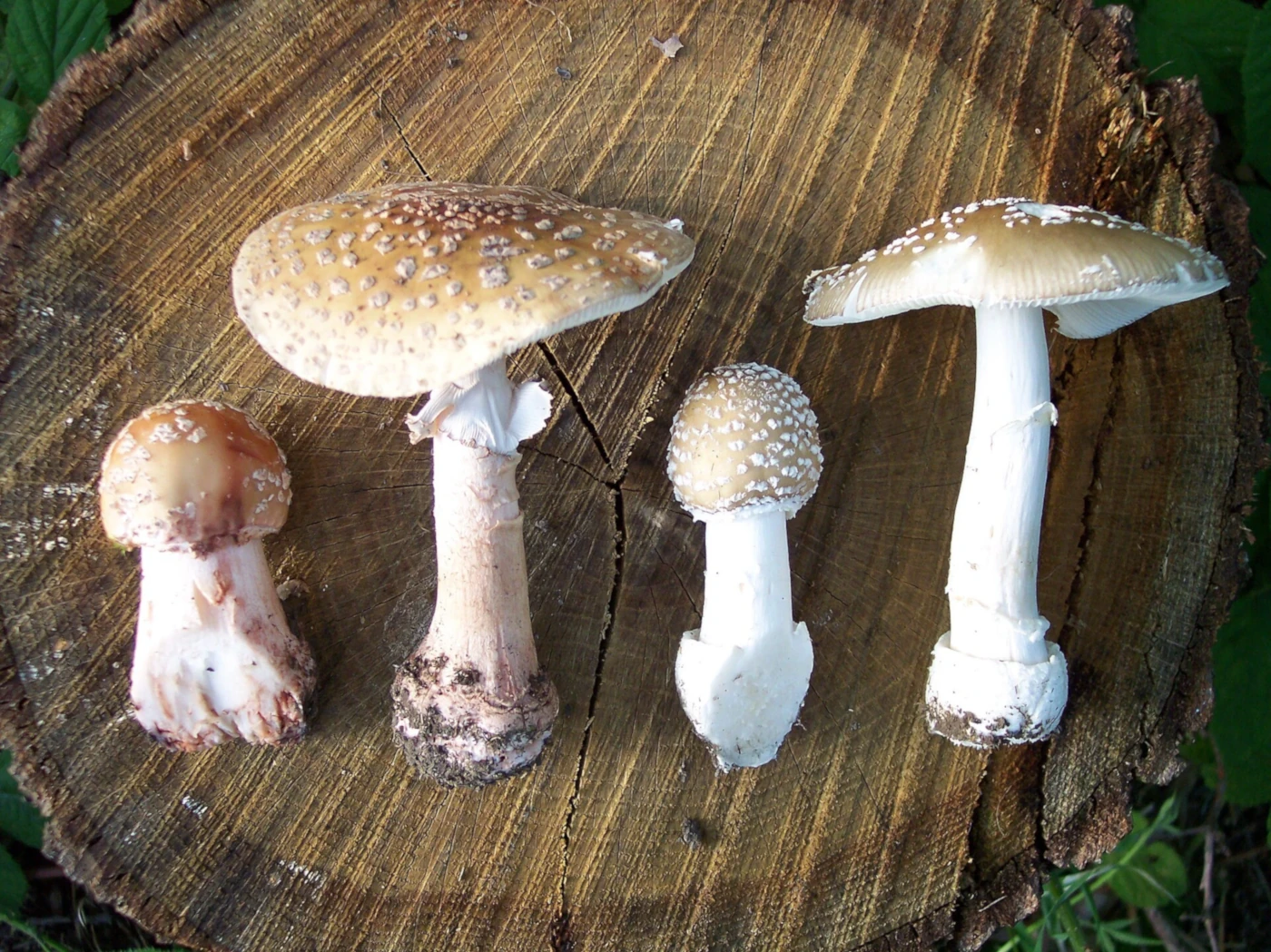
Cap
The cap begins rounded or hemispherical and becomes convex, then flatter with age. Mature caps can become fairly broad.
Its surface is usually smooth beneath the veil remnants and can become slightly sticky in wet weather. White patches are often relatively small, distinct, and evenly distributed.
The cap margin may become visibly striated in mature specimens. These fine radial lines near the edge can provide another useful identification clue.
White Veil Patches
The white spots on the cap are remnants of the universal veil.
Unlike true scales that grow as part of the cap surface, these patches sit on top and may be removed by rain, handling, or age.
This means that relying on “brown cap with white spots” alone is unsafe. Other Amanitas can also have white veil remnants, and Panther Caps sometimes lose them.
Gills
The gills are white to cream and remain pale as the mushroom matures.
They are usually crowded and free from the stem, meaning they stop just before reaching it.
Persistent white gills are typical of many Amanitas, so gill color helps identify the genus but does not separate Panther Cap from every look-alike.
Stem
The stem is white to cream, cylindrical, and usually has a prominent ring on the upper half.
It may appear relatively smooth above the ring and more textured below. The stem is often somewhat hollow in mature specimens.
The base is one of the most important features and should always be exposed completely during identification.
Ring
The ring is usually white and membranous.
It may be fairly smooth and skirt-like, though it can become damaged or partly disappear in older specimens.
The presence of a ring is useful, but many Amanita species also have one, so it should never be used by itself.
Stem Base and Volva
The stem base is typically bulbous and surrounded by distinct remnants of the universal veil.
In Panther Cap, these remnants often form one or more collar-like or rim-like zones around the bulb rather than a deep sack-shaped volva like that of the Death Cap.
This basal structure is one of the most important differences between Amanita species.
Always remove the mushroom carefully from the soil rather than cutting it off at ground level if identification is required.
Spore Print
The spore print is white.
This is consistent with many Amanita species and can support genus-level identification.
However, white spores do not distinguish Panther Cap from other white-spored Amanitas.
Flesh
The flesh is white and generally does not develop strong reddish staining when cut or bruised.
This is especially important when comparing Panther Cap with Amanita rubescens, the Blusher, which characteristically develops reddish or pinkish discoloration after injury.
The absence of reddening is therefore a useful clue.
Smell
The odor is usually mild and not especially distinctive.
Some people describe mature specimens as having a slightly earthy or radish-like smell, but odor is subjective and variable.
It should be treated only as supporting information.
Where Does Amanita pantherina Grow?
The Panther Cap grows from soil in woodland because it forms mycorrhizal relationships with living trees.
It can occur in deciduous, coniferous, and mixed forests depending on region. Common associations include beech, oak, pine, spruce, and other suitable hosts.
The mushroom does not normally grow directly from logs or dead wood.
Distribution
Amanita pantherina is widely associated with Europe and parts of western Eurasia.
Reports from other regions sometimes involve related species that closely resemble true A. pantherina. This is especially important in North America, where several similar Amanitas may historically have been given the same name.
Geographic location should therefore be considered when making a species-level identification.
When Does Panther Cap Grow?
The main fruiting period is typically summer through autumn.
Fruiting often increases after periods of rain and moderate temperatures. In milder climates, the season can extend later.
The same woodland area may produce fruit bodies repeatedly in favorable years.
Is Amanita pantherina Poisonous?
Yes. The Panther Cap is poisonous. It contains ibotenic acid and muscimol, compounds that affect the central nervous system. These are also associated with Amanita muscaria. Effects can include confusion, agitation, altered perception, loss of coordination, drowsiness, delirium, nausea, vomiting, and changes in consciousness.
Panther Cap Poisoning
Symptoms can vary substantially depending on the amount eaten, individual sensitivity, and toxin concentration in the mushroom.
Neurological effects may alternate between agitation and sedation. Disorientation, unusual behavior, muscle movements, and impaired coordination can occur.
Severe poisoning can require medical observation and supportive treatment.
The mushroom should not be treated as safe because its toxins differ from the amatoxins found in Death Caps.
Is Amanita pantherina Deadly?
Fatal poisoning is less characteristic than with amatoxin-containing Amanitas such as Amanita phalloides, but severe intoxication is possible. The main syndrome is neurological rather than delayed liver failure. Because toxin levels and individual responses vary, suspected ingestion should be treated seriously.
Amanita pantherina Look-Alikes
Several brown Amanitas can resemble Panther Cap closely. The most important comparison is Amanita rubescens, especially in Europe, because it can share a brown cap with pale veil patches.
Amanita rubescens — The Blusher
- Scientific name: Amanita rubescens
- Common name: The Blusher
The Blusher can have a brown, reddish-brown, or gray-brown cap covered with pale veil patches. The key difference is the bruising reaction. Amanita rubescens typically develops pink, reddish, or wine-colored staining where damaged, especially in the flesh and around insect tunnels. Panther Cap generally remains white or pale when cut.
Panther Cap vs Blusher
| Feature | Amanita pantherina | Amanita rubescens |
|---|---|---|
| Cap | Brown with white patches | Brown to reddish with pale patches |
| Flesh after damage | Usually remains pale | Reddens or pinks |
| Stem base | Bulb with distinct collar-like veil zones | Bulbous, usually without same sharp rim |
| Cap margin | Often striated | Usually less distinctly striated |
| Toxicity | Poisonous | Edibility differs after preparation, but requires expert identification |
The staining reaction is one of the most useful distinctions, but it should still be combined with the stem base and cap margin.
Amanita excelsa — Grey Spotted Amanita
Amanita excelsa can also have a gray-brown or brown cap with pale veil remnants. It often looks less sharply patterned than Panther Cap and usually has different basal veil structures. The cap margin is generally less strongly striated. Species-level separation can be difficult, particularly with weathered specimens.
Amanita muscaria — Fly Agaric
Fly Agaric is closely related and shares many structural features. Typical Amanita muscaria has a red to orange-red cap with white patches, but faded specimens can become orange-brown or yellowish. The basal veil structure also differs, and color usually separates fresh specimens easily.
Panther Cap vs Fly Agaric
| Feature | Panther Cap | Fly Agaric |
|---|---|---|
| Cap color | Brown to gray-brown | Red to orange-red |
| Veil patches | White | White |
| Gills | White | White |
| Stem | White | White |
| Toxins | Ibotenic acid, muscimol | Ibotenic acid, muscimol |
| Toxicity | Poisonous | Poisonous |
Both species should be treated as toxic.
Amanita phalloides — Death Cap
The Death Cap may occasionally have a brownish or olive-brown cap and can superficially resemble a Panther Cap when veil patches are missing. However, Amanita phalloides usually lacks the characteristic white wart-like cap remnants of Panther Cap and has a sack-like volva at the base. The toxicology is also very different. Death Cap contains amatoxins capable of causing fatal liver failure.
How to Identify Amanita pantherina Step by Step
Begin with the cap. A brown cap with white universal veil patches is consistent with Panther Cap, especially when the margin shows fine striations.
Next, examine the underside and stem. The gills should be white, the stem pale, and a ring should usually be present.
Then expose the entire stem base. Look for a bulb with distinct collar-like veil remnants.
Finally, cut or bruise the mushroom. The absence of reddish staining helps separate Panther Cap from the Blusher.
Why the Stem Base Matters
Amanita identification often depends heavily on structures at or below soil level. If the mushroom is cut off above the ground, the bulb and volva remnants may be left behind. This can remove some of the strongest evidence needed to distinguish Panther Cap from related species.
How to Photograph Panther Cap for Identification
Photograph the cap from above so the color, white patches, and margin are visible. Take another image of the gills and ring. Then photograph the complete stem base after gently removing surrounding soil. A close-up of damaged flesh can also help document whether reddish staining develops.
Can Panther Cap Be Identified From a Photo?
Typical specimens can often be recognized from a good series of photographs. A single image from above is much less reliable because white veil patches may be washed away and several Amanitas share brown caps. The strongest photo set includes the cap, gills, ring, complete stem base, and a cut or bruised area.
Common Identification Mistakes
One common mistake is assuming every brown Amanita with white spots is Panther Cap.
Another is ignoring bruising reactions. Reddish staining can strongly suggest the Blusher rather than Panther Cap.
A third mistake is failing to dig out the complete stem base, which removes one of the most useful identification structures.
Panther Cap vs Brown Mushrooms Without a Volva
Many ordinary brown woodland mushrooms can superficially resemble a Panther Cap from above.
However, mushrooms outside Amanita may lack the combination of white free gills, stem ring, universal veil remnants, and bulbous base.
The complete structure is therefore far more important than cap color.
Are Panther Caps Always Covered With White Spots?
No.
Rain can wash the veil remnants away, while older mushrooms may retain only a few patches.
A smooth brown cap can therefore still potentially belong to a Panther Cap or another Amanita.
Can Panther Caps Grow in Parks?
Yes, if suitable host trees are present.
Like other mycorrhizal Amanitas, they can grow in woodland edges, parks, landscaped areas, and grassy areas beneath established trees.
They do not require untouched forest.
Frequently Asked Questions
What does Amanita pantherina look like?
It usually has a brown cap with white veil patches, white gills, a pale stem with a ring, and a bulbous base with veil remnants.
Is Amanita pantherina poisonous?
Yes. It contains ibotenic acid and muscimol and can cause significant neurological poisoning.
Does Panther Cap contain amatoxins?
Its characteristic poisoning is associated with ibotenic acid and muscimol rather than the amatoxin syndrome of Death Cap.
What color are Panther Cap gills?
The gills are white to cream.
What color is the spore print?
The spore print is white.
Where does Amanita pantherina grow?
It grows from soil near suitable trees in deciduous, coniferous, and mixed woodland.
When does Panther Cap appear?
It most commonly fruits from summer through autumn.
What is the main Panther Cap look-alike?
Amanita rubescens, the Blusher, is one of the most important look-alikes in Europe.
How can I tell Panther Cap from the Blusher?
The Blusher develops reddish or pinkish staining when damaged, while Panther Cap typically does not.
Can Panther Cap lose its white spots?
Yes. Rain and age can remove veil remnants from the cap.
Final Identification Notes
Amanita pantherina is best recognized by a combination of a brown cap with white veil remnants, white gills, a pale ringed stem, a bulbous base with collar-like veil zones, and flesh that does not redden strongly when damaged.
The most important look-alike is the Blusher, Amanita rubescens, which develops characteristic reddish staining. Fly Agaric and other brown Amanitas can also create confusion.
Never identify a Panther Cap from cap color or white spots alone. The complete stem base, bruising reaction, gills, ring, habitat, and geographic region should all be considered together.
Upload a photo and get possible matches in seconds.