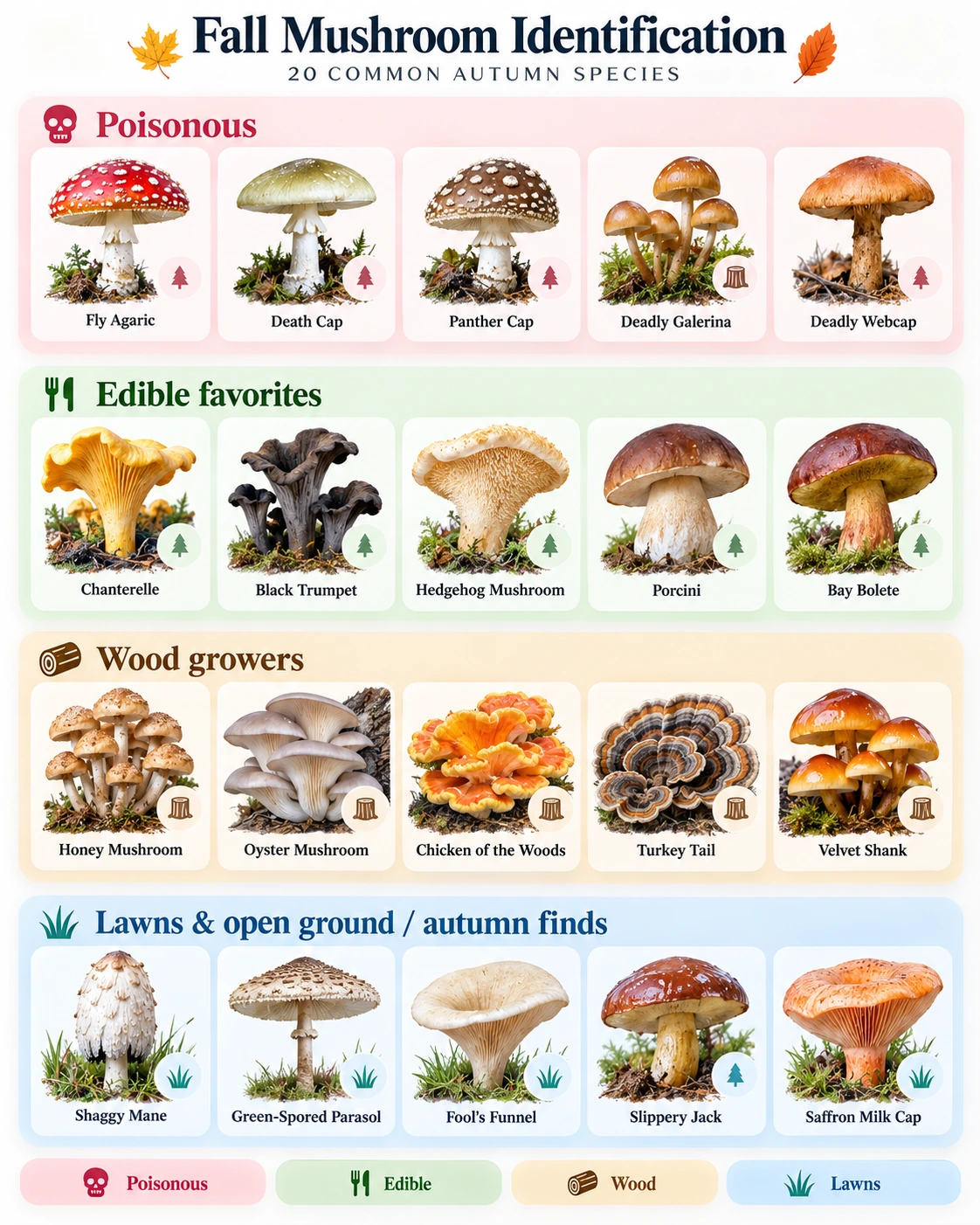
Autumn is one of the most productive seasons for mushroom hunting and identification. Cooler temperatures, moist soil, shorter days, and repeated rainfall encourage many fungi to produce fruit bodies in forests, lawns, parks, roadsides, and on dead wood.
This abundance also makes fall one of the most challenging seasons for beginners. Edible mushrooms can appear beside poisonous look-alikes, and several dangerous species are common at exactly the same time as popular edible mushrooms.
⚠️ Important: This guide is for identification and education only. Never eat a wild mushroom based solely on a photograph, AI result, or comparison with an online guide.
Quick Guide to 20 Common Fall Mushrooms
| Species | Common name | Typical habitat | Safety |
|---|---|---|---|
| Amanita muscaria | Fly Agaric | Woodland near trees | Poisonous |
| Amanita phalloides | Death Cap | Broadleaf woodland | Deadly poisonous |
| Amanita pantherina | Panther Cap | Woodland | Poisonous |
| Cantharellus species | Chanterelles | Forest soil | Edible when correctly identified |
| Craterellus cornucopioides | Black Trumpet | Hardwood forests | Edible when correctly identified |
| Hydnum repandum | Hedgehog Mushroom | Woodland soil | Edible when correctly identified |
| Boletus edulis | Porcini | Woodland near trees | Edible when correctly identified |
| Imleria badia | Bay Bolete | Conifer and mixed forests | Edible when correctly identified |
| Suillus luteus | Slippery Jack | Near pines | Edible when correctly identified |
| Lactarius deliciosus group | Saffron Milk Cap | Near pines | Edible when correctly identified |
| Armillaria species | Honey Mushrooms | Stumps and roots | Edibility varies |
| Galerina marginata | Deadly Galerina | Dead wood | Deadly poisonous |
| Coprinus comatus | Shaggy Mane | Lawns and disturbed soil | Edible when young and correctly identified |
| Chlorophyllum molybdites | Green-Spored Parasol | Lawns | Poisonous |
| Pleurotus ostreatus | Oyster Mushroom | Dead hardwood | Edible when correctly identified |
| Laetiporus sulphureus | Chicken of the Woods | Hardwood trunks and stumps | Edible when young and correctly identified |
| Trametes versicolor | Turkey Tail | Dead hardwood | Not a typical food mushroom |
| Cortinarius rubellus | Deadly Webcap | Woodland | Deadly poisonous |
| Clitocybe rivulosa | Fool’s Funnel | Lawns and grassland | Poisonous |
| Flammulina velutipes | Velvet Shank | Dead wood, cool weather | Edible when correctly identified |
Why Autumn Is Peak Mushroom Season
Autumn creates a combination of moisture and moderate temperatures that favors fungal fruiting. Soil remains relatively warm after summer while cooler air and frequent rain prevent the surface layers from drying too quickly.
Many mycorrhizal fungi respond by producing visible mushrooms around their host trees. At the same time, wood-decaying fungi become conspicuous on logs, stumps, dead roots, and weakened trees.
Because several species can fruit in the same habitat at once, identification should always focus on the complete mushroom rather than on color or season alone.
1. Amanita muscaria — Fly Agaric
Identification
Fly Agaric is one of the most recognizable autumn mushrooms. Its cap is usually red to orange-red and decorated with white remnants of the universal veil, although rain can wash many of these spots away.
The gills are white, and the pale stem usually carries a ring. The stem base is enlarged and has additional veil remnants, which are important for confirming Amanita identification.
Habitat and Season
Amanita muscaria grows from soil near living trees because it forms mycorrhizal relationships with their roots. Birch, pine, spruce, and several other trees can act as hosts.
Fruiting is especially common from late summer through autumn. Wet weather can produce large flushes containing many fruit bodies.
Safety
Fly Agaric is poisonous and contains ibotenic acid and muscimol. Poisoning can cause gastrointestinal symptoms, confusion, altered perception, poor coordination, and other neurological effects.
Its appearance is distinctive, but faded specimens can be less obvious. A washed-out orange Amanita should still be treated cautiously.
2. Amanita phalloides — Death Cap
Identification
The Death Cap usually has a smooth olive, greenish, grayish, brownish, or sometimes nearly white cap. The gills remain white, while the pale stem usually carries a ring.
The most important feature is the sack-like volva surrounding the stem base. This structure may be partly buried underground, so the whole base should be exposed when identifying an unknown Amanita.
Habitat and Season
Death Caps grow from soil near suitable broadleaf trees such as oak, beech, chestnut, and other hosts. They can occur in forests, parks, gardens, and landscaped areas.
Autumn is one of the major fruiting periods in temperate regions. Mild climates may support fruiting later into the year.
Safety
Amanita phalloides contains amatoxins capable of causing severe liver failure. Symptoms may be delayed for many hours, which makes the poisoning particularly dangerous.
A temporary period of apparent improvement can occur after the initial gastrointestinal stage while organ damage continues internally.
3. Amanita pantherina — Panther Cap
Identification
Panther Cap usually has a brown to gray-brown cap with white veil patches. The gills are white, the stem is pale, and a ring is normally present.
The bulbous stem base carries distinctive universal veil remnants. Unlike the Blusher, the flesh usually does not develop strong pink or reddish staining when damaged.
Habitat and Season
The species grows from soil in deciduous, coniferous, and mixed woodland. It forms mycorrhizal associations with living trees rather than decomposing dead wood.
Summer through autumn is the main fruiting season. White cap spots can disappear after heavy rain, making the basal structures even more important.
Safety
Panther Cap is poisonous and contains ibotenic acid and muscimol. The main effects are neurological and can include confusion, agitation, altered consciousness, and impaired coordination.
It should not be confused with amatoxin-containing Amanitas, because the poisoning syndrome is different even though both can be serious.
4. Cantharellus Species — Chanterelles
Identification
Chanterelles are usually yellow, golden, or orange-yellow with thick fleshy fruit bodies. Their cap margins often become wavy or irregular as they mature.
The underside has blunt ridges or folds rather than thin blade-like true gills. These false gills often fork and run down the stem.
Habitat and Season
Chanterelles grow from soil in association with living trees. Different species occur in both deciduous and coniferous forests across Europe and North America.
Many fruit from summer into autumn. Warm wet periods can produce abundant flushes over relatively large areas of forest floor.
Look-Alikes
The most important comparison is with Jack-o’-Lantern mushrooms, which have true gills and commonly grow from wood or buried roots. False Chanterelles are another orange gilled look-alike.
The underside structure is usually more useful than cap color. True chanterelles should not have sharp, separate gill blades.
5. Craterellus cornucopioides — Black Trumpet
Identification
Black Trumpets are dark gray to nearly black and have thin funnel-shaped fruit bodies. Their edges are often irregular and curled.
The outer fertile surface is smooth to slightly wrinkled and lacks true gills. This unusual structure makes the mushroom look more like a hollow trumpet than a conventional cap-and-stem species.
Habitat and Season
They grow from woodland soil, especially in association with hardwood trees. Fallen leaves can hide them almost completely despite their relatively large size.
Late summer and autumn are important fruiting periods. Productive locations can sometimes produce many mushrooms across a small area.
Safety
Black Trumpets are regarded as edible when correctly identified. Their shape is distinctive, but dark woodland fungi should still be checked carefully before use.
6. Hydnum repandum — Hedgehog Mushroom
Identification
The Hedgehog Mushroom has a cream, yellowish, or pale orange cap. The underside is covered with soft downward-pointing teeth instead of gills or pores.
The stem is solid, and the flesh is thick and relatively brittle. This combination of features makes Hydnum one of the easier woodland groups to recognize.
Habitat and Season
It grows from soil near both hardwoods and conifers. Mossy forest floors and areas with deep leaf litter are common habitats.
Fruiting usually occurs from late summer through autumn. Wet years can produce large numbers of fruit bodies.
Safety
Hydnum repandum is considered edible when correctly identified. Most confusion is with closely related Hydnum species rather than dangerous gilled mushrooms.
7. Boletus edulis — Porcini
Identification
Porcini has a brown cap, thick pale to brownish stem, and a sponge-like pore surface underneath instead of gills. The upper stem often displays a fine pale net-like pattern.
Young pores are whitish and become more yellow or olive as the mushroom ages. The flesh usually remains pale and does not show dramatic blue bruising.
Habitat and Season
Boletus edulis grows in mycorrhizal association with several tree species. Spruce, pine, birch, oak, and beech can all be important depending on region.
Autumn is a major season for Porcini in temperate forests. Fruiting often follows substantial rainfall.
Look-Alikes
Several boletes can resemble Porcini. Important differences include stem pattern, pore color, bruising reactions, and overall cap texture.
8. Imleria badia — Bay Bolete
Identification
Bay Bolete has a chestnut to dark brown cap and yellow pores underneath. The pore surface can develop blue or blue-green staining when pressed or damaged.
The stem is brownish and usually lacks the pronounced reticulation of classic Porcini.
Habitat and Season
It is common in coniferous and mixed forests, especially near spruce and pine. It may appear singly or in scattered groups.
Wet autumn weather can produce very large numbers. It is one of the more familiar brown boletes in suitable European forests.
Safety
Bay Bolete is widely regarded as edible when correctly identified. As with all boletes, the pore surface and bruising reaction should be examined carefully.
9. Suillus luteus — Slippery Jack
Identification
Slippery Jack has a brown cap with a distinctly slimy or sticky surface in wet conditions. The underside has yellow pores rather than gills.
The stem normally has a ring. This combination of sticky cap, yellow pores, and pine habitat makes mature specimens relatively recognizable.
Habitat and Season
The species is strongly associated with pine trees. It can appear in forests, plantations, roadside plantings, and grassy places where pine roots are present.
Autumn is one of its main fruiting seasons. Groups can become abundant after rain.
Safety
Suillus luteus is generally considered edible when correctly identified and prepared. Some people remove the slimy cap skin, and gastrointestinal sensitivity can occur.
10. Lactarius deliciosus Group — Saffron Milk Caps
Identification
Saffron Milk Caps are orange mushrooms that often display darker concentric rings on the cap. When damaged, the gills and flesh release orange latex.
Green staining can develop with age or injury. This combination of orange latex and green discoloration is highly characteristic of the group.
Habitat and Season
These mushrooms are strongly associated with pine and related conifer roots. They grow from soil rather than from wood.
Autumn is an important season, and large numbers may appear in suitable pine forests after rain.
Safety
Several species in the group are widely collected as edible mushrooms. Other orange milkcaps can differ in taste and edibility, so latex color and host tree should both be checked.
11. Armillaria Species — Honey Mushrooms
Identification
Honey Mushrooms usually have honey-yellow, tan, or brown caps and pale gills. The stems are relatively robust, and many species have rings.
Large dense clusters are common. Several fruit bodies may emerge tightly packed around a stump or tree base.
Habitat and Season
Armillaria species grow on wood, roots, tree bases, and buried woody material. Some species can parasitize living trees, while others behave more as decomposers.
Autumn is a major fruiting season. Large clusters can appear quickly after wet weather.
Look-Alikes
Deadly Galerina is the most important safety comparison. Honey Mushrooms usually produce white spores, while Galerina marginata produces rusty-brown spores.
12. Galerina marginata — Deadly Galerina
Identification
Deadly Galerina is a small brown wood-growing mushroom with a yellow-brown to reddish-brown cap. The mature gills develop rusty tones.
The stem is slender and can carry a fragile ring or only a faint ring zone. Its ordinary appearance is one reason it is so dangerous.
Habitat and Season
It grows on decaying logs, stumps, buried wood, and other woody material. Autumn conditions are highly favorable for fruiting.
Several species can grow on the same stump. A nearby edible cluster does not make all brown mushrooms on that substrate safe.
Safety
Galerina marginata contains amatoxins and can cause severe, potentially fatal liver poisoning. Small size does not mean low risk.
13. Coprinus comatus — Shaggy Mane
Identification
Young Shaggy Manes have tall cylindrical white caps covered in shaggy scales. The gills begin white, become pink, and eventually turn black.
The cap then starts dissolving into dark ink-like liquid. This process is known as deliquescence.
Habitat and Season
Shaggy Manes frequently appear in lawns, parks, roadsides, and disturbed soil. They can emerge rapidly after autumn rain.
Their visible life cycle is short. A fresh white specimen can become dark and partially dissolved within a relatively brief period.
Safety
Young correctly identified specimens are regarded as edible. Once the gills darken significantly and deliquescence begins, the mushroom is already deteriorating.
14. Chlorophyllum molybdites — Green-Spored Parasol
Identification
Green-Spored Parasol is a large pale mushroom with brownish scales on the cap. The stem usually carries a prominent ring.
Young gills are pale but become gray-green as spores mature. The mature spore print is distinctly green.
Habitat and Season
The species commonly grows in lawns, parks, gardens, and other grassy areas. Large fairy rings may contain many fruit bodies.
It is particularly common in warmer regions but may continue fruiting into autumn where conditions remain suitable.
Safety
Chlorophyllum molybdites is poisonous and can cause severe gastrointestinal symptoms. It is one of the most important lawn mushrooms to distinguish from edible parasol species.
15. Pleurotus ostreatus — Oyster Mushroom
Identification
Oyster Mushrooms have broad fan-shaped caps that often grow in overlapping layers. Their color ranges from white and cream to gray or brown.
The pale gills run down the short lateral stem or attachment point. This growth form creates the characteristic oyster-shell appearance.
Habitat and Season
They grow directly from dead or weakened hardwood. Logs, trunks, and fallen branches are common substrates.
Autumn and cool weather are particularly favorable for many populations. Fruiting may continue into early winter.
Safety
Oyster Mushrooms are widely considered edible when correctly identified. Pale shelf fungi on wood should still be checked carefully because not every oyster-shaped mushroom belongs to Pleurotus.
16. Laetiporus sulphureus — Chicken of the Woods
Identification
Chicken of the Woods produces large overlapping orange and yellow brackets. The underside has a yellow pore surface rather than gills.
Young brackets are thick, soft, and fleshy. As they age, they become paler, tougher, and more fibrous.
Habitat and Season
The fungus grows directly from wood, especially hardwood trunks, stumps, and large branches. It can occur on both living and dead trees.
Fruiting usually begins in summer and may continue well into autumn.
Safety
Young fruit bodies are regarded as edible when correctly identified. Individual sensitivity and confusion with other bracket fungi should still be considered.
17. Trametes versicolor — Turkey Tail
Identification
Turkey Tail forms thin semicircular brackets decorated with multiple concentric color bands. Gray, brown, cream, rust, and bluish tones may all occur on the same fruit body.
The underside is pale and covered with very small pores. This pore surface helps separate genuine Turkey Tail from superficially similar crust fungi.
Habitat and Season
It grows mainly on dead hardwood and fallen branches. Large overlapping colonies are common.
Turkey Tail can be visible throughout much of the year, but moist autumn weather often produces fresh growth.
18. Cortinarius rubellus — Deadly Webcap
Identification
Deadly Webcap is an orange-brown to reddish-brown woodland mushroom. Young specimens may show a fine cobweb-like partial veil called a cortina.
As spores mature, rusty material can accumulate on the gills and stem. This rusty color is typical of many Cortinarius species.
Habitat and Season
It grows from soil in woodland in association with trees. Autumn is one of the primary fruiting seasons.
The genus contains many similar species, so confident species-level identification can be difficult from appearance alone.
Safety
Cortinarius rubellus contains orellanine, a toxin capable of causing severe kidney damage. Symptoms can be delayed for days, making poisoning especially dangerous.
19. Clitocybe rivulosa — Fool’s Funnel
Identification
Fool’s Funnel is a small pale mushroom with a cream to white cap. Mature specimens often develop a shallow funnel shape.
The pale gills run somewhat down the stem. The overall appearance can be deceptively plain.
Habitat and Season
It grows in lawns, parks, meadows, and other grassy environments. It may form arcs, rings, or scattered groups.
Autumn rainfall often triggers abundant fruiting, sometimes in areas used for recreation.
Safety
The mushroom contains muscarine and can cause significant poisoning. Symptoms may include sweating, salivation, gastrointestinal distress, and cardiovascular effects.
20. Flammulina velutipes — Velvet Shank
Identification
Velvet Shank has yellow-orange to brown caps and pale gills. The lower part of the stem becomes distinctly dark and velvety.
Caps may look shiny or sticky in wet conditions. The mushrooms often grow in tight groups.
Habitat and Season
It grows from dead wood, stumps, and weakened broadleaf trees. Unlike many other mushrooms, it tolerates cold conditions well.
Fruiting often starts in late autumn and can continue into winter, making it an important cold-season species.
Look-Alikes
Deadly Galerina can occur in similar habitats and has a broadly similar brown appearance. Stem texture, gill color, spore print, and overall morphology should all be checked.
How to Identify Fall Mushrooms by Habitat
Woodland Soil
Woodland soil supports many mycorrhizal fungi, including Amanitas, boletes, chanterelles, Hedgehog Mushrooms, milkcaps, and Cortinarius. Nearby tree species can provide important clues because many fungi are associated with particular host groups.
A mushroom growing beneath pine should be approached differently from one growing beneath oak or beech. Tree association is especially useful when several visually similar species are possible.
Dead Wood
Dead logs and stumps support Oyster Mushrooms, Turkey Tail, Velvet Shank, Deadly Galerina, Honey Mushrooms, and many other decomposers. Some fungi may appear to grow from soil when they are actually attached to buried wood.
The exact attachment point should therefore be checked carefully. Substrate can be as informative as cap shape.
Lawns and Grassland
Shaggy Mane, Green-Spored Parasol, and Fool’s Funnel are among the important autumn mushrooms found in grassy areas. Trees around lawns can also support Amanitas and other mycorrhizal species.
A lawn should never be assumed to contain only harmless mushrooms. Several important poisonous species are regularly found in parks and gardens.
How to Identify Fall Mushrooms by Underside
Gills
True gills occur in Amanitas, Galerina, Honey Mushrooms, Fool’s Funnel, Velvet Shank, and many other autumn species. Their color, thickness, attachment, and changes with age can all be informative.
White gills, rusty gills, and darkening gills point toward different groups. The underside should almost always be photographed during identification.
Pores
Porcini, Bay Bolete, Slippery Jack, Chicken of the Woods, and Turkey Tail have pores rather than true gills. Pore size, color, and bruising behavior can help narrow the identification.
A sponge-like bolete surface looks very different from the tiny pores of a thin bracket fungus. This distinction can eliminate large groups immediately.
Ridges and Teeth
Chanterelles have blunt folds or false gills rather than true blades. Hedgehog Mushrooms have clearly defined downward-pointing teeth.
These unusual structures are among the easiest autumn identification features to learn. Once recognized, they rapidly reduce the number of plausible species.
Fall Mushroom Identification by Color
Cap color is useful as a starting clue, but it is one of the least reliable features when used alone. Rain, sunlight, age, and local growing conditions can all change the appearance of a mushroom.
Red and orange mushrooms include Fly Agaric, chanterelles, Saffron Milk Caps, and many unrelated species. Brown mushrooms include boletes, Honey Mushrooms, Galerina, Cortinarius, and dozens of other groups.
White mushrooms deserve special caution because deadly Amanitas can appear surprisingly plain. Structural features should always take priority over color.
How to Photograph an Autumn Mushroom for Identification
A useful identification set should include the cap, underside, complete stem, and stem base. If the mushroom is growing on wood, photograph the exact attachment point.
A wider image should show whether the specimen is growing in grass, woodland soil, on a stump, or from buried roots. Nearby trees can also provide valuable ecological information.
When possible, photograph young and mature specimens together. Gill color, cap shape, veil structures, and bruising can change dramatically during development.
Can AI Identify Fall Mushrooms?
AI can help narrow possible species when several clear photographs are available. Distinctive species such as Fly Agaric, Shaggy Mane, Chicken of the Woods, or Hedgehog Mushroom are often easier to recognize than small brown mushrooms.
Accuracy drops when the image shows only the upper cap surface. Important characteristics such as the stem base, spore print, gill attachment, bruising reactions, and substrate may not be visible.
AI should therefore be treated as an identification aid rather than as a final decision about whether a mushroom is safe to eat.
Common Fall Mushroom Identification Mistakes
One common mistake is assuming every mushroom in the same patch belongs to the same species. Multiple fungi can fruit simultaneously on one stump, lawn, or forest floor.
Another mistake is relying on color. Cap color may be helpful for generating possibilities, but it should not outweigh gills, pores, stem structures, or habitat.
A third mistake is leaving the stem base behind. This is especially dangerous with Amanita identification because important volva structures may remain underground.
Frequently Asked Questions
What are the most common mushrooms in autumn?
Common autumn groups include boletes, Amanitas, chanterelles, milkcaps, Honey Mushrooms, Oyster Mushrooms, webcaps, and many wood-decaying fungi. Which species dominate depends on region, tree community, rainfall, soil, and temperature.
Why are there so many mushrooms in fall?
Autumn often combines moist soil with temperatures that remain warm enough for active fungal growth. Repeated rain provides the moisture needed for underground mycelium to produce visible fruit bodies.
What edible mushrooms grow in autumn?
Depending on region, autumn can produce Porcini, chanterelles, Hedgehog Mushrooms, Saffron Milk Caps, Oyster Mushrooms, Shaggy Mane, and other edible species. Each individual mushroom still needs confident identification because poisonous species can fruit in the same habitats.
What poisonous mushrooms grow in autumn?
Important examples include Death Cap, Panther Cap, Fly Agaric, Deadly Galerina, Deadly Webcap, Green-Spored Parasol, and Fool’s Funnel. Some cause rapid gastrointestinal or neurological symptoms, while others can produce delayed liver or kidney damage.
What fall mushrooms grow on trees?
Oyster Mushrooms, Chicken of the Woods, Turkey Tail, Honey Mushrooms, Velvet Shank, and Deadly Galerina are among the common wood-associated autumn species. Some grow on living trees, while others prefer dead trunks, roots, or stumps.
What fall mushrooms grow in lawns?
Shaggy Mane, Green-Spored Parasol, and Fool’s Funnel are several important examples. Tree-associated Amanitas can also appear in lawns when their host roots extend beneath the grass.
What brown mushrooms are common in fall?
Porcini, Bay Bolete, Honey Mushrooms, Galerina, Cortinarius, and numerous other species can all have brown caps. The underside, spore color, substrate, and stem are generally more useful than brown coloration itself.
Are red autumn mushrooms poisonous?
Not necessarily. Red and orange colors occur in both poisonous and non-poisonous mushroom groups, so color does not indicate toxicity reliably.
Can mushrooms still grow after the first frost?
Yes. Some species tolerate low temperatures well, including Velvet Shank and several Oyster Mushrooms. Fruiting may resume during mild periods even after earlier frosts.
What should I photograph to identify a fall mushroom?
Photograph the cap, underside, complete stem, stem base, and habitat. If several specimens are present, images of different ages can reveal changes in gill color, cap shape, or veil remnants that help with identification.
Final Identification Notes
Fall mushroom identification becomes much easier when mushrooms are first grouped by structure and habitat. True gills, pores, blunt ridges, teeth, or bracket-like growth each point toward different fungal groups and are usually more informative than cap color.
The 20 mushrooms in this guide include several common edible species as well as some of the most important poisonous autumn fungi to recognize. Learning Death Cap, Deadly Galerina, Panther Cap, poisonous lawn species, common boletes, chanterelles, and major wood-growing mushrooms provides a strong foundation for autumn identification.
Always examine the complete fruit body and combine morphology with substrate, nearby trees, season, and geographic location. When edibility is involved, uncertainty should be treated as a reason to continue identifying rather than a reason to guess.
Upload a photo and get possible matches in seconds.