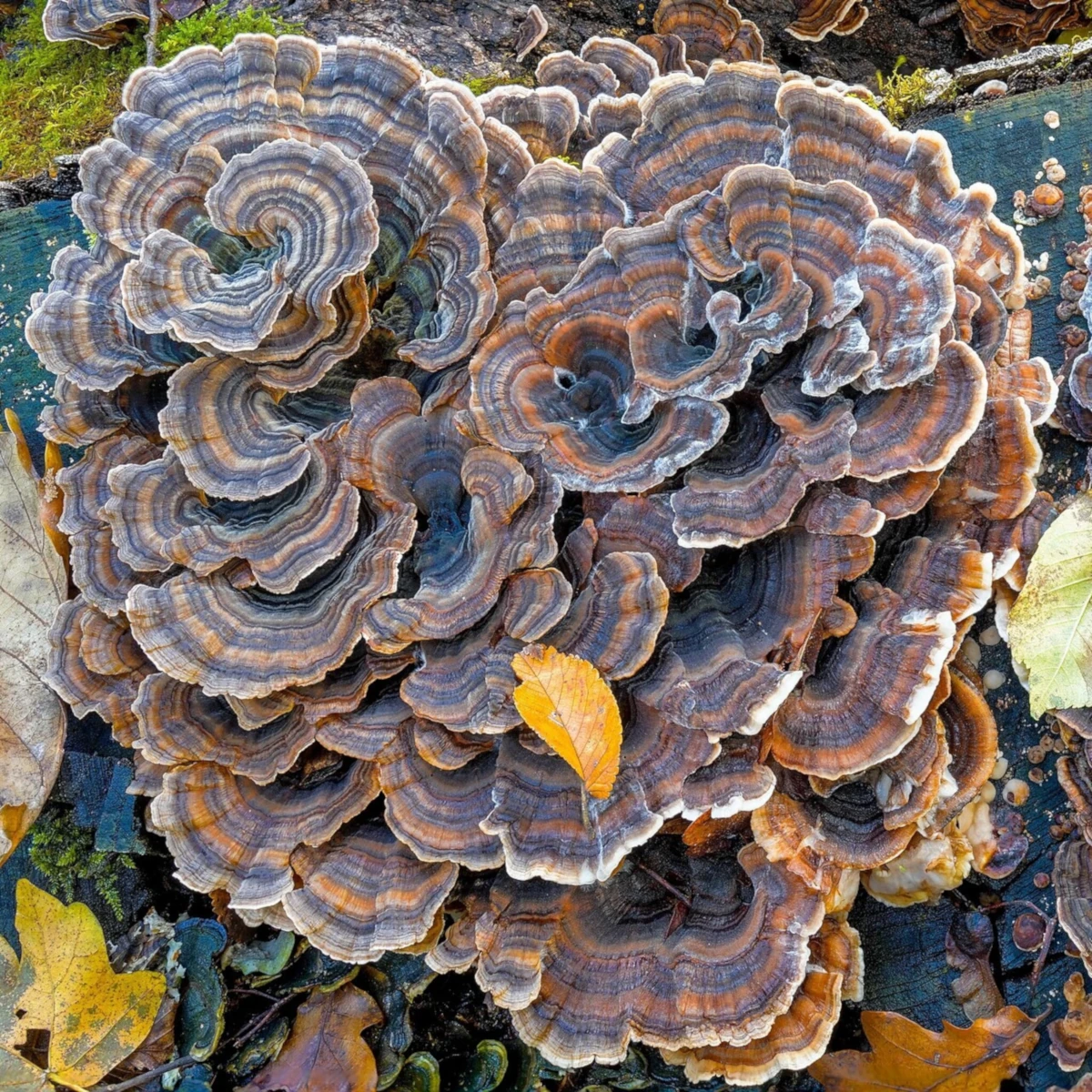
Trametes versicolor, commonly known as Turkey Tail, is one of the most recognizable bracket fungi found on dead wood. Its thin fan-shaped fruit bodies are covered with contrasting concentric bands of brown, gray, cream, orange, blue-gray, and almost black, creating a pattern reminiscent of a wild turkey’s tail.
Color alone is not enough for reliable identification because several other bracket and crust fungi have similar bands. The most important feature is underneath the cap: true Turkey Tail has a pale surface covered with numerous tiny round pores rather than a smooth surface, teeth, or gill-like structures.
⚠️ Important: This guide is for identification and education only. Turkey Tail is tough and leathery and is not usually treated as a conventional edible mushroom. Never use a wild mushroom as food or for medicinal purposes based solely on a photograph or online comparison.
Quick Identification
| Feature | Trametes versicolor |
|---|---|
| Scientific name | Trametes versicolor |
| Common name | Turkey Tail |
| Family | Polyporaceae |
| Shape | Thin semicircular or fan-shaped brackets |
| Upper surface | Strongly zoned, velvety |
| Colors | Brown, gray, cream, orange, blue-gray, black |
| Underside | White to cream |
| Fertile surface | Tiny round pores |
| Pores | Usually about 3–6 per mm |
| Thickness | Very thin, usually only a few millimeters |
| Texture | Tough, flexible, leathery |
| Stem | Absent |
| Spore print | White |
| Substrate | Mainly dead hardwood |
| Ecology | Saprobic wood decomposer |
| Rot type | White rot |
| Main look-alikes | False Turkey Tail, Trametes ochracea, Trametes hirsuta, Violet-toothed Polypore |
What Does Turkey Tail Look Like?
Turkey Tail forms thin brackets that project horizontally from logs, fallen branches, stumps, and other dead wood. Individual fruit bodies are usually semicircular or fan-shaped, but many often grow together in overlapping rows or rosettes.
The upper surface is divided into concentric bands of contrasting colors. These zones may include cream, tan, reddish brown, dark brown, gray, blue-gray, or black, and the exact pattern can vary considerably between individual colonies.
A typical fresh Turkey Tail feels thin, flexible, and leathery rather than thick or woody. Its surface also has a fine velvety texture that becomes easier to see when the mushroom is dry.
The Concentric Color Bands
The multicolored rings are the feature most people notice first. They are usually narrow, numerous, and sharply differentiated from one another, producing the characteristic striped appearance.
Some bands are more densely covered with fine hairs than others, which changes how they reflect light. This can give fresh specimens a subtle silky or satin-like appearance.
Older fruit bodies may fade, become dirty, or develop green algae on the surface. For this reason, the color pattern should always be checked together with the underside.
Upper Surface Texture
The upper surface is finely hairy or velvety rather than completely smooth. Running a finger gently across a fresh dry specimen may reveal subtle changes in texture between the concentric bands.
This feature can help separate Trametes versicolor from similar bracket fungi with smoother upper surfaces. However, rain, age, and weathering can flatten or remove the fine hairs, so texture is not always obvious.
A hand lens can make the fine surface hairs much easier to see.
The Underside: The Most Important Feature
The underside of Turkey Tail is white to cream and covered with very small pores. These pores are often difficult to distinguish individually without looking closely.
A true Turkey Tail should not have a completely smooth underside. It should also not have obvious teeth, maze-like slots, or conventional mushroom gills.
This single feature eliminates several of the most common look-alikes.
What Do Turkey Tail Pores Look Like?
The pores are tiny, round to slightly angular, and densely packed. A typical specimen has roughly several pores per millimeter, often around 3–6 depending on the individual and how the pores are measured.
From a distance, the underside may look nearly smooth because the pores are so small. Looking closely with a hand lens usually reveals the fine honeycomb-like surface.
The pore surface normally remains pale rather than becoming strongly gray, purple, or brown.
Shape and Size
Individual brackets are usually only a few millimeters thick but may spread several centimeters across. Their outer edge is thin, flexible, and often lighter than the older inner zones.
Several fruit bodies frequently overlap like roof tiles. Large colonies can cover a substantial section of a fallen log even though each individual bracket remains relatively small.
The thinness of the fruit body is an important clue because several similar polypores are noticeably thicker and more rigid.
Does Turkey Tail Have a Stem?
No. Turkey Tail attaches directly to wood.
The attachment is usually broad along the rear edge of the fan-shaped fruit body. There is no conventional central or lateral stem.
A small multicolored mushroom with a distinct stem should therefore suggest another species.
Flesh and Texture
The flesh is thin, pale, and leathery. It is much tougher than the flesh of typical gilled mushrooms and cannot easily be broken apart like a soft cap.
Fresh fruit bodies remain somewhat flexible, while older specimens become drier and more rigid. Even then, they are generally much thinner than perennial conks such as Ganoderma or Fomes.
The combination of thin flesh and a flexible bracket shape is characteristic.
Spore Print
Turkey Tail produces a white spore print. Obtaining a clear print from a bracket fungus can be less straightforward than making one from a gilled mushroom because the spores fall from thousands of tiny pores.
Spore color supports identification but is not particularly distinctive because many polypores also produce pale or white spores. The pore structure and upper surface are usually more useful in the field.
Where Does Turkey Tail Grow?
Trametes versicolor grows mainly on dead wood and acts as a decomposer. Fallen hardwood logs, dead branches, stumps, and standing dead trees are typical substrates.
It is especially common on deciduous wood, although it can occasionally occur on other woody material. Colonies often persist for months, so Turkey Tail can be found outside the main autumn mushroom season.
The fungus contributes to the breakdown of lignin and produces white rot in the wood.
Does Turkey Tail Grow on Living Trees?
Turkey Tail is primarily associated with dead wood, but fruit bodies may occasionally appear on dead portions of damaged or declining trees. A branch can be biologically dead even while the rest of the tree remains alive.
The exact condition of the substrate is therefore useful when assessing an identification. Healthy intact bark with no dead tissue would be less typical than a dead branch, stump, or decaying trunk.
When Does Turkey Tail Grow?
Fresh fruit bodies can develop during much of the year when moisture is sufficient. Autumn is especially favorable because dead wood remains damp for long periods and cooler temperatures reduce drying.
Unlike many soft mushrooms, the tough brackets can persist after active growth has stopped. Old specimens may therefore remain visible through winter and into the following season.
When identifying them, fresher growth with a pale clean pore surface is usually easier to interpret.
Distribution
Turkey Tail is widespread across temperate regions and is commonly encountered in Europe, North America, and many other parts of the world. Its broad distribution helps explain why it is one of the best-known bracket fungi. The species grows wherever suitable dead wood and adequate moisture are available. Forests, parks, woodland edges, gardens, and piles of fallen branches can all provide habitat. Local abundance can be extremely high where dead hardwood is plentiful.
Turkey Tail Look-Alikes
Several fungi can resemble Turkey Tail from above. Some have almost identical concentric bands, which makes examination of the underside essential. The most useful rule is simple: true Turkey Tail has a pale underside covered with tiny pores. A smooth, toothed, gray, or gill-like underside points toward another fungus.
False Turkey Tail — Stereum Species
Identification
Several Stereum species are commonly called False Turkey Tail because their upper surfaces can show attractive concentric bands very similar to Trametes versicolor. They also form thin fan-shaped brackets on dead wood.
The crucial difference is the underside. Stereum species have a smooth fertile surface without true pores.
Turkey Tail vs False Turkey Tail
| Feature | Turkey Tail | False Turkey Tail |
|---|---|---|
| Upper surface | Multicolored concentric zones | Multicolored concentric zones |
| Underside | Tiny pores | Smooth |
| Texture | Thin and leathery | Thin and leathery |
| Growth | Dead wood | Dead wood |
| Main clue | Porous underside | No pores |
Looking underneath is usually enough to separate the two groups. From above alone, photographs can be surprisingly misleading.
Trametes ochracea — Ochre Bracket
Identification
Trametes ochracea is another thin zoned bracket fungus that can resemble Turkey Tail. Its colors tend to be warmer and more uniform, often dominated by cream, ochre, tan, and brown.
The bands usually have less dramatic contrast than the varied gray, black, blue-gray, and brown zones commonly seen in Turkey Tail. The fruit body can also feel somewhat thicker and more rigid.
Main Difference
Both species have pores, so simply checking the underside is not enough. Turkey Tail generally has finer pores, stronger multicolored zoning, and a thinner, more flexible fruit body.
Difficult specimens may require closer examination because natural variation creates considerable overlap.
Trametes hirsuta — Hairy Bracket
Identification
Hairy Bracket is pale gray, white, or brownish and has a noticeably hairy upper surface. It can also develop concentric zones and grow in overlapping tiers.
The fruit bodies tend to be thicker than Turkey Tail, and the color palette is usually much less varied.
Main Difference
Turkey Tail generally shows numerous narrow, strongly contrasting colored bands. Hairy Bracket tends to look coarser, paler, and more heavily hairy.
The pore surface underneath can also differ in pore size and coloration.
Trametes pubescens — Downy Bracket
Identification
Downy Bracket forms pale cream to buff brackets with a soft finely hairy surface. It grows on dead hardwood and can occur in layered groups much like Turkey Tail.
Its zones are usually subtle rather than dramatically multicolored. Many specimens appear almost uniformly cream or pale tan.
Main Difference
Strong contrasting rings favor Turkey Tail, while a much paler and more uniform bracket suggests Trametes pubescens. Both have pores, so upper-surface pattern and texture become important.
Trichaptum Species — Violet-Toothed Polypores
Identification
Several Trichaptum species form thin brackets with zoned gray, brown, or greenish upper surfaces. From above, weathered specimens can resemble Turkey Tail.
The underside provides the strongest clue. Fresh fruit bodies often show violet or purple coloration, and the fertile surface can become tooth-like or irregular rather than having the fine round pores of Turkey Tail.
Main Difference
A purple, violet, or distinctly toothed underside is inconsistent with Trametes versicolor. Turkey Tail should have a white to cream finely porous lower surface.
Lenzites betulina — Birch Mazegill
Identification
Birch Mazegill is another fan-shaped bracket with a zoned upper surface. The top can be pale gray, brown, or buff and may look surprisingly similar to Turkey Tail in photographs.
The underside, however, contains elongated gill-like structures rather than tiny round pores.
Main Difference
Turn the bracket over. Turkey Tail has numerous minute pores, while Birch Mazegill has obvious elongated slots that resemble gills.
This makes underside photography particularly useful when identifying bracket fungi.
Bjerkandera adusta — Smoky Bracket
Identification
Smoky Bracket forms thin gray-brown brackets on dead hardwood. The upper surface may have concentric zones, creating another superficial resemblance.
Its fertile surface is typically gray to smoky rather than clean white or cream. This difference becomes especially clear on mature fruit bodies.
Main Difference
A distinctly gray underside points away from Turkey Tail. True T. versicolor normally has a pale white to cream pore surface.
Turkey Tail vs False Turkey Tail
The most common identification problem deserves special emphasis because the two fungi may appear almost identical from above. Both can have thin multicolored fans, concentric zones, and overlapping growth on hardwood.
The underside resolves the problem in most cases. Turkey Tail has tiny visible pores, while False Turkey Tail has a smooth or slightly textured surface without pore openings.
Never identify Turkey Tail from the colorful upper surface alone.
Turkey Tail vs Violet-Toothed Polypore
Both fungi can produce thin overlapping brackets and develop greenish areas as algae colonize older fruit bodies. This makes weathered colonies difficult to separate from a distance.
Turkey Tail should have a pale finely porous underside. Violet-toothed polypores usually develop violet, purple, or tooth-like structures underneath, particularly when fresh.
Checking several fruit bodies of different ages can make the distinction easier.
How to Identify Turkey Tail Step by Step
Start with the overall form. Look for thin semicircular brackets growing directly from dead wood, usually in overlapping rows or clusters.
Next, inspect the upper surface for numerous narrow concentric bands and a fine velvety texture. A wide range of contrasting colors strongly supports Turkey Tail, although color alone is not conclusive.
Finally, turn the bracket over. A white to cream underside covered with many tiny round pores is the key confirmation feature.
A Simple Three-Feature Check
1. Thin and Flexible
A typical Turkey Tail bracket should be thin and relatively flexible rather than thick, fleshy, or heavily woody. Thick rigid conks belong to different groups.
2. Strong Concentric Zoning
The upper surface should show several clearly defined zones of different colors and textures. Uniformly colored brackets are less typical.
3. Tiny Pores Underneath
The underside should have numerous minute round pores. If it is smooth, toothed, gray, or gill-like, reconsider the identification.
These three features together provide a much stronger identification than any one characteristic alone.
Can Turkey Tail Be Identified From a Photo?
Turkey Tail can often be recognized from good photographs, but an upper-surface image alone is not sufficient. False Turkey Tail and several other bracket fungi can produce nearly identical banded patterns.
A useful photo set should always include the underside. Close-up images showing the pore surface, upper texture, edge thickness, and attachment to wood greatly improve identification.
AI identification also benefits from multiple views because the pore surface contains some of the most diagnostic visual information.
How to Photograph Turkey Tail for Identification
Photograph the entire colony first to show the overlapping growth pattern. Then take a close-up of a single fresh bracket from above so the concentric bands and surface texture are visible.
The next image should show the underside in sharp focus. If possible, include a ruler or another scale reference because fruit-body thickness and pore size can help separate similar species.
A final habitat photo showing the type of wood can provide additional context.
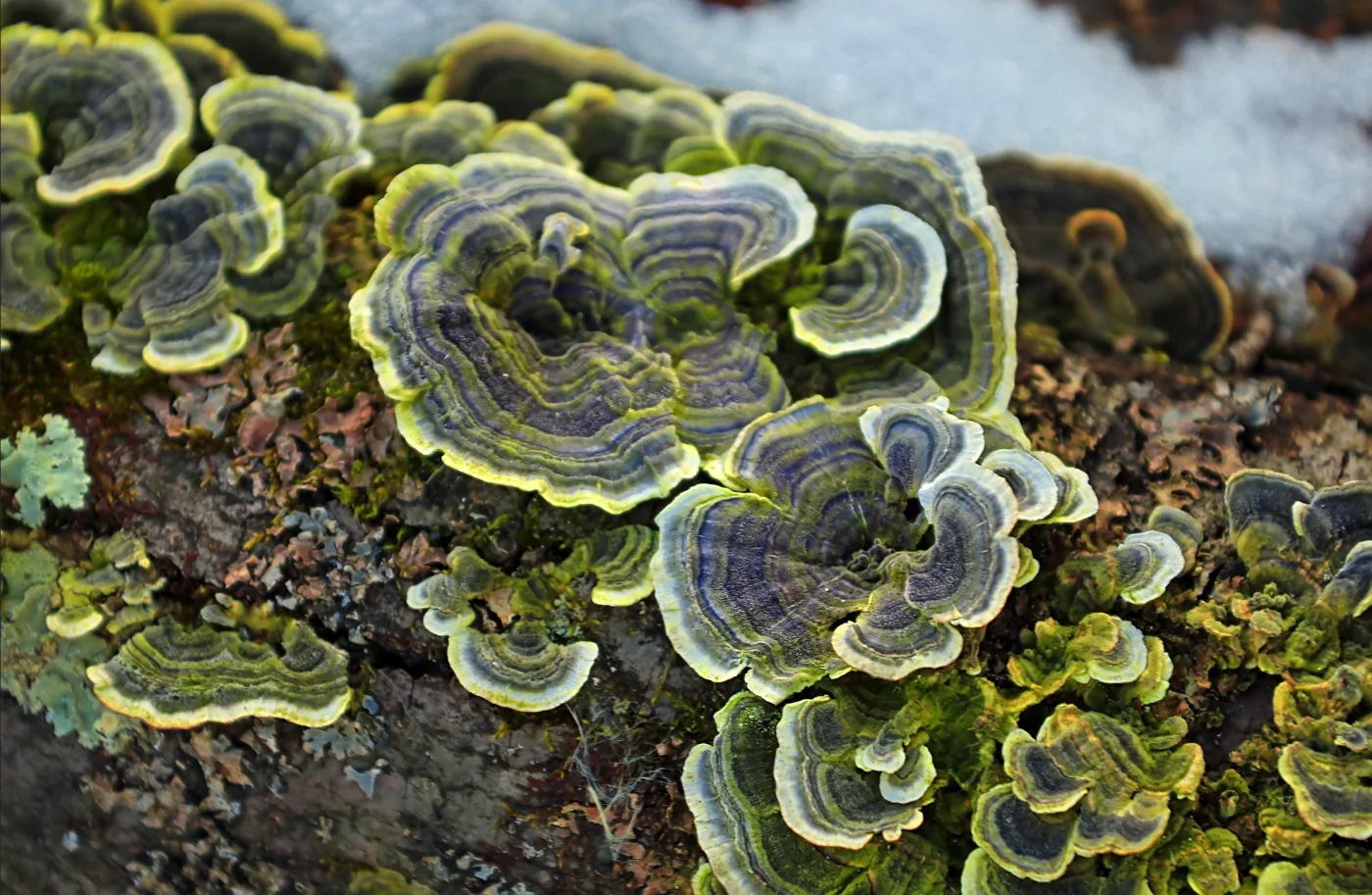
Why Does Turkey Tail Sometimes Turn Green?
Older Turkey Tail fruit bodies can become green because algae grow on their upper surfaces. The fungus itself does not normally produce a bright green cap.
Moist shaded environments encourage algal growth, particularly on persistent brackets that remain attached to wood for long periods. Green areas therefore do not rule out Turkey Tail.
The original concentric pattern can often still be seen beneath or between the algal patches.
Is Turkey Tail Edible?
Turkey Tail is too thin and leathery to be eaten like Oyster Mushrooms, Porcini, or chanterelles. It is therefore not normally treated as a conventional culinary mushroom.
The species has a history of use in preparations such as extracts and teas, but identifying a wild specimen correctly is still essential. Claims about health effects should not be used as a reason to consume an uncertain mushroom.
From an identification perspective, its ecological and visual characteristics are more useful than classifying it simply as edible or inedible.
Is Turkey Tail the Same as a Bracket Fungus?
Turkey Tail is one type of bracket fungus, but “bracket fungus” is a broad descriptive term covering many unrelated or distantly related species that grow in shelf-like forms.
Some brackets are thin and annual, while others form thick woody conks that remain for many years. Their undersides may have pores, teeth, gill-like structures, or other surfaces.
This is why bracket shape alone is never enough for species identification.
What Kind of Rot Does Turkey Tail Cause?
Turkey Tail causes white rot in wood. White-rot fungi break down lignin along with other components of the wood, leaving the decayed material pale and fibrous.
This ecological role makes Trametes versicolor an important decomposer in forests. By breaking down dead trees and branches, it helps return nutrients to the ecosystem.
The presence of Turkey Tail is therefore a normal part of woodland decomposition.
Common Turkey Tail Identification Mistakes
One of the most common mistakes is identifying any striped bracket as Turkey Tail. Several unrelated fungi have concentric rings that look convincing from above.
Another mistake is failing to examine the pore surface closely. Tiny pores can initially look smooth, especially in photographs with poor focus.
A third mistake is using color too strictly. Turkey Tail is extremely variable, and individual colonies may be dominated by brown, gray, orange, or blue-gray rather than displaying every possible color.
Frequently Asked Questions
What does Turkey Tail mushroom look like?
Turkey Tail forms thin fan-shaped brackets covered with numerous concentric bands of contrasting colors. The underside is white to cream and has many tiny round pores.
How can I tell if Turkey Tail is real?
Check the underside first. True Turkey Tail has a porous lower surface, while the commonly called False Turkey Tail has a smooth underside without pores.
Does Turkey Tail have gills?
No. It is a polypore and releases spores through tiny pores on the underside. A bracket with obvious conventional gills or long gill-like slots should be identified as something else.
Where does Turkey Tail grow?
It grows mainly on dead wood, especially hardwood logs, fallen branches, and stumps. Large overlapping colonies can cover substantial sections of decaying timber.
What color is Turkey Tail?
The upper surface can contain combinations of brown, cream, gray, reddish brown, orange, blue-gray, and nearly black. The pattern of sharply contrasting concentric zones is generally more useful than any single color.
What is False Turkey Tail?
The name is commonly applied to several Stereum species that have banded fan-shaped fruit bodies resembling Turkey Tail. Their undersides are smooth rather than covered with tiny pores.
What is the easiest way to distinguish Turkey Tail from look-alikes?
Turn the mushroom over and examine the fertile surface. A thin zoned bracket with a pale surface containing tiny round pores strongly supports Trametes versicolor.
Can Turkey Tail grow on living trees?
It is mainly a decomposer of dead wood, although fruit bodies may appear on dead portions of damaged or declining trees. A dead branch can support Turkey Tail while the rest of the tree remains alive.
Can Turkey Tail be green?
Older specimens can develop green coloration when algae colonize the upper surface. The underlying bracket usually still shows some of the characteristic zoned pattern.
What color is the Turkey Tail spore print?
The spore print is white. Because many polypores also produce pale spores, this characteristic is less useful than the tiny pores and multicolored upper surface.
Final Identification Notes
Trametes versicolor is best recognized by the combination of thin flexible brackets, strongly contrasting concentric color zones, a finely velvety upper surface, growth on dead wood, and a white to cream underside covered with tiny round pores.
The underside is the most important confirmation feature. False Turkey Tail lacks pores, Birch Mazegill has gill-like slots, Violet-toothed Polypores develop a toothed or purple fertile surface, and Smoky Bracket typically has a gray underside.
When identifying Turkey Tail from photographs, never rely only on its attractive striped upper surface. A clear underside image can turn a difficult bracket-fungus identification into a much more reliable one.
Upload a photo and get possible matches in seconds.