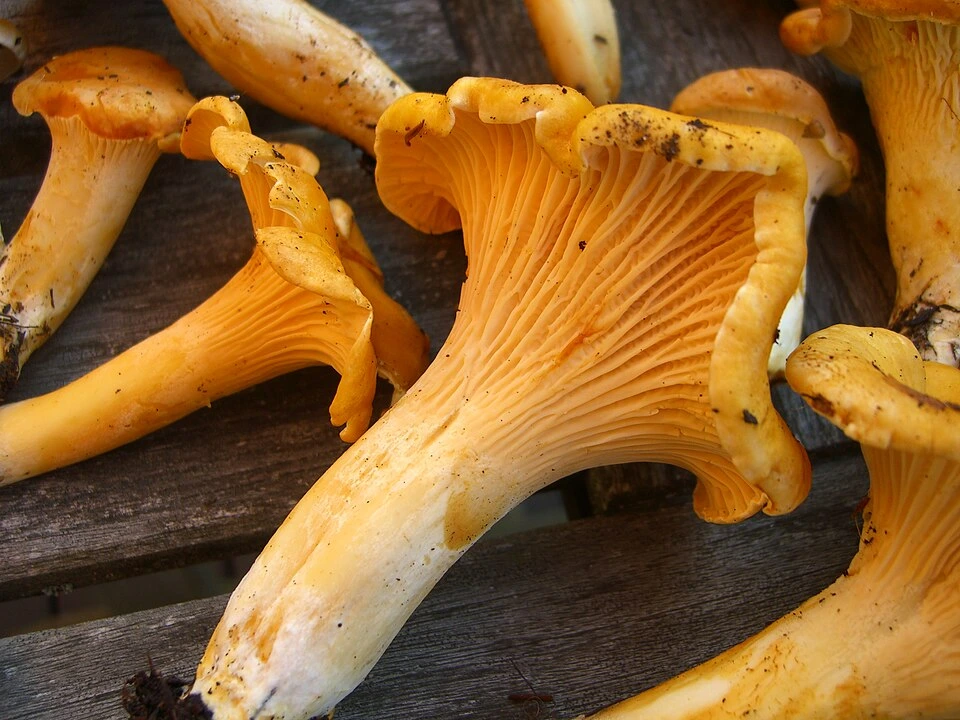
Cantharellus formosus, commonly known as the Pacific Golden Chanterelle, is one of the characteristic chanterelles of the Pacific Northwest. It is a yellow to orange woodland mushroom with thick flesh, a funnel-shaped cap, and blunt false gills that run down the stem.
This species is closely associated with conifer forests and is especially important in western North America. It can be confused with other chanterelles, False Chanterelles, and poisonous Jack-o’-Lantern mushrooms, so identification should focus on the underside, flesh, habitat, and growth pattern rather than cap color alone.
⚠️ Important: This guide is for identification and education only. Never eat a wild mushroom based solely on a photograph, AI result, or comparison with an online guide.
Quick Identification
| Feature | Cantharellus formosus |
|---|---|
| Scientific name | Cantharellus formosus |
| Common name | Pacific Golden Chanterelle |
| Family | Cantharellaceae |
| Cap color | Yellow-orange to orange-brown |
| Cap shape | Convex when young, becoming irregular or funnel-shaped |
| Underside | Blunt false gills or ridges |
| True gills | Absent |
| Stem | Solid, pale yellow to orange |
| Flesh | Pale, firm, solid |
| Spore print | Pale cream to yellowish |
| Ecology | Mycorrhizal |
| Habitat | Conifer and mixed forests |
| Main region | Pacific Northwest |
| Season | Late summer through autumn |
| Edibility | Edible when correctly identified |
| Main look-alikes | False Chanterelle, Jack-o’-Lantern mushrooms, other golden chanterelles |
What Does Cantharellus formosus Look Like?
The Pacific Golden Chanterelle has a thick fleshy cap that ranges from yellow-orange to deeper orange or orange-brown. Young specimens are usually convex, while mature caps often become irregular, lobed, or funnel-shaped.
The underside is one of the most important features. Instead of thin true gills, the mushroom has thick, blunt ridges that fork and run down the stem.
The overall texture is firm and substantial. This helps separate true chanterelles from thinner orange mushrooms that may look similar from above.
Cap
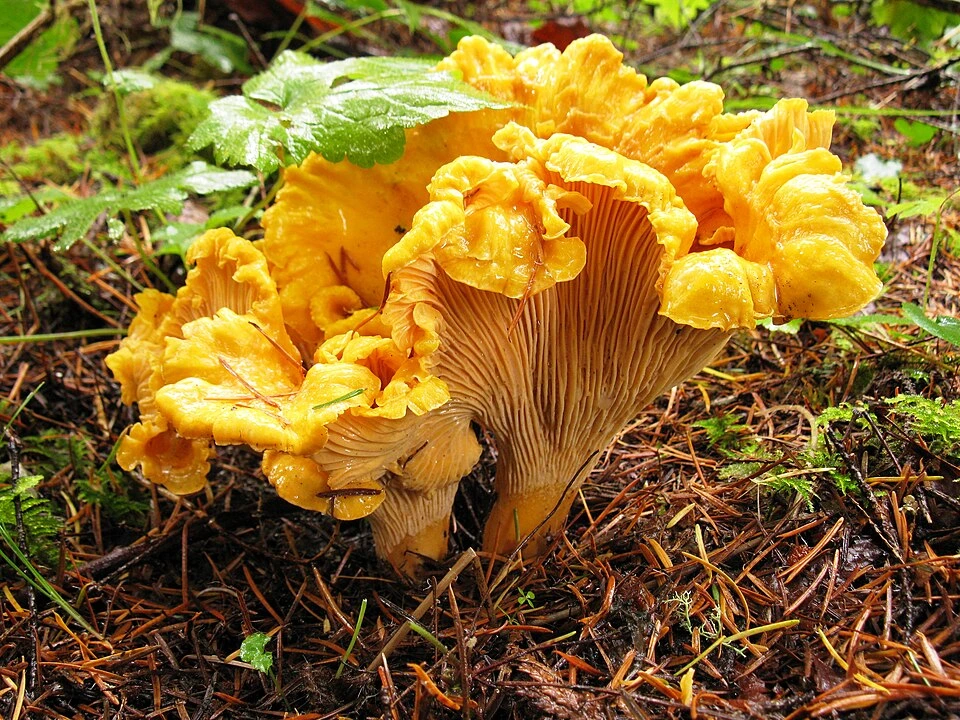
The cap can become fairly broad and is often irregular rather than perfectly round. The margin may become wavy or lobed with age. Color varies with age, moisture, and lighting. Some specimens are bright yellow-orange, while others show deeper orange-brown or slightly pinkish tones. The cap surface is generally smooth to slightly uneven and lacks the prominent scales found in some unrelated orange mushrooms.
False Gills
The underside has thick ridges often called false gills. These are not separate blade-like structures but folds of the mushroom’s surface. They often fork, branch, and connect with neighboring ridges. The edges are blunt rather than sharp. This is one of the strongest features for distinguishing Pacific Golden Chanterelles from poisonous orange mushrooms with true gills.
Does Cantharellus formosus Have True Gills?
No. Like other chanterelles, C. formosus has false gills. True gills are thin and blade-like, while chanterelle ridges are thicker, rounded, and integrated into the flesh of the cap. If the underside shows many sharp, separate blades, another genus should be considered.
Stem
The stem is solid and relatively thick. It usually matches the cap color or is slightly paler. The stem often blends gradually into the cap rather than meeting it at a sharply defined angle. There is no ring or volva. When cut lengthwise, the interior should remain solid rather than hollow.
Flesh
The flesh is pale cream to whitish inside and relatively firm. This pale interior is useful because some orange look-alikes remain strongly orange throughout the flesh. The texture is usually denser than that of many thin-gilled mushrooms.
Smell
Pacific Golden Chanterelles are often described as having a mild fruity aroma, sometimes compared with apricots. The strength of the odor varies, and dry or older mushrooms may smell much less strongly. Smell should be used only as supporting evidence because it is subjective.
Spore Print
The spore print is pale, usually cream to yellowish. This supports identification as a chanterelle-like fungus but is not enough to distinguish C. formosus from related species. Underside structure and geography are usually more useful.
Where Does Cantharellus formosus Grow?
The Pacific Golden Chanterelle grows from soil in forest rather than directly from wood. It forms mycorrhizal relationships with living tree roots. It is strongly associated with coniferous and mixed forests of the Pacific Northwest. Douglas-fir and other conifers are especially important habitat components. Because the fungal network is underground, mushrooms may appear some distance from the nearest visible trunk.
Distribution
Cantharellus formosus is characteristic of western North America, particularly the Pacific Northwest. It is strongly associated with coastal and montane forest regions from northern California through Oregon and Washington into British Columbia. Geography is an important identification clue because eastern North America contains different chanterelle species.
When Does the Pacific Golden Chanterelle Grow?
The main season usually runs from late summer through autumn. Fruiting often increases after sustained rainfall and cooler temperatures. In wetter coastal areas, the season can continue well into late autumn. The exact timing varies with elevation, latitude, and yearly weather.
Is Cantharellus formosus Edible?
Yes. The Pacific Golden Chanterelle is regarded as edible when correctly identified. Like other chanterelles, it is valued for its firm texture and mild fruity aroma. The main safety concern is confusion with poisonous orange mushrooms rather than toxicity of the chanterelle itself. Accurate identification should therefore focus on the underside and substrate.
Pacific Golden Chanterelle Look-Alikes
Several orange woodland mushrooms can resemble C. formosus. The most important comparisons are False Chanterelle and Jack-o’-Lantern mushrooms.
Other western chanterelle species can also be very similar and may require geography or microscopic features for confident separation.
Hygrophoropsis aurantiaca — False Chanterelle
Identification
False Chanterelle usually has an orange to brownish-orange cap and many thin forked true gills underneath.
The cap is often darker in the center and thinner than that of a true chanterelle. The overall mushroom usually feels less substantial.
Main Difference
Pacific Golden Chanterelles have thick blunt ridges, while False Chanterelles have thin blade-like gills.
This underside difference is more reliable than color.
Omphalotus Species — Jack-o’-Lantern Mushrooms
Identification
Jack-o’-Lantern mushrooms are bright orange and commonly form dense clusters from wood, stumps, or buried roots.
Their underside has true gills that run down the stem. The flesh is often more uniformly orange.
Safety
Jack-o’-Lantern mushrooms are poisonous and can cause severe gastrointestinal symptoms.
They are one of the most important dangerous look-alikes for chanterelles.
Pacific Golden Chanterelle vs Jack-o’-Lantern
| Feature | Pacific Golden Chanterelle | Jack-o’-Lantern |
|---|---|---|
| Underside | Blunt false gills | True blade-like gills |
| Growth | Usually scattered | Often dense clusters |
| Substrate | Soil | Wood or buried roots |
| Flesh | Pale inside | Often orange-yellow |
| Texture | Thick and firm | More fibrous |
| Safety | Edible when correctly identified | Poisonous |
The combination of false gills, soil growth, and pale flesh strongly supports chanterelle identification.
Pacific Golden Chanterelle vs False Chanterelle
| Feature | Pacific Golden Chanterelle | False Chanterelle |
|---|---|---|
| Underside | Thick blunt ridges | Thin forked gills |
| Cap | Thick and fleshy | Thinner |
| Flesh | Firm and pale | Softer, more orange |
| Growth | Mycorrhizal, from soil | Often near decaying wood |
| Edibility | Edible when correctly identified | Generally not considered a choice edible |
The underside remains the most important feature in this comparison.
Cantharellus formosus vs Cantharellus lateritius
Cantharellus lateritius, the Smooth Chanterelle, is more characteristic of eastern North America.
Its underside can be almost smooth or only lightly wrinkled, while C. formosus typically develops much more obvious false gills.
Geography provides an important clue because these species occupy different parts of the continent.
Cantharellus formosus vs Cantharellus cibarius
The name Cantharellus cibarius was historically applied very broadly to golden chanterelles in North America.
Modern taxonomy recognizes that many North American chanterelles belong to distinct species, including C. formosus in the Pacific Northwest.
This is why older field guides may use C. cibarius for mushrooms now identified differently.
How to Identify Cantharellus formosus Step by Step
Start with the underside. Look for thick, blunt, forked ridges rather than true gills.
Next, check the habitat. The mushroom should be growing from soil in western conifer or mixed forest.
Then examine the flesh and stem. Both should be solid and substantial, with pale interior flesh.
Finally, consider geography. A golden chanterelle in the Pacific Northwest is far more likely to be C. formosus or another western chanterelle than an eastern species.
Why Geography Matters
Chanterelles are a good example of why mushroom identification cannot rely on appearance alone.
Several species look extremely similar but occupy different regions and associate with different trees.
A mushroom that looks identical in Oregon and Ohio may belong to completely different species.
How to Photograph Pacific Golden Chanterelles
Photograph the cap from above, then take a clear image of the underside.
The ridges should be visible in enough detail to show that they are blunt and forked rather than true gills.
Also photograph the full stem and surrounding forest. Nearby conifers, moss, and soil conditions can provide useful identification context.
Can AI Identify Cantharellus formosus?
AI can often recognize a chanterelle-like mushroom when the underside is visible. Species-level identification is harder because several North American chanterelles look very similar. Geographic location and nearby tree species can significantly improve accuracy. A cap-only photograph is much less reliable than a full set showing the underside and habitat.
Common Identification Mistakes
One common mistake is calling every golden chanterelle Cantharellus cibarius. North American chanterelle taxonomy is more complex than older field guides suggested.
Another is identifying chanterelles only by color. Bright orange mushrooms from completely different genera can look similar from above.
The most dangerous mistake is ignoring the underside. False gills versus true gills is the feature that should be checked first.
Frequently Asked Questions
What is Cantharellus formosus?
Cantharellus formosus is the Pacific Golden Chanterelle, a golden chanterelle native to western North America. It is especially associated with conifer forests of the Pacific Northwest.
Where does the Pacific Golden Chanterelle grow?
It grows from soil in coniferous and mixed forests, particularly in the Pacific Northwest. Douglas-fir and other western conifers are common components of its habitat.
When does Cantharellus formosus grow?
The main season is late summer through autumn. Fruiting often increases after cool wet weather and may continue into late autumn in mild coastal regions.
Does Cantharellus formosus have true gills?
No. It has blunt false gills or ridges that are thicker and more integrated into the cap than true blade-like gills.
Is the Pacific Golden Chanterelle edible?
Yes. It is regarded as edible when correctly identified, but poisonous orange look-alikes must be ruled out first.
What is the most dangerous look-alike?
Jack-o’-Lantern mushrooms are among the most important poisonous comparisons. They have true gills and commonly grow from wood or buried roots.
How can I tell it from False Chanterelle?
False Chanterelle has thin forked true gills, while C. formosus has thick blunt ridges. The true chanterelle is also usually firmer and more substantial.
Is Cantharellus formosus the same as Cantharellus cibarius?
No. They are separate species. The name C. cibarius was historically used too broadly for North American golden chanterelles.
What color is the spore print?
The spore print is pale cream to yellowish. This is useful as supporting evidence but does not identify the species by itself.
Can Pacific Golden Chanterelles grow on wood?
No. They grow from soil in association with living tree roots. A bright orange mushroom growing directly from wood should suggest another species.
Final Identification Notes
Cantharellus formosus is best recognized by a combination of golden-orange coloration, thick blunt false gills, solid pale flesh, growth from soil, and western conifer forest habitat.
The underside is the most important feature. Thin true gills point away from chanterelles and toward look-alikes such as False Chanterelle or Jack-o’-Lantern mushrooms.
Geography also matters because North America contains several distinct golden chanterelle species. In the Pacific Northwest, C. formosus is one of the key species to consider when identifying a golden chanterelle.
Upload a photo and get possible matches in seconds.