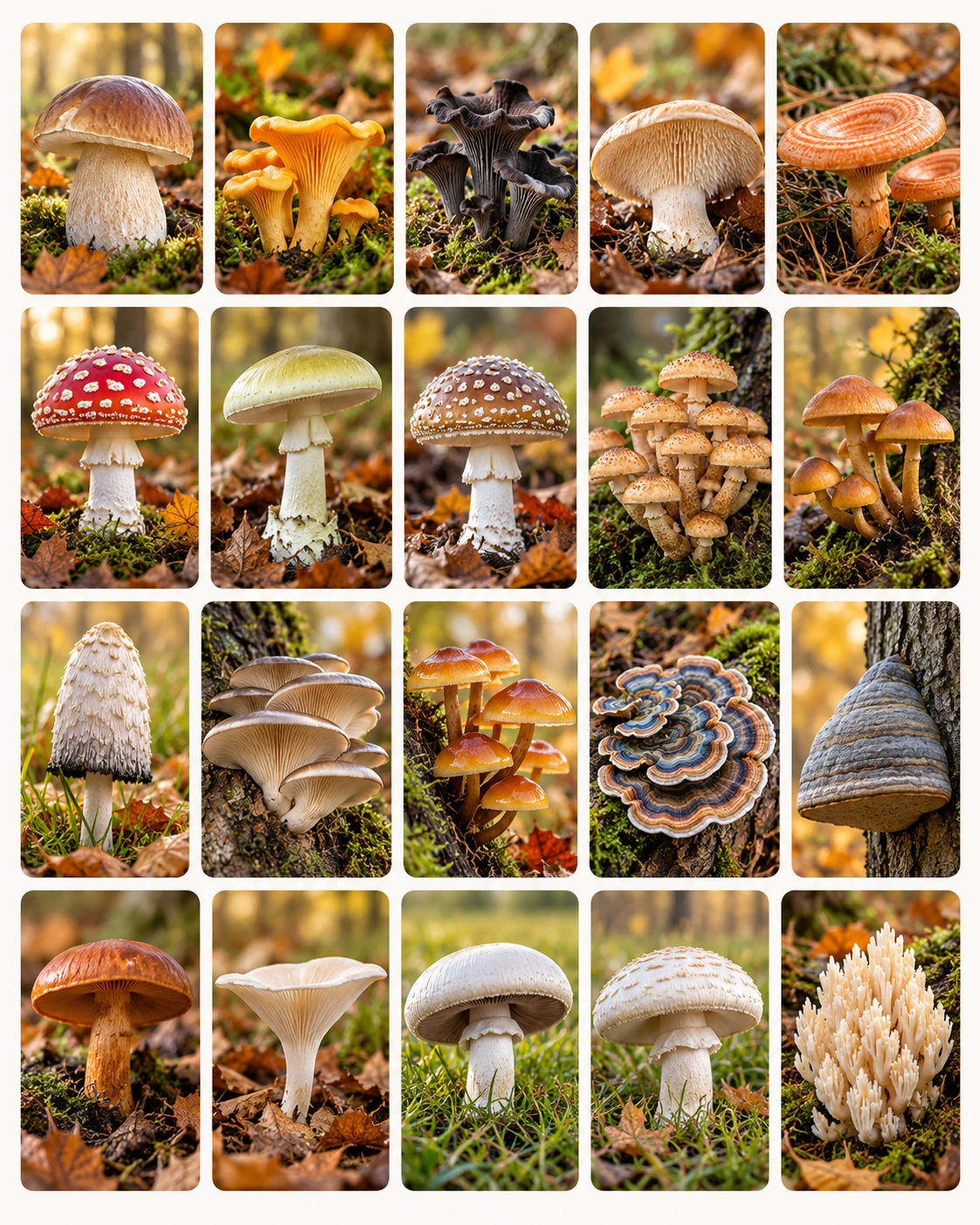
October is one of the richest months for mushroom diversity across much of Europe. Cooler temperatures, wetter soils, falling leaves, and still-warm ground create ideal conditions for many woodland, grassland, and wood-decaying fungi to produce fruit bodies.
Depending on region, October can bring boletes, chanterelles, milkcaps, Amanitas, Honey Mushrooms, waxcaps, puffballs, brackets, and many other species. The exact mix changes between Scandinavia, Central Europe, the British Isles, the Alps, and Mediterranean regions, but autumn is generally one of the most productive periods for mushroom identification.
⚠️ Important: This guide is for identification and education only. Never eat a wild mushroom based solely on a photograph, AI result, or comparison with an online guide.
Quick Guide to Common October Mushrooms in Europe
| Species | Common name | Typical habitat | Safety |
|---|---|---|---|
| Boletus edulis | Porcini / Penny Bun | Woodland near trees | Edible when correctly identified |
| Cantharellus cibarius group | Chanterelles | Forest soil | Edible when correctly identified |
| Craterellus cornucopioides | Black Trumpet | Hardwood forest | Edible when correctly identified |
| Hydnum repandum | Hedgehog Mushroom | Woodland soil | Edible when correctly identified |
| Lactarius deliciosus group | Saffron Milk Cap | Near pines | Edible when correctly identified |
| Amanita muscaria | Fly Agaric | Woodland | Poisonous |
| Amanita phalloides | Death Cap | Broadleaf woodland | Deadly poisonous |
| Amanita pantherina | Panther Cap | Woodland | Poisonous |
| Armillaria species | Honey Mushrooms | Stumps and roots | Edibility varies |
| Galerina marginata | Deadly Galerina | Dead wood | Deadly poisonous |
| Coprinus comatus | Shaggy Mane | Lawns and disturbed ground | Edible when young and correctly identified |
| Pleurotus ostreatus | Oyster Mushroom | Dead hardwood | Edible when correctly identified |
| Flammulina velutipes | Velvet Shank | Dead wood | Edible when correctly identified |
| Trametes versicolor | Turkey Tail | Dead hardwood | Not a typical food mushroom |
| Fomes fomentarius | Tinder Fungus | Birch, beech and other trees | Inedible |
| Cortinarius rubellus | Deadly Webcap | Woodland | Deadly poisonous |
| Clitocybe rivulosa | Fool’s Funnel | Lawns and grassland | Poisonous |
| Agaricus campestris | Field Mushroom | Grassland | Edible when correctly identified |
| Agaricus arvensis | Horse Mushroom | Meadows and fields | Edible when correctly identified |
| Hericium coralloides | Coral Tooth Fungus | Dead hardwood | Rare; identification interest |
Why October Is Such a Good Mushroom Month
October often combines frequent rainfall with moderate temperatures. Summer heat has usually passed, but the soil has not yet cooled enough to stop fungal activity.
This allows many mycorrhizal fungi to continue fruiting around living trees while decomposers thrive in wet logs, stumps, and leaf litter. In many parts of Europe, October is therefore a point where several fungal communities overlap.
Regional Differences Matter
Northern Europe may already be moving toward the end of its main mushroom season by October, while Central and Western Europe can still be extremely productive. In southern Europe, cooler and wetter autumn weather may actually mark the beginning of the strongest fruiting period.
Altitude also changes timing significantly. Mountain forests can behave more like northern regions, with earlier peaks and faster decline after hard frosts.
1. Boletus edulis — Porcini
Identification
Boletus edulis has a brown cap, thick pale to brownish stem, and a sponge-like pore surface underneath instead of gills. A fine pale net-like pattern is often visible on the upper stem.
Young pores are whitish and gradually become yellowish or olive. The flesh is firm and generally remains pale when cut.
Where to Find It in October
Porcini grows in association with trees such as spruce, pine, birch, beech, and oak. It is found in both coniferous and deciduous woodland across much of Europe.
October is often near the end of its main season in cooler regions, but productive flushes can still occur after rainfall. In milder climates, fruiting may continue well into the month.
2. Cantharellus Species — Chanterelles
Identification
Chanterelles are yellow to golden-orange mushrooms with blunt ridges or folds underneath the cap rather than true blade-like gills. The fruit body is usually thick, solid, and irregularly funnel-shaped when mature.
Their interior flesh is generally pale. This helps separate them from some orange look-alikes that are more uniformly colored inside.
Where to Find Them in October
Different chanterelle species occur under both hardwoods and conifers. Mossy forest floors, shaded slopes, and moist woodland are particularly productive habitats.
By October, chanterelle numbers may be declining in colder parts of Europe, while milder western and southern regions can still produce good fruitings.
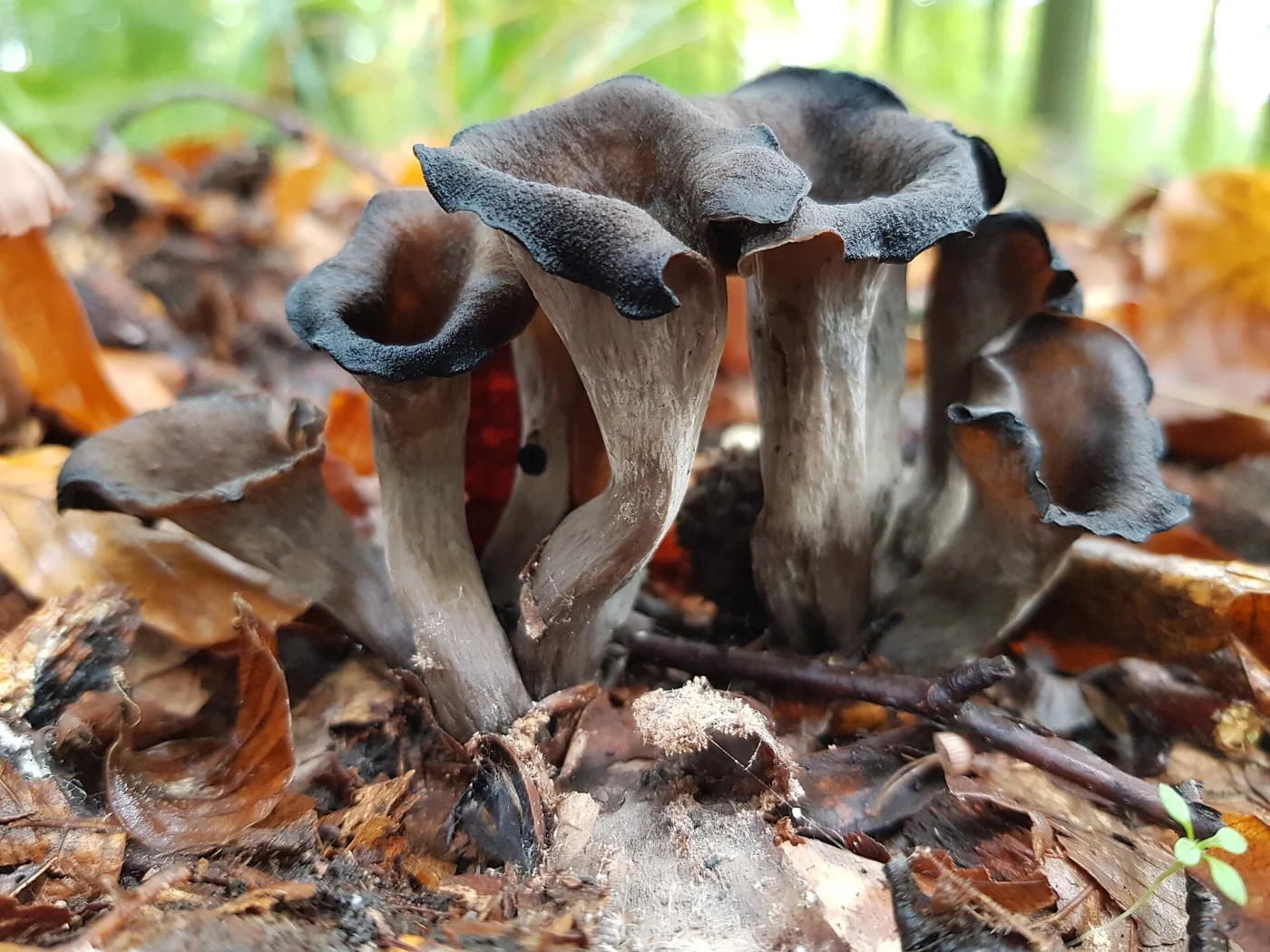
3. Craterellus cornucopioides — Black Trumpet
Identification
Black Trumpets are dark gray to nearly black and have thin hollow funnel-shaped fruit bodies. They lack true gills and usually have a smooth or lightly wrinkled outer surface.
Their dark coloration makes them easy to overlook among wet fallen leaves. Once one is found, several more are often nearby.
Where to Find Them in October
They are commonly associated with hardwood forests, especially mature deciduous woodland. Damp leaf litter and shaded slopes can be productive.
October is an excellent month for Black Trumpets in many European regions. Cooler wet weather often favors large flushes.
4. Hydnum repandum — Hedgehog Mushroom
Identification
The Hedgehog Mushroom has a cream, pale yellow, or light orange cap. The underside is covered with soft downward-pointing teeth instead of gills or pores.
The stem is solid and pale, while the flesh is relatively thick and brittle. This toothed underside makes the species group easy to recognize.
Where to Find It in October
Hydnum repandum grows from woodland soil under both deciduous and coniferous trees. Mossy ground and moist leaf litter are common habitats.
October is one of the best months to find it in temperate Europe. It often continues after some summer mushrooms have disappeared.
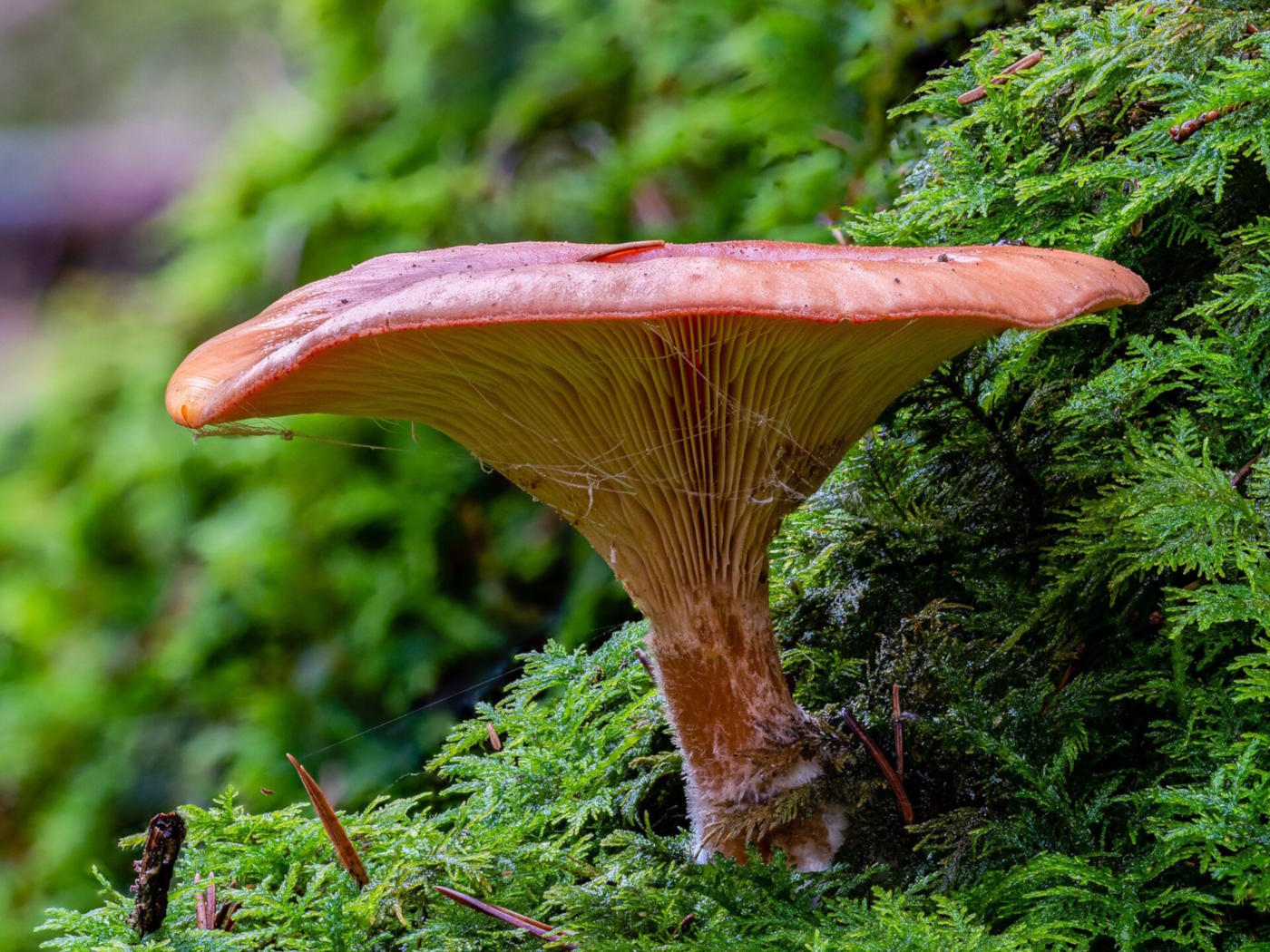
5. Lactarius deliciosus Group — Saffron Milk Caps
Identification
Saffron Milk Caps are orange mushrooms with zoned caps and orange latex released from damaged gills or flesh. Green staining commonly develops with age or injury.
The combination of orange milk and pine habitat is particularly useful. Several closely related species occur across Europe.
Where to Find Them in October
These mushrooms are strongly associated with pines. Pine woodland, plantations, and forest edges are among the best places to search.
October is often a peak month in many regions. Mild wet conditions can produce large numbers around suitable host trees.
6. Amanita muscaria — Fly Agaric
Identification
Fly Agaric usually has a red or orange-red cap with white veil remnants, white gills, and a pale ringed stem. Its base is enlarged and carries additional universal veil remnants.
Heavy rain can remove many of the white cap spots. Older mushrooms may therefore look much less like the classic red-and-white image.
Where to Find It in October
It is especially common near birch, pine, spruce, and other host trees. Woodland edges, parks, and mixed forests can all support it.
October is one of the classic months for Fly Agaric in Europe. Large groups can appear after sustained autumn rain.
Safety
Fly Agaric is poisonous and contains compounds that affect the central nervous system. It should not be consumed based on appearance or traditional preparation claims.
7. Amanita phalloides — Death Cap
Identification
The Death Cap may be olive, greenish, brownish, grayish, or very pale. It has persistent white gills, a pale stem with a ring, and a sack-like volva at the base.
The volva may be buried in soil. This is why removing the complete stem base is essential during identification.
Where to Find It in October
It is associated mainly with broadleaf trees such as oak, beech, chestnut, and other suitable hosts. Parks and landscaped areas can also support it.
October is an important fruiting month across much of Europe. Mild wet autumns can produce substantial numbers.
Safety
Amanita phalloides contains amatoxins and can cause fatal liver failure. Symptoms can be delayed for many hours, so suspected ingestion requires urgent medical attention.
8. Amanita pantherina — Panther Cap
Identification
Panther Cap has a brown to gray-brown cap with white veil patches, white gills, and a pale stem with a ring. The stem base is bulbous and has characteristic universal veil remnants.
The flesh usually does not develop the strong reddish staining seen in the Blusher. Rain can wash veil patches from the cap, which makes the stem base even more important.
Where to Find It in October
It grows from soil near suitable deciduous and coniferous trees. Mixed woodland can be particularly productive.
Autumn is the main fruiting period, and October remains important in many parts of Europe.
Safety
Panther Cap is poisonous and contains ibotenic acid and muscimol. Neurological symptoms can be significant.
9. Armillaria Species — Honey Mushrooms
Identification
Honey Mushrooms typically have honey-yellow to brown caps, pale gills, and fibrous stems. Many species have a ring, although not all members of the group do.
They frequently appear in dense clusters around tree bases, stumps, and buried roots.
Where to Find Them in October
October is one of the classic months for Honey Mushrooms. Cool wet weather can trigger very large clustered fruitings.
They may grow on living trees, dead wood, roots, or apparently from soil where woody material is buried.
Important Look-Alike
Deadly Galerina can also grow on wood and may appear nearby. Honey Mushrooms generally have pale gills and white spores, while Galerina marginata develops rusty-brown gills and spores.
10. Galerina marginata — Deadly Galerina
Identification
Deadly Galerina is a small yellow-brown to reddish-brown mushroom with a slender stem. Mature gills become rusty brown, and a fragile ring or ring zone may be present.
Its cap often changes color as it dries. This can make the same species look different depending on moisture conditions.
Where to Find It in October
It grows on dead and decaying wood, including stumps, logs, and buried woody debris. October conditions are often ideal.
Small brown mushrooms on wood should always be examined carefully because several edible and poisonous species share this habitat.
Safety
Galerina marginata contains amatoxins and can cause severe liver failure. It is one of the most important poisonous autumn mushrooms to recognize.
11. Coprinus comatus — Shaggy Mane
Identification
Young Shaggy Manes have tall white cylindrical caps covered with shaggy scales. As they mature, the gills become pink and then black before the cap dissolves into dark liquid.
This self-dissolving process is called deliquescence. It can happen quickly once the mushroom reaches maturity.
Where to Find It in October
Lawns, parks, roadsides, paths, and disturbed ground are typical habitats. The species often appears in groups after rain.
October is one of the best months to find fresh Shaggy Manes in much of Europe.
12. Pleurotus ostreatus — Oyster Mushroom
Identification
Oyster Mushrooms have fan-shaped caps growing in overlapping layers. The pale gills run down the short stem or attachment point.
Caps vary from cream to gray or brown. Their soft layered structure is characteristic when young.
Where to Find Them in October
They grow directly from dead or weakened hardwood. Fallen trunks, logs, and standing dead trees are common substrates.
October often marks the beginning of stronger cool-weather fruiting. Some populations continue into winter.
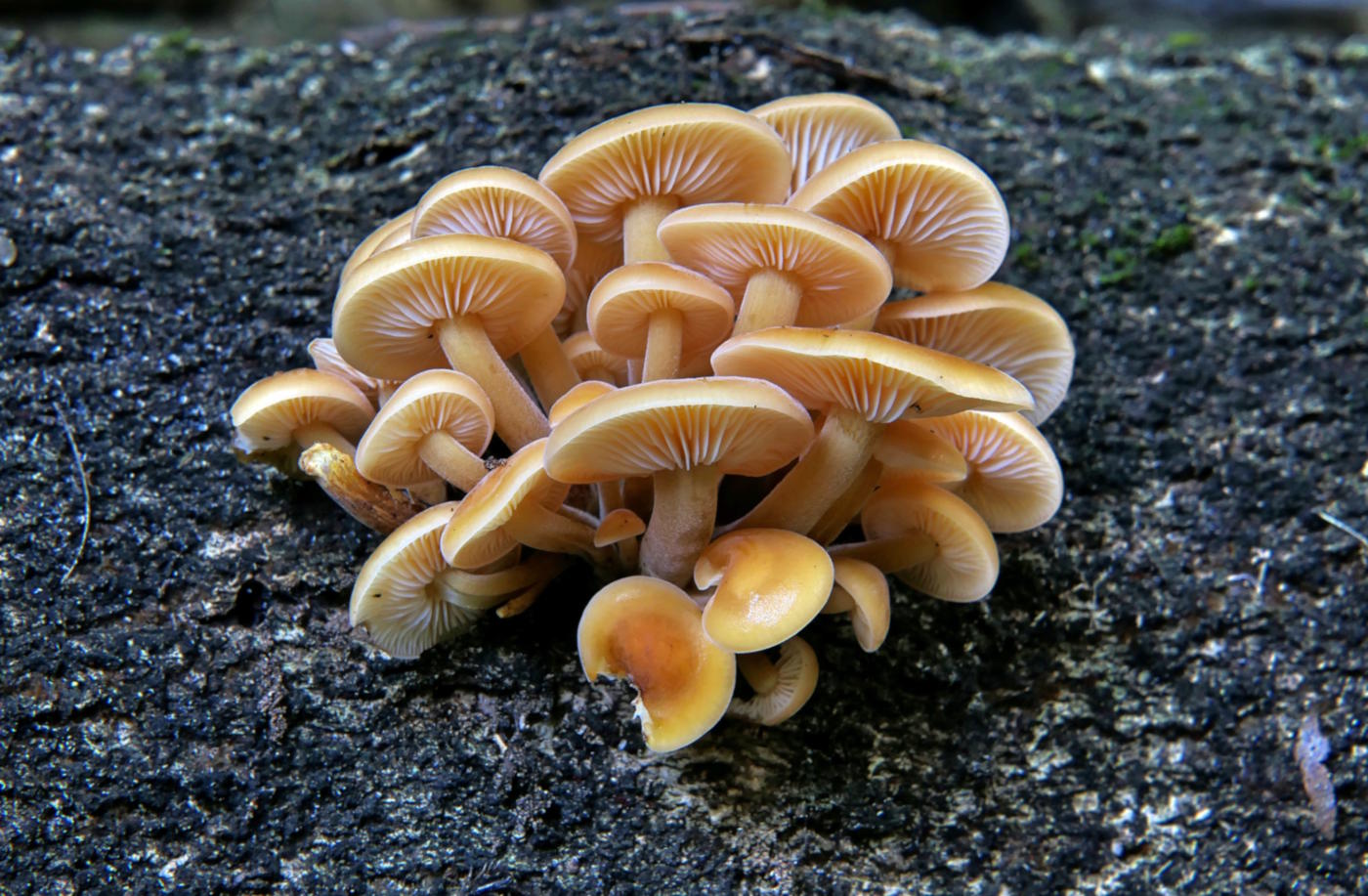
13. Flammulina velutipes — Velvet Shank
Identification
Velvet Shank has yellow to orange-brown caps, pale gills, and a distinctive dark velvety lower stem. The cap can become shiny or sticky in wet weather.
The mushrooms usually grow in small clusters on wood. Their winter tolerance makes them unusual among many gilled species.
Where to Find It in October
It grows on dead or weakened broadleaf trees and stumps. Late October can mark the beginning of its main season.
The species may remain active after other autumn mushrooms decline, sometimes continuing through winter.
14. Trametes versicolor — Turkey Tail
Identification
Turkey Tail forms thin semicircular brackets with concentric bands of gray, brown, cream, rust, and other shades. The underside is pale and covered in very fine pores.
Many brackets may overlap into broad layered colonies. The fruit bodies remain relatively thin and flexible when fresh.
Where to Find It in October
Dead hardwood is the main substrate. Fallen branches and logs are especially common locations.
Turkey Tail can be found much of the year, but wet autumn weather often makes fresh growth more conspicuous.
15. Fomes fomentarius — Tinder Fungus
Identification
Tinder Fungus forms hard gray to brown hoof-shaped brackets. Unlike soft annual mushrooms, the fruit body is perennial and develops additional growth layers.
The underside has a pale pore surface. Mature fruit bodies can remain attached to the tree for years.
Where to Find It in October
Birch and beech are common hosts, although other broadleaf trees can support it. Both living and dead trees may carry fruit bodies.
Because it is perennial, October does not define its entire season. However, autumn woodland walks make these large brackets especially easy to notice.
16. Cortinarius rubellus — Deadly Webcap
Identification
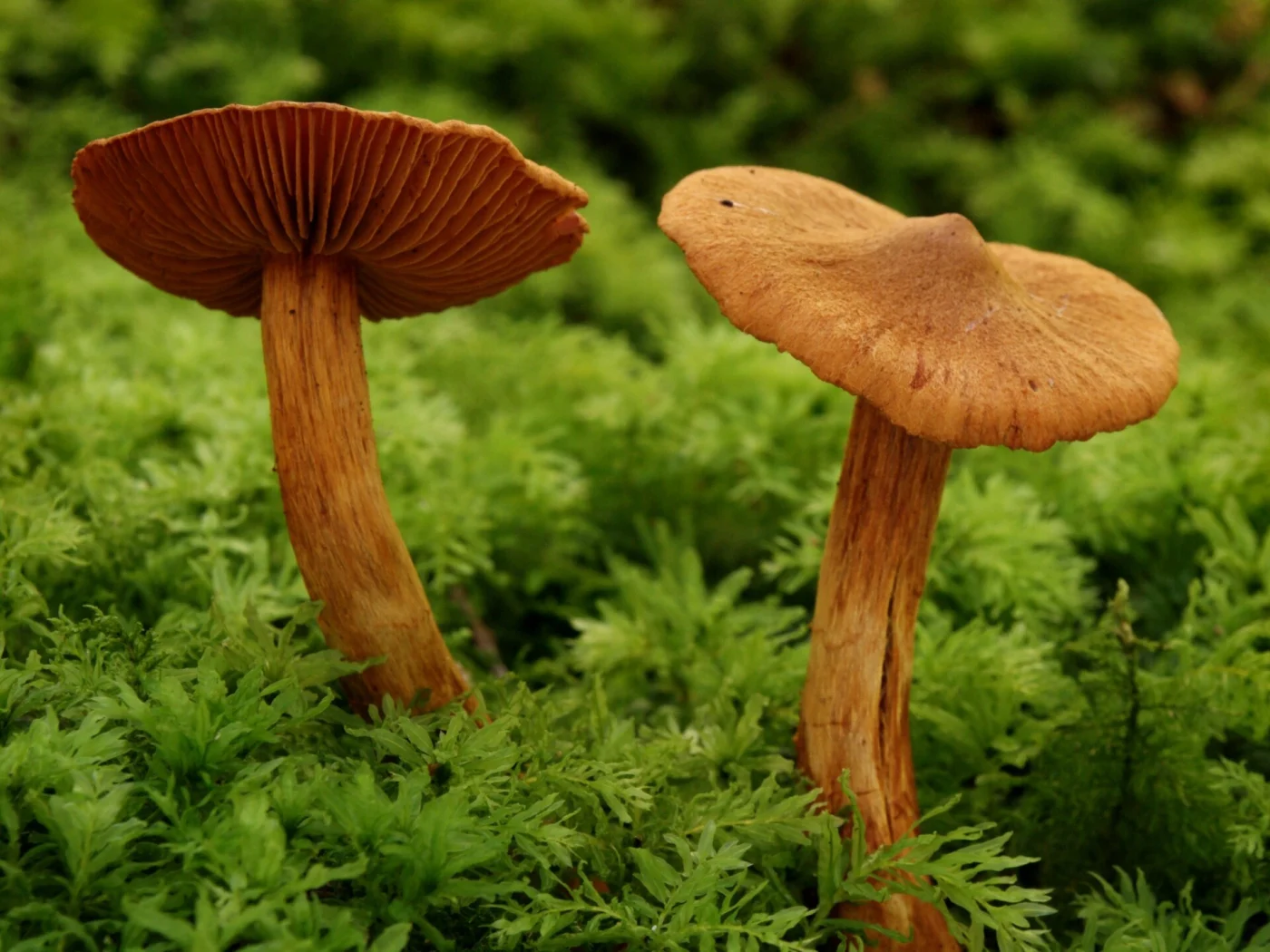
Deadly Webcap is orange-brown to reddish-brown and grows from soil. Young specimens may show a cobweb-like cortina between the cap and stem.
Mature spores are rusty brown and can stain the gills and stem. Several other Cortinarius species have a similar overall appearance.
Where to Find It in October
It occurs in woodland in association with trees. Autumn is the main fruiting period, making October an important month.
Species-level identification within Cortinarius can be difficult. Unknown rusty-spored woodland mushrooms should be approached cautiously.
Safety
The species contains orellanine and can cause severe kidney damage. Symptoms may be delayed for several days.
17. Clitocybe rivulosa — Fool’s Funnel
Identification
Fool’s Funnel is a small pale mushroom with a white to cream cap. As it matures, the cap often becomes shallowly funnel-shaped.
The pale gills run somewhat down the stem. Its plain appearance can make it easy to overlook.
Where to Find It in October
Lawns, meadows, parks, and grassy verges are typical habitats. It can grow in arcs, rings, or scattered groups.
October rainfall frequently triggers fruiting.
Safety
The species contains muscarine and can cause sweating, salivation, gastrointestinal distress, and cardiovascular symptoms.
18. Agaricus campestris — Field Mushroom
Identification
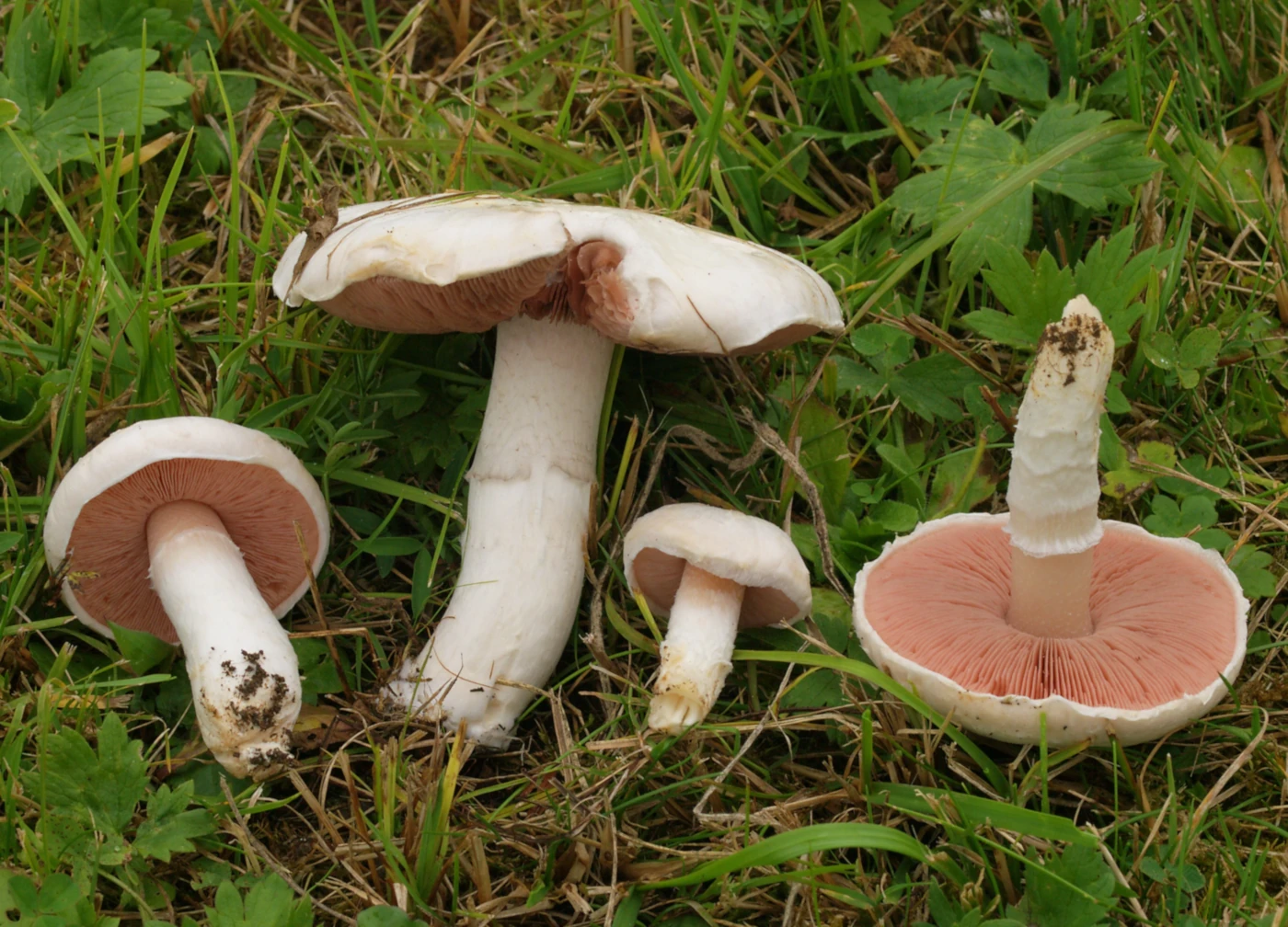
Field Mushroom has a pale cap and gills that begin pink and become dark brown as the spores mature. The stem is white and usually has a relatively simple ring.
The darkening gills are one of the most useful features. White-gilled Amanitas should never be confused with mature Agaricus.
Where to Find It in October
Grasslands, meadows, lawns, and pastures are typical habitats. It grows from soil rather than directly from wood.
October can still produce strong fruiting in mild conditions. In colder regions, the season may already be ending.
19. Agaricus arvensis — Horse Mushroom
Identification
Horse Mushroom is usually larger than Field Mushroom and has a white to cream cap that may yellow with age or handling. The gills progress from pale pink to dark brown.
The stem has a substantial ring. Its general size and structure make mature specimens impressive.
Where to Find It in October
Meadows, fields, roadsides, and open grassy places are common habitats. Rich soils can support large groups.
October remains within the normal fruiting period in many parts of Europe.
20. Hericium coralloides — Coral Tooth Fungus
Identification
Coral Tooth Fungus forms a white branching structure covered with numerous downward-pointing teeth. It looks more like underwater coral than a conventional mushroom.
Older specimens become cream or yellowish. The highly branched structure distinguishes it from the more compact Lion’s Mane.
Where to Find It in October
It grows on dead or dying broadleaf wood, especially mature hardwood. Suitable old woodland is an important habitat.
October is within the normal fruiting period, although the species is much less common than many mushrooms in this guide.
October Mushrooms by Habitat
Deciduous Woodland
Oak, beech, birch, and other broadleaf forests can support Death Caps, Porcini, Black Trumpets, Hedgehog Mushrooms, Amanitas, and numerous Cortinarius species. Moist leaf litter also creates favorable conditions for many smaller fungi.
The exact species depend on tree composition and local climate. Mature woodland generally supports greater diversity than isolated trees.
Coniferous Forest
Pine and spruce forests can produce Saffron Milk Caps, Porcini, Bay Boletes, Slippery Jacks, Fly Agarics, and many other mycorrhizal mushrooms. Mossy ground can remain especially productive in wet October weather.
Host-tree identification is extremely useful here. Many species have strong preferences for pine, spruce, or other conifers.
Lawns and Meadows
Shaggy Mane, Field Mushroom, Horse Mushroom, Fool’s Funnel, and numerous small grassland fungi can appear in October. Well-watered parks and old grasslands may become highly productive.
Trees growing nearby can also introduce mycorrhizal species into apparently open lawns. A mushroom in grass is therefore not necessarily a true grassland species.
Logs, Stumps and Dead Wood
Oyster Mushrooms, Deadly Galerina, Velvet Shank, Turkey Tail, Honey Mushrooms, and many bracket fungi can occur on wood in October. Prolonged wet weather makes dead wood especially favorable.
Several fungal species can share the same log. Each cluster should therefore be identified independently.
Edible Mushrooms Found in Europe in October
October can produce many prized edible mushrooms, including Porcini, chanterelles, Black Trumpets, Hedgehog Mushrooms, Saffron Milk Caps, Oyster Mushrooms, Field Mushrooms, and several others. Their availability depends heavily on local weather and habitat.
The presence of edible species does not make a site generally safe for collecting. Deadly Amanitas, Galerina, and Cortinarius may fruit only a short distance away.
Poisonous Mushrooms Found in Europe in October
October is also a major season for several of Europe’s most important poisonous mushrooms. Death Cap, Fly Agaric, Panther Cap, Deadly Galerina, Deadly Webcap, and Fool’s Funnel can all be encountered.
Some produce rapid neurological or gastrointestinal symptoms, while amatoxin and orellanine poisoning can be dangerously delayed. Identifying poisonous groups is therefore just as important as recognizing edible ones.
How to Identify an October Mushroom
Begin with the underside. Determine whether the mushroom has true gills, pores, blunt ridges, teeth, or another fertile surface.
Then check the stem, complete stem base, substrate, nearby trees, bruising reactions, and growth pattern. These features are usually more informative than cap color alone.
Season can support an identification but should never determine it. Dozens of unrelated species can fruit in October.
How to Photograph October Mushrooms for Identification
Take at least one photograph from above and one from underneath. Include the complete stem and stem base whenever possible, especially for Amanitas.
A wider habitat photo is also valuable because it can reveal host trees, dead wood, grassland, or other ecological clues. If several ages are present, photograph young and mature specimens together.
Good identification photographs should document structure rather than simply produce an attractive top view.
Frequently Asked Questions
Is October a good month for mushrooms in Europe?
Yes. October is one of the richest mushroom months across much of temperate Europe because rainfall is often frequent while soil temperatures remain suitable for fungal activity. The exact peak varies by latitude, altitude, and local weather.
What edible mushrooms grow in Europe in October?
Common possibilities include Porcini, chanterelles, Black Trumpets, Hedgehog Mushrooms, Saffron Milk Caps, Oyster Mushrooms, and various Agaricus species. Availability differs substantially between northern, central, western, and southern Europe.
What poisonous mushrooms grow in October?
Death Cap, Panther Cap, Fly Agaric, Deadly Galerina, Deadly Webcap, and Fool’s Funnel are important examples. October is therefore not only productive for edible mushrooms but also a critical month for learning dangerous species.
Can Porcini still grow in October?
Yes. October remains within the normal Porcini season in many parts of Europe, although colder northern areas may be approaching the end of fruiting. Mild and wet conditions can extend the season.
Do chanterelles still grow in October?
They can. Chanterelles often continue into October in mild regions, while their season may end earlier farther north or at higher elevations.
What mushrooms grow under pine trees in October?
Saffron Milk Caps, Porcini, Slippery Jacks, Fly Agarics, and several other species can occur near pine. The exact species depends on region and soil conditions.
What mushrooms grow on wood in October?
Honey Mushrooms, Oyster Mushrooms, Deadly Galerina, Turkey Tail, Velvet Shank, and numerous bracket fungi are common possibilities. Some grow on dead wood, while others can also occur on living or weakened trees.
What lawn mushrooms appear in October?
Shaggy Mane, Field Mushroom, Horse Mushroom, Fool’s Funnel, and many smaller grassland fungi can appear. In warmer European regions, lawn fruiting may remain strong throughout the month.
Does frost stop October mushrooms?
A light frost does not necessarily end the season. Cold-tolerant species such as Oyster Mushroom and Velvet Shank can continue fruiting after temperatures become too low for many other mushrooms.
Does mushroom season end after October?
No. November and even winter can remain productive, particularly in milder regions and for wood-growing species. The diversity usually declines, but mushroom season does not end everywhere at the same time.
Final Identification Notes
October is one of the best months to explore mushroom diversity in Europe because woodland, grassland, and wood-decaying species all overlap. Porcini, chanterelles, Hedgehog Mushrooms, milkcaps, Amanitas, Honey Mushrooms, Oyster Mushrooms, and many other fungi may all be visible during the same week.
The best way to identify an October mushroom is to combine underside structure, stem features, substrate, nearby trees, growth pattern, bruising, spore color, and geographic region. The calendar provides useful context, but morphology remains the basis of reliable identification.
October also brings some of Europe’s most dangerous poisonous mushrooms, including Death Cap and Deadly Galerina. When a mushroom is being considered for food, uncertainty should always be treated as a reason to continue identifying rather than a reason to guess.
Upload a photo and get possible matches in seconds.