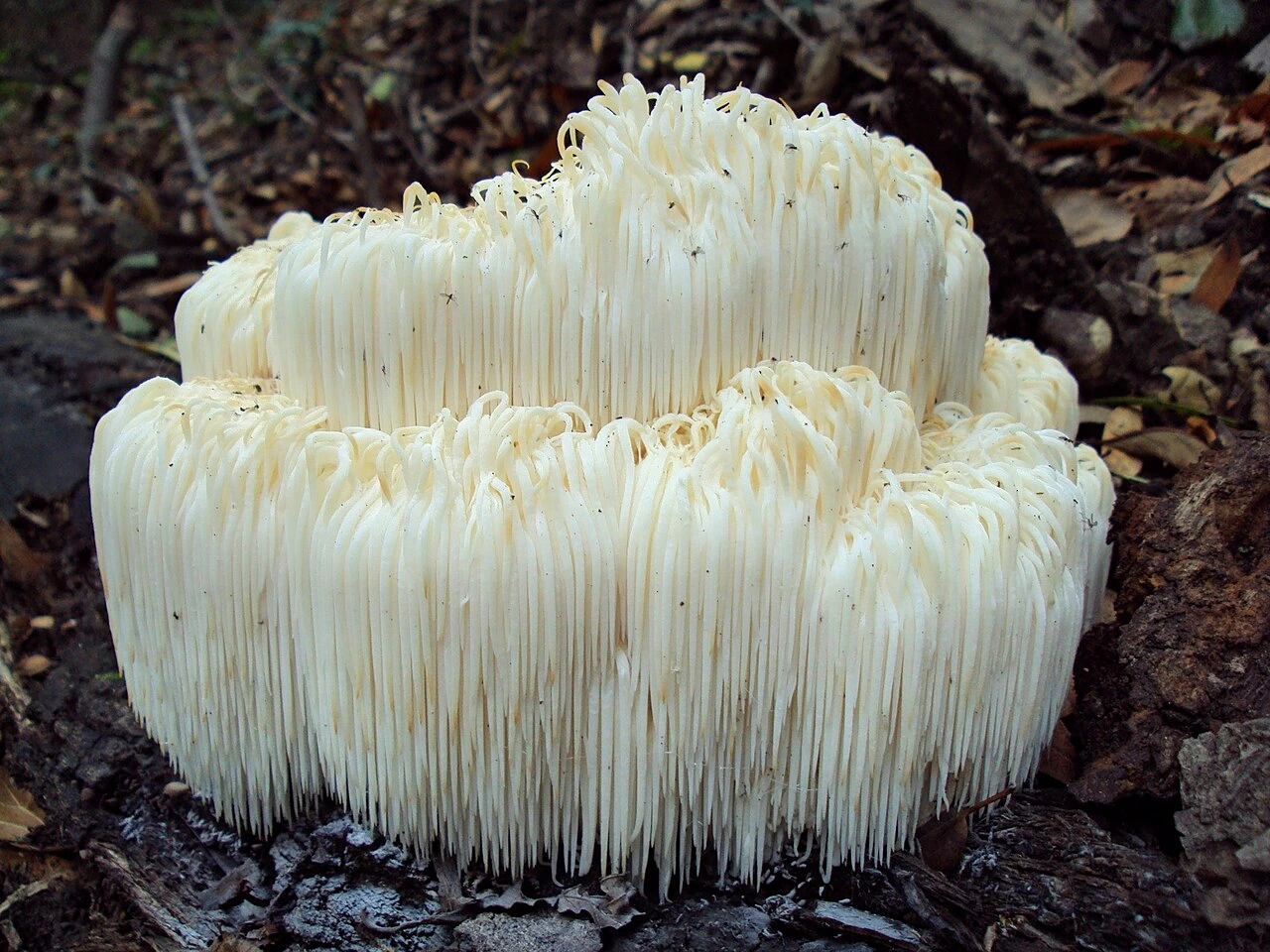
Hericium erinaceus, commonly known as Lion’s Mane, is one of the most distinctive edible mushrooms in temperate forests. Instead of a conventional cap with gills or pores, it forms a rounded mass covered with long white spines that hang downward like teeth, giving the fungus its characteristic shaggy appearance.
Because of this unusual structure, mature Lion’s Mane is easier to recognize than many other edible mushrooms. The main identification challenge is usually not distinguishing it from a deadly species, but separating it from other closely related Hericium mushrooms that also produce white hanging spines.
⚠️ Important: This guide is for identification and education only. Never eat a wild mushroom based solely on a photograph, AI result, or comparison with an online guide.
Quick Identification
| Feature | Hericium erinaceus |
|---|---|
| Scientific name | Hericium erinaceus |
| Common names | Lion’s Mane, Bearded Tooth Fungus |
| Family | Hericiaceae |
| Shape | Rounded or irregular white mass |
| Spines | Long, hanging, usually unbranched |
| Color | White when young, yellowish or cream with age |
| Stem | Usually absent or very short |
| Spore print | White |
| Habitat | Living or dead hardwood |
| Common hosts | Beech, oak, maple and other broadleaf trees |
| Season | Usually late summer through autumn |
| Edibility | Edible when young and correctly identified |
| Main look-alikes | Hericium coralloides, Hericium americanum and other tooth fungi |
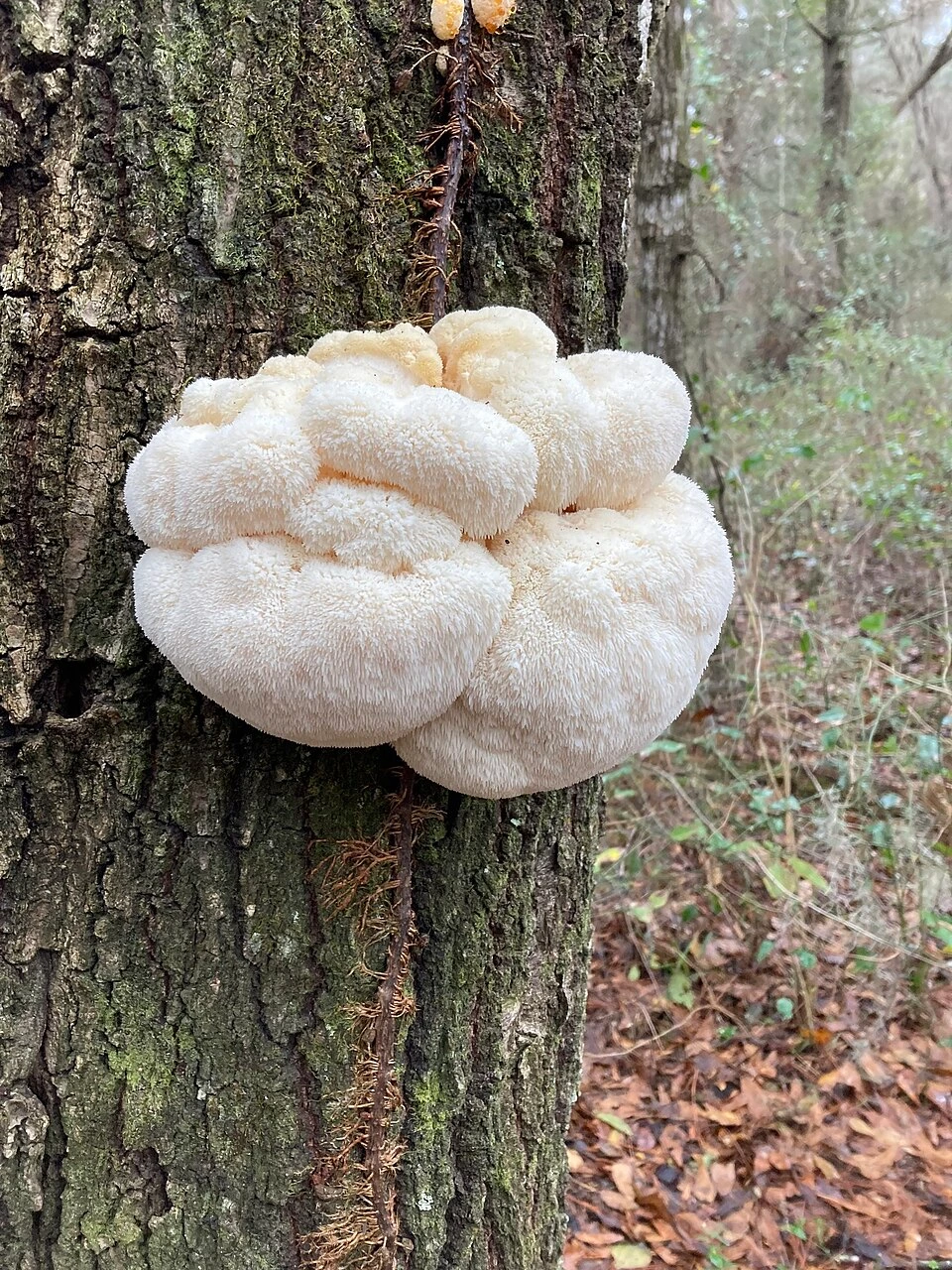
What Does Hericium erinaceus Look Like?
Lion’s Mane does not resemble the classic mushroom shape. It generally forms a single compact or lobed mass covered with hundreds of downward-pointing spines.
Young specimens are bright white and can look like a ball of soft icicles or shaggy fur attached to a tree. As the mushroom ages, the surface often becomes cream, pale yellow or slightly brownish, particularly around the tips of the spines.
The fruit body can become quite large. Well-developed specimens may reach 10–30 cm across, although size varies considerably depending on age, host tree and growing conditions.
Spines
The hanging spines are the most important identification feature. In mature Hericium erinaceus, they are usually long, relatively straight and arise from a compact, mostly unbranched body.
They may grow several centimeters long and hang vertically under gravity. This distinguishes Lion’s Mane from some related Hericium species in which the spines grow from numerous branching structures rather than from one dense central mass.
Very young specimens may not yet have long obvious spines, which can make early identification less certain.
Color and Aging
Fresh young Lion’s Mane is usually pure white. As the fungus ages, it gradually shifts toward cream, ivory or yellowish tones and may eventually develop brownish areas.
Older mushrooms often become softer, wetter or discolored and are generally less desirable for culinary use. Extensive yellowing or browning usually indicates that the fruit body is past its best condition.
Color alone is not sufficient for identification, but a mature fruit body that is strongly orange, gray, black or dark brown is unlikely to be fresh Hericium erinaceus.
Stem and Attachment
Lion’s Mane usually has no obvious central stem. Instead, it grows directly from wood and attaches to the trunk, branch or exposed internal wood through a relatively broad base.
This attachment can sometimes be hidden from view when the fruit body is large. The fungus may appear almost spherical when growing from the side of a trunk.
The absence of a typical cap-and-stem structure is one of the reasons Lion’s Mane is comparatively easy to recognize.
Spore Print
The spore print of Hericium erinaceus is white. Spores are released from the surface of the downward-hanging teeth rather than from gills or pores.
Because several related tooth fungi also produce pale or white spores, spore color is generally less useful for distinguishing between Hericium species than the overall branching structure and shape of the fruit body.
Where Does Lion’s Mane Grow?
Lion’s Mane grows on hardwood trees. It may occur on living trees, wounded trees, standing dead trunks, fallen logs and exposed sections of old wood.
Common hosts include beech, oak, maple and other broadleaf trees. Exact host preference varies by region.
The fungus causes white rot in wood. In living trees, its presence may indicate internal decay, although the fruit body itself can appear on trees that still look healthy externally.
Does Lion’s Mane Grow From the Ground?
Normally, Lion’s Mane grows directly from wood rather than from ordinary soil. If a white tooth fungus appears to be growing from the ground, there may be buried wood or roots underneath.
This ecological feature is useful during identification because a similar-looking white fungus sitting directly on grass with no woody substrate would require closer examination.
Always check the attachment point and surrounding habitat rather than relying only on a close-up photograph.
Habitat
Lion’s Mane is primarily associated with mature deciduous woodland, old trees, parks and other areas where large hardwood trees are present.
It may occur relatively high on a standing trunk, inside a damaged section of wood, or close to ground level on a fallen log. This means specimens are not always easy to spot during casual mushroom hunting.
Old forests and long-established trees can provide especially suitable habitat because the fungus benefits from large amounts of mature or decaying hardwood.
Distribution
Hericium erinaceus occurs across parts of Europe, Asia and North America. Its abundance varies considerably by region.
In some European countries it is uncommon or legally protected because of habitat loss and the decline of old broadleaf forests. Collecting wild specimens may therefore be restricted or discouraged in certain locations.
Before harvesting a wild Lion’s Mane, it is sensible to check local conservation rules rather than assuming the species can be collected everywhere.
When Does Lion’s Mane Grow?
Lion’s Mane most often fruits during late summer and autumn in temperate climates. Fruiting usually becomes more likely after wetter weather and when temperatures begin to cool.
The exact season depends on latitude, altitude and regional climate. In mild regions, fruit bodies may persist relatively late into the year.
The fungus can return to the same tree in subsequent seasons if suitable conditions remain.
Is Lion’s Mane Edible?
Yes. Hericium erinaceus is considered an edible mushroom when correctly identified and harvested while young and fresh.
The texture is firm but tender, and many people describe the flavor as mildly seafood-like. It is commonly cultivated commercially, which provides a much safer alternative to collecting wild specimens.
Wild mushrooms should still be inspected carefully for insects, decay and contamination before use. Specimens growing on polluted wood, treated timber or contaminated urban substrates should not be collected for food.
Cultivated vs Wild Lion’s Mane
Cultivated Lion’s Mane often forms cleaner, more rounded white clusters than wild specimens. Commercial fruit bodies are usually grown on sterilized hardwood-based substrates under controlled conditions.
Wild specimens may be more irregular because they develop around bark, cavities and uneven tree surfaces. They are also more likely to show insect damage, debris, yellowing or weather exposure.
Shape differences between wild and cultivated mushrooms do not necessarily indicate a different species.
Hericium erinaceus Look-Alikes
The main look-alikes are other members of the genus Hericium. These mushrooms are generally easier to separate from dangerous fungi than many other edible mushroom groups because the long white teeth are so distinctive.
The most useful feature is the way the spines are arranged. Lion’s Mane forms a dense compact mass, while related species are usually more obviously branched.
1. Hericium coralloides — Coral Tooth Fungus
- Scientific name: Hericium coralloides
- Common names: Coral Tooth Fungus, Coral Hedgehog
This species has numerous white hanging spines, but they grow from a highly branched structure resembling underwater coral.
Instead of one dense rounded body, the mushroom consists of many branching arms covered in short teeth.
The overall appearance is much more open and delicate than Lion’s Mane.
Main difference
Lion’s Mane: compact, rounded and largely unbranched.
Coral Tooth: strongly branched, open and coral-like.
2. Hericium americanum — Bear’s Head Tooth
- Scientific name: Hericium americanum
- Common name: Bear’s Head Tooth
This North American species can resemble Lion’s Mane quite closely. It forms white masses with hanging teeth but has a more branched internal structure.
Clusters may appear as several connected lobes rather than one single rounded mass.
The distinction can be subtle in some specimens, especially when the mushroom is young or photographed from only one angle.
Main difference
Bear’s Head Tooth usually shows more obvious branching behind the spines, while Hericium erinaceus tends to form a more compact solid-looking body.
3. Hericium abietis — Conifer Coral Hericium
- Scientific name: Hericium abietis
- Common name: Conifer Coral Hericium
This species occurs mainly in western North America and grows on conifer wood rather than hardwood.
Its fruit body is branched and coral-like, with hanging white teeth along the branches.
The substrate is therefore an important clue. Lion’s Mane is primarily a hardwood species, while H. abietis is associated with conifers.
4. Other Tooth Fungi
Several unrelated fungi also produce teeth or spines rather than gills. However, most do not form the large white hanging masses characteristic of Hericium species.
Some hydnoid fungi grow from soil and have a conventional cap with teeth underneath, while others form crusts or shelves on wood. Observing the overall structure quickly narrows the possibilities.
A white tooth fungus forming a large suspended mass on hardwood strongly suggests the genus Hericium.
Lion’s Mane vs Coral Tooth Fungus
| Feature | Hericium erinaceus | Hericium coralloides |
|---|---|---|
| Common name | Lion’s Mane | Coral Tooth Fungus |
| Overall shape | Compact rounded mass | Strongly branched |
| Spines | Long and hanging | Shorter teeth along branches |
| Branching | Minimal | Extensive |
| Substrate | Hardwood | Hardwood |
| Color | White to cream | White to cream |
The difference in architecture is much more useful than color because both species can have nearly identical white coloration when fresh.
Lion’s Mane vs Bear’s Head Tooth
| Feature | Hericium erinaceus | Hericium americanum |
|---|---|---|
| Shape | Dense compact mass | Branched lobed mass |
| Spines | Long, hanging from one main body | Hanging from several branches |
| Habitat | Hardwood | Hardwood |
| Distribution | Europe, Asia, North America | Mainly North America |
| Spore print | White | White |
These species can be difficult to separate from photographs if the internal branching is hidden, so multiple viewing angles are helpful.
How to Identify Lion’s Mane Step by Step
Begin with the overall body shape. A likely Lion’s Mane should be a white or cream tooth fungus growing directly from wood and forming a relatively compact mass rather than a conventional cap.
Then look at the spines. They should hang downward and become long on mature specimens. Finally, examine the substrate and branching structure. Hardwood habitat and minimal branching strongly support Hericium erinaceus.
No single feature should be considered completely definitive, especially with young fruit bodies.
How to Photograph Lion’s Mane for Identification
Photograph the entire fruit body from the side so that the hanging spines are visible. A second image from underneath can help show spine length and attachment.
Also photograph the tree or log and the exact attachment point. If possible, include enough of the trunk to help identify whether it is hardwood or conifer.
Close-ups are useful, but a macro photograph of the spines alone removes some of the most important structural information.
Can Lion’s Mane Be Identified From a Photo?
Mature Lion’s Mane is one of the more photo-friendly wild mushrooms because its structure is highly distinctive. Good photographs showing a dense white body with long hanging spines on hardwood can often narrow identification considerably.
The main uncertainty is usually between different Hericium species rather than between edible and deadly mushrooms. Young or poorly developed specimens can still be difficult to distinguish, particularly when branching is hidden.
AI identification can therefore be useful, but habitat and complete structure should still be checked manually.
Does Lion’s Mane Have Poisonous Look-Alikes?
Lion’s Mane does not have a famous deadly look-alike comparable to the dangerous doubles associated with morels, honey mushrooms or white Amanitas.
Its closest visual matches are other Hericium species, several of which are also considered edible when correctly identified. This makes the group relatively beginner-friendly from a toxicity perspective, but identification still matters because conservation rules, regional species and habitat can differ.
Unusual specimens that do not clearly match the Hericium structure should not be assumed safe.
Why Is Lion’s Mane Sometimes Yellow?
A fresh fruit body is normally white, but yellowing is common as the mushroom matures. Heat, dryness, sunlight and physical damage can accelerate discoloration.
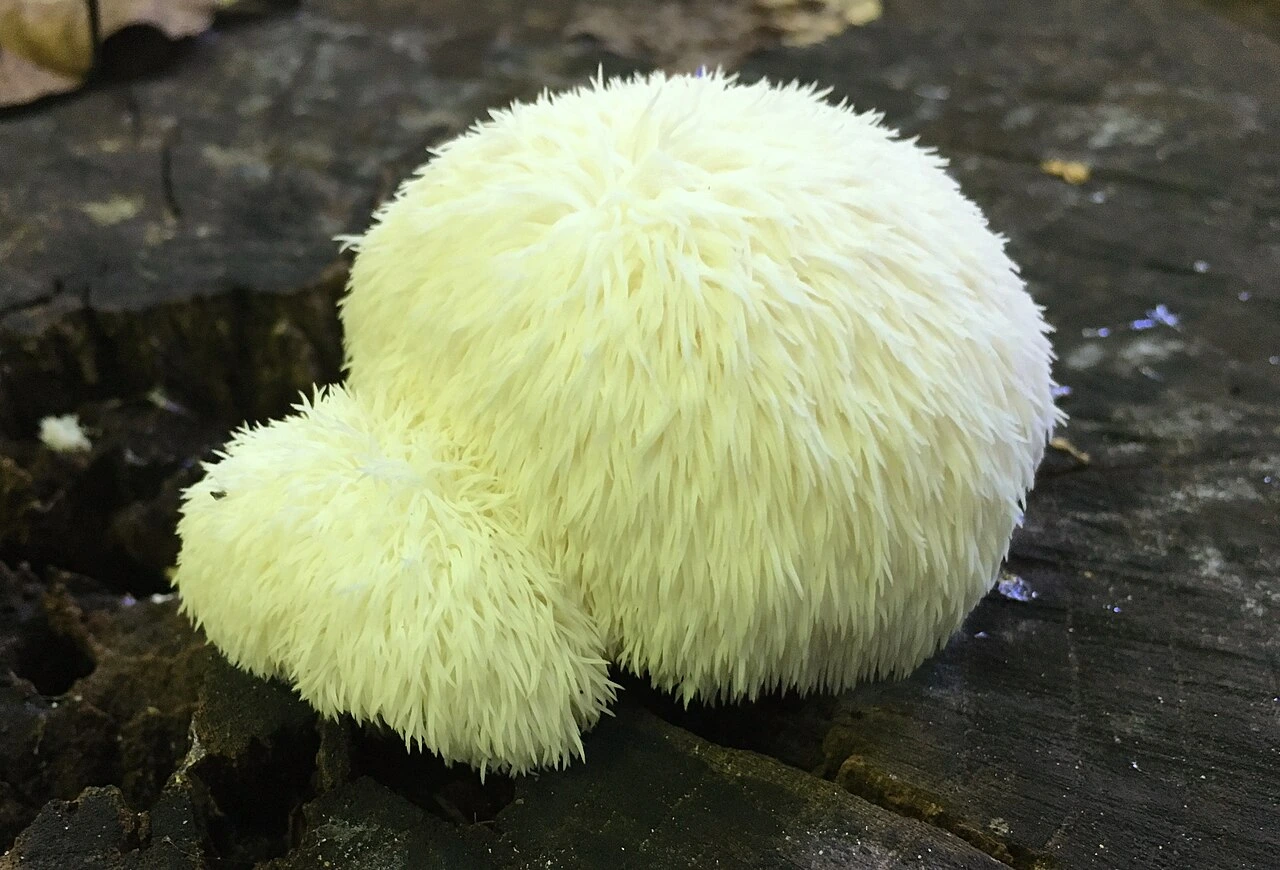
A small amount of cream or pale yellow does not necessarily indicate another species. Strong browning, softness, unpleasant odor or extensive deterioration usually suggests that the mushroom is old.
Commercial Lion’s Mane can also yellow slightly during storage.
Can Lion’s Mane Grow on a Living Tree?
Yes. Lion’s Mane can fruit from both living and dead hardwood.
On a living tree, the fungus may be associated with internal decay, wounds or cavities. The visible mushroom can therefore emerge from a section of trunk that appears relatively intact from the outside.
Finding Lion’s Mane on a tree does not automatically mean the tree is about to fall, but fungal fruiting can be evidence of internal wood decomposition.
Is Lion’s Mane Rare?
Its abundance varies significantly by region. In some parts of North America it can be locally common, while in several European regions it is considered uncommon or threatened.
The decline of old broadleaf woodland and removal of aging trees reduce suitable habitat. This is why wild collection may be restricted or discouraged in some countries.
Cultivated Lion’s Mane is widely available and removes the need to harvest rare wild populations.
Interesting Facts About Hericium erinaceus
Lion’s Mane belongs to a group of fungi that produce spores on hanging teeth rather than gills or pores. This structure makes the genus immediately recognizable once a person becomes familiar with it.
The mushroom is also widely cultivated as both a food and a commercial functional-mushroom product. Its unusual appearance has helped it become one of the most recognizable cultivated gourmet mushrooms alongside oyster mushrooms and shiitake.
Despite the name, the “mane” consists entirely of fungal tissue rather than fibers or hairs. Each spine is part of the reproductive surface of the mushroom.
Frequently Asked Questions
What does Lion’s Mane mushroom look like?
It forms a white rounded or irregular mass covered with long hanging spines. Mature specimens often resemble a white pom-pom, beard or cluster of icicles.
Where does Lion’s Mane grow?
It grows directly from hardwood trees and logs. Common hosts include beech, oak, maple and other broadleaf trees.
Does Lion’s Mane grow from soil?
Normally no. If it appears to be growing from the ground, buried wood or tree roots may be present underneath.
Is Lion’s Mane edible?
Yes, when correctly identified and fresh. Cultivated specimens are widely sold as food.
What mushrooms look like Lion’s Mane?
The closest look-alikes are other Hericium species, especially Hericium coralloides and Hericium americanum.
Does Lion’s Mane have poisonous look-alikes?
There are no well-known deadly mushrooms that closely match the classic mature Lion’s Mane structure. Most confusion occurs with related tooth fungi.
What is the difference between Lion’s Mane and Coral Tooth Fungus?
Lion’s Mane forms a compact mass with long hanging spines, while Coral Tooth Fungus has a highly branched coral-like structure.
Why is my Lion’s Mane turning yellow?
Yellowing usually occurs as the mushroom ages or dries. Strong discoloration and soft texture can indicate deterioration.
What color is the Lion’s Mane spore print?
The spore print is white.
When does Lion’s Mane grow?
In temperate climates it typically fruits from late summer through autumn, although exact timing varies by region.
Final Identification Notes
A typical Hericium erinaceus combines several distinctive features: a white to cream fruit body, long downward-hanging spines, a compact largely unbranched shape and growth directly from hardwood.
The main identification challenge is distinguishing Lion’s Mane from other Hericium species. Branching structure is usually the most useful clue. Lion’s Mane forms one dense shaggy body, while Coral Tooth and Bear’s Head Tooth tend to develop obvious branches or multiple lobes.
Because mature Lion’s Mane has such a distinctive structure, it is one of the easier wild mushrooms to recognize visually. Even so, habitat and complete morphology should always be checked rather than relying on one photograph alone.
Found a white tooth fungus on a tree? Photo identification can help narrow the species, but examine the branching pattern, spine length and host wood before making a final identification.