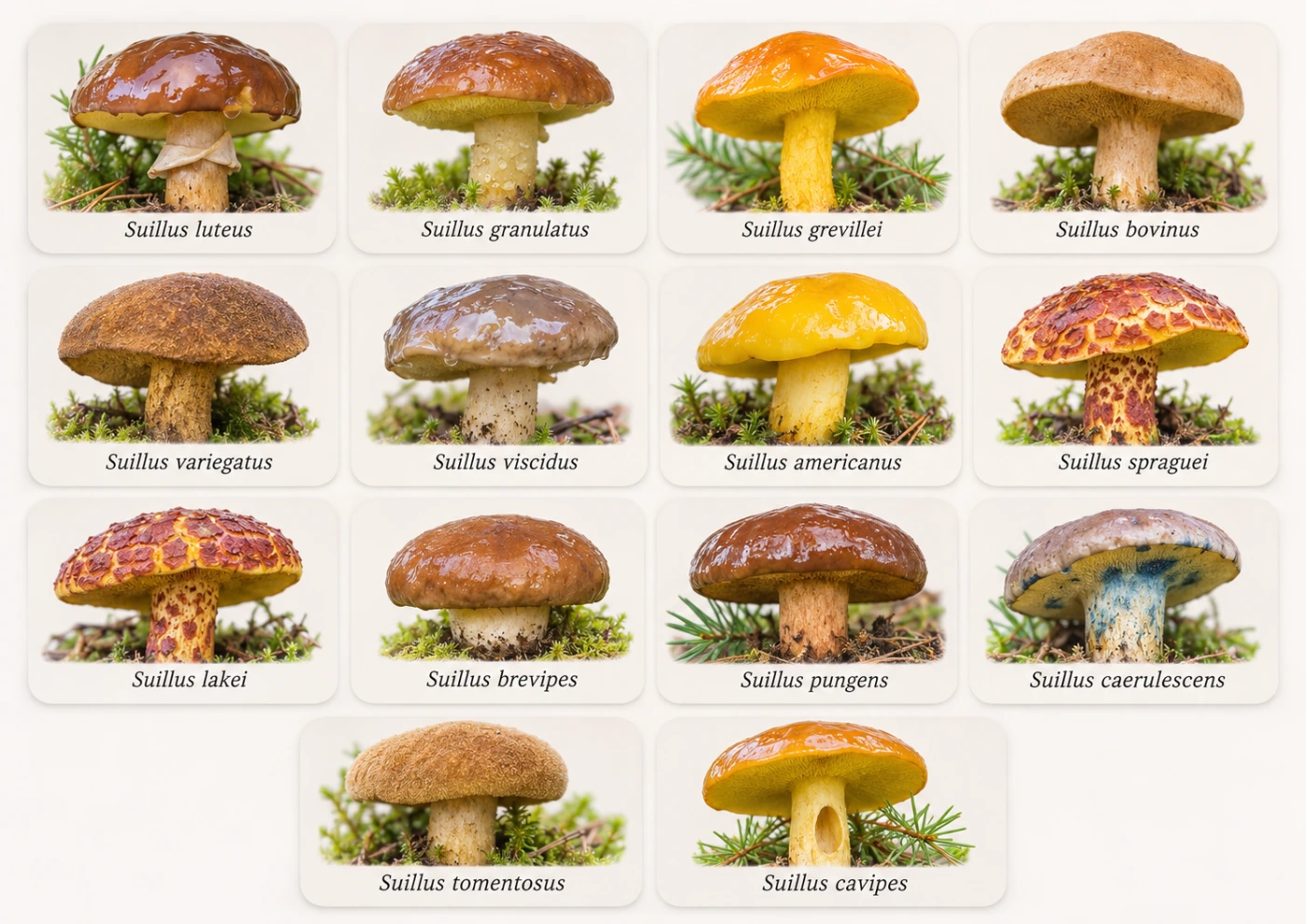
Suillus is a genus of boletes strongly associated with conifer trees, especially pine and larch. Many species have sticky or slimy caps, yellow pore surfaces, soft flesh, and stems marked with rings, glandular dots, or both.
The most useful field pattern is bolete with pores + conifer habitat + viscid cap + glandular dots or ring features on the stem. Exact species identification depends heavily on the host tree, because many Suillus are closely tied to particular conifers.
⚠️ Important: Not every sticky bolete is Suillus, and not every Suillus is Suillus luteus. Host tree, ring structure, pore droplets, stem dots, bruising, and regional distribution all matter.
Quick Identification
| Feature | Suillus |
|---|---|
| Underside | Pores, not gills |
| Cap | Often sticky, greasy, or slimy |
| Cap color | Yellow, orange, brown, olive, reddish |
| Pores | Usually yellow when young |
| Stem | Pale to yellowish |
| Ring | Present in some species, absent in others |
| Glandular dots | Common in many species |
| Flesh | Soft to firm, often pale yellow |
| Spore print | Olive-brown to brown |
| Ecology | Mycorrhizal |
| Main hosts | Pine, larch, spruce, Douglas fir and other conifers |
| Growth | From soil near host trees |
| Season | Mainly summer to autumn |
| Edibility | Varies by species |
| Main look-alikes | Other boletes, Gomphidius, Chroogomphus |
What Are Suillus Mushrooms?
Suillus are boletes, so they have a sponge-like pore surface under the cap instead of gills. Most species live in mycorrhizal association with conifer roots.
This host relationship is one of the strongest features of the genus. A mushroom may look very similar to another Suillus, but if it grows with a different tree, the identification can change completely.
Why Suillus Caps Are Often Slimy
Many Suillus species have a gelatinized cap surface that becomes strongly viscid after rain. Fresh specimens can feel oily, greasy, or almost covered in mucus.
In dry weather, the same cap may look only slightly shiny or even almost matte. This is why a dry specimen can appear less typical than one collected after rain.
Sticky Cap Is Not Enough
Several unrelated mushrooms also have sticky caps. Some Hygrophorus, Cortinarius, Gomphidius, and other boletes can look similar from above.
Always turn the mushroom over first. The presence of pores immediately separates Suillus from gilled genera.
Pore Surface
Young pores are often pale yellow to bright yellow. With age, they can become darker, more olive, or brownish.
Some species produce droplets from the pore surface when young. This is especially useful in species such as Suillus granulatus.
Glandular Dots
Small brown, reddish, or dark dots on the stem are common in Suillus. These are called glandular dots and can be extremely useful for identification.
They may be concentrated near the upper stem or spread more broadly. Color, density, and whether droplets form around them can help separate species.
Ringed vs Ringless Suillus
Some species have a clear ring produced by a partial veil. Others completely lack a ring.
This creates one of the easiest practical divisions in the genus. Suillus luteus is ringed, while Suillus granulatus is ringless.
Why Host Tree Matters So Much
Many Suillus have strong host preferences. Pine-associated species can look nearly identical to larch-associated species, but the tree association immediately narrows the identification.
A good field habit is therefore to identify the nearby conifer before identifying the mushroom.
Suillus With Pine
Pine is the most important host for many species. Suillus luteus, S. granulatus, S. bovinus, and several North American species occur with different pines.
The exact pine species can sometimes help further. Some Suillus are highly specialized on two-needle, three-needle, or five-needle pines.
Suillus With Larch
Several species are closely associated with larch. Suillus grevillei is the classic example.
A bright yellow-orange slimy bolete under larch is much more likely to be S. grevillei than a pine-associated Slippery Jack.
Suillus With Douglas Fir
Western North America has Suillus associated with Douglas fir and other conifers. These regional species may be poorly represented in European field guides.
This is another reason broad names should not be applied automatically across continents.
Main Suillus Species
Suillus luteus — Slippery Jack
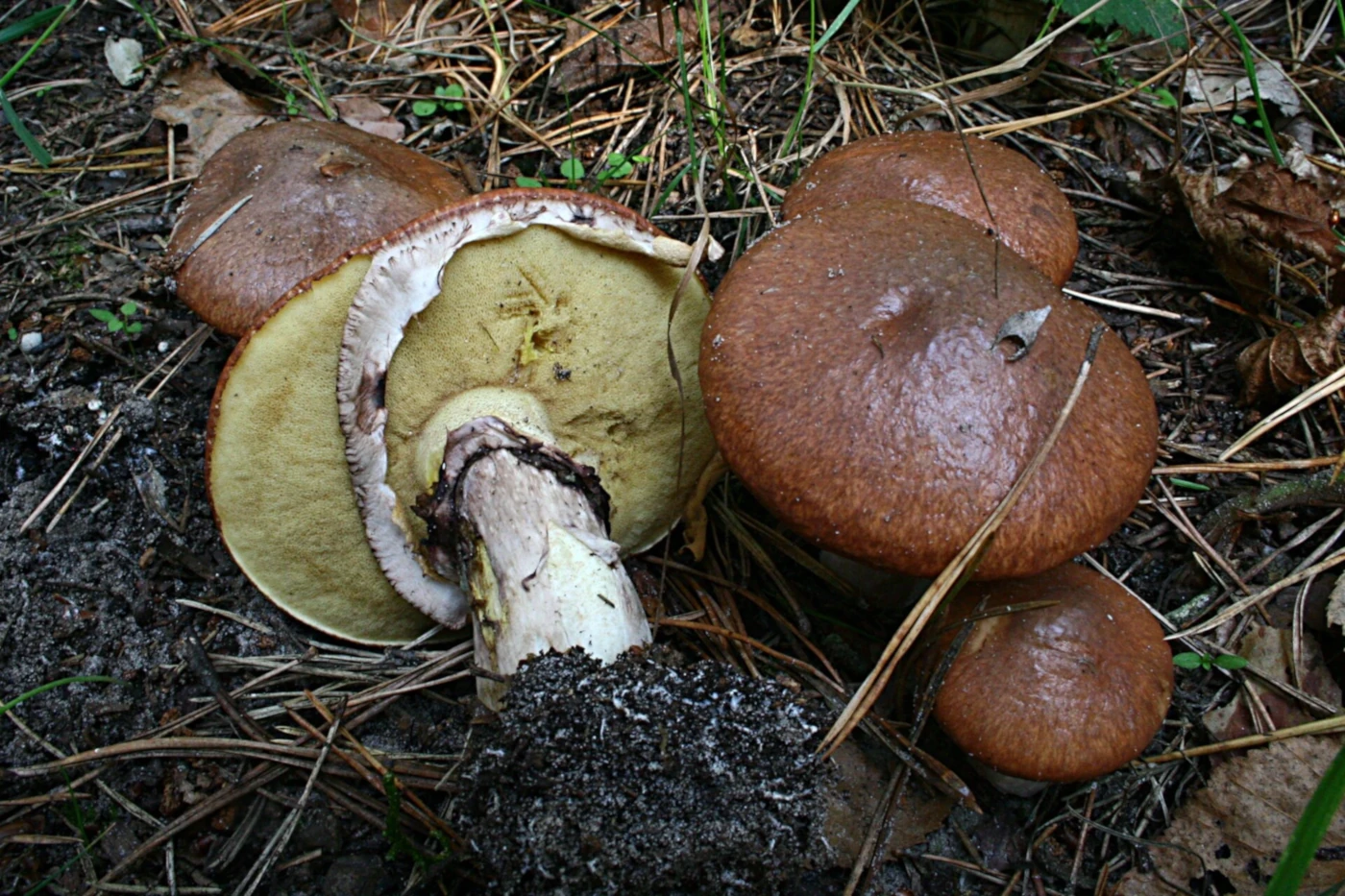
Suillus luteus is one of the best-known species in the genus. It has a dark brown to chestnut slimy cap, yellow pores, and a distinct stem ring.
It grows mainly with pine. The cap skin is often peeled before cooking because of its slippery texture.
Identification
Look for a dark brown viscid cap, yellow pores, ringed stem, and pine habitat.
Main Difference
The ring separates it from many similar pine-associated species.
Suillus granulatus — Weeping Bolete
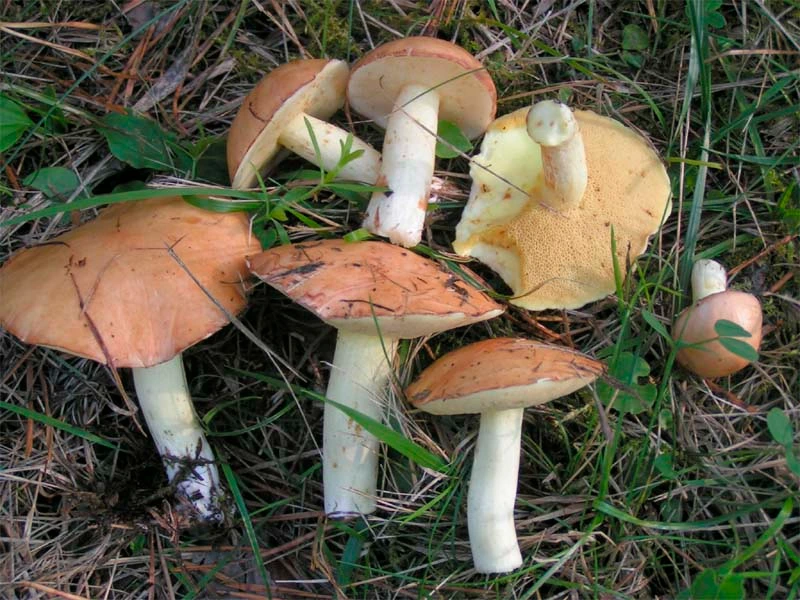
Suillus granulatus has a yellow-brown to orange-brown sticky cap and lacks a ring. Young pores often produce small pale or amber droplets.
The upper stem usually has glandular dots. Pine association is characteristic.
Identification
Sticky cap, yellow pores, no ring, glandular dots, and pore droplets are the key combination.
Main Difference
No ring separates it from S. luteus.
Suillus grevillei — Larch Bolete
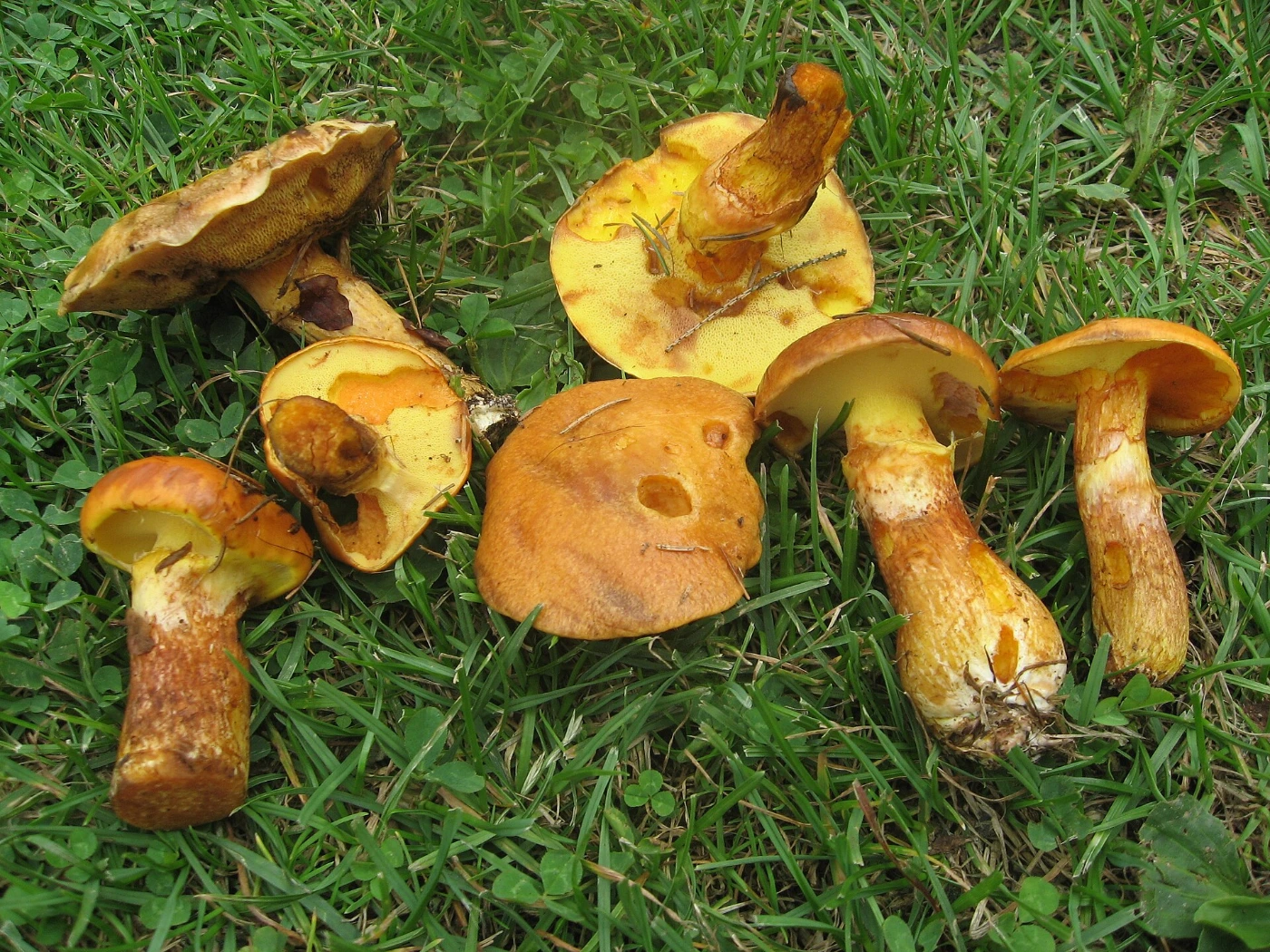
Suillus grevillei has a bright yellow to orange-yellow strongly slimy cap. The pores are yellow, and the stem often retains a ring or ring zone.
It is strongly associated with larch.
Identification
Bright orange-yellow viscid cap plus larch habitat is the strongest clue.
Main Difference
Host tree is decisive: larch favors S. grevillei, while pine suggests other species.
Suillus bovinus — Bovine Bolete
Suillus bovinus is usually duller and less vividly colored than Slippery Jack. Its cap is yellow-brown to orange-brown and becomes sticky when wet.
The pores are often larger and irregular, and the stem lacks a ring. It is associated with pine.
Identification
Look for large irregular pores, ringless stem, and pine habitat.
Main Difference
The pore structure is more open and angular than in many other Suillus.
Suillus variegatus — Velvet Bolete
Suillus variegatus is less slimy than many members of the genus. Its yellow-brown cap may feel dry or finely velvety rather than strongly glutinous.
It grows with pine and can show some blue staining in the flesh or pores.
Identification
A relatively dry cap, pine habitat, yellow-brown colors, and possible blue staining are useful clues.
Main Difference
Its cap is much less slimy than the classic Slippery Jack group.
Suillus viscidus — Sticky Bolete
Suillus viscidus is a grayish to brownish viscid species associated with larch. The cap can be dull gray, olive-gray, or brown.
The stem often has a ring and grayish tones.
Identification
Gray-brown slimy cap, ring, and larch association are characteristic.
Main Difference
It is much grayer and duller than the bright yellow-orange S. grevillei.
Suillus americanus — Chicken Fat Mushroom
Suillus americanus is a distinctive North American pine-associated species. It often has a bright yellow cap with reddish or brownish scales or fibrils.
The cap is sticky, and the stem bears glandular dots.
Identification
Bright yellow coloration, sticky surface, glandular dots, and eastern North American pine habitat are key clues.
Main Difference
Its vivid yellow cap and North American distribution help separate it from European species.
Suillus spraguei — Painted Suillus
Suillus spraguei is one of the most visually distinctive North American Suillus. The cap has reddish or pinkish scales over a yellow background.
It is associated mainly with eastern white pine and other five-needle pines.
Identification
Look for a patterned red-yellow cap, pores beneath, and white pine habitat.
Main Difference
The strongly patterned cap is unlike the smooth brown cap of Slippery Jack.
Suillus lakei — Western Painted Suillus
Suillus lakei is a western North American species associated with Douglas fir. Its cap often has reddish-brown scales over a yellowish background.
It may be dry to slightly sticky rather than extremely slimy.
Identification
Douglas fir habitat plus a scaly reddish-brown cap strongly supports the species.
Main Difference
Host tree and western distribution separate it from eastern painted Suillus.
Suillus brevipes — Short-Stemmed Slippery Jack
Suillus brevipes is a common western North American pine-associated species. It has a brown to reddish-brown viscid cap and a notably short stem.
The stem lacks a ring.
Identification
A brown sticky cap, short ringless stem, and pine habitat are typical.
Main Difference
Its short stem and lack of ring separate it from S. luteus.
Suillus pungens
Suillus pungens is a western North American species associated especially with Monterey pine and Bishop pine. Young caps may be pale and sticky, later becoming brownish or mottled.
The stem can show glandular dots, and the mushroom often has a strong odor.
Identification
Coastal California pine habitat is one of the best clues.
Main Difference
Regional ecology is more useful than cap color alone.
Suillus caerulescens
Suillus caerulescens occurs in western North America and is associated with Douglas fir. It can show blue staining around the stem base after handling or cutting.
The cap is brownish and may be viscid.
Identification
Douglas fir plus blue-staining stem base is a useful combination.
Main Difference
Blue staining distinguishes it from many non-staining Suillus.
Suillus tomentosus
Suillus tomentosus is another western North American species associated with pine. Its cap is yellow-brown and often covered with fine tomentose fibers.
Blue staining can occur after damage.
Identification
Tomentose cap, pine habitat, and blue staining help narrow the identification.
Main Difference
The cap texture is less slimy and more finely hairy than in classic Slippery Jacks.
Suillus cavipes
Suillus cavipes is a larch-associated species with a relatively dry, scaly cap. The stem becomes hollow with age.
The pores are large and angular.
Identification
Larch habitat, hollow stem, and large pores are useful clues.
Main Difference
Unlike many Suillus, the cap is not strongly slimy.
Not Every Suillus Is Slimy
The genus is famous for sticky caps, but some species are only slightly viscid or even relatively dry. Cap texture therefore cannot define the genus by itself.
Host tree, pores, stem features, and spore color remain more important.
Ringed Suillus Species
Ringed species include Suillus luteus, S. grevillei, and several others. The ring develops from a partial veil that covers the pore surface in young mushrooms.
With age, the ring can collapse or disappear. Young specimens are therefore especially useful for identification.
Ringless Suillus Species
Ringless species include Suillus granulatus, S. bovinus, and S. brevipes. In these mushrooms, glandular dots and pore structure often become more important.
A ringless sticky bolete under pine should not automatically be called S. granulatus. Multiple species share that general pattern.
Suillus in Europe
Europe has several familiar species, including S. luteus, S. granulatus, S. grevillei, S. bovinus, S. variegatus, and S. viscidus.
Pine and larch associations are especially useful in European identification. Many species have been well documented in traditional field guides.
Suillus in North America
North America contains many regional species that differ from European taxa. Some older sources applied European names too broadly.
Species such as S. americanus, S. spraguei, S. lakei, S. brevipes, S. pungens, and S. caerulescens are especially useful for understanding North American diversity.
Suillus and Introduced Pines
Some Suillus have spread far beyond their native range because their host trees were planted elsewhere. Pine plantations can carry both tree and fungus into new regions.
This explains why certain European or North American species now occur on other continents.
Are Suillus Mushrooms Edible?
Several species are considered edible when correctly identified and properly cooked. However, they are not universally well tolerated.
Some people report gastrointestinal upset after eating Suillus. The sticky cap skin is often removed before cooking, particularly in strongly viscid species.
Why Peel the Cap?
The slimy cap skin can have an unpleasant texture and collect dirt and forest debris. Removing it improves preparation for many species.
Peeling is a culinary preference and does not make an uncertain mushroom safe.
Why Remove the Pore Layer?
In older mushrooms, the pore layer can become very soft and sponge-like. It may also contain insects.
Removing it can improve texture. Young firm pore layers are usually much more usable.
Look-Alikes
The most important look-alikes include other boletes and gilled mushrooms that resemble sticky boletes from above.
Other Boletes
Identification
Several bolete genera have yellow pores and brown caps. Some may also feel slightly sticky.
The absence of glandular dots, different host trees, strong blue staining, or red pore surfaces can point away from Suillus.
Main Difference
Conifer association plus characteristic stem dots or ring structures strongly support Suillus.
Gomphidius Species
Identification
Gomphidius can have extremely slimy caps and may grow in the same conifer forests as Suillus. From above, they can look surprisingly similar.
The underside gives the answer immediately: Gomphidius has thick gills, not pores.
Main Difference
Pores = bolete group. Gills = Gomphidius.
Chroogomphus Species
Identification
Chroogomphus species also occur with conifers and can have sticky reddish-brown caps. Their gills are thick and run down the stem.
Mature spores darken the gills considerably.
Main Difference
Again, the presence of gills rules out Suillus.
Boletus and Related King Boletes
Identification
King boletes usually have thick stems, firm flesh, and reticulation rather than glandular dots. Their caps are often dry or only slightly tacky.
They also tend to be much more robust than typical Suillus.
Main Difference
Reticulated stem and firm king-bolete build favor Boletus. Glandular dots and slimy cap favor Suillus.
Suillus luteus vs Suillus granulatus
| Feature | Suillus luteus | Suillus granulatus |
|---|---|---|
| Cap | Dark brown, slimy | Yellow-brown, sticky |
| Ring | Present | Absent |
| Pores | Yellow | Yellow, often with droplets |
| Stem | Ringed | Glandular dots |
| Main host | Pine | Pine |
| Best clue | Ring | No ring + droplets |
This is one of the most useful comparisons for European mushroom hunters.
Suillus grevillei vs Suillus viscidus
| Feature | Suillus grevillei | Suillus viscidus |
|---|---|---|
| Cap | Bright yellow-orange | Gray-brown |
| Cap surface | Strongly slimy | Slimy |
| Ring | Present / ring zone | Present |
| Host | Larch | Larch |
| Best clue | Bright coloration | Gray coloration |
Host tree is the same, so cap color becomes much more useful.
Suillus vs King Bolete
| Feature | Suillus | King Boletes |
|---|---|---|
| Cap | Often slimy | Usually dry to slightly tacky |
| Stem | Glandular dots or ring | Reticulation common |
| Flesh | Often softer | Firm and dense |
| Host | Mostly conifers | Broadleaf or conifers depending on species |
| Pores | Often yellow early | Usually white when very young |
| Best clue | Sticky cap + dots | Thick reticulated stem |
This comparison is especially useful when a young Suillus looks unusually robust.
How to Identify Suillus Step by Step
First confirm that the mushroom has pores rather than gills. Then check whether it grows near a conifer.
Next identify the host tree if possible. Pine, larch, and Douglas fir immediately divide the genus into useful groups.
Finally, inspect the stem for a ring, glandular dots, blue staining, or unusual coloration. These details usually provide the final narrowing.
Young vs Mature Suillus
Young mushrooms often show the clearest veil structures, droplets, and cap texture. Their pores may be bright yellow and compact.
Older specimens lose rings, become softer, and develop darker pores. Their caps may also dry enough to hide the original slimy texture.
How Rain Changes Suillus Appearance
Rain can make the cap extremely glossy and slippery. Needles and leaves often stick to the surface.
During dry weather, the same mushroom may appear much duller. This is why several specimens should be examined when possible.
Why Suillus Often Grow in Groups
The underground mycelium spreads through soil around the roots of its host tree. Multiple mushrooms can therefore appear in arcs, lines, or scattered groups.
The pattern reflects the root system and fungal colony rather than random fruiting.
Common Identification Mistakes
One common mistake is calling every brown slimy bolete Slippery Jack. Many Suillus share the same basic appearance.
Another mistake is ignoring host trees. This removes one of the most powerful identification clues in the genus.
A third mistake is relying only on ring presence in old specimens. Veil remnants can disappear with age.
A fourth mistake is applying European species names to North American mushrooms without checking regional taxonomy.
How to Photograph Suillus Mushrooms
Photograph the mushroom in place and include the nearby conifer. Needles, cones, bark, and leaves can help document the host tree.
Then photograph the pore surface, complete stem, and any ring or glandular dots. If bruising occurs, take another image after several minutes.
Can AI Identify Suillus?
AI can often recognize the genus when pores, slimy cap, stem dots, and conifer habitat are visible. Exact species identification becomes much more reliable when the host tree is known.
A cap-only image is often insufficient. Several Suillus species are nearly indistinguishable from above.
Interesting Facts
Suillus species are among the most host-specific common boletes. Their close relationship with conifers makes tree identification unusually important.
Some species have spread around the world with planted pine trees. The fungus can effectively travel with its host through forestry and landscaping.
The slimy cap is not universal within the genus. Some species have relatively dry or finely hairy caps, showing that host ecology and stem characters are often more important than surface texture.
Several Suillus also interact ecologically with Gomphidius and Chroogomphus species in conifer forests. These mushrooms can occur together and may be biologically linked through shared mycorrhizal systems.
Frequently Asked Questions
How do you identify a Suillus mushroom?
Look for a bolete with pores, conifer habitat, and often a sticky cap. Ring structure, glandular dots, and host tree then help narrow the species.
Are all Suillus caps slimy?
No. Many are strongly viscid, but some are only slightly sticky or relatively dry.
Do Suillus mushrooms grow with hardwoods?
Most are associated with conifers. Pine and larch are especially important hosts.
What are glandular dots?
They are small colored dots on the stem surface, often produced by secretory structures. Their color and distribution can be useful for species identification.
Are all Suillus edible?
No. Several are considered edible, but quality varies and some people experience gastrointestinal reactions.
Why are Suillus often found under pine trees?
They form mycorrhizal partnerships with pine roots. The fungus receives sugars from the tree and helps the tree obtain water and minerals.
What is the easiest way to separate Suillus luteus from Suillus granulatus?
Check the stem. S. luteus has a ring, while S. granulatus does not and often has glandular dots and pore droplets.
Can Suillus grow outside its native range?
Yes. Several species have spread with planted conifers and can now be found far from their original geographic range.
Final Notes
Suillus mushrooms are best recognized by the combination of pore-bearing caps, strong association with conifers, frequent sticky or slimy cap surfaces, and distinctive stem features such as rings or glandular dots.
Host tree is one of the most important identification characters. Pine, larch, Douglas fir, and other conifers support different species, and regional taxonomy matters especially in North America.
The practical field pattern is: bolete + conifer + sticky cap + ring or glandular dots = strong Suillus candidate. From there, host tree, pore structure, staining, and regional distribution help determine the species.
Upload a photo and get possible matches in seconds.