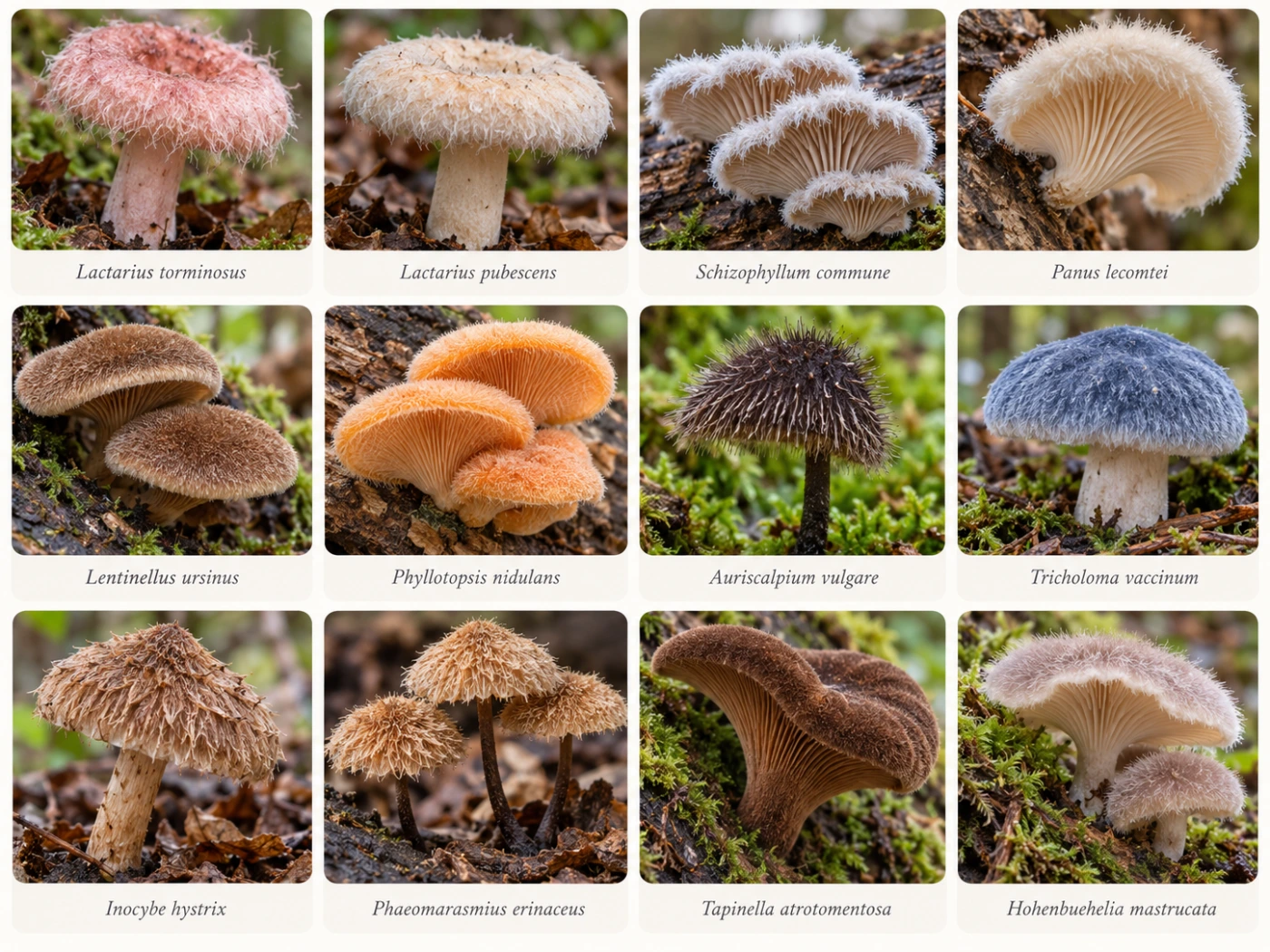
A hairy or fuzzy mushroom cap can be a surprisingly useful identification clue. Some species have long woolly hairs around the margin, while others are covered with fine felt, stiff bristles, fibrils, or dense scales that create a hairy appearance.
Texture is often more dependable than cap color because colors change with age, rain, and sunlight. A pink mushroom with a woolly edge, a tiny brown fungus covered in bristles, and an orange fuzzy bracket may belong to completely different groups despite sharing the same “hairy” appearance.
⚠️ Important: A hairy cap does not indicate whether a mushroom is edible or poisonous. Always combine surface texture with gills or pores, latex, substrate, stem structure, habitat, and spore characters.
Quick Identification
| Mushroom | Scientific name | Hairy feature | Typical habitat |
|---|---|---|---|
| Woolly Milkcap | Lactarius torminosus | Long woolly cap margin | Under birch |
| Downy Milkcap | Lactarius pubescens | Pale downy margin | Birch, grass, woodland edges |
| Split Gill | Schizophyllum commune | Dense gray-white hairs | Dead hardwood |
| Hairy Oysterling | Panus lecomtei | Densely hairy cap | Dead hardwood |
| Bear Lentinus | Lentinellus ursinus | Velvety to hairy brown cap | Dead hardwood |
| Mock Oyster | Phyllotopsis nidulans | Orange fuzzy surface | Dead wood |
| Pinecone Tooth | Auriscalpium vulgare | Tiny dark hairy cap | Fallen pine cones |
| Russet Scaly Tricholoma | Tricholoma vaccinum | Woolly fibrils and scales | Spruce and other conifers |
| Scaly Fibrecap | Inocybe hystrix | Dense fibrous scales | Woodland soil |
| Phaeomarasmius erinaceus | Phaeomarasmius erinaceus | Erect spine-like fibrils | Hardwood twigs |
| Velvet Rollrim | Tapinella atrotomentosa | Matted velvety hairs | Conifer wood |
| Woolly Hohenbuehelia | Hohenbuehelia mastrucata | Hairy, woolly cap | Dead wood |
What Does “Hairy Cap” Actually Mean?
Mushroom descriptions use several words for surfaces that can look hairy. Tomentose means covered in short dense hairs that create a felt-like surface, while hirsute describes longer or coarser hairs.
A fibrillose cap is covered with fine thread-like fibers. A squamulose or scaly cap has small scales, and these scales may themselves be made from bundled fibrils, giving the mushroom a shaggy appearance.
The location of the hairs is also useful. Some mushrooms are hairy across the whole cap, while others have a mostly smooth cap with a conspicuously woolly margin.
1. Lactarius torminosus — Woolly Milkcap
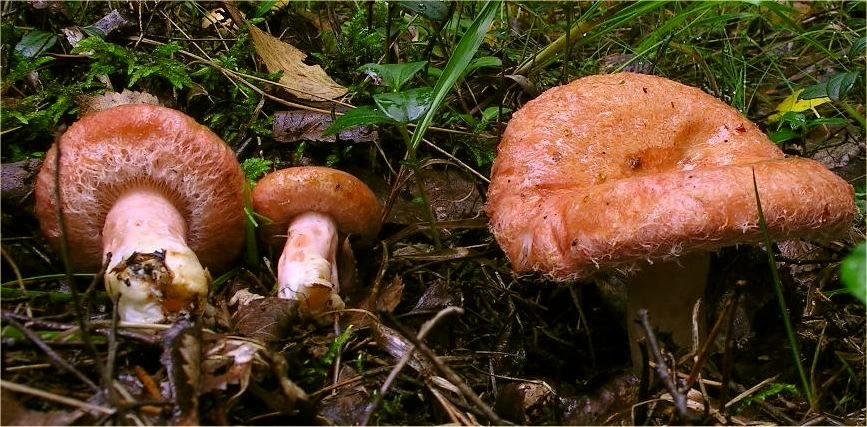
Lactarius torminosus is one of the classic hairy-capped mushrooms. Its pale pink to salmon-colored cap often has darker concentric zones, while the inrolled margin is covered with conspicuous woolly hairs.
The species is strongly associated with birch. When the gills or flesh are damaged, they release white latex, providing another important clue.
Hairy Feature
The longest hairs are concentrated around the cap margin, particularly in young mushrooms. They can create a thick fringe that looks almost like white or pale pink fur.
Older specimens become less obviously hairy as the margin expands and weathers. The combination of a zoned pink cap, woolly edge, white latex, and birch habitat is much more useful than any one feature alone.
Similar Species
Lactarius pubescens is the closest obvious comparison. It is generally paler and often lacks the stronger pink concentric zoning of L. torminosus.
2. Lactarius pubescens — Downy Milkcap
Downy Milkcap is another pale, hairy-edged milkcap associated with birch. Its cap is cream, whitish, pale pinkish, or buff and often has an inrolled fuzzy margin.
Like other milkcaps, it releases latex when damaged. The overall appearance is usually softer and less strongly colored than Woolly Milkcap.
Hairy Feature
Young specimens have a distinctly downy or woolly edge. The hairs are most conspicuous while the margin is still rolled inward.
The cap center is generally less dramatically zoned than Lactarius torminosus. This gives the mushroom a paler and more uniform appearance.
3. Schizophyllum commune — Split Gill
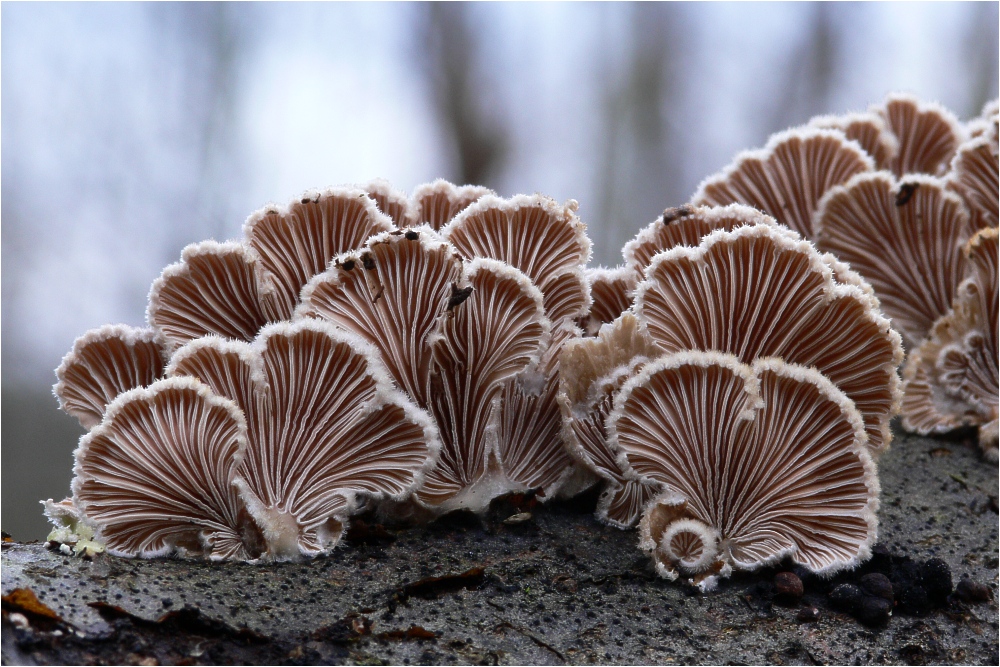
Split Gill forms small white, gray, or gray-brown fans on dead wood. The upper surface is densely hairy or felted, while the underside carries its famous longitudinally split gill-like folds.
It is one of the most widespread wood-decaying fungi in the world. Fruit bodies are thin and leathery and can survive repeated drying and rehydration.
Hairy Feature
Fine hairs cover much of the upper cap and create a soft gray-white texture. Under magnification, the surface can look much more densely covered than it appears to the naked eye.
The combination of hairy fan-shaped cap + split folds underneath is highly distinctive. Similar small brackets generally have normal gills, pores, or smooth undersides.
4. Panus lecomtei — Hairy Oysterling
Hairy Oysterling is a tough wood-growing mushroom with a fan-shaped or funnel-shaped cap. Fresh specimens may have purple, reddish, orange-brown, or tan tones depending on age.
The cap surface is densely hairy and retains this texture even as the mushroom matures. The crowded gills run down toward the point of attachment.
Hairy Feature
The cap may look almost bristly, particularly when dry. These coarse hairs give the mushroom a much rougher appearance than a typical oyster mushroom.
Young gills can show lilac or violet coloration before fading toward buff or orange-brown. The combination of persistent cap hairs and wood-growing habit is very useful.
5. Lentinellus ursinus — Bear Lentinus
Lentinellus ursinus is a stemless or nearly stemless mushroom growing in groups on dead hardwood. Its kidney-shaped to semicircular cap can be tan, reddish-brown, or darker brown.
The upper surface is velvety or hairy, especially toward the point where it attaches to the wood. Underneath are pale gills with distinctly serrated or saw-toothed edges.
Hairy Feature
The central or attached portion of the cap often carries noticeable tufts of hairs. The margin may be smoother and paler, creating a two-textured appearance.
The serrated gills are especially useful for confirmation. A hairy brown fan with ordinary smooth-edged gills belongs in a different comparison.
6. Phyllotopsis nidulans — Mock Oyster
Mock Oyster is a striking orange wood-growing mushroom that often resembles a brightly colored oyster mushroom. It forms fan-shaped or shell-shaped caps directly on logs and branches.
The cap is usually orange to yellow-orange and conspicuously fuzzy when fresh. The gills are also orange, and mature mushrooms can have a strong unpleasant odor.
Hairy Feature
The surface is covered in short hairs that create a soft, felt-like appearance. Young mushrooms tend to look especially fuzzy.
This texture helps separate Mock Oyster from smoother orange wood fungi. The combination of orange fuzzy cap + orange gills + no substantial stem is particularly characteristic.
7. Auriscalpium vulgare — Pinecone Tooth
Pinecone Tooth is one of the smallest and most unusual mushrooms in this guide. It has a tiny kidney-shaped brown cap carried on a thin lateral or off-center stem.
Instead of gills or pores, the underside is covered with downward-pointing teeth. The mushroom grows directly from fallen or buried pine cones.
Hairy Feature
The dark cap is covered with fine brown bristles or hairs. Its stem can also be hairy, giving the entire mushroom a rough, miniature appearance.
The habitat makes identification much easier. A tiny hairy mushroom with teeth underneath and a stem emerging from a pine cone is difficult to confuse with most other species.
8. Tricholoma vaccinum — Russet Scaly Tricholoma
Tricholoma vaccinum is a reddish-brown woodland mushroom associated particularly with spruce and other conifers. Its cap is covered with radial fibrils and small scales that give it a woolly or shaggy appearance.
Young caps commonly have an inrolled margin with cottony veil remnants. Pale gills may develop reddish or brownish spots with age.
Hairy Feature
The cap is not covered in soft fur like a Woolly Milkcap. Instead, reddish-brown fibrils and scales separate over a paler background and produce a coarse hairy texture.
Young margins may retain especially noticeable hairs or fibrils. This combination with conifer habitat is more useful than brown color alone.
9. Inocybe hystrix — Scaly Fibrecap
Scaly Fibrecap is a brown mushroom with a dramatically rough cap and stem. Its surface is covered in dark fibrillose scales that can stand away from the cap and create a bristly appearance.
Like other Inocybe species, it is a woodland mushroom rather than a wood-decaying bracket. The mature gills develop brownish tones as the spores form.
Hairy Feature
The fibers are organized into prominent shaggy or pointed scales. The mushroom can look as though both the cap and stem have been covered with coarse brown hairs.
Inocybe includes poisonous species, and members of the genus should not be treated as edible targets. Exact identification can also require microscopic features.
10. Phaeomarasmius erinaceus
Phaeomarasmius erinaceus is a very small rusty-brown mushroom that grows on dead or aging hardwood twigs and branches. Its cap is commonly less than two centimeters across.
Despite its tiny size, the surface is remarkably textured. Dense fibrillose scales can become almost spine-like toward the center.
Hairy Feature
The cap is densely tomentose to fibrillose-scaly, with some fibers standing nearly upright. The edge may also carry hanging fibrils that create a fringed outline.
Because the mushroom is so small, a hand lens makes the texture much easier to appreciate. Habitat on thin hardwood twigs provides another useful clue.
11. Tapinella atrotomentosa — Velvet Rollrim
Velvet Rollrim is a large brown mushroom that grows from conifer stumps, logs, roots, and buried wood. The cap may become broad and shallowly depressed, with yellowish to brown decurrent gills underneath.
Its most famous feature is the thick dark velvety stem, but young caps can also be distinctly velvety or covered with matted hairs. Older caps tend to become smoother.
Hairy Feature
The young cap has a dry felted surface rather than obvious long hairs. The stem is much more dramatically hairy, often dark brown to almost black and densely velvety.
This species illustrates why texture should be examined across the whole fruit body. A brown cap and decurrent gills alone can resemble other rollrims, while the dark velvet stem is much more distinctive.
12. Hohenbuehelia mastrucata — Woolly Hohenbuehelia
Hohenbuehelia mastrucata is a less familiar wood-growing mushroom with a lateral, oyster-like form. Its scientific name itself refers to the sheepskin-like or hairy appearance of the upper cap surface.
The mushroom grows on dead wood and has a tough or somewhat gelatinous structure typical of the genus. Its irregular hairy covering makes fresh specimens particularly distinctive.
Hairy Feature
The upper surface can appear woolly, shaggy, or covered with coarse patches. These hairs and scales give the cap a much rougher surface than common Oyster Mushrooms.
It is a useful species to know because not every pale oyster-shaped mushroom on wood belongs to Pleurotus. Surface texture can immediately suggest a different group.
Hairy Cap vs Scaly Cap
Hair and scales overlap more than the words suggest. Mushroom scales are often formed from bundled surface fibers, so a cap can look hairy when young and distinctly scaly when older.
This is especially relevant to Tricholoma vaccinum, Inocybe hystrix, and Phaeomarasmius erinaceus. Their “hairs” are more accurately described as fibrils or fibrous scales than as soft fur.
Hairy Margin vs Hairy Entire Cap
The location of the hairs can narrow the possibilities quickly. Lactarius torminosus and L. pubescens are especially known for their woolly margins, while Schizophyllum commune and Hairy Oysterling are hairy over much more of the cap surface.
A mushroom with a smooth center but shaggy edge should therefore be approached differently from a uniformly felted bracket. Taking a close-up photograph of the margin often reveals this distinction.
Hairy Mushrooms on Wood
Several species in this guide grow directly from dead wood. Split Gill, Hairy Oysterling, Bear Lentinus, Mock Oyster, Velvet Rollrim, and Hohenbuehelia mastrucata all belong in this broad ecological group.
The underside quickly separates them. Split Gill has divided folds, Bear Lentinus has saw-edged gills, Mock Oyster has orange gills, and Velvet Rollrim has forked decurrent gills.
Hairy Mushrooms on the Ground
Woolly Milkcap, Downy Milkcap, Tricholoma vaccinum, and Scaly Fibrecap grow terrestrially. Their underground ecology differs considerably even if the caps appear similarly fuzzy.
Tree association becomes especially valuable here. Birch strongly supports the woolly milkcaps, while spruce and other conifers are important for Tricholoma vaccinum.
Look-Alikes
Several smoother mushrooms can become rough, cracked, or covered with veil remnants and appear hairy in photographs. It is important to distinguish true cap texture from temporary debris or weather damage.
Lactarius deliciosus and Other Orange Milkcaps
Identification
Orange milkcaps can have zoned caps and inrolled margins similar in general shape to Woolly Milkcap. Their caps, however, are normally smooth rather than densely woolly at the edge.
They also produce orange or reddish latex rather than the white latex of Lactarius torminosus. Host tree is another useful difference.
Main Difference
A strongly hairy pink margin with white latex suggests the Woolly Milkcap group. A smoother orange cap with orange latex points toward saffron milkcaps.
Pleurotus Species
Identification
True Oyster Mushrooms form pale gray, brown, or whitish fans on wood. Their upper surfaces are generally much smoother than those of Hairy Oysterling, Mock Oyster, or woolly Hohenbuehelia.
They have pale decurrent gills and usually grow in overlapping clusters. Surface texture and color can quickly move an identification away from Pleurotus.
Main Difference
A strongly fuzzy orange or densely bristly cap is unusual for typical Oyster Mushrooms. Hairy wood-growing caps deserve comparison with other genera.
Stereum and Small Bracket Fungi
Identification
Thin bracket fungi can have hairy upper surfaces, particularly along their margins. Many also show concentric zones of brown, orange, or gray.
Their undersides, however, are usually smooth rather than gilled. This immediately separates them from hairy gilled fungi such as Panus or Lentinellus.
Main Difference
Always turn the fruit body over. Smooth, porous, toothed, and gilled undersides represent very different groups even when the upper surfaces look alike.
Pholiota Species
Identification
Many Pholiota mushrooms have conspicuous scales across their caps and may look shaggy or hairy. They typically grow on wood and often have brown spore prints.
Their caps usually carry discrete scales rather than a continuous layer of fine hairs. Stem rings or veil remnants are also common in several species.
Main Difference
Clearly separated scales and brown spores favor Pholiota. Dense wool, bristles, or a felted cap surface point toward other groups in this guide.
How to Identify a Hairy-Capped Mushroom
First determine what “hairy” means in the specimen. Look closely to see whether the cap has long hairs, short velvet, woolly fibers, pointed bristles, or lifted scales.
Next check where the texture occurs and what is underneath the cap. A hairy margin with latex suggests a very different mushroom from a hairy fan with split gills or a tiny bristly cap with teeth.
Habitat then narrows the possibilities further. Birch soil, spruce forest, hardwood logs, conifer stumps, and fallen pine cones each point toward different species in this group.
Photographing Hairy Caps
Side lighting is particularly useful because it reveals raised hairs and scales better than flat overhead light. A close-up of the cap edge can show features that disappear completely in a standard full-mushroom photograph.
Also photograph the underside and substrate. A beautiful macro shot of the fuzzy cap alone may still be insufficient to distinguish a milkcap from a wood-growing fan-shaped species.
Can AI Identify Hairy-Capped Mushrooms?
Hairy texture can be a strong visual feature for image identification, particularly in species such as Woolly Milkcap, Split Gill, and Hairy Oysterling. Results improve considerably when the hairs are sharp enough to distinguish wool, fibrils, scales, and bristles.
The underside and habitat remain essential. Texture alone can place unrelated species together because similar hairy surfaces have evolved repeatedly in different fungal groups.
Common Identification Mistakes
One frequent mistake is interpreting any rough cap as hairy. Dried mud, cracked skin, veil fragments, and ordinary scales can all create a similar appearance in photographs.
Another mistake is ignoring age. Woolly margins may become nearly bald, while velvety young caps can become smoother as they mature.
A third mistake is assuming that hairy mushrooms form a natural taxonomic group. Hairiness is simply a surface feature and occurs independently among milkcaps, wood decomposers, fibrecaps, Tricholomas, and many other fungi.
Interesting Facts
Mushroom hairs can perform several different functions rather than serving one universal purpose. Dense surface fibers may help retain moisture, protect developing tissue, or simply result from the way the outer hyphae are organized.
The hairs can also change dramatically during development. A mushroom that appears almost furry when young may become nearly smooth after rain, expansion, and repeated handling.
Some hairy fungi are extremely specialized in habitat. Auriscalpium vulgare, for example, is strongly associated with fallen pine cones, while the much larger Velvet Rollrim grows on decaying conifer wood.
The same visual texture has therefore evolved in mushrooms with very different lifestyles. Hairiness is an excellent clue, but it becomes much more powerful when combined with ecology and underside structure.
Frequently Asked Questions
Why do some mushroom caps have hairs?
The hairs are extensions or arrangements of fungal hyphae at the cap surface. Depending on the species, they can create woolly, velvety, bristly, or fibrous textures.
Do hairy mushrooms lose their hairs with age?
Many do. Rain, expansion of the cap, and ordinary weathering can make an older mushroom much smoother than a young specimen.
Are hairy mushroom caps safe to touch?
Surface hairiness itself does not make a mushroom dangerous to touch. Normal handling for identification is generally different from eating a mushroom, although hands should be washed after handling wild fungi.
Are all woolly milkcaps poisonous?
Edibility classifications and traditional preparation vary by species and region. Hairy margins alone should never be used to decide whether a milkcap is suitable for food.
Can oyster mushrooms have hairy caps?
Some oyster-shaped fungi are hairy, but they are not necessarily true Pleurotus. Hairy Oysterling, Mock Oyster, and several other wood-growing genera can resemble oyster mushrooms in overall shape.
Why does a mushroom look fuzzy only around the edge?
Some species concentrate veil remnants or specialized hairs along the young inrolled margin. Woolly Milkcap is a classic example.
Can rain remove mushroom hairs?
Yes, particularly loose fibrils, scales, and veil remnants. Old rain-washed mushrooms may therefore lose one of their most obvious identification features.
Is a magnifying glass useful for hairy mushrooms?
Yes, especially with tiny species such as Phaeomarasmius erinaceus. Magnification can reveal whether a surface is genuinely hairy, fibrillose, scaly, or merely rough.
Final Identification Notes
Hairy mushroom caps occur in many unrelated fungal groups, so the type and location of the hairs matter more than the simple presence of fuzz. Woolly margins, dense felt, stiff bristles, fibrous scales, and velvet-like surfaces are different identification characters.
Among the most distinctive examples are the woolly pink margin of Lactarius torminosus, the gray hairy fans of Schizophyllum commune, the bristly surface of Hairy Oysterling, and the tiny dark cap of Auriscalpium vulgare growing from pine cones.
The practical approach is: examine the hair type → check the underside → identify the substrate or host tree → compare overall shape and size. This turns a vague observation like “the cap looks fuzzy” into a much more useful identification clue.
Upload a photo and get possible matches in seconds.