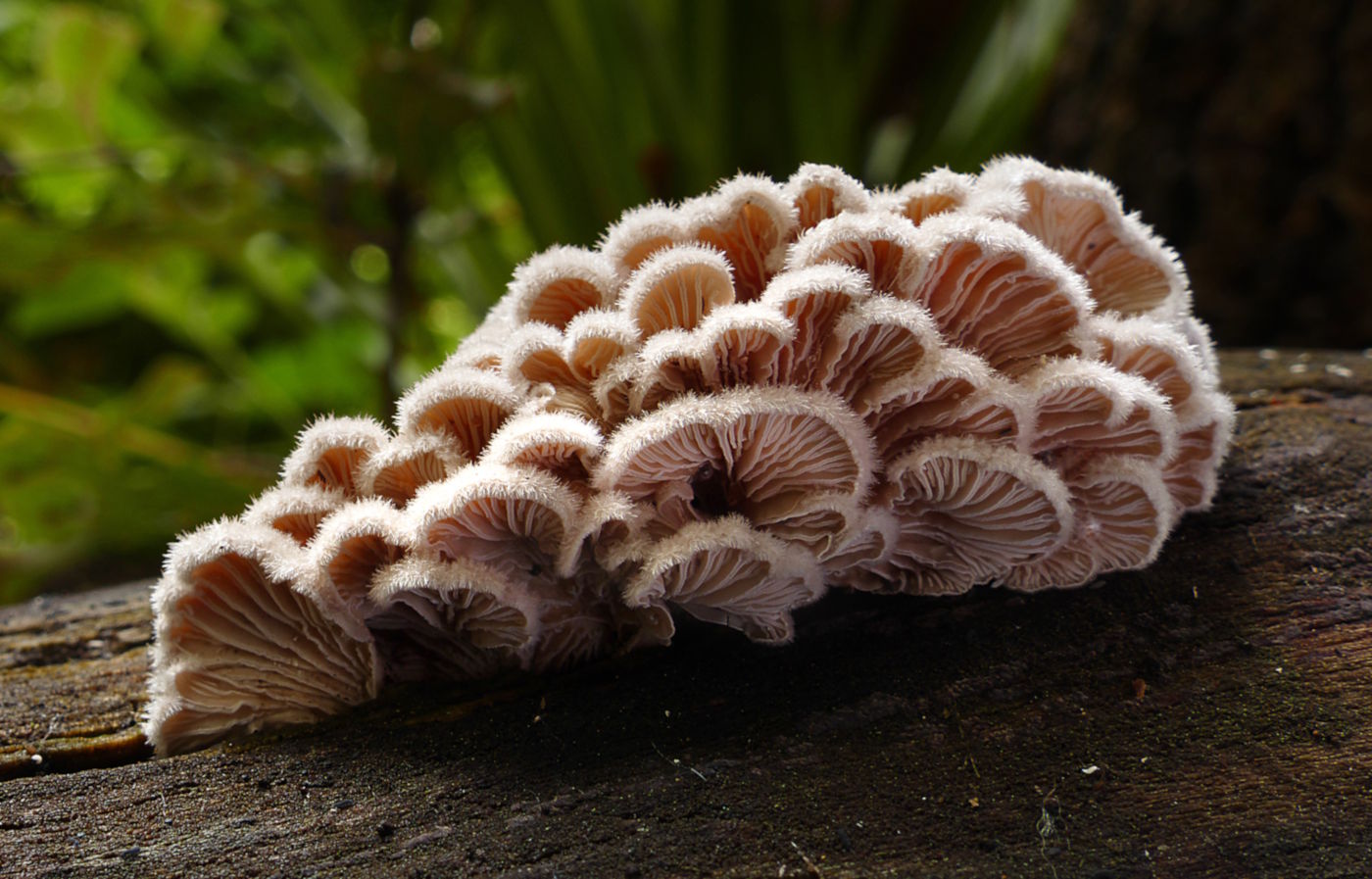
Schizophyllum commune, commonly known as the Split Gill, is a small fan-shaped wood-growing mushroom found on dead branches, logs, stumps, and sometimes weakened living trees. It is one of the most widespread wood-decaying fungi and can occur in both temperate and tropical regions.
The species is best recognized by the unusual underside of its fruit body. Instead of ordinary thin gills, it has pale radial folds that appear split lengthwise, creating the feature that gives the mushroom its common name.
⚠️ Important: Split Gill is not a good beginner food mushroom and should not be treated as edible simply because it is common. The species has also been documented as a rare opportunistic human pathogen, so it is better approached as an identification species rather than a culinary target.
Quick Identification
| Feature | Schizophyllum commune |
|---|---|
| Scientific name | Schizophyllum commune |
| Common name | Split Gill |
| Family | Schizophyllaceae |
| Shape | Small fan, shell, or kidney shape |
| Cap color | White, cream, grayish |
| Cap surface | Hairy, woolly, or finely felted |
| Underside | Radial split gill-like folds |
| Stem | Usually absent or extremely short |
| Flesh | Thin, tough, leathery |
| Spore print | White to pale |
| Ecology | Wood-decaying |
| Substrate | Dead branches, logs, stumps, cut timber |
| Growth | Often in groups or overlapping rows |
| Season | Can appear through much of the year |
| Distribution | Very widespread |
| Edibility | Not recommended |
| Main look-alikes | Small white brackets, Crepidotus, Panellus, Stereum |
What Does Schizophyllum commune Look Like?
Split Gill forms small brackets that project outward from wood. The individual fruit bodies are usually semicircular, fan-shaped, shell-shaped, or slightly kidney-shaped rather than having the normal cap-and-stem structure of a typical gilled mushroom.
Fresh specimens are usually white, cream, or pale gray. They can become duller, gray-brown, or weathered with age, especially when repeatedly drying and rehydrating.
Cap
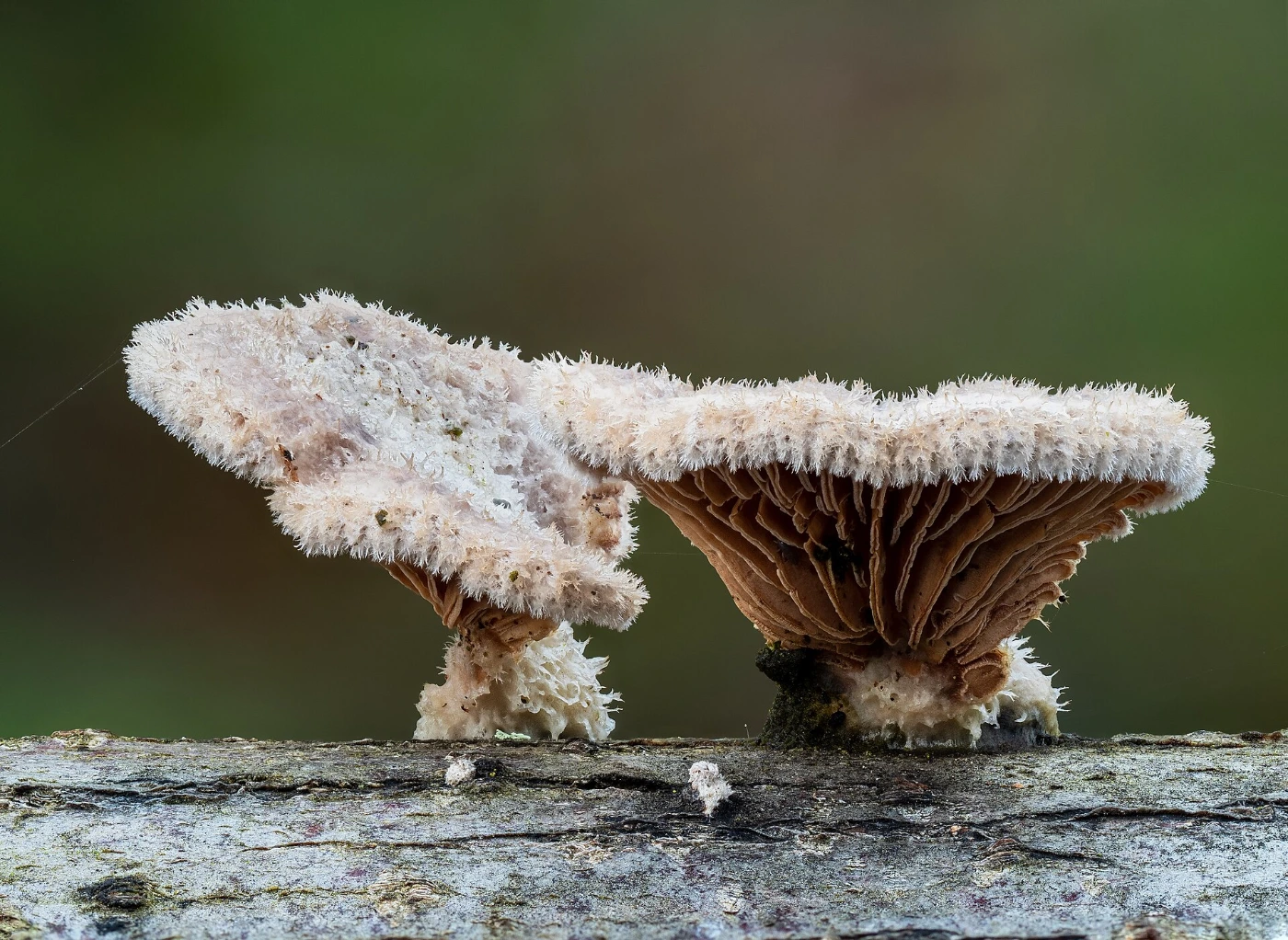
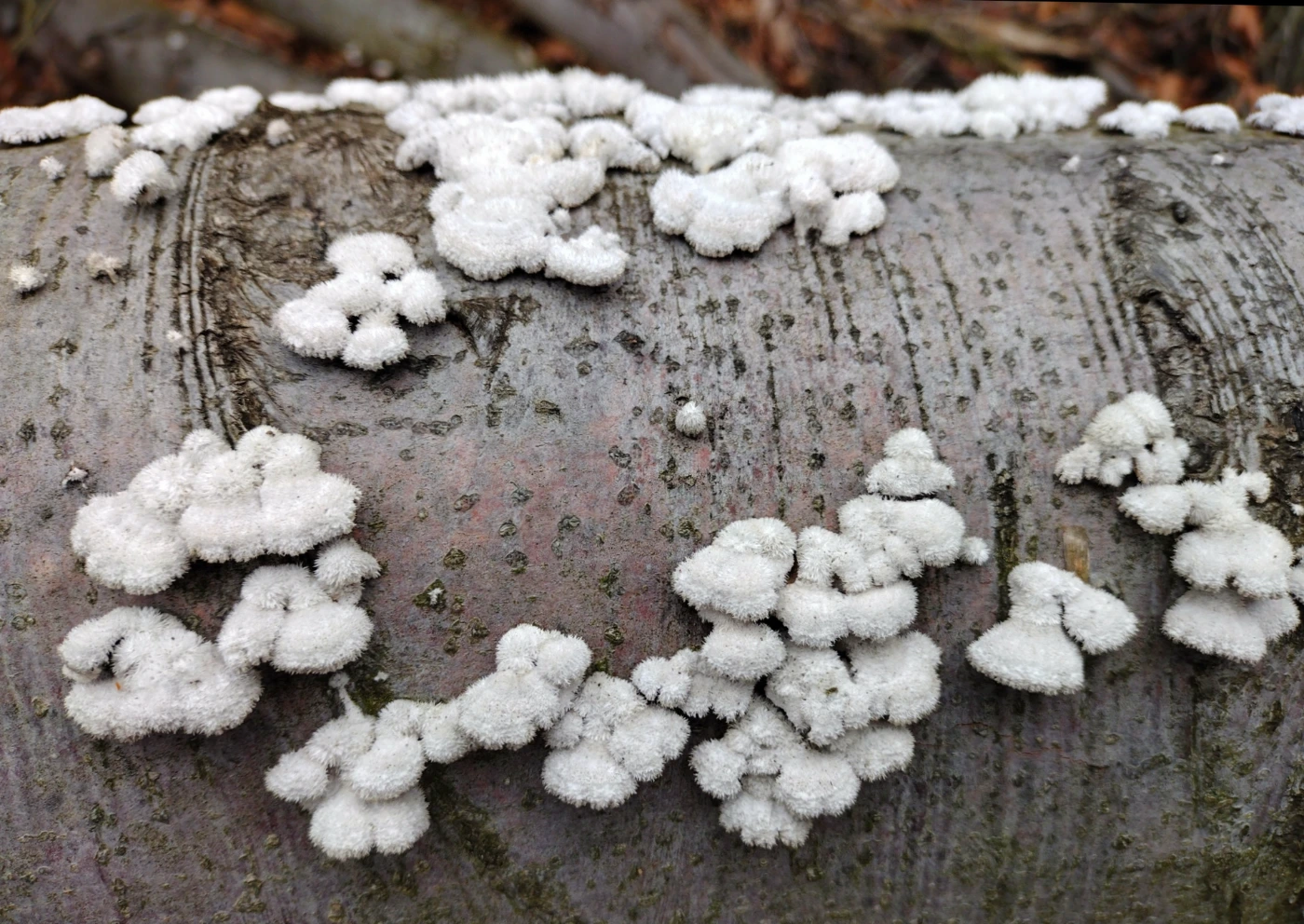
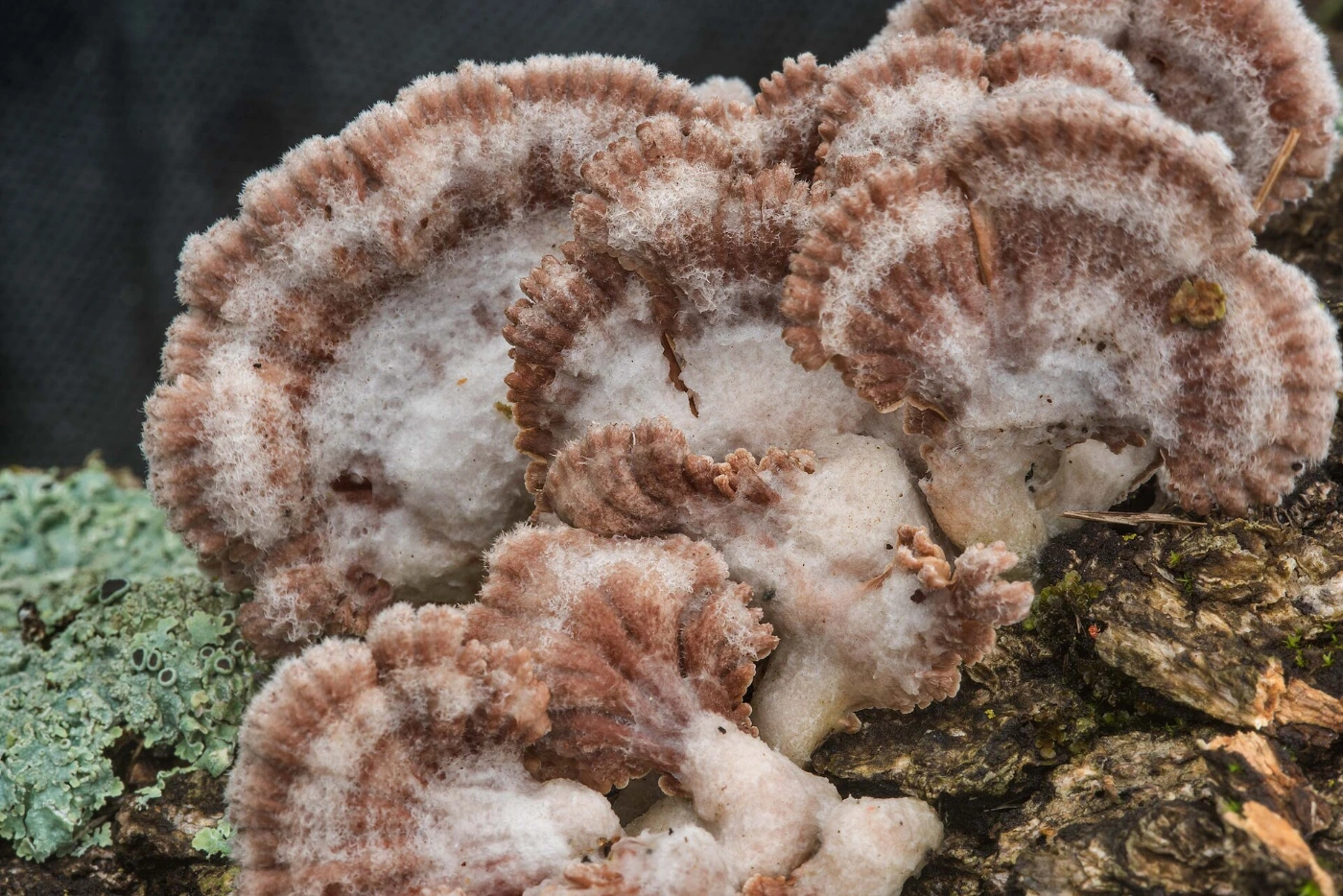
The cap is relatively small and thin, with a rounded outer edge and a narrow attachment to the wood. Several caps often grow close together and may overlap like roof tiles.
The upper surface is covered with fine hairs that can give it a woolly or felted appearance. This texture is often more obvious in young, dry specimens than in old weathered ones.
Cap Color
Typical colors range from white to cream and pale gray. Older fruit bodies can accumulate dirt, algae, or weather stains and may look considerably darker.
Cap color is not the best identification feature because many small wood-growing fungi have similar pale surfaces. The unusual underside is much more distinctive.
The Split Gills
The underside is the key feature of Schizophyllum commune. It has numerous radial folds that look superficially like ordinary gills but are split along their length.
These folds can curl inward when conditions become dry. After moisture returns, the fruit body can rehydrate and the fertile surfaces become exposed again.
Why the Gills Look Split
The gill-like structures are adapted to changing moisture conditions. Their split edges can close together as the fruit body dries, helping protect the spore-producing surface.
When humidity increases, the folds open again. This allows a fruit body that has survived a dry period to continue releasing spores when conditions improve.
Stem
A distinct central stem is normally absent. The fruit body attaches directly to wood from one side or from a small point near the base.
On thin branches, the mushroom may appear almost circular if it grows around the underside of the substrate. This can make its shape look different from the classic fan form shown in field guides.
Flesh
The flesh is thin, tough, and leathery rather than soft and fleshy. Older specimens can become surprisingly dry and rigid.
This texture helps the mushroom survive repeated changes in moisture. Even fruit bodies that look dried out can become softer after rain.
Spore Print
The spores are pale, and a print is generally white to very pale. Spore color is less useful than the split underside because many unrelated white-spored wood fungi occur in the same habitats.
A spore print can still help when comparing Split Gill with dark-spored shell-like mushrooms. In typical specimens, however, the distinctive folds are usually enough to recognize the species group.
Where Does Split Gill Grow?
Schizophyllum commune grows on dead or dying plant material, especially hardwood branches and logs. It may also colonize cut timber, fallen limbs, stumps, and woody debris.
The species is a decomposer and helps break down wood. It can sometimes occur on damaged or weakened living trees where dead tissue provides suitable substrate.
Dead Branches and Logs
Fallen branches are among the easiest places to find Split Gill. Small pale fans may cover long sections of bark or exposed wood.
The mushrooms can remain attached for a long time and survive periods of dry weather. After rain, old fruit bodies may become more flexible and active again.
Stumps and Cut Wood
Split Gill can colonize stumps, stacked branches, and cut timber. Human-created woody substrates can therefore provide suitable habitat as well as natural forest debris.
Its ability to tolerate drying helps explain why it is frequently found on exposed wood. A branch in an open sunny location may still support persistent fruit bodies.
Season
Split Gill can be encountered during much of the year because its fruit bodies are relatively persistent. Fruiting and spore release become more active when sufficient moisture is available.
In temperate regions it may be noticed especially after rain. Unlike many short-lived fleshy mushrooms, it does not depend on a narrow autumn fruiting window.
Distribution
Schizophyllum commune is exceptionally widespread and occurs in many parts of the world. It is known from Europe, North America, Asia, Africa, and other regions with suitable woody substrates.
This broad distribution makes it useful for an international identification guide. Unlike many familiar forest mushrooms, its name does not need to be restricted to only a narrow European or North American context.
Is Schizophyllum commune Edible?
Split Gill has been consumed in some parts of the world, but it is not a mushroom I would recommend as a general edible species. The tough leathery texture already makes it very different from common culinary mushrooms such as oyster mushrooms.
There is also an additional medical reason for caution. Schizophyllum commune is capable of causing rare opportunistic infections in humans, particularly involving the respiratory tract and sinuses, so presenting it simply as an edible wild mushroom would be misleading.
Look-Alikes
The closest look-alikes are other small pale fungi growing as fans or brackets on dead wood. The split radial folds underneath are the most useful feature for separating Schizophyllum commune from them.
Crepidotus Species
Identification
Crepidotus species are small shell-shaped mushrooms that grow directly from wood. Many are white, cream, buff, or pale brown and can resemble Split Gill from above.
Their undersides have ordinary gills rather than longitudinally split folds. Mature spores are often brownish rather than white.
Main Difference
Turn the mushroom over and examine the gills closely. Normal thin gills without split edges point toward Crepidotus rather than Schizophyllum commune.
Panellus Species
Identification
Some Panellus species form small fan-shaped or kidney-shaped mushrooms on logs and branches. They may have pale caps and ordinary gills radiating from a lateral point of attachment.
The texture varies by species, but many lack the characteristic hairy upper surface and divided folds of Split Gill. Some also have more noticeable short stems or different cap colors.
Main Difference
The underside provides the quickest distinction. Panellus has ordinary gills, while Split Gill has the characteristic paired-looking folds with longitudinal splits.
Stereum Species
Identification
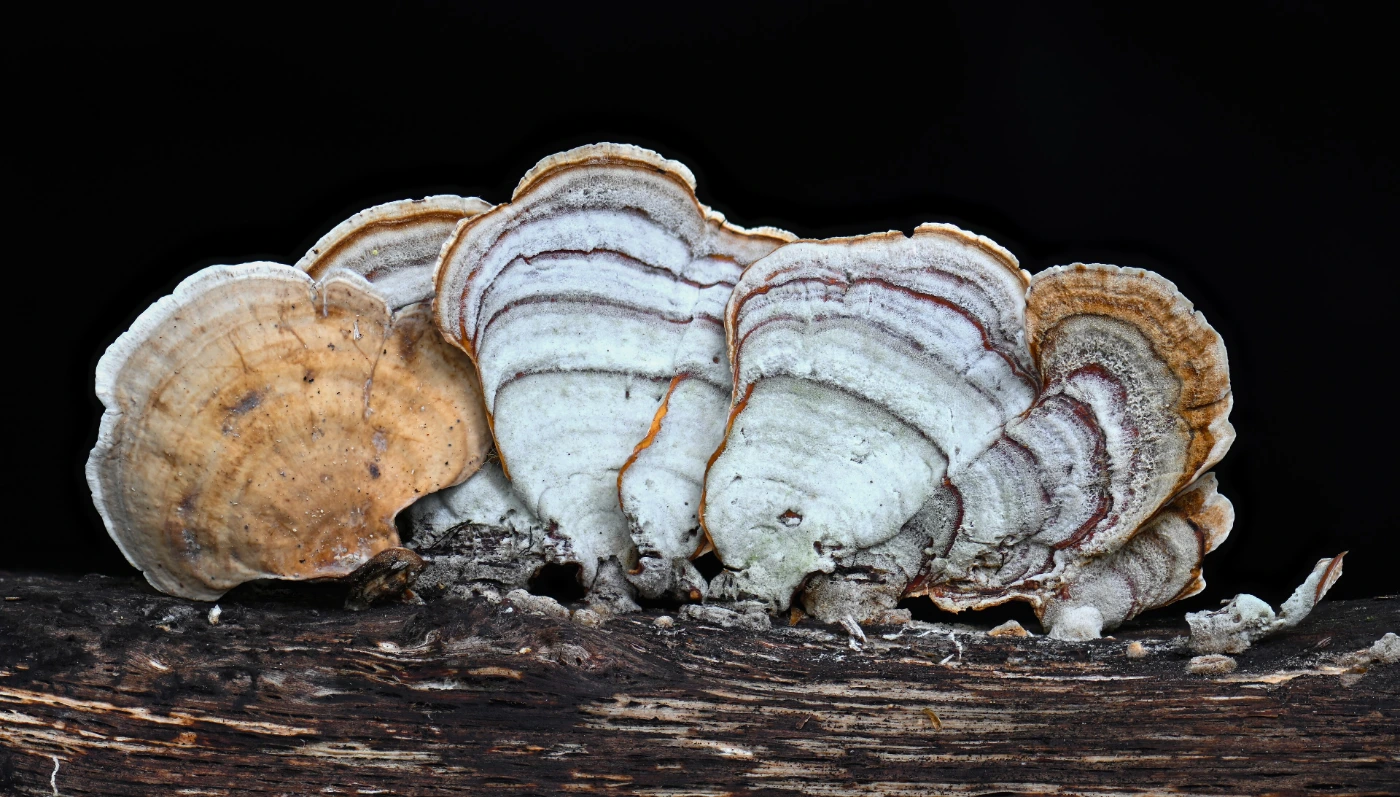
Stereum species form thin leathery brackets on dead wood and can sometimes occur in large overlapping groups. Their upper surfaces may be hairy, zoned, or pale enough to resemble weathered Split Gill.
The underside, however, is smooth or only slightly wrinkled. There are no true gills or split gill-like folds.
Main Difference
A smooth underside immediately points away from Schizophyllum commune. Split Gill should show clearly visible radial folded structures when examined from below.
Small Trametes Species
Identification
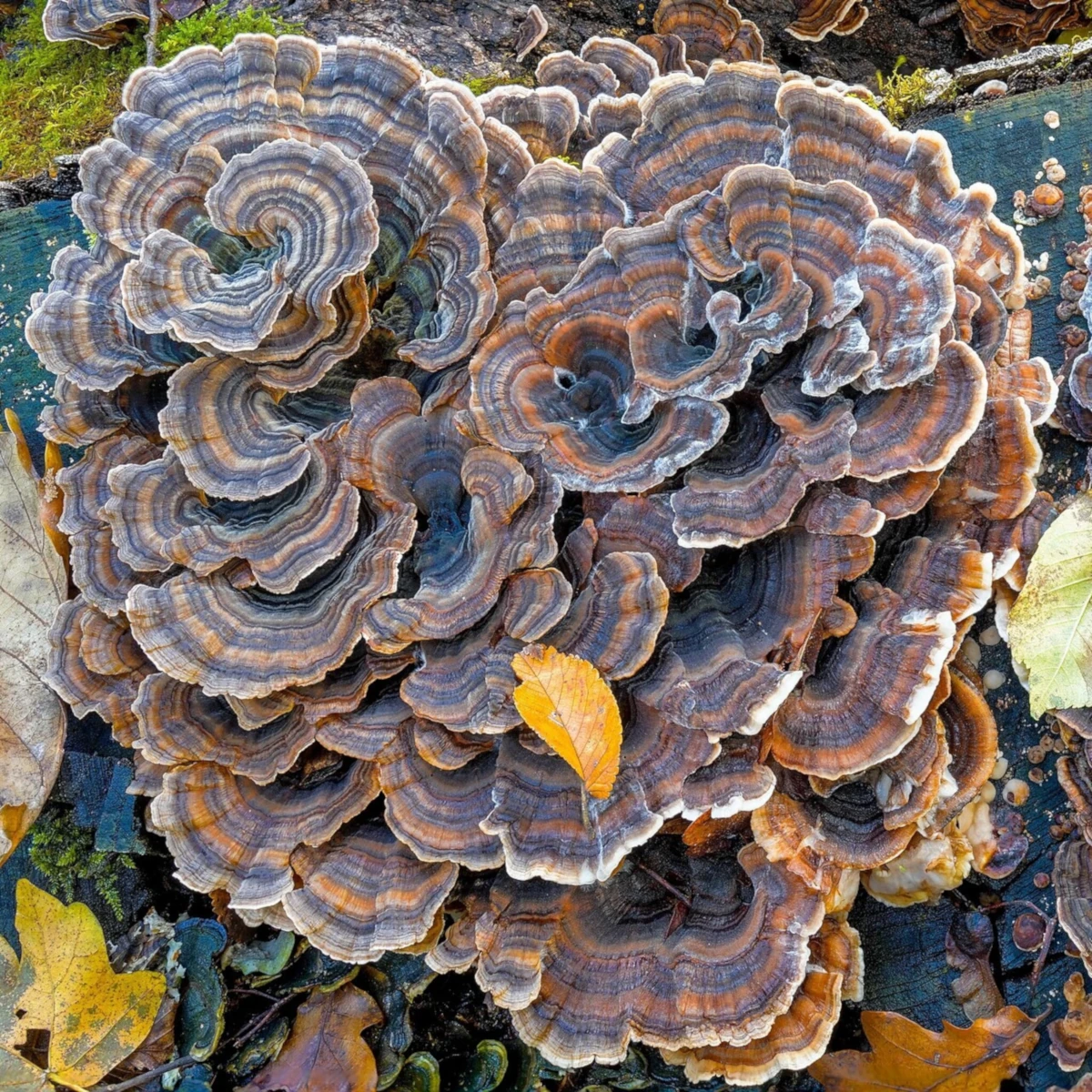
Small Trametes species can form thin pale brackets with hairy or zoned upper surfaces. They often grow in overlapping rows on dead hardwood.
Their fertile surface is covered with tiny pores rather than gills. A close view of the underside usually reveals this difference immediately.
Main Difference
Tiny round pores indicate a polypore such as Trametes. Radial split folds indicate Schizophyllum commune.
Schizophyllum commune vs Crepidotus
| Feature | Schizophyllum commune | Crepidotus spp. |
|---|---|---|
| Shape | Fan or shell | Fan or shell |
| Upper surface | Hairy, felted | Variable |
| Underside | Split folds | Ordinary gills |
| Stem | Absent | Usually absent or very short |
| Spore color | Pale | Often brownish |
| Substrate | Dead wood | Dead wood |
| Best clue | Split gills | Normal gills |
These mushrooms can look remarkably similar from above. Turning them over is usually enough to place them in very different groups.
Schizophyllum commune vs Stereum
| Feature | Schizophyllum commune | Stereum spp. |
|---|---|---|
| Shape | Small fan | Thin bracket |
| Texture | Tough, leathery | Tough, leathery |
| Upper surface | Hairy | Often hairy or zoned |
| Underside | Split folds | Smooth |
| Pores | No | No |
| Best clue | Radial split folds | Smooth fertile surface |
Both can form persistent colonies on dead branches. The underside is much more useful than cap color for separating them.
How to Identify Split Gill
The easiest approach is to turn the fruit body over and examine the underside before considering subtle cap features. The characteristic radial folds immediately narrow the possibilities.
After that, check the thin leathery texture, hairy pale upper surface, lack of a normal stem, and direct growth from wood. When all of these features occur together, Schizophyllum commune is a strong candidate.
Check the Underside
Look for numerous pale folds radiating from the attachment point toward the cap edge. Each fold should appear divided or split along its length rather than forming a simple single blade.
A hand lens can help with small dry specimens. Moisture may also make the structures easier to see because heavily dried folds can curl inward.
Check the Upper Surface
The cap should be thin and usually covered with fine hairs. White, cream, and pale gray are the most typical colors in fresh specimens.
Strong concentric color zones may suggest another bracket fungus. A completely smooth cap surface should also encourage comparison with other genera.
Check the Substrate
Split Gill should be growing from woody material rather than directly from ordinary soil. The substrate may be a branch, log, stump, timber, or buried piece of wood.
When the wood is partly buried, the mushroom can appear terrestrial at first glance. Looking carefully around the base usually reveals the real substrate.
How to Photograph Schizophyllum commune
Take one photograph showing several fruit bodies on the branch or log. Their overlapping fan-shaped growth pattern is useful ecological context.
The most important second photograph is a sharp close-up of the underside. Make sure the split folds are visible, because a top-down image alone can make the mushroom look like many unrelated small brackets.
Can AI Identify Split Gill?
Split Gill is relatively suitable for photo identification when the underside is clearly shown. The unusual split folds provide a stronger visual character than the cap colors of many other small wood fungi.
A photograph from above alone is much less useful. Several Crepidotus, Panellus, Stereum, and small polypore species can resemble it from that angle.
Common Identification Mistakes
A common mistake is assuming that every small white fan on a branch is Split Gill. Many unrelated fungi have independently evolved a similar shell-shaped growth form on wood.
Another mistake is describing the underside simply as ordinary gills. The longitudinally split folds are the defining visual character and should always be checked at close range.
A third mistake is dismissing dried specimens as too old to identify. Split Gill is unusually tolerant of drying, and its fruit bodies can persist and rehydrate when moisture returns.
Interesting Facts
Split Gill is one of the classic model organisms used in research on mushroom development and fungal mating. Its reproductive biology has been studied for decades because the species has an unusually large number of possible compatible mating combinations.
The common name directly describes its most distinctive structure. The genus name Schizophyllum also refers to the split appearance of the gill-like folds.
Its ability to dry out and later become active again helps the fungus survive on exposed branches. This tolerance is one reason it can occur in an exceptionally wide range of climates.
The species is also unusual because a familiar wood-decaying mushroom can occasionally behave as an opportunistic pathogen. Human infection is rare, but the phenomenon has made S. commune important in medical mycology as well as forest ecology.
Frequently Asked Questions
Are the split gills true gills?
They are specialized gill-like folds rather than ordinary lamellae of the type seen in many cap-and-stem mushrooms. Their divided structure is one of the defining characters of the species.
Can Split Gill survive after drying out?
Yes, the persistent fruit bodies can tolerate considerable drying. After moisture returns, they may rehydrate and expose their fertile surfaces again.
Does Split Gill grow only on hardwood?
Hardwood is especially common, but the species can occur on a variety of woody substrates. Exact substrate preferences can vary with region and local availability.
Can it grow on living trees?
It can occur on weakened or damaged trees, especially where dead woody tissue is available. It is much more commonly encountered as a decomposer of dead branches, logs, and timber.
Why does it sometimes look gray instead of white?
Age, weather, dirt, algae, and repeated drying can all darken the fruit body. Fresh young specimens usually show the palest colors.
Can Split Gill grow indoors on timber?
It can colonize suitable woody material when moisture conditions permit. Finding fruit bodies indoors would indicate that the wood has remained damp enough to support fungal growth.
Is Split Gill common in North America and Europe?
Yes, it occurs on both continents and is much more broadly distributed worldwide. This makes it one of the better examples of a genuinely widespread wood-decaying mushroom.
Can one photo identify Schizophyllum commune?
A clear photograph of the underside can often provide a strong identification because the split folds are so distinctive. A photograph showing only the upper cap is much less reliable.
Final Identification Notes
Schizophyllum commune is best recognized by its small pale fan-shaped fruit bodies, hairy upper surface, tough leathery texture, direct growth from wood, and characteristic longitudinally split gill-like folds underneath. The underside is much more diagnostic than cap color or overall shape.
Its main look-alikes include Crepidotus, Panellus, Stereum, and small polypores. Ordinary gills, a smooth fertile surface, or tiny pores point toward those groups rather than Split Gill.
The practical field pattern is: small hairy white fan on wood + pale radial folds that are visibly split lengthwise = strong Schizophyllum commune candidate.
Upload a photo and get possible matches in seconds.