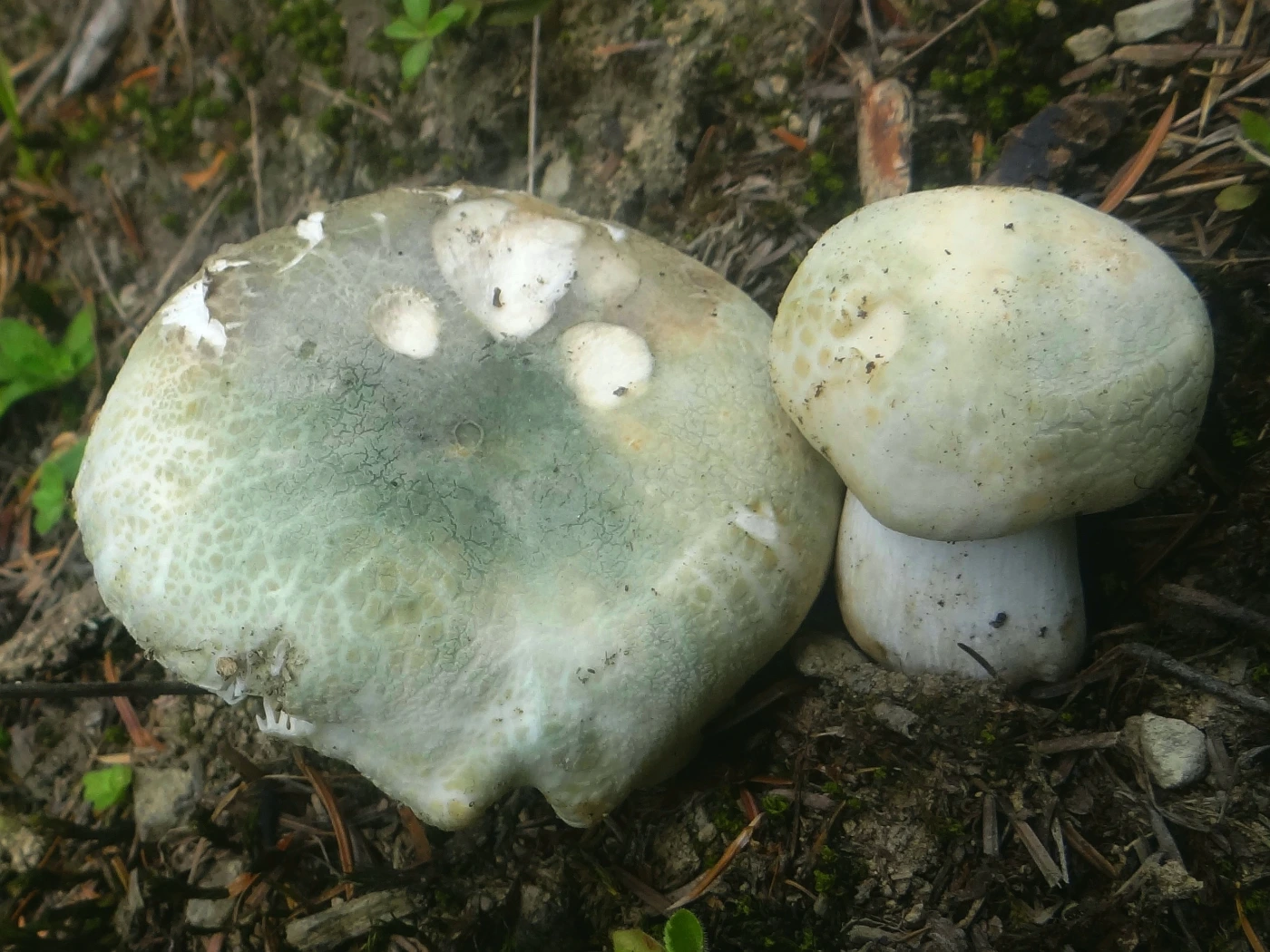
Russula virescens, commonly known as the Green-Cracking Russula, is one of the most distinctive green members of the genus Russula. Its cap often develops a mosaic of pale green, gray-green, or olive patches that look like cracked tiles across the surface.
The mushroom has the brittle flesh typical of Russulas, pale gills, and a white stem without a ring or volva. The most useful identification pattern is green mosaic cap + brittle flesh + pale gills + simple white stem + woodland habitat.
⚠️ Important: Green cap color does not prove that a mushroom is edible. Several unrelated mushrooms can be greenish, so identification should include the cap surface, gills, stem base, texture, habitat, and spore print.
Quick Identification
| Feature | Russula virescens |
|---|---|
| Scientific name | Russula virescens |
| Common name | Green-Cracking Russula |
| Family | Russulaceae |
| Cap color | Green, gray-green, olive-green |
| Cap surface | Distinctive cracked or mosaic pattern |
| Gills | White to cream |
| Stem | White, stout, brittle |
| Ring | Absent |
| Volva | Absent |
| Latex | Absent |
| Flesh | White, brittle |
| Spore print | Cream to pale yellowish |
| Ecology | Mycorrhizal |
| Main habitat | Deciduous and mixed woodland |
| Common hosts | Oak, beech and other broadleaf trees |
| Season | Summer to autumn |
| Edibility | Edible when correctly identified |
| Main look-alikes | Green Russulas, green Amanitas, other pale-gilled woodland mushrooms |
What Does Russula virescens Look Like?
The cap is usually the first feature that attracts attention. Fresh specimens often show a pale green background broken into darker or lighter polygonal patches.
The overall appearance can vary from vivid green to dull gray-green or olive. Older mushrooms may fade considerably, so the cracked surface pattern is often more useful than the exact shade.
Cap
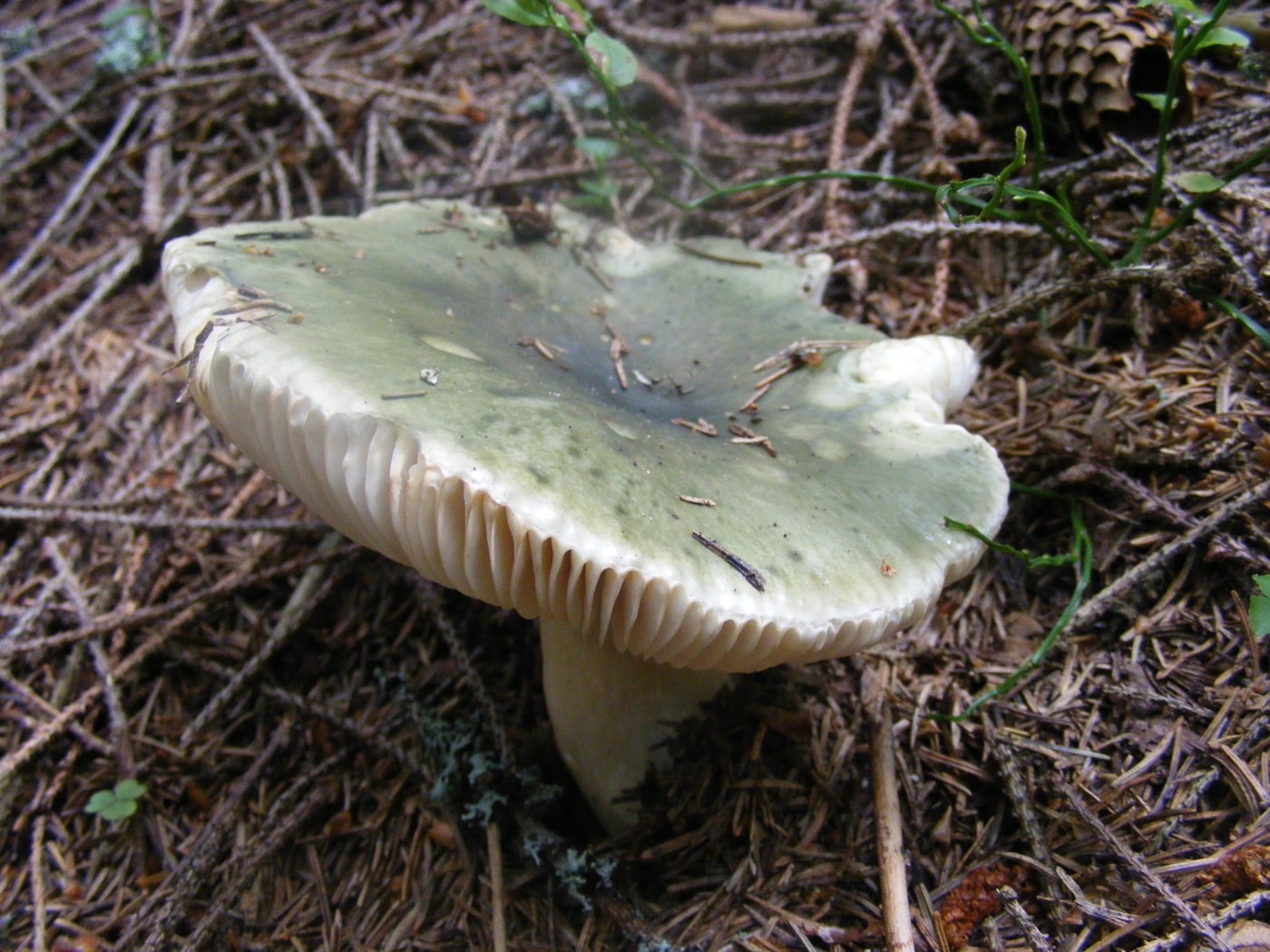
The cap begins convex and gradually becomes flatter with age. Mature specimens may develop a shallow depression in the center.
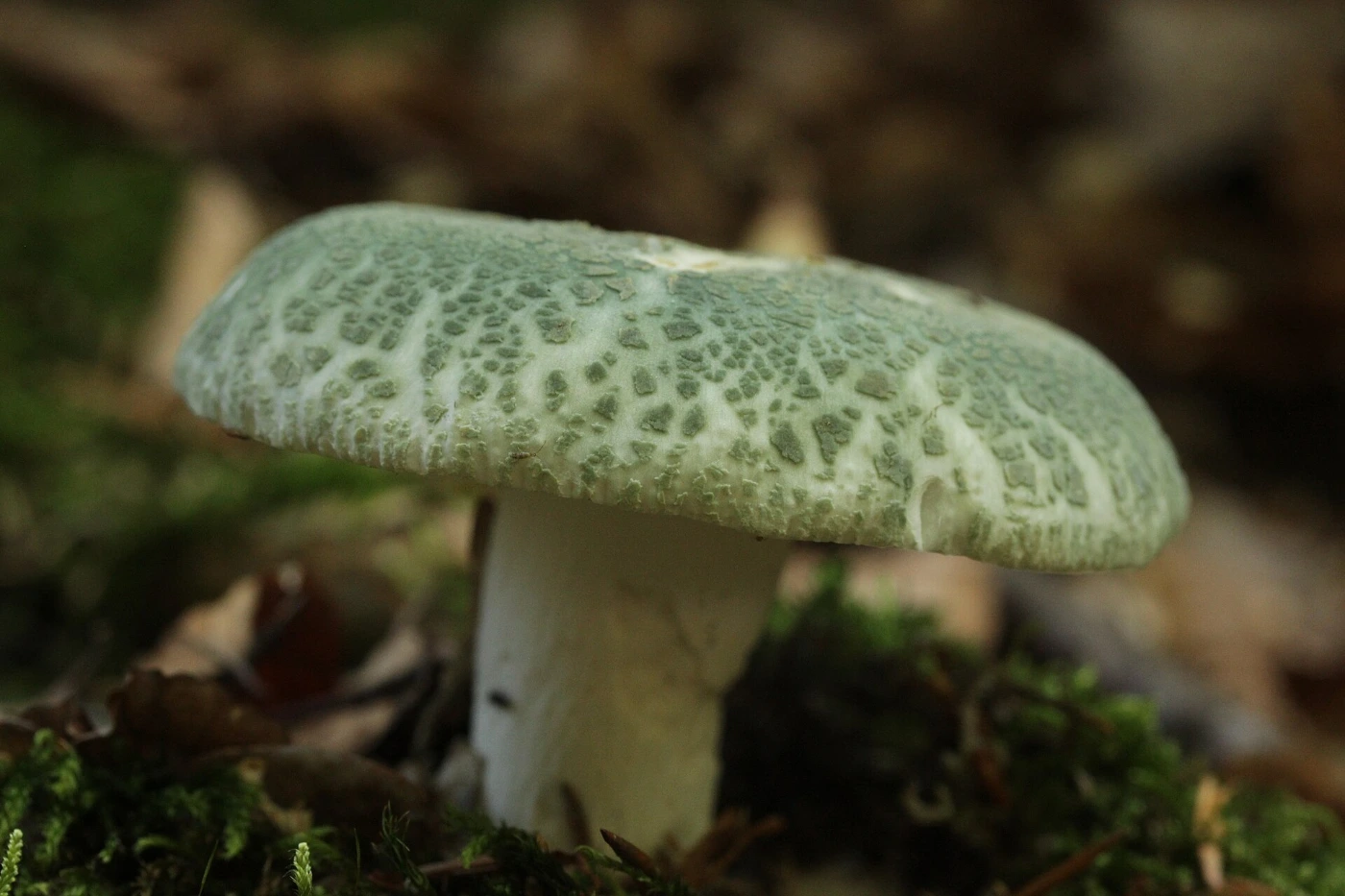
The surface often breaks into irregular patches that create the characteristic mosaic appearance. These patches are usually most obvious in dry or mature fruit bodies.
Cap Color
Typical colors include pale green, olive-green, gray-green, and bluish-green. Some caps may contain cream or yellowish areas between the darker patches.
Weather can change the color noticeably. Heavy rain may wash out the surface, while dry conditions can make the mosaic pattern look more pronounced.
Cracked Mosaic Pattern
The cap skin often separates into small polygonal areas that resemble cracked paint or reptile scales. This is one of the best field characters for Russula virescens.
The pattern is not always equally strong across the entire cap. Young mushrooms may look smoother, while older specimens can become heavily cracked.
Gills
The gills are white to cream and relatively brittle. They are usually fairly close together and can break easily when rubbed.
They do not release latex when damaged. This helps separate Russula virescens from milkcaps, which share the same brittle family structure but produce visible milk.
Stem
The stem is usually white, firm, and relatively stout. It lacks both a ring and a volva.
Like the rest of the mushroom, the stem has brittle flesh rather than fibrous tissue. A fresh stem often snaps cleanly instead of tearing into strands.
Flesh
The flesh is white and compact, especially in young mushrooms. It does not normally show dramatic blue, red, or black staining.
The chalk-like texture is typical of the genus. This brittle structure is one of the most useful ways to recognize a Russula before attempting species-level identification.
Smell
The smell is usually mild and not especially distinctive. Some specimens may have a faint pleasant or mushroom-like odor.
Odor is much less useful than the cap pattern and brittle texture. It should only be treated as supporting information.
Spore Print
The spore print is cream to pale yellowish. This fits the general range seen in many Russula species.
Spore color helps confirm the broader group but is not usually enough to identify R. virescens by itself. The cracked green cap remains the more useful field clue.
Where Does Russula virescens Grow?
Russula virescens is mycorrhizal and grows in partnership with living tree roots. It is most often found in deciduous and mixed woodland rather than on dead wood or compost.
Oak and beech are among the most important tree associates in Europe. The mushroom can also occur with other broadleaf trees depending on region.
Oak Woodland
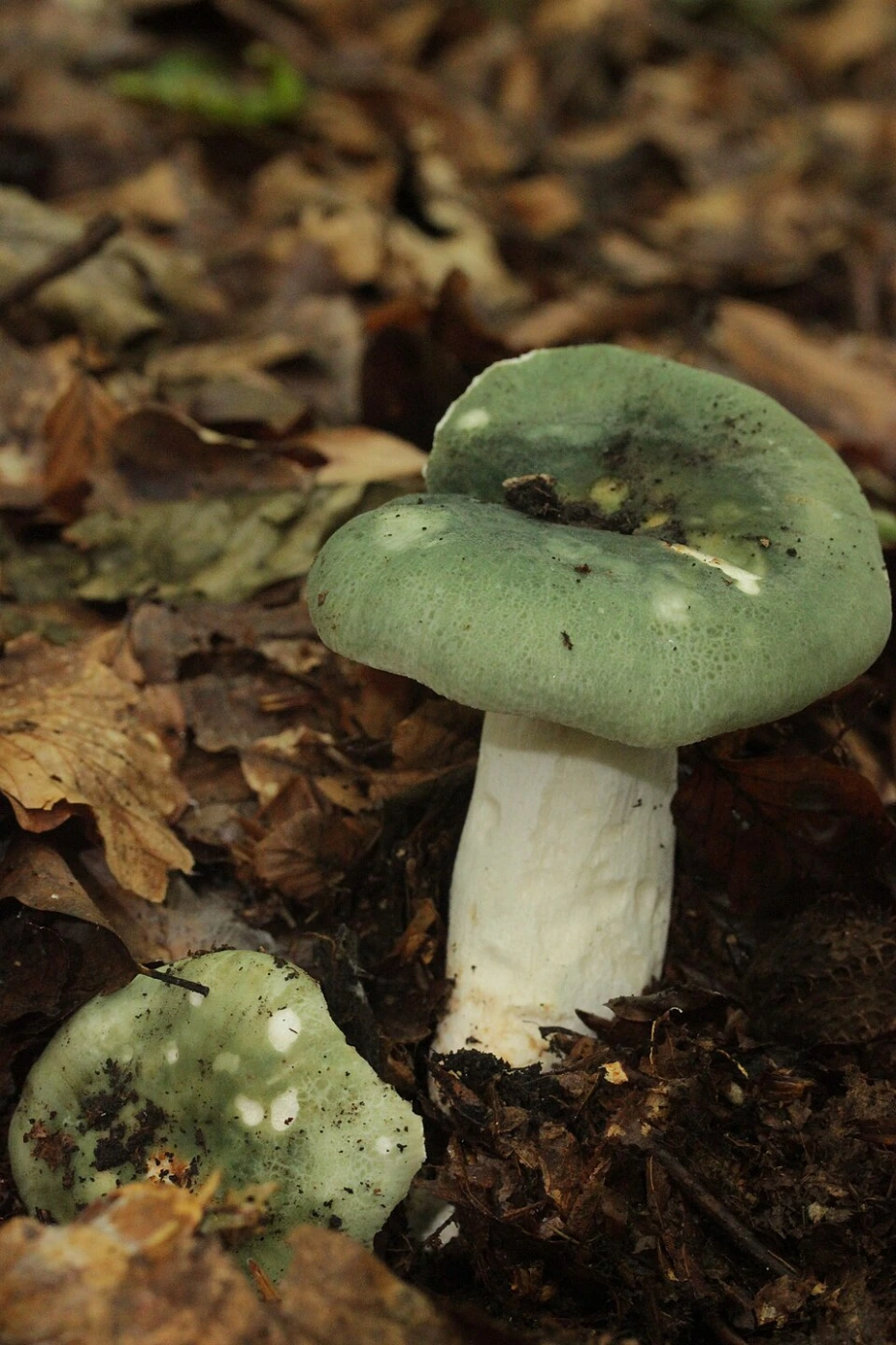
Oak is one of the classic hosts for Green-Cracking Russula. The mushroom may appear in leaf litter, moss, or relatively open woodland soil beneath mature trees.
Several fruit bodies can occur in the same general area. Productive sites may fruit repeatedly across different years when weather conditions are favorable.
Beech Woodland
Beech forest can also support Russula virescens. Pale green caps can be surprisingly difficult to notice among dry leaves despite their distinctive pattern.
The mushroom may occur together with several other Russula species. This makes careful attention to cap surface especially important.
Season
Fruiting usually occurs from summer into autumn. Warm wet periods can trigger a flush after dry weather.
The exact timing depends on climate and latitude. In mild regions, fruiting may continue later into autumn.
Distribution
Russula virescens is best known from Europe and parts of Eurasia. Similar green Russulas occur in other regions, but they should not automatically be assigned this name.
North American green brittlegills may represent different species or complexes. Regional taxonomy should therefore be considered before applying a European name broadly.
Is Russula virescens Edible?
Russula virescens is widely regarded as edible when correctly identified. It is considered one of the more desirable Russulas in regions where it is traditionally collected.
Correct identification remains essential because green cap color is not unique. Pale or greenish Amanitas and other woodland mushrooms can create dangerous confusion if the stem base and veil structures are ignored.
Look-Alikes
Several green or pale Russulas can resemble Russula virescens. The most important differences involve cap texture, brittleness, ring or volva structures, and host-tree association.
Russula cyanoxantha — Charcoal Burner
Identification
Russula cyanoxantha can have green, purple, blue-gray, or mixed cap colors. Its surface is usually smoother and lacks the strong cracked mosaic pattern typical of R. virescens.
The gills are unusually flexible for a Russula and tend to bend rather than crumble immediately. This difference can be very useful in fresh specimens.
Main Difference
The smoother cap and flexible gills favor R. cyanoxantha. A strongly cracked green mosaic cap fits R. virescens much better.
Other Green Russula Species
Identification
Several Russulas can develop olive, green, gray-green, or mixed-colored caps. Many share pale gills, white stems, and brittle flesh.
The main difficulty is that cap color overlaps heavily. Habitat, spore print, cap skin, smell, and microscopic characters may be needed for exact separation.
Main Difference
The distinctive polygonal cracking of R. virescens is its strongest feature. A smooth green cap should be treated as a different identification problem.
Amanita phalloides — Death Cap
Identification
Death Cap can have an olive-green, yellow-green, or gray-green cap and pale gills. From above, some specimens can superficially resemble a large green Russula.
The stem structure is completely different, however. Amanita phalloides has a ring and a sac-like volva at the base, while Russula virescens has neither.
Main Difference
Always inspect the full stem base. A ring or volva points away from Russula and should immediately raise concern for Amanita.
Amanita Species With Pale Green Caps
Identification
Several Amanitas can have greenish or olive caps and white gills. They often have veil remnants, a bulbous base, a ring, or a volva.
Their flesh is also less brittle than Russula flesh. The stem usually tears more fibrously rather than snapping like chalk.
Main Difference
Russula has brittle flesh, no ring, and no volva. Amanita has veil structures and a more fibrous stem.
Russula virescens vs Russula cyanoxantha
| Feature | Russula virescens | Russula cyanoxantha |
|---|---|---|
| Cap | Green, cracked mosaic | Green, purple, blue-gray, smooth |
| Gills | Brittle | More flexible |
| Stem | White, brittle | White, brittle |
| Ring | No | No |
| Volva | No | No |
| Best clue | Cracked cap | Flexible gills |
These two can occur in similar woodland habitats. Cap surface and gill texture are usually more useful than color alone.
Russula virescens vs Death Cap
| Feature | Russula virescens | Amanita phalloides |
|---|---|---|
| Cap | Green, cracked mosaic | Olive-green to yellow-green |
| Gills | Pale, brittle | White, not Russula-brittle |
| Ring | No | Usually present |
| Volva | No | Present |
| Stem base | Simple | Sac-like volva |
| Flesh | Brittle | More fibrous |
| Main clue | Mosaic cap + no veil structures | Ring + volva |
This is the most important safety comparison. A green cap should never be identified without examining the complete stem base.
How to Identify Russula virescens Step by Step
Start by confirming that the mushroom is a Russula before trying to name the species. Brittle flesh, pale gills, no latex, and absence of a ring or volva establish the basic group.
After that, focus on the cap surface. A strong green mosaic pattern is the main clue that points toward Russula virescens.
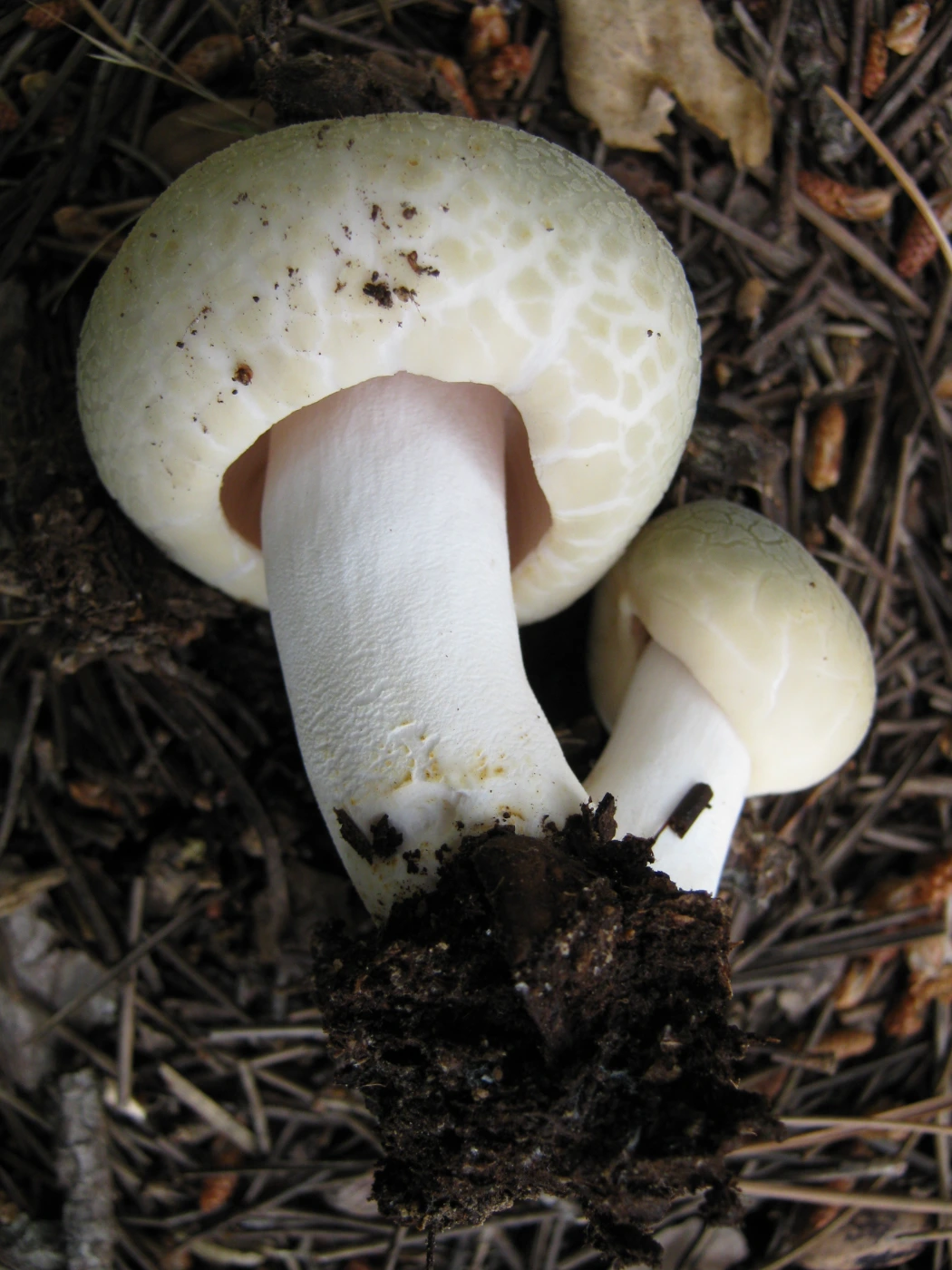
Step 1: Check the Cap Surface
Look for a green or gray-green cap divided into irregular polygonal patches. The pattern often resembles cracked paint or small tiles.
A smooth green cap suggests another Russula or another genus. The mosaic character is more useful than the exact shade of green.
Step 2: Check the Texture
Break a small section of the stem or cap. The flesh should snap rather than tear into long fibers.
This brittle texture supports Russula. A fibrous stem should move the identification toward another group.
Step 3: Look for Latex
Scratch the gills and watch for liquid. Russula virescens should not release milk.
If white or colored latex appears, the mushroom belongs in a milkcap comparison. This is an easy way to separate two closely related groups.
Step 4: Inspect the Stem Base
Check the complete stem from top to bottom. There should be no ring, bulbous volva, or sac-like structure.
Any clear veil structure should make Amanita a serious alternative. Never leave the stem base buried when identifying a pale or green mushroom.
Step 5: Consider the Habitat
Broadleaf woodland, especially with oak or beech, fits Russula virescens well. Habitat supports the identification once the structural characters already match.
Tree association is particularly useful when several green Russulas occur in the same area. It should be combined with cap texture rather than used alone.
How to Photograph Russula virescens
Take one photograph of the cap from above so the cracked mosaic pattern is clearly visible. This is the single most useful visual feature of the species.
Then photograph the gills, full stem, and complete stem base. Including nearby oak, beech, or other trees can provide useful ecological context.
Can AI Identify Russula virescens?
AI can often recognize a likely Green-Cracking Russula when the cap pattern is clearly visible. Exact identification becomes less reliable when the cap is very young, washed out by rain, or heavily damaged.
A useful photo set should include the cap surface, underside, full stem, and surrounding trees. A cap-only photograph can miss the critical absence of ring and volva.
Common Identification Mistakes
One common mistake is assuming that every green Russula is Russula virescens. Several species can produce green or olive caps without developing the characteristic mosaic pattern.
Another mistake is ignoring Amanita because the mushroom appears brittle or Russula-like from above. The complete stem base should still be checked every time.
The third mistake is treating cap color as fixed. Weathering and age can make a typical green specimen look much paler, grayer, or more yellowish.
Interesting Facts
The cracked pattern on the cap develops because the surface skin does not expand evenly as the mushroom grows. This creates the distinctive patchwork that gives the species its common name.
The green coloration can vary widely between specimens. Some mushrooms are vivid green, while others are muted gray-green or olive and can blend surprisingly well into leaf litter.
Like other Russulas, R. virescens forms a mycorrhizal relationship with trees. The visible mushroom is only a temporary fruit body produced by a much larger underground fungal network.
Its brittle flesh reflects the unusual cellular structure characteristic of Russulaceae. Rounded cells in the tissue help explain why the mushroom snaps rather than tearing into fibers.
Frequently Asked Questions
Does Russula virescens always have a strongly cracked cap?
No. Young specimens may show only weak cracking, and very wet conditions can make the pattern less obvious. The mosaic usually becomes more pronounced as the cap matures.
Can the cap be more gray than green?
Yes. Gray-green, olive, and pale bluish-green tones are all possible. The surface pattern matters more than the exact color.
Can Russula virescens grow under conifers?
It is more strongly associated with broadleaf trees such as oak and beech. A similar green Russula in pure conifer forest should make you consider other species.
Does it release latex when cut?
No. The absence of latex helps separate Russula from Lactarius and Lactifluus.
Can the stem turn hollow with age?
Older Russulas can become softer or partly hollow inside. This does not replace the more useful characters of cap pattern and brittle flesh.
Is every cracked green Russula Russula virescens?
No. Similar patterns can occur in related species, and regional taxa may differ. Identification should still consider habitat, geography, gills, and stem characters.
Can Death Cap also have a green cap?
Yes, which is why the stem base must always be checked. A volva or ring points strongly toward Amanita rather than Russula.
Can Russula virescens be identified from one photo?
A strongly cracked mature cap may give a good preliminary clue, but one image is not ideal. Photos of the underside, full stem, stem base, and habitat make the identification much stronger.
Final Identification Notes
Russula virescens is best recognized by the combination of a green to gray-green cracked mosaic cap, brittle white flesh, pale fragile gills, no latex, and a simple white stem without a ring or volva. Broadleaf woodland, especially around oak and beech, provides useful additional support.
The main visual comparison is with other green Russulas, particularly Russula cyanoxantha. The most important safety comparison is with greenish Amanitas, especially Death Cap, which can be separated by the presence of a ring and volva.
The practical field pattern is: green mosaic cap + brittle flesh + no latex + no ring or volva = strong Russula virescens candidate.
Upload a photo and get possible matches in seconds.