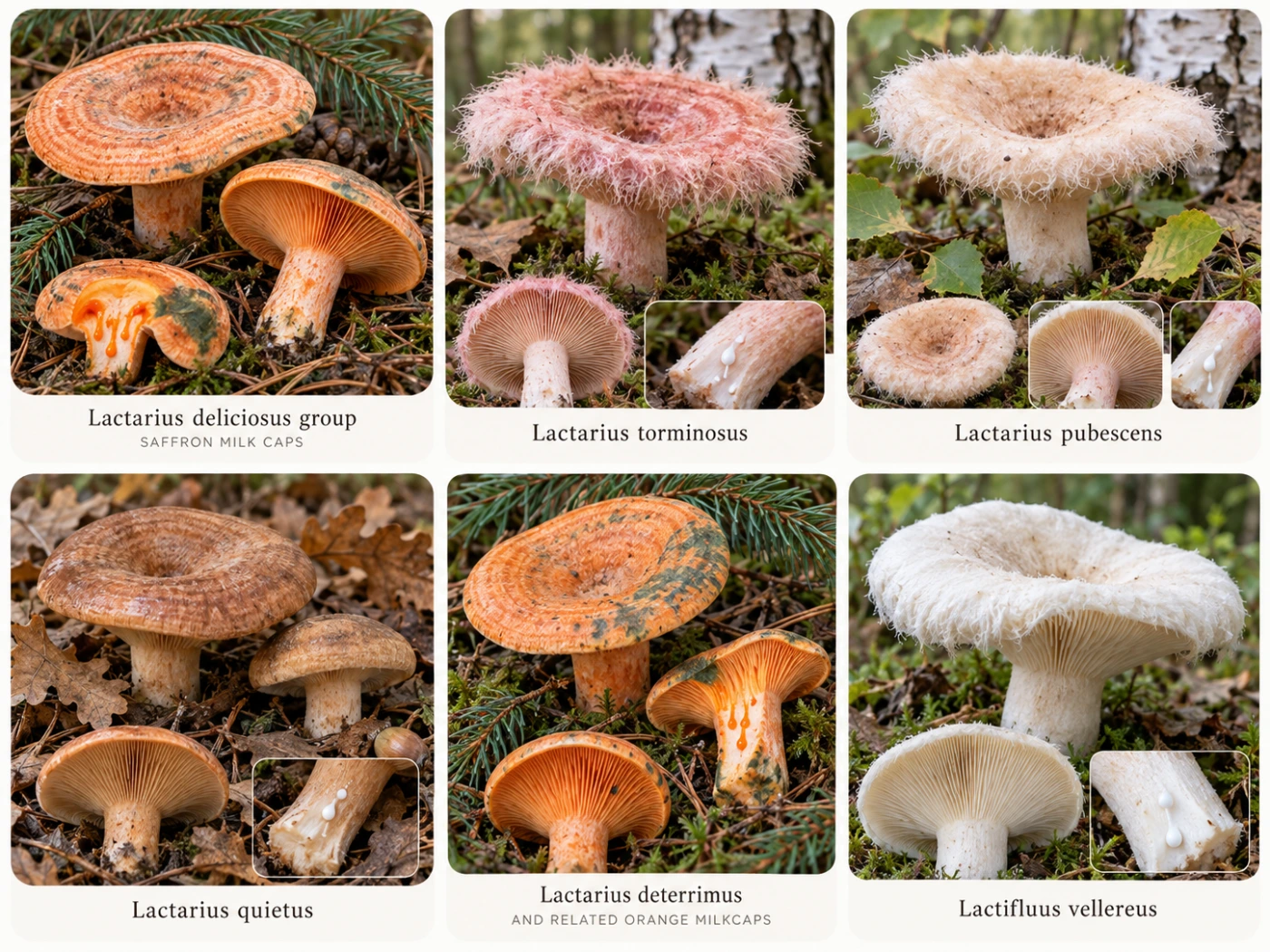
Milkcaps are among the most distinctive gilled mushrooms once you know what to look for. Their defining feature is the latex, or “milk,” that appears when the gills or flesh are damaged, although the amount, color, and behavior of that latex vary greatly between species.
For identification, latex should never be used alone. The most reliable approach combines latex color, color changes after exposure, cap pattern, gill color, smell, taste characteristics, nearby trees, and habitat.
⚠️ Important: Some milkcaps are edible when correctly identified and properly prepared, while others are acrid, irritating, or unsuitable for food. Never decide edibility from latex color, cap color, photographs, or AI identification alone.
Quick Identification
| Feature | What to Check |
|---|---|
| Main groups | Lactarius and Lactifluus |
| Key feature | Latex released from damaged tissue |
| Latex colors | White, orange, red, yellowing, watery, or scarce |
| Gills | Usually attached to decurrent |
| Cap | Often depressed with age |
| Surface | Dry, velvety, sticky, or zoned depending on species |
| Stem | Usually central and without a ring |
| Spore print | Usually white to cream or pale ochre |
| Ecology | Mostly mycorrhizal |
| Important hosts | Pine, spruce, birch, beech, oak and others |
| Best clues | Latex + host tree + gills + cap pattern |
| Edibility | Varies strongly by species |
What Is a Milkcap Mushroom?
Milkcaps are mushrooms that release a liquid from damaged gills or flesh. This latex can be obvious and abundant, or it can be so sparse that only a small drop appears after the gills are cut.
Many milkcaps were traditionally placed in the genus Lactarius, while modern taxonomy separates some related species into Lactifluus. For field identification, both groups share the familiar idea of “milk-producing” mushrooms.
Why Latex Is So Important
Latex provides several useful identification characters at once. You can observe its initial color, whether it changes after exposure to air, whether it stains the gills, and how quickly that reaction happens.
A white latex that remains white is very different from orange latex that turns greenish, or white latex that gradually becomes yellow. These differences can help narrow a specimen to a much smaller group.
How to Test the Latex
The easiest method is to gently cut or scratch a few fresh gills. If the mushroom is producing latex actively, small droplets should appear along the damaged edges.
Very dry, old, or weathered mushrooms may release almost none. In that case, cutting into fresh flesh closer to the cap center may produce a better reaction.
White Latex
White is one of the most common starting colors. It occurs in many unrelated milkcap species, so the initial white color alone is not enough.
The important question is what happens next. The latex may remain white, become yellow, stain brownish, or interact with the gills in a characteristic way.
Orange or Red Latex
Orange, carrot-colored, or reddish latex is especially important in the Lactarius deliciosus group and related orange milkcaps. These species often develop green stains where the tissue is damaged or aged.
Host tree becomes essential here because superficially similar orange milkcaps can associate with different conifers. A mushroom under pine should not automatically be given the same name as a similar specimen under spruce.
Yellowing Latex
Some milkcaps release white latex that slowly changes to yellow. The speed and intensity of this change can be useful in distinguishing closely related species.
Always observe the latex for a little while rather than recording only its first appearance. A reaction that develops after several seconds or minutes can be more informative than the initial color.
Watery or Scarce Latex
Not every milkcap produces thick white milk. Some species release watery, nearly transparent, or very limited latex.
Dry weather can also reduce latex production. A suspected milkcap with no visible milk should therefore be checked using fresh tissue before the group is ruled out.
Cap Shape
Many milkcaps begin with convex caps and later develop a depressed or funnel-shaped center. The margin may stay rolled inward for some time, especially in young fruit bodies.
Cap shape is useful, but it is rarely unique. Russulas and several unrelated mushrooms can develop a similar depressed form.
Cap Color
Milkcaps occur in a wide range of colors, including orange, brown, cream, white, pinkish, gray-green, yellow, and reddish tones. Some have strongly zoned caps, while others are almost uniformly colored.
Color should be recorded carefully but interpreted cautiously. Weather, age, moisture, and sun exposure can change it dramatically.
Concentric Zones
Some milkcaps show obvious rings of darker and lighter color across the cap. These concentric zones are especially familiar in several orange and brown species.
Zoning can be highly useful when combined with latex behavior and host tree. It should not be treated as a universal milkcap feature because many species lack it.
Cap Surface
The cap may be dry, smooth, velvety, hairy, sticky, or strongly slimy depending on species. Texture is therefore an important part of identification.
Some species have particularly hairy margins when young. Others develop a glossy or viscid surface after rain, which can change their appearance substantially.
Gills
Milkcap gills are often relatively close and usually attach to the stem or run slightly downward along it. Their color may be white, cream, yellowish, orange, pinkish, or brownish depending on the species.
Damage to the gills is especially informative because it reveals latex and may also trigger staining. Orange milkcaps, for example, can develop green discoloration around injured areas.
Stem
The stem is usually central and lacks a ring or volva. It may be smooth, pitted, spotted, hollow with age, or similar in color to the cap.
Some orange milkcaps develop shallow depressions or darker spots on the stem. These can help distinguish them from other orange woodland mushrooms.
Flesh
Milkcap flesh is usually relatively brittle compared with strongly fibrous mushrooms. This reflects their close relationship to the Russulaceae, which also includes the brittlegills or Russula species.
When cut, the flesh may release additional latex and sometimes changes color. The internal reaction can be more obvious than what happens on the gills alone.
Smell
Some milkcaps have distinctive odors, while others smell only mildly mushroom-like. Depending on species, descriptions may include coconut, fishy, fruity, spicy, or unpleasant notes.
Smell should always be treated as supporting evidence. Perception differs between people, and weathered specimens may lose much of their characteristic odor.
Spore Print
Milkcap spore prints are generally pale, ranging from white through cream to pale yellowish or ochre shades. The exact tone can sometimes help separate similar species.
For many field identifications, the spore print is less immediately useful than latex behavior and habitat. It becomes more valuable when several similar species remain possible.
Habitat Is One of the Best Identification Tools
Most milkcaps are mycorrhizal and form close relationships with living trees. This means that the surrounding tree species can be as important as the mushroom’s color.
A milkcap under pine may belong to a very different species from a nearly identical mushroom under birch. Recording nearby trees should therefore be standard practice.
Milkcaps Under Pine
Pine-associated milkcaps include several orange species in the Lactarius deliciosus group. These mushrooms often have orange latex, zoned caps, and green staining after damage.
The exact species depends on region and host. European names should not automatically be transferred to similar North American orange milkcaps.
Milkcaps Under Spruce
Spruce supports its own characteristic milkcap communities. Some orange species associated with spruce can look extremely similar to pine-associated relatives.
Tree identification is especially useful in these cases because cap and latex colors may overlap strongly.
Milkcaps Under Birch
Birch is associated with several distinctive milkcaps, including pinkish, pale, and white species. Some have woolly or hairy cap margins, especially when young.
Species such as Lactarius torminosus are strongly linked with birch. Finding the correct host tree can immediately make certain identifications much more plausible.
Milkcaps Under Beech and Oak
Broadleaf forests with beech and oak support many brown, cream, and reddish milkcaps. Some are difficult to identify without a combination of smell, latex reaction, cap texture, and host.
This is one of the groups where broad ecological context becomes particularly important. A generic “brown milkcap” label may be safer than forcing a species name from one photograph.
Lactarius deliciosus Group — Saffron Milk Caps
Identification
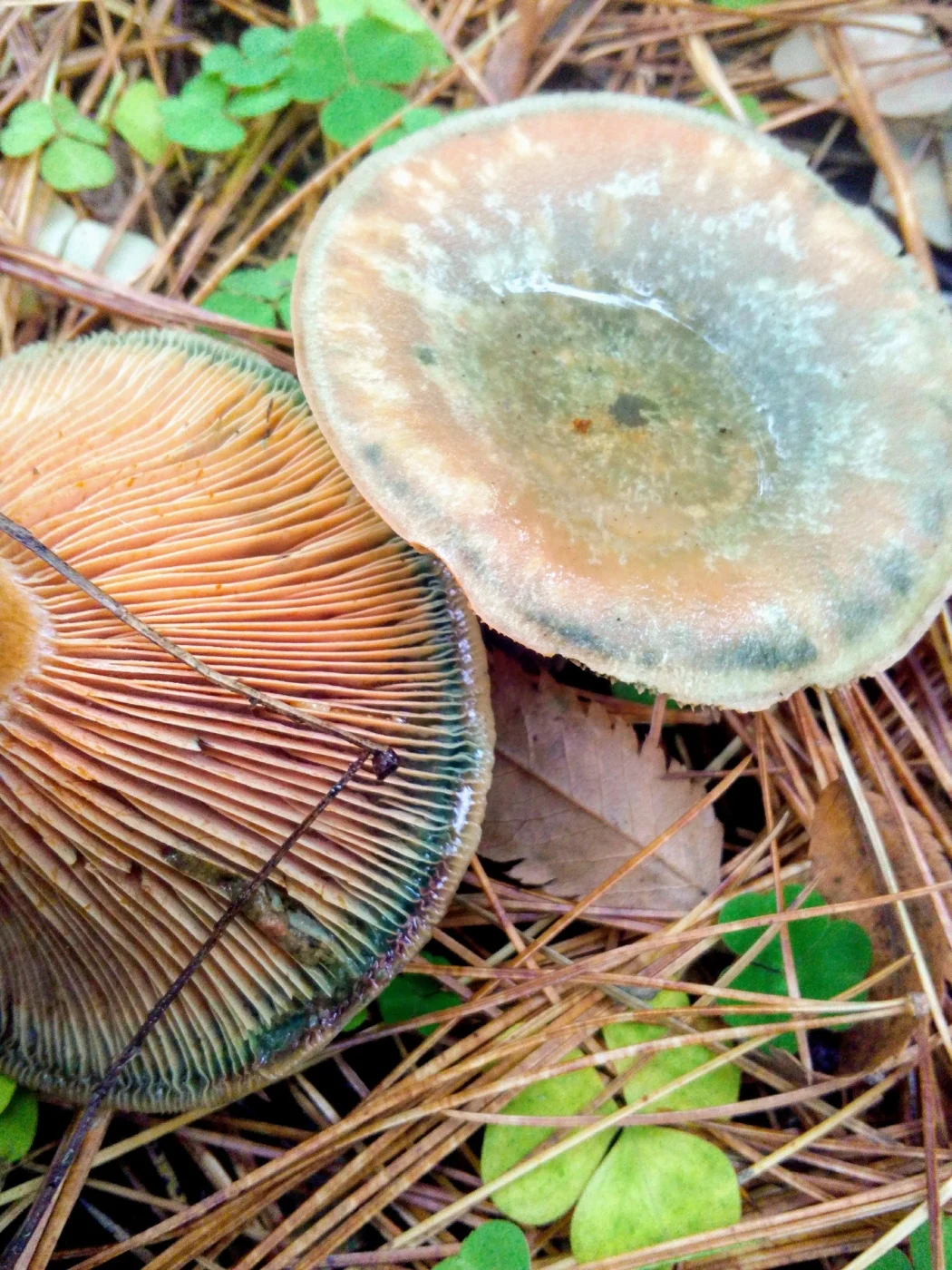
Orange milkcaps in the Lactarius deliciosus group are among the best-known members of the family. They typically have orange to carrot-colored caps, orange latex, and green staining after damage or age.
Many also show concentric zones on the cap. Their association with conifers, especially pine or related hosts depending on species, is a key identification feature.
Main Identification Clue
Orange latex is a powerful clue, but it does not identify the species by itself. Host tree, geography, stem markings, cap zoning, and the pattern of green staining should all be considered together.
Lactarius torminosus — Woolly Milkcap
Identification
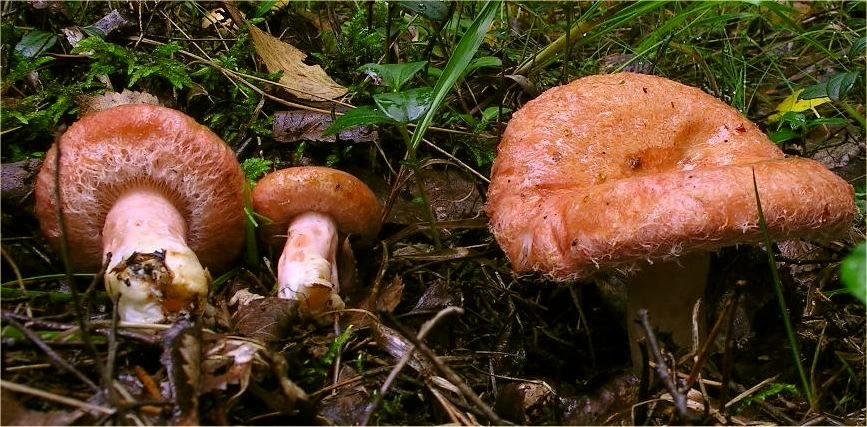
Lactarius torminosus usually has a pinkish to salmon cap with clear concentric zones and a distinctly woolly or hairy margin when young. It is strongly associated with birch.
The latex is white and does not provide the orange reaction seen in saffron milkcaps. The combination of birch habitat and hairy margin is particularly useful.
Main Identification Clue
The woolly cap edge and birch association distinguish it from many smoother milkcaps. Young specimens usually show the hairy margin most clearly.
Lactarius pubescens — Bearded Milkcap
Identification
This species is also associated with birch and can have a pale cream to pinkish cap with a hairy margin. It is generally paler than Lactarius torminosus.
Because the two share habitat and some structural characters, color intensity and cap zoning can help. Exact identification may still require careful comparison.
Lactarius quietus — Oak Milkcap
Identification
Oak Milkcap is typically brownish and associated with oak. It may show subtle zoning and has pale latex.
Its odor can be useful once familiar, though habitat is often the strongest initial clue. A brown milkcap under oak should bring this species group into consideration.
Lactarius deterrimus and Related Orange Milkcaps
Identification
Several orange milkcaps resemble Lactarius deliciosus but differ in host association and staining behavior. Some are linked especially with spruce and may develop more extensive green coloration.
These species demonstrate why “orange milkcap” should not automatically be converted into one exact name. Ecology and regional taxonomy matter as much as color.
Lactifluus vellereus — Fleecy Milkcap
Identification
Lactifluus vellereus is a large pale milkcap with a white to cream cap, widely spaced gills, and a substantial fruit body. The surface can look finely felted or velvety.
Its size and pale appearance make it very different from the small colorful milkcaps many people first notice. White latex alone is still not enough for exact identification.
Milkcap vs Russula
Milkcaps and Russula species are close relatives and can share brittle flesh, similar cap shapes, and pale spores. The major field distinction is the presence of latex.
A Russula does not produce true milk when the gills are cut. If a brittle mushroom releases obvious latex, a milkcap becomes much more likely.
Milkcap vs Funnel-Shaped Mushrooms
Many unrelated gilled mushrooms can develop depressed or funnel-shaped caps. Some may even have pale gills running down the stem.
The presence of latex immediately changes the identification pathway. Without latex, genera such as Clitocybe and other funnel-shaped mushrooms should be considered instead.
Milkcap vs Orange Chanterelle-Like Mushrooms
Orange milkcaps can sometimes be confused at a glance with chanterelles or False Chanterelles. The underside solves much of the problem.
Milkcaps have true gills and produce latex when damaged. Chanterelles have blunt false gills or ridges, while False Chanterelles have true forked gills but do not produce milk.
How to Identify a Milkcap Step by Step
The best approach is to start with fresh tissue and habitat rather than cap color alone. Once latex is confirmed, its behavior can be combined with host tree and structural features.
This method works better than trying to memorize every milkcap by appearance.
Step 1: Confirm Latex
Scratch or cut fresh gills and watch for liquid. Record both the initial color and any change after exposure.
If no latex appears, try fresher tissue before ruling out the group.
Step 2: Check the Gill Color
Observe whether the gills are white, cream, orange, yellowish, or darker. Then note whether damage causes staining.
Gill color combined with latex behavior often separates major milkcap groups.
Step 3: Examine the Cap
Record color, zoning, hairiness, stickiness, and whether the center is depressed. The margin can be especially informative in young specimens.
Do not rely on color alone because several species fade dramatically.
Step 4: Identify Nearby Trees
Check pine, spruce, birch, beech, oak, or other possible hosts. This can eliminate many otherwise plausible species.
If more than one tree species is present, avoid assuming the nearest trunk is automatically the partner.
Step 5: Look for Staining
Observe the gills, stem, and flesh for several minutes after damage. Green, yellow, brown, or other stains may develop gradually.
Timing matters because some reactions are not immediate.
How to Photograph Milkcaps for Identification
Photograph the complete mushroom in habitat before handling it. Include nearby trees or at least enough surroundings to document whether the mushroom is in coniferous or broadleaf woodland.
Then take a close-up of the gills immediately after cutting them. A second image a few minutes later can capture changes in latex or staining that a single photograph would miss.
A stem photograph and a view of the cap surface are also useful. For orange milkcaps, make sure green bruising and any stem pits are clearly visible.
Can AI Identify Milkcaps?
AI can often recognize a mushroom as a milkcap when latex, gill structure, and habitat are shown clearly. Exact species identification is much harder because many milkcaps differ in ecological or chemical characters that may not be visible in one image.
A photograph of the cap alone is particularly weak evidence. Including fresh latex, host tree, staining reaction, and underside can improve the result substantially.
For difficult species, a result such as “orange milkcap group” or “birch-associated milkcap” can be more accurate than forcing a precise species.
Common Identification Mistakes
A common mistake is assuming all orange milkcaps are Lactarius deliciosus. Several similar species occur with different conifers and in different regions.
Another mistake is recording only the initial latex color. White latex that later turns yellow can carry much more information than simply writing “latex white.”
Habitat is also frequently ignored. A photograph without nearby trees removes one of the strongest clues available for milkcap identification.
Interesting Facts About Milkcaps
The “milk” of milkcaps is not sap in the botanical sense. It is latex produced by specialized fungal cells and contains a mixture of compounds that can change after exposure to air.
Some of the dramatic color changes are chemical reactions triggered by tissue damage. Orange latex turning green in certain saffron milkcaps is therefore not just discoloration from age but part of the mushroom’s chemistry.
Milkcaps also demonstrate how closely fungal identification can depend on trees. Two mushrooms that appear nearly identical may represent different species because one associates with pine and another with spruce or birch.
Modern DNA studies have significantly changed the classification of milkcaps. Species once grouped together in Lactarius are now divided between Lactarius, Lactifluus, and related lineages, showing that outward similarity does not always reflect close evolutionary relationships.
Frequently Asked Questions
Can a milkcap stop producing latex when it gets old?
Yes. Old, dry, or weathered fruit bodies can produce very little liquid even when the species normally has abundant latex. Fresh gills or inner flesh are usually better places to test.
Why does latex sometimes look different on a photograph than in the field?
Lighting and camera processing can shift white, yellow, orange, and red tones. It is useful to record the color in words at the time of observation rather than relying only on the photograph.
Can two milkcap species grow under the same tree?
Yes. A single woodland can support several milkcaps associated with the same tree genus, so habitat narrows the possibilities but does not usually prove the species.
Does freezing weather affect latex?
Yes. Frost can damage tissue and alter how much latex is released or how the mushroom stains. Recently frozen specimens are often harder to interpret.
Can latex appear only after cutting deeply into the cap?
Yes. Some species produce little visible milk from superficial scratches, especially in dry conditions. Cutting fresher tissue can reveal a reaction that was initially missed.
Why are some milkcaps hollow inside the stem?
The stems of some species become hollow or chambered as they mature. This is a normal age-related feature in certain milkcaps and can sometimes support identification.
Can insects change the color of the latex or flesh?
Damage from larvae can expose tissue long before the mushroom is examined. Old damaged areas may therefore show stains that look different from a fresh reaction.
Is every mushroom that releases white liquid a milkcap?
No. Other fungi can exude moisture or droplets, and damaged mushrooms may contain clear liquid for different reasons. True milkcap latex should be interpreted together with brittle flesh, gill structure, spores, and habitat.
Final Identification Notes
Milkcap identification works best when latex, color, staining, gills, and habitat are treated as one system. No single feature, including the presence of milk itself, is sufficient for reliable species-level identification.
Start by observing the latex and then watch what happens to it. Combine that reaction with cap structure, gill color, nearby trees, geography, and season before narrowing the identification.
The simplest field rule is: cut the gills, watch the latex, identify the nearby trees, and wait for color changes. That sequence usually provides far more information than the cap color alone.
Upload a photo and get possible matches in seconds.