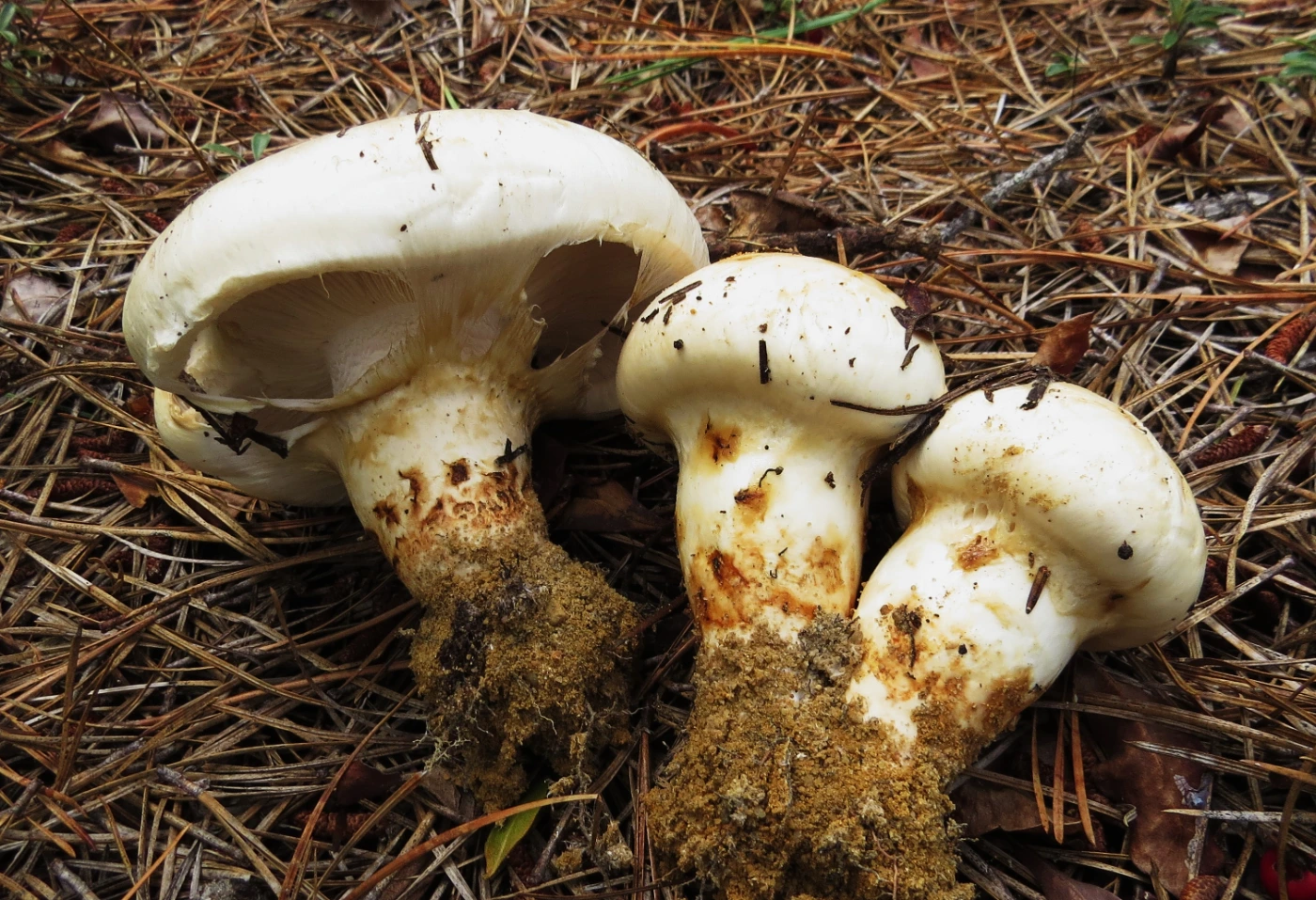
Tricholoma magnivelare, commonly known as the American Matsutake, is a large, firm, white to pale brown mushroom of coniferous forests in North America. It is especially known for its distinctive spicy-aromatic smell, dense flesh, thick stem, and persistent partial veil that forms a ring.
The species is closely associated with trees through mycorrhiza and often grows partly buried in forest duff. Because several large white Tricholoma species and other pale mushrooms can look similar, identification should rely on the full combination of odor, gills, stem structure, ring, habitat, and geography.
⚠️ Important: American Matsutake is considered edible when correctly identified, but wild mushrooms should never be eaten based only on photographs, AI identification, or aroma. Large white gilled mushrooms can include dangerous look-alikes, so the full fruit body must be checked carefully.
Quick Identification
| Feature | Tricholoma magnivelare |
|---|---|
| Scientific name | Tricholoma magnivelare |
| Common names | American Matsutake, White Matsutake |
| Family | Tricholomataceae |
| Cap color | White to cream, later tan or brownish |
| Cap shape | Convex, later broadly convex to flatter |
| Cap surface | Dry, often fibrous or with pressed scales |
| Gills | White to cream |
| Gill attachment | Notched to sinuate |
| Stem | Thick, firm, white |
| Ring | Present, from partial veil |
| Volva | Absent |
| Flesh | White, dense, firm |
| Smell | Strong spicy, sweet, cinnamon-like or aromatic |
| Spore print | White |
| Ecology | Mycorrhizal |
| Main habitat | Coniferous forest |
| Season | Late summer to autumn |
| Main range | North America |
| Edibility | Edible when correctly identified |
| Main look-alikes | Other Tricholoma spp., Catathelasma spp., pale Amanitas |
What Does Tricholoma magnivelare Look Like?
American Matsutake is usually a robust mushroom with a thick stem and a substantial cap. Young specimens can remain partly buried under needles, moss, or forest litter, so only the rounded top of the cap may be visible at first.
The overall color is pale, especially in younger fruit bodies. With age, the cap often develops tan, cinnamon, or brownish areas, particularly toward the center.
Cap
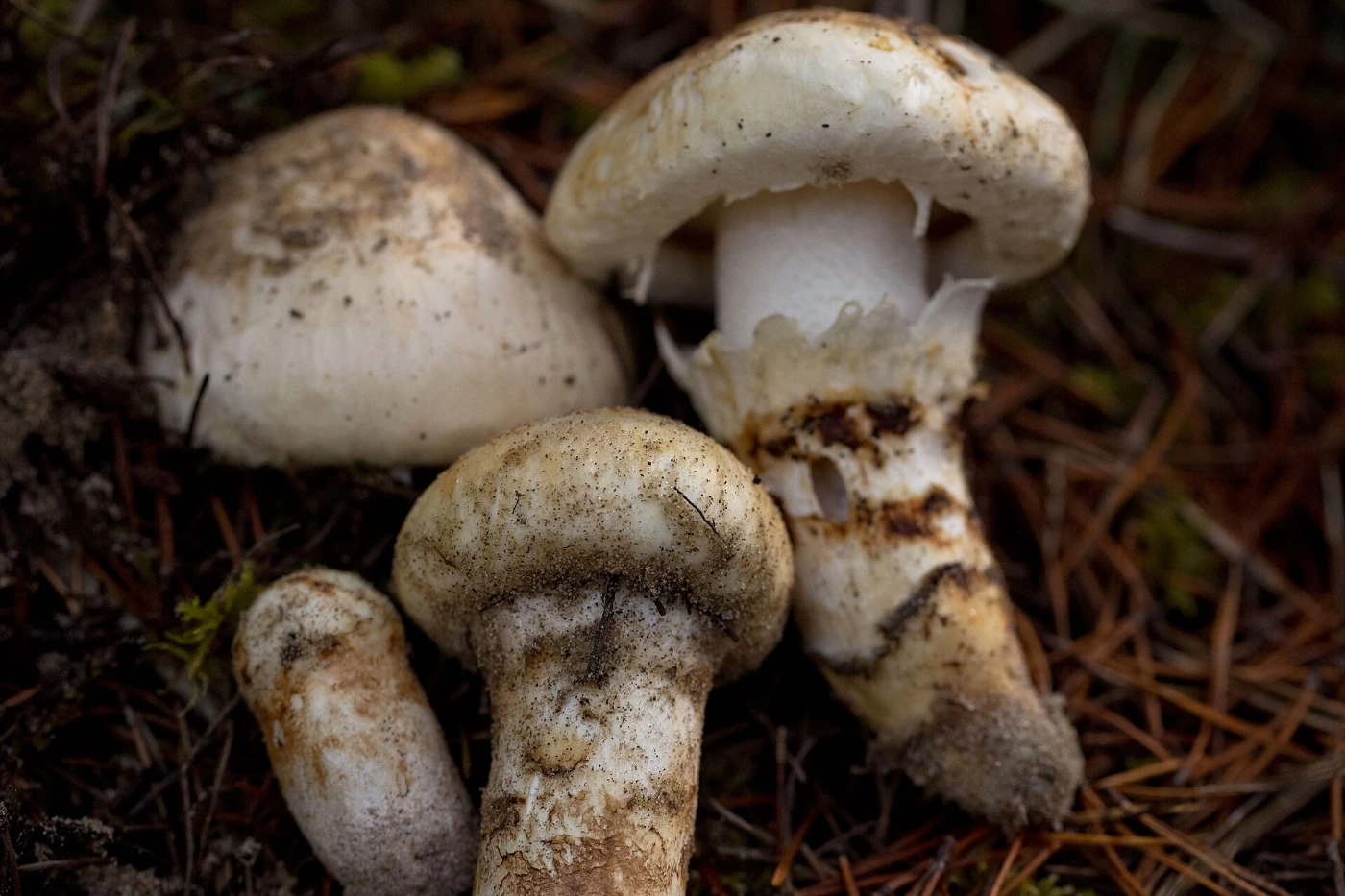
The cap is initially convex and can remain strongly rounded for some time. Mature fruit bodies become broadly convex or somewhat flattened, although they usually retain a thick, fleshy appearance.
Color ranges from white and cream to pale tan or brownish. Older caps may show darker fibrous markings or flattened scales.
Cap Surface
The surface is generally dry rather than slimy. It can look finely fibrous, silky, or slightly scaly, especially as the cap expands.
Forest debris often adheres to young caps because the mushrooms develop under needles and loose soil. This partly buried growth habit is very characteristic of matsutake-type mushrooms.
Gills
The gills are white to cream and relatively closely spaced. They are usually notched or sinuate near the stem rather than running strongly down it.
As the mushroom ages, the gills may develop cream or slightly yellowish tones. They should not become pink, brown, or dark purple with maturity.
Why Gill Color Matters
White gills help place the mushroom within the correct group but are not enough for identification. Many unrelated mushrooms also have white gills.
The combination of white gills, a thick ringed stem, dense flesh, and strong aroma is much more useful.
Stem
The stem is thick, solid, and usually white to pale cream. It may taper slightly toward the base or remain relatively even in width.
Young stems are often surrounded by a substantial partial veil. As the cap opens, the veil tears and leaves a distinct ring.
Ring
The ring is one of the most useful visible features. It is formed by the partial veil and can remain as a persistent membranous zone around the upper stem.
Below the ring, the stem may show fibrous or slightly scaly texture. Above it, the surface is usually smoother.
Stem Base
The base is solid but does not have a true volva. This is important when comparing American Matsutake with pale Amanitas.
The entire base should still be exposed during identification. A buried stem base can hide features that would suggest another genus.
Flesh
The flesh is white, thick, and unusually firm. Fresh specimens often feel much denser than many ordinary gilled mushrooms.
This firm texture is one reason matsutake mushrooms can remain intact even when growing through compact forest litter.
Smell
The odor is one of the best-known features of Tricholoma magnivelare. It is commonly described as spicy, sweet, aromatic, cinnamon-like, resinous, or reminiscent of a mixture of spices and forest wood.
Descriptions vary from person to person, so smell should not be treated as proof by itself. However, a strong distinctive aroma combined with the correct structure and habitat strongly supports the identification.
Spore Print
The spore print is white. This is consistent with the genus Tricholoma and helps separate the species from mushrooms with pink, brown, or dark spores.
Spore print color is most useful when the specimen does not fit perfectly with other visible features.
Where Does American Matsutake Grow?
Tricholoma magnivelare is mycorrhizal and grows in association with living trees. It is especially linked with coniferous forests.
The mushrooms often emerge through deep layers of needles, moss, and organic duff. Only part of the cap may be visible until the surrounding litter is moved aside.
Conifer Associations
Depending on region, American Matsutake can occur with pine, fir, hemlock, spruce, and other conifers. Exact host relationships vary geographically.
This ecological information is important because similar pale mushrooms in hardwood forest may belong to completely different species.
Soil and Forest Floor
The species often favors well-drained soils with substantial forest litter. Fruiting bodies can be deeply anchored and may push up through moss or needles.
The partly buried growth habit can make young specimens difficult to spot. Experienced collectors often notice subtle raised areas in the forest floor.
When Does Tricholoma magnivelare Grow?
The main fruiting season is late summer through autumn, depending on region and elevation. Cooler nights and suitable moisture often trigger fruiting.
In mountainous or northern regions, the season may begin earlier or be relatively short. In milder areas, fruiting can continue well into autumn.
Distribution
Tricholoma magnivelare is primarily a North American species. It is associated especially with western and northern forest regions, although related matsutake-type taxa occur elsewhere.
It should not automatically be treated as the same species as the Asian matsutake, Tricholoma matsutake. The two are closely related but geographically and taxonomically distinct.
Is Tricholoma magnivelare Edible?
American Matsutake is considered edible when correctly identified and has high culinary value in some regions. Its firm texture and strong aroma make it particularly distinctive compared with many other wild mushrooms.
However, the presence of large white gilled mushrooms in the same habitat means careful identification is essential. A specimen should not be considered safe to eat because it smells “like matsutake” alone.
Tricholoma magnivelare Look-Alikes
The most important look-alikes include other white Tricholoma species, Catathelasma, and pale Amanitas. Some share white gills and thick stems, so ring structure, odor, stem base, and habitat become especially important.
The safest approach is to compare the whole mushroom rather than relying on one memorable feature.
Catathelasma ventricosum — Swollen-Stalked Cat
Identification
Catathelasma ventricosum is a large, pale mushroom that can also grow in coniferous forests. It has thick white flesh, a substantial stem, and a persistent ring or ring zone.
It may superficially resemble American Matsutake, especially from a distance.
Main Difference
Catathelasma typically has more strongly decurrent gills and can have a more massive, rooting-looking stem. The odor also differs and is usually less distinctly spicy in the classic matsutake sense.
Gill attachment is therefore especially useful in this comparison.
Other White Tricholoma Species
Identification
Several Tricholoma species can be white, cream, or pale brown and may occur under conifers. They often share firm flesh and white spores.
Some lack a persistent ring, while others differ in smell, cap texture, or host preference.
Main Difference
A strong partial veil and persistent ring strongly support T. magnivelare among pale Tricholoma-like mushrooms. The characteristic spicy aroma and robust build provide additional support.
Pale Amanita Species
Identification
Some pale Amanitas have white gills, a ring, and a substantial stem. Young specimens can be particularly confusing if the stem base is buried.
The critical difference is that Amanitas may have a volva or other universal-veil remnants at the stem base.
Main Difference
Tricholoma magnivelare does not have a true volva. Any sac, cup, or distinct volval structure around the base should immediately point away from matsutake and toward another group.
Tricholoma magnivelare vs Catathelasma
| Feature | American Matsutake | Catathelasma |
|---|---|---|
| Cap | White to tan, fibrous | Pale cream to gray-brown |
| Gills | Notched to sinuate | More strongly decurrent |
| Stem | Thick, firm | Very thick, often massive |
| Ring | Present | Present |
| Smell | Strong spicy-aromatic | Usually less distinctive |
| Habitat | Conifer forest | Conifer forest |
| Spore print | White | White |
| Main clue | Aroma + notched gills | Decurrent gills + massive build |
This comparison is one of the more practical ones in western North American forests.
Tricholoma magnivelare vs Amanita
| Feature | American Matsutake | Pale Amanita |
|---|---|---|
| Gills | White | White |
| Ring | Present | Often present |
| Volva | Absent | Often present |
| Stem base | Solid, no sac | May have sac, rim, or bulb |
| Smell | Strong spicy | Variable |
| Ecology | Mycorrhizal | Mycorrhizal |
| Safety | Edible when correctly identified | Some species deadly |
The stem base is particularly important in this comparison. A mushroom collected without its full base may be impossible to identify safely.
How to Identify Tricholoma magnivelare Step by Step
Start with the overall structure and habitat. A large pale mushroom in conifer forest with a thick stem, white gills, ring, and strong spicy smell is a good candidate.
Then confirm the gill attachment and inspect the complete stem base.
Step 1: Check the Habitat
Look for growth in coniferous forest rather than directly from wood. The mushroom should emerge from soil and forest litter.
Nearby pine, fir, spruce, or hemlock supports the identification.
Step 2: Smell the Mushroom
A strong spicy, sweet, aromatic scent is an important clue. The odor should be obvious in fresh specimens.
If the mushroom has no distinctive smell at all, identification deserves more caution.
Step 3: Examine the Gills
The gills should be white to cream and notched near the stem. They should not run strongly downward.
Strongly decurrent gills suggest Catathelasma or another genus.
Step 4: Check the Ring
Look for the persistent partial-veil ring around the upper stem. It may be thick and membranous in fresh specimens.
A ringless pale Tricholoma requires a different identification pathway.
Step 5: Expose the Stem Base
Carefully remove the mushroom with the entire base intact. Confirm that there is no volva or sac.
This step is essential for excluding dangerous pale Amanitas.
How to Photograph American Matsutake for Identification
Take one image of the mushroom in its natural forest habitat before removing it. The surrounding conifer litter and nearby trees provide useful ecological context.
Then photograph the underside, full stem, ring, and exposed base. A close-up of the cap surface can also show the fibrous texture and age-related brown markings.
If several fruit bodies are present, include both young and mature specimens. This helps document how cap color and ring structure change with age.
Can AI Identify Tricholoma magnivelare?
AI can often recognize the overall matsutake-like appearance when the complete mushroom and habitat are visible. Exact identification becomes less reliable when only the cap is photographed.
The stem base, ring, gill attachment, and forest context are particularly important. A cautious result should remain uncertain if a pale gilled mushroom is photographed without its base.
Regional information also matters because matsutake-like species differ across North America and Asia.
Common Identification Mistakes
One common mistake is assuming that any pale aromatic mushroom in conifer forest is American Matsutake. Other large white fungi can grow in the same habitat.
Another mistake is ignoring gill attachment. Strongly decurrent gills can point toward Catathelasma rather than Tricholoma.
The most serious mistake is cutting off the stem base. Without the complete base, a pale Amanita may be harder to exclude safely.
Interesting Facts About Tricholoma magnivelare
American Matsutake is part of a broader group of highly aromatic Tricholoma mushrooms found across the Northern Hemisphere. Different regional taxa have historically been grouped under the general idea of “matsutake,” even though modern taxonomy recognizes important differences.
The mushrooms often develop underground or beneath thick forest duff before pushing upward. This explains why collectors sometimes search for subtle cracks or bumps in the forest floor rather than visible mature caps.
The strong aroma has made matsutake mushrooms culturally and economically important. In parts of North America, commercial harvesting has historically supplied markets both locally and internationally.
The species is also a good example of why common names can hide taxonomic complexity. “Matsutake” may refer to related but distinct species depending on whether the mushroom comes from Asia, Europe, or North America.
Frequently Asked Questions
Can American Matsutake have a brown cap?
Yes. Older specimens commonly develop tan, cinnamon, or brownish areas, especially toward the center. Young mushrooms are often much paler.
Why are some specimens almost completely buried?
The fruit bodies often develop under deep forest litter before emerging. Needles and moss can remain packed tightly around the cap and stem.
Can the ring disappear with age?
It can become damaged or less obvious, especially in old or handled specimens. Young fresh fruit bodies usually show the partial veil more clearly.
Does every specimen have the same strong smell?
No. Aroma intensity varies with freshness, age, temperature, and individual perception, although fresh American Matsutake usually has a distinctive odor.
Can it grow under hardwoods?
The species is primarily associated with coniferous forests. A similar mushroom found well away from conifers deserves careful reconsideration.
Why are the gills sometimes slightly yellowish?
Age and handling can introduce cream or pale yellow tones. They should still remain fundamentally pale rather than becoming dark-spored.
Can several related Tricholoma species occur in the same forest?
Yes. Conifer forests can support multiple pale Tricholoma species, making ring structure and odor especially useful.
Is American Matsutake the same species as Japanese Matsutake?
No. Tricholoma magnivelare is the North American species traditionally called American Matsutake, while the classic Asian Matsutake is Tricholoma matsutake.
Final Identification Notes
Tricholoma magnivelare is best recognized by the combination of a large pale cap, white notched gills, thick firm stem, persistent ring, strong spicy-aromatic smell, and growth in coniferous forest.
Its most important look-alikes include Catathelasma species, other pale Tricholoma, and pale Amanitas. Gill attachment and the complete stem base are particularly important because American Matsutake has no volva.
The simplest identification pattern is: large white aromatic mushroom + conifer habitat + ring + notched white gills + no volva = strong American Matsutake candidate.
Upload a photo and get possible matches in seconds.