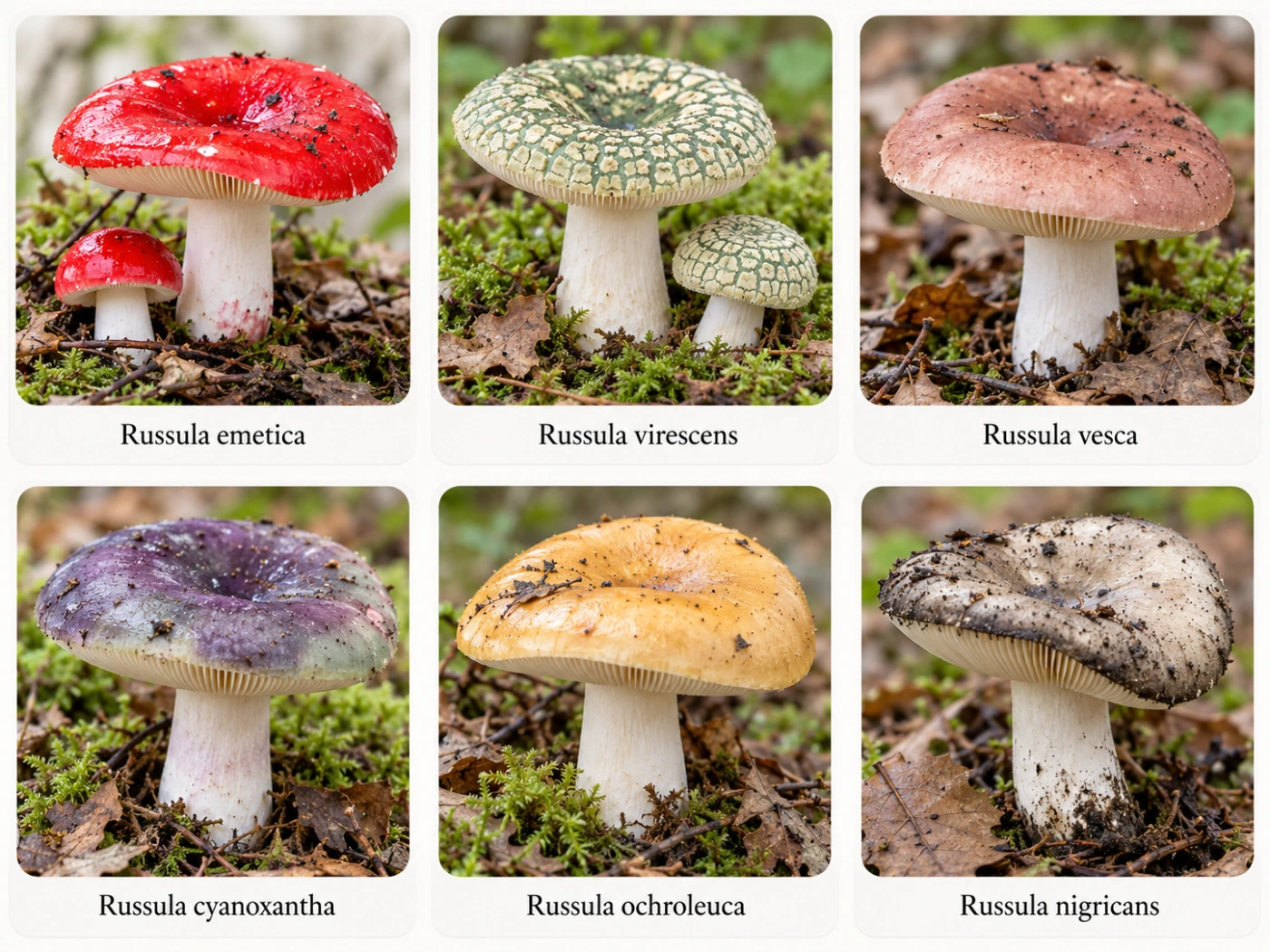
Russula is one of the largest and most familiar genera of woodland mushrooms. Its members are often called brittlegills because their flesh and gills break cleanly rather than bending like those of many other mushrooms.
Russulas occur in an enormous range of colors, including red, green, yellow, purple, brown, gray, and nearly white. Color can be useful for narrowing the possibilities, but it is rarely enough to identify a species because several unrelated Russulas may look almost identical from above.
⚠️ Important: Some Russula species are eaten when correctly identified, while others can cause unpleasant gastrointestinal symptoms. Do not use cap color, taste, or old folk rules as the only basis for deciding whether a Russula is edible.
Quick Identification
| Feature | Typical Russula |
|---|---|
| Genus | Russula |
| Common name | Brittlegills |
| Cap colors | Red, pink, purple, green, yellow, brown, gray, white |
| Gills | Usually pale, brittle, attached to free depending on species |
| Stem | Usually white or pale, without a ring |
| Flesh | Brittle, snaps rather than fibers |
| Latex | Absent |
| Ring | Usually absent |
| Volva | Absent |
| Spore print | White, cream, yellowish, or ochre depending on species |
| Ecology | Mycorrhizal |
| Main habitats | Woodland, parks, forest edges |
| Main hosts | Oak, beech, birch, pine, spruce and other trees |
| Season | Mainly summer to autumn |
| Edibility | Varies by species |
| Main look-alikes | Lactarius, pale Amanita, Tricholoma and other gilled mushrooms |
What Is a Russula Mushroom?
Russulas are mycorrhizal fungi that live in partnership with the roots of trees. The underground mycelium exchanges mineral nutrients and water with the tree while receiving sugars produced by photosynthesis.
The mushrooms we see above ground are only temporary fruit bodies. A single fungal network may remain associated with the same trees for many years and produce mushrooms whenever moisture and temperature become favorable.
Why Are Russulas Called Brittlegills?
The flesh of Russula mushrooms contains rounded cells that make it unusually brittle. Instead of pulling apart into long fibers, the stem often snaps cleanly like a piece of chalk.
The gills are also fragile and may crumble when rubbed with a finger. This brittle texture is one of the most useful ways to recognize the genus in the field.
Cap
Russula caps are extremely variable in color and can be red, orange, yellow, green, blue-green, purple, brown, gray, cream, or combinations of several shades. Some species have a nearly uniform surface, while others fade strongly toward the center or edge.
The cap usually begins convex and becomes flatter with age. Many mature Russulas develop a shallow central depression, although the exact shape varies between species.
Cap Surface
The surface may be dry, slightly greasy, sticky when wet, or finely textured. In some species, part of the cap skin can be peeled away from the margin, but this feature varies and should not be treated as a universal Russula test.
Rain and sunlight can dramatically change cap color. A bright red mushroom may fade toward pink or cream, while green and purple species can become patchy or mottled.
Gills
The gills are usually pale when young and may remain white, cream, yellowish, or ochre depending on the species. They are often relatively fragile and can break easily when touched.
Gill spacing and attachment vary across the genus. Some Russulas have crowded narrow gills, while others have thicker and more widely spaced gills.
Stem
The stem is usually white, cream, or pale, although some species develop pink, red, gray, or other colored areas. It is generally cylindrical and lacks both a ring and a volva.
Older stems may become hollow or spongy inside. Fresh specimens are usually firm but still show the characteristic brittle break when snapped.
Flesh
Russula flesh is usually white or pale and breaks rather than separating into fibers. This brittle texture is shared with the closely related milkcaps in Lactarius and Lactifluus.
Some species change color when damaged or cut. Gray, brown, red, or black staining can be highly useful for identifying particular Russula groups.
No Latex
One of the easiest ways to separate Russula from Lactarius is to damage the gills and look for liquid. Russula species do not normally release the milky latex characteristic of milkcaps.
This distinction is especially helpful when the cap colors overlap. A brittle mushroom that releases white, orange, or colored milk belongs in a milkcap comparison rather than a typical Russula one.
Spore Print
Russula spore prints range from white and cream to yellow or deeper ochre. Spore color can be very useful because many otherwise similar species fall into different spore-print groups.
A print is especially valuable when cap color has faded or several Russulas are growing together. Precise species identification may still require microscopic examination of the ornamented spores.
Where Do Russula Mushrooms Grow?
Russulas grow with living trees and are most often found on woodland soil. They can occur in deciduous forest, coniferous forest, mixed woodland, parks, old lawns near trees, and forest edges.
Different species have different host preferences. Knowing whether the mushroom is under oak, birch, beech, pine, spruce, or another tree can greatly reduce the number of possibilities.
Russulas Under Oak
Oak woodland supports many Russula species. Green, red, purple, yellow, and brown brittlegills can all occur around oak roots.
Host tree is particularly useful when several visually similar species are being compared. A Russula strongly associated with oak may have a nearly identical relative that prefers birch or conifers.
Russulas Under Birch
Birch forests and mixed woodland contain a rich Russula community. Several red and pink species are especially common in association with birch.
Wet birch woodland can also support species that prefer cooler or more acidic soils. Because roots can extend beyond the visible canopy, the nearest trunk is not always the actual fungal partner.
Russulas Under Pine and Spruce
Many Russulas grow with conifers, including pine and spruce. Acidic needle-covered forest floors can support red, purple, yellow, and brown species at the same time.
Tree identification is therefore an important part of Russula identification. A cap-only photograph often contains far less useful information than an image that also shows the surrounding habitat.
When Do Russulas Appear?
Most Russulas fruit from summer through autumn, especially after periods of sustained rain. Fruiting can begin earlier in warm regions and continue later where autumn remains mild.
Different species peak at different times. A woodland may therefore produce several waves of Russulas over the course of one season.
Common Russula Species
The genus contains a very large number of species, and exact identification can sometimes be difficult even for experienced mushroom hunters. The species below represent some of the better-known examples rather than a complete list.
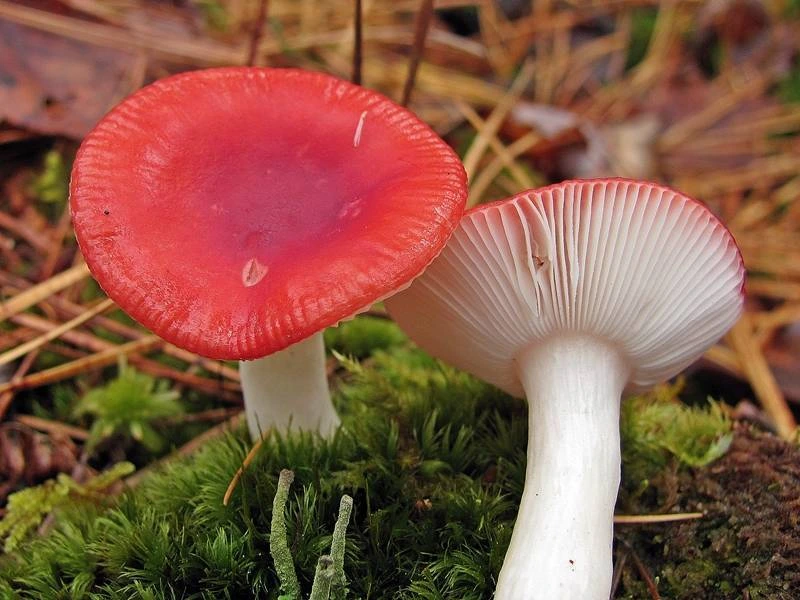
Russula emetica — The Sickener
Identification
Russula emetica is best known for its bright red cap, white stem, pale gills, and strongly acrid flesh. The cap surface can be glossy when wet and often contrasts sharply with the white stem.
Several other red Russulas look similar, so bright red color alone does not identify this species. Habitat and microscopic characters may be needed to separate members of the wider group reliably.
Edibility
The Sickener can cause gastrointestinal illness and should not be treated as an edible mushroom. Its common name reflects the nausea and vomiting historically associated with consumption.
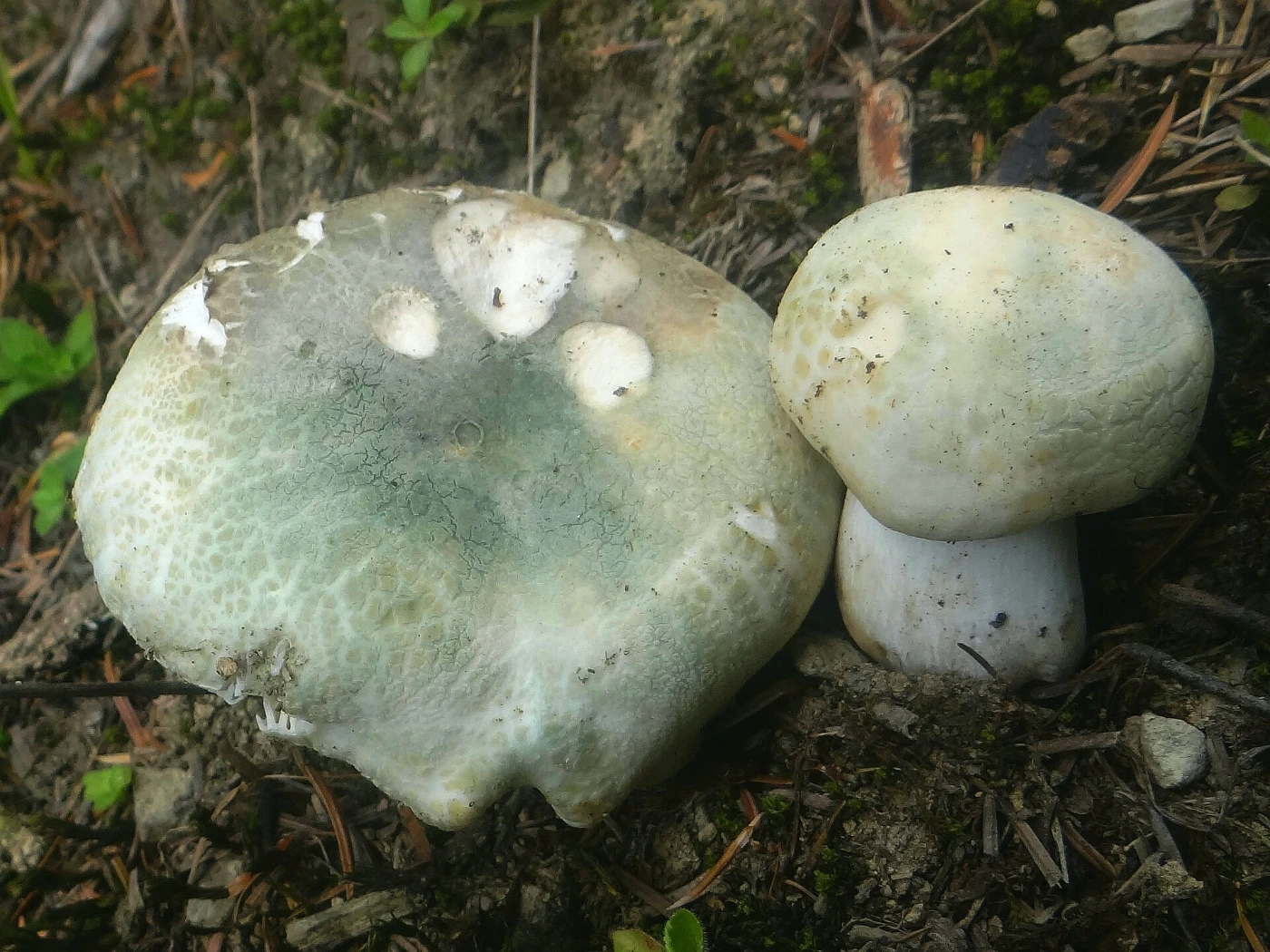
Russula virescens — Green-Cracking Russula
Identification
Russula virescens has a green to gray-green cap that often breaks into a distinctive mosaic of small patches. The stem and gills are pale, producing a striking contrast with the patterned cap.
The cracked surface is one of its most recognizable features. Other green Russulas can be smoother and may require closer examination.
Edibility
This species is considered edible when correctly identified. Green cap color alone is not enough, because several Russulas and unrelated mushrooms can also be greenish.
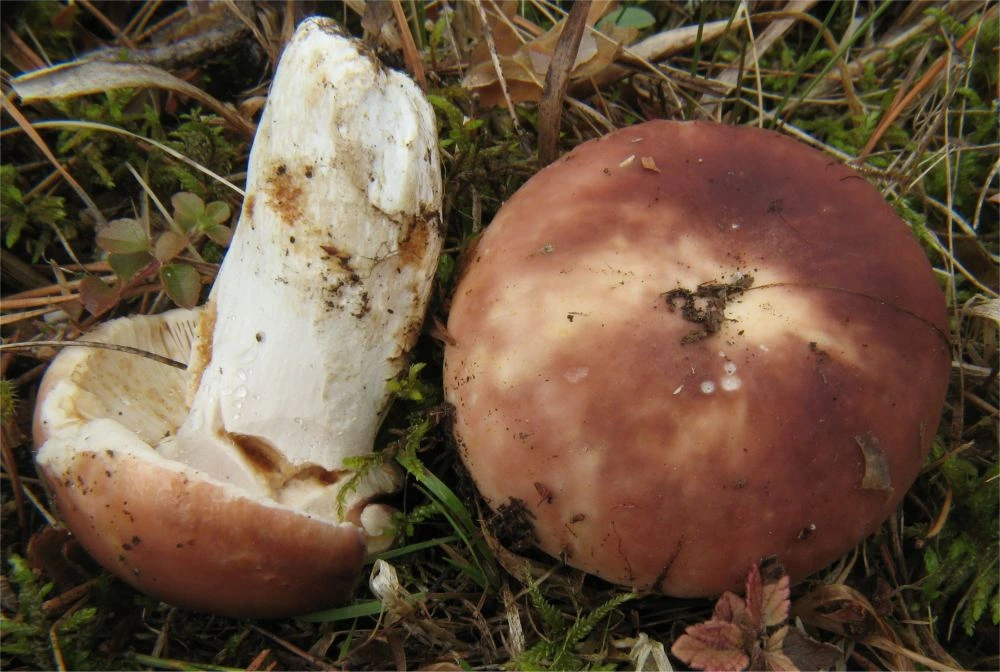
Russula vesca — Bare-Toothed Russula
Identification
Russula vesca usually has a pinkish-brown, flesh-colored, or muted reddish cap. The cap skin often stops slightly short of the edge, exposing the ends of the gills and giving rise to the common name Bare-Toothed Russula.
It occurs mainly with broadleaf trees and has mild-tasting flesh. The subtle colors can make it easy to overlook among leaf litter.
Edibility
Russula vesca is regarded as edible when correctly identified. As with other Russulas, identification should be based on several characters rather than taste alone.
Russula cyanoxantha — Charcoal Burner
Identification
Charcoal Burner is famous for its highly variable purple, green, blue-gray, or mixed-colored cap. Its gills are unusually flexible for a Russula and tend to bend rather than shatter immediately when rubbed.
This gill texture is a particularly useful field character. The species is commonly associated with broadleaf woodland.
Edibility
Russula cyanoxantha is considered edible when correctly identified. Its variable cap color means that gill texture and habitat are often more useful than color.
Russula ochroleuca — Ochre Brittlegill
Identification
Ochre Brittlegill has a yellow-ochre to dull yellow cap, pale gills, and a whitish to grayish stem. It is common in many European woodlands and can occur with both coniferous and broadleaf trees.
The cap is usually less vivid than that of brighter yellow Russulas. Exact separation from similar species can still require a combination of habitat and microscopic features.
Russula nigricans — Blackening Brittlegill
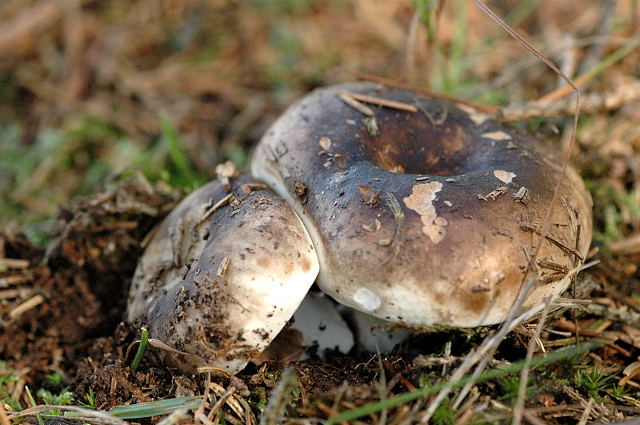
Identification
Russula nigricans begins pale or brownish but changes dramatically after damage and with age. The flesh typically reddens before gradually turning dark gray or black.
The gills are relatively thick and widely spaced compared with those of many Russulas. Old fruit bodies can become almost completely black.
Main Feature
The strong red-to-black color change is much more useful than the original cap color. This reaction places it among the distinctive blackening Russula groups.
Red Russulas
Red is one of the most common and confusing colors in the genus. Several species can have scarlet, cherry-red, pink-red, or dark wine-colored caps while sharing pale stems and gills.
A red cap should therefore be treated as the beginning of identification rather than the answer. Host tree, spore print, staining, odor, and microscopic features can all be needed to reach a species.
Green Russulas
Green Russulas include several attractive species with olive, blue-green, gray-green, or grass-green caps. Some develop a cracked mosaic surface, while others remain smooth.
Green color should never be interpreted as a sign of edibility. Unrelated mushrooms can also have greenish caps, and identification still depends on the complete set of structural features.
Yellow Russulas
Yellow Russulas range from bright lemon-yellow to dull ochre. Their gills and spores may also vary from white to distinctly yellowish.
Several yellow species are difficult to separate visually. Habitat, smell, spore color, and changes after bruising can be especially useful.
Purple and Blue Russulas
Purple, violet, blue-gray, and mixed-colored Russulas are common in many forests. The same species can show very different cap colors from one specimen to another.
This variation makes photographs particularly difficult to use for exact species identification. Multiple views and habitat information are much more useful than a single top-down image.
Are Russula Mushrooms Edible?
Edibility varies widely across the genus. Some species are traditionally collected as food, while others are avoided because they are strongly acrid or can cause gastrointestinal symptoms.
A general identification as “Russula” is not sufficient for deciding that a mushroom is edible. Species-level identification and local knowledge are needed before any culinary use is considered.
Can Taste Identify an Edible Russula?
Older mushroom traditions sometimes divide Russulas into mild-tasting and acrid-tasting groups. Although taste can have taxonomic value for experienced mycologists, it is not a reliable universal safety test.
Not every mild Russula should automatically be treated as edible, and identification rules vary between regions. Beginners are better served by visible characters, host trees, spore prints, and confirmed species identification.
Look-Alikes
Russulas are most often confused with milkcaps because the two groups share brittle flesh. Pale Russulas can also superficially resemble Amanitas or other ordinary gilled mushrooms when important stem-base features are not visible.
Lactarius and Lactifluus — Milkcaps
Identification
Milkcaps also have brittle flesh and can occur in many of the same woodland habitats as Russulas. Their cap colors range from white and brown to orange, pink, greenish, and almost black.
The key feature appears when the gills or flesh are damaged. Milkcaps release latex that may be white, orange, red, or another color.
Main Difference
Russulas do not normally release latex. A brittle mushroom producing obvious milk belongs to Lactarius, Lactifluus, or a related milkcap group.
Amanita Species
Identification
Some pale Russulas can superficially resemble pale Amanitas when viewed only from above. Amanitas may have white gills and pale stems, making incomplete specimens potentially confusing.
Amanitas can possess a ring, volva, bulbous base, or universal-veil remains that are absent from typical Russulas. Some Amanita species are deadly poisonous, so the full stem base should always be examined.
Main Difference
Typical Russulas have no ring and no volva and possess distinctly brittle flesh. A mushroom with a sac, basal rings, or a membranous stem ring should be checked carefully for Amanita.
Tricholoma Species
Identification
Many Tricholoma species are sturdy woodland mushrooms with pale gills and white or pale stems. Brown, gray, greenish, or yellow caps can overlap with the colors of some Russulas.
Their flesh is usually more fibrous than Russula flesh. The stem tends to split into fibers rather than snapping with the characteristic brittle texture.
Main Difference
Texture is highly useful in this comparison. A stem that breaks cleanly like chalk supports Russula, while a tough fibrous stem points toward another genus.
Russula vs Lactarius
| Feature | Russula | Lactarius / Lactifluus |
|---|---|---|
| Flesh | Brittle | Brittle |
| Latex | Absent | Present |
| Gills | Often fragile | Often fragile |
| Ring | Absent | Absent |
| Volva | Absent | Absent |
| Ecology | Mycorrhizal | Mycorrhizal |
| Best clue | No milk | Releases milk |
The relationship between these groups explains why their overall structures can look similar. Checking for latex is usually the fastest practical separation.
Russula vs Amanita
| Feature | Russula | Amanita |
|---|---|---|
| Flesh | Brittle | Usually more fibrous |
| Ring | No | Often present |
| Volva | No | Present in many species |
| Stem base | Simple | May be bulbous or enclosed |
| Spore print | White to ochre | Usually white |
| Main clue | Brittle, simple stem | Veil structures |
This distinction is especially important with pale mushrooms. Never discard the stem base before identification is complete.
How to Identify a Russula Step by Step
The easiest way to recognize the genus is to combine brittle texture with the absence of latex and veil structures. Once the genus is established, exact species identification becomes a separate and often more difficult task.
Step 1: Check the Texture
Gently break the stem or a section of the cap. Typical Russula flesh snaps cleanly rather than separating into flexible fibers.
The gills are often similarly fragile. This chalk-like texture immediately narrows the identification possibilities.
Step 2: Look for Latex
Damage several fresh gills and watch for liquid. A typical Russula should remain dry rather than releasing milky droplets.
If latex appears, move the identification toward milkcaps. Observe its color and any subsequent changes because these can help identify the milkcap species.
Step 3: Check for a Ring and Volva
Examine the full stem from cap to base. Russulas generally have a simple stem without a ring or basal volva.
Any veil structure should trigger a careful reconsideration. This is particularly important when the mushroom is white, pale green, or yellowish.
Step 4: Identify the Host Trees
Look at the trees surrounding the mushroom and note whether the habitat is dominated by oak, birch, beech, pine, spruce, or another species. Host association can eliminate many otherwise similar Russula candidates.
In mixed woodland, inspect a wider area rather than assuming the closest trunk is the partner. Tree roots can extend several meters through the soil.
Step 5: Make a Spore Print
A white, cream, yellow, or ochre print provides useful information for species identification. Even small differences in spore shade can separate groups that look similar in the field.
Exact color is easier to judge against both white and dark backgrounds. Allow enough time for a dense print to form before comparing shades.
Step 6: Check Color Changes and Smell
Cut or bruise the mushroom and watch for red, gray, brown, or black discoloration. Some Russula groups have distinctive staining sequences that can greatly narrow the identification.
Odor can also help with certain species. Some smell fruity, fishy, earthy, or otherwise distinctive, although smell should always be combined with other characters.
Can AI Identify Russula Species?
AI can often recognize a mushroom as a likely Russula when the brittle build, pale gills, simple stem, and woodland habitat are visible. Exact species identification is much harder because many Russulas differ in characters that photographs do not capture well.
For a useful photo set, show the cap, underside, complete stem, nearby trees, and any staining after cutting. Adding spore-print color and habitat information can make the result considerably more useful.
Common Identification Mistakes
One common mistake is treating cap color as a species-level feature. Russula colors are highly variable, and several species may share almost the same shade of red, green, yellow, or purple.
Another mistake is using the absence of a ring as proof that a mushroom is a Russula. Many unrelated woodland mushrooms also lack rings, so brittle flesh and other characters still need to match.
A third mistake is applying one regional name everywhere. Russula taxonomy is complex, and mushrooms from Europe and North America that look nearly identical may represent different species.
Why Russula Species Can Be Difficult to Identify
Many Russulas share the same general body shape and differ only in relatively subtle features. Cap color may also change substantially with age, moisture, and sunlight, which removes one of the easiest visual clues.
Accurate identification can require spore-print color, chemical reactions, microscopic spore ornamentation, host tree, and sometimes DNA data. For this reason, a careful identification to a Russula group can be more accurate than forcing an uncertain species name.
Interesting Facts
The brittle texture of Russulas comes from the unusual structure of their flesh. Rounded cells mixed into the tissue cause the mushroom to snap instead of tearing into long fibers.
Russulas are also major components of forest ecosystems because many form mycorrhizal partnerships with trees. A forest containing numerous Russula species can support a complex underground network of fungal-tree relationships.
The extraordinary range of cap colors has made the genus popular with mushroom photographers. Bright red, purple, green, yellow, and multicolored fruit bodies can sometimes occur within the same patch of woodland.
Modern research continues to reorganize Russula taxonomy. Species that once appeared identical based on visible features can turn out to represent several genetically distinct lineages.
Frequently Asked Questions
Are all Russula mushrooms brittle?
Brittle flesh is one of the defining practical characteristics of the genus, although the degree varies between species and with age. Very old or waterlogged specimens may not snap as cleanly as fresh ones.
Do Russulas always have white stems?
No. White and cream stems are common, but some species develop pink, red, gray, or other colors. Stem color should therefore be treated as one feature among many.
Can Russulas grow in lawns?
They can grow in lawns when suitable tree roots extend beneath the grass. A Russula appearing far from obvious woodland may still be connected to a nearby oak, birch, pine, or another host tree.
Why do several different Russulas grow under one tree?
A single tree can form mycorrhizal relationships with more than one fungal species at the same time. Different Russulas may therefore fruit close together while sharing the same general habitat.
Can a Russula change color after being picked?
Yes. Some species stain when damaged, while others fade or darken naturally as the tissues age. Observing these changes can provide useful identification information.
Do Russulas have poisonous species?
Some species can cause significant gastrointestinal illness and should not be eaten. A general Russula identification is therefore not enough to establish edibility.
Can the cap skin always be peeled from a Russula?
No. The amount of peelable cap skin differs between species and is sometimes useful for identification, but it is not a universal character. Using it as a simple test for the genus can lead to mistakes.
Can Russula species be identified reliably from one photo?
Sometimes a distinctive species can be suggested, but many cannot be separated reliably from a single image. Multiple views, host-tree information, spore color, smell, and staining reactions may all be necessary.
Final Identification Notes
Russula mushrooms are best recognized by the combination of brittle flesh, fragile gills, absence of latex, a simple stem without a ring or volva, and mycorrhizal growth near trees. Their caps can occur in almost every common mushroom color, so color should be used to narrow the possibilities rather than to identify a species by itself.
Once the genus is recognized, species identification can become much more difficult. Host tree, spore-print color, smell, staining reactions, gill characters, and sometimes microscopic examination are needed to separate similar Russulas.
The practical field pattern is: brittle mushroom + no latex + no ring or volva + woodland tree association = strong Russula candidate.
Upload a photo and get possible matches in seconds.