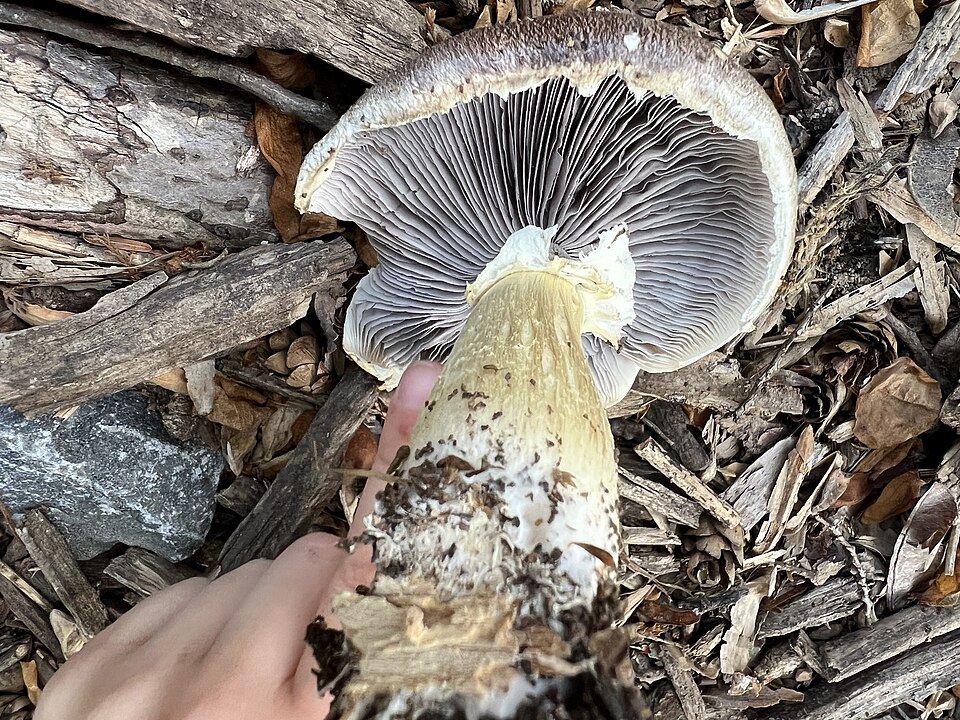
Stropharia rugosoannulata, commonly known as the Wine Cap, King Stropharia, or Garden Giant, is a large wood-chip mushroom with a reddish-brown to wine-colored cap, pale gills that darken with age, and a thick stem with a prominent ring. It is especially common in mulched gardens, wood-chip beds, paths, landscaped areas, and other places rich in buried or surface wood.
This species is popular with gardeners because it can spread through fresh wood chips and sometimes produce very large fruit bodies. The most useful identification pattern is large size, burgundy to reddish-brown cap, dark purplish-brown mature gills, a strong ring, and growth from wood chips or woody mulch.
⚠️ Important: Wine Caps are considered edible when correctly identified and properly cooked, but they should not be identified from cap color alone. Several brown or reddish mushrooms can grow in mulch, so always check the gills, ring, stem, substrate, and mature spore color.
Quick Identification
| Feature | Stropharia rugosoannulata |
|---|---|
| Scientific name | Stropharia rugosoannulata |
| Common names | Wine Cap, King Stropharia, Garden Giant |
| Cap color | Wine-red, reddish-brown, chestnut, tan with age |
| Cap size | Medium to very large |
| Cap surface | Smooth, often moist when fresh |
| Young gills | Pale gray to grayish-lilac |
| Mature gills | Dark purple-brown to nearly blackish-purple |
| Stem | Thick, pale, often robust |
| Ring | Large, persistent, often grooved or toothed |
| Volva | Absent |
| Spore print | Dark purplish-brown |
| Ecology | Saprotrophic |
| Main substrate | Wood chips, mulch, woody debris |
| Season | Spring to autumn, depending on climate |
| Edibility | Edible when correctly identified and cooked |
| Main look-alikes | Leratiomyces ceres, Hypholoma spp., Psilocybe spp., Agrocybe spp., other Stropharia |
What Does Stropharia rugosoannulata Look Like?
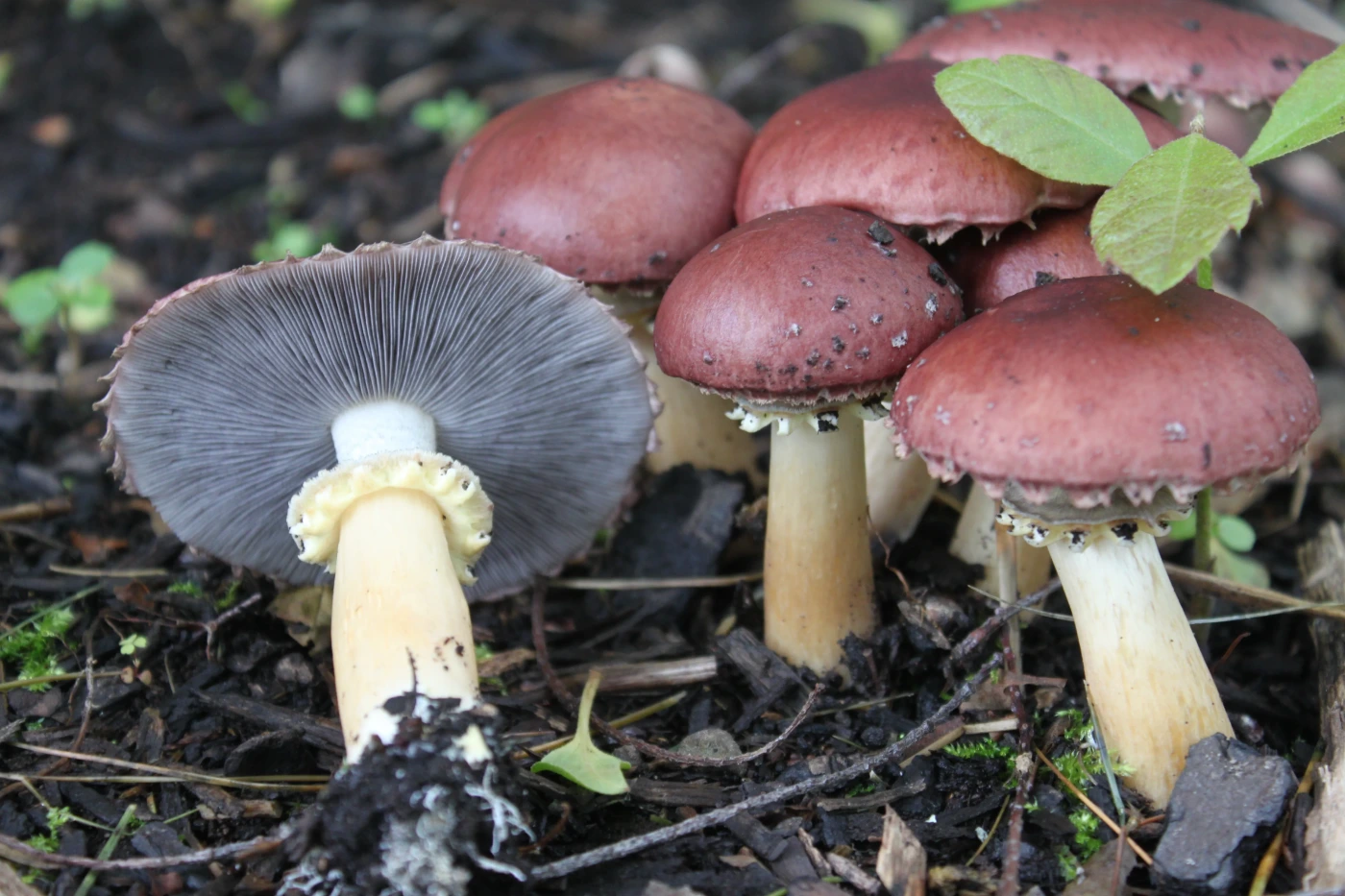
Wine Cap is usually a substantial mushroom with a broad cap and thick stem. Young fruit bodies often have a deep red, reddish-purple, or burgundy cap that becomes paler and browner with age.
Mature specimens can become very large and may look striking in wood-chip beds. The combination of a broad reddish cap, darkening gills, and a strong ring is usually more useful than color alone.
Cap
The cap begins rounded or convex and becomes broadly convex to almost flat with age. Large specimens can expand considerably, especially in moist, nutrient-rich wood-chip beds.
Fresh caps are often burgundy, wine-red, reddish-brown, or deep chestnut. As the mushroom ages or dries, the color may fade toward tan, ochre-brown, or pale brown.
Cap Surface
The cap is usually smooth and can feel slightly moist or greasy in wet weather. It is not normally covered with prominent scales or warts.
Young caps may show pale veil remnants near the edge. These features can disappear quickly as the cap expands.
Gills
Young gills are pale gray, grayish-lilac, or dull purplish-gray. As spores mature, the gills become increasingly dark purple-brown.
This change in gill color is an important feature. A mature Wine Cap should not retain pure white gills.
Stem
The stem is thick, firm, and usually pale cream to whitish. It may become slightly brownish toward the base or where handled.
Large specimens can have impressively robust stems. The overall build often looks heavier than many smaller mulch-growing mushrooms.
Ring
The ring is one of the most important identification features. It is usually broad, persistent, and positioned high on the stem.
The upper surface may show grooves from contact with the gills, while the underside can appear toothed or irregular. This strong ring helps separate Wine Cap from several ringless wood-chip mushrooms.
Flesh
The flesh is pale and relatively thick, especially in the stem and center of the cap. It usually remains whitish when cut and does not show dramatic blue or red bruising.
Older fruit bodies may become softer or waterlogged. Insect damage is also common in large mature specimens.
Smell
The smell is generally mild and mushroom-like. It may have a slightly earthy or radish-like quality, but odor is not usually a strong field character.
A very unusual chemical or strongly unpleasant smell should make you reconsider the identification. Smell is best treated as supporting evidence rather than a decisive feature.
Spore Print
The spore print is dark purplish-brown. This matches the deepening color of the mature gills.
Spore color is useful when comparing Wine Cap with brown-spored or rusty-spored look-alikes. It is especially helpful when the mushroom is old enough for a good print.
Where Does Wine Cap Grow?
Stropharia rugosoannulata is saprotrophic and grows on decomposing woody material. It is especially associated with wood chips, bark mulch, garden paths, landscaped beds, and other human-modified habitats.
The species can also occur around compost, straw mixed with woody material, and buried wood. It does not need to grow directly from a visible log because the feeding substrate may be mixed into the soil.
Wood Chips and Mulch
Fresh or aging wood-chip beds are one of the classic habitats for Wine Cap. The mushrooms may appear in clusters, loose groups, or scattered over a large mulched area.
A productive patch can fruit repeatedly when moisture is sufficient. Large flushes may develop after warm weather followed by rain.
Gardens
Wine Caps are sometimes deliberately introduced into gardens because their mycelium can colonize wood chips. They are especially common around vegetable beds, orchard paths, and mulched borders.
Once established, the fungus may spread through the mulch layer and produce mushrooms for more than one season. The size and number of fruit bodies can vary greatly from year to year.
Parks and Landscaped Areas
The species can also appear in urban parks and commercial landscaping. Municipal mulch beds and recently chipped paths can provide excellent substrate.
This makes Wine Cap one of the more noticeable large mushrooms in human-modified environments. It can sometimes appear far from natural woodland.
Season
Wine Caps can fruit from spring through autumn in temperate climates. The exact season depends on rainfall, temperature, and the condition of the wood-chip substrate.
Spring and early summer flushes can be especially strong in some regions. Additional fruiting may occur later in the year if moisture returns.
Distribution
Stropharia rugosoannulata is widely distributed and has been reported from Europe, North America, and other temperate regions. Its association with landscaping and cultivated wood-chip beds has helped it spread well beyond purely natural habitats.
It is especially common where wood mulch is used extensively. Regional abundance can therefore depend as much on human landscaping practices as on natural forest distribution.
Is Stropharia rugosoannulata Edible?
Wine Cap is widely regarded as edible when correctly identified and properly cooked. Young, firm specimens are usually considered better than large, old fruit bodies.
As with any wild mushroom, accurate identification comes first. Large mulch mushrooms can overlap in color and habitat, so ring structure, gill color, spore print, and substrate should all agree.
Look-Alikes
Several mushrooms can resemble Wine Cap because they also grow in wood chips and develop reddish, brown, or yellow-brown caps. The most useful differences involve ring presence, gill color, spore color, size, and bruising.
Leratiomyces ceres — Redlead Roundhead
Identification
Leratiomyces ceres is a common wood-chip mushroom with a vivid orange-red to brick-red cap. It is usually smaller and more slender than Wine Cap.
The gills begin pale and darken toward purple-brown as the spores mature. Young mushrooms may show veil remnants around the cap margin, but they do not usually develop the same large persistent ring as Stropharia rugosoannulata.
Main Difference
Wine Cap is generally larger, more robust, and has a prominent ring. Leratiomyces ceres is usually smaller, brighter orange-red, and less heavily built.
Hypholoma Species
Identification
Several Hypholoma species grow in clusters on wood or woody debris. Their caps are often yellow, orange-brown, or brick-colored, and the gills darken as spores mature.
Many species lack a strong persistent ring. They also tend to fruit more directly from stumps, logs, or buried wood rather than broad garden mulch beds.
Main Difference
The strong ring and large size of Wine Cap are important clues. Clustered mushrooms with no ring and more yellow or brick-colored caps are more likely to belong to Hypholoma or another wood-decaying group.
Psilocybe Species
Identification
Some Psilocybe species grow in wood chips and produce dark purple-brown spores. They are usually much smaller and more slender than Wine Cap.
Several species may develop blue bruising after damage. Their caps are generally thinner and more hygrophanous, changing color noticeably as they dry.
Main Difference
Wine Cap is much larger, more robust, and has a prominent ring. Blue bruising and a slender build point toward another group.
Agrocybe Species
Identification
Agrocybe species can grow in wood chips, soil, gardens, and disturbed ground. Many have tan to brown caps and some develop a ring.
Their mature gills and spores are brown rather than dark purple-brown. The overall color is usually less wine-red than a fresh young Wine Cap.
Main Difference
Spore color is especially useful. Brown spores favor Agrocybe, while dark purplish-brown spores support Stropharia rugosoannulata.
Other Stropharia Species
Identification
Other Stropharia species can have dark spores and ringed stems. Some are smaller, more colorful, or associated with different habitats.
Exact identification may require careful attention to cap texture, size, ring structure, substrate, and microscopic features. The large size and wood-chip habitat of S. rugosoannulata are especially useful in the field.
Main Difference
Wine Cap is one of the largest and most robust members of the group. Its combination of wine-colored cap, strong ring, dark purple-brown spores, and mulch habitat is highly characteristic.
Wine Cap vs Leratiomyces ceres
| Feature | Stropharia rugosoannulata | Leratiomyces ceres |
|---|---|---|
| Cap color | Wine-red to chestnut | Orange-red to brick-red |
| Size | Medium to very large | Small to medium |
| Build | Thick and robust | More slender |
| Ring | Large and persistent | Weak, absent, or veil remnants |
| Mature gills | Dark purplish-brown | Purple-brown |
| Habitat | Wood-chip beds and mulch | Wood chips and mulch |
| Best clue | Large size + strong ring | Smaller bright red-orange cap |
Both species can occur in the same general type of landscaping. Ring structure and overall proportions are usually more useful than cap color alone.
Wine Cap vs Agrocybe
| Feature | Wine Cap | Agrocybe |
|---|---|---|
| Young cap | Wine-red to reddish-brown | Tan to brown |
| Mature spores | Dark purplish-brown | Brown |
| Ring | Usually strong | Variable |
| Size | Often large | Usually smaller |
| Substrate | Wood chips, mulch | Soil, wood chips, disturbed ground |
| Best clue | Purple-brown spores | Brown spores |
The two groups can overlap in gardens and landscaped areas. A spore print can quickly make the comparison easier.
How to Identify Wine Cap Step by Step
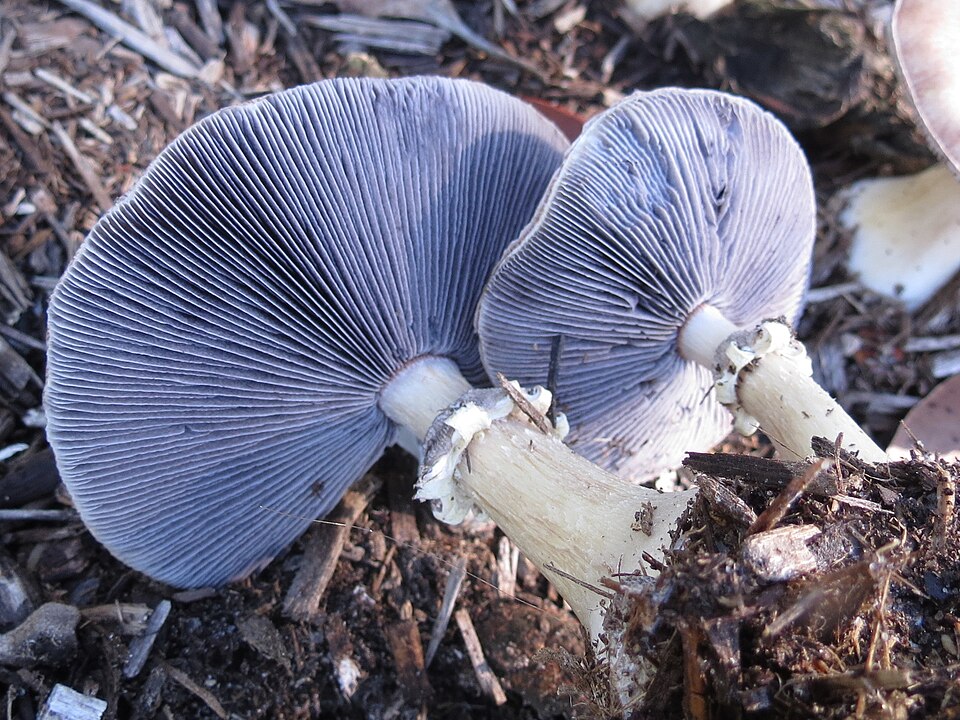
The best approach is to start with substrate and overall size. Then check the ring and mature gills before relying on cap color.
Step 1: Check the Substrate
Look for wood chips, bark mulch, buried woody debris, or compost mixed with wood. Wine Cap strongly favors these rich saprotrophic habitats.
A large mushroom growing only from undisturbed forest soil deserves a different comparison. The presence of visible or buried wood is important supporting evidence.
Step 2: Examine the Cap
Look for a smooth wine-red, burgundy, reddish-brown, or chestnut cap. Remember that older specimens may fade considerably toward tan.
Cap color is most useful in fresh young mushrooms. Weathered specimens can lose much of the classic wine coloration.
Step 3: Check the Ring
Look for a broad persistent ring high on the stem. This is one of the strongest field characters for the species.
A completely ringless mushroom should make you reconsider the identification. Damage can sometimes reduce the ring, but a mature Wine Cap usually shows clear veil structure.
Step 4: Look at Mature Gill Color
Young gills should be pale gray to grayish-lilac, while mature gills become dark purplish-brown. White mature gills do not fit Wine Cap.
The gill color should match the expected dark spore print. This feature helps distinguish the species from several pale-spored mushrooms.
Step 5: Consider the Whole Mushroom
A strong candidate should combine a large robust body, reddish-brown cap, dark purple-brown mature gills, broad ring, and wood-chip habitat. When all these features occur together, the identification becomes much stronger.
Do not rely on a single feature. Mulch habitats can contain several unrelated mushrooms at the same time.
How to Photograph Wine Cap for Identification
Take one wide photograph that shows the mushroom together with the wood-chip or mulch substrate. Habitat is especially valuable for this species because it frequently fruits in human-created beds.
Then photograph the cap, underside, full stem, and ring. A mature specimen with dark gills is particularly useful because the spore color becomes much easier to judge.
Can AI Identify Stropharia rugosoannulata?
AI can often recognize a typical mature Wine Cap when size, cap color, ring, and wood-chip habitat are visible. A single photograph of the cap is much less reliable because several mulch mushrooms share similar reddish-brown colors.
A photo set that includes the underside and full stem greatly improves identification. Showing the substrate also helps separate Wine Cap from similar mushrooms growing directly on logs or soil.
Common Identification Mistakes
One common mistake is identifying every large red-brown mushroom in mulch as Wine Cap. Wood-chip beds can contain Leratiomyces, Agrocybe, Hypholoma, Psilocybe, and other genera.
Another mistake is ignoring the ring. A strong persistent ring is one of the most useful characteristics of Stropharia rugosoannulata and should be checked carefully.
The third mistake is judging old specimens by cap color. Mature Wine Caps can fade so strongly that the original wine-red tone is almost completely lost.
Interesting Facts
Wine Cap is sometimes intentionally cultivated in garden wood-chip beds. Its mycelium can spread through mulch while helping decompose woody material.
The mushroom can become remarkably large under favorable conditions. This explains the alternative common name “Garden Giant,” which is especially appropriate for mature specimens.
Its ability to colonize landscaped habitats has made it much more visible to people than many forest fungi. A productive patch may appear beside vegetable beds, paths, parks, or even commercial landscaping.
The dark spore color is also useful visually because it can leave purplish-brown deposits on the ring or nearby mushrooms. These deposits can provide an additional clue even without making a formal spore print.
Frequently Asked Questions
Can Wine Caps lose their red color?
Yes. Older caps can fade from wine-red or burgundy to tan, ochre, or ordinary brown. Color is therefore most useful on fresh young fruit bodies.
Can Wine Caps grow without visible wood chips?
Yes, because woody material may be buried under soil or grass. If the mushroom appears terrestrial, check whether the site was previously mulched or landscaped.
Can they grow in vegetable gardens?
Yes. Wood-chip paths and mulched beds around vegetables can provide excellent habitat. The fungus feeds on decaying woody material rather than the vegetables themselves.
Can Wine Caps grow in large groups?
Yes. A well-established patch can produce many fruit bodies across a broad area. Individual mushrooms may appear scattered or in loose clusters.
Do the gills start purple?
Not usually. Young gills are typically pale gray or grayish-lilac and darken as the spores mature.
Is the ring always obvious?
It is usually strong and persistent, but weather and physical damage can alter it. Looking at several mushrooms in the same patch can make identification easier.
Can Wine Caps appear in spring?
Yes. Spring fruiting is common in some climates, especially after wet weather and mild temperatures. Additional flushes may appear later in the season.
Can they return to the same mulch bed?
Yes. If the mycelium remains active and enough woody substrate is available, the fungus may fruit again in later seasons.
Final Identification Notes
Stropharia rugosoannulata is best recognized by the combination of a large robust body, wine-red to reddish-brown cap, dark purplish-brown mature gills, broad persistent ring, and growth from wood chips or woody mulch. Older specimens can fade substantially, so substrate, ring structure, and gill color are more reliable than cap color alone.
The most useful comparisons are Leratiomyces ceres, Agrocybe species, Hypholoma species, and smaller dark-spored wood-chip mushrooms. A strong ring and large size usually make Wine Cap stand out from most of them.
The practical field pattern is: wood chips + large burgundy-brown cap + broad ring + dark purple-brown gills = strong Stropharia rugosoannulata candidate.
Upload a photo and get possible matches in seconds.