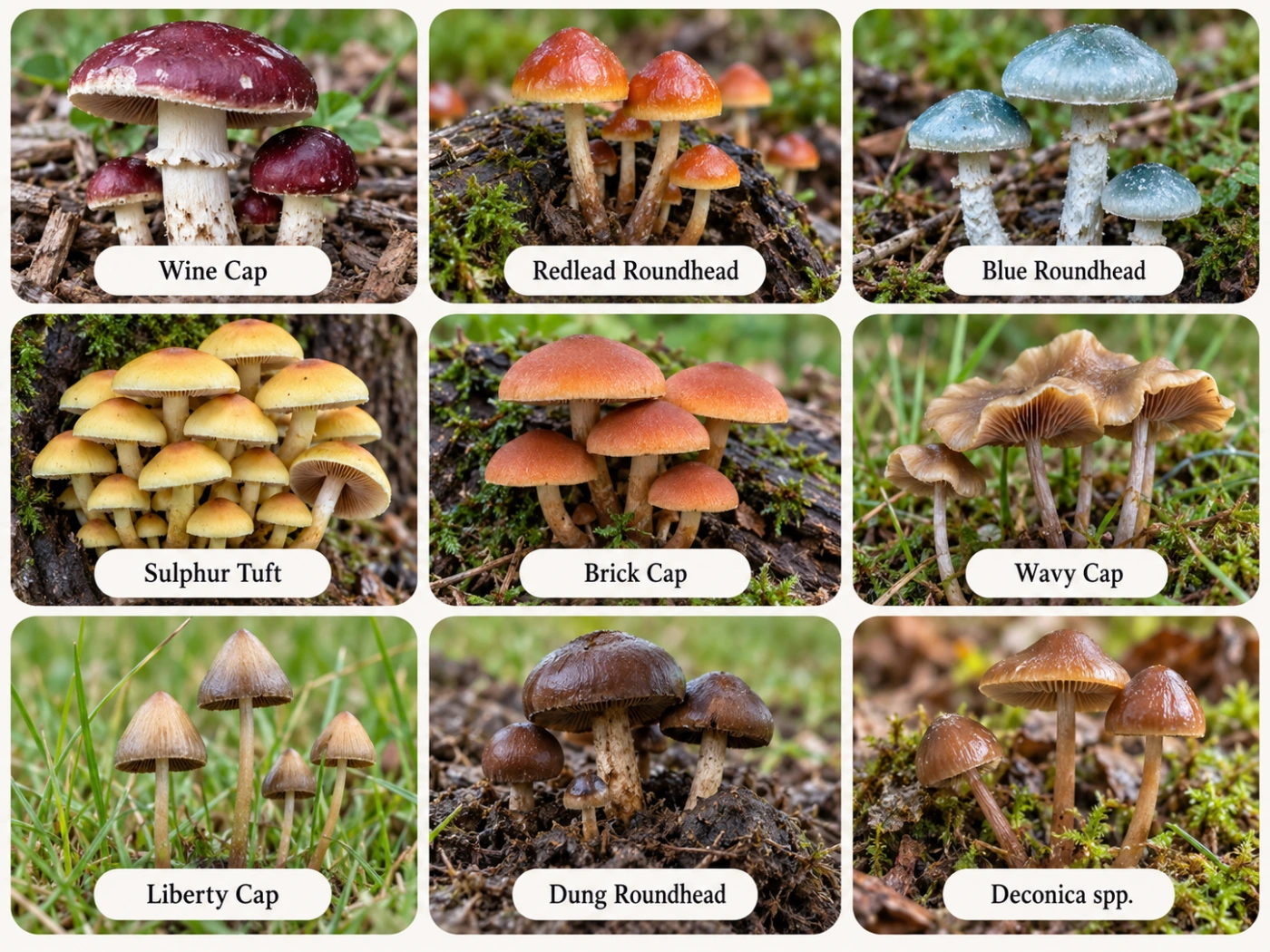
Purple-brown gills are an important clue in several groups of dark-spored mushrooms. The color usually develops as violet-brown, chocolate-purple, or nearly black spores mature and accumulate on the gill surfaces.
This feature is especially common in mushrooms growing on wood chips, mulch, dead wood, grass, and disturbed soil. Purple-brown gills are useful for narrowing the possibilities, but they do not identify a mushroom by themselves because several unrelated genera can develop similar mature colors.
⚠️ Important: Young mushrooms may have pale gray, cream, yellowish, or almost white gills before the spores mature. Mature specimens and a spore print are therefore much more informative than gill color in very young mushrooms.
Quick Identification
| Mushroom | Scientific name | Typical habitat | Main clue |
|---|---|---|---|
| Wine Cap | Stropharia rugosoannulata | Wood chips, mulch | Large, strong ring |
| Redlead Roundhead | Leratiomyces ceres | Wood chips, mulch | Orange-red cap |
| Blue Roundhead | Stropharia caerulea | Grass, parks, disturbed soil | Blue-green cap |
| Sulphur Tuft | Hypholoma fasciculare | Dead wood | Yellow clusters |
| Brick Cap | Hypholoma lateritium | Dead hardwood | Brick-red clustered caps |
| Wavy Cap | Psilocybe cyanescens | Wood chips | Wavy cap, blue bruising |
| Liberty Cap | Psilocybe semilanceata | Grassland | Small pointed cap |
| Dung Roundhead | Protostropharia semiglobata | Dung-rich grassland | Slimy yellow cap |
| Deconica | Deconica spp. | Wood debris, moss, organic matter | Small dark-spored species |
Why Do Gills Turn Purple-Brown?
In many dark-spored mushrooms, the original gill tissue is much paler than the mature gills appear. As thousands of spores develop, their color gradually covers the surface and changes the overall appearance.
This is why mushrooms from the same patch can have different gill colors. Young fruit bodies may still look pale-gilled while older specimens have already become deep violet-brown.
Purple-Brown, Chocolate-Brown, or Rusty-Brown?
Distinguishing these colors can immediately narrow the identification. Purple-brown spores are common in groups such as Stropharia, Psilocybe, and several related genera, while Agaricus usually develops warmer chocolate-brown spores.
Rusty or cinnamon-brown spores point toward groups such as Cortinarius and Galerina. The distinction can be subtle in poor light, so a spore print is much more dependable than judging the gills from a photograph.
Spore Print
A dark purple-brown or purple-black spore print is one of the most useful characters in this group. It confirms that the dark color of mature gills is connected with similarly colored spores rather than simply aging tissue.
Using both a white and dark background can make the shade easier to judge. This is especially helpful when trying to separate dark purple-brown spores from ordinary brown or rusty spores.
Where Do Purple-Brown-Gilled Mushrooms Grow?
These mushrooms occur in several distinct habitats. Some are strongly associated with wood chips and landscaping, while others grow directly from dead wood or in open grassland.
Habitat is particularly valuable because species with similar gills can live in very different places. A large ringed mushroom in garden mulch belongs in a very different comparison from a tiny pointed mushroom in pasture.
Wood Chips and Mulch
Mulched gardens and landscaped beds can support a surprising number of dark-spored species. Wine Cap, Redlead Roundhead, Wavy Cap, and several smaller mushrooms may all occur in the same type of habitat.
The wood may be fresh, partly decomposed, or buried beneath soil. This explains why some mushrooms appear to grow directly from the ground even though their mycelium is actually feeding on woody material below.
Dead Wood
Species of Hypholoma commonly grow in clusters from stumps, logs, buried roots, and other decaying wood. Their fruit bodies may form dense groups containing mushrooms at several different stages of development.
Buried roots can make the substrate difficult to see. A cluster that appears terrestrial may still be growing from dead wood beneath the soil.
Grassland
Some purple-brown-spored mushrooms are typical of grassland rather than wood. Liberty Caps and Protostropharia species are examples of dark-spored mushrooms that may occur in pastures and other open habitats.
The details of the habitat still matter. Liberty Caps are associated with grassland but do not normally grow directly from dung, while Protostropharia semiglobata is commonly found in dung-rich ground.
Common Mushrooms With Purple-Brown Gills
Several widespread species make useful reference points when identifying mushrooms with dark mature gills. Their cap shape, substrate, size, and veil structures usually provide clearer differences than gill color itself.
Stropharia rugosoannulata — Wine Cap
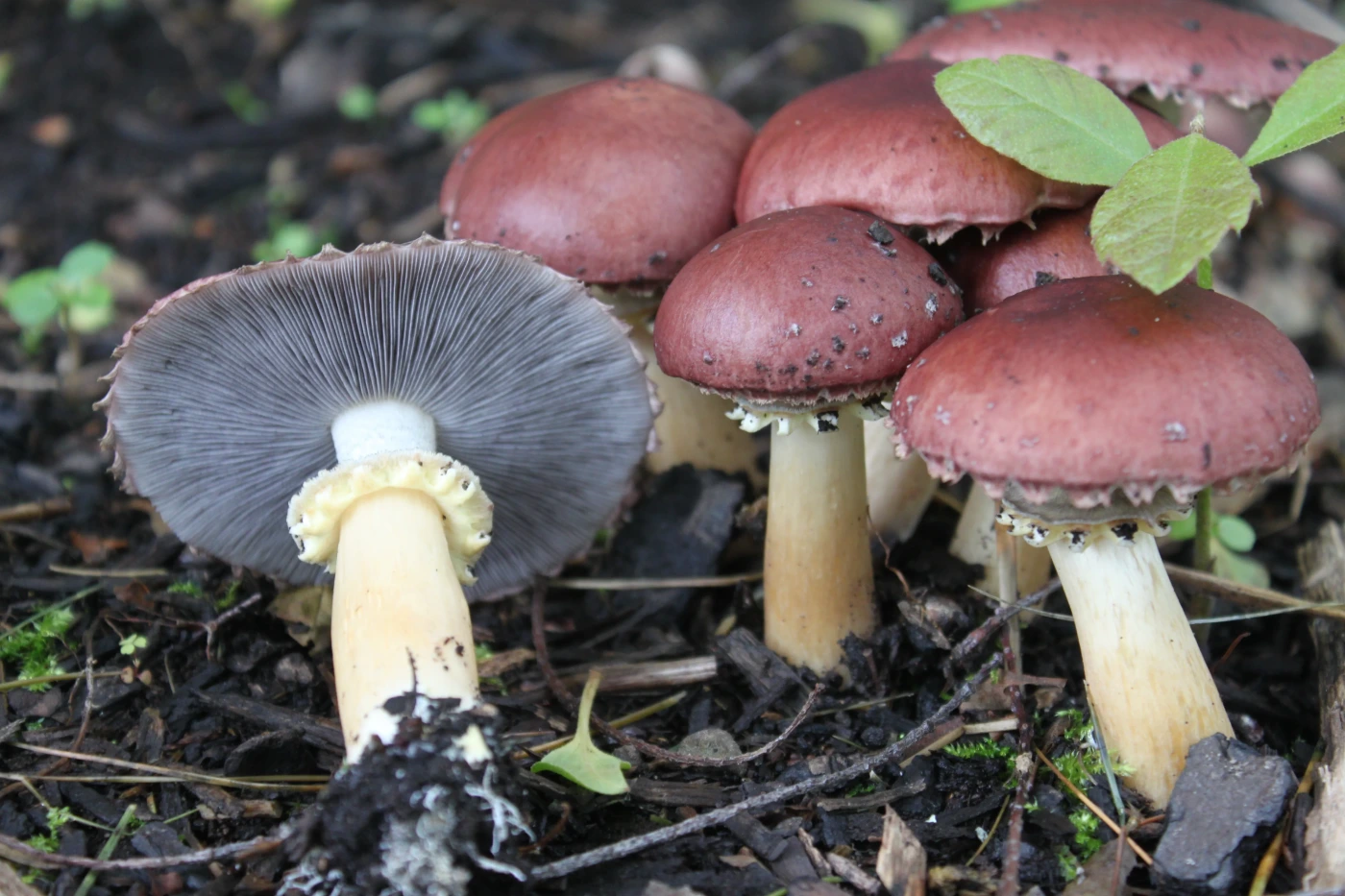
Wine Cap is a large, robust mushroom commonly found in garden mulch and wood-chip beds. Fresh caps can be burgundy, wine-red, chestnut, or reddish-brown, although older specimens often fade considerably.
The gills begin grayish and become deep purple-brown as the mushroom matures. A thick pale stem and broad persistent ring are among the best field characters.
Best Clues
The combination of large size, wood-chip habitat, and a prominent ring makes Wine Cap easier to recognize than most smaller dark-spored mulch mushrooms. Cap color is useful on young specimens but becomes much less reliable after fading.
Leratiomyces ceres — Redlead Roundhead
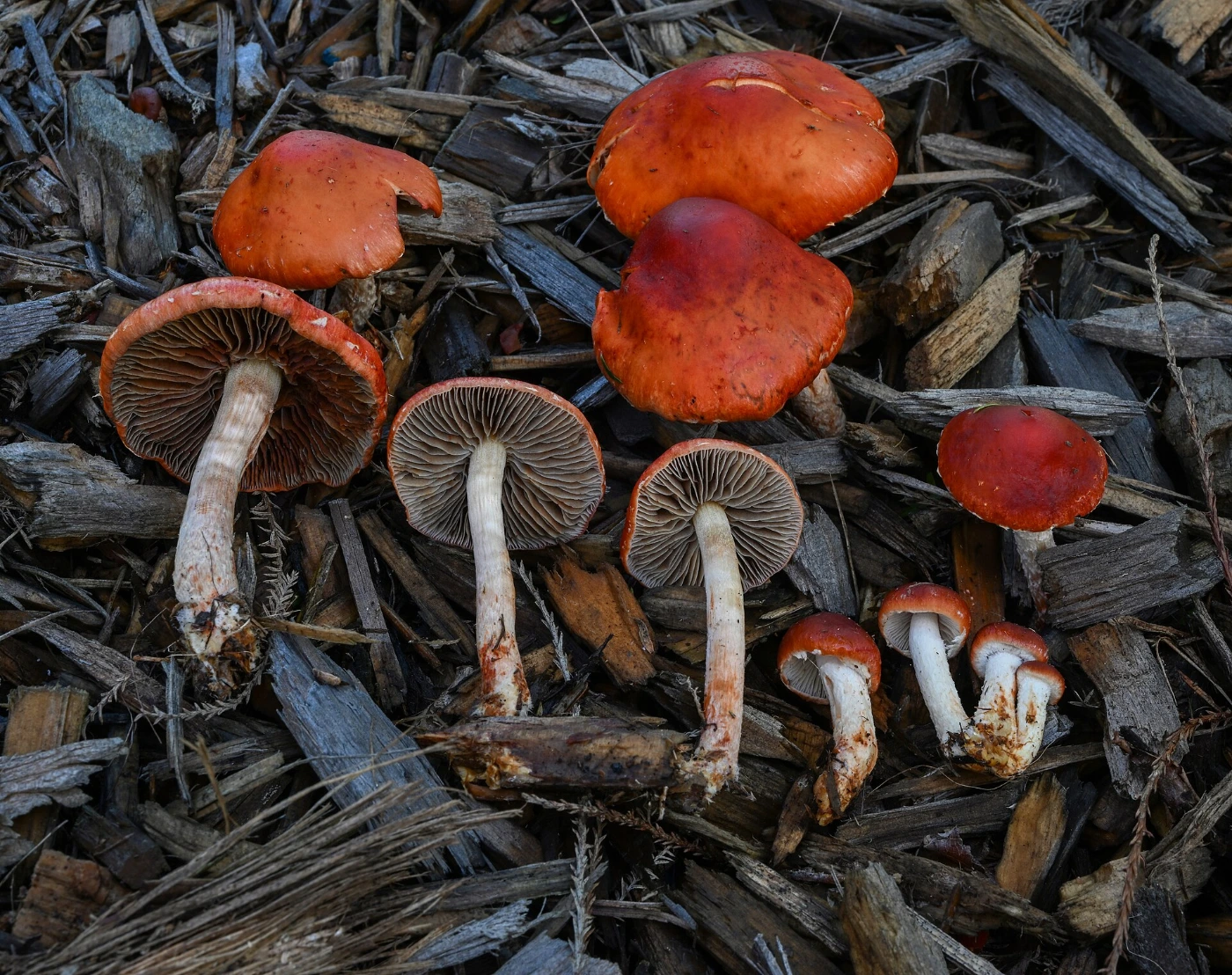
Leratiomyces ceres is a smaller wood-chip mushroom with a vivid orange-red or brick-red cap. It can appear in large numbers in landscaped beds after wet weather.
Its gills darken toward purple-brown as the spores mature. Young specimens may show pale veil fragments around the margin, but they lack the large persistent ring typical of Wine Cap.
Best Clues
The bright orange-red cap, relatively small size, and mulch habitat form a useful combination. Mature fruit bodies are generally much more slender than Stropharia rugosoannulata.
Stropharia caerulea — Blue Roundhead
Blue Roundhead has a blue-green to turquoise cap when fresh. The color can fade toward greenish, yellowish, or brown as the mushroom ages.
The cap is often sticky or slimy in wet weather, while the mature gills become purple-brown. Veil remnants may form a weak ring zone on the stem.
Best Clues
Fresh blue-green coloration is the most striking feature. Older faded specimens become harder to recognize, so cap texture and dark spore color become more useful.
Hypholoma fasciculare — Sulphur Tuft
Sulphur Tuft grows in dense clusters on dead wood and has bright sulphur-yellow caps with darker centers. Young gills may have a yellow-green or olive tone before becoming much darker at maturity.
The species is poisonous and commonly causes gastrointestinal symptoms. It lacks the broad persistent ring seen in Wine Cap.
Best Clues
Dense clustered growth and strong yellow coloration are more useful than the mature gill color. The greenish tone of young gills can also help distinguish it from many other dark-spored wood mushrooms.
Hypholoma lateritium — Brick Cap
Brick Cap usually grows in clusters from dead hardwood and buried roots. Its cap has a brick-red or reddish-brown center surrounded by a paler margin.
The gills begin grayish and become darker brown to purplish-brown as spores mature. Mature clusters can contain both pale young specimens and much darker older mushrooms.
Best Clues
The brick-red cap center and clustered growth on hardwood provide the clearest field pattern. This combination separates it from the brighter yellow Sulphur Tuft.
Psilocybe cyanescens — Wavy Cap
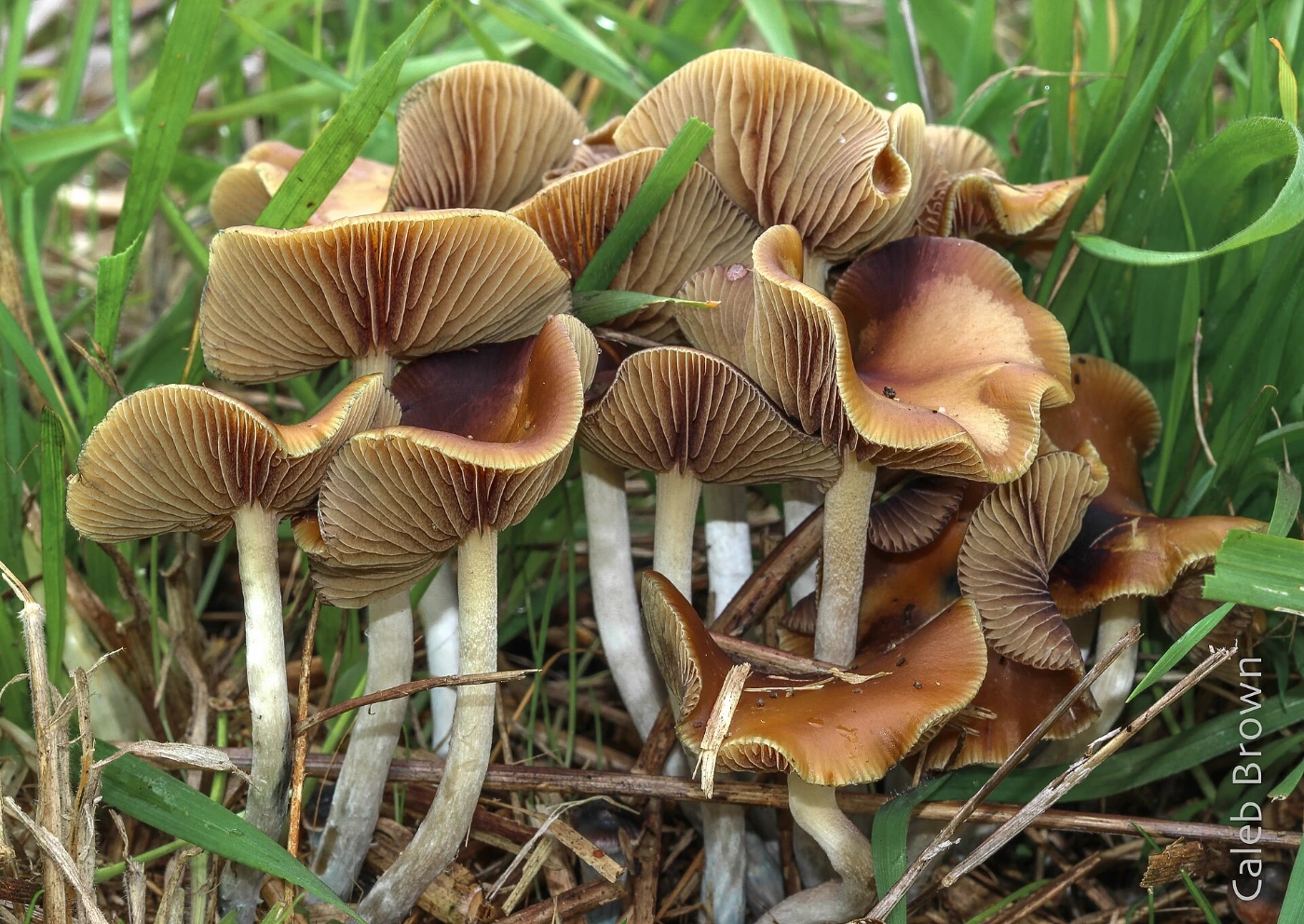
Psilocybe cyanescens is a relatively small mushroom associated especially with wood chips and woody debris. Mature caps often develop a conspicuously wavy edge and can fade dramatically as they dry.
The spores are dark purple-brown, and damaged tissue may develop blue staining. The cap is commonly caramel-brown when moist and much paler after drying.
Best Clues
The combination of a wavy mature cap, wood-chip habitat, and blue bruising is useful. Small brown mulch mushrooms remain difficult to identify safely from a single photograph, so several features should agree.
Psilocybe semilanceata — Liberty Cap
Liberty Cap is a small grassland mushroom with a narrow bell-shaped or conical cap. A distinct pointed papilla is commonly visible at the top.
The stem is slender and flexible, while the mature gills become dark gray-brown to purple-brown. Its proportions are completely different from large mulch species such as Wine Cap.
Best Clues
The small pointed cap and open grassland habitat are the most useful characters. Gill color mainly supports an identification already suggested by the mushroom’s shape and ecology.
Protostropharia semiglobata — Dung Roundhead
This small grassland mushroom usually has a smooth yellowish or straw-colored cap. Fresh caps and stems can be noticeably slimy.
The gills become dark purple-brown with maturity, and the species often occurs around dung or in heavily grazed ground. Its rounded cap lacks the prominent pointed shape of Liberty Cap.
Best Clues
A slimy hemispherical cap combined with dung-rich grassland is the strongest field pattern. Its mature spore color helps confirm placement among dark-spored mushrooms.
Deconica Species
Deconica includes small dark-spored mushrooms growing on woody debris, plant remains, moss, and other organic substrates. Many are visually inconspicuous and can resemble numerous other small brown mushrooms.
Species-level identification often requires microscopic characters. In photographs, genus or group-level identification may be more realistic than forcing an exact species name.
How to Narrow the Identification
Once mature purple-brown gills are confirmed, substrate is usually the fastest way to reduce the possibilities. Large mushrooms in mulch, clustered mushrooms on dead wood, and tiny mushrooms in grass belong to very different groups.
After habitat, examine ring or veil structures, overall size, cap texture, and any distinctive bruising. A spore print can then confirm whether the spores are truly purple-brown rather than rusty or chocolate-brown.
Look-Alikes
Several common mushrooms can have mature gills that appear similar in poor lighting. Their spore colors and veil structures usually provide better separation than subtle shades of brown.
Agaricus Species
Identification
Agaricus mushrooms commonly have pink gills when young, which gradually become dark chocolate-brown. Many species have a clear stem ring and grow in lawns, woodland, gardens, or disturbed ground.
Their mature gills can appear almost purple in some lighting. A brown spore print and the characteristic pink-to-chocolate progression are more useful than a photograph of the mature gills alone.
Main Difference
Young pink gills strongly support Agaricus. Purple-brown-spored groups such as Stropharia generally do not show the same classic pink-to-chocolate sequence.
Cortinarius Species
Identification
Cortinarius contains many woodland mushrooms with brown, purple, orange, or gray caps. Young specimens often have a cobweb-like cortina between the cap and stem rather than a normal ring.
As spores mature, the gills turn rusty or cinnamon-brown. These mushrooms are mycorrhizal and usually grow on soil near living trees.
Main Difference
A rusty spore print and woodland tree association point toward Cortinarius. Purple-brown-spored mulch mushrooms usually have a darker, cooler-colored print.
Galerina Species
Identification
Galerina species are often small brown mushrooms growing on wood, moss, or woody debris. Their spores develop rusty to cinnamon-brown colors rather than a true dark purple-brown.
Some species are dangerously poisonous, including Galerina marginata. Small brown mushrooms on wood therefore deserve particularly careful identification.
Main Difference
The rusty-brown spore print is the strongest distinction. Cap color alone is unreliable because Galerina can overlap strongly with other small wood-growing mushrooms.
Common Identification Mistakes
One frequent mistake is treating every dark mature gill as evidence of black spores. Brown, chocolate, rusty, and purple-brown spores can all make the underside appear nearly black in poor light.
Another mistake is comparing mushrooms of different ages as though gill color were fixed. Young and mature fruit bodies from the same mycelium can look strikingly different.
A third problem is overusing the label Psilocybe for small brown mushrooms in wood chips. Mulch habitats contain many unrelated species, including some potentially dangerous look-alikes.
How to Photograph Purple-Brown-Gilled Mushrooms
A useful identification set should show the cap, mature gills, complete stem, and substrate. Including several specimens of different ages can reveal how the gills and cap change during development.
Photographs of the surrounding habitat are also valuable. Wood chips, dead logs, grassland, and dung-rich soil can be more informative than subtle differences in cap shade.
Can AI Identify Mushrooms With Purple-Brown Gills?
AI can often narrow a mushroom to a dark-spored group when the habitat and complete fruit body are visible. Exact identification becomes less reliable with very small brown mushrooms because many genera share similar shapes and colors.
Spore-print color and information about bruising can greatly improve the result. A cap-only photograph usually removes too many of the distinguishing characters.
Interesting Facts
Purple-brown gills often become visible only shortly before or during spore maturity. The change can therefore make a mushroom look like a completely different species over only a few days.
Modern wood-chip landscaping has also created extensive habitat for several dark-spored fungi. Some species have become common in urban parks and gardens because suitable woody substrate is repeatedly added.
Spore-print color remains valuable even in the era of DNA-based fungal taxonomy. It is one of the quickest field characters for separating mushrooms that otherwise share almost identical cap shapes and habitats.
Frequently Asked Questions
Are purple-brown gills a sign that a mushroom is poisonous?
No. Dark gill color does not indicate whether a mushroom is edible or poisonous. Both harmless and toxic species can produce purple-brown spores.
Can young mushrooms have pale gills even if the mature gills are purple-brown?
Yes. Gill color can change dramatically as spores develop, and young specimens may initially look cream or gray. Mature fruit bodies are generally more informative.
Are purple-brown gills the same as black gills?
No. Very dark purple-brown gills can look black, particularly in shade or photographs. A spore print reveals the underlying color much more clearly.
Why do mushrooms in one cluster sometimes have different gill colors?
They are usually at different stages of maturity. Older mushrooms have accumulated more dark spores on their gills than younger ones.
Can purple-brown-spored mushrooms grow in lawns?
Yes. Some species occur in grassland or lawns, while others are strongly tied to wood chips or dead wood. Habitat remains one of the quickest ways to separate the groups.
Can spore color identify the exact species?
Usually not. Spore color narrows the possibilities, but several genera and many species can share a similar purple-brown print.
Final Identification Notes
Purple-brown mature gills are common in groups including Stropharia, Leratiomyces, Hypholoma, Psilocybe, Protostropharia, and Deconica. The color is most useful as a group-level clue rather than as a species-level identification.
The fastest practical approach is to determine where the mushroom grows and what its overall structure looks like, then confirm the dark spore color. A large ringed mushroom in mulch, a yellow cluster on a stump, and a tiny pointed grassland mushroom may all have purple-brown spores but are otherwise very different.
Upload a photo and get possible matches in seconds.