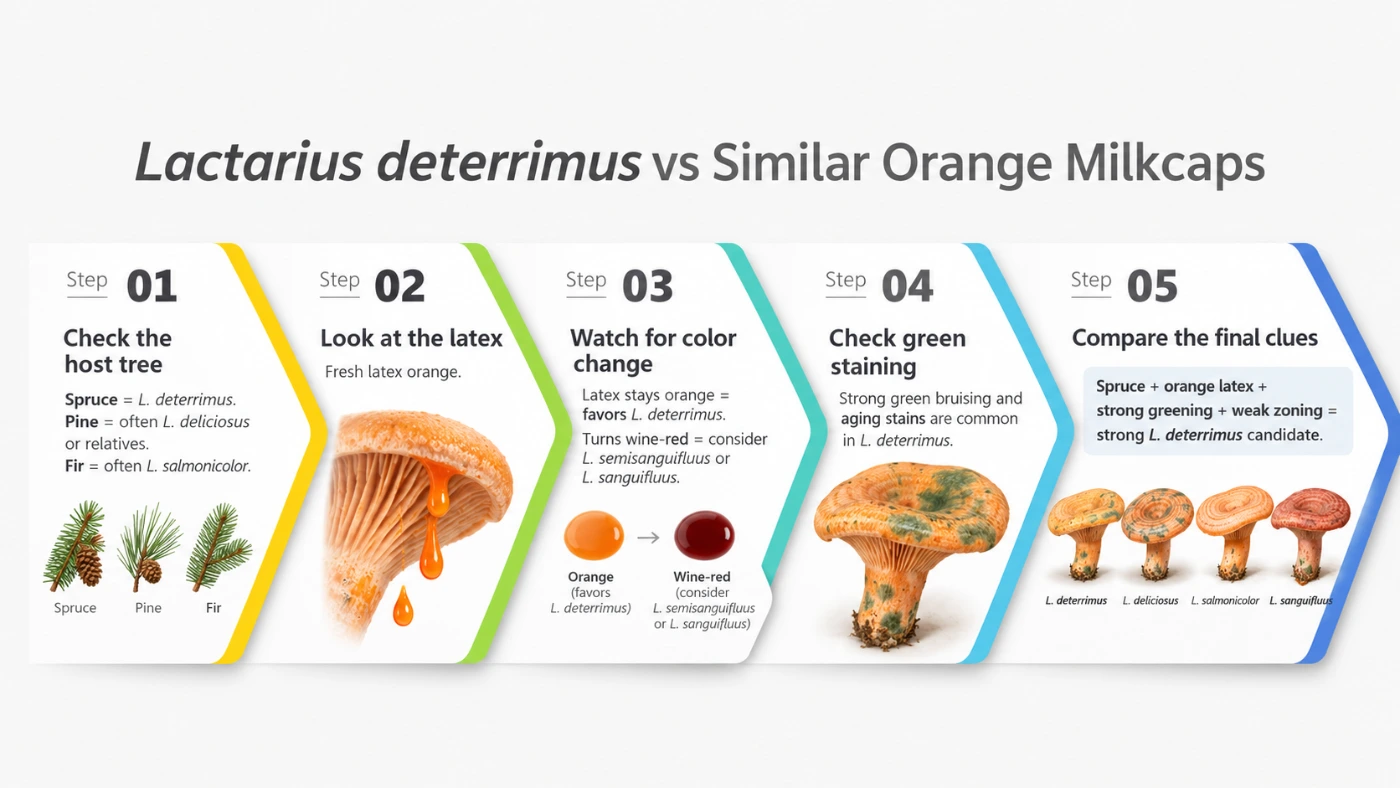
Lactarius deterrimus, commonly known as the False Saffron Milk Cap, belongs to a group of orange milkcaps that can be extremely difficult to separate by appearance alone. Many of these mushrooms share orange caps, orange or reddish latex, decurrent gills, and green staining after damage.
The most useful clues are usually host tree, latex color and how it changes, cap zoning, stem markings, and the intensity of green staining. For Lactarius deterrimus, the strongest field clue is its close association with spruce.
⚠️ Important: Orange latex does not automatically mean that a milkcap is safe to eat. Several closely related species overlap strongly in appearance, so identification should combine the mushroom itself with habitat, host tree, geography, and latex behavior.
Quick Comparison
| Species | Main host | Latex | Green staining | Cap zoning | Best clue |
|---|---|---|---|---|---|
| Lactarius deterrimus | Spruce | Orange | Often strong | Usually weak to moderate | Spruce + heavy greening |
| Lactarius deliciosus | Pine | Orange | Usually moderate | Often clearer | Pine + zoned cap |
| Lactarius salmonicolor | Fir | Orange | Usually weak | Often subtle | Fir association |
| Lactarius sanguifluus | Pine | Red to wine-red | Variable | Variable | Red latex |
| Lactarius semisanguifluus | Pine | Orange, then wine-red | Often strong | Variable | Latex changes red |
| Lactarius quieticolor group | Pine | Orange | Moderate to strong | Often visible | Darker muted cap + pine |
What Does Lactarius deterrimus Look Like?
Lactarius deterrimus is an orange to salmon-orange milkcap with decurrent gills and orange latex. It often develops extensive green staining on the cap, gills, stem, and damaged tissue as the fruit body ages.
The cap may show concentric zones, but they are often less distinct than in typical Lactarius deliciosus. The stem is usually orange to pale orange and may show small spots, although strong scrobiculation is often less obvious than in some related species.
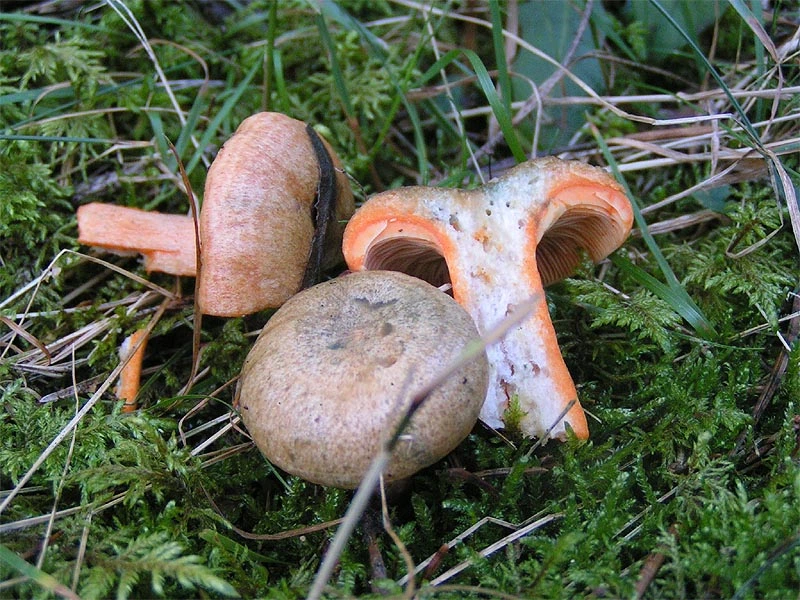
The Importance of Spruce
Spruce association is one of the strongest clues for Lactarius deterrimus. In Europe, the species is especially linked with spruce rather than pine or fir.
This ecological relationship is extremely useful because several similar milkcaps are associated with different conifers. A visually similar mushroom under pine or fir deserves a different comparison before being called L. deterrimus.
Cap
The cap is usually orange, salmon-orange, carrot-orange, or orange-brown. It begins convex and often develops a central depression as the mushroom expands.
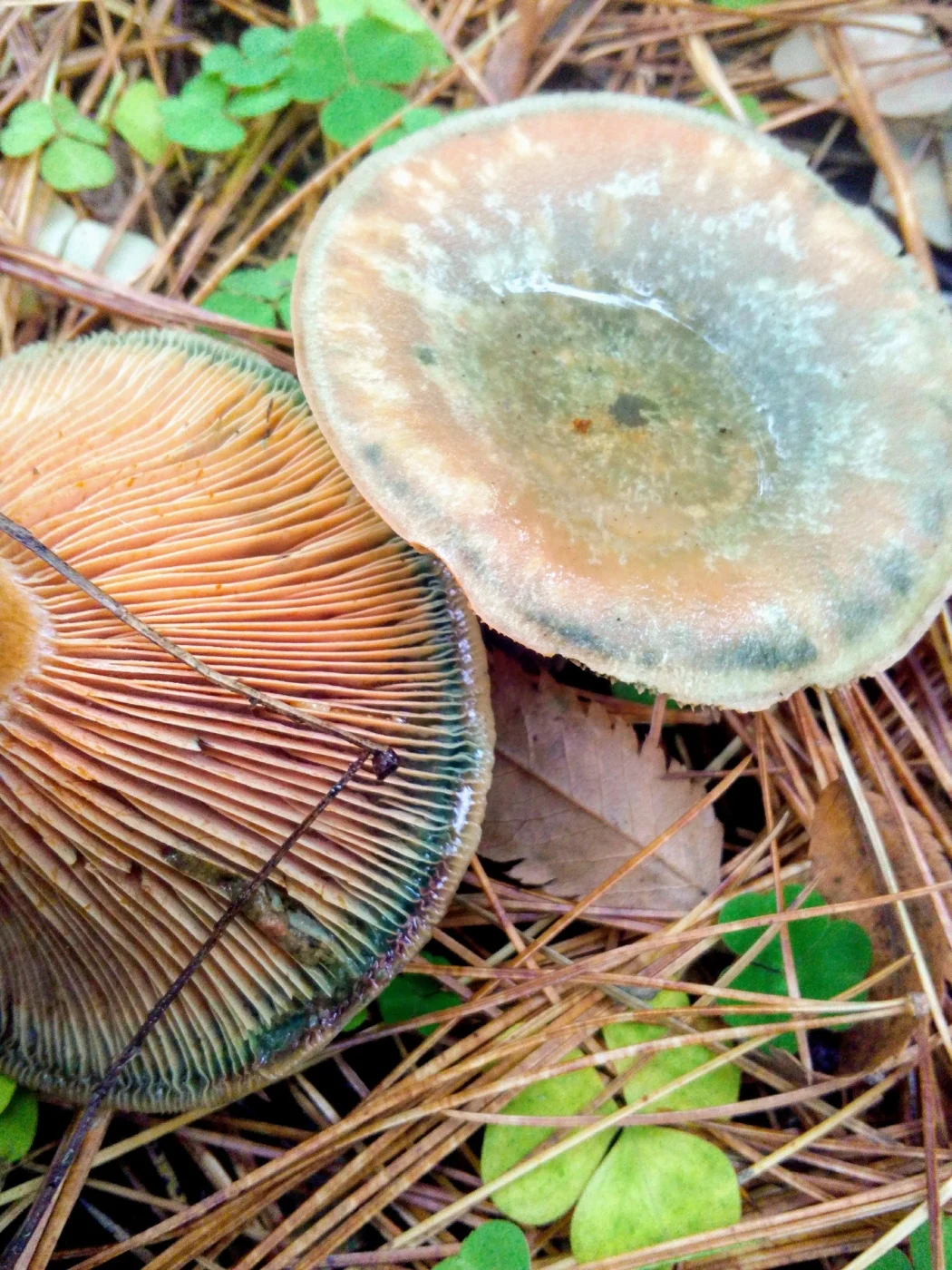
Concentric rings may be visible, but they are frequently weak, irregular, or partly hidden by green discoloration. Older fruit bodies can become heavily mottled with blue-green or dark green patches.
Gills
The gills are orange to salmon-colored and run down the stem. Fresh damage usually releases orange latex from the gills and nearby flesh.
Green discoloration often develops after bruising or with age. The reaction can become particularly strong in mature specimens and is one of the most noticeable features of the species.
Latex
Fresh latex is orange and is easiest to observe by scratching or cutting the gills. Dry or old mushrooms may release much less liquid, so younger specimens are more useful for this test.
Unlike some related species, the latex does not typically change rapidly from orange to deep red or wine-red. A clear red color change points toward another member of the saffron milkcap group.
Stem
The stem is usually orange to pale orange and can become hollow with age. It may show scattered darker spots or shallow pits, but these are often less pronounced than in typical Lactarius deliciosus.
Green staining may develop on damaged areas of the stem. In older specimens, large green patches can obscure the original orange color almost completely.
Flesh
The flesh is pale orange to whitish and may become green where damaged. It has the brittle texture typical of milkcaps and other members of Russulaceae.
The flesh releases colored latex rather than remaining dry like a Russula. This helps confirm that the mushroom belongs to the milkcap group.
Habitat
Lactarius deterrimus grows in spruce woodland, spruce plantations, mixed forests containing spruce, and mossy conifer habitats. It is mycorrhizal and therefore depends on living tree roots rather than decomposing litter as its primary food source.
The mushroom may appear among moss, needles, grass, or low vegetation. In mixed woodland, identifying the nearby trees carefully is especially important because pine-associated orange milkcaps may occur only a short distance away.
Season
Fruiting usually occurs from summer through autumn. Wet periods can trigger substantial flushes, particularly in cool spruce forests.
The exact season varies with altitude, latitude, and local weather. In mild years, mushrooms may continue appearing well into late autumn.
Distribution
Lactarius deterrimus is widespread in Europe and other parts of Eurasia where spruce is present. Its distribution largely follows suitable spruce habitats.
Outside Europe, closely related orange milkcaps may represent different taxa. A North American mushroom should therefore not automatically be assigned a European name simply because it looks similar.
Is Lactarius deterrimus Edible?
Lactarius deterrimus is eaten in some European traditions when correctly identified and properly prepared. It is often considered less desirable than Lactarius deliciosus, particularly because older specimens can have poorer texture and flavor.
Edibility should never be decided from orange latex alone. Exact identification remains important because the saffron milkcap group contains several similar regional species.
Look-Alikes
The closest look-alikes are other orange or reddish milkcaps in the saffron milkcap group. Host tree and latex behavior usually provide stronger evidence than subtle differences in cap shade.
Lactarius deliciosus — Saffron Milk Cap
Identification
Lactarius deliciosus is one of the best-known orange milkcaps. It has an orange cap that often shows clearer concentric zoning, orange decurrent gills, orange latex, and an orange stem that may show distinct pits.
It is strongly associated with pine. Green staining can occur, especially after damage or with age, but it is often less extensive than in L. deterrimus.
Main Difference
The host tree is the most useful difference. Pine favors L. deliciosus, while spruce strongly favors L. deterrimus.
Cap pattern provides additional support. L. deliciosus often has more obvious concentric rings and stronger stem pitting.
Lactarius salmonicolor — Salmon Milkcap
Identification
Lactarius salmonicolor has a salmon-orange to peach-orange cap and orange latex. It often looks cleaner and more uniformly colored than heavily green-stained L. deterrimus.
This species is strongly associated with fir. Green discoloration may occur, but it is generally much less dramatic.
Main Difference
Fir association is the strongest clue. An orange milkcap under fir should make L. salmonicolor a leading candidate rather than L. deterrimus.
The reduced tendency to green also helps. A fresh salmon-colored milkcap that stays relatively clean-looking fits L. salmonicolor better.
Lactarius sanguifluus — Bloody Milkcap
Identification
Lactarius sanguifluus often has deeper reddish, orange-red, or vinaceous tones. Its latex becomes red or wine-colored rather than remaining simply orange.
The species is commonly associated with pine, especially in warmer regions of Europe. Cap color can become darker and more muted than in typical L. deterrimus.
Main Difference
Latex color is the strongest feature. Red or wine-red milk strongly points toward L. sanguifluus.
Spruce habitat and purely orange latex fit L. deterrimus much better. Host tree and latex together usually make the comparison easier.
Lactarius semisanguifluus
Identification
Lactarius semisanguifluus can initially produce orange latex that later changes toward red or wine-colored tones. It may also develop strong green staining, making it particularly easy to confuse with L. deterrimus.
The cap is often orange with variable zoning and green patches. It is generally associated with pine rather than spruce.
Main Difference
Watch the latex for several minutes instead of judging it immediately. A shift from orange toward wine-red supports L. semisanguifluus.
Pine habitat is another important clue. Spruce association and latex that remains orange favor L. deterrimus.
Lactarius quieticolor Group
Identification
Mushrooms in the Lactarius quieticolor group can have darker, duller orange, gray-orange, or muted brown-orange caps. They produce orange latex and may develop substantial green staining.
They are usually associated with pine. Their overall colors can appear less bright than typical L. deliciosus or fresh L. deterrimus.
Main Difference
Pine habitat points away from L. deterrimus. The darker, more muted cap colors can provide additional support when host information is available.
Taxonomy in this group can be complicated. Regional treatment and microscopic characters may be needed for exact identification.
Lactarius torminosus — Woolly Milkcap
Identification
Lactarius torminosus can have a pinkish-orange or salmon-colored cap with concentric zones. The cap margin is distinctly woolly or hairy, especially in young specimens.
The latex is white rather than orange. It is strongly associated with birch rather than spruce.
Main Difference
White latex immediately separates it from the saffron milkcap group. The hairy cap margin and birch association provide two additional strong clues.
Lactarius pubescens
Identification
Lactarius pubescens is a pale cream, pinkish, or buff milkcap with a woolly cap margin. It also produces white latex and typically grows with birch.
Young mushrooms may have warm salmon tones that create superficial confusion. The overall appearance is usually much paler than L. deterrimus.
Main Difference
The combination of white latex and a hairy margin points away from L. deterrimus. Birch habitat provides additional confirmation.
Lactarius deterrimus vs Lactarius deliciosus
| Feature | L. deterrimus | L. deliciosus |
|---|---|---|
| Main host | Spruce | Pine |
| Latex | Orange | Orange |
| Green staining | Often extensive | Usually less extensive |
| Cap zoning | Often weaker | Often clearer |
| Stem pits | Usually less pronounced | Often more obvious |
| Best clue | Spruce | Pine |
These species can overlap strongly in color and structure. Host tree is usually more reliable than trying to judge the exact shade of orange.
Lactarius deterrimus vs Lactarius salmonicolor
| Feature | L. deterrimus | L. salmonicolor |
|---|---|---|
| Main host | Spruce | Fir |
| Cap | Orange, often green-stained | Salmon-orange |
| Latex | Orange | Orange |
| Green staining | Often strong | Usually weak |
| Best clue | Spruce + greening | Fir + cleaner salmon color |
This comparison is especially useful in European conifer forests where spruce and fir can occur close together. Identifying the tree correctly often solves most of the problem.
Lactarius deterrimus vs Lactarius sanguifluus
| Feature | L. deterrimus | L. sanguifluus |
|---|---|---|
| Main host | Spruce | Pine |
| Latex | Orange | Red to wine-red |
| Cap | Orange to salmon | Orange-red to vinaceous |
| Green staining | Often strong | Variable |
| Best clue | Orange latex | Red latex |
Latex color provides a strong separation when fresh mushrooms are available. Old or dry specimens can be more difficult because they may produce very little liquid.
How to Identify Lactarius deterrimus Step by Step
The most efficient approach begins with the tree and then moves to the mushroom. This reduces the temptation to identify orange milkcaps by cap color alone.
Step 1: Identify the Host Tree
Look carefully for spruce rather than simply assuming that any nearby conifer is suitable. Spruce needles occur individually, while pine needles grow in bundles and fir needles are generally flatter.
Spruce association strongly supports L. deterrimus. Pine or fir should immediately move other species higher on the list.
Step 2: Check the Latex
Scratch several fresh gills and observe the liquid. Typical L. deterrimus should produce orange latex.
Watch the latex and surrounding tissue for several minutes. A change toward red or wine color suggests species such as L. semisanguifluus or L. sanguifluus.
Step 3: Examine Green Staining
Look for green patches on the cap, gills, and stem. Strong widespread greening is common in mature or damaged L. deterrimus.
Do not use this feature alone because several related species also become green. Its value increases when spruce habitat and orange latex are already confirmed.
Step 4: Check Cap Zoning
Look for concentric bands or rings on the cap. Weak or irregular zoning fits L. deterrimus, while very clear concentric bands may favor L. deliciosus.
Weather can blur the pattern considerably. Old green-stained caps may retain almost none of their original zoning.
Step 5: Examine the Stem
Look for the intensity of pits or scrobicules on the orange stem. Strongly visible pits are more typical of some related saffron milkcaps, particularly L. deliciosus.
A relatively even orange stem supports L. deterrimus, but this feature varies. It should be treated as a secondary clue rather than a final test.
How to Photograph Orange Milkcaps for Identification
Take a wide photograph that includes the mushrooms and nearby conifer branches, needles, or cones. Host tree information can be more useful than another close-up of the cap.
Then photograph the upper surface, gills, complete stem, fresh latex, and any green staining. If possible, take another photograph several minutes after damaging the gills so any latex color change becomes visible.
Can AI Separate Similar Orange Milkcaps?
AI can often recognize the saffron milkcap group from orange decurrent gills, brittle flesh, and colored latex. Exact species identification is much less reliable if the host tree and latex changes are missing.
A photo of a mushroom beside identifiable spruce branches can dramatically improve the result. Multiple photographs showing fresh latex and staining are much more useful than a single cap-only image.
Common Identification Mistakes
The most common mistake is calling every orange milkcap Lactarius deliciosus. The saffron milkcap group contains several similar species that differ more strongly in ecology than in cap color.
Another mistake is assuming that heavy green staining uniquely identifies L. deterrimus. Several related species can become green, especially as they age or are damaged.
A third mistake is recording the latex color only at the moment of cutting. Some species begin orange and then change toward wine-red, so observing the reaction over time can be important.
Interesting Facts
The green color that develops on damaged orange milkcaps is caused by chemical changes in pigments within the mushroom. It is a normal reaction and does not by itself mean that the fruit body is moldy or rotten.
Host preference is one of the most fascinating features of this group. Closely related mushrooms that look almost identical above ground can form partnerships with entirely different conifer species below ground.
The common name False Saffron Milk Cap reflects its resemblance to Lactarius deliciosus. The name can be misleading because L. deterrimus is a distinct species rather than a fake or artificial version of another mushroom.
Modern taxonomy has also shown that orange milkcaps are more diverse than older field guides suggested. Regional species and genetically distinct lineages can hide behind very similar orange caps and latex reactions.
Frequently Asked Questions
Does Lactarius deterrimus always grow under spruce?
Spruce is its characteristic host and one of the strongest practical identification clues. In mixed woodland, however, the actual fungal partner may not be the closest visible tree, so the surrounding area should be checked carefully.
Does Lactarius deterrimus always turn green?
Green staining is very common, especially in older or damaged specimens, but the intensity varies. Fresh young fruit bodies may initially show little green coloration.
Can Lactarius deliciosus also turn strongly green?
Yes, it can develop substantial green staining under some conditions. The difference is therefore not absolute, and host tree remains more useful.
Is orange latex enough to identify Lactarius deterrimus?
No. Several related milkcaps produce orange latex, including L. deliciosus, L. salmonicolor, and other species. Tree association and latex changes are needed to narrow the identification.
Can the latex disappear in old mushrooms?
Yes. Dry or aging specimens may release little or no visible milk when damaged. Fresh younger mushrooms usually provide a better latex test.
Can several orange milkcap species grow in one forest?
Yes, especially in mixed conifer woodland containing spruce, pine, and fir. Different species may occur only a short distance apart because each is connected to a different host tree.
Why does the cap sometimes look almost completely green?
Repeated bruising, age, and weather can cause extensive green discoloration. In heavily stained specimens, the original orange zoning may become difficult to see.
Can Lactarius deterrimus be identified from one photo?
A typical specimen can often be suggested, but a cap-only image is rarely enough for confident separation from close relatives. A useful identification set should include the gills, latex, stem, staining, and host tree.
Final Identification Notes
Lactarius deterrimus is best recognized as an orange milkcap with orange latex, strong green staining, decurrent orange gills, and a close association with spruce. Cap zoning and stem pits are useful supporting features, but they are more variable than host tree.
The closest comparisons include Lactarius deliciosus under pine, L. salmonicolor under fir, and the red- or wine-latex species L. sanguifluus and L. semisanguifluus. Looking at both the fungus and the conifer beside it is therefore essential.
The practical field pattern is: spruce + orange latex that stays orange + strong green staining = strong Lactarius deterrimus candidate.
Upload a photo and get possible matches in seconds.