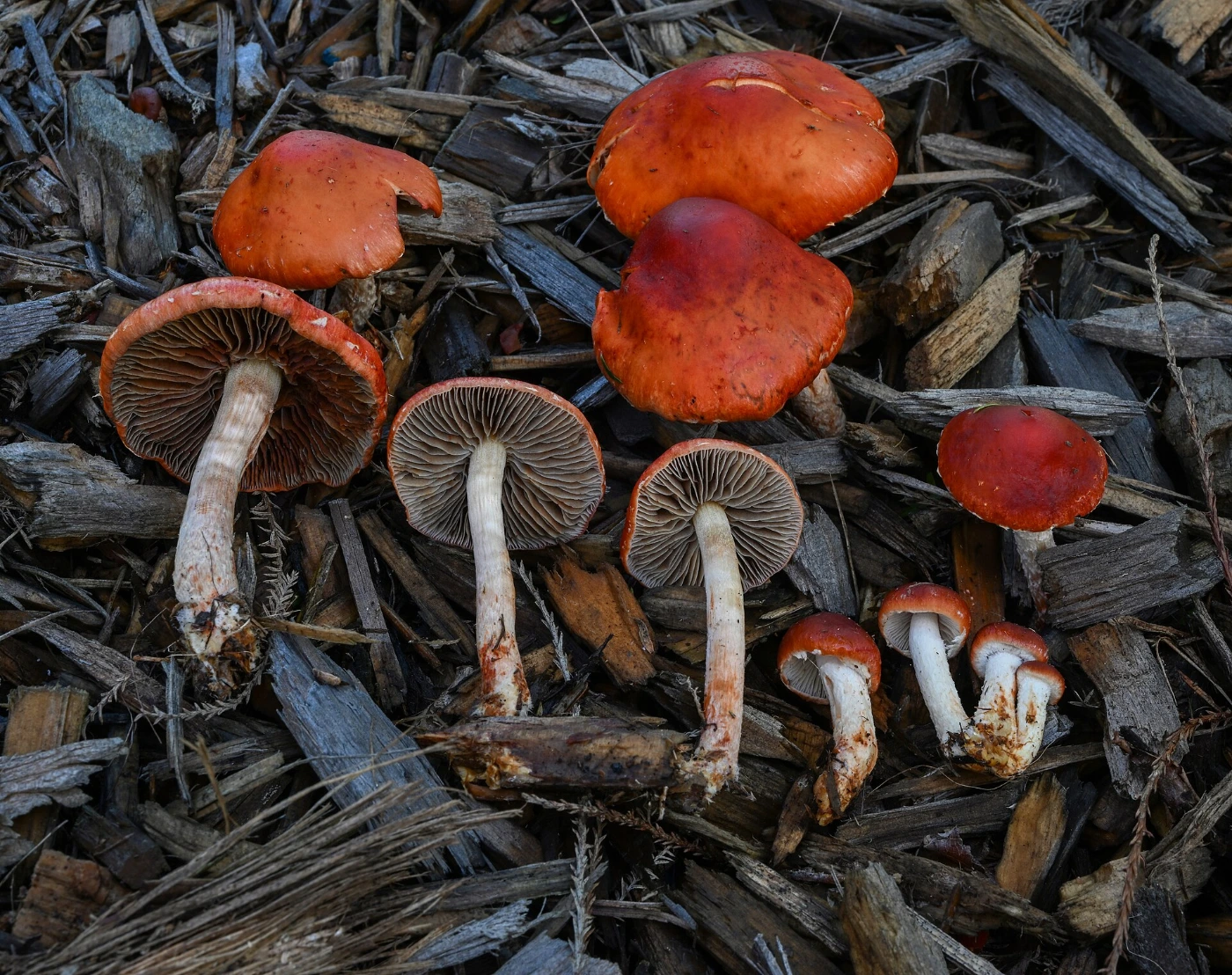
Leratiomyces ceres, commonly known as the Redlead Roundhead, is a striking orange-red mushroom frequently found in wood-chip beds, bark mulch, landscaped gardens, parks, and other disturbed habitats. Its bright cap often stands out strongly against pale wood chips, making it one of the easier urban mulch mushrooms to notice.
Identification becomes more reliable when the cap color is combined with the darkening gills, pale stem, veil remnants, and characteristic wood-chip habitat. Several other orange, red, and brown mushrooms can grow in the same places, so color alone is not enough.
⚠️ Important: This guide is for identification and education only. Leratiomyces ceres is not recommended as a food mushroom, and wild mushrooms should never be eaten based solely on photographs, AI identification, or a single visible feature.
Quick Identification
| Feature | Leratiomyces ceres |
|---|---|
| Scientific name | Leratiomyces ceres |
| Common name | Redlead Roundhead |
| Family | Strophariaceae |
| Cap color | Orange-red to brick-red |
| Cap shape | Convex, later flatter |
| Cap surface | Smooth, sometimes slightly sticky |
| Gills | Pale when young, later gray to purple-brown |
| Stem | Pale cream to yellowish |
| Ring | Usually absent as a persistent ring |
| Veil remnants | Often visible at cap margin when young |
| Spore print | Purple-brown to dark purplish brown |
| Substrate | Wood chips, bark mulch, woody debris |
| Habitat | Parks, gardens, landscaped beds |
| Season | Often autumn, but can fruit in other wet periods |
| Ecology | Saprotrophic |
| Edibility | Not recommended |
| Main look-alikes | Stropharia rugosoannulata, Hypholoma fasciculare, Gymnopilus spp., Psilocybe spp., other mulch mushrooms |
What Does Leratiomyces ceres Look Like?
Redlead Roundhead is a small to medium-sized gilled mushroom with a vivid cap that ranges from orange-red to brick-red. Young specimens are often especially bright and rounded, while mature caps become flatter and may fade toward orange-brown.
The stem is much paler than the cap, producing a strong color contrast. As the mushroom matures, the gills darken considerably because of the developing purple-brown spores.
Cap
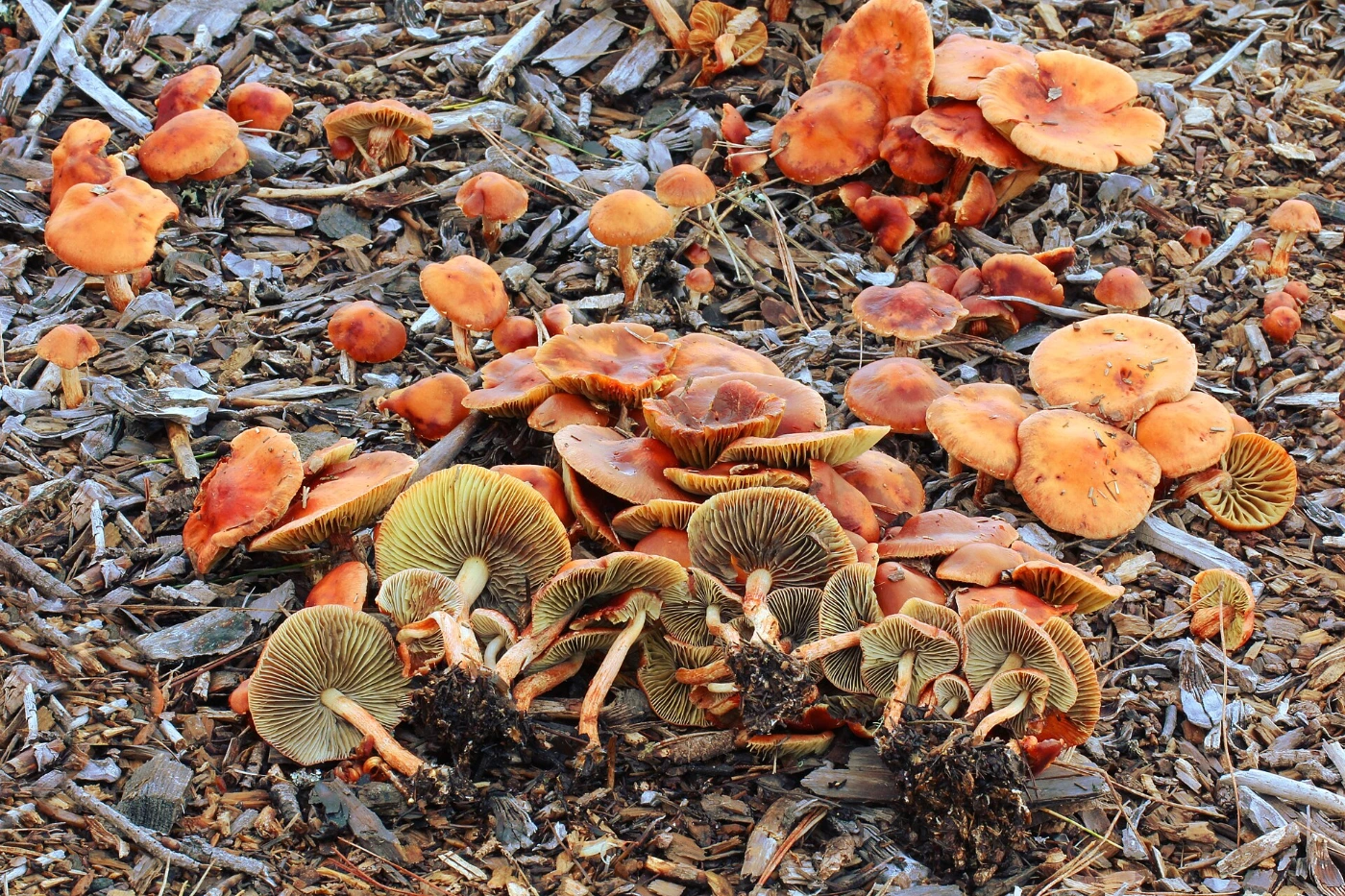
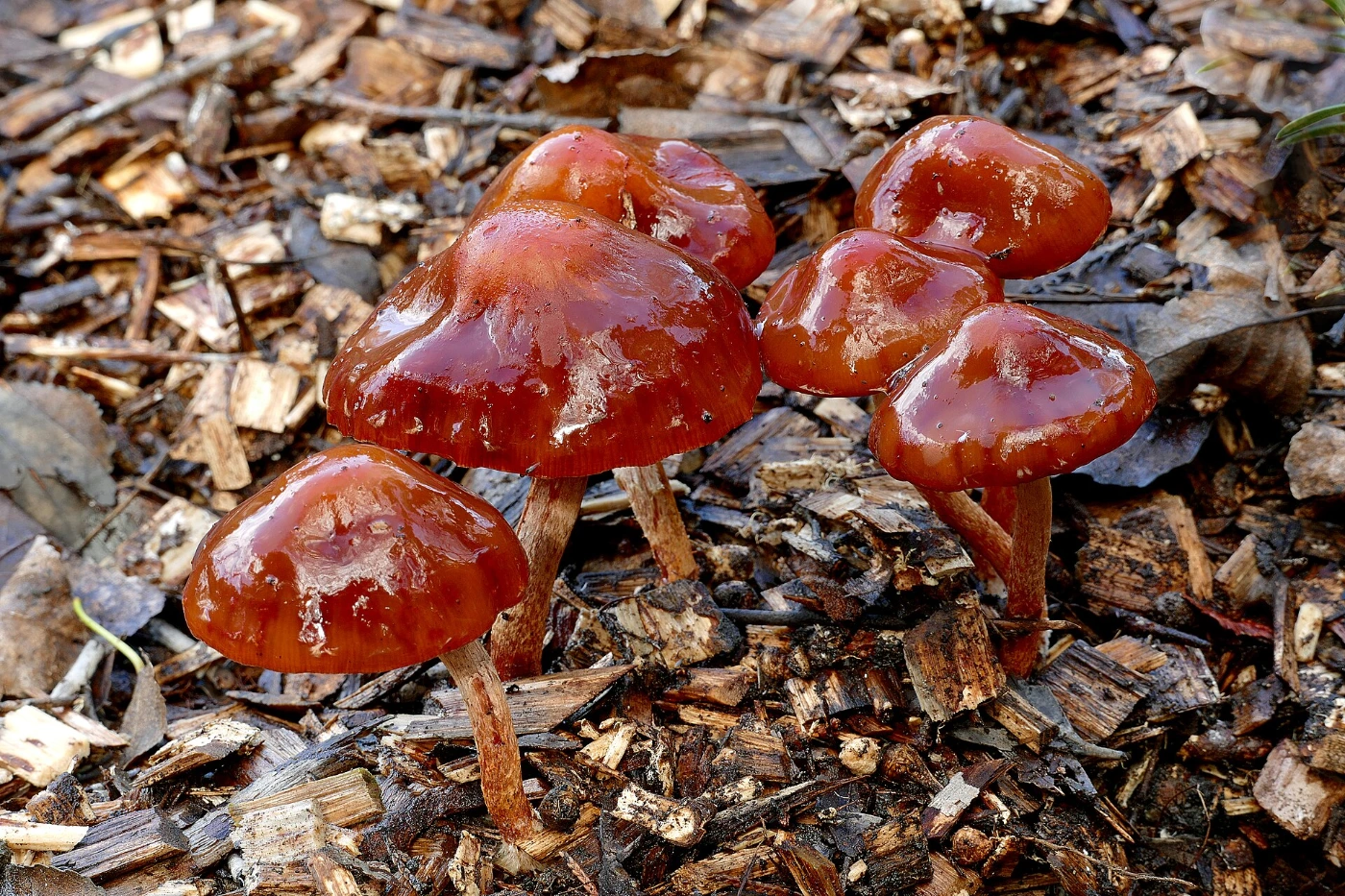
The cap is initially rounded or strongly convex and later becomes broadly convex to nearly flat. Typical colors include vivid orange, red-orange, brick-red, and reddish brown. Older or sun-exposed specimens can become noticeably paler. Rain may also darken the cap temporarily and make the surface appear more glossy.
Cap Surface
The surface is generally smooth and can be slightly sticky when fresh and wet. It does not normally have the heavy coarse scales seen in some Gymnopilus or Pholiota species. Young mushrooms may show pale veil fragments around the edge of the cap. These fragments often disappear as the fruit body expands or after heavy rain.
Cap Margin
The margin may initially curve downward and carry whitish veil remnants. As the mushroom matures, the cap opens and these remnants become less conspicuous. This feature is most useful when several young and mature mushrooms can be compared within the same patch.
Gills
The gills are attached to the stem and begin pale grayish or cream-colored. They progressively become darker as the spores mature. Mature gills may appear gray, brownish gray, violet-brown, or deep purple-brown. This darkening is an important clue for placing the mushroom within the Strophariaceae.
Why Gill Color Matters
A bright orange cap can occur in many unrelated fungi. Mature gill color gives much more information about the mushroom’s broader group. Orange mushrooms with pale, rusty, greenish, or purple-brown mature gills may belong to very different genera. This makes an underside photograph particularly useful.
Stem
The stem is usually pale cream, whitish, or yellowish and relatively slender. It may show scattered fibers or darker staining near the base. A persistent thick ring is generally absent. Young specimens can retain temporary veil material, but this often disappears with age.
Stem Base
The base may be surrounded by wood-chip fragments or mycelial material. Because the species is a decomposer, it often emerges directly through loose mulch. The stem does not have a volva or the bulbous Amanita-type base seen in some toxic woodland mushrooms.
Flesh
The flesh is pale and relatively thin compared with larger robust mushrooms such as Wine Cap. There is no dramatic blue bruising reaction. Damage may simply produce duller brownish or reddish tones.
Smell
The odor is generally mild and not particularly diagnostic. Some specimens may have an earthy or slightly radish-like mushroom smell. Smell should be used only as a supporting feature because individual perception varies considerably.
Spore Print
The spore print is dark purple-brown to purplish brown. This is a useful confirmation when the exact identification is uncertain. The dark spores explain why mature gills become much darker than those of young fruit bodies.
Where Does Leratiomyces ceres Grow?
Redlead Roundhead is especially associated with wood chips and landscaped mulch. It is a decomposer that feeds on woody organic material rather than forming mycorrhiza with living trees.
Parks, gardens, paths, playgrounds, urban flower beds, and recently mulched planting areas can all produce large numbers after suitable rain.
Wood Chips and Bark Mulch
Fresh or partially decomposed wood chips provide an ideal substrate. The mycelium grows through the mulch layer and can produce many fruit bodies at once.
This habitat is one of the strongest clues for the species. A bright red-orange mushroom emerging from a landscaped wood-chip bed should immediately bring Leratiomyces ceres into consideration.
Does It Grow on Natural Wood?
The species is most famous for wood-chip beds but can also occur among woody debris and other disturbed substrates.
Its strong association with human-created mulch habitats has helped make it particularly conspicuous in urban and suburban areas.
When Does Redlead Roundhead Grow?
Fruiting is especially common during cool, wet periods, often in autumn. However, the exact season varies with climate and rainfall.
In mild regions, wood-chip beds can produce fruit bodies during more than one part of the year. Moisture is usually more important than the calendar alone.
Distribution
Leratiomyces ceres is now found in many temperate regions and is particularly common in areas with extensive landscaping and wood-chip use.
It has become a familiar urban mushroom in parts of Europe, North America, Australia, New Zealand, and other regions. Human movement of mulch and plant material likely contributes to its spread.
Is Leratiomyces ceres Edible?
Redlead Roundhead is not recommended as a food mushroom. It is not regarded as a desirable edible species, and similar mulch mushrooms can be difficult to identify with certainty.
For practical mushroom identification, the important point is not to treat its bright color as a sign of either safety or danger. Correct species identification should come first.
Leratiomyces ceres Look-Alikes
Wood-chip beds can support many species at the same time. Orange, red, brown, and yellow mushrooms may appear together after rain, making substrate alone insufficient for exact identification.
The most useful comparisons involve cap color, mature gills, ring structure, bruising, and overall size.
Stropharia rugosoannulata — Wine Cap
Identification
Wine Cap is another common mushroom of wood chips and mulch. It is usually much larger and more robust, with a wine-red to burgundy or brown cap.
The stem is thick and carries a prominent ring. Mature gills become dark purple-brown.
Main Difference
Size and ring structure are the easiest differences. Wine Cap is usually substantially larger and has a strong persistent ring, while Leratiomyces ceres is smaller and generally lacks such a prominent ring.
The cap also tends to be deeper burgundy rather than vivid orange-red.
Hypholoma fasciculare — Sulphur Tuft
Identification
Sulphur Tuft forms dense clusters of yellow to sulfur-yellow mushrooms, often on stumps, buried roots, or decaying wood.
The gills can develop greenish or olive tones before becoming darker.
Main Difference
The yellow cap and greenish mature gills strongly favor Sulphur Tuft. Leratiomyces ceres is more orange-red and develops purple-brown rather than greenish gills.
Growth in tight dense clusters is also more typical of Sulphur Tuft.
Gymnopilus Species
Identification
Some Gymnopilus species have orange to rusty-orange caps and grow from wood. They can occur in clusters and may superficially resemble Redlead Roundhead.
Their mature gills and spore prints are rusty orange-brown rather than purple-brown.
Main Difference
Spore color is particularly useful. Purple-brown spores support Leratiomyces, while rusty-brown spores suggest Gymnopilus.
Many Gymnopilus species are also larger and more robust.
Psilocybe cyanescens — Wavy Cap
Identification
Wavy Cap is another mushroom strongly associated with wood chips in some temperate regions. It usually has a caramel-brown cap rather than a bright red-orange one.
Mature caps often develop a distinctly wavy margin, and damaged tissue may stain blue.
Main Difference
Blue bruising and caramel-brown wavy caps point toward Psilocybe cyanescens. Leratiomyces ceres does not characteristically show this blue staining.
Both can have dark purplish spores, so cap color and bruising become especially important.
Other Small Orange Mulch Mushrooms
Identification
Several small orange-brown species can occur among wood chips, including Tubaria and other saprotrophic genera.
Some are considerably smaller and more fragile than Leratiomyces ceres.
Main Difference
Redlead Roundhead usually has a brighter, more saturated orange-red cap and a sturdier overall build than many tiny brown-orange mulch mushrooms.
Mature purple-brown gills provide another useful clue.
Leratiomyces ceres vs Wine Cap
| Feature | Redlead Roundhead | Wine Cap |
|---|---|---|
| Scientific name | Leratiomyces ceres | Stropharia rugosoannulata |
| Cap | Orange-red to brick-red | Wine-red to burgundy |
| Size | Small to medium | Medium to large |
| Ring | No strong persistent ring | Large prominent ring |
| Mature gills | Purple-brown | Purple-brown |
| Stem | Slender and pale | Thick and pale |
| Habitat | Wood chips | Wood chips, straw, mulch |
| Food use | Not recommended | Edible when correctly identified |
The shared habitat and dark spores can create confusion, but mature Wine Caps are generally much larger and more robust.
Leratiomyces ceres vs Sulphur Tuft
| Feature | Leratiomyces ceres | Hypholoma fasciculare |
|---|---|---|
| Cap | Orange-red | Sulfur-yellow |
| Mature gills | Purple-brown | Greenish to dark gray-purple |
| Growth | Scattered or grouped | Dense clusters |
| Substrate | Wood chips and mulch | Dead wood, roots, buried wood |
| Safety | Not recommended | Poisonous |
The color of the mature gills is especially useful in difficult specimens.
How to Identify Leratiomyces ceres Step by Step
Start with the habitat. A small bright orange-red mushroom growing in a landscaped wood-chip bed is already in the right ecological setting.
Then check the gills, stem, and veil remnants rather than relying on the cap alone.
Step 1: Check the Cap
Look for vivid orange-red, brick-red, or reddish-orange coloration. Young specimens often show the strongest color.
A distinctly yellow, cream, or caramel-brown cap suggests other mulch species.
Step 2: Examine the Gills
Young gills should be relatively pale, while mature gills should become dark gray to purple-brown.
Rusty-orange or greenish gills point toward different groups.
Step 3: Look at the Stem
The stem should be pale and relatively slender. A large persistent ring is not typical.
A very thick ringed stem suggests Wine Cap or another species.
Step 4: Look for Veil Remnants
Young specimens may have pale fragments around the cap margin. These are remnants of the partial veil.
Because they disappear with age, compare several fruit bodies if possible.
Step 5: Confirm the Substrate
Check that the mushrooms are emerging from wood chips, bark mulch, or similar woody material.
If they are growing directly from grass or undisturbed forest soil, another species may be more likely.
How to Photograph Redlead Roundhead for Identification
Take a wider photograph showing several mushrooms and the wood-chip substrate. Habitat is particularly important for this species.
Then photograph the underside of both a young and mature specimen. This can document the change from pale to dark purple-brown gills.
A side image showing the stem and cap margin is also useful because it may reveal veil remnants.
Can AI Identify Leratiomyces ceres?
AI can often recognize Redlead Roundhead well when its bright cap and wood-chip habitat are visible. The species has a strong combination of visual and ecological clues.
Cap-only photographs remain less reliable because several unrelated orange mushrooms can look similar. Showing mature gills and substrate significantly improves the result.
A cautious identification should also consider Wine Cap, Gymnopilus, Hypholoma, and other mulch fungi when key features are missing.
Common Identification Mistakes
One common mistake is identifying every bright orange mushroom in mulch as Leratiomyces ceres. Wood-chip beds support a surprisingly diverse fungal community.
Another mistake is ignoring mature gill color. Orange caps can overlap across genera, while purple-brown, rusty-brown, and greenish gills point toward very different groups.
A third mistake is assuming all mushrooms in one mulch bed belong to the same species. Several fungi can fruit only centimeters apart.
Interesting Facts About Leratiomyces ceres
Redlead Roundhead is a good example of a fungus that thrives in human-created habitats. Large areas of wood-chip landscaping provide an artificial environment that can closely mimic naturally accumulated woody debris.
Its geographic spread is also linked to modern horticulture. Mulch, nursery plants, soil, and landscaping materials can move fungal mycelium and spores over long distances.
The species has undergone taxonomic changes as well. Older field guides may place it under other names, so historic records can be confusing when compared with modern classifications.
Its vivid red-orange coloration also makes it disproportionately noticeable compared with many equally common brown mulch fungi. This is one reason it frequently appears in mushroom identification requests.
Frequently Asked Questions
Why are some Redlead Roundheads almost brown instead of red?
Age, sunlight, and drying can fade the cap considerably. Older specimens may lose much of the vivid orange-red coloration seen in young fruit bodies.
Can rain remove the veil remnants?
Yes. The pale material around the cap margin can disappear quickly through rain, growth, or physical damage.
Why are young gills pale if the mature spores are dark?
The spores have not yet accumulated in large numbers when the mushroom is young. As they mature, the gills gradually take on the darker color associated with the spore deposit.
Can the species grow in flower beds without visible wood chips?
Yes, especially if woody material is buried beneath soil or compost. Old mulch layers may also become difficult to recognize after decomposition.
Can hundreds appear at once?
Yes. A well-colonized mulch bed can produce large flushes after suitable rainfall and temperature changes.
Does the red cap indicate toxicity?
No. Cap color has no universal relationship with toxicity. Brightly colored mushrooms can be edible, poisonous, or simply unsuitable for food.
Can Redlead Roundhead grow beside Wine Caps?
Yes. Multiple mulch-decomposing fungi can fruit in the same bed, so neighboring mushrooms should not automatically be assumed to belong to one species.
Why does the same mulch bed produce different mushrooms each year?
Wood chips change as they decompose. Different fungi may become dominant as moisture, nutrient availability, and wood structure change over time.
Final Identification Notes
Leratiomyces ceres is best recognized by the combination of a bright orange-red to brick-red cap, pale stem, gills that darken to purple-brown, young veil remnants, and growth from wood chips or bark mulch.
The main look-alikes include Wine Cap, Sulphur Tuft, Gymnopilus species, Psilocybe species, and various smaller mulch mushrooms. Mature gill color, ring structure, bruising, and overall size usually provide the best separation.
The simplest field rule is: orange-red cap + purple-brown mature gills + wood-chip habitat = strong Redlead Roundhead candidate.
Upload a photo and get possible matches in seconds.