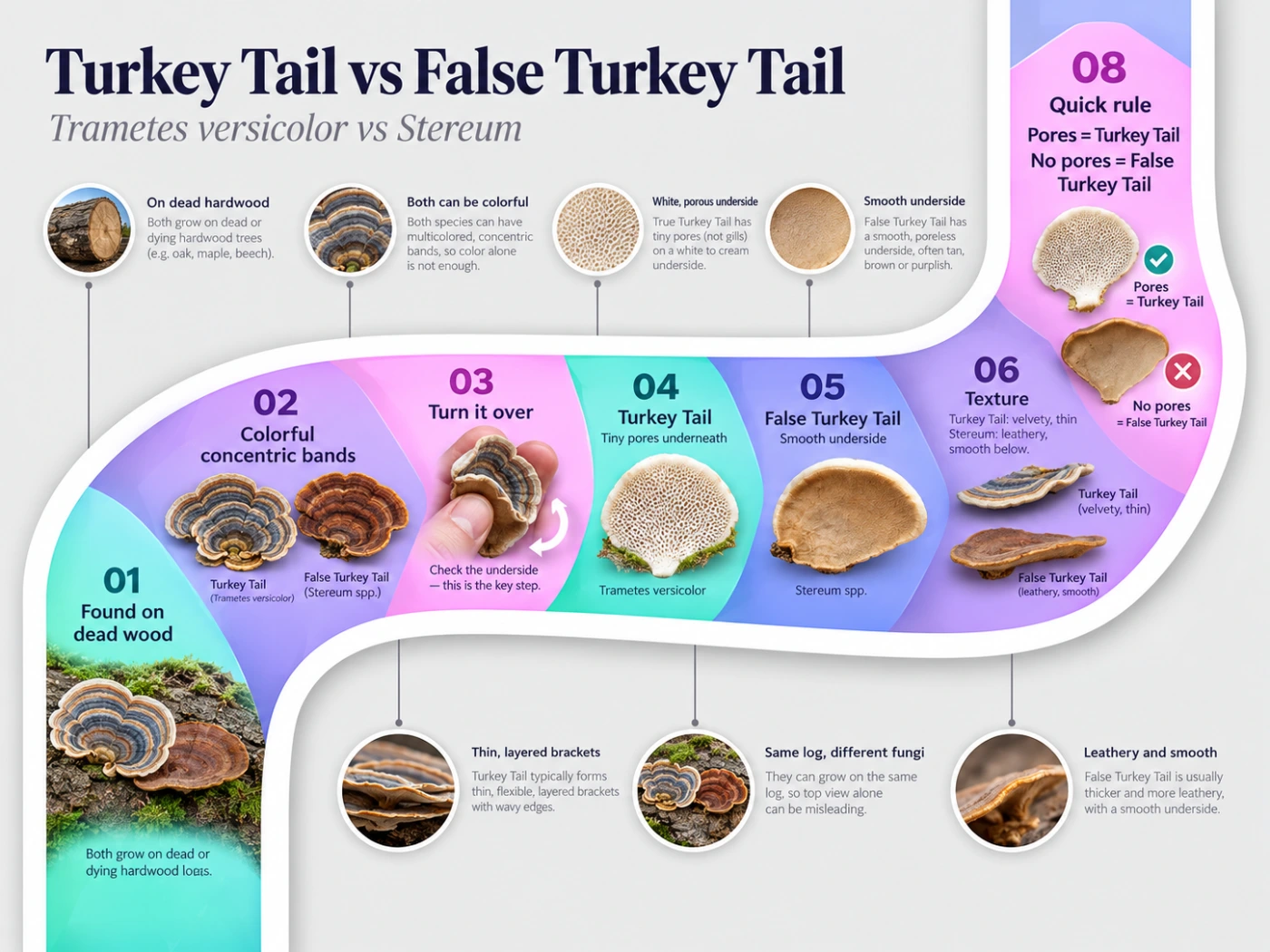
Turkey Tail (Trametes versicolor) and the fungi commonly called False Turkey Tail (Stereum species) can look remarkably similar from above. Both form thin, fan-shaped brackets with concentric bands of brown, gray, cream, orange, or bluish tones, and both often grow in overlapping layers on dead hardwood.
The most reliable difference is found on the underside. True Turkey Tail has a pale surface covered with tiny pores, while False Turkey Tail has a smooth or slightly wrinkled underside with no pores at all. Once this feature is checked, the comparison becomes much easier.
⚠️ Important: A colorful upper surface alone is not enough to identify Turkey Tail. Always inspect the underside before deciding that a bracket fungus is Trametes versicolor.
Quick Comparison
| Feature | Turkey Tail | False Turkey Tail |
|---|---|---|
| Scientific name | Trametes versicolor | Stereum species |
| Growth form | Thin fan-shaped brackets | Thin fan-shaped brackets |
| Upper surface | Strongly zoned, usually velvety | Zoned, often hairy or velvety |
| Underside | Tiny pores | Smooth or slightly wrinkled |
| Pore density | Usually about 3–6 pores per mm | No pores |
| Underside color | White to cream when fresh | Cream, tan, yellowish, grayish |
| Thickness | Thin and leathery | Thin and leathery |
| Substrate | Dead wood | Dead wood |
| Growth pattern | Overlapping shelves or rosettes | Shelves, crusts, or mixed forms |
| Spore print | White | Pale |
| Food use | Too tough for normal culinary use | Inedible / too tough |
| Best field clue | Porous underside | Smooth underside |
The Fastest Way to Tell Them Apart
The simplest method is to turn the bracket over and look closely at the fertile surface. Turkey Tail produces spores through thousands of tiny tubes, so the underside should show a dense field of small pore openings.
False Turkey Tail does not have those tubes. Its underside is smooth, slightly wrinkled, or uneven, but it lacks the regular pore pattern seen in Trametes versicolor.
Turkey Tail — Trametes versicolor
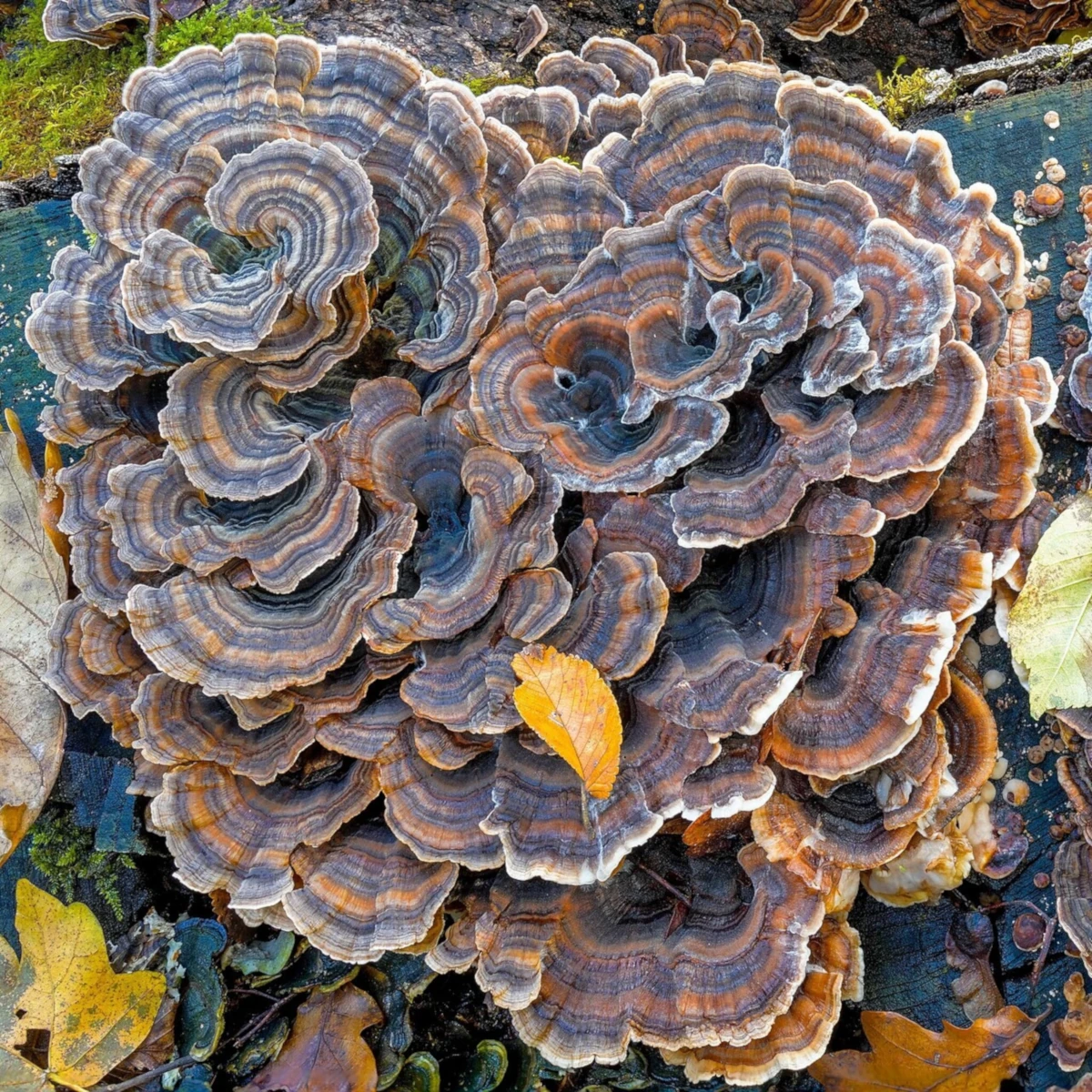
Trametes versicolor is one of the most familiar bracket fungi in temperate forests. It grows on dead wood and often forms large groups of thin overlapping shelves that resemble the spread tail feathers of a turkey.
The species name versicolor reflects its highly variable coloration. One cluster may combine gray, brown, cream, black, rusty orange, and blue-gray bands, while another may be much more muted.
Upper Surface
The upper surface is divided into distinct concentric zones that differ in color and texture. These bands usually remain visible even when the overall color palette is rather dull.
Fresh Turkey Tail also tends to have a finely velvety or hairy surface. In good side lighting, the tiny hairs can make the zones appear even more clearly separated.
Color Variation
Turkey Tail is extremely variable, so color is helpful only as a supporting feature. Some fruit bodies are dominated by brown and gray, while others show strong orange, cream, or almost black bands.
Weather also changes the appearance considerably. Rain can darken the surface, while sun and age can bleach older brackets until they look much paler than fresh growth.
Underside
The underside is usually white to cream when fresh and contains many tiny pores. These pores may be difficult to see from a distance because they are only a fraction of a millimeter across.
A macro photograph or hand lens is often useful. When the underside is clean and young, the pore pattern should become obvious on close inspection.
How Small Are the Pores?
Turkey Tail usually has approximately 3–6 pores per millimeter. The exact appearance varies with age and the condition of the fruit body, but the surface should still look clearly porous when examined closely.
Old brackets can become dirty, stained, or colonized by algae and other organisms. In that case, the youngest outer edge often provides the best place to inspect the pore layer.
Shape and Thickness
Individual brackets are usually semicircular, fan-shaped, or irregularly lobed. They grow directly from wood and frequently overlap in dense horizontal tiers.
The brackets are thin and leathery rather than thick and fleshy. This helps separate Turkey Tail from larger polypores such as Birch Polypore or Chicken of the Woods.
Flesh
The internal tissue is pale, thin, and fibrous. There is very little fleshy material between the upper surface and pore layer.
That construction gives Turkey Tail its flexible but tough texture. Fresh brackets may bend slightly, while dried specimens become much stiffer.
False Turkey Tail — Stereum Species
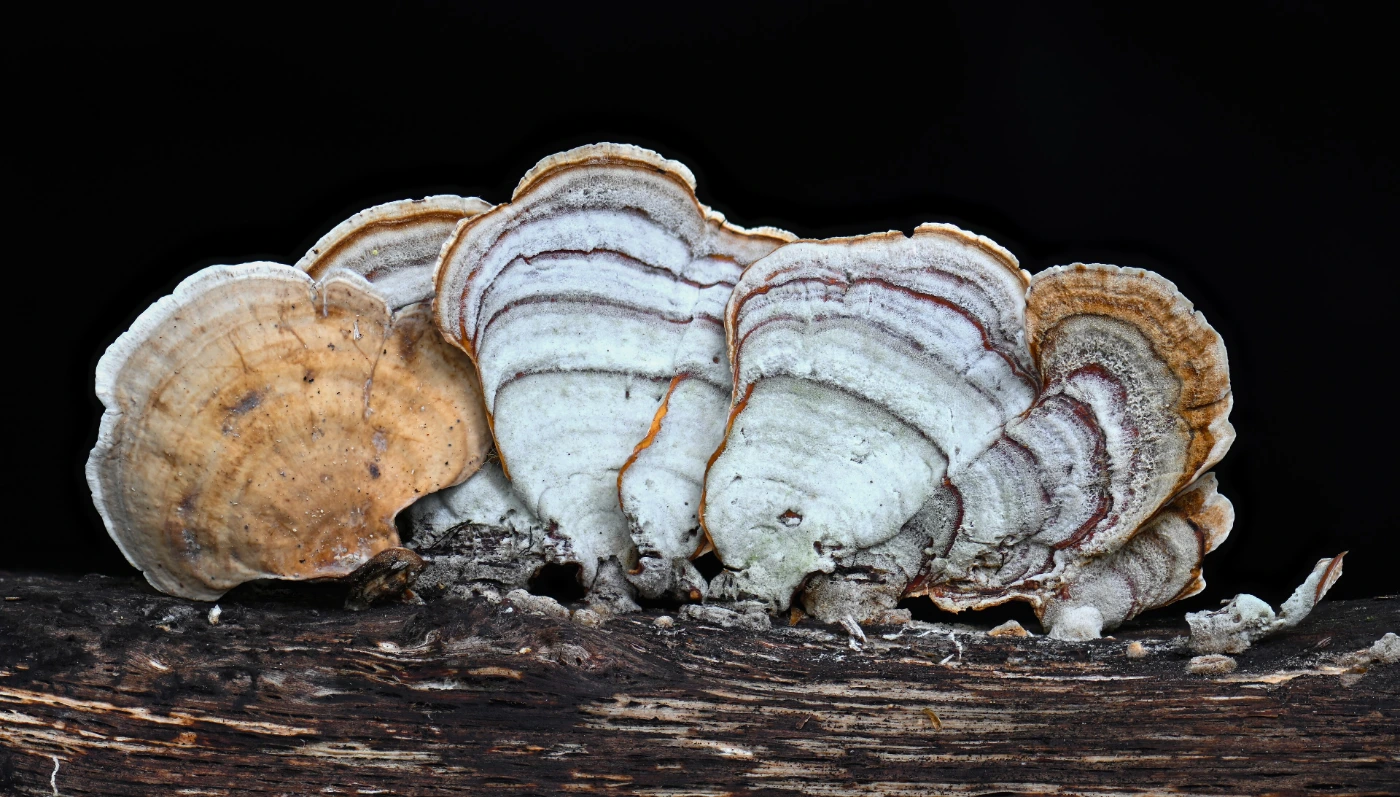
“False Turkey Tail” usually refers to one or more Stereum species that mimic the zoned appearance of Trametes versicolor. From above, some examples can be so convincing that even experienced mushroom hunters need to examine the underside.
The important difference is anatomical rather than cosmetic. Stereum does not produce a layer of tubes and pores underneath the bracket.
Upper Surface
Many Stereum species have concentric bands of brown, tan, orange, gray, or cream. The upper surface can also be hairy or velvety, making the resemblance to Turkey Tail even stronger.
This overlap is why upper-surface color should never be the deciding feature. A very colorful Stereum can look more “Turkey Tail-like” than a faded true Turkey Tail.
Underside
The fertile surface of Stereum is smooth to slightly wrinkled. It may be cream, buff, tan, yellowish, grayish, or orange-brown depending on the species and age.
Most importantly, there are no true pores. Even under magnification, you will not see the regular pattern of small openings characteristic of Trametes versicolor.
Texture
The underside may feel smooth or slightly leathery. Some species can develop subtle folds or uneven areas, but these should not be mistaken for pores.
If there is any doubt, inspect several young brackets from the same cluster. Fresh growth usually shows the structure most clearly.
Growth Form
Some Stereum species form neat shelf-like brackets, while others grow partly as crusts pressed against the wood. The outer edge may then curve outward and form small fan-shaped projections.
This mixed crust-and-bracket growth is often more characteristic of Stereum than of typical Turkey Tail. However, it should still be treated as a supporting clue rather than the primary test.
Turkey Tail vs False Turkey Tail: Key Differences
The upper surfaces of these fungi overlap too much for reliable identification. The underside should always be the first structural feature you compare.
| Feature | Trametes versicolor | Stereum spp. |
|---|---|---|
| Concentric color bands | Yes | Yes |
| Velvety or hairy upper surface | Usually | Often |
| White or pale underside | Usually | Often possible |
| Pores underneath | Yes | No |
| Smooth fertile surface | No | Yes |
| Thin shelf-like growth | Yes | Yes |
| Crust-like growth | Less typical | Common in some species |
| Best clue | Tiny pores | Smooth underside |
Pores vs Smooth Underside
This is the most important part of the comparison. Turkey Tail is a polypore, meaning its spores are produced inside tiny tubes that open as visible pores on the underside.
Stereum uses a different reproductive surface. Its spores develop on a smooth exposed layer rather than inside tubes, so the underside lacks pores completely.
Why This Difference Is So Reliable
Color can fade, surface hairs can wear away, and brackets can become distorted by weather. The basic reproductive structure, however, remains fundamentally different.
That makes the pore test much more useful than comparing shades of brown or counting color bands.
What if the Underside Looks Smooth?
A Turkey Tail underside can appear almost smooth if the pores are very small or the photograph lacks enough detail. This is especially common when the image is taken from too far away.
Use a close-up or macro photo and inspect the freshest area of the bracket. If no pores can be found even under close examination, true Turkey Tail becomes unlikely.
Does True Turkey Tail Always Have Strong Color Bands?
Most fruit bodies show clear concentric zoning, but the contrast varies. Some brackets have spectacular alternating bands, while others are dominated by subtle gray-brown tones.
Very old specimens can become faded or partially covered by algae. For that reason, attractive multicolored bands should be treated as supportive rather than decisive evidence.
Turkey Tail Look-Alikes Beyond Stereum
Several other bracket fungi can resemble Turkey Tail and still have pores underneath. Once pores are found, the identification process is therefore not automatically finished.
Other Trametes species and some related polypores differ in cap texture, color pattern, pore size, and thickness. These features become important after the smooth-versus-porous comparison has been resolved.
Trametes ochracea — Ochre Bracket
Trametes ochracea forms thin, zoned brackets with a pale porous underside. The upper surface tends to emphasize ochre, tan, cream, and brown rather than the more varied palette often seen in Turkey Tail.
The bands can still be very distinct, so color alone is not enough. Texture and the overall zoning pattern should be considered together with pore characters.
Trametes hirsuta — Hairy Bracket
Hairy Bracket usually has a coarser, more obviously hairy upper surface. Its colors are often pale gray, cream, or brown with broader, less delicate bands.
The underside contains pores, so it cannot be separated from Turkey Tail using the simple pore test. The stronger coarse hairs and more subdued pattern become useful at that stage.
Trametes pubescens — Downy Bracket
This species is generally much paler and less strongly zoned. Cream, white, and buff tones often dominate the upper surface.
Its underside is also porous, but the overall appearance is usually softer and more uniform than classic Turkey Tail.
Trichaptum Species
Some Trichaptum species form thin brackets that can resemble Turkey Tail from above. Their fertile surface may develop violet or purple coloration, particularly in fresh specimens.
That underside color is an important clue. Purple or violet tones strongly suggest another polypore rather than Trametes versicolor.
Where Does Turkey Tail Grow?
Turkey Tail grows directly from dead wood and is an active decomposer. Fallen logs, branches, stumps, and standing dead trees are all common substrates.
It is especially frequent on hardwood, including oak, beech, maple, birch, and many other broadleaf trees. Host species can support the identification, but the underside remains far more important.
Where Does False Turkey Tail Grow?
Stereum species also occur on dead wood, particularly hardwood branches and logs. Their habitats therefore overlap strongly with those of Turkey Tail.
That ecological overlap explains why location alone is not useful for separating them. Two almost identical-looking bracket fungi can grow on the same type of wood in the same forest.
Can Turkey Tail and Stereum Grow on the Same Log?
Yes. A fallen tree can support several wood-decaying fungi at the same time, and different species may fruit only centimeters apart.
This can create a misleading impression that every colorful bracket on one log belongs to the same species. Each cluster should therefore be checked separately.
Is Turkey Tail Edible?
Turkey Tail is too thin, tough, and leathery to be considered a normal culinary mushroom. It is not eaten in the same way as oyster mushrooms, chanterelles, or young polypores with fleshy tissue.
The species is well known because compounds and standardized preparations derived from Trametes versicolor have been studied scientifically. That research should not be confused with the idea that eating an unidentified wild bracket provides medical benefits.
Is False Turkey Tail Edible?
Stereum species are also tough and leathery and are not considered ordinary food mushrooms. Their thin structure provides little edible tissue even aside from identification concerns.
They should not be treated as culinary substitutes for Turkey Tail. Exact species identification within Stereum can also be difficult from photographs alone.
How to Identify Turkey Tail Step by Step
A reliable identification starts with the substrate and underside rather than the colors on top. After pores are confirmed, the upper surface and overall structure can be used to strengthen the identification.
Step 1: Confirm Growth on Wood
Turkey Tail should grow directly from woody material. Fallen logs, dead branches, and stumps are especially typical.
A similarly colored fungus growing from soil should be approached as a different identification problem.
Step 2: Turn the Bracket Over
Look for a pale underside and inspect it closely. The presence of many tiny pores strongly supports a polypore such as Turkey Tail.
A completely smooth underside points instead toward Stereum or another non-poroid fungus.
Step 3: Check the Upper Surface
Look for strong concentric zones with alternating colors. The surface should usually be finely velvety rather than completely smooth.
Muted specimens are still possible, so the upper surface should confirm rather than determine the identification.
Step 4: Check Thickness
Turkey Tail brackets should be thin and leathery. A thick, woody, or fleshy bracket suggests another species.
Examining the side of the fruit body often makes this difference easier to judge than looking straight down from above.
Step 5: Compare Several Fruit Bodies
Use both young and old brackets if several are available. Young edges often preserve white pores and fine surface hairs better than weathered centers.
Comparing multiple fruit bodies also helps reveal the natural variability of the species.
How to Photograph Turkey Tail for Identification
Start with a wide image showing the brackets growing on the log or branch. This documents the growth pattern and substrate.
Then photograph both surfaces separately. A top image should show the concentric zones, while the underside image should be close enough to resolve individual pores.
The Most Important Photograph
For this comparison, the underside photograph is the critical one. A beautiful image of the upper bands may still leave Turkey Tail and False Turkey Tail impossible to separate.
Use natural light and focus closely on the fertile surface. If possible, include a macro shot of the pore structure.
Can AI Tell Turkey Tail From False Turkey Tail?
AI can often recognize the general Turkey Tail appearance from the colorful zoned cap, but a photograph from above alone creates substantial uncertainty. Stereum can mimic that appearance extremely well.
Accuracy improves dramatically when the underside is included. Visible pores support Trametes, while a smooth fertile surface points away from true Turkey Tail.
For poor or incomplete photographs, a cautious result such as “Turkey Tail or Stereum-like bracket fungus” can be more accurate than forcing an exact species.
Common Identification Mistakes
The most common mistake is identifying Turkey Tail solely from colorful concentric bands. Those bands are shared by several other bracket fungi.
Another mistake is assuming that every white underside is porous. A pale Stereum underside can look very similar from a distance, so the surface must be examined closely.
Old brackets create another source of error because algae, dirt, fading, and physical damage can hide the normal appearance. Fresh growth at the margin is usually more informative.
Interesting Facts About Turkey Tail and False Turkey Tail
The name versicolor means approximately “of many colors,” which fits Turkey Tail particularly well. Even brackets produced by the same fungal colony can vary significantly in their combination of brown, gray, orange, cream, and dark bands.
The concentric zones form as the fruit body expands outward. Changes in growth rate, pigmentation, and surface hairs contribute to the layered appearance that makes these fungi so visually distinctive.
Turkey Tail and Stereum are also excellent examples of convergent appearance. They can look almost identical from above even though their spore-producing surfaces are built in fundamentally different ways.
Both groups are important decomposers in forest ecosystems. By breaking down dead wood, they help recycle nutrients and gradually return material locked in trunks and branches to the soil.
Frequently Asked Questions
Can Turkey Tail pores disappear with age?
The tube structure does not simply disappear, but old surfaces can become damaged, clogged with dirt, or difficult to see. A clean young edge is usually much easier to examine than an old central area.
Why does my Turkey Tail have green areas?
Algae can colonize old or persistently damp fruit bodies and create green patches. This coloration may therefore come from another organism growing on the fungus rather than from Turkey Tail itself.
Can False Turkey Tail have a white underside?
Yes. Some Stereum species can have very pale fertile surfaces, so color alone is not enough to separate them.
The important question is whether the surface contains actual pores. A smooth white underside still points away from Turkey Tail.
Why are some Turkey Tails almost black?
Some growth bands naturally become very dark brown or nearly black. Moisture, genetics, age, and lighting can make those dark zones even more pronounced.
Can Turkey Tail be found during winter?
Yes, older fruit bodies may persist through winter, especially in cool damp climates. They may no longer be actively growing, but their brackets can remain attached to wood for a long time.
Do all Stereum species resemble Turkey Tail?
No. The genus contains a variety of forms and colors, and only some create the strongly zoned fan-shaped brackets commonly called False Turkey Tail.
This is why “False Turkey Tail” is better understood as a practical look-alike category rather than one exact species in every case.
Can different bracket species grow mixed together?
Yes. One log can host several fungi simultaneously, and their brackets can overlap visually.
Never assume that every bracket on the same piece of wood belongs to the same species.
Does a velvety cap prove Turkey Tail?
No. Both Turkey Tail and some Stereum species can have hairy or velvety upper surfaces.
The underside remains the much stronger feature.
Final Identification Notes
Turkey Tail and False Turkey Tail are easiest to separate by ignoring the attractive upper surface at first. Instead, turn the bracket over and inspect how the spores are produced.
True Turkey Tail, Trametes versicolor, has a white to cream underside covered with tiny pores. False Turkey Tail in the Stereum group has a smooth or slightly wrinkled fertile surface without pores.
The simplest rule is therefore easy to remember: pores underneath = Turkey Tail candidate; smooth underside = Stereum candidate. Color bands, velvety texture, thin growth, and dead-wood habitat can then be used to confirm the identification.
Upload a photo and get possible matches in seconds.