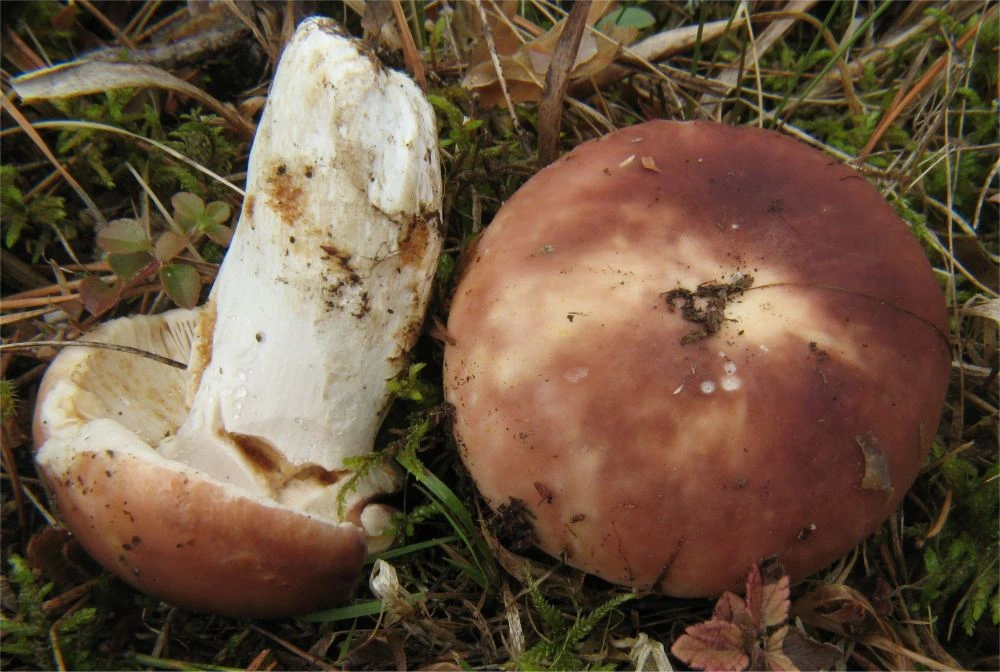
Russula vesca, commonly known as The Flirt, is a widespread woodland Russula with a pinkish, reddish-brown, or flesh-colored cap, pale gills, and a white brittle stem. It is not as brightly colored as many other Russulas, but several subtle features make it distinctive when examined carefully.
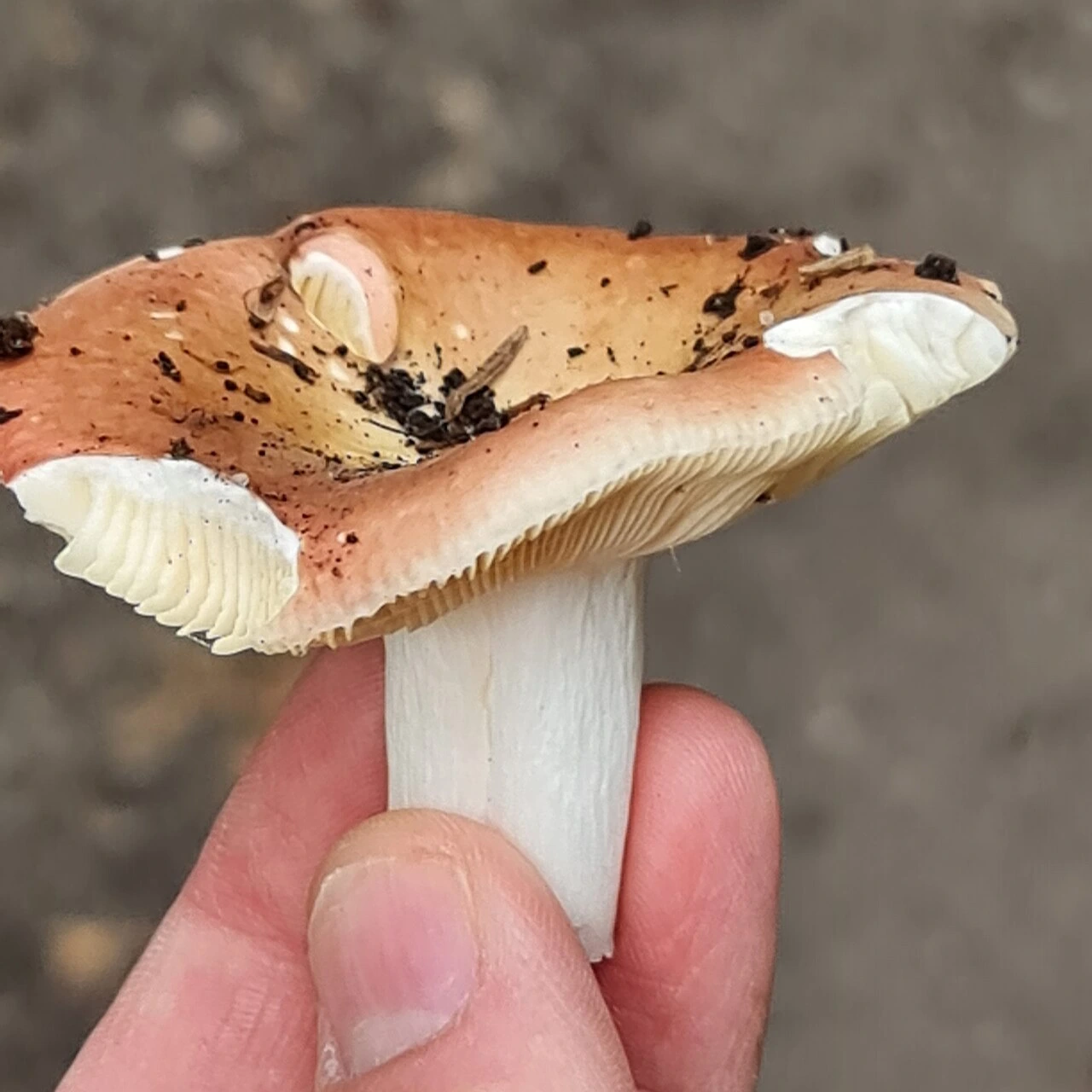
One of the most useful clues is the cap skin. In many specimens, the colored skin stops slightly short of the cap edge, leaving a narrow pale or white rim of exposed flesh around the margin.
⚠️ Important: Russulas can be difficult to identify to species level because many share similar cap colors and brittle flesh. Use cap skin, gill color, spore print, habitat, taste characteristics reported in field guides, and regional taxonomy together rather than relying on color alone.
Quick Identification
| Feature | Russula vesca |
|---|---|
| Common name | The Flirt |
| Cap color | Pink, reddish-brown, flesh-colored, muted red |
| Cap shape | Convex, later flat to shallowly depressed |
| Cap skin | Often stops short of the margin |
| Margin | May show a narrow white rim of flesh |
| Gills | White to cream |
| Stem | White, firm, brittle |
| Ring | Absent |
| Volva | Absent |
| Latex | Absent |
| Flesh | White, brittle |
| Taste | Mild |
| Spore print | Cream |
| Ecology | Mycorrhizal |
| Habitat | Deciduous and mixed woodland |
| Common hosts | Beech, oak and other broadleaf trees |
| Season | Summer to autumn |
| Edibility | Edible when correctly identified |
| Main look-alikes | Other pink and red Russulas |
What Does Russula vesca Look Like?
The cap is usually pinkish-brown, reddish-brown, muted red, or flesh-colored rather than bright scarlet. It can also contain cream, ochre, or paler patches, especially with age.
The overall appearance is often understated compared with vivid Russulas such as Russula emetica. This makes cap structure and the exposed pale rim more useful than color intensity.
Cap
Young caps are convex and gradually flatten as the mushroom matures. Older specimens may develop a shallow depression in the center.
The surface is smooth and can be slightly sticky in wet weather. The cap skin is usually peelable for at least part of the radius.
Cap Color
Typical shades include dusty pink, pink-brown, reddish-brown, wine-pink, and flesh tones. The center may be darker or more brownish than the edge.
Weather can alter these colors substantially. Rain may wash the cap paler, while dry conditions can produce duller or more irregular tones.
The White Rim
One of the best-known field characters is that the colored cap skin often does not reach the very edge of the cap. This leaves a thin pale line of exposed flesh around the margin.
The feature is not equally obvious on every specimen. It is most useful when present clearly rather than as a mandatory character.
Gills
The gills are white to cream and relatively crowded. Like other Russulas, they are brittle and can break easily when touched.
They do not produce latex when damaged. This separates Russula vesca from milkcaps, which belong to the same family but release visible milk.
Stem
The stem is white, firm, and usually cylindrical. It may become slightly wrinkled or softer with age.
There is no ring and no volva. The flesh snaps rather than tearing into long fibers, which is typical of Russula.
Flesh
The flesh is white and brittle. It does not usually show dramatic color changes after cutting.
The texture is chalk-like because of the cellular structure characteristic of Russulaceae. This brittle flesh is one of the easiest ways to recognize a Russula as a group.
Smell
The smell is usually mild and not especially distinctive. Some specimens may have a faint mushroom-like or slightly nutty odor.
Odor is therefore a secondary clue. Cap skin, brittle structure, and habitat are more useful.
Spore Print
The spore print is cream. This helps confirm placement within the broader Russula group but is not enough to identify the species alone.
Several similar Russulas also produce cream spores. Exact identification depends on a combination of macroscopic and ecological characters.
Where Does Russula vesca Grow?
Russula vesca is mycorrhizal and grows in association with living trees. It is most often found in deciduous and mixed woodland.
Beech and oak are common partners in Europe. It can also occur with other broadleaf trees depending on region.
Beech Woodland
Beech forest is one of the classic habitats for this species. The muted cap colors often blend well with dry leaves and forest soil.
Several Russula species can fruit in the same area. This makes small structural details more important than habitat alone.
Oak Woodland
Oak-associated woodland can also support Russula vesca. Mushrooms may appear among leaf litter, moss, or relatively open ground.
The species can occur singly or in loose groups. It does not grow directly from wood.
Season
Russula vesca usually fruits from summer into autumn. Warm wet periods can produce noticeable flushes.
In mild climates, fruiting may continue later into autumn. Timing varies with rainfall, latitude, and local temperature.
Distribution
The species is best known from Europe and other parts of the Northern Hemisphere. Similar pinkish Russulas occur widely, so regional identification should still be handled carefully.
For North American observations, a familiar European name should not automatically be applied to every similar fruit body. Local taxonomy and species concepts may differ.
Is Russula vesca Edible?
Russula vesca is generally regarded as edible when correctly identified. Its mild taste distinguishes it from many acrid or peppery Russulas.
As with all wild mushrooms, correct identification comes first. A pink or reddish cap alone is not enough to confirm this species.
Look-Alikes
The main look-alikes are other Russulas with pink, red, brown, or flesh-colored caps. Exact separation often depends on cap skin, taste, spore color, habitat, and subtle structural differences.
Russula emetica — The Sickener
Identification
Russula emetica usually has a much brighter red cap with white gills and a white stem. It is strongly acrid or peppery and is associated especially with wet coniferous or boggy habitats.
Its cap color is often more vivid and uniform than that of R. vesca. The two can still overlap when weather has faded the red.
Main Difference
A bright red cap and strongly acrid taste favor R. emetica. Muted flesh-pink or reddish-brown tones and a mild taste fit R. vesca better.
Russula cyanoxantha — Charcoal Burner
Identification
Russula cyanoxantha can show mixtures of purple, green, gray, blue, and pink. The cap is often more variable in color than that of R. vesca.
Its gills are unusually flexible for a Russula and tend to bend instead of crumbling easily. This is one of the best practical differences.
Main Difference
Flexible gills favor R. cyanoxantha. Brittle gills and the characteristic pale exposed cap margin fit R. vesca better.
Russula virescens — Green-Cracking Russula
Identification
Russula virescens has a green to gray-green cap with a distinctive cracked mosaic surface. The flesh, gills, and stem are similarly brittle and pale.
The overall structure can resemble R. vesca, but the cap surface is completely different. Green tessellated patches are the key clue.
Main Difference
A cracked green mosaic cap points strongly toward R. virescens. Pink-brown coloration and an exposed white rim favor R. vesca.
Russula rosea and Other Pink Russulas
Identification
Several Russulas can have pink, rose-red, or reddish caps with white stems. Some are brighter, more uniformly colored, or have different spore-print shades.
Species-level separation can be difficult from photographs alone. Taste, ecology, microscopy, and regional taxonomy may be necessary in atypical cases.
Main Difference
The pale rim caused by the cap skin ending short of the margin is particularly useful for R. vesca. It should still be combined with mild taste and cream spores.
Russula vesca vs Russula emetica
| Feature | Russula vesca | Russula emetica |
|---|---|---|
| Cap | Pink-brown, flesh-colored | Bright red |
| Cap margin | Often pale exposed rim | Usually fully colored |
| Taste | Mild | Strongly acrid |
| Gills | White to cream | White |
| Stem | White | White |
| Habitat | Deciduous/mixed woodland | Often wet coniferous habitats |
| Best clue | Mild + pale cap rim | Bright red + acrid |
These species can overlap in general structure. Cap tone and taste characteristics are more useful than size alone.
Russula vesca vs Russula cyanoxantha
| Feature | Russula vesca | Russula cyanoxantha |
|---|---|---|
| Cap color | Pink-brown, flesh tones | Purple, green, blue-gray, mixed |
| Gills | Brittle | Flexible |
| Cap skin | Often short of margin | Usually reaches margin |
| Spore print | Cream | White to pale cream |
| Habitat | Broadleaf/mixed woodland | Broadleaf/mixed woodland |
| Best clue | White rim | Flexible gills |
The two may occur in the same forest. Gill flexibility is particularly useful when both caps are faded or unusually colored.
How to Identify Russula vesca
Start by confirming that the mushroom is a Russula. Brittle flesh, pale gills, no latex, no ring, and no volva establish the basic group.
Then examine the cap margin closely. A muted pink-brown cap with skin ending slightly short of the edge is a strong clue.
Finally, consider the mild taste profile and broadleaf woodland habitat. These characters together support Russula vesca much more strongly than cap color alone.
Young vs Mature Russula vesca
Young specimens are usually firm with convex caps and clear coloration. The pale exposed rim may already be visible around the edge.
Older mushrooms flatten and may become faded, cracked, or damaged. The cap can also develop more brown or ochre tones as it ages.
Common Identification Mistakes
One common mistake is assuming that every mild pink Russula is Russula vesca. Several species can have similar colors and grow in the same forests.
Another mistake is ignoring the cap skin. The exposed white margin is one of the most useful field characters when present.
A third mistake is identifying an old faded specimen from color alone. Weathered Russulas can lose much of their original coloration and become difficult to separate visually.
How to Photograph Russula vesca
Take a top-down photograph showing the full cap and margin. A close-up of the edge can reveal whether the colored skin ends before the cap flesh.
Also photograph the gills, complete stem, and surrounding trees. Habitat and underside structure are especially useful when cap color is ambiguous.
Can AI Identify Russula vesca?
AI can often suggest Russula vesca when the muted pink cap and pale exposed margin are clearly visible. Exact confidence is lower when the mushroom is faded or when several similar Russulas occur locally.
A useful photo set should include the cap margin, underside, full stem, and habitat. Cap-only photographs are not ideal for species-level Russula identification.
Interesting Facts
The common English name “The Flirt” is unusual among mushroom names and is much less descriptive than names such as Green-Cracking Russula or Woolly Milkcap. In practice, the scientific name is often more useful in field guides.
The cap skin ending short of the edge is one of the features that makes Russula vesca visually distinctive. This can give the mushroom a thin white outline around an otherwise pinkish cap.
Like other Russulas, the species forms mycorrhizal associations with trees. The visible mushroom is only the temporary fruiting structure of a fungus living around and between tree roots.
Its brittle texture comes from spherical cells in the flesh known as sphaerocysts. These help explain why Russulas snap rather than tear into fibers.
Frequently Asked Questions
Does Russula vesca always have a white rim around the cap?
No. The exposed pale margin is common and useful but can be weak or absent in some specimens. Weather and age also affect how clearly it can be seen.
Can the cap be brown instead of pink?
Yes. Pink-brown, reddish-brown, flesh-colored, and muted brownish tones are all possible. The exact shade is less important than the full combination of features.
Does Russula vesca produce latex?
No. The absence of latex helps separate Russula from Lactarius and Lactifluus.
Is the taste mild?
Yes, it is generally described as mild rather than strongly acrid. Taste should only be considered in the context of expert mushroom identification practices.
Can it grow under conifers?
It is more strongly associated with broadleaf and mixed woodland. A similar Russula in pure conifer forest may belong to another species.
Is Russula vesca common in Europe?
Yes, it is widely reported in European broadleaf and mixed woodland. Local abundance varies with habitat and climate.
Can it be confused with poisonous Russulas?
Yes, because several red or pink Russulas look similar from above. Cap skin, taste profile, habitat, and spore print help separate them.
Can Russula vesca be identified from one photo?
Sometimes a good cap photograph can suggest it, especially if the pale rim is visible. A full identification is stronger with gills, stem, habitat, and several specimens.
Final Identification Notes
Russula vesca is best recognized by the combination of a muted pink to reddish-brown cap, pale gills, brittle white flesh, no latex, and cap skin that often stops short of the edge to expose a narrow white rim.
Its closest visual look-alikes are other pink and red Russulas. Russula emetica is usually brighter and acrid, while R. cyanoxantha has more flexible gills and often more mixed cap colors.
The practical field pattern is: pink-brown Russula + brittle flesh + no latex + mild taste profile + pale exposed cap rim = strong Russula vesca candidate.
Upload a photo and get possible matches in seconds.