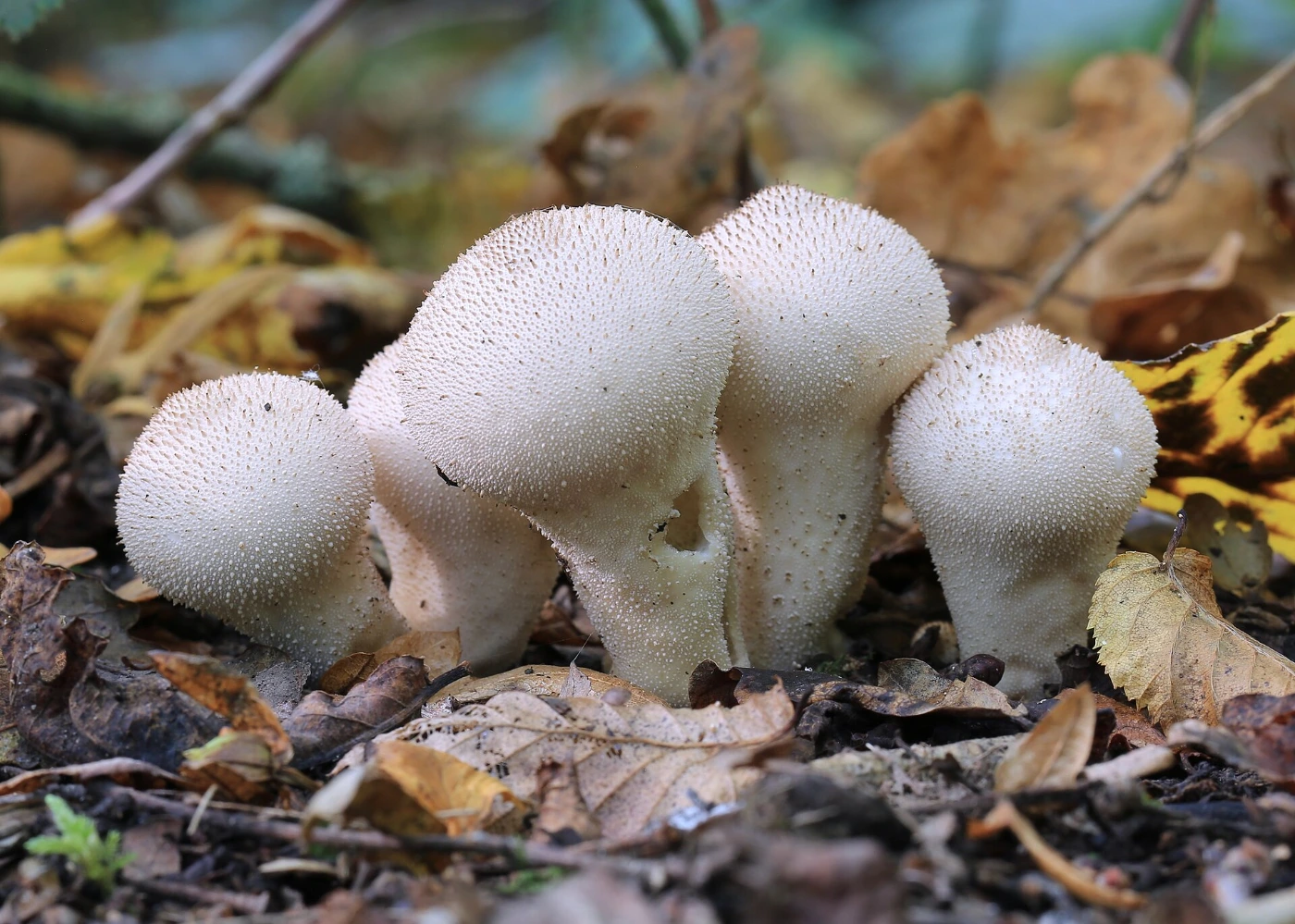
Lycoperdon perlatum, commonly known as the Common Puffball, is one of the most widespread and easily recognized puffballs in temperate forests. Young specimens are white to cream, pear-shaped, and covered with small pointed warts that often look like tiny pearls or short spines.
As the mushroom ages, these surface decorations fall away and leave a distinctive net-like pattern. The interior also changes dramatically, from solid white flesh in young mushrooms to an olive-brown mass of mature spores.
⚠️ Important: A young puffball considered for eating must be cut vertically from top to bottom. The inside should be completely uniform and white, with no developing cap, gills, stem, or other internal structures.
Quick Identification
| Feature | Lycoperdon perlatum |
|---|---|
| Common name | Common Puffball |
| Shape | Pear-shaped to rounded |
| Surface | Covered with small pointed warts or “pearls” |
| Surface after warts fall | Fine net-like pattern |
| Color when young | White to cream |
| Color when mature | Tan, ochre, olive-brown |
| Stem | Short, sterile base |
| Young interior | Solid, homogeneous white |
| Mature interior | Olive-brown spore mass |
| Spore release | Through an opening at the top |
| Habitat | Woodland, leaf litter, sometimes grassland |
| Growth | Usually in groups |
| Season | Summer to late autumn |
| Ecology | Saprotrophic |
| Edibility | Edible only when young, correctly identified, and white throughout |
| Main look-alikes | Earthballs, young Amanitas, other puffballs |
What Does Lycoperdon perlatum Look Like?
Common Puffball has a rounded upper section and a narrower base that gives the fruit body a pear-like shape. Most specimens are only a few centimeters tall, although size varies with age and growing conditions.
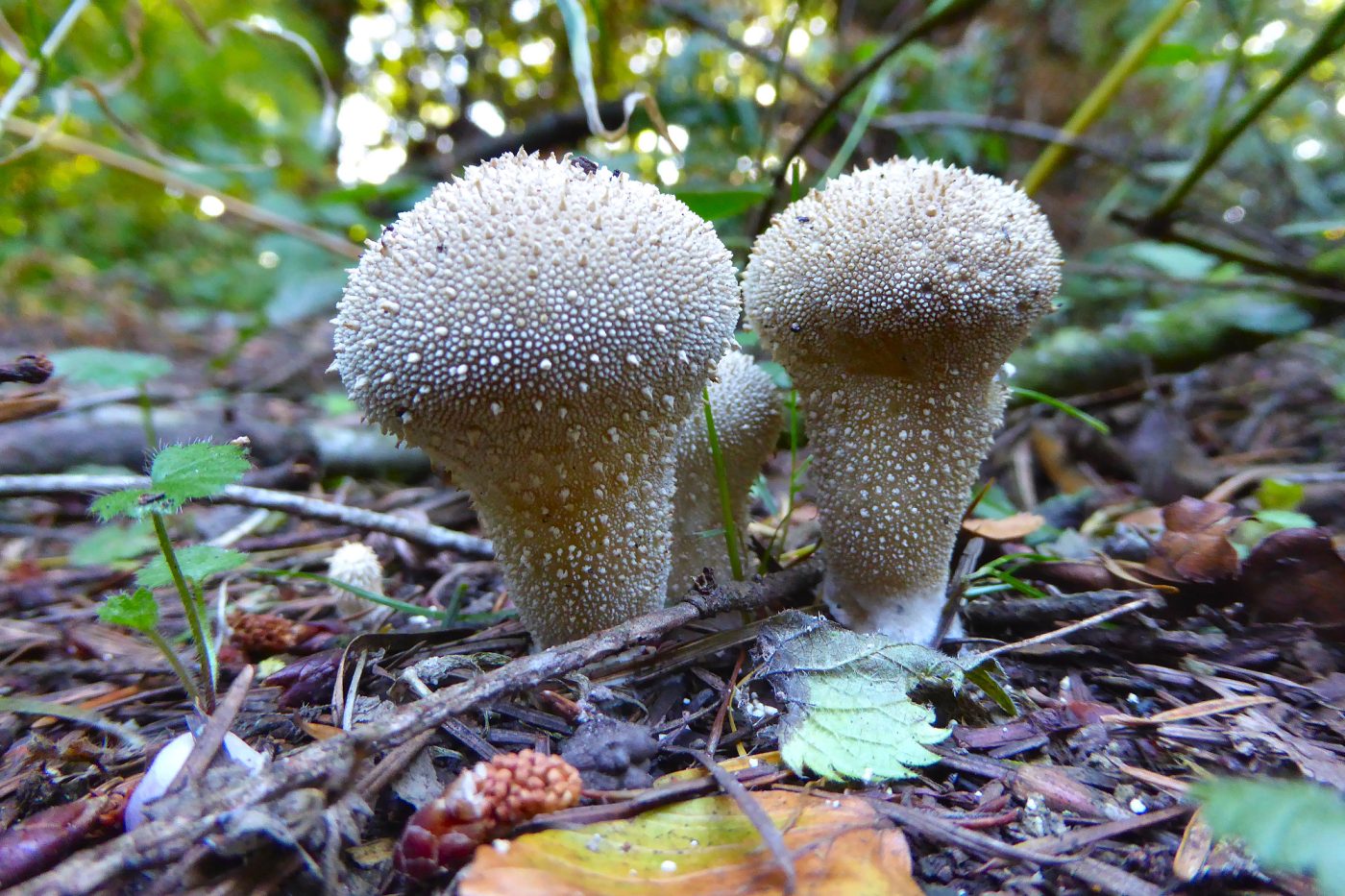
The young surface is covered with numerous small projections. Larger pointed warts are often surrounded by smaller ones, creating the characteristic textured appearance.
Surface Warts and Spines
The surface decorations are one of the most useful identification features. They are usually pale when young and can be rubbed off relatively easily as the mushroom matures.
When they disappear, they often leave small circular scars. Together these scars form a delicate reticulated or net-like pattern over the outer surface.
Why the Net Pattern Matters
Many puffballs have warts or spines, but not all leave the same fine pattern after they fall away. On Lycoperdon perlatum, the remaining surface can look almost like a mesh.
This pattern is especially useful on older specimens whose original white coloration has faded. Even when most surface warts are gone, their scars can still support the identification.
Shape
The upper part is usually rounded or slightly flattened, while the lower section narrows into a short sterile base. This gives the species a classic pestle- or pear-like outline.
Unlike a normal cap-and-stem mushroom, there is no separate cap. The entire fruit body forms one enclosed structure while young.
Color
Young Common Puffballs are white or creamy white. They gradually become beige, ochre, tan, and eventually brown as the spores mature.
Weather can accelerate this change. Rain and age can make older fruit bodies look much darker and less recognizable than fresh white specimens.
Interior
The interior is one of the most important features to examine. In a young specimen it should be completely solid, uniform, and white from top to bottom.
There should be no outline of a cap, gills, stem, or other mushroom structures. Any visible internal anatomy means the specimen is not a true puffball in the edible young stage.
How the Interior Changes With Age
As spores develop, the white flesh gradually becomes yellowish, olive, and then brown. At this point the mushroom is no longer suitable for culinary use.
Eventually almost the entire upper interior becomes a powdery spore mass. Only the lower sterile base remains more solid.
Spore Release
A mature Common Puffball develops a small opening at the top. Pressure from raindrops, animals, footsteps, or a light touch can force spores through this opening in a visible cloud.
This “puff” of spores is the origin of the common name puffball. Mature specimens may continue releasing spores for a considerable time as long as the fruit body remains intact.
Stem-Like Base
The lower part is sterile and does not contain the same spore-producing tissue as the rounded head. It can make the mushroom look as if it has a short thick stem.
This base is not a true stem like that of a bolete or gilled mushroom. The transition from upper body to base is usually gradual rather than sharply separated.
Where Does Common Puffball Grow?
Lycoperdon perlatum is a decomposer that grows on the ground where it breaks down organic material. Woodland is the classic habitat, particularly areas with leaf litter and decaying plant debris.
Both deciduous and coniferous forests can support it. It can also occur along paths, woodland edges, and occasionally in grassland.
Woodland Habitat
Common Puffballs often appear among fallen leaves, needles, moss, and small pieces of decaying wood. They may form loose groups, lines, or clusters rather than growing as isolated fruit bodies.
A productive site can produce new puffballs over several weeks. Different ages are often visible together, from small white young mushrooms to brown mature specimens.
Grassland and Paths
Although strongly associated with woodland, the species can also occur in grassy areas with sufficient organic matter. Woodland paths and disturbed ground are particularly suitable.
This habitat overlap can bring it into contact with earthballs. The internal structure and surface texture are therefore more useful than location alone.
Season
Common Puffball typically fruits from summer through autumn. In many European regions it can still be found into November when weather remains mild.
The exact season varies with latitude, rainfall, and temperature. Moist periods following dry weather can trigger noticeable flushes.
Distribution
Lycoperdon perlatum is widely distributed and has been reported across Europe, North America, Asia, and many other parts of the world. It is one of the better examples of a familiar mushroom with a very broad geographic range.
Its appearance is relatively consistent across much of this range. Regional identification should still consider similar local puffballs, but the species itself is genuinely widespread.
Is Lycoperdon perlatum Edible?
Common Puffball is generally regarded as edible when it is young, correctly identified, and completely white inside. Once the interior begins turning yellow, olive, or brown, it should not be eaten.
The most important safety step is cutting the mushroom vertically. A homogeneous white interior supports a young puffball, while visible internal structures may reveal a potentially dangerous Amanita button.
What Does a Young Edible Puffball Look Like Inside?
A young Common Puffball should look almost like a solid piece of white foam when cut open. The texture should be even and uninterrupted.
There should be no outline of a miniature mushroom inside. This distinction matters because some Amanitas begin as enclosed egg-like structures before the cap and stem emerge.
Look-Alikes
Common Puffball has several similar species, but the most important safety comparisons are with earthballs and young Amanitas. Other true puffballs usually differ in surface texture, size, or overall shape.
Scleroderma citrinum — Common Earthball
Identification
Common Earthball is usually more rounded and has a thick, tough outer skin. Its surface is often yellow-brown or ochre and divided into coarse scales or cracked patches.
The inside becomes dark gray, purple-brown, or nearly black much earlier than in a true young puffball. The interior is usually dense and dark rather than soft, uniform white.
Main Difference
Cut the fruit body open. A young Lycoperdon perlatum should be pure white inside, while an earthball commonly shows a darker interior and much thicker skin.
Young Amanita Species
Identification
Young Amanitas can emerge as rounded white “eggs” enclosed in universal veil tissue. From the outside, they can superficially resemble puffballs.
When cut vertically, however, the internal mushroom is visible. The developing cap, gills, and stem form a recognizable miniature mushroom inside the outer covering.
Main Difference
A true young puffball has no internal cap, no gills, and no stem structure. Any organized mushroom anatomy inside rules out Lycoperdon perlatum.
Lycoperdon echinatum — Spiny Puffball
Identification
Spiny Puffball has longer, more conspicuous spines that often form clusters. It usually becomes reddish-brown or darker much earlier than Common Puffball.
The overall body can be similar in size and shape. The surface texture provides the easiest distinction.
Main Difference
Lycoperdon echinatum has long obvious spines, while L. perlatum has shorter pearl-like warts and a paler overall appearance.
Lycoperdon mammiforme — Flaky Puffball
Identification
Flaky Puffball begins pale but develops large irregular flakes or scales on its surface. These are broader and more dramatic than the small pearl-like warts of Common Puffball.
It is also generally larger and can have a more conspicuously layered surface. Habitat may overlap in deciduous woodland.
Main Difference
Large cream-colored flakes favor Lycoperdon mammiforme. Numerous small pointed warts that leave a fine mesh pattern favor L. perlatum.
Lycoperdon excipuliforme — Pestle Puffball
Identification
Pestle Puffball is much larger and taller, with a conspicuous elongated sterile base. Mature fruit bodies can look almost club-shaped.
Its surface also carries warts when young, but the proportions are very different. The long base can remain standing after the upper spore-bearing section has broken down.
Main Difference
Size and shape are the easiest clues. L. excipuliforme is tall and pestle-shaped, while Common Puffball is smaller and compactly pear-shaped.
Apioperdon pyriforme — Stump Puffball
Identification
Stump Puffball commonly grows in dense groups on decaying wood, buried roots, or old stumps. Its surface is generally smoother and lacks the prominent pearl-like warts of Common Puffball.
It may appear to grow from soil when the wood is buried. Large colonies containing many nearly identical fruit bodies are characteristic.
Main Difference
Substrate is particularly useful here. Stump Puffball is closely tied to dead wood, while Lycoperdon perlatum usually grows terrestrially in woodland litter.
Common Puffball vs Earthball
| Feature | Common Puffball | Common Earthball |
|---|---|---|
| Scientific name | Lycoperdon perlatum | Scleroderma citrinum |
| Young surface | Pale with pointed warts | Thick, coarse, cracked or scaly |
| Outer wall | Relatively thin | Thick and tough |
| Young interior | Pure white | Often grayish to dark |
| Mature interior | Olive-brown spores | Dark purple-brown to black |
| Shape | Pear-shaped | More rounded |
| Edibility | Young specimens edible when correctly identified | Inedible / toxic |
| Best clue | White homogeneous interior | Thick skin + dark interior |
This is one of the most useful puffball comparisons to learn. Earthballs can appear deceptively similar from above, but the interior usually tells a very different story.
Common Puffball vs Amanita Egg
| Feature | Common Puffball | Young Amanita |
|---|---|---|
| Outer shape | Rounded or pear-shaped | Egg-shaped |
| Cut surface | Uniform white | Internal mushroom structures |
| Gills inside | No | Developing gills visible |
| Stem inside | No | Developing stem visible |
| Cap inside | No | Developing cap visible |
| Main safety clue | Completely homogeneous | Organized internal anatomy |
This is the most important safety check for beginners. Cutting every young puffball vertically removes much of the ambiguity.
How to Identify Lycoperdon perlatum
Look first at the surface and shape. A small pear-shaped puffball with short pale warts and no conventional cap or gills is a good starting point.
Then examine the scars left when some of the warts fall away. A fine mesh-like pattern strongly supports Common Puffball.
Finally, cut a young specimen vertically if accurate identification matters. A uniform white interior confirms the expected puffball structure and rules out a developing gilled mushroom.
Young vs Mature Common Puffballs
Young mushrooms are pale, firm, and covered with distinct warts. Their interior is white and fleshy.
Mature specimens become brown, lose many of their surface projections, and develop a powdery interior. The opening at the top eventually becomes the main visible feature.
Common Identification Mistakes
One common mistake is calling every small round mushroom a puffball. Earthballs, stinkhorn eggs, and young Amanitas can all begin as enclosed rounded structures.
Another mistake is using only the outside surface. Cutting the mushroom open reveals information that cannot be seen from a photograph of the cap-like exterior.
A third mistake is assuming that a brown mature puffball is simply an older edible specimen. Once the interior has begun changing color and forming spores, the culinary stage has passed.
How to Photograph Common Puffball
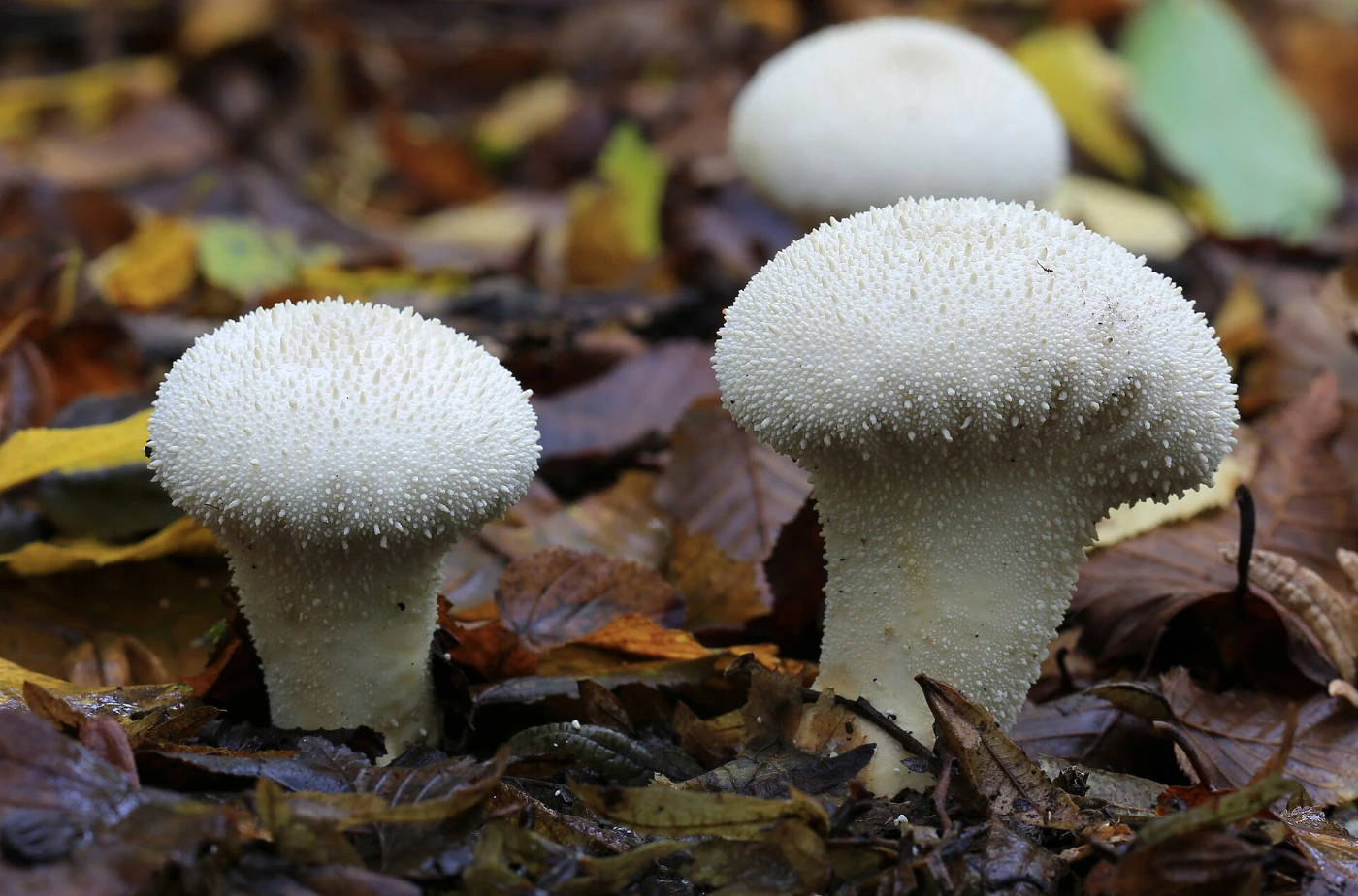
Photograph the entire fruit body from the side so its pear-shaped profile and short base are visible. A close-up of the surface is particularly useful because the small warts and net-like scars are diagnostic.
For young specimens, a photograph of a clean vertical cross-section provides even stronger evidence. Showing both exterior and interior makes photo-based identification much more reliable.
Can AI Identify Lycoperdon perlatum?
Typical Common Puffballs are relatively suitable for image identification because the combination of shape and surface texture is distinctive. Older smooth specimens are harder because many identifying warts may already have disappeared.
A cross-section greatly improves the result when a young puffball is involved. AI should not be relied upon to decide edibility when the interior and potential Amanita structures have not been checked directly.
Interesting Facts
The Common Puffball’s surface decorations are temporary. As the mushroom matures, they fall away and leave a surprisingly intricate pattern beneath them.
Its spore-release system also reacts to physical impact. A raindrop hitting a mature puffball can compress the fruit body and send a cloud of spores through the opening at the top.
The genus name Lycoperdon has traditionally been interpreted from Greek words associated with “wolf” and “breaking wind.” The name refers humorously to the clouds of brown spores released from mature puffballs.
Common Puffballs also illustrate how dramatically one fungal fruit body changes during development. A firm white mushroom can eventually become a lightweight shell filled with millions of dry spores.
Frequently Asked Questions
Does Lycoperdon perlatum always have visible spines?
Not on older specimens. The warts gradually fall away and leave a fine network of scars, so mature mushrooms can look much smoother than young ones.
Can Common Puffballs grow in groups?
Yes. They frequently occur in small groups or scattered colonies in woodland litter. Finding several fruit bodies at different ages is common.
Why is the inside of my puffball yellow?
Yellowing indicates that the spore-producing tissue has begun to mature. A young culinary-stage puffball should be completely white inside.
Can a mature puffball still release spores after it dries?
Yes. Dry mature fruit bodies can persist and continue releasing spores when compressed by rain, animals, or other disturbances.
Does Common Puffball grow on dead wood?
It normally grows terrestrially in woodland litter rather than directly from wood. A dense group clearly attached to a stump or log is more suggestive of Stump Puffball.
Are all white puffballs edible when young?
No. Identification still matters, and some superficially similar rounded fungi are not true puffballs. A white exterior alone is never enough.
Why should a puffball be cut from top to bottom?
A vertical cut exposes the entire internal structure. This makes developing cap, gills, or stem structures inside an Amanita egg much easier to detect.
Can Common Puffball occur in North America and Europe?
Yes. Lycoperdon perlatum is a broadly distributed species and occurs on both continents as well as in many other regions.
Final Identification Notes
Lycoperdon perlatum is best recognized by its small pear-shaped fruit body, pale pearl-like warts, fine net pattern left after the warts fall away, and completely white homogeneous interior when young. Mature mushrooms become brown and release spores through an opening at the top.
The main true puffball look-alikes differ in surface texture, size, or substrate. The most important safety comparisons are with earthballs and young Amanitas, which can be separated by cutting the entire fruit body vertically.
The practical field pattern is: pear-shaped puffball + short pearl-like warts + net-like scars + uniform white interior when young = strong Lycoperdon perlatum candidate.
Upload a photo and get possible matches in seconds.