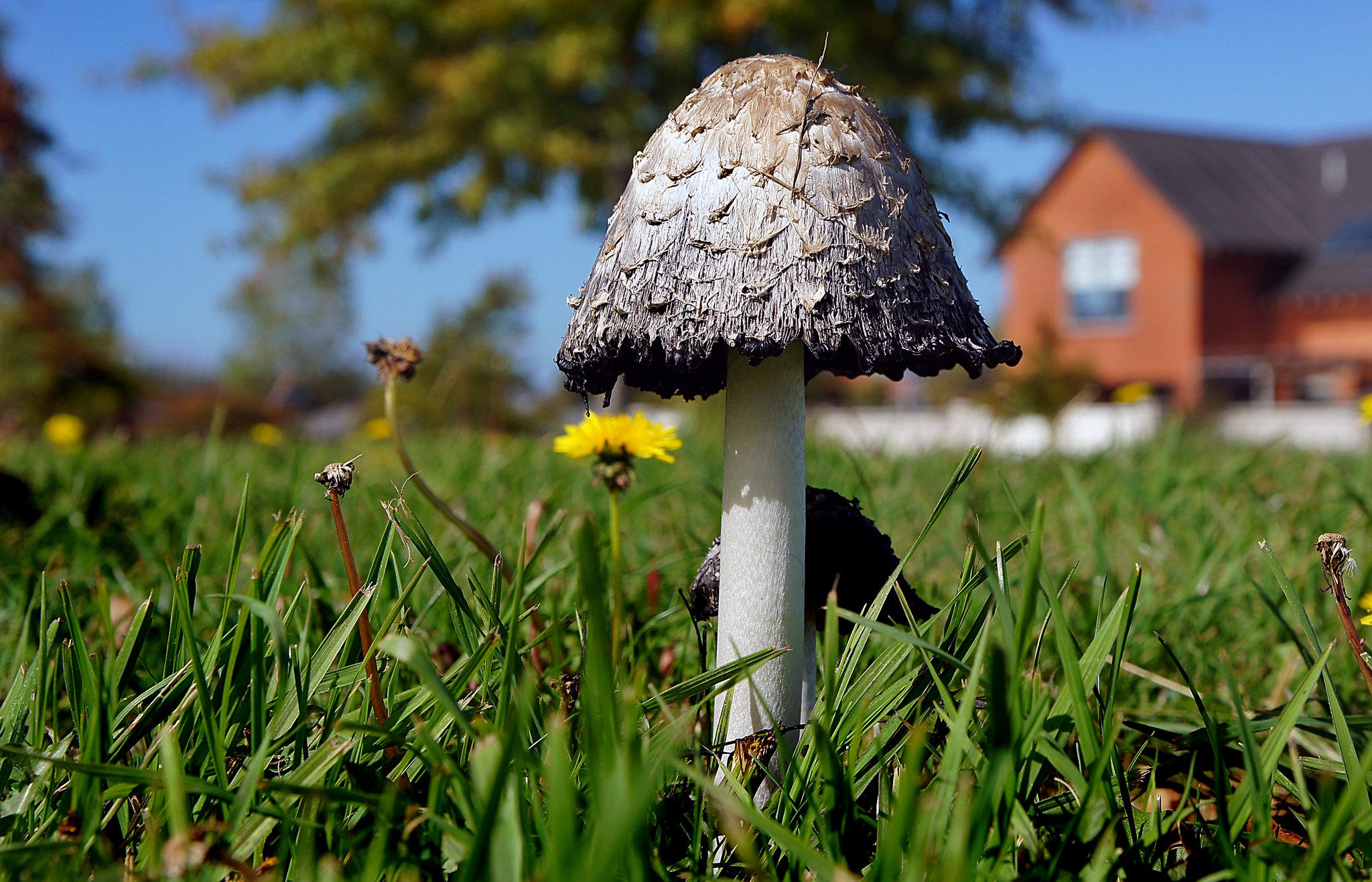
Coprinus comatus, commonly known as the Shaggy Mane or Lawyer’s Wig, is one of the most distinctive mushrooms found in lawns, parks, roadsides and disturbed ground. Young specimens have tall white cylindrical caps covered with shaggy scales, but the mushroom changes dramatically as it matures.
Within a short period, the cap opens, the gills turn from white to pink and then black, and the mushroom begins to dissolve into a dark ink-like liquid. This process, known as deliquescence, makes mature Shaggy Manes almost unrecognizable compared with young fruit bodies.
⚠️ Important: This guide is for identification and education only. Never eat a wild mushroom based solely on a photograph, AI result, or comparison with an online guide.
Quick Identification
| Feature | Coprinus comatus |
|---|---|
| Scientific name | Coprinus comatus |
| Common names | Shaggy Mane, Shaggy Ink Cap, Lawyer’s Wig |
| Family | Agaricaceae |
| Young cap | Tall, cylindrical, white and shaggy |
| Mature cap | Bell-shaped, darkening from the edge |
| Gills | White, then pink, then black |
| Stem | Tall, white, hollow |
| Ring | Thin and movable or easily detached |
| Spore print | Black |
| Habitat | Lawns, roadsides, parks and disturbed ground |
| Growth | Solitary, scattered or in groups |
| Main season | Usually spring through autumn |
| Edibility | Edible when young and correctly identified |
| Main look-alikes | Common Ink Cap, Magpie Inkcap, other inkcaps |
What Does Coprinus comatus Look Like?
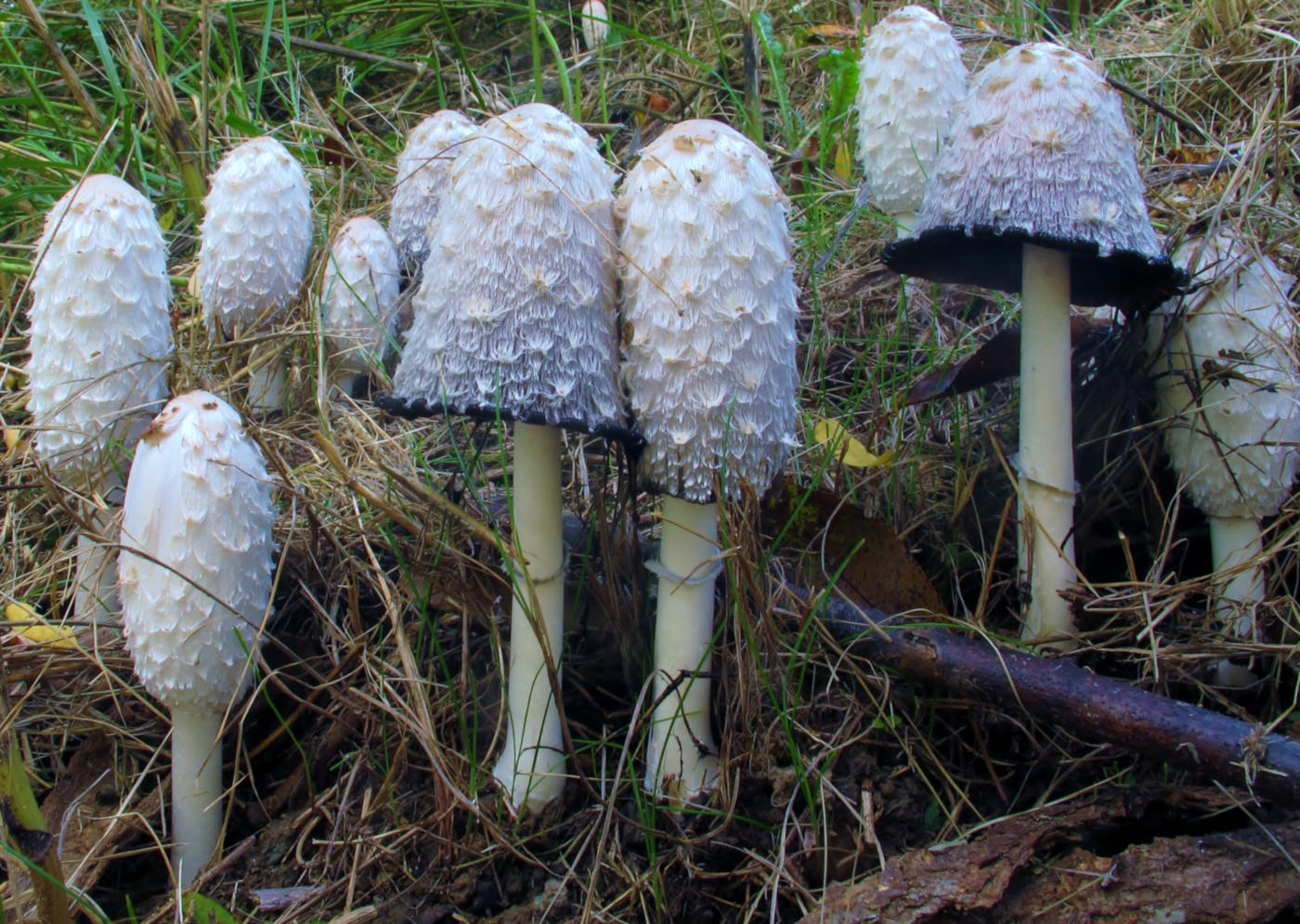
A young Shaggy Mane has a distinctive elongated cap that resembles a closed umbrella, white cylinder or narrow egg. The cap is covered with loose white scales, often with a tan or light brown patch at the top.
As the mushroom grows, the lower edge begins to separate from the stem and darken. The cap gradually becomes bell-shaped while the outer edge turns pinkish, gray and eventually black.
The transformation can happen quickly, particularly during warm or wet weather. A fresh mushroom in the morning may already be partly liquefied by later the same day.
Cap
The cap is usually around 5–15 cm tall when fully developed, although size varies. Young specimens are much taller than they are wide and often completely surround the upper section of the stem.
The shaggy scales are one of the species’ most recognizable features. They create a rough, torn or feathery surface rather than the smooth cap seen in many other lawn mushrooms.
The center of the cap may remain pale brown or tan even while the rest is bright white. As deliquescence begins, the margin darkens first and the blackened area gradually moves upward.
Gills
The gills are initially white and tightly packed. As spores mature, they become pale pink, then deeper gray or purple-black, and finally black.
This color progression occurs rapidly. Once the gills darken, the surrounding cap tissue begins to break down and release spores in a dark liquid.
The changing gill color is an important identification feature, but mature blackened specimens can be difficult to distinguish from other inkcaps.
Stem
The stem is tall, slender, white and usually hollow. It often becomes exposed as the cap expands upward.
A thin ring may occur around the lower or middle portion of the stem. Unlike the substantial fixed rings of many Amanitas, the Shaggy Mane ring is delicate and may move or disappear.
The stem is usually smooth or only slightly fibrous, contrasting with the strongly shaggy cap.
Spore Print
The spore print is black. Obtaining a conventional spore print can be difficult from very mature fruit bodies because the cap may begin dissolving before the process is complete.
A fresh specimen with partially opened gills is more suitable. Black spore color helps distinguish Shaggy Mane from many pale lawn mushrooms, although other inkcaps also produce dark spores.
Spore print should therefore support, rather than replace, the characteristic cap structure and developmental changes.
What Is Deliquescence?
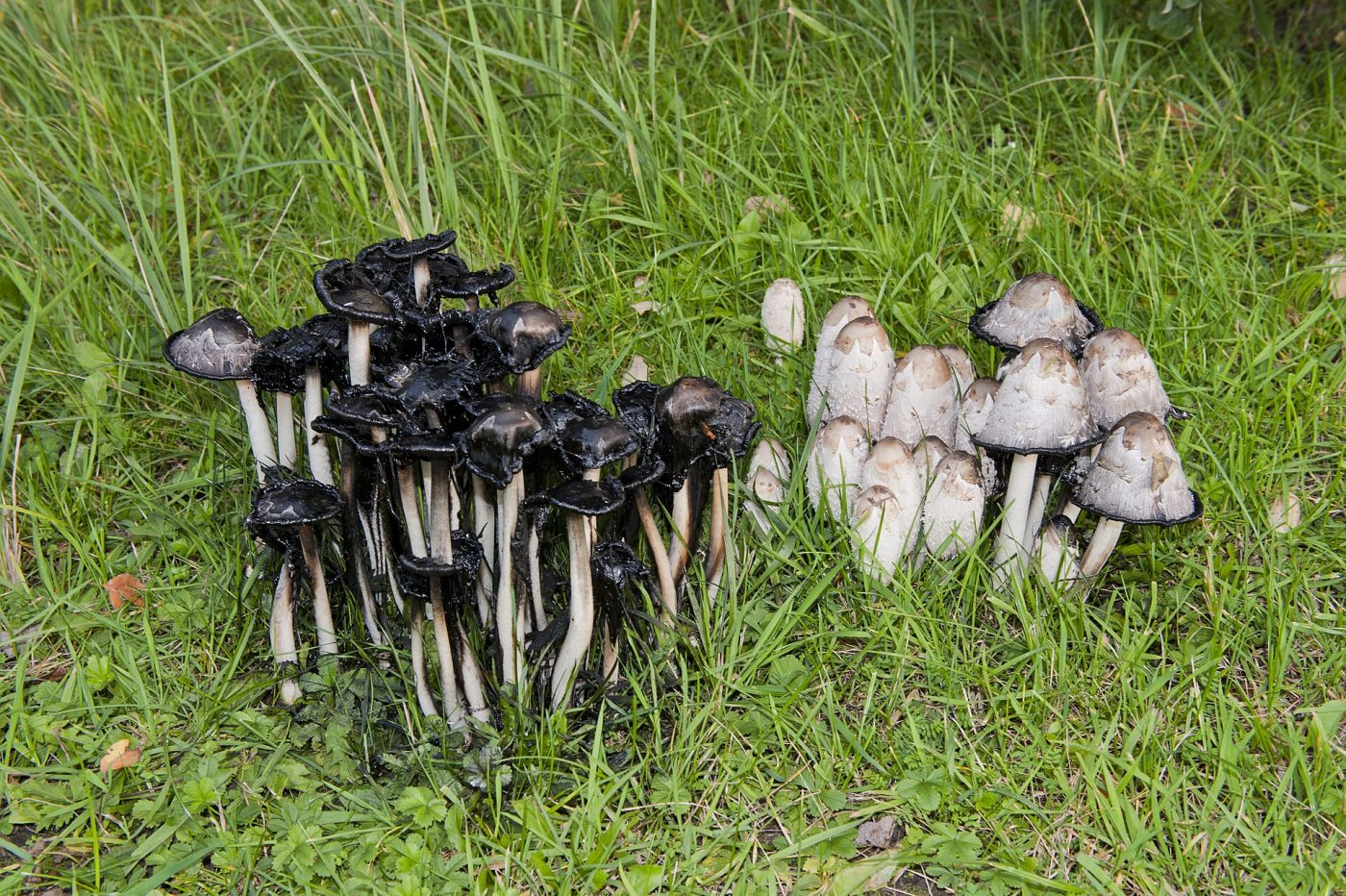
Deliquescence is the self-dissolving process that gives many inkcaps their common name. As the mushroom matures, enzymes break down the gills and cap tissue into a black liquid.
This process helps expose and release mature spores. It also means that Shaggy Manes have a very short window between fresh maturity and complete collapse.
Not all related inkcaps dissolve to the same degree, but Coprinus comatus is a classic example of the phenomenon.
Where Does Shaggy Mane Grow?
Shaggy Manes usually grow from soil rather than wood. They prefer nutrient-rich, disturbed environments and often appear in places strongly influenced by human activity.
Common habitats include lawns, parks, roadside verges, garden edges, paths, playing fields and recently disturbed soil. They can also appear in meadows and open woodland edges.
This preference for disturbed ground means they are frequently encountered in towns and suburban areas rather than only in wild forests.
Does Coprinus comatus Grow in Lawns?
Yes. Lawns are one of the classic habitats for Shaggy Mane.
The mushrooms often appear after rain and can emerge rapidly from apparently ordinary grass. Sometimes they occur in large groups, while at other times only a few fruit bodies appear.
Because lawns also support poisonous species, habitat alone is never enough for identification. The tall shaggy cap and distinctive deliquescence remain much more useful.
When Does Shaggy Mane Grow?
Shaggy Manes can appear from spring through autumn, with fruiting often increasing after periods of rain and cooler weather.
In temperate regions, large flushes are especially common during autumn. Mild climates may support additional fruiting periods outside this main season.
The same location can produce mushrooms repeatedly because the underground mycelium remains in the soil after the visible fruit bodies disappear.
Is Coprinus comatus Edible?
Yes. Young Shaggy Manes are widely regarded as edible when correctly identified.
Only specimens with white or very pale gills are normally considered suitable for food. Once the gills begin turning pink or black, the mushroom deteriorates quickly and should no longer be treated as a fresh edible specimen.
Because the mushroom changes so rapidly after harvesting, it is usually cooked soon after collection.
Shaggy Mane and Alcohol
Shaggy Mane is often confused with the Common Ink Cap, Coprinopsis atramentaria, which contains coprine and can cause unpleasant reactions when consumed with alcohol.
Coprinus comatus is not generally considered to cause the classic coprine-alcohol reaction associated with the Common Ink Cap. This distinction is important because older mushroom guides sometimes create confusion by grouping many inkcaps together.
Even so, accurate identification remains essential before consumption because similar-looking species may have different properties.
Coprinus comatus Look-Alikes
The Shaggy Mane is fairly distinctive when young, but confusion becomes more likely with older specimens or other tall inkcaps. The most useful differences involve cap texture, growth form, color and how the mushroom changes with age.
Coprinopsis atramentaria — Common Ink Cap
- Scientific name: Coprinopsis atramentaria
- Common names: Common Ink Cap, Tippler’s Bane
The Common Ink Cap often grows in dense clusters around buried wood, old stumps and tree roots. Its cap is smooth to slightly grooved and gray or gray-brown rather than strongly shaggy and white.
Both species eventually darken and deliquesce, but the young forms look quite different. Shaggy Mane has a tall white scaly cap, while Common Ink Cap is usually smoother and more bell-shaped.
The Common Ink Cap contains coprine, which can interfere with alcohol metabolism and cause flushing, nausea, headache and other unpleasant symptoms if alcohol is consumed around the same time.
Shaggy Mane vs Common Ink Cap
| Feature | Coprinus comatus | Coprinopsis atramentaria |
|---|---|---|
| Young cap | Tall, white and shaggy | Gray to gray-brown, smoother |
| Scales | Prominent | Weak or absent |
| Growth | Solitary or grouped | Often dense clusters |
| Substrate | Soil | Often buried wood or roots |
| Deliquescence | Strong | Strong |
| Alcohol interaction | Not typical | Coprine reaction possible |
| Edibility | Edible when young and correctly identified | Complicated by alcohol interaction |
This comparison is most useful with young mushrooms. Once both species have begun dissolving into black liquid, many of their distinguishing features are lost.
Coprinopsis picacea — Magpie Inkcap
- Scientific name: Coprinopsis picacea
- Common names: Magpie Inkcap, Magpie Fungus
The Magpie Inkcap is a striking species with a dark brown to almost black cap decorated with large white patches. It often grows in deciduous woodland rather than open lawns.
Young specimens can have a tall shape somewhat reminiscent of Shaggy Mane, but the dark background color under the white patches quickly separates the two.
The overall appearance resembles the black-and-white plumage of a magpie, which explains the common name.
Coprinellus micaceus — Mica Cap
- Scientific name: Coprinellus micaceus
- Common name: Mica Cap
Mica Caps are much smaller than typical Shaggy Manes and grow in clusters from buried wood, tree bases and decaying roots.
Their caps are honey-brown to amber and may be covered in tiny reflective granules when young. These granules can wash away after rain.
They also darken with age, but their size, color and clustered growth pattern make them quite different from the tall white Shaggy Mane.
Leucocoprinus Species
Some pale Leucocoprinus species have white scaly caps and can superficially resemble young Shaggy Manes.
However, they usually have a more conventional umbrella-shaped cap rather than the elongated cylindrical form of Coprinus comatus. They also do not undergo the dramatic black deliquescence characteristic of inkcaps.
The gills generally remain pale rather than passing rapidly through pink to black.
How to Identify Shaggy Mane Step by Step
Begin with the cap shape. A young Shaggy Mane should be tall, cylindrical or elongated and covered with conspicuous shaggy white scales.
Next, examine the gills. Fresh specimens begin with white gills that gradually become pink and then black as the mushroom matures.
Finally, consider habitat and aging behavior. Growth from disturbed soil combined with rapid black deliquescence strongly supports Coprinus comatus.
If the mushroom has a smooth gray cap or is growing in a dense cluster around buried wood, another inkcap species may be more likely.
How to Photograph Shaggy Mane for Identification
Photograph young specimens before they begin to dissolve. The complete cap shape and shaggy scales are easiest to evaluate at this stage.
Take an additional image of the gills if the cap has opened enough to expose them. A wider photograph showing the lawn, roadside or other substrate can provide useful habitat information.
If several mushrooms at different ages are present, include them in the same series. The transition from white cylindrical cap to black deliquescing fruit body is highly characteristic.
Can Shaggy Mane Be Identified From a Photo?
Young typical specimens are among the easier lawn mushrooms to recognize from photographs because the tall white shaggy cap is distinctive.
Confidence decreases as the mushroom matures. Once most of the cap has turned black and dissolved, structural differences between inkcap species become much harder to see.
AI identification can therefore work well on fresh specimens but should still be checked against habitat, cap texture and gill development.
Why Does Shaggy Mane Turn Black?
The black color comes from mature spores and the breakdown of cap tissue during deliquescence.
The process starts at the edge of the cap and gradually moves upward. Pinkish gills indicate the beginning of maturation, followed by dark gray and eventually black tissue.
This rapid change is normal and does not mean the mushroom has been attacked by mold or disease.
Why Does Shaggy Mane Appear So Quickly?
The underground fungus can remain hidden in soil for long periods. When moisture and temperature become favorable, fruit bodies can develop very rapidly.
After rain, a cluster may seem to appear almost overnight. Because the mushrooms also mature and dissolve quickly, their entire visible life cycle can be remarkably short.
This makes timing important for both observation and photography.
Does Shaggy Mane Grow on Wood?
It normally appears terrestrial, growing from soil rather than directly from visible wood.
However, disturbed ground can contain buried organic material, and other inkcap species commonly grow from buried roots and timber. If a mushroom is tightly clustered around an old stump or tree base, Coprinopsis or Coprinellus species should also be considered.
Substrate is therefore useful for distinguishing look-alikes.
Interesting Facts About Coprinus comatus
The species name comatus means “hairy” or “shaggy,” referring to the scales covering the cap. The common name Lawyer’s Wig compares the young white cap with the traditional curled wigs once worn in legal courts.
Shaggy Mane was historically grouped with many other inkcaps in the genus Coprinus. Modern classification has moved numerous former members into genera such as Coprinopsis and Coprinellus, while Coprinus comatus remains in Coprinus.
This means mushrooms commonly called “inkcaps” are not necessarily each other’s closest relatives, despite sharing similar deliquescing behavior.
Frequently Asked Questions
What does a Shaggy Mane mushroom look like?
A young Shaggy Mane has a tall cylindrical white cap covered with shaggy scales. As it matures, the cap opens and the gills progress from white to pink and then black.
Where does Coprinus comatus grow?
It commonly grows in lawns, parks, roadsides, paths and other disturbed soils.
Is Shaggy Mane edible?
Yes, young correctly identified specimens with white gills are widely regarded as edible. Mature darkening mushrooms deteriorate rapidly and are not suitable as fresh edible specimens.
Why does Shaggy Mane turn into black liquid?
The mushroom undergoes deliquescence, an enzymatic process that breaks down the cap and gills while spores mature.
Does Shaggy Mane react with alcohol?
The classic alcohol reaction is associated with Coprinopsis atramentaria, the Common Ink Cap, rather than Coprinus comatus.
What is the main Shaggy Mane look-alike?
The Common Ink Cap is an important comparison, especially because both eventually dissolve into black liquid. Young specimens are easier to separate by cap texture and color.
What color is the Shaggy Mane spore print?
The spore print is black.
Do Shaggy Manes grow in groups?
Yes. They may appear singly, scattered or in groups, sometimes with many fruit bodies emerging from the same area.
When do Shaggy Manes grow?
They can fruit from spring through autumn, with especially large flushes often occurring after rain.
Can you identify Shaggy Mane after it turns black?
Identification becomes much harder once the cap has largely deliquesced. Young specimens preserve the most useful characteristics.
Final Identification Notes
A typical Coprinus comatus combines a tall cylindrical white cap covered in shaggy scales, a slender white stem, gills that change from white to pink and then black, and growth from lawns or other disturbed soil.
Its rapid transformation is just as characteristic as its initial appearance. The cap gradually opens and dissolves into black liquid, sometimes within hours of reaching maturity.
The most important look-alike is the Common Ink Cap, which is generally smoother, grayer and more strongly associated with buried wood and dense clusters. For the strongest identification, combine cap texture, gill development, substrate, growth pattern and the characteristic deliquescence.