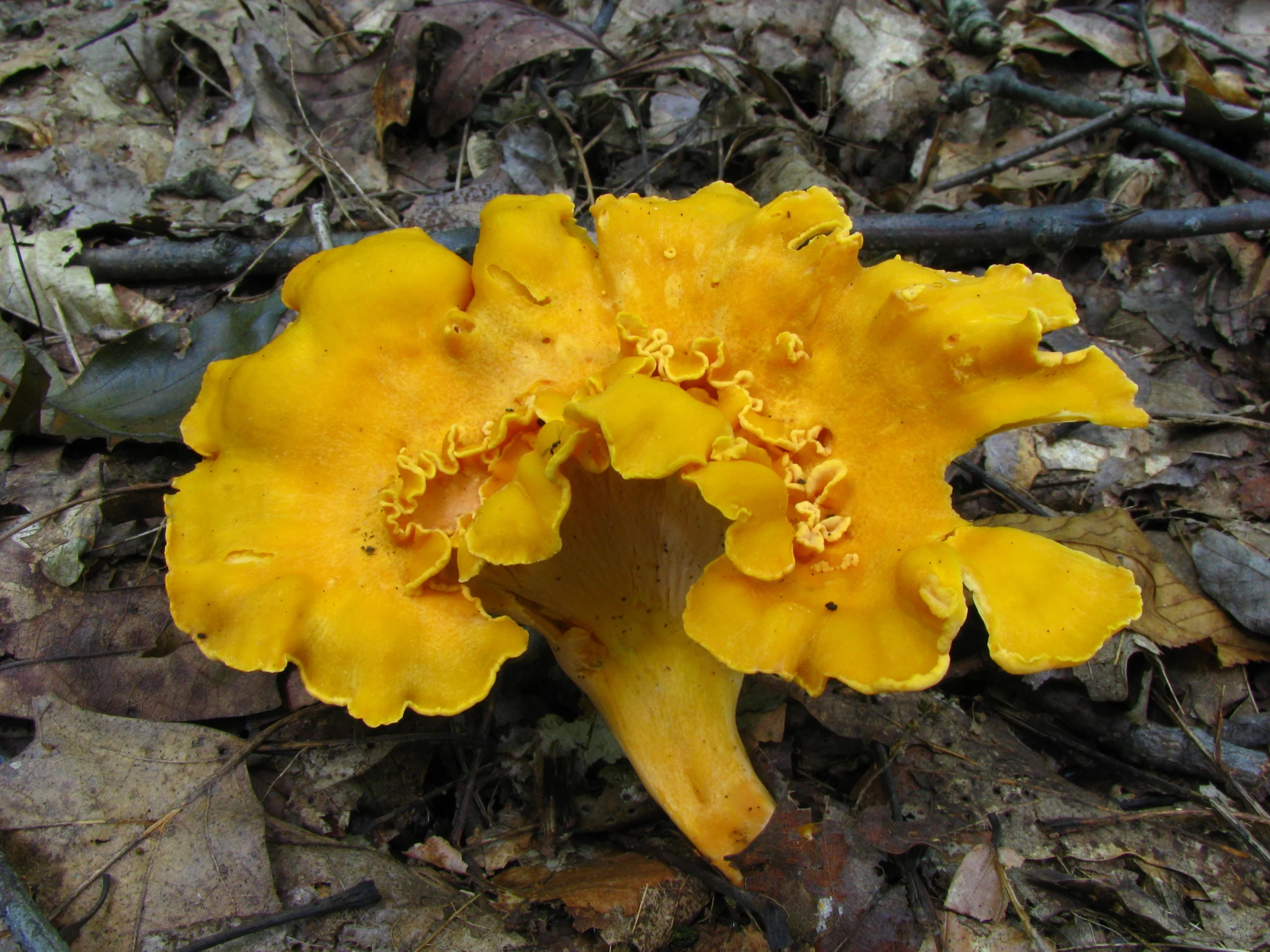
Cantharellus lateritius, commonly known as the Smooth Chanterelle, is a widespread chanterelle of eastern North America. It is a bright yellow to orange mushroom found on the forest floor, particularly in association with hardwood trees such as oaks.
Unlike many familiar golden chanterelles, the Smooth Chanterelle may have an almost completely smooth underside rather than prominent false gills. This unusual feature gives the species its common name and makes it especially interesting for mushroom identification.
⚠️ Important: This guide is for identification and education only. Never eat a wild mushroom based solely on a photograph, AI result, or comparison with an online guide.
Quick Identification
| Feature | Cantharellus lateritius |
|---|---|
| Scientific name | Cantharellus lateritius |
| Common name | Smooth Chanterelle |
| Family | Cantharellaceae |
| Cap color | Yellow to orange-yellow |
| Cap shape | Convex when young, becoming flat or funnel-shaped |
| Underside | Smooth to shallowly wrinkled |
| True gills | Absent |
| Stem | Solid, yellow to orange |
| Flesh | Pale, firm and solid |
| Spore print | Pale cream to yellowish |
| Ecology | Mycorrhizal |
| Habitat | Hardwood forests |
| Common tree association | Especially oaks |
| Distribution | Eastern North America |
| Main season | Summer into early autumn |
| Edibility | Edible when correctly identified |
| Major look-alikes | Jack-o’-Lantern mushrooms, other chanterelles, False Chanterelle |
What Does Cantharellus lateritius Look Like?
The Smooth Chanterelle is typically yellow, golden-yellow or orange-yellow throughout. Young mushrooms begin with rounded or convex caps, but the center gradually becomes depressed as the fruit body expands.
Older specimens may develop the broad funnel shape associated with many chanterelles. The cap margin often becomes irregular or wavy rather than remaining perfectly circular.
The most distinctive feature is found underneath the cap. Instead of thin blade-like gills, the fertile surface may be almost smooth or covered only with shallow wrinkles.
Cap
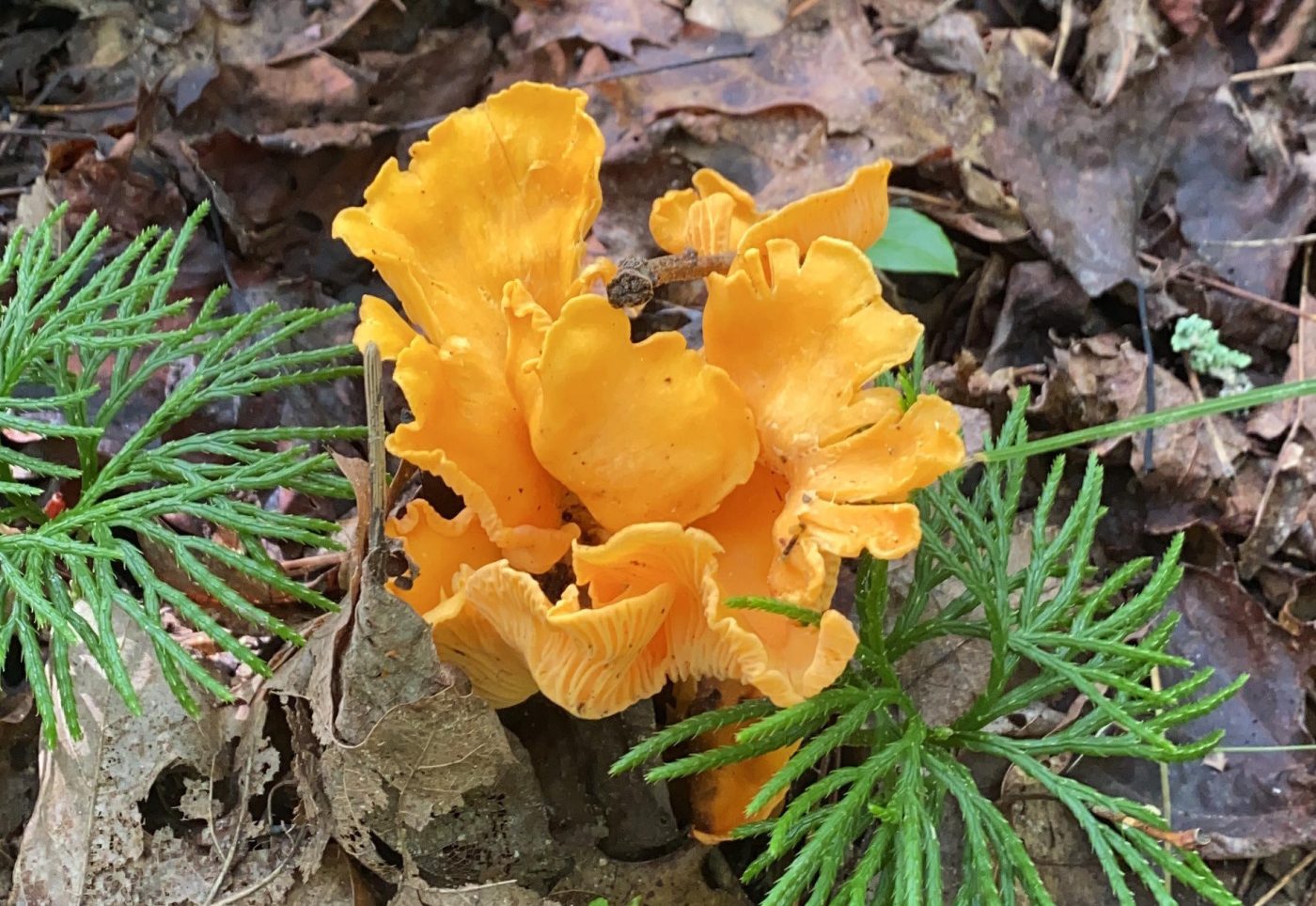
The cap is usually several centimeters across and can become relatively large under favorable conditions. Its surface is generally smooth rather than scaly or fibrous.
Color varies from pale yellow to rich egg-yolk yellow and orange-yellow. Older specimens can fade, particularly after prolonged rain or exposure to sunlight.
The cap margin often starts curved downward. As the mushroom matures, it expands and may become lobed, uneven or strongly wavy.
Smooth Underside
The underside is the feature that separates Cantharellus lateritius most clearly from many other chanterelles.
In typical specimens, the fertile surface is almost smooth. Other fruit bodies may develop shallow wrinkles or low ridges running partly down the stem.
These structures are not true gills. They are part of the mushroom’s continuous surface rather than separate blade-like plates.
This distinction is extremely important because poisonous orange mushrooms such as Jack-o’-Lanterns have genuine, thin gills.
Does the Smooth Chanterelle Have Gills?
No. Cantharellus lateritius does not have true gills.
Depending on the specimen, the underside can range from nearly smooth to shallowly wrinkled. Some individuals develop more pronounced folds and may become difficult to separate visually from related chanterelles.
True gills have thin edges and can usually be distinguished as individual blade-like structures. Chanterelle folds are thicker, blunter and integrated into the flesh of the cap.
Stem
The stem is usually solid and relatively thick. Its color is generally similar to the cap or slightly paler.
The stem blends gradually into the cap rather than meeting it at a sharply defined boundary. There is no ring or volva.
When cut lengthwise, the mushroom should have firm solid flesh rather than a hollow stem.
Flesh
The flesh is firm and pale, often whitish to pale yellow inside. Unlike many fragile gilled mushrooms, chanterelles have a relatively substantial texture.
The flesh does not normally show dramatic color changes when damaged. Some specimens may develop subtle discoloration with age or handling.
Texture can be useful when separating true chanterelles from thinner, more fragile look-alikes.
Smell
Chanterelles are often described as having a pleasant fruity smell, sometimes compared with apricots. The intensity varies considerably among individual mushrooms.
Smell is useful as supporting evidence but should not be treated as a required identification feature. Some specimens have only a faint odor, particularly when dry.
Structural characteristics are far more reliable than aroma alone.
Spore Print
The spore print is pale, usually cream to yellowish or slightly pinkish-cream.
This differs from the rusty, brown or dark spore prints produced by many unrelated mushrooms. However, several chanterelle species have similarly pale spores.
A spore print can support identification but is usually less useful than the underside structure and habitat.
Where Does Cantharellus lateritius Grow?
The Smooth Chanterelle grows from soil in forests rather than from logs or stumps. It forms mycorrhizal relationships with living trees, exchanging nutrients with their roots.
It is strongly associated with hardwood forests in eastern North America and is frequently found near oaks. Other hardwood associations can also occur.
Because the fungus is connected to underground roots, mushrooms may appear several meters from the visible trunk of the host tree.
Distribution in North America
Cantharellus lateritius is primarily an eastern North American species. It is widespread across suitable hardwood forests in the eastern United States and neighboring regions.
This geographic pattern is important because North America contains many different golden chanterelles. The species encountered in the Pacific Northwest are generally different from those found in eastern hardwood forests.
Older field guides often used the European name Cantharellus cibarius broadly for yellow chanterelles. Modern taxonomy recognizes considerably more North American species.
When Does the Smooth Chanterelle Grow?
Smooth Chanterelles are primarily summer mushrooms. Fruiting often begins after warm periods of substantial rainfall.
In many areas, mushrooms appear from June or July through late summer, sometimes continuing into early autumn depending on local climate.
Several flushes can occur during a wet season. Dry weather can dramatically reduce fruiting even when underground mycelium remains healthy.
How Do Chanterelles Grow?
Smooth Chanterelles may grow singly, scattered across the forest floor or in loose groups. Several mushrooms can appear in the same general area because they are associated with the same tree root systems.
They do not normally form dense fused clusters growing directly from a stump.
Finding numerous yellow mushrooms packed tightly onto visible wood should therefore suggest another identification.
Is Cantharellus lateritius Edible?
The Smooth Chanterelle is regarded as an edible chanterelle when correctly identified. Like other chanterelles, it is collected as a wild food in regions where it occurs.
The primary safety issue is not the mushroom itself but confusion with poisonous orange species, especially Jack-o’-Lantern mushrooms.
Correct identification should therefore focus on the underside structure, growth substrate and complete fruit body rather than simply recognizing a yellow-orange cap.
Smooth Chanterelle Look-Alikes
Several yellow and orange mushrooms can resemble Cantharellus lateritius. Some are closely related edible chanterelles, while others are poisonous.
The most important distinction is between chanterelle folds or a smooth fertile surface and true blade-like gills.
Jack-o’-Lantern Mushrooms — Omphalotus Species
Jack-o’-Lantern mushrooms are the most important poisonous comparison for orange chanterelles in North America.
They are orange to deep orange and often grow in large clusters from stumps, roots or buried wood. The underside contains numerous thin, sharp true gills that run down the stem.
Smooth Chanterelles grow from soil in association with living trees and have a smooth or shallowly wrinkled underside.
Smooth Chanterelle vs Jack-o’-Lantern
| Feature | Smooth Chanterelle | Jack-o’-Lantern |
|---|---|---|
| Underside | Smooth or shallow folds | True blade-like gills |
| Growth | Forest soil | Wood or buried roots |
| Pattern | Single or scattered | Often dense clusters |
| Flesh | Pale inside | Often orange-yellow |
| Ecology | Mycorrhizal | Wood decomposer |
| Edibility | Edible when correctly identified | Poisonous |
The underside is usually the fastest way to separate these mushrooms.
False Chanterelle — Hygrophoropsis aurantiaca
The False Chanterelle is an orange woodland mushroom that can resemble true chanterelles from above.
Its cap is usually orange to brownish-orange and often darker toward the center. The underside has numerous thin, forked true gills rather than the smooth surface or blunt folds of Cantharellus.
False Chanterelles are also generally thinner and less substantial in texture.
Main Difference
A Smooth Chanterelle has a solid fleshy body and a smooth to wrinkled underside. A False Chanterelle has obvious thin gills that can be distinguished individually.
Pacific Golden Chanterelle — Cantharellus formosus
Cantharellus formosus is one of the principal golden chanterelles of the Pacific Northwest.
It usually has much more developed false gills than C. lateritius. The cap may show orange, yellow-brown and subtle pinkish tones.
Geography is extremely useful here. C. formosus is associated with western conifer forests, while C. lateritius is characteristic of eastern hardwood forests.
Other Golden Chanterelles
Eastern North America contains numerous species of yellow and orange Cantharellus. Some are visually very similar and cannot always be separated confidently from photographs alone.
The situation is complicated by older identification guides that grouped many North American chanterelles under the European name Cantharellus cibarius.
For practical identification, recognizing the chanterelle group can be easier than determining the exact species. Geography, host trees and underside structure become increasingly important when moving to species-level identification.
Is Cantharellus cibarius Found in North America?
The name Cantharellus cibarius was historically applied to many golden chanterelles across North America.
Modern molecular research has shown that the classic C. cibarius is European and that North America contains numerous distinct chanterelle species that resemble it.
For this reason, old North American records labeled C. cibarius should not automatically be interpreted as the European species.
This taxonomic change explains why many modern mushroom guides use names that were absent from older books.
Smooth Chanterelle vs Golden Chanterelle
The term “Golden Chanterelle” is a common name rather than a reliable species identification in North America. Several species can produce the familiar yellow-orange chanterelle appearance.
Cantharellus lateritius stands out because its underside is unusually smooth. Many other golden chanterelles develop much stronger false gills or ridges.
Regional distribution is also valuable. A golden chanterelle in Oregon may belong to a completely different species from an apparently identical mushroom in Ohio.
How to Identify Cantharellus lateritius Step by Step
Begin with the underside. Look for a smooth to shallowly wrinkled surface rather than true blade-like gills.
Next, check the mushroom’s structure. It should have firm solid flesh, a substantial stem and a yellow to orange cap that often becomes depressed or funnel-shaped.
Then examine the habitat. A Smooth Chanterelle should be growing from soil in eastern hardwood forest, often near oak.
Finally, consider nearby mushrooms and geography. If the specimen has strong true gills, grows directly from wood or occurs outside the expected range, another species should be considered.
How to Photograph a Smooth Chanterelle for Identification
Take one photograph from above to show the cap color and shape, then photograph the entire underside. The smooth fertile surface is essential for identifying this species.
Include the full stem and the point where it enters the soil. A wider image showing nearby trees can provide important information about possible mycorrhizal partners.
If several specimens are available, photograph both young and mature mushrooms. The underside can become more wrinkled as the fruit body develops.
Can Chanterelles Be Identified From a Photo?
Chanterelles can often be recognized as a group from good photographs, particularly when the underside is clearly visible.
Species-level identification can be harder. Several North American chanterelles are extremely similar, and geographic range and tree association may be necessary to distinguish them.
AI identification is therefore more reliable when photographs are accompanied by location, habitat and nearby tree information.
Common Chanterelle Identification Mistakes
One of the most common mistakes is assuming every yellow-orange forest mushroom is a chanterelle. Color alone is not enough.
Another is calling every North American golden chanterelle Cantharellus cibarius. Modern taxonomy has shown that North American chanterelle diversity is much greater than previously recognized.
A third mistake is calling the ridges underneath chanterelles “gills.” Understanding the difference between false gills and true gills is one of the most useful skills for chanterelle identification.
Why Are Chanterelles Associated With Trees?
Chanterelles are mycorrhizal fungi. Their underground fungal threads form close associations with living tree roots.
The tree supplies the fungus with carbohydrates produced through photosynthesis, while the fungal network helps the tree obtain water and mineral nutrients from the soil.
This relationship is one reason chanterelles are closely tied to particular forest habitats and are difficult to cultivate commercially like ordinary button or oyster mushrooms.
Interesting Facts About Cantharellus lateritius
The word “smooth” in Smooth Chanterelle describes the fertile underside rather than the upper cap. Some specimens are so smooth underneath that they appear almost featureless.
Other individuals develop shallow wrinkles, creating intermediate forms that can make field identification less obvious.
The species is also a good illustration of the diversity hidden behind the word “chanterelle.” Mushrooms that once might all have been casually called Golden Chanterelles can represent several biologically distinct species.
Frequently Asked Questions
What is the Smooth Chanterelle?
The Smooth Chanterelle is Cantharellus lateritius, a yellow to orange chanterelle widespread in eastern North America.
Why is it called a Smooth Chanterelle?
Its underside is usually smooth or only shallowly wrinkled rather than covered with prominent false gills.
Does Cantharellus lateritius have true gills?
No. It has a smooth to folded fertile surface rather than separate blade-like gills.
Where does Cantharellus lateritius grow?
It grows from soil in hardwood forests of eastern North America, particularly in association with oak.
When do Smooth Chanterelles appear?
They usually fruit during summer and may continue into early autumn depending on rainfall and climate.
Is the Smooth Chanterelle edible?
Yes, it is regarded as edible when correctly identified.
What is the most dangerous Smooth Chanterelle look-alike?
Jack-o’-Lantern mushrooms are an important poisonous comparison. They have true gills and commonly grow from wood or buried roots.
How can I tell a chanterelle from a Jack-o’-Lantern?
Check the underside and substrate. Chanterelles have smooth surfaces or blunt folds and grow from soil, while Jack-o’-Lanterns have true blade-like gills and usually grow from woody material.
Is Cantharellus lateritius the same as Cantharellus cibarius?
No. They are separate species. The name C. cibarius was historically used too broadly for North American golden chanterelles.
What is the most common chanterelle in North America?
There is no single species that dominates the entire continent. C. lateritius is common and widespread in eastern North America, while species such as C. formosus are important and common in the Pacific Northwest.
Final Identification Notes
Cantharellus lateritius is a distinctive eastern North American chanterelle with a yellow to orange cap, solid flesh and an unusually smooth or shallowly wrinkled underside.
The most important identification feature is the absence of true gills. Combined with growth from soil in hardwood forest, a firm solid body and association with trees such as oak, this strongly supports Smooth Chanterelle identification.
The main safety comparison is with orange mushrooms that possess real gills, especially poisonous Jack-o’-Lantern mushrooms. Always examine the underside and substrate before considering any orange woodland mushroom identified.