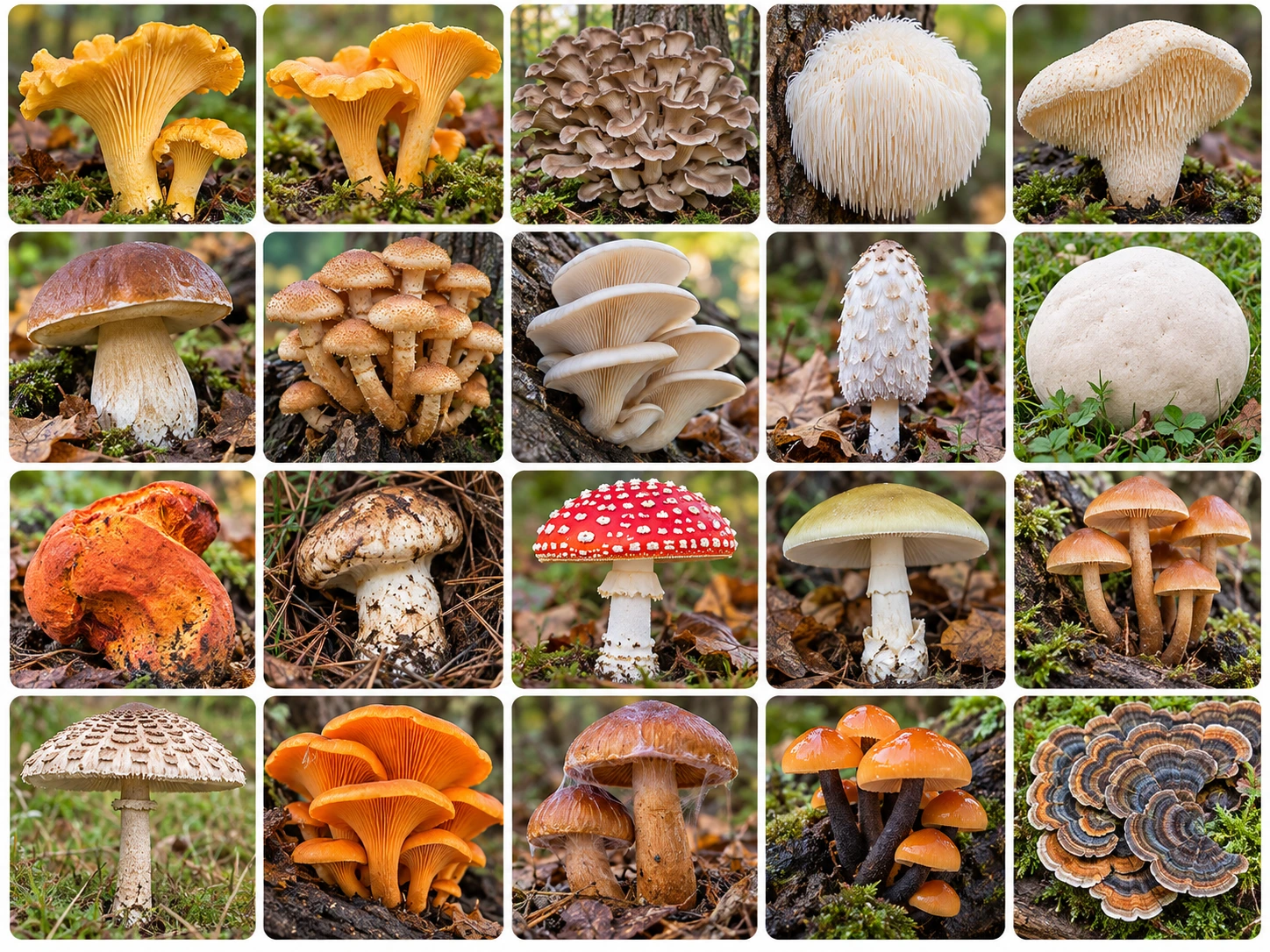
October is one of the most fascinating months for mushroom identification, both in Europe and across much of North America. Autumn rain, cooler nights, moist forest floors, and still-active tree roots can bring out chanterelles, boletes, Honey Mushrooms, Oyster Mushrooms, Lion’s Mane, puffballs, Amanitas, and many other fungi within the same few weeks.
There is no single October mushroom season for the entire continent, however. October in coastal Oregon can be the beginning of a major chanterelle season, while farther north or at higher elevations frost may already be ending the season, and warm parts of the southeastern United States can continue producing mushrooms well beyond October.
⚠️ Important: This guide is for identification and education. Mushroom seasons vary greatly by region and weather, and no wild mushroom should be eaten based only on a photograph, AI result, or online comparison.
Quick Guide to 20 Common October Mushrooms in North America
| Species or group | Common name | Typical habitat | Safety |
|---|---|---|---|
| Cantharellus formosus | Pacific Golden Chanterelle | Pacific Northwest conifer forests | Edible when correctly identified |
| Cantharellus species | Eastern Chanterelles | Hardwood and mixed forests | Edible when correctly identified |
| Grifola frondosa | Hen of the Woods | Base of hardwoods, especially oak | Edible when correctly identified |
| Hericium erinaceus | Lion’s Mane | Hardwood trunks and logs | Edible when correctly identified |
| Hydnum species | Hedgehog Mushrooms | Woodland soil | Edible when correctly identified |
| Boletus edulis group | King Boletes / Porcini | Forest soil near trees | Edible when correctly identified |
| Armillaria species | Honey Mushrooms | Stumps, trunks and roots | Edibility varies |
| Pleurotus ostreatus group | Oyster Mushrooms | Dead hardwood | Edible when correctly identified |
| Coprinus comatus | Shaggy Mane | Lawns and disturbed soil | Edible when young and correctly identified |
| Calvatia gigantea | Giant Puffball | Lawns, fields and woodland edges | Edible only when correctly identified and immature |
| Hypomyces lactifluorum | Lobster Mushroom | Forest soil | Edibility depends on correct identification |
| Tricholoma murrillianum and relatives | Matsutake | Conifer forests | Edible when correctly identified |
| Amanita muscaria complex | Fly Agaric | Forest soil near trees | Poisonous |
| Amanita phalloides | Death Cap | Woodland and parks | Deadly poisonous |
| Galerina marginata | Deadly Galerina | Decaying wood | Deadly poisonous |
| Chlorophyllum molybdites | Green-Spored Parasol | Lawns and grassland | Poisonous |
| Omphalotus species | Jack-o’-Lantern | Wood and buried roots | Poisonous |
| Cortinarius species | Webcaps | Forest soil | Some dangerously poisonous |
| Flammulina velutipes complex | Velvet Shank | Dead hardwood | Identification requires caution |
| Trametes versicolor | Turkey Tail | Dead wood | Not a conventional food mushroom |
Why October Is Such a Good Mushroom Month
October often brings exactly the combination fungi need to produce visible fruit bodies. Summer heat has faded, evaporation slows, and repeated rain can keep soil, moss, leaf litter, logs, and buried wood moist for days at a time.
The effect can be dramatic because the fungus itself was already present before the mushrooms appeared. Underground mycelium and fungi living inside wood can respond quickly once moisture and temperature reach suitable levels, so an apparently empty forest can look completely different after a week of autumn rain.
October Is Not the Same Everywhere
North America covers an enormous range of climates, from Alaska and northern Canada to subtropical Florida and from Atlantic hardwood forests to the rain-soaked Pacific coast. The calendar therefore matters less than the combination of recent rainfall, temperature, elevation, and local vegetation.
In the Pacific Northwest, October is often one of the richest periods of the year and can bring chanterelles, matsutake, boletes, hedgehogs, and many wood-growing fungi. In parts of the Northeast and Midwest, October can also be excellent, although an early hard freeze may shorten the season considerably.
1. Cantharellus formosus — Pacific Golden Chanterelle
Identification
The Pacific Golden Chanterelle is one of the characteristic fall mushrooms of the Pacific Northwest. It has a yellow to orange cap, firm pale flesh, and blunt false gills that fork and run down the stem.
The structures underneath are folds rather than thin blade-like true gills. This is one of the most important features separating chanterelles from several orange look-alikes.
Where to Find It in October
Cantharellus formosus grows from soil in association with conifers, particularly in the forests of Oregon, Washington, British Columbia, and nearby western regions. Moist forests with Douglas-fir and other conifers are classic habitat.
October can be especially productive after autumn rains begin. In mild coastal forests, chanterelle season may continue through November and sometimes considerably later.
Look-Alikes
Jack-o’-Lantern mushrooms have true gills and are poisonous, while False Chanterelles also have thin gill-like structures. A cap-only photograph is therefore not enough for a reliable chanterelle identification.
2. Eastern North American Chanterelles
Identification
Eastern North America contains numerous Cantharellus species rather than a single universal “golden chanterelle.” Many have yellow to orange caps, solid flesh, and blunt ridges underneath.
Species-level identification can be complicated because appearance overlaps considerably. Geographic location, host trees, size, coloration, and microscopic features may all matter.
Where to Find Them in October
Hardwood and mixed forests can still produce chanterelles in October, particularly in relatively mild or southern regions. Farther north, their season may already be declining by mid- or late October.
They grow from soil rather than directly from logs or stumps. Scattered groups beneath hardwoods are more typical than dense clusters emerging from wood.
3. Grifola frondosa — Hen of the Woods
Identification
Hen of the Woods, also known as Maitake, forms large rosettes made from many overlapping gray-brown or brownish fan-shaped caps. A mature cluster can become very large and may look like a mass of layered feathers at the base of a tree.
The undersides have pores rather than gills. The branching central structure often connects dozens of individual caps into one fruit body.
Where to Find It in October
October is a classic month for Hen of the Woods in eastern North America. It is especially associated with mature oaks and often appears at or near the base of the same tree in successive years.
The fruit body may emerge directly beside the trunk or several feet away where large roots run beneath the soil. Searching around old oaks can therefore be particularly productive.
4. Hericium erinaceus — Lion’s Mane
Identification
Lion’s Mane looks completely different from a conventional cap-and-stem mushroom. It forms a white rounded mass covered with long hanging teeth that may resemble icicles or a shaggy white pom-pom.
Young specimens are bright white, while older ones become cream, yellowish, or brown. The long unbranched teeth distinguish Lion’s Mane from more coral-like Hericium species.
Where to Find It in October
Lion’s Mane grows from hardwood, including living but damaged trees, standing dead trees, and fallen logs. Beech, maple, and other hardwoods can support the fungus depending on region.
Autumn is a productive season across much of its North American range. October can be especially good because cool, moist weather allows the soft fruit bodies to develop without drying rapidly.
5. Hydnum Species — Hedgehog Mushrooms
Identification
Hedgehog Mushrooms have one of the easiest undersides to recognize. Instead of gills or pores, the cap is covered underneath with numerous soft downward-pointing teeth.
Cap colors range from pale cream to yellow, buff, or orange depending on species. The flesh is generally firm, and the mushrooms grow from soil rather than directly from wood.
Where to Find Them in October
Several Hydnum species occur in North America, and the exact species differs by region. They can be found in both conifer and hardwood forests.
October is particularly productive in western regions where wet autumn weather arrives early enough to trigger substantial fruiting. Some Pacific Northwest species can continue even later into autumn.
6. Boletus edulis Group — King Boletes
Identification
King Boletes have brown caps, thick stems, and a sponge-like layer of pores underneath rather than gills. Many show a fine net-like pattern on the upper stem, although exact appearance varies among members of the broader group.
Young pore surfaces are typically pale and become yellowish or olive as the mushroom matures. The dense white flesh is another characteristic feature of many king boletes.
Where to Find Them in October
Boletes form partnerships with living trees, so forest type matters. Conifer forests of western North America and various northern forests can produce autumn king boletes and related species.
October timing varies greatly with elevation. High-elevation fruiting may end earlier, while lower and coastal forests can remain productive after substantial fall rain.
7. Armillaria Species — Honey Mushrooms
Identification
Honey Mushrooms typically form clusters of yellow-brown to honey-colored caps with pale gills. Many species have a ring on the stem, although North America also contains ringless members of the group.
The stems are generally tougher and more fibrous than the caps. White spore deposits can sometimes accumulate on mushrooms growing beneath other caps in a dense cluster.
Where to Find Them in October
Honey Mushrooms fruit from trunks, stumps, tree bases, and buried roots. A cluster can appear to emerge from ordinary soil even though woody material lies underneath.
October is a major Honey Mushroom period across many northern and eastern regions. Large fruitings can contain dozens of mushrooms packed around the same tree base.
Dangerous Look-Alike
Deadly Galerina can share the same general habitat and brown coloration. Galerina marginata produces rusty-brown spores rather than the white spores typical of Armillaria, and it contains deadly amatoxins.
8. Pleurotus ostreatus Group — Oyster Mushrooms
Identification
Oyster Mushrooms form layered clusters of fan-shaped caps on wood. Their pale gills run down toward the short lateral stem or attachment point.
Cap colors can be white, cream, gray, or brownish. Cool-weather specimens can look substantially darker than mushrooms of the same group growing under different conditions.
Where to Find Them in October
Oysters grow mainly on dead or weakened hardwood. Fallen trunks, standing dead trees, and large branches are useful places to search.
October often marks the beginning of excellent Oyster Mushroom conditions in cooler parts of North America. Fruiting may continue into November and winter whenever temperatures remain suitable.
9. Coprinus comatus — Shaggy Mane
Identification
Young Shaggy Manes have tall white caps covered with shaggy scales. As they mature, the gills turn from white to pink and finally black while the cap begins dissolving into an ink-like liquid.
This rapid transformation makes the species particularly memorable. A colony can look fresh in the morning and be heavily blackened later in the day.
Where to Find It in October
Lawns, roadsides, parks, compacted soil, and other disturbed areas are typical habitats. It often appears in large groups after cool autumn rain.
October can be an excellent month across much of the northern United States and southern Canada. The species is much more associated with open ground than with deep forest.
10. Calvatia gigantea — Giant Puffball
Identification
Giant Puffballs can become enormous white spheres growing directly from the ground. Young fruit bodies are uniformly white inside when cut through the center.
As spores mature, the interior changes from white to yellowish, olive, and eventually brown. Only the solid white immature stage has the classic fresh appearance.
Where to Find It in October
Fields, lawns, woodland margins, and nutrient-rich open ground can support Giant Puffballs. The species is particularly conspicuous because mature specimens may become larger than a basketball.
Depending on region and weather, October can still produce fresh specimens. Earlier frost in northern areas may end fruiting sooner.
Important Safety Check
Young Amanitas can initially look like small puffballs from outside. Cutting a suspected puffball completely in half should reveal uniform interior flesh rather than a developing cap, gills, and stem.
11. Hypomyces lactifluorum — Lobster Mushroom
Identification
Lobster Mushroom is unusual because it is not simply one mushroom species producing its own conventional fruit body. A parasitic fungus transforms certain host mushrooms, covering them in a firm orange-red crust and distorting their original shape.
The resulting mushroom often resembles a bright orange piece of cooked lobster shell. The original gills become reduced or almost completely obscured.
Where to Find It in October
Lobster Mushrooms are especially familiar in western North American forests, although they occur elsewhere on the continent. They grow from soil where suitable host fungi are present.
October can remain productive in the Pacific Northwest after fall rains. In other regions, peak fruiting may occur earlier.
12. Matsutake — Tricholoma murrillianum and Related Species
Identification
Western matsutake are pale, robust mushrooms with firm white flesh and a distinctive spicy aromatic odor. Young caps may remain partly buried beneath forest litter.
The stem is substantial, and a veil can leave a ring-like structure. Species and naming vary across North America, so regional identification is important.
Where to Find It in October
Matsutake are associated with particular conifer forests and often grow in well-drained soils with deep organic layers. The Pacific Northwest is especially famous for autumn matsutake fruiting.
October can be an important month, although elevation and local climate strongly affect timing. Experienced collectors often learn specific habitats rather than searching randomly across the forest.
13. Amanita muscaria Complex — Fly Agaric
Identification
Fly Agaric and its North American relatives typically have red, orange, or yellowish caps with pale veil remnants. The gills are white, and the pale stem usually carries a ring and an enlarged base.
Heavy rain can remove much of the classic white spotting. Mature or weathered mushrooms may therefore look very different from the familiar storybook form.
Where to Find It in October
Fly Agaric-type Amanitas grow from soil near conifers and broadleaf trees. They can appear in natural forests, parks, lawns near mature trees, and planted landscapes.
October is well within the season across many parts of North America. In some mild western areas, fruiting can continue substantially later.
Safety
These mushrooms are poisonous and contain compounds including ibotenic acid and muscimol. They should not be treated as edible because of traditional or recreational uses.
14. Amanita phalloides — Death Cap
Identification
Death Cap has white gills, a pale stem with a ring, and a sack-like volva at the base. The cap can be olive, yellow-green, grayish, brownish, or surprisingly pale.
The complete stem base is essential for identification because the volva may be hidden beneath soil or leaf litter. Cutting the mushroom off at ground level can remove one of the most important diagnostic features.
Where to Find It in October
Death Cap is especially important in parts of western North America, although its distribution is broader than many people realize. It forms associations with living trees and can appear in parks and landscaped environments as well as forests.
Late summer, autumn, and even winter can be part of its season depending on region. October therefore falls squarely within an important fruiting period in several areas.
Safety
Amanita phalloides contains amatoxins capable of causing fatal liver failure. Early symptoms may be delayed, so suspected ingestion requires urgent medical attention even if the person initially feels well.
15. Galerina marginata — Deadly Galerina
Identification
Deadly Galerina is a relatively small brown mushroom that grows from decaying wood. The cap can be yellow-brown, honey-brown, or reddish brown, while mature gills and spores become rusty brown.
The stem is slender and may have a fragile ring or only a faint ring zone. Moisture can change the color of the cap considerably.
Where to Find It in October
Logs, stumps, buried wood, and heavily decayed woody material can support Galerina marginata. It occurs widely across North America.
Summer and autumn are important fruiting periods, so October is a key month for recognizing it. This is especially relevant when collecting other brown mushrooms from wood.
Safety
Deadly Galerina contains amatoxins similar to those responsible for Death Cap poisoning. Its small size should never be interpreted as meaning that it is harmless.
16. Chlorophyllum molybdites — Green-Spored Parasol
Identification
Green-Spored Parasol is a large pale lawn mushroom with brown scales and a ring on the stem. Young gills are pale, but mature spores give them an increasingly gray-green appearance.
The spore print is distinctly green, which is a major identification feature. Large mature caps can look impressively similar to edible parasol mushrooms.
Where to Find It in October
Lawns, golf courses, parks, gardens, and grassy areas are typical habitats. It can form large fairy rings containing many mushrooms.
Warm regions may continue producing it well into autumn. October occurrences are therefore particularly relevant across large parts of the United States.
Safety
The species causes severe gastrointestinal poisoning. It is one of the most important poisonous lawn mushrooms in North America.
17. Omphalotus Species — Jack-o’-Lantern Mushrooms
Identification
Jack-o’-Lantern mushrooms are bright orange and possess true thin gills that run down the stem. They often grow in dense clusters from wood, stumps, tree bases, or buried roots.
The orange coloration can lead to confusion with chanterelles. Chanterelles, however, have blunt ridges rather than true blade-like gills.
Where to Find Them in October
Different Omphalotus species occur in different parts of North America. Eastern and western regions therefore have different species even though the general appearance can be similar.
Autumn is a typical season, and October is an important month in many regions. Hidden buried wood can make a cluster appear to grow directly from soil.
Safety
Jack-o’-Lantern mushrooms are poisonous and can cause severe gastrointestinal symptoms. The gills and clustered wood-associated growth are the most important differences from true chanterelles.
18. Cortinarius Species — Webcaps
Identification
Cortinarius is an enormous genus containing mushrooms in shades of brown, orange, red, purple, and gray. Young specimens often possess a fine cobweb-like veil called a cortina between the cap and stem.
The spores typically mature to rusty brown. Rust-colored deposits may eventually become visible on the gills and upper stem.
Where to Find Them in October
Webcaps are common components of autumn forests because they form mycorrhizal relationships with trees. Both hardwood and conifer forests can support large numbers of species.
October is an excellent month to encounter them across northern temperate North America. Species-level identification can be extremely difficult even for experienced observers.
Safety
Some Cortinarius species contain dangerous toxins capable of causing delayed kidney injury. Unknown webcaps should therefore never be assumed edible simply because similar-looking species exist.
19. Flammulina velutipes Complex — Velvet Shank
Identification
Velvet Shank has yellow to orange-brown caps, pale gills, and a lower stem that becomes dark and distinctly velvety. Caps can look shiny or sticky when wet.
The mushrooms usually grow in small clusters directly from wood. The dark stem base becomes particularly obvious in mature specimens.
Where to Find It in October
Velvet Shank is a cold-tolerant wood-growing mushroom and can begin appearing as many other species decline. Dead or weakened hardwoods are common substrates.
October may mark the beginning of its main season in cooler regions, while fruiting can continue through winter. The timing makes it a useful transition species between autumn and winter mushroom seasons.
Dangerous Look-Alike
Small brown wood-growing mushrooms always deserve caution because Deadly Galerina can occupy similar substrates. Spore color, stem texture, and complete morphology should all be checked.
20. Trametes versicolor — Turkey Tail
Identification
Turkey Tail forms thin semicircular brackets covered with contrasting concentric bands of gray, brown, cream, orange, blue-gray, and darker colors. Several brackets often overlap across fallen logs or dead branches.
The underside is pale and covered with numerous tiny pores. This is an important distinction from False Turkey Tail, which has a smooth underside.
Where to Find It in October
Turkey Tail grows primarily on dead wood and can be found during much of the year. Autumn moisture encourages fresh growth and makes existing colonies easier to notice.
Because the fruit bodies are leathery and persistent, October specimens can include both fresh and older brackets on the same log. Fresher fruit bodies usually have cleaner white pore surfaces.
October Mushrooms by Region
Pacific Northwest
October is often one of the most diverse mushroom months in Washington, Oregon, coastal British Columbia, and nearby areas. Pacific Golden Chanterelles, matsutake, hedgehogs, Oyster Mushrooms, boletes, lobster mushrooms, Amanitas, and many other groups can overlap.
Autumn rainfall is especially important because summers can be comparatively dry in many western forests. Once sustained rain returns, fungal activity can increase dramatically.
Northeast
The Northeast can still be highly productive in October, particularly early and mid-month. Hen of the Woods, Honey Mushrooms, Oyster Mushrooms, puffballs, Lion’s Mane, boletes, and numerous woodland fungi may be present.
The main limiting factor is frost. A prolonged hard freeze can quickly reduce terrestrial mushroom diversity, although several wood-growing species continue later.
Midwest
October can bring Honey Mushrooms, puffballs, Oyster Mushrooms, Shaggy Manes, Hen of the Woods, and many other fungi across the Midwest. Oak-rich forests and mature parklands can be particularly productive for some autumn species.
Conditions can change quickly from year to year because early cold weather may shorten the season. In a mild wet October, fruiting can remain impressive until late in the month.
Southeastern United States
The Southeast often retains warmer temperatures much later than northern regions. This allows various lawn, woodland, and wood-growing species to continue fruiting through October and beyond.
Chanterelles may persist in some areas, while Oyster Mushrooms, Green-Spored Parasols, Amanitas, and numerous boletes or gilled fungi can remain active. Local rainfall can matter more than the calendar itself.
Rocky Mountains and High Elevations
Elevation can compress autumn mushroom season dramatically. A site that remains productive in September may experience snow or frozen soil by October.
Lower elevations and sheltered forests can still produce mushrooms after higher slopes have shut down. When identifying by season, elevation should therefore always be considered.
Southern Canada
Southern British Columbia, Ontario, Quebec, and the Maritime provinces can all have productive October periods, but the species mix varies enormously. Coastal British Columbia often remains active later than inland or northern regions.
Early frost is the biggest variable in colder areas. Wood-growing mushrooms generally continue longer than delicate terrestrial species.
Mushrooms Growing Under Conifers in October
Conifer forests can produce chanterelles, matsutake, boletes, Hedgehog Mushrooms, Amanitas, and large numbers of webcaps. Which species occur depends on whether the forest is dominated by Douglas-fir, pine, spruce, hemlock, or other trees.
The tree itself is therefore part of the identification process. A mushroom’s host association can eliminate species that look almost identical in photographs.
Mushrooms Growing Under Oak Trees in October
Oaks support a particularly rich fungal community. Hen of the Woods may grow around the base, while various boletes, Amanitas, milkcaps, russulas, and other mycorrhizal fungi can emerge from surrounding soil.
A mushroom several yards from the trunk can still be associated with the tree because large roots extend well beyond the visible canopy. Habitat should therefore be interpreted on a broader scale than the immediate spot where the fruit body appears.
Mushrooms Growing on Wood in October
Dead and weakened wood can support Oyster Mushrooms, Honey Mushrooms, Deadly Galerina, Turkey Tail, Velvet Shank, Lion’s Mane, and many other fungi. Logs become particularly productive after weeks of cool wet weather because wood absorbs and retains substantial moisture.
Several species can grow on the same stump or fallen tree at once. Each cluster should be examined separately rather than assuming every mushroom on the wood belongs to one species.
Lawn Mushrooms in October
Lawns can still produce Shaggy Manes, Green-Spored Parasols, puffballs, and numerous smaller species. Warm southern lawns may remain active much later than grasslands in northern Canada.
Nearby trees complicate the picture because their roots can support mycorrhizal Amanitas or boletes beneath the grass. A mushroom growing in a lawn is therefore not necessarily a grassland decomposer.
Edible Mushrooms Found in October
October can produce some of North America’s best-known edible mushrooms, including chanterelles, Hen of the Woods, Lion’s Mane, Hedgehog Mushrooms, king boletes, Oyster Mushrooms, and several others. Regional differences are substantial, so no single edible list applies equally everywhere.
The same season also produces deadly and poisonous species. An excellent edible mushroom may grow only a few feet from a dangerous Amanita or Galerina, which is why every specimen must be identified independently.
Poisonous Mushrooms Found in October
October is an important month for learning poisonous species because several major groups can be active simultaneously. Death Caps, Fly Agarics, Deadly Galerina, poisonous webcaps, Jack-o’-Lanterns, and Green-Spored Parasols are among the possibilities.
They do not share a universal warning appearance. Some are brightly colored, while others look like ordinary white or brown mushrooms, so toxicity cannot be judged from color.
How to Identify an October Mushroom
Start with structure rather than color. Determine whether the underside has true gills, pores, blunt ridges, teeth, or another type of fertile surface.
Next, examine the complete stem and stem base, then determine whether the mushroom is growing from soil, grass, wood, or buried roots. Nearby trees, bruising reactions, smell, spore color, and geographic region can then narrow the possibilities further.
Season should be used only as supporting evidence. October may make a species plausible, but it cannot prove an identification.
How to Photograph October Mushrooms for Identification
Take a clear top view, but do not stop there. The underside, full stem, stem base, and attachment to the substrate are usually more important than an attractive cap photograph.
A wider habitat image should show nearby trees and whether the mushroom is growing from woodland soil, lawn, stump, or log. When several specimens are available, including both young and mature examples can reveal changes in gill color, veil structures, and cap shape.
Good identification photography records evidence rather than simply making the mushroom look attractive.
Can AI Identify October Mushrooms?
AI can help narrow a large list of possibilities, particularly when the mushroom has distinctive features such as the teeth of Lion’s Mane, the layered form of Hen of the Woods, or the shaggy cap of Coprinus comatus. Results become much more useful when several photographs and habitat information are available.
Small brown mushrooms, boletes, Amanitas, and large genera such as Cortinarius can be much harder. Important characteristics may be hidden underground, require a spore print, or be too subtle to judge reliably from a photograph.
AI should therefore be treated as one part of the identification process rather than as proof that a mushroom is safe to eat.
Frequently Asked Questions
Is October a good month for mushrooms in North America?
Yes, October is one of the most productive months across many temperate parts of North America. The Pacific Northwest, Northeast, Midwest, southern Canada, and other regions can all have strong fruiting, although the timing and species differ substantially.
What are the most common mushrooms in North America in October?
Common groups include chanterelles, Honey Mushrooms, Oyster Mushrooms, puffballs, Hen of the Woods, boletes, Amanitas, webcaps, and many wood-growing fungi. Which ones dominate depends on forest type, climate, rainfall, and latitude.
What edible mushrooms can be found in October?
Depending on region, October can produce Pacific Golden Chanterelles, Hen of the Woods, Lion’s Mane, Hedgehog Mushrooms, king boletes, Oyster Mushrooms, Shaggy Manes, and matsutake. Every specimen still requires accurate identification because poisonous look-alikes can occur in the same habitats.
What poisonous mushrooms appear in October?
Important examples include Death Cap, Fly Agaric, Deadly Galerina, Jack-o’-Lantern mushrooms, Green-Spored Parasol, and poisonous Cortinarius species. Some cause rapid illness, while others can produce delayed liver or kidney injury.
Are chanterelles still growing in October?
Yes, especially in the Pacific Northwest, where October can be an important part of chanterelle season. In parts of eastern North America the season may be nearing its end, particularly after frost.
Do porcini grow in North America in October?
King boletes and related species can fruit in October in suitable regions, especially in western and northern forests. Elevation and rainfall can shift their season substantially.
What mushrooms grow under oak trees in October?
Hen of the Woods is a famous autumn oak-associated mushroom, while boletes, Amanitas, russulas, milkcaps, and many other mycorrhizal species can occur in the surrounding soil. The exact community differs by region.
What mushrooms grow on logs in October?
Oyster Mushrooms, Deadly Galerina, Turkey Tail, Lion’s Mane, Velvet Shank, and various other decomposers can occur on logs. A single log may support several species simultaneously.
Does the first frost end mushroom season?
A hard freeze can end or greatly reduce fruiting for many soft terrestrial mushrooms, but it does not stop every fungus. Oyster Mushrooms, Velvet Shank, Turkey Tail, and other wood-growing species can continue into colder weather.
Is October the best mushroom month in the Pacific Northwest?
October is often among the richest periods because autumn rains trigger widespread fruiting in conifer forests. Chanterelles, matsutake, boletes, hedgehogs, lobster mushrooms, and many other groups can overlap during this period.
Final Identification Notes
October can be one of North America’s most diverse mushroom months, but it does not look the same everywhere. Pacific Northwest conifer forests may be entering their prime autumn season while northern inland regions are already approaching frost, and the Southeast may remain productive long after northern forests quiet down.
The most useful way to identify an October mushroom is to combine underside structure, stem features, substrate, nearby trees, growth pattern, bruising, spore color, region, and recent weather. The month tells you what is plausible, but the physical features of the mushroom determine what it actually is.
October also brings edible and poisonous species into the same habitats at the same time. Treat each mushroom as a separate identification problem, and never let a familiar autumn location substitute for checking the complete fruit body.
Upload a photo and get possible matches in seconds.