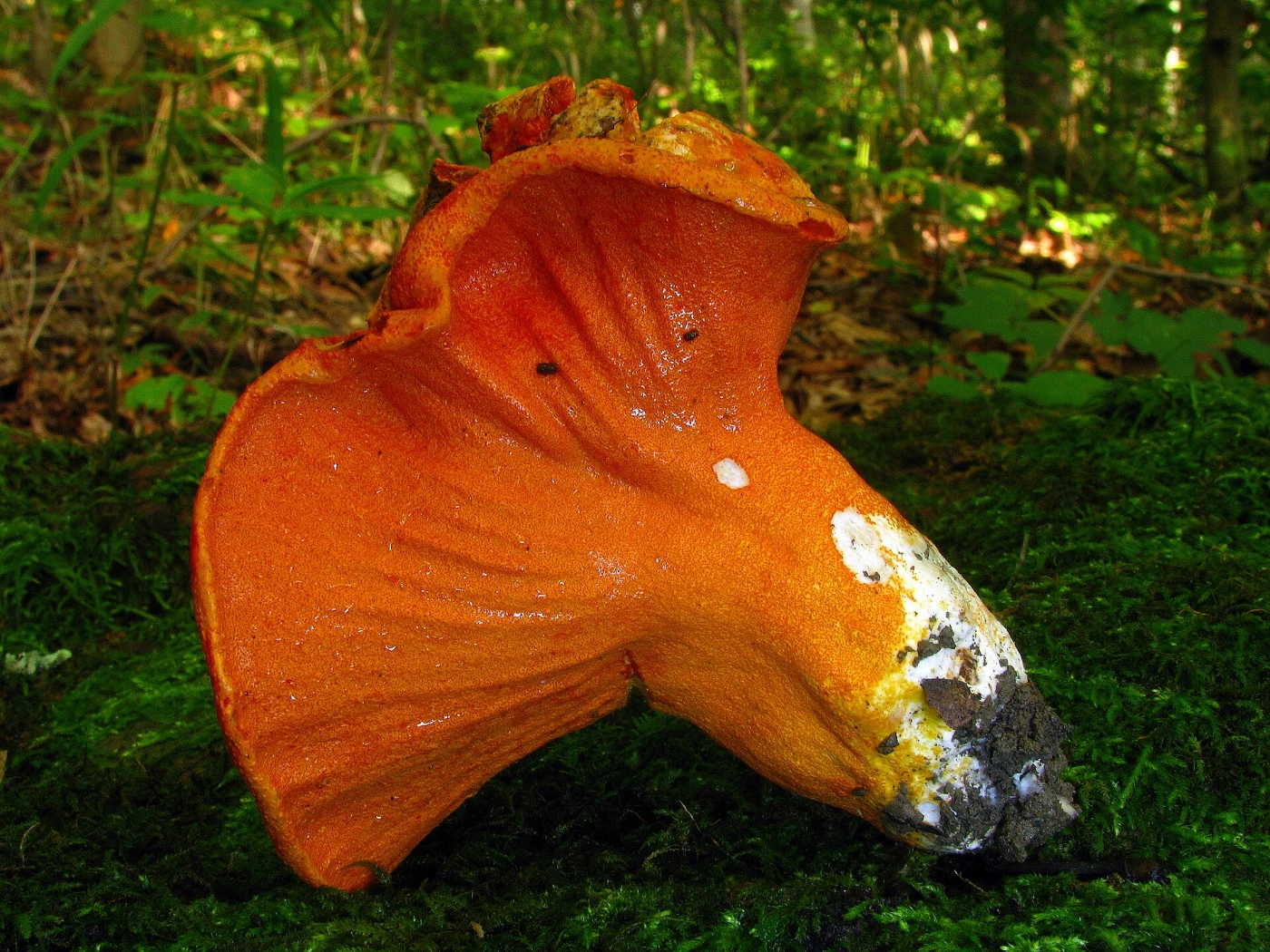
Hypomyces lactifluorum, commonly known as the Lobster Mushroom, is one of the most unusual edible wild mushrooms in North America. Instead of producing a familiar cap and stem of its own, it grows as a parasitic fungus over another mushroom and transforms its host into a dense, irregular, orange-red fruit body.
The resulting mushroom often looks very different from the original host. Gills can become reduced to blunt ridges, the cap becomes distorted, and the entire surface develops a bright orange to reddish crust that gives the Lobster Mushroom its distinctive appearance.
⚠️ Important: Lobster Mushrooms are considered edible when correctly identified and in good condition, but the parasite can make the original host difficult to recognize. Never eat a specimen that is decaying, unusually soft, foul-smelling, or does not fit the typical Lobster Mushroom structure.
Quick Identification
| Feature | Hypomyces lactifluorum |
|---|---|
| Scientific name | Hypomyces lactifluorum |
| Common name | Lobster Mushroom |
| Type | Parasitic fungus growing on another mushroom |
| Typical hosts | Russula, Lactarius, and related Russulaceae |
| Color | Bright orange, orange-red, red-orange |
| Shape | Distorted cap and stem |
| Underside | Gills reduced, covered, or transformed into blunt folds |
| Surface | Firm, crust-like, rough to finely pimpled |
| Interior | White to pale, dense and brittle |
| Smell | Mild to seafood-like in some specimens |
| Spore-bearing surface | Orange-red outer crust |
| Habitat | Woodland soil near host trees |
| Ecology | Parasite of mycorrhizal mushrooms |
| Season | Summer to autumn |
| Distribution | Especially common in North America |
| Edibility | Edible when correctly identified and fresh |
| Main look-alikes | Orange Russula/Lactarius, decayed Lobsters, other Hypomyces, orange woodland mushrooms |
What Is a Lobster Mushroom?
A Lobster Mushroom is not a conventional mushroom produced solely by Hypomyces lactifluorum. The orange fungus attacks the fruit body of another mushroom, usually a member of the Russulaceae, and gradually covers and deforms it.
The host still provides the basic shape of cap and stem, but much of its normal appearance disappears. The parasite creates the characteristic orange-red outer layer and changes the texture, odor, and form of the mushroom.
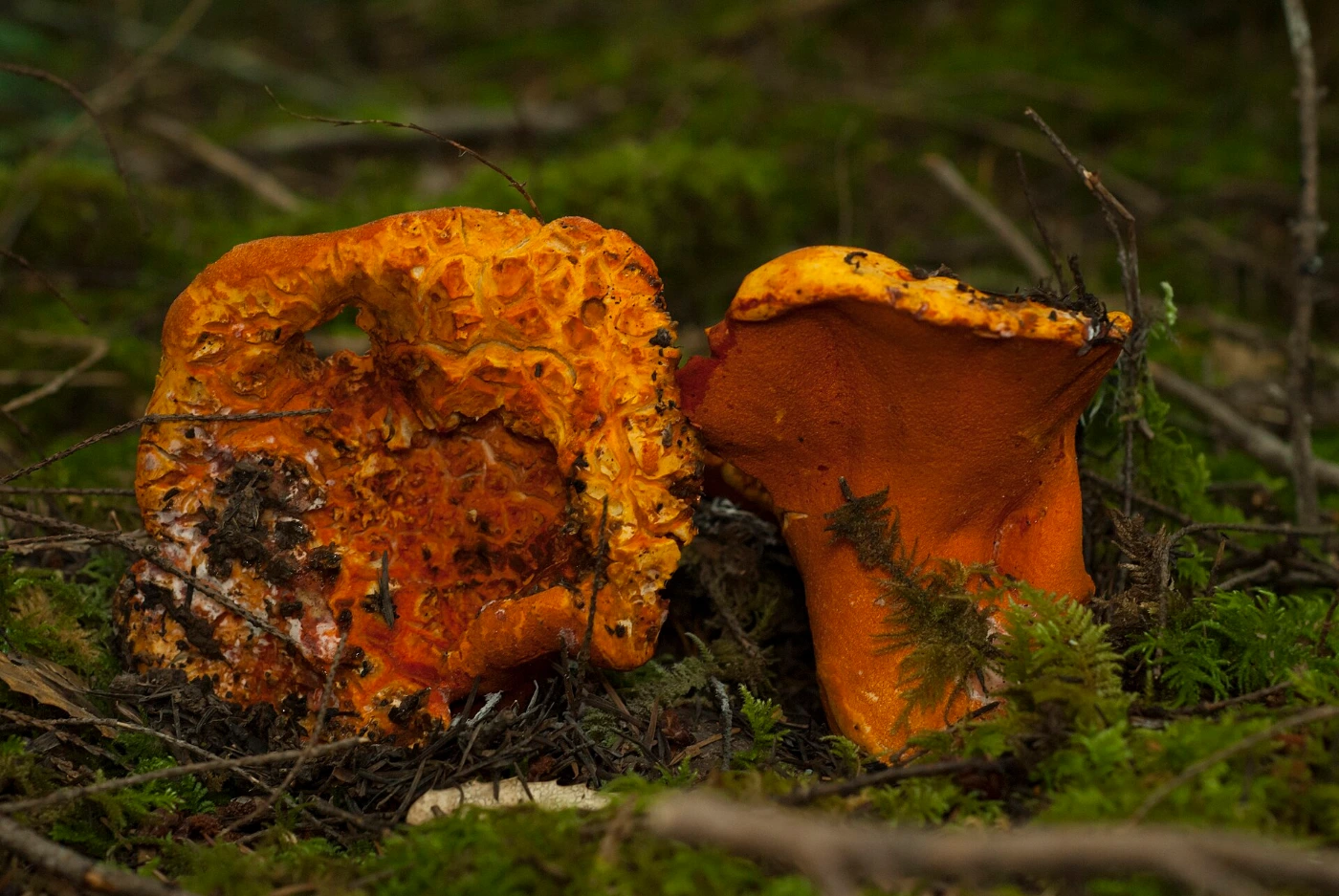
Which Mushrooms Does Hypomyces lactifluorum Parasitize?
The most frequently reported hosts belong to Russula, Lactarius, Lactifluus, and related groups. These hosts already tend to have firm, brittle flesh, which helps explain the dense texture of a finished Lobster Mushroom.
Exact host identification is often impossible once parasitism is advanced. The gills, cap surface, and original colors may have been almost completely transformed.
Why the Host Matters
The host species contributes to the shape and internal structure of the finished fruit body. One Lobster Mushroom may therefore look broad and funnel-shaped, while another is compact or irregularly twisted.
This variability is normal. Identification should focus on the orange parasitic crust, deformed Russulaceae-like body, firm pale interior, and woodland habitat rather than expecting every specimen to have the same silhouette.
Color
The outer surface is usually vivid orange, pumpkin-orange, red-orange, or lobster-shell red. Young and fresh fruit bodies often have the strongest color.
Older specimens may become darker, duller, or develop brownish areas. Extensive dark decay, gray mold, or wet decomposing tissue should not be confused with normal aging.
Surface Texture
The surface feels firm and can be slightly rough, granular, or finely pimpled. This texture is produced by the parasitic fungus covering the host.
The original cap skin is usually no longer visible. Instead, the entire fruit body may appear coated in one continuous orange layer.
Cap Shape
The cap can be highly irregular because the parasite interferes with normal development. It may be folded, twisted, lumpy, funnel-shaped, or asymmetrical.
Some Lobster Mushrooms retain a recognizable Russula-like or milkcap-like outline. Others become so distorted that the original cap and stem are difficult to separate visually.
What Happens to the Gills?
The underside is one of the most interesting features. Normal thin gills are often reduced, fused, covered over, or transformed into broad shallow ridges.
This means a mature Lobster Mushroom may appear almost smooth underneath. The loss of ordinary gills is a strong clue that the host has been heavily parasitized.
Why the Underside Matters
A bright orange mushroom with normal, thin, clearly separated gills is less convincing as Hypomyces lactifluorum. Typical Lobster Mushrooms show substantial modification of the host’s original gill structure.
Photographing the underside is therefore valuable. It helps distinguish a genuine parasitized host from an unrelated orange gilled mushroom.
Stem
The stem is usually thick, firm, and irregular. It may also be covered almost completely by the orange-red parasitic layer.
Because the host mushroom is often a Russula or milkcap, the stem tends to break rather than bend into long fibers. The interior remains pale and relatively dense.
Flesh
The interior is normally white to pale cream and has a firm, brittle texture. When cut, a fresh Lobster Mushroom should look dense rather than hollow, watery, or decomposed.
Some original host tissues may remain visible beneath the orange exterior. The contrast between the bright outer crust and pale interior is characteristic.
Smell
Fresh specimens usually have a mild mushroom odor, while some develop a distinctive seafood-like aroma that contributes to the common name. Not every individual smells strongly of lobster or shellfish.
A sour, putrid, fermented, or strongly unpleasant odor suggests deterioration. Condition should always be considered separately from species identification.
Where Do Lobster Mushrooms Grow?
Because their hosts are mycorrhizal mushrooms, Lobster Mushrooms appear on the ground in forests rather than directly from logs or stumps. The underground host mycelium is associated with living tree roots.
They can occur in both coniferous and broadleaf forests, depending on the host species. Forest type therefore varies considerably across the range.
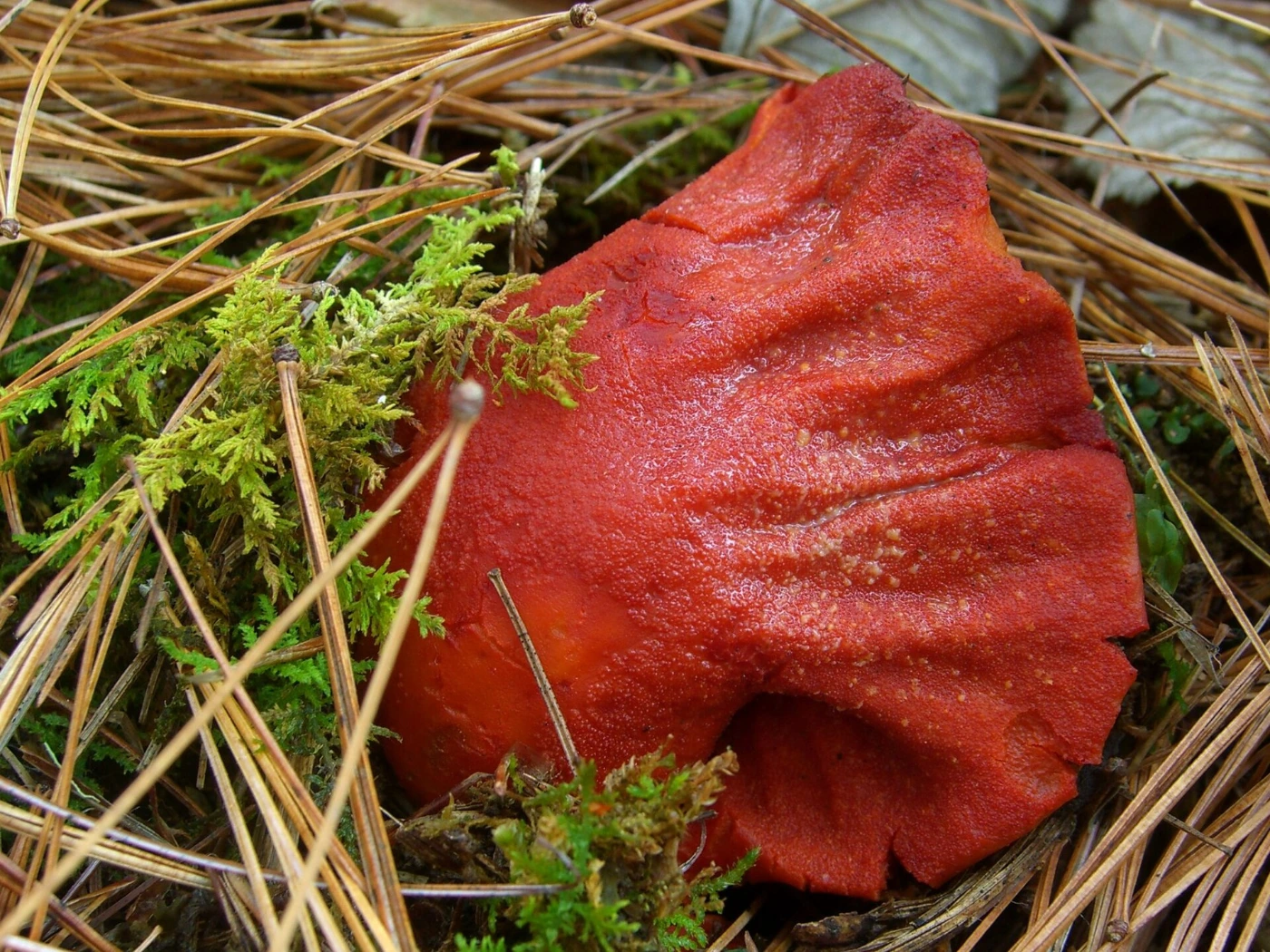
Lobster Mushrooms in Conifer Forests
Many North American finds occur in coniferous woodland with pine, fir, spruce, or hemlock. Thick needle litter can partially hide the orange fruit bodies.
Their intense coloration often makes them surprisingly easy to spot once part of the mushroom emerges through the forest floor.
Lobster Mushrooms in Broadleaf Forests
The species can also occur in mixed and hardwood forests where suitable Russulaceae hosts are present. Oaks and other broadleaf trees can support host mushrooms that later become infected.
Tree association is therefore useful as ecological context but is not sufficient for species identification.
When Do Lobster Mushrooms Grow?
The main season is summer through autumn, with timing varying substantially by region and rainfall. Fruiting often becomes abundant after sustained moisture.
Like their host mushrooms, Lobster Mushrooms may appear in repeated flushes during a favorable season. Dry weather can sharply reduce fruiting.
Distribution
Hypomyces lactifluorum is particularly well known and widely collected in North America. It occurs in both the United States and Canada across suitable forest habitats.
Reports exist from other regions, but the mushroom has its strongest cultural and foraging association with North America. Geography should still be considered because other parasitic Hypomyces species occur worldwide.
Is Lobster Mushroom Edible?
Lobster Mushroom is widely considered edible when correctly identified, fresh, and properly prepared. Its dense texture and unusual appearance have made it a popular wild mushroom in many parts of North America.
However, the transformed host can no longer always be identified visually. For this reason, specimens should fit the classic Lobster Mushroom appearance well rather than merely being an orange mushroom with irregular shape.
Does the Unknown Host Make It Unsafe?
This question is frequently raised because Hypomyces lactifluorum can obscure most identifying features of its host. In practice, the parasite is strongly associated with Russulaceae hosts, particularly Russula and milkcap-type mushrooms.
That does not mean every distorted orange mushroom is automatically safe. Correct identification of Hypomyces lactifluorum itself remains essential, and old or atypical specimens should be avoided.
Lobster Mushroom Look-Alikes
A fully developed Lobster Mushroom is relatively distinctive, but incomplete parasitism can make identification harder. Orange woodland mushrooms and other parasitized fungi can create superficial similarities.
The best identification uses texture, underside structure, pale brittle interior, and the continuous orange crust.
Orange Russula Species
Identification
Several Russula species can have red, orange, or reddish-brown caps and pale stems. Their brittle flesh can also resemble the texture of Lobster Mushroom hosts.
Uninfected Russulas, however, retain normal thin gills and do not have the thick orange parasitic crust covering the entire fruit body.
Main Difference
Normal cap skin and intact gills point toward an ordinary Russula. A distorted mushroom coated in orange-red crust with reduced gills fits Lobster Mushroom much better.
Orange Lactarius and Lactifluus Species
Identification
Orange milkcaps can be strikingly colorful and some produce orange latex. They may also show green staining and grow in similar woodland habitats.
Their gills remain recognizable unless another process has deformed them. Damaged fresh tissue can release latex, which provides another important clue.
Main Difference
A normal milkcap has organized gills and a conventional cap surface. In a Lobster Mushroom, those structures are heavily distorted and covered by Hypomyces tissue.
Hypomyces chrysospermus — Bolete Eater
Identification
Hypomyces chrysospermus is another parasitic fungus, but it attacks boletes rather than the typical Russulaceae hosts of Lobster Mushroom. Infected boletes can become coated with white, yellow, or golden powdery fungal growth.
Advanced infections may distort the host substantially. The appearance is nevertheless very different from the firm orange-red crust of a classic Lobster Mushroom.
Main Difference
Yellow or golden powdery growth on a bolete points toward H. chrysospermus. Dense orange-red transformation of a Russula or milkcap-type fruit body supports H. lactifluorum.
Omphalotus Species
Identification
Jack-o’-Lantern mushrooms can be bright orange and may form large, striking fruit bodies. They have true, well-developed orange gills and usually grow from wood, buried roots, or the base of trees.
They are toxic and should not be confused with edible orange woodland mushrooms.
Main Difference
Normal thin gills and clustered wood-associated growth strongly point away from Lobster Mushroom. Hypomyces lactifluorum grows from soil because its host is mycorrhizal.
Hygrophoropsis aurantiaca — False Chanterelle
Identification
False Chanterelle is orange and has strongly forked, thin gills. It usually retains a regular cap-and-stem shape.
The mushroom is much thinner and softer than a typical Lobster Mushroom. It also lacks the rough orange parasitic crust.
Main Difference
Thin forked gills indicate False Chanterelle. Reduced or deformed gills beneath a dense orange-red crust are much more consistent with Lobster Mushroom.
Lobster Mushroom vs Orange Milkcap
| Feature | Lobster Mushroom | Orange Milkcap |
|---|---|---|
| Outer surface | Orange-red parasitic crust | Normal cap skin |
| Shape | Strongly distorted | Regular cap and stem |
| Gills | Reduced or covered | Distinct true gills |
| Latex | Usually obscured / variable | Often visible when fresh |
| Interior | White, dense, brittle | Pale to orange-tinted |
| Green staining | Not defining | Common in some orange milkcaps |
| Main clue | Parasitized deformed fruit body | Normal milkcap structure |
The two can occur in similar forests because milkcaps themselves can serve as hosts for Hypomyces lactifluorum.
Lobster Mushroom vs Jack-o’-Lantern
| Feature | Lobster Mushroom | Jack-o’-Lantern |
|---|---|---|
| Color | Orange to red-orange | Bright orange |
| Gills | Reduced or obscured | Thin, true gills |
| Growth | From soil | Usually from wood or roots |
| Form | Distorted and irregular | Conventional caps in clusters |
| Texture | Dense and firm | Fleshy but normally structured |
| Edibility | Edible when correctly identified | Poisonous |
The substrate and underside provide particularly strong separation.
How to Identify a Lobster Mushroom Step by Step
Begin by looking for a deformed orange-red mushroom growing from forest soil. Then inspect the underside and cut the fruit body to check the interior.
A genuine Lobster Mushroom should look like a normal mushroom that has been substantially transformed by another fungus.
Step 1: Check the Orange Crust
Look for a continuous orange to red-orange coating over the cap, stem, and often underside. The color should appear embedded in the surface rather than simply being normal cap pigmentation.
A smooth conventional orange cap with a separate pale stem is less convincing.
Step 2: Examine the Underside
Look for gills that have been reduced, fused, or almost erased. Broad shallow folds may remain where the original host once had normal gills.
Clear thin gills throughout the underside suggest another mushroom.
Step 3: Cut the Mushroom
The interior should be pale, dense, and relatively firm. A clean white-to-cream cross-section supports a fresh specimen.
Wet, brown, hollow, or decomposing flesh indicates poor condition even if the species identification is correct.
Step 4: Check the Habitat
Confirm that the mushroom is emerging from soil in woodland. Suitable host mushrooms are mycorrhizal and therefore associated with tree roots.
Growth directly from a stump or log should make you reconsider the identification.
Step 5: Evaluate Freshness
Choose firm specimens with clean interiors and no strong unpleasant odor. Older Lobster Mushrooms can become soft, waterlogged, or heavily damaged by insects.
Freshness is especially important because the dense fruit body can conceal internal decay.
Partially Parasitized Lobster Mushrooms
Not every host is completely covered. Some mushrooms show patches of orange Hypomyces growth while other areas still retain recognizable Russula or Lactarius features.
These intermediate specimens are especially interesting for identification because they reveal the transformation process. The remaining gills, latex, or original cap color may even provide clues about the host.
How to Photograph Lobster Mushrooms for Identification
Start with a photograph of the complete fruit body in its woodland habitat. Then show the upper surface, underside, stem, and any area where the orange crust transitions into exposed host tissue.
A cut cross-section is particularly valuable because it demonstrates the pale dense interior. If the mushroom is only partially infected, photograph both transformed and untransformed areas.
Can AI Identify Lobster Mushrooms?
AI can often recognize mature Lobster Mushrooms because the combination of orange-red crust and distorted shape is distinctive. Complete specimens photographed from several angles are much easier to identify than small fragments.
Partially parasitized mushrooms are more challenging. A cautious identification may need to mention both Hypomyces lactifluorum and the probable Russulaceae host rather than forcing a simple species label.
AI should not be used as the sole basis for deciding that a wild mushroom is safe to eat.
Common Identification Mistakes
One common mistake is identifying any malformed orange mushroom as Lobster Mushroom. Color and distortion alone are not enough without the characteristic crust and host structure.
Another mistake is ignoring the underside. Normal thin gills strongly suggest that the mushroom has not undergone the typical transformation caused by Hypomyces lactifluorum.
Condition is also frequently overlooked. A correctly identified Lobster Mushroom can still be unsuitable for food if it is old, soft, decomposed, or foul-smelling.
Interesting Facts About Hypomyces lactifluorum
The Lobster Mushroom is essentially a biological partnership in which one fungus parasitizes the fruit body of another. What people collect is therefore the physical body of a host mushroom dramatically remodeled by Hypomyces lactifluorum.
The parasite can alter more than appearance. Texture, smell, and even the shape of the spore-producing surface change as the infection progresses.
The bright orange crust is the reproductive tissue of Hypomyces, not simply a stain on the host. Tiny structures within this outer layer produce the parasite’s spores.
Lobster Mushroom also demonstrates why fungal taxonomy can become conceptually unusual. The object in a basket may contain tissues and biological features from two different fungal species at the same time.
Frequently Asked Questions
Why are some Lobster Mushrooms much redder than others?
Color varies with age, moisture, individual development, and environmental conditions. Fresh specimens can range from pumpkin-orange to deep red-orange.
Can the original mushroom still be recognized?
Sometimes. In partially parasitized specimens, remaining gills, cap structure, or latex may reveal whether the host was a Russula or milkcap-type mushroom. Fully transformed specimens can make host identification extremely difficult.
Why do some Lobster Mushrooms have cracked surfaces?
As the transformed fruit body expands or dries, the thick outer crust can split. Moderate cracking can be normal and does not necessarily indicate decay.
Can two Lobster Mushrooms from the same forest look very different?
Yes. Different host species, host age, and infection stage can produce substantial differences in shape and size.
Why do insects often damage Lobster Mushrooms?
The dense fleshy interior provides food for insect larvae, just as in many other woodland mushrooms. Cutting specimens open is useful for checking condition.
Can a Lobster Mushroom grow without any visible cap shape?
Yes. Severe deformation can make the host nearly unrecognizable. Some specimens become compact, folded masses rather than conventional mushrooms.
Can rain wash off the orange color?
No, not in the way loose cap warts can wash from an Amanita. The orange layer is fungal tissue, although weathering can dull or darken its appearance.
Can Lobster Mushrooms return to the same area each year?
Yes. Suitable host fungi and Hypomyces can recur in the same woodland when environmental conditions are favorable, although fruiting varies from year to year.
Final Identification Notes
Hypomyces lactifluorum is best recognized as a bright orange-red parasitic crust transforming a Russula or milkcap-type mushroom into a dense, irregular fruit body. The gills become reduced or obscured, while the interior remains pale, firm, and brittle.
Its unusual appearance makes a fully developed Lobster Mushroom relatively distinctive, but partial infections and unrelated orange mushrooms can create confusion. The most useful combination is orange-red crust + distorted Russulaceae-like body + reduced gills + white dense interior + woodland soil habitat.
The simplest field pattern is: a firm orange-red mushroom that looks as though a Russula or milkcap has been completely remodeled by another fungus = strong Lobster Mushroom candidate.
Upload a photo and get possible matches in seconds.