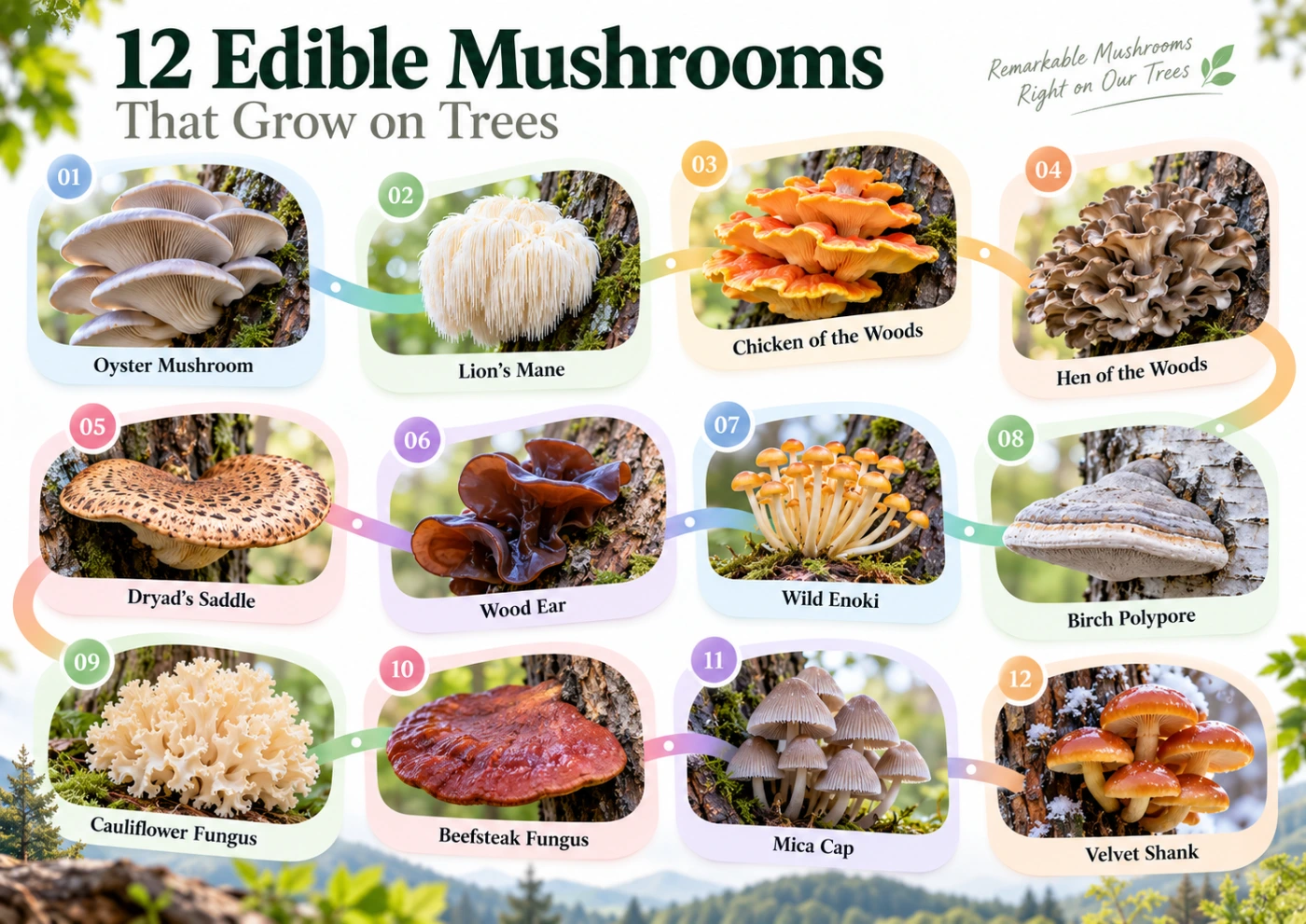
Many edible mushrooms grow directly on living trees, dead trunks, fallen logs, stumps, and buried wood. Some are easy to recognize because they form large brackets or clusters, while others can be confused with toxic wood-growing species.
The most important rule is to identify the mushroom itself, not just the fact that it grows on a tree. Wood is an extremely common substrate, and edible, inedible, and deadly poisonous fungi can all fruit from the same log or stump.
⚠️ Important: Never eat a wild mushroom only because it grows on a tree or resembles a familiar edible species. Confirm the full set of features, including underside, stem, substrate, age, and possible look-alikes.
Quick Guide to Edible Tree-Growing Mushrooms
| Mushroom | Scientific name | Typical substrate | Main identification clue |
|---|---|---|---|
| Oyster Mushroom | Pleurotus ostreatus | Dead hardwood | Decurrent white gills |
| Lion’s Mane | Hericium erinaceus | Hardwood | Long white hanging spines |
| Chicken of the Woods | Laetiporus spp. | Hardwood, sometimes conifers depending on species | Bright orange-yellow shelves |
| Hen of the Woods | Grifola frondosa | Base of hardwoods | Large gray-brown rosette |
| Dryad’s Saddle | Cerioporus squamosus | Hardwood trunks and logs | Dark scales on pale cap |
| Wood Ear | Auricularia spp. | Dead or weakened wood | Ear-shaped gelatinous fruit bodies |
| Enoki | Flammulina spp. | Dead hardwood | Velvety dark stem base |
| Birch Polypore | Fomitopsis betulina | Birch | Thick pale bracket |
| Cauliflower Fungus | Sparassis spp. | Conifer roots or bases | Curly cauliflower-like mass |
| Beefsteak Fungus | Fistulina hepatica | Oak and chestnut | Red fleshy tongue-like bracket |
| Mica Cap | Coprinellus micaceus | Buried wood, stumps, roots | Clustered honey-brown caps |
| Velvet Shank | Flammulina velutipes group | Dead hardwood | Orange-brown cap, dark velvety stem |
Why Do So Many Edible Mushrooms Grow on Trees?
Wood contains large amounts of cellulose and lignin, which fungi are uniquely equipped to break down. Wood-decaying mushrooms play a major ecological role by recycling nutrients from trunks, branches, and roots back into the ecosystem.
Some edible species are saprotrophic and feed on dead wood, while others may occur on living but weakened trees. A few species fruit from buried roots and can look as though they are growing directly from soil.
If you want a broader overview of both edible and non-edible species found on wood, see Mushrooms Growing on Trees.
Oyster Mushroom — Pleurotus ostreatus
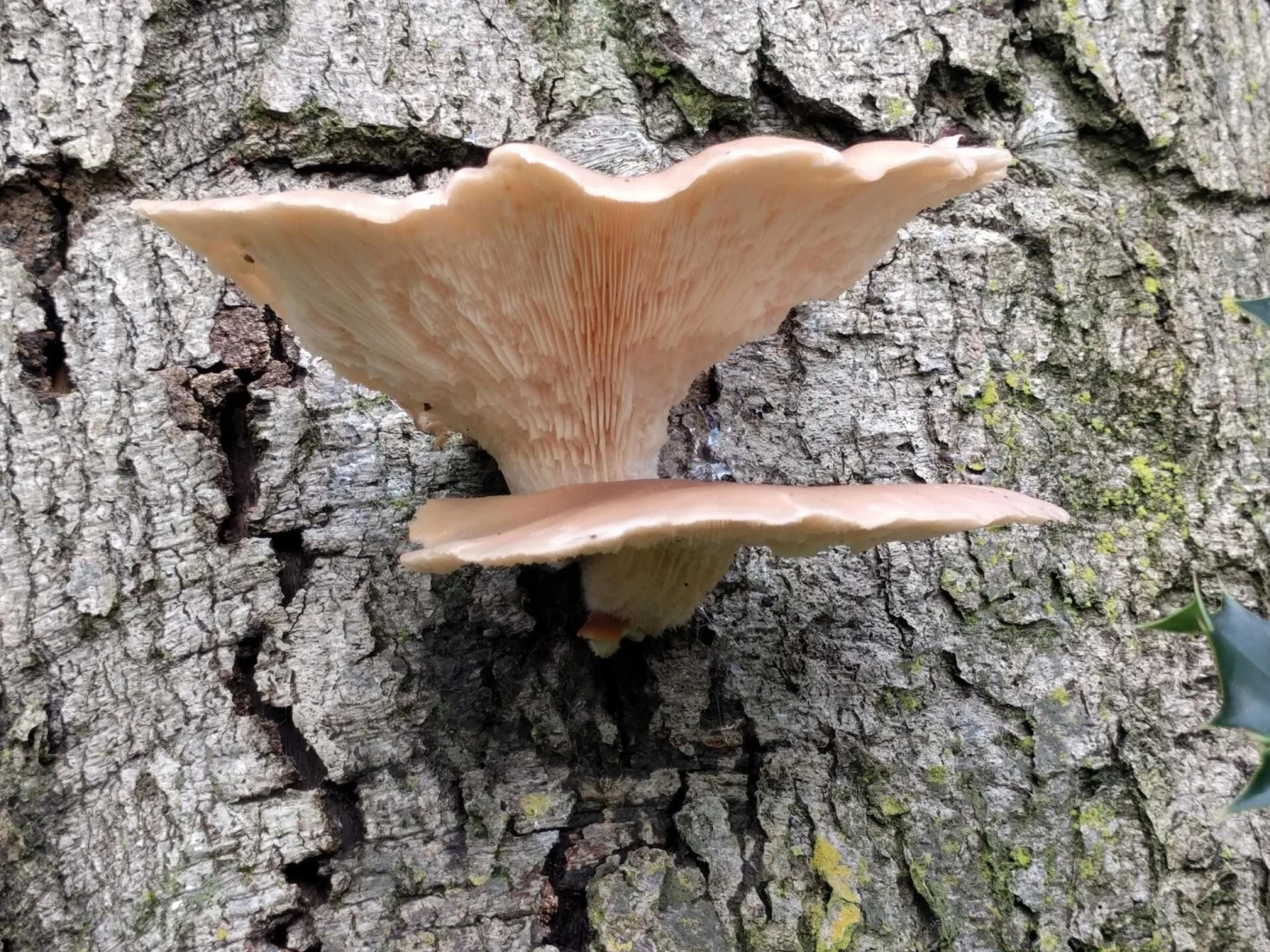
Oyster Mushroom is one of the most familiar edible fungi growing on wood. It typically forms overlapping clusters of gray, beige, or pale brown fan-shaped caps on dead or dying hardwood.
The underside has white to cream gills that run distinctly down the short lateral stem. This decurrent gill structure is one of the strongest identification features.
Where It Grows
Oyster Mushrooms commonly fruit on beech, poplar, willow, and many other hardwoods. They may appear on standing dead trees, fallen logs, or large branches.
In cool climates, fruiting can continue into late autumn and winter. This makes Oyster Mushroom one of the more common edible tree fungi outside the main summer season.
Main Look-Alikes
Other Pleurotus species can be very similar and may also be edible when correctly identified. Pale wood-growing fungi with different gill structures or tougher flesh should not automatically be treated as Oyster Mushrooms.
Lion’s Mane — Hericium erinaceus
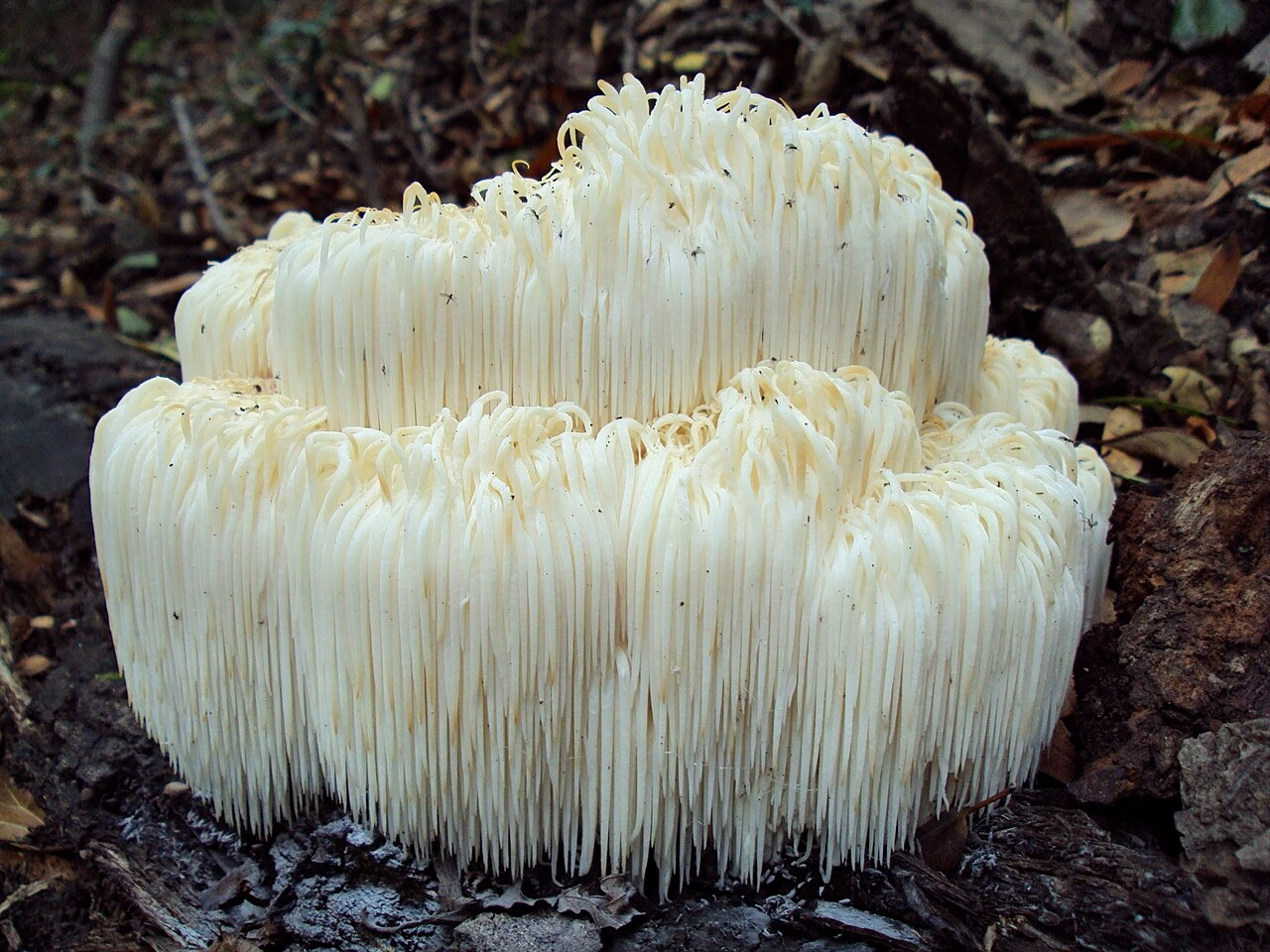
Lion’s Mane is one of the most distinctive edible mushrooms associated with trees. Instead of a conventional cap and gills, it forms a white rounded mass covered with long hanging spines.
Fresh specimens look soft and shaggy, while older fruit bodies become cream or yellowish. The unusual structure makes mature examples relatively easy to recognize.
Where It Grows
Lion’s Mane grows on hardwoods, including beech and oak, depending on region. It can fruit from dead wood as well as from wounds or cavities in living trees.
The species may appear high on trunks, so not every fruiting body is accessible from ground level.
Chicken of the Woods — Laetiporus Species
Chicken of the Woods forms large overlapping brackets in vivid orange and yellow. Young fruit bodies are soft and fleshy, while older ones become tougher and paler.
The underside has pores rather than gills. Different Laetiporus species vary by host tree and region, so exact identification should take ecology into account.
Where It Grows
Some species are strongly associated with hardwoods such as oak, while others can occur on conifers. Host tree can therefore matter both for identification and regional taxonomy.
Bright orange shelves on a trunk are highly suggestive, but age and species should still be checked before any consideration of eating.
Hen of the Woods — Grifola frondosa
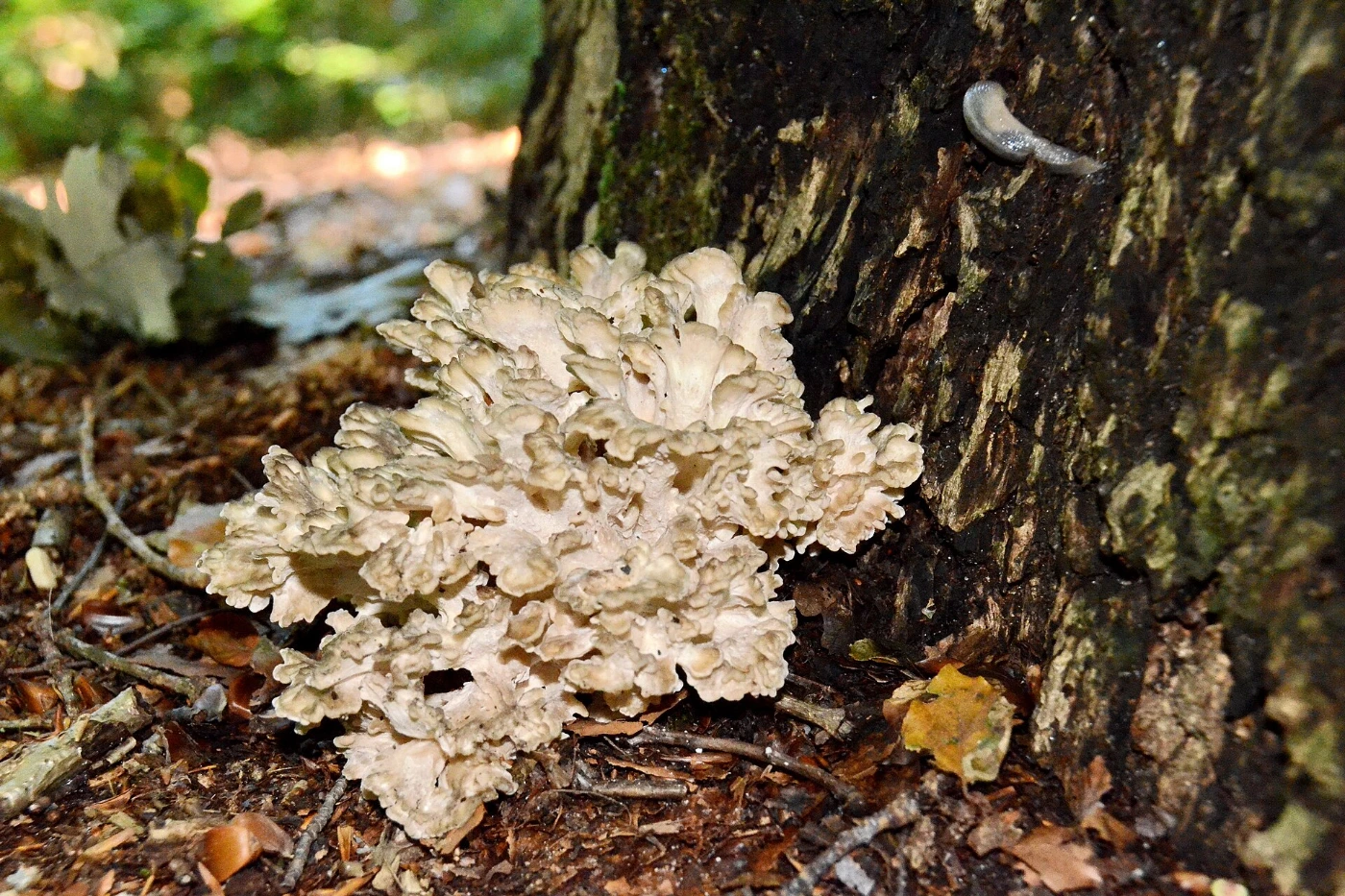
Hen of the Woods, also known as Maitake, grows as a large branching rosette composed of many gray-brown fan-shaped fronds. The entire cluster can become very large and usually arises near the base of a tree.
The underside of each frond has tiny white pores. This separates it from gilled mushrooms and many superficially similar rosette-forming fungi.
Where It Grows
Maitake is especially associated with oak and other mature hardwoods. It often fruits at the same tree or root system in more than one season.
Large clustered growth at the base of oak is one of the strongest ecological clues.
Dryad’s Saddle — Cerioporus squamosus
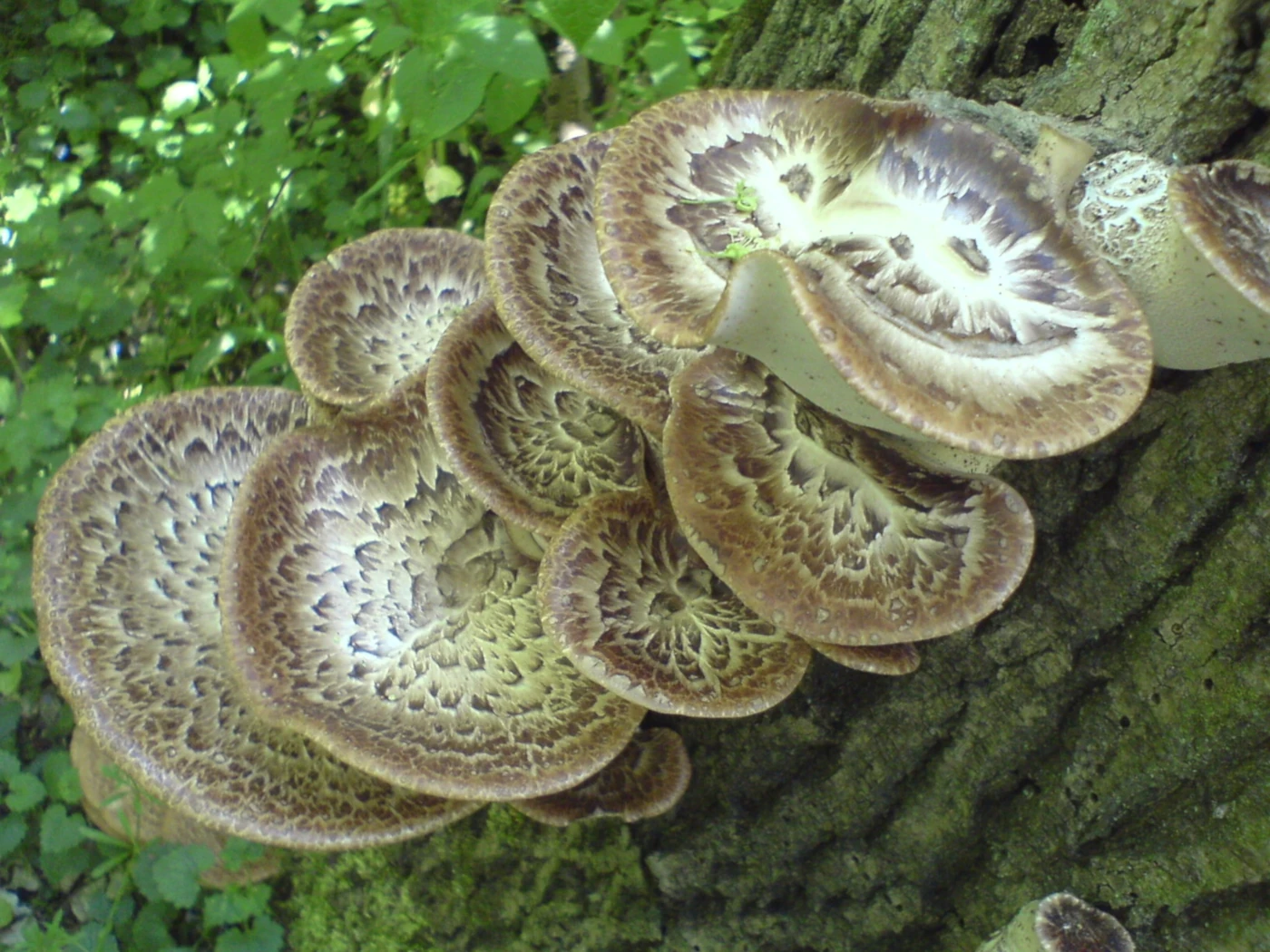
Dryad’s Saddle is a broad pale bracket covered with distinct dark brown scales. The pattern often resembles pheasant feathers, which explains the alternative common name Pheasant Back.
The underside has relatively large pale pores. Young fruit bodies can be fleshy, while older caps become tougher and more fibrous.
Where It Grows
The species commonly grows on hardwood trunks, stumps, and fallen logs. Elm, maple, beech, poplar, and several other trees can serve as hosts.
It can fruit from the side of a trunk rather than only at ground level. This distinguishes its typical growth pattern from some large basal rosette-forming polypores.
Wood Ear — Auricularia Species
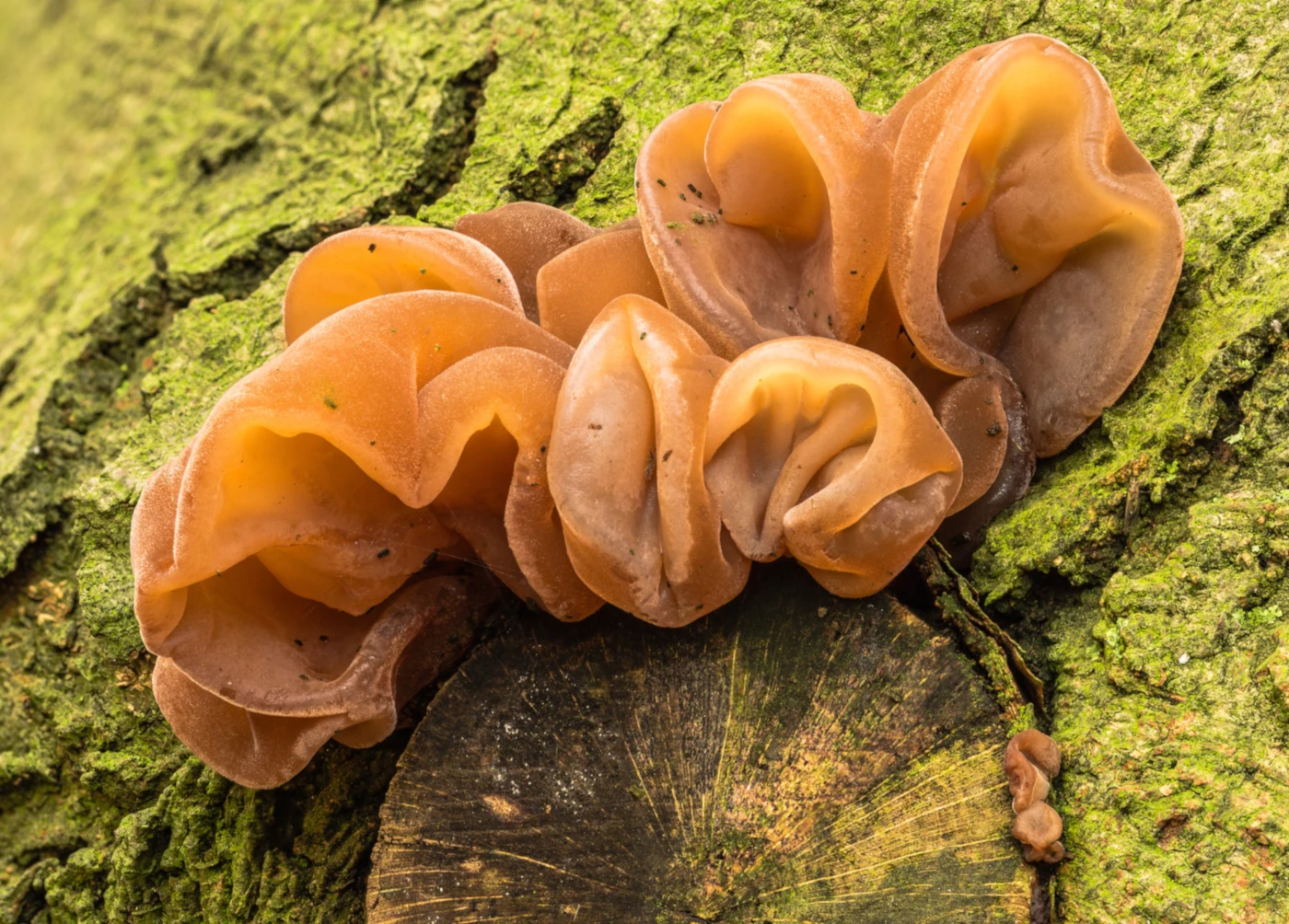
Wood Ear mushrooms form thin, flexible, ear-shaped fruit bodies with a gelatinous texture. Their color ranges from tan and reddish brown to dark brown.
The surface can be smooth or slightly veined, while the outer side is often more finely textured. There are no gills or pores like those of conventional capped mushrooms.
Where It Grows
Different Auricularia species occur on dead or weakened hardwoods around the world. Exact species names are regional, so not every Wood Ear should automatically be called Auricularia auricula-judae outside Europe.
They often appear on fallen branches after wet weather and can dry out almost completely before rehydrating after rain.
Wild Enoki — Flammulina Species
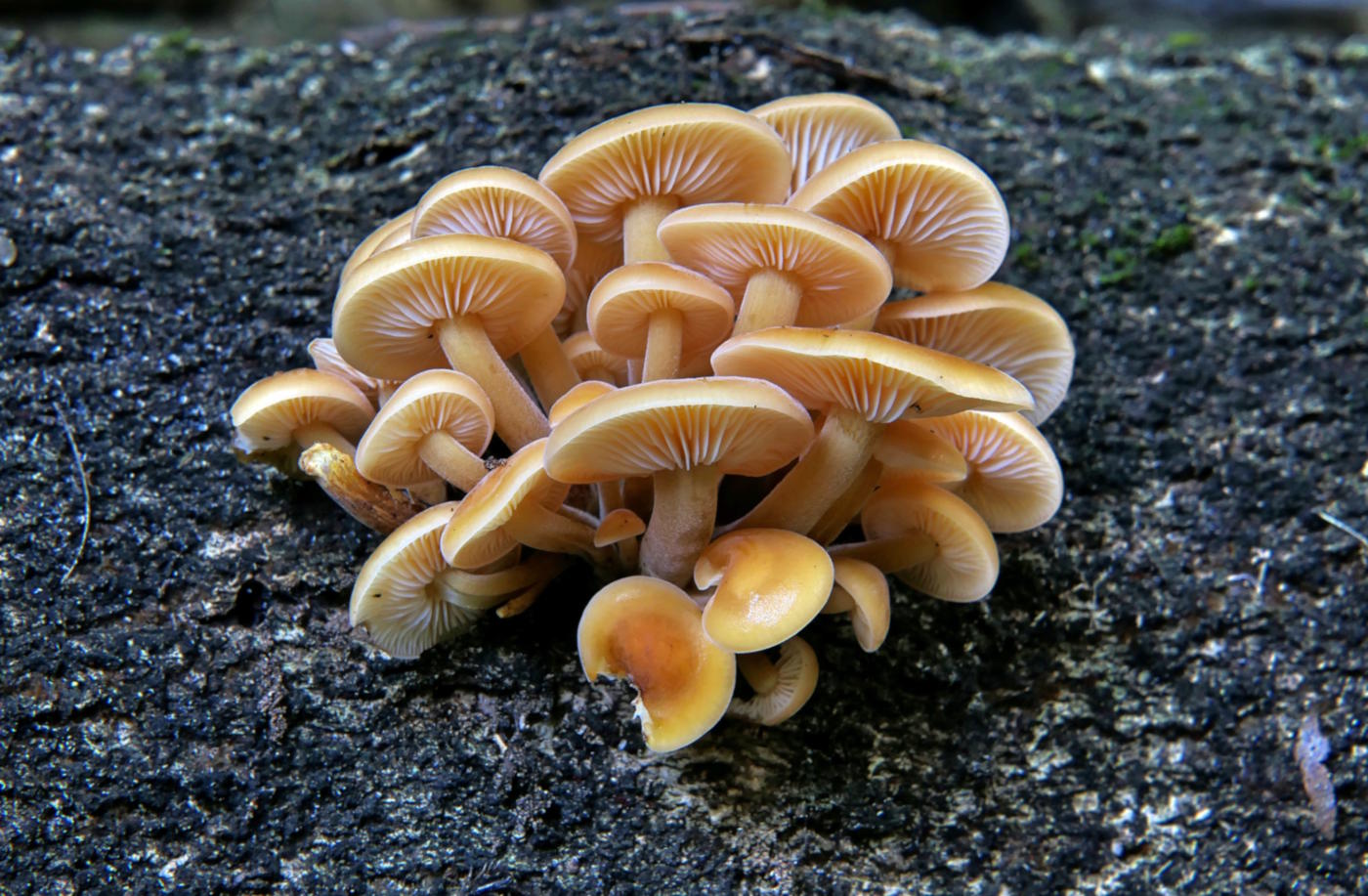
Wild Enoki is very different in appearance from the long white cultivated form sold in stores. Wild fruit bodies usually have orange-brown to honey-colored caps and grow in dense clusters on dead wood.
The stems become darker toward the base and develop a distinctive velvety texture. This dark velvety lower stem is one of the most useful field characters.
Where It Grows
Wild Enoki commonly fruits on dead hardwood during cool weather. It can appear in late autumn, winter, or early spring depending on climate.
The species complex varies geographically, so exact identification should consider region.
Dangerous Look-Alike
Deadly Galerina (Galerina marginata) can grow on similar wood and sometimes in similar weather. Galerina has rusty-brown spores, while Flammulina has a white spore print.
This is one of the most important wood-mushroom comparisons for foragers.
Birch Polypore — Fomitopsis betulina
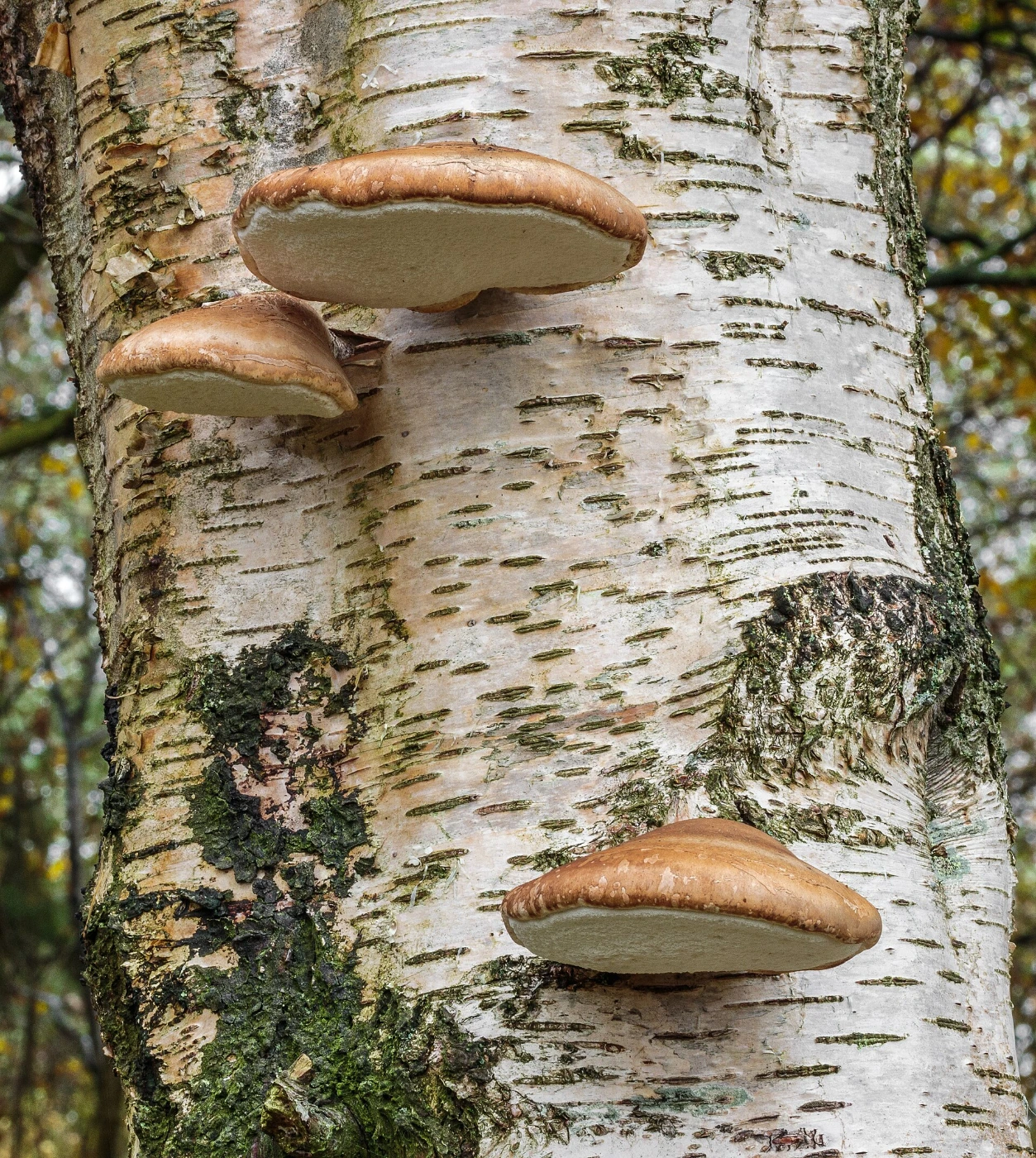
Birch Polypore forms thick, pale, rounded brackets on birch. Young specimens can be soft and white to cream, while older fruit bodies become firmer and more brownish.
The underside is covered with tiny white pores. It has no true stem and attaches directly to the wood.
Where It Grows
This species is very strongly associated with birch, making host identification unusually useful. It commonly occurs on dead, dying, or weakened birch trunks.
The fruiting bodies are annual but can persist after they stop actively growing.
Cauliflower Fungus — Sparassis Species
Cauliflower fungi produce large tangled masses of thin, wavy, cream-colored lobes. The structure resembles a head of cauliflower or a pile of curled ribbons.
The fruiting body can become surprisingly large. Its unusual shape makes mature examples difficult to confuse with most ordinary gilled mushrooms.
Where It Grows
Different Sparassis species are associated with conifers or occasionally other trees, depending on region. They often appear near the base of trees or from buried roots.
Because the attachment may be underground, they can look as though they are growing directly from soil.
Beefsteak Fungus — Fistulina hepatica
Beefsteak Fungus is a thick reddish bracket with a fleshy texture that can resemble raw meat. Young specimens may exude reddish liquid when cut or damaged.
The underside consists of closely packed individual tubes rather than ordinary gills. This tube structure is unusual and worth examining closely.
Where It Grows
The species is strongly associated with oak and sweet chestnut in Europe. It usually fruits from trunks, stumps, or damaged wood.
Its reddish coloration and fleshy consistency make it quite different from most pale woody polypores.
Mica Cap — Coprinellus micaceus
Mica Caps grow in dense clusters around stumps, buried roots, and decaying hardwood. Their honey-brown caps may be covered with tiny glittering veil particles when young.
The gills begin pale and gradually darken toward black as the spores mature. Old caps can partially dissolve or collapse in the typical inkcap manner.
Where It Grows
Because much of the wood may be buried underground, Mica Caps can appear to grow from ordinary lawn or soil. Checking for old roots or buried timber can reveal the true substrate.
This species illustrates why “growing from the ground” does not always mean a mushroom is soil-dwelling.
Velvet Shank — Flammulina velutipes Group
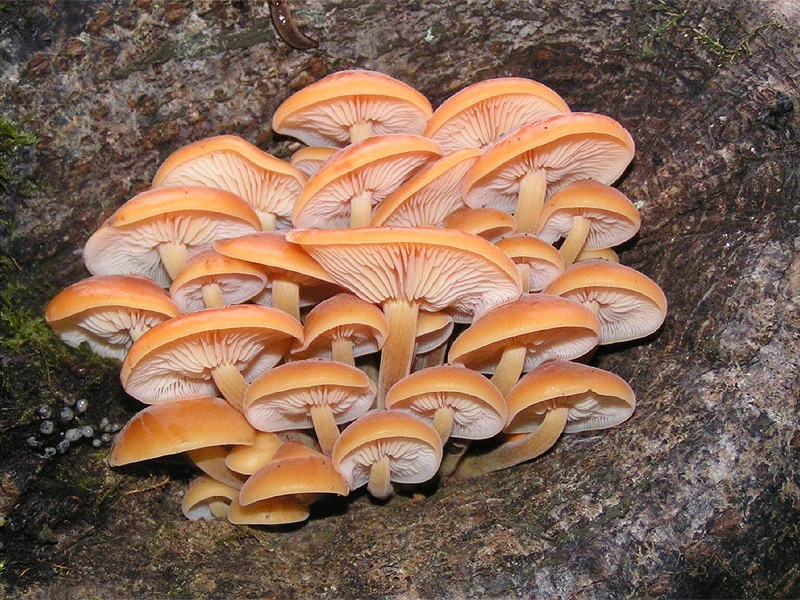
Velvet Shank is another common name used for wild Flammulina species. The caps are orange to reddish brown, often shiny or sticky in damp weather.
The lower stem becomes dark brown to almost black and distinctly velvety. Pale gills and a white spore print provide additional confirmation.
Why It Matters
This is a useful winter mushroom identification group because relatively few fleshy gilled mushrooms fruit during cold periods. Unfortunately, dangerous wood-growing mushrooms can overlap in habitat, so careful identification remains essential.
Which Edible Mushrooms Grow on Living Trees?
Some edible tree mushrooms can fruit from living hosts, especially where the tree is wounded, weakened, or internally decayed. Lion’s Mane, Chicken of the Woods, Beefsteak Fungus, and some large polypores may all appear on apparently living trees.
The presence of a mushroom does not necessarily mean the entire tree is dead. Fungi can colonize heartwood, damaged tissue, roots, or individual branches while the canopy remains alive.
Which Edible Mushrooms Grow on Dead Trees?
Oyster Mushrooms, Wood Ears, Wild Enoki, and many other edible species frequently grow on dead trunks and fallen logs. These fungi are important decomposers of woody material.
Dead wood is also home to many inedible and poisonous mushrooms. Substrate therefore helps with identification but never determines edibility by itself.
Edible Mushrooms Growing on Stumps
Stumps are particularly productive because they retain large amounts of wood close to moist soil. Oyster Mushrooms, Mica Caps, Hen of the Woods, and other fungi can appear around them.
Buried stump roots can continue producing mushrooms several feet from the original trunk. A cluster that seems to emerge from soil may still be feeding on underground wood.
Edible Mushrooms Growing at the Base of Trees
Large rosette-forming mushrooms are especially common around tree bases. Hen of the Woods is a classic example, while Cauliflower Fungus can emerge near the base of conifers.
The overall growth form is important here. Large clusters should be photographed from a distance as well as close up because architecture can be more diagnostic than individual caps.
How to Identify an Edible Mushroom Growing on a Tree
Begin by identifying the type of mushroom rather than asking whether it is edible. Determine whether it has gills, pores, teeth, a smooth underside, or another spore-producing structure.
Then examine growth form and host tree. A single bracket, dense cluster of gilled caps, coral-like mass, and large basal rosette belong to very different identification pathways.
Step 1: Check the Underside
Look for gills, pores, teeth, or a smooth surface. This is often the fastest way to separate major groups.
For example, Oyster Mushrooms have gills, Chicken of the Woods has pores, and Lion’s Mane has hanging spines.
Step 2: Identify the Host Tree
Determine whether the wood is hardwood or conifer and, if possible, identify the tree species. Some fungi have strong host preferences.
Host information is especially useful with Birch Polypore, Beefsteak Fungus, and regional Laetiporus species.
Step 3: Examine Growth Form
Note whether mushrooms grow individually, in overlapping shelves, dense clusters, or one large rosette. Take photographs that show the entire colony.
Growth architecture often provides more information than cap color alone.
Step 4: Check Age and Texture
Young and old polypores can look dramatically different. Young fruit bodies may be soft and brightly colored, while older ones become tough, pale, or darkened.
Texture can also determine whether an otherwise edible species is still suitable for normal culinary use.
Dangerous Tree-Growing Mushrooms to Know
Tree growth is not a safety indicator. Some highly toxic fungi also grow directly from dead wood. One of the most important is Galerina marginata, which can occur on logs, stumps, and buried wood and contains amatoxins.
Galerina marginata — Deadly Galerina
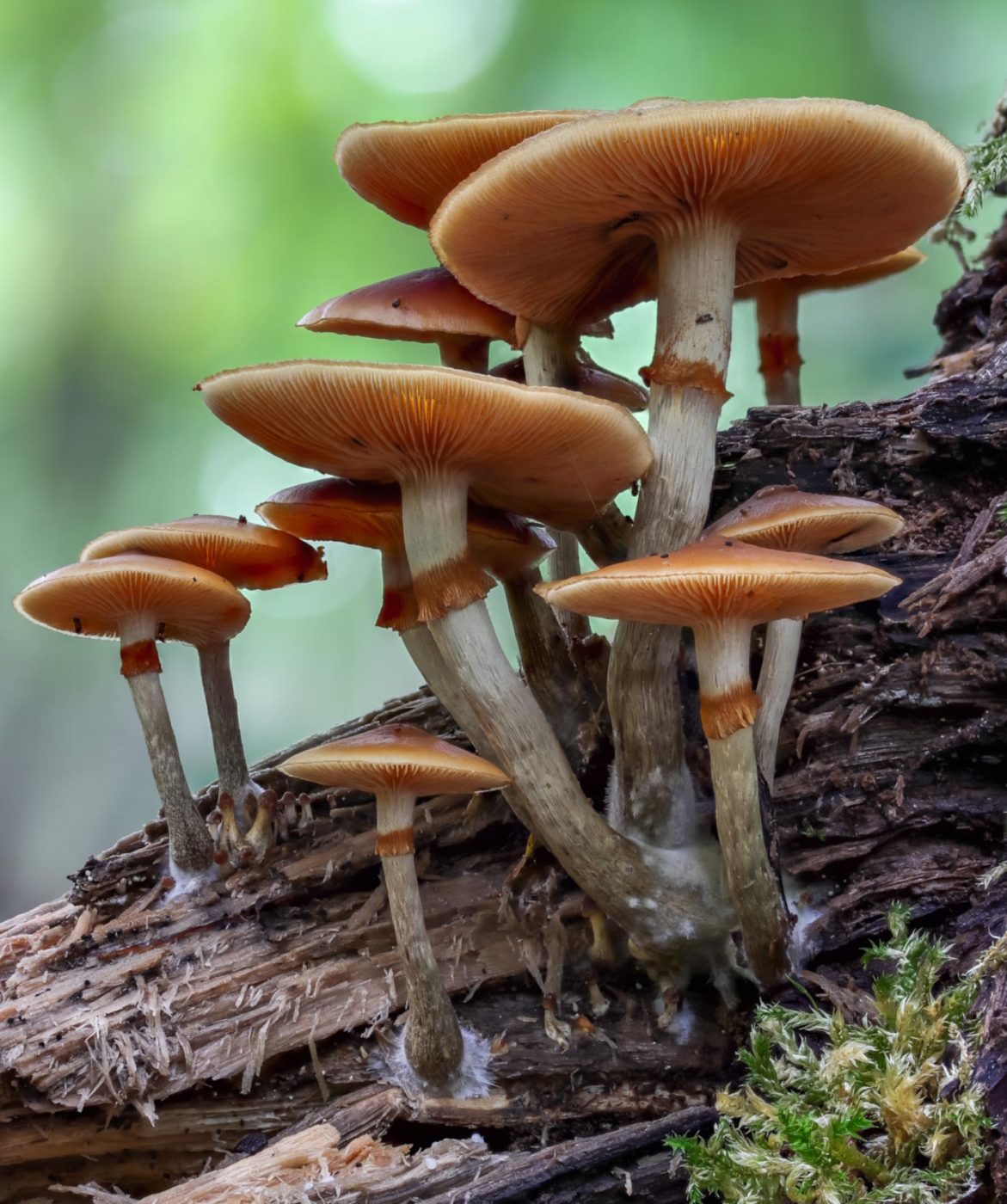
Deadly Galerina is a small brown gilled mushroom that grows on wood. Mature specimens produce rusty-brown spores and may have a ring or ring zone on the stem.
It is especially important because it can occur in the same general habitats as edible wood-growing mushrooms such as wild Enoki. Any small brown clustered mushroom on wood deserves careful identification.
Can You Identify Tree Mushrooms From the Host Alone?
No. A single tree species can host many unrelated fungi, and the same mushroom species may sometimes grow on several different hosts.
Host tree is best treated as one part of the identification. It becomes powerful when combined with underside structure, cap texture, growth form, and geography.
How to Photograph Mushrooms Growing on Trees
Take one wide image showing the entire cluster and the part of the tree where it is growing. This documents whether the fungus is on the trunk, stump, roots, or fallen wood.
Then photograph the upper and lower surfaces of an individual fruit body. For gilled mushrooms, include the full stem; for polypores, show pore size and attachment to the wood.
Photographing the bark can also help identify the host. This is particularly valuable for fungi with strong tree associations.
Can AI Identify Edible Tree Mushrooms?
AI can often narrow tree-growing mushrooms effectively when several photographs are provided. Growth form, underside, host, and texture can together create a strong identification pattern.
Problems arise when only the upper surface is visible. A brown bracket or cluster of brown caps may have many possible identities, some of which can be toxic.
AI should therefore be used to generate possible matches rather than as an independent decision that a wild mushroom is safe to eat.
Common Identification Mistakes
One common mistake is assuming that large shelf fungi are all edible polypores. Many are too tough, unsuitable as food, or belong to very different species.
Another is ignoring the host and attachment point. A mushroom growing from buried roots may look terrestrial even though it is actually wood-decaying.
The most serious mistake is treating clustered growth on wood as a sign of edibility. Deadly Galerina demonstrates why substrate alone cannot establish safety.
Interesting Facts About Edible Tree Mushrooms
Wood-growing fungi are some of the most important recyclers in forests. Without them, fallen trunks and branches would decompose far more slowly and nutrients would remain locked in woody material.
Different fungi specialize in different components of wood. White-rot fungi can break down lignin as well as cellulose, while brown-rot fungi leave behind a crumbly brown residue rich in modified lignin.
Some tree mushrooms can produce fruit bodies repeatedly from the same trunk or root system for years. The visible mushroom is temporary, but the mycelium may remain active deep inside the wood.
Tree fungi can also reveal hidden wood. Mushrooms appearing in lawns several feet away from a stump may be growing from roots that remain underground long after the tree itself has disappeared.
Frequently Asked Questions
Can an edible mushroom grow on a poisonous tree?
Yes. Mushroom toxicity is not simply inherited from the host tree. However, exact fungal identification and host context should still be considered before any culinary use.
Why do mushrooms sometimes appear several feet from a stump?
They may be growing from buried roots. The underground root system can extend far beyond the visible stump and continue decomposing for years.
Can the same tree have both edible and poisonous mushrooms?
Yes. Multiple fungal species can colonize one trunk or stump at the same time. Every cluster should be identified independently.
Why do tree mushrooms often appear after rain?
The fungal mycelium is already present inside or around the wood. Moisture and suitable temperatures trigger the production and expansion of fruit bodies.
Can old edible polypores still be eaten?
Many become too tough or woody with age even when the species itself is edible when young. Culinary suitability and species identification are separate questions.
Do all edible tree mushrooms grow on hardwood?
No. Many do, but some species or species groups are associated with conifers. Host preference can vary regionally.
Can mushrooms damage a living tree?
Some can. Certain wood-decay fungi colonize wounds, roots, or weakened tissue and may contribute to structural decay.
Should mushrooms be removed from a living tree?
Removing the fruit body does not usually remove the fungus living inside the wood. If structural tree health is a concern, an arborist is more useful than simply cutting off the mushrooms.
Final Identification Notes
Many well-known edible mushrooms grow on trees, stumps, logs, and buried roots. Oyster Mushroom, Lion’s Mane, Chicken of the Woods, Hen of the Woods, Wood Ear, Wild Enoki, and several polypores are classic examples.
The safest way to identify them is to combine underside structure + growth form + host tree + texture + geography. Tree growth itself never proves that a mushroom is edible.
The simplest field rule is: first identify how the mushroom is built, then identify what wood it is growing on, and only after that consider the species and edibility.
Upload a photo and get possible matches in seconds.