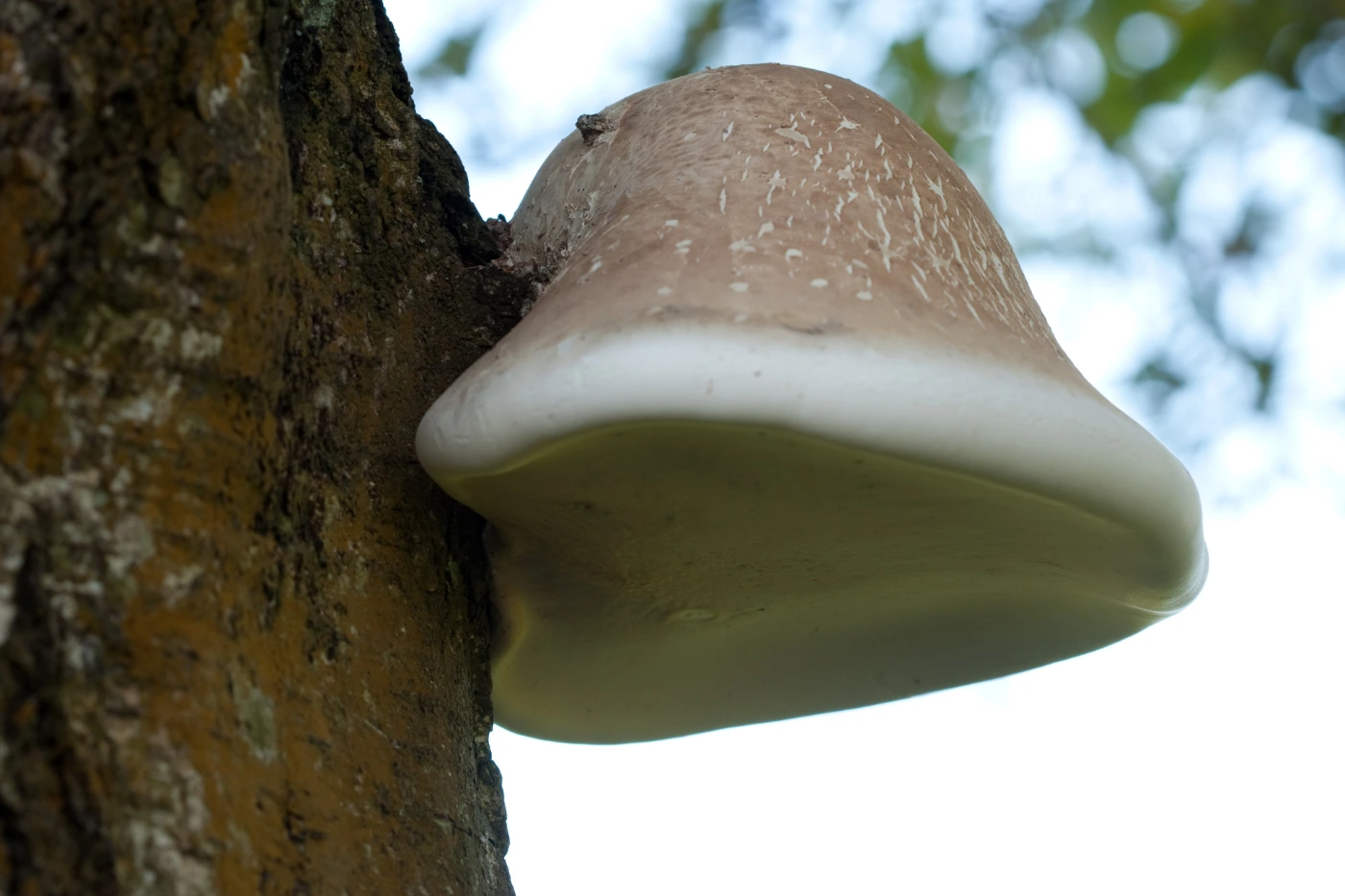
Fomitopsis betulina, commonly known as the Birch Polypore, is one of the most characteristic fungi found on birch trees. It forms thick, pale bracket-like fruit bodies directly from trunks and branches and is strongly associated with dead, dying, or weakened birch.
The species is easy to recognize once you learn its combination of features: a smooth pale upper surface, a rounded hoof- or cushion-like form, white pores underneath, soft corky flesh when young, and an almost exclusive relationship with birch.
⚠️ Important: This guide is for identification and education only. Never eat or use a wild fungus medicinally based solely on photographs, AI identification, or an online comparison.
Quick Identification
| Feature | Fomitopsis betulina |
|---|---|
| Scientific name | Fomitopsis betulina |
| Common name | Birch Polypore |
| Former name | Piptoporus betulinus |
| Growth form | Bracket / polypore |
| Cap color | White, cream, gray-brown |
| Cap surface | Smooth, matte to slightly velvety |
| Underside | White to cream pores |
| Pore size | Very small |
| Stem | Usually absent |
| Flesh | White, corky, soft when young |
| Host | Almost exclusively birch |
| Substrate | Dead, dying, or weakened birch |
| Season | Mainly summer–autumn, often persists into winter |
| Ecology | Wood-decaying |
| Rot type | Brown rot |
| Edibility | Not generally eaten as a normal food mushroom |
| Main look-alikes | Fomes fomentarius, Trametes species, young Ganoderma, other pale polypores |
What Does Fomitopsis betulina Look Like?
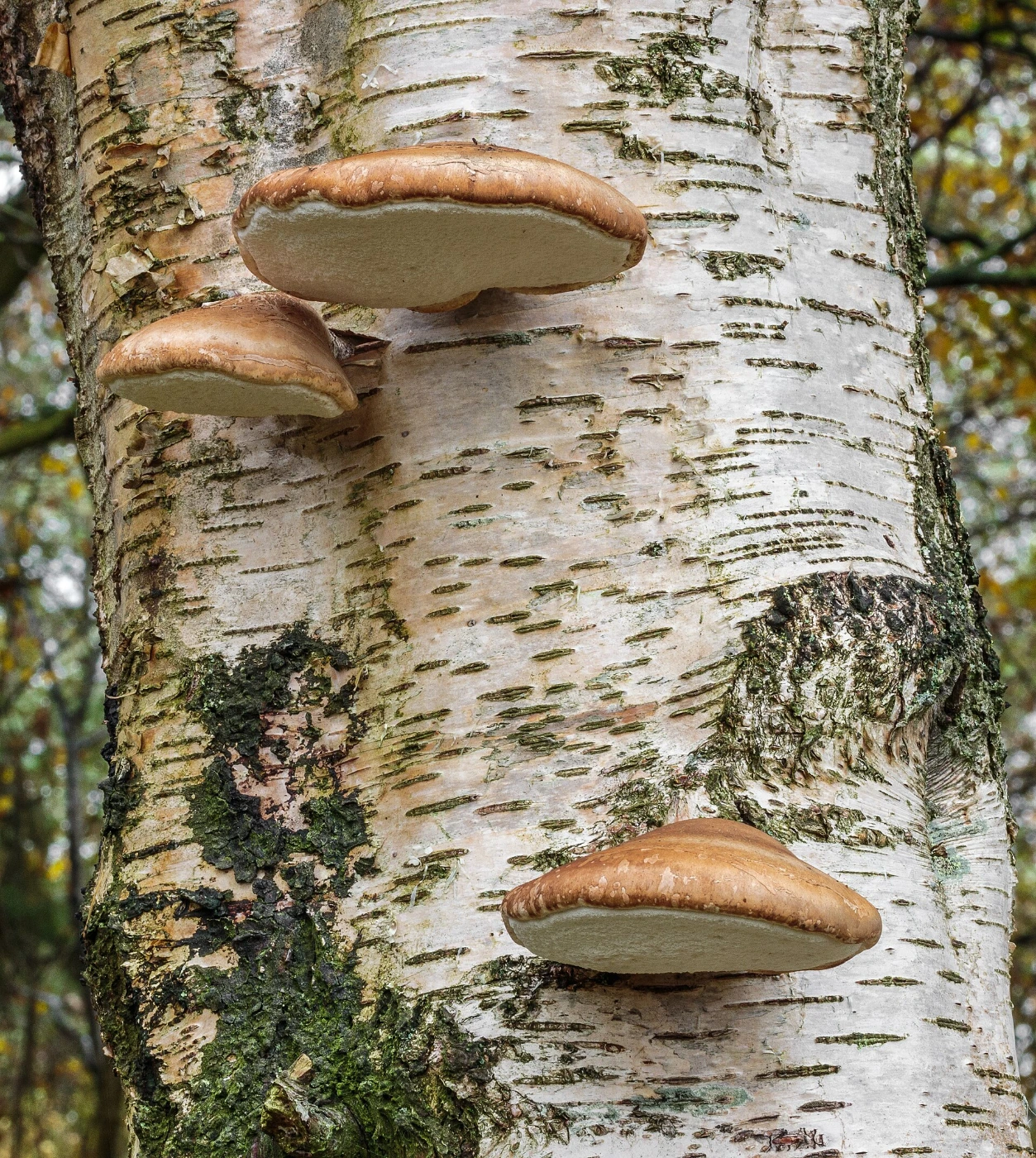
Birch Polypore usually forms a single thick bracket protruding from birch wood. Young fruit bodies are pale, rounded, and soft, while older specimens become flatter, browner, and tougher.
The fungus lacks a true stem. Instead, the fruit body attaches directly to the bark or exposed wood.
Cap
The upper surface is white to cream when young and may later become pale gray, beige, or light brown.
The cap is smooth and usually lacks the strong concentric zoning seen in species such as Turkey Tail.
Cap Shape
Young fruit bodies are often rounded and cushion-like. As they grow, they become more semicircular or hoof-like.
The margin is usually thick and rounded rather than thin and sharp.
Pore Surface
The underside is covered with a white to cream pore layer. The pores are very small and may look almost smooth from a distance.
Unlike gilled mushrooms, Birch Polypore produces spores through thousands of tiny tubes.
Pore Color
Fresh pore surfaces are usually white. Older specimens may become cream, dull beige, or slightly brownish.
Dark bruising is not usually one of the main diagnostic features.
Flesh
The flesh is white and thick. Young specimens can be surprisingly soft and corky compared with many other bracket fungi.
As the mushroom ages, the flesh becomes firmer and tougher.
Texture
A fresh Birch Polypore often has a dense foam-like or cork-like consistency. This is quite different from the woody hardness of old perennial conks.
The texture changes significantly with age and drying.
Stem
There is usually no real stem. The fruit body attaches laterally to the birch trunk or branch.
The attachment area may narrow slightly, but it does not form a conventional mushroom stalk.
Spore Print
The spore print is white. In practice, this is rarely necessary for field identification.
Host tree and overall structure are much more useful.
Where Does Fomitopsis betulina Grow?
Birch Polypore is strongly associated with birch trees. This host preference is one of its most important identification clues.
It most often appears on dead, dying, or severely weakened birches.
Birch Association
Species of Betula are the classic hosts. The fungus is so closely linked to birch that finding the same-looking bracket on another tree should prompt reconsideration.
This makes host identification unusually powerful in this case.
Dead and Dying Trees
The fungus commonly fruits from standing dead trunks, fallen birch logs, broken branches, and weakened trees.
It is a wood-decaying species rather than a mycorrhizal mushroom.
Can It Grow on Living Birch?
Yes, especially on stressed or damaged trees. However, it is much more typical of dead or declining wood.
The presence of fruit bodies often indicates substantial internal decay.
What Kind of Rot Does It Cause?
Birch Polypore causes brown rot. It breaks down cellulose and hemicellulose while leaving modified lignin behind.
The affected wood becomes brown, brittle, and often cracks into block-like pieces.
When Does Birch Polypore Grow?
Fresh fruit bodies are most commonly produced from summer into autumn.
However, old brackets can remain attached through winter and sometimes much longer.
Fresh vs Old Fruit Bodies
Fresh specimens are pale, smooth, and relatively soft. Old ones become darker, dry, hard, cracked, or weathered.
This difference is useful because old Birch Polypores can look much less typical.
Distribution
Fomitopsis betulina is widespread throughout birch-rich regions of the Northern Hemisphere.
It is common across Europe and occurs in northern Asia and North America where suitable birch species are present.
Is Fomitopsis betulina Edible?
Birch Polypore is not generally regarded as a conventional edible mushroom because its flesh is tough, bitter, and corky.
Young fruit bodies are softer, but that does not make them a typical food mushroom.
Traditional Uses
Historically, the fungus has been used in various practical and traditional contexts. Its tough, absorbent texture made it useful for purposes other than food.
Modern interest often focuses more on ethnomycology and fungal chemistry than on culinary use.
Fomitopsis betulina Look-Alikes
The strongest look-alikes are other pale bracket fungi growing on hardwoods.
Host tree, texture, cap zoning, and whether the fruit body is annual or perennial help separate them.
Fomes fomentarius — Tinder Fungus
Identification
Tinder Fungus forms hard perennial hoof-shaped conks with gray to dark gray zoned upper surfaces.
The fruit body is woody and persists for years.
Main Difference
Birch Polypore is usually paler, smoother, softer, and more rounded when fresh.
Tinder Fungus is much harder and develops pronounced perennial growth zones.
Fomitopsis betulina vs Fomes fomentarius
| Feature | Birch Polypore | Tinder Fungus |
|---|---|---|
| Host | Mainly birch | Many hardwoods |
| Shape | Rounded bracket | Hard hoof |
| Texture | Corky when young | Woody |
| Upper surface | Smooth, pale | Gray, zoned |
| Lifespan | Annual | Perennial |
| Pores | White | Pale gray to brownish |
| Main clue | Soft pale bracket on birch | Hard layered hoof conk |
This is one of the most common comparisons on birch trunks.
Trametes Species
Identification
Many Trametes species form thin shelf-like brackets with zoned surfaces.
They are usually much thinner than Birch Polypore.
Main Difference
Birch Polypore is thick, cushion-like, and relatively smooth. Trametes brackets are typically thinner and more layered.
Turkey Tail in particular has strong multicolored concentric zones.
Ganoderma Species
Identification
Some young Ganoderma fruit bodies can be pale before developing their typical brown or reddish lacquered appearance.
Their structure and surface texture change significantly with age.
Main Difference
A mature glossy reddish-brown crust strongly suggests Ganoderma, not Birch Polypore.
Birch Polypore stays matte to dull and lacks a lacquered finish.
Other Pale Polypores
Several other white or cream bracket fungi can occur on hardwoods. Their host preferences, pore structure, growth pattern, and internal texture may differ.
When the fungus is on birch and has the classic thick pale cushion-like form, Fomitopsis betulina is much more likely.
Birch Polypore vs Turkey Tail
Turkey Tail is thin and leathery with clear concentric color zones. Birch Polypore is much thicker and more fleshy or corky.
Their silhouettes are completely different once mature.
Underside
Both have pores, but Turkey Tail has a thin bracket with many small white pores.
Birch Polypore has a much thicker fruit body and a more substantial white pore surface.
How to Identify Fomitopsis betulina Step by Step
Start with the host tree. If the fungus is growing on birch, the identification immediately becomes much easier.
Then examine the thickness, cap surface, pore layer, and texture.
Step 1: Confirm Birch
Look for white or peeling birch bark, birch leaves, or the characteristic bark pattern.
A very similar fungus on oak or beech deserves a second look.
Step 2: Check the Growth Form
Look for a thick bracket attached directly to the wood.
It should not have a true stem.
Step 3: Examine the Cap
Fresh specimens should be pale and relatively smooth.
Strong zoning, heavy scales, or lacquered surfaces point toward other polypores.
Step 4: Check the Underside
The underside should have very small pale pores.
Gills, teeth, or a smooth underside would rule out Birch Polypore.
Step 5: Test the Texture
Fresh young fruit bodies are corky rather than rock-hard.
A very hard layered hoof is more consistent with a perennial conk such as Fomes fomentarius.
How to Photograph Birch Polypore for Identification
Take one image showing the whole bracket attached to the birch trunk. Make sure the host bark is visible.
Then photograph the underside closely enough to show the pores.
A side view is useful because it shows thickness and attachment shape. If the fungus is damaged or cut, the internal white corky flesh can also help.
Can AI Identify Fomitopsis betulina?
AI can often recognize Birch Polypore well when the host tree and full fruit body are visible.
The combination of pale bracket, smooth cap, white pores, and birch bark is visually distinctive.
Problems arise when only a close-up of the cap is shown. Host context is one of the most valuable clues for this species.
Common Identification Mistakes
A common mistake is confusing old Birch Polypore with Tinder Fungus. Old specimens can darken and become much harder than fresh ones.
Another mistake is ignoring the host tree. A similar bracket on non-birch wood may belong to another species.
A third mistake is focusing only on cap color. Texture, thickness, pores, and host are more reliable.
Interesting Facts About Fomitopsis betulina
Birch Polypore has a long history of association with humans. One of the most famous examples is the prehistoric individual known as Ötzi the Iceman, whose equipment included pieces of birch polypore.
The fungus has historically been used as a practical material because of its corky texture. It has been associated with sharpening, polishing, absorbent uses, and traditional fungal preparations.
Its close association with birch also makes it a useful ecological indicator. Where mature or dying birch trees are common, Birch Polypore is often one of the most conspicuous bracket fungi.
The species was long known as Piptoporus betulinus. Modern taxonomy places it in Fomitopsis, so older books and websites may use the former name.
Frequently Asked Questions
Can Birch Polypore grow on a healthy-looking birch?
Yes. Internal decay may be present before obvious external decline appears. A fruit body can indicate that the fungus has already colonized substantial wood.
Why are some specimens nearly white and others brown?
Young fruit bodies are much paler. Weathering, age, drying, and exposure gradually darken the upper surface.
Can several Birch Polypores grow on one trunk?
Yes. Multiple brackets can occur along the same standing trunk or fallen log.
Why do old brackets remain on the tree after the growing season?
The dried fruit bodies are fairly durable. They can persist long after active spore production has ended.
Can the fungus grow on fallen birch logs?
Yes. Fallen birch is an extremely common substrate.
Why are young specimens softer than old ones?
Fresh tissue contains more moisture and has not yet hardened through drying and aging.
Does Birch Polypore always have a perfect semicircular shape?
No. Growth position, bark shape, competition, and damage can produce irregular forms.
Can insects live inside the fruit body?
Yes. Older brackets can be colonized by insects and other small organisms that use the fungus as food or shelter.
Final Identification Notes
Fomitopsis betulina is best recognized by the combination of a thick pale bracket, smooth upper surface, white pore layer, corky flesh, lack of a true stem, and very strong association with birch.
The most important look-alike is Fomes fomentarius, but that species is usually much harder, darker, more strongly zoned, and perennial.
The simplest rule is: thick pale annual bracket + white pores + birch = strong Birch Polypore candidate.
Upload a photo and get possible matches in seconds.