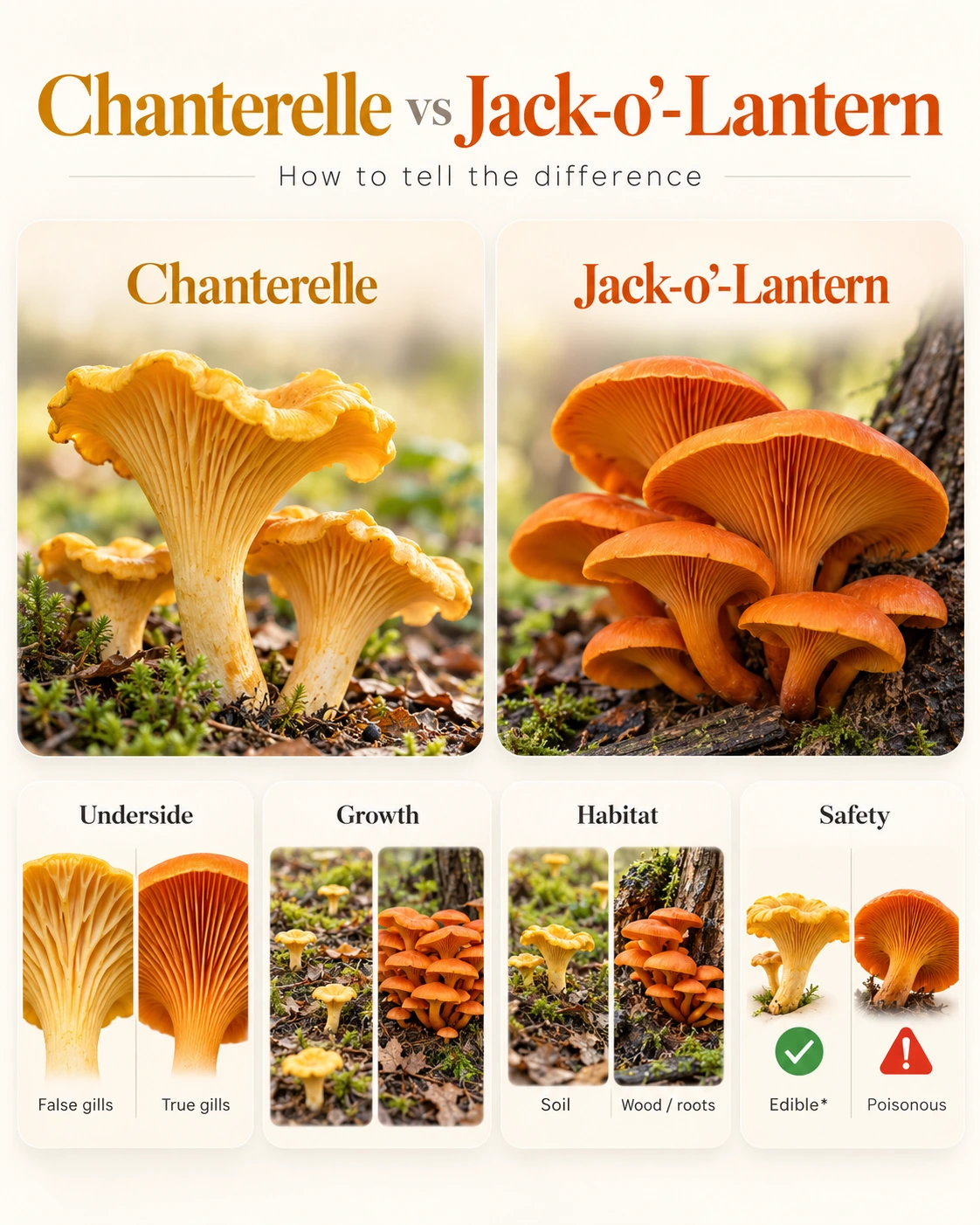
Chanterelles and Jack-o’-Lantern mushrooms are both bright yellow to orange and can appear in woodland at the same time of year. From a distance, they may look similar enough to confuse beginners, but the two groups differ in several important ways.
The safest way to separate them is to examine the underside, growth pattern, flesh color, and substrate. Chanterelles have blunt ridges or false gills and usually grow from soil, while Jack-o’-Lantern mushrooms have true blade-like gills and commonly grow from wood or buried roots.
⚠️ Important: This guide is for identification and education only. Never eat a wild mushroom based solely on a photograph, AI result, or comparison with an online guide.
Quick Comparison
| Feature | Chanterelle | Jack-o’-Lantern |
|---|---|---|
| Main group | Cantharellus species | Omphalotus species |
| Color | Yellow to golden-orange | Bright orange to deep orange |
| Underside | Blunt ridges or folds | True thin gills |
| Growth | Usually single or scattered | Often dense clusters |
| Substrate | Soil | Wood, stumps, buried roots |
| Flesh inside | Pale or whitish | Often orange-yellow |
| Stem | Solid, same general color as cap | Orange, often clustered |
| Edibility | Edible when correctly identified | Poisonous |
| Main danger | Confusion with gilled orange mushrooms | Severe gastrointestinal poisoning |
What Do Chanterelles Look Like?
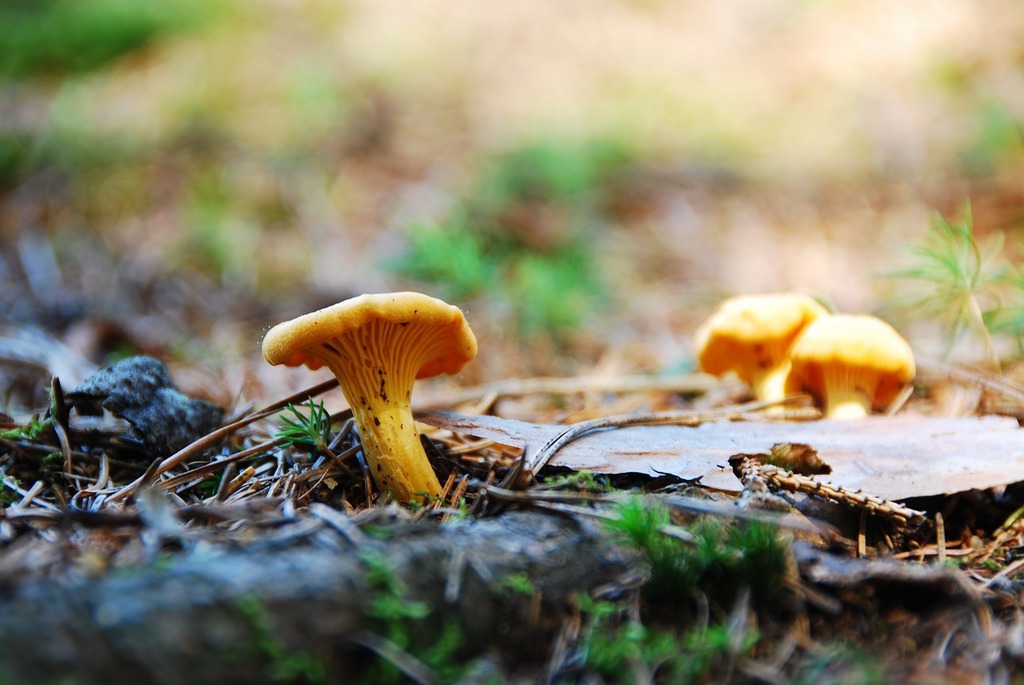
Chanterelles belong mainly to the genus Cantharellus. They are usually yellow, golden, or orange-yellow and have thick, fleshy fruit bodies.
The cap often starts convex and becomes flatter or funnel-shaped with age. Margins may become wavy, lobed, or irregular.
The underside is one of the most important features. Instead of true gills, chanterelles have blunt ridges or folds that run down the stem.
What Do Jack-o’-Lantern Mushrooms Look Like?
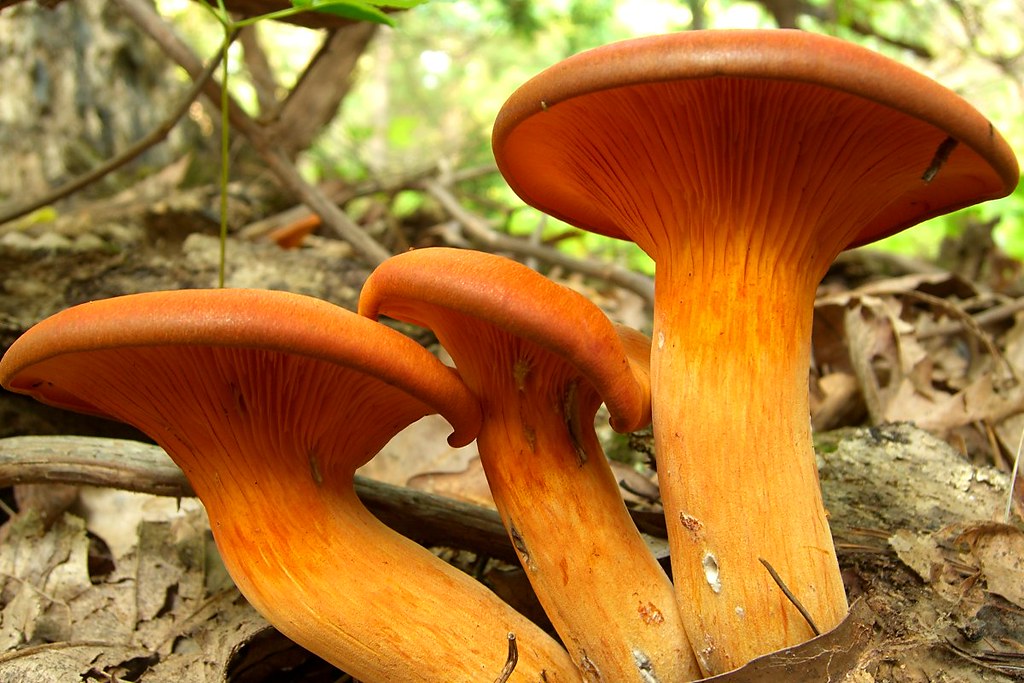
Jack-o’-Lantern mushrooms belong to the genus Omphalotus. In North America, species such as Omphalotus illudens and Omphalotus olivascens are important, while Europe has related species.
They are usually a stronger orange than chanterelles and often form dense clusters. The caps may be convex when young and become flatter or funnel-shaped with age.
Their underside has true gills that are thin, sharp, and clearly separated from one another.
The Most Important Difference: Gills vs False Gills
This is the feature to check first.
Chanterelle ridges are thick, blunt, and fused into the flesh of the mushroom. They can fork and cross-connect and are difficult to separate cleanly from the cap.
Jack-o’-Lantern gills are thin blades with sharp edges. They are clearly distinct structures and run down the stem.
If the underside looks like many separate, knife-like blades, the mushroom is not a true chanterelle.
What Are False Gills?
False gills are folds in the mushroom’s surface rather than separate plates.
They are usually thick, rounded, and irregular. They may branch repeatedly and merge with neighboring ridges.
In a chanterelle, the transition between the cap flesh and the folds is gradual, while true gills look like individual structures attached to the underside.
Cap Color
Both groups can overlap in color, so cap color should never be used alone.
Chanterelles are often yellow, egg-yolk yellow, golden-orange, or pale orange. Different species vary considerably.
Jack-o’-Lantern mushrooms tend to be richer orange, orange-red, or pumpkin-colored.
Lighting, age, rain, and camera settings can change apparent color, which makes structure more useful than shade.
Flesh Color
Cutting the mushroom can provide another useful clue.
Chanterelles usually have pale, whitish, or cream-colored flesh inside, even when the outside is golden-orange.
Jack-o’-Lantern mushrooms often have orange or yellow-orange flesh that is more similar to the exterior.
This is a helpful difference, but it should support other features rather than replace them.
Growth Pattern
Chanterelles often grow singly, scattered, or in loose groups across the forest floor.
Jack-o’-Lantern mushrooms frequently form dense clusters with several stems emerging close together from the same woody base.
A large bouquet-like cluster of bright orange mushrooms should therefore make you check for Omphalotus immediately.
Where Do Chanterelles Grow?
Chanterelles grow from soil because they form mycorrhizal associations with living tree roots.
They occur in deciduous, coniferous, and mixed forests depending on species and region.
Even when they appear near a stump, the fruit body is usually connected to soil rather than directly to the wood.
Where Do Jack-o’-Lantern Mushrooms Grow?
Jack-o’-Lantern mushrooms are wood-associated fungi.
They commonly fruit from stumps, dead roots, buried wood, and the bases of trees. Sometimes the wood is hidden underground, making the mushrooms appear to grow from soil.
If a bright orange cluster appears tightly packed around a stump or tree base, inspect the gills carefully.
Can Jack-o’-Lanterns Appear to Grow From Soil?
Yes.
Buried roots or decaying wood can be completely hidden below the surface. A cluster may therefore look terrestrial even though the fungus is actually feeding on woody material.
This is one reason substrate alone should not be used as the only identification feature.
Chanterelle Stem
The stem of a chanterelle is solid and usually blends gradually into the cap.
It is often similar in color to the cap or slightly paler. There is no ring or volva.
The stem is generally firm and fleshy rather than thin and hollow.
Jack-o’-Lantern Stem
Jack-o’-Lantern stems are also solid and usually orange.
In clustered fruitings, several stems may grow close together or merge near the base.
The gills typically run noticeably down the stem, which makes the decurrent gill structure easy to see in mature specimens.
Smell
Chanterelles are often described as having a pleasant fruity odor, sometimes compared with apricots.
Jack-o’-Lantern mushrooms do not usually have the same characteristic fruity scent.
Smell can support an identification, but it is subjective and should never outweigh structural features.
Spore Print
Chanterelles generally produce pale spore prints, often cream to yellowish or pinkish-cream depending on species.
Jack-o’-Lantern mushrooms also tend to have pale spore prints, so spore color is not the strongest way to separate these two groups.
The underside structure remains much more useful.
Chanterelle vs Jack-o’-Lantern at a Glance
| Feature | Chanterelle | Jack-o’-Lantern |
|---|---|---|
| Underside | Blunt ridges | True gills |
| Ridge/gill texture | Thick and rounded | Thin and sharp |
| Growth | Usually scattered | Often dense clusters |
| Substrate | Soil | Wood or buried roots |
| Interior flesh | Pale | More orange-yellow |
| Odor | Often fruity | Usually not fruity |
| Safety | Edible when correctly identified | Poisonous |
The combination of false gills + soil growth + pale interior flesh strongly favors chanterelle.
The combination of true gills + clustered wood-associated growth + orange interior flesh strongly favors Jack-o’-Lantern.
Why Are Jack-o’-Lantern Mushrooms Poisonous?
Jack-o’-Lantern mushrooms contain compounds that can cause severe gastrointestinal poisoning.
Symptoms can include nausea, vomiting, abdominal pain, and diarrhea.
The poisoning is usually not associated with the delayed liver failure seen with deadly Amanitas, but it can still be severe and require medical treatment.
Can Jack-o’-Lantern Mushrooms Glow?
Some Omphalotus species are famous for bioluminescence.
The gills can emit a faint greenish glow under suitable conditions, although the effect may be weak and difficult to see.
The absence of visible glowing does not rule out Jack-o’-Lantern.
Are All Chanterelles Yellow?
No.
North America and Europe contain multiple chanterelle species with different shades of yellow, gold, orange, and even pale or reddish tones.
This variation is another reason color alone is unreliable.
Are All Jack-o’-Lantern Mushrooms Bright Orange?
Most are distinctly orange, but exact color varies with species, age, moisture, and lighting.
Older specimens may become paler or more brownish.
Again, the gills and growth pattern are much more important than exact hue.
Chanterelle vs False Chanterelle
False Chanterelle, Hygrophoropsis aurantiaca, is another orange mushroom that can cause confusion.
It has true gills rather than chanterelle ridges, but its gills are often thinner, more densely packed, and strongly forked.
It is usually less robust than a true chanterelle and often grows on or near decaying woody material in conifer forests.
Chanterelle vs Omphalotus illudens
Omphalotus illudens is a common Jack-o’-Lantern species in eastern North America.
It forms dense orange clusters and has strongly decurrent true gills.
The combination of clustered growth and blade-like gills distinguishes it well from chanterelles.
Chanterelle vs Omphalotus olivascens
Omphalotus olivascens is an important western North American Jack-o’-Lantern species.
It can show orange, olive, or brownish-orange tones and often grows in dense clusters from wood or roots.
As with other Omphalotus, the key distinction is the presence of true gills.
How to Tell Them Apart Step by Step
Start with the underside. If the mushroom has thick blunt ridges, chanterelle is possible; if it has thin sharp gills, Jack-o’-Lantern becomes more likely.
Then check how the mushrooms are growing. Scattered mushrooms from soil support chanterelle, while dense clustered growth from wood or tree roots supports Jack-o’-Lantern.
Finally, cut one specimen and examine the interior. Pale flesh supports chanterelle, while more uniformly orange flesh supports Jack-o’-Lantern.
How to Photograph Them for Identification
Take a clear photo of the cap, but always include the underside.
A side view is especially useful because it shows whether the structures underneath are ridges or true gills.
Also photograph the base and surrounding substrate so it is clear whether the mushrooms are growing from soil, a stump, or buried wood.
Can AI Tell Chanterelles From Jack-o’-Lanterns?
AI can often distinguish clear, mature specimens when the underside and growth pattern are visible.
The risk increases when only the cap is photographed. From above, both groups can look like orange funnel-shaped mushrooms.
For better identification, provide multiple images showing the underside, stem, cluster pattern, and substrate.
Common Identification Mistakes
One common mistake is using color as the primary feature. Both groups can be orange.
Another is calling any downward-running structure a gill. Chanterelle ridges also run down the stem, but they are thick and blunt rather than blade-like.
A third mistake is assuming that a mushroom growing “from the ground” cannot be Jack-o’-Lantern. Buried wood can make wood-growing fungi appear terrestrial.
Frequently Asked Questions
What is the easiest way to tell a chanterelle from a Jack-o’-Lantern?
Check the underside. Chanterelles have blunt ridges, while Jack-o’-Lanterns have true thin gills.
Do chanterelles have true gills?
No. They have false gills or ridges.
Are Jack-o’-Lantern mushrooms poisonous?
Yes. They can cause severe gastrointestinal poisoning.
Do Jack-o’-Lantern mushrooms grow in clusters?
Yes. Dense clustered growth is very common.
Do chanterelles grow on wood?
True chanterelles grow from soil in association with tree roots rather than directly from wood.
Can Jack-o’-Lantern mushrooms grow from buried roots?
Yes. This can make them appear to grow from soil.
What color is chanterelle flesh inside?
It is usually pale, whitish, or cream-colored.
What color is Jack-o’-Lantern flesh?
It is often more orange or yellow-orange throughout.
Do Jack-o’-Lantern mushrooms glow?
Some species can show faint green bioluminescence in the gills, but the effect is not always obvious.
Can cap color alone identify a chanterelle?
No. Color overlaps too much with poisonous look-alikes.
Final Identification Notes
The most important difference between chanterelles and Jack-o’-Lantern mushrooms is the underside.
A true chanterelle has thick, blunt false gills or ridges, usually grows from soil, and often has pale flesh inside. A Jack-o’-Lantern has thin blade-like true gills, commonly grows in dense clusters from wood or buried roots, and often has more uniformly orange flesh.
When an orange mushroom is being considered for food, always check the underside before anything else. If the structures are sharp true gills rather than blunt folds, do not treat the mushroom as a chanterelle.
Upload a photo and get possible matches in seconds.